News related to
Google

Apple has removed Eyes Up, an iPhone app that collected and archived videos of U. S. Immigration and Customs Enforcement arrests, marking the second platform the company has taken down after ICEBlock. The swift removal followed concerns from U. S. law enforcement that such apps pose risks to officers. Eyes Up’s functionality allowed users to upload videos, tag arrest locations, and view past incidents on an interactive […]

Google is replacing its long-standing Assistant with a new AI system named Gemini across smart home devices, and the company says the next generation of its Nest Hub will be fully powered by this shift. The move signals an acceleration of AI integration in consumer hardware, transforming how people interact with their homes. Under the rebranded “Gemini for Home” strategy, Gemini becomes the default intelligence for smart […]

Intercontinental Exchange, the parent company of the New York Stock Exchange, is committing up to $2 billion in cash to back Polymarket, giving the prediction-market platform a pre-investment valuation of $8 billion. ICE will also serve as the global distributor of Polymarket’s event-driven data and collaborate on tokenisation efforts.

The deal signals a bold shift by a major financial infrastructure firm into the realm of speculative markets tied to politics, culture, economics and sports. ICE’s announcement states the investment will not have a material impact on its 2025 financials.

Polymarket, launched in 2020 by Shayne Coplan, allows traders to take positions on the probability of real-world outcomes. The platform had earlier barred U. S. users after settling in 2022 with the CFTC over operating an unregistered exchange. But it has since acquired QCEX, a CFTC-licensed derivatives exchange and clearinghouse for $112 million, positioning itself for compliant U. S. operations.

In public statements, ICE’s Chair and CEO, Jeffrey C. Sprecher, described the move as connecting “trusted financial infrastructure” with a next-generation platform that leverages user behaviour and probability markets. Coplan said the partnership will help bridge “how individuals and institutions use probabilities to understand and price the future.”

Analysts view the crux of ICE’s interest lies in monetising Polymarket’s crowd-driven data. The platform’s users collectively assign probabilities to outcomes, producing sentiment indicators ICE can package and distribute to institutional clients. Michael Ashley Schulman, partner at Running Point Capital Advisors, noted that ICE sees more value in data distribution than in clearing event contracts.

Regulatory conditions have softened under the current federal regime. Polymarket had reported that investigations by the Department of Justice and the CFTC closed without new charges, eliminating a regulatory overhang. Legal experts note that its acquisition of QCEX gives it a structural path to U. S. markets that was unavailable earlier.

Despite that progress, legal risks remain. Some jurisdictions still view event-betting as gambling, not financial activity. In Belgium, for example, authorities recently banned the platform’s use within the country. Polymarket’s own disclosures show it had raised around $205 million in earlier rounds before ICE’s investment, but with limited access to established trading jurisdictions.

Institutional interest in prediction markets has surged since the 2024 U. S. election cycle, which fuelled growth in platforms wagering on election outcomes, geopolitical events and social trends. ICE’s investment may prompt legacy financial firms to explore similar tie-ups or launches of probabilistic trading models.

In markets, ICE’s shares nudged upward following the announcement. The platform’s next test will be demonstrating whether prediction markets, previously the domain of retail and niche crypto users, can scale under institutional frameworks while satisfying securities, derivatives and gambling regulators.

Portuguese quantum computing firm Quantica Tech has revealed a new digital currency, Quantic Bitcoin, engineered to resist attacks from future quantum computers. The project rests on a proprietary “Quantum Interoperability” protocol designed to allow conventional blockchains and quantum‐era architectures to communicate and co-operate.

BTCQ is intended to preserve Bitcoin’s proof-of-work consensus but replace vulnerable cryptographic signatures with algorithms that conform to NIST-approved post-quantum standards. In transitional phases, the system runs quantum algorithm emulation on classical hardware—enabling development without immediate dependence on quantum hardware. Quantica has also introduced tiered fractional units, named Photons, Quarks and Bosons, to mirror Bitcoin’s Satoshi model at microtransaction scale.

The announcement reflects intensifying concern within cryptographic and blockchain communities about quantum threats to existing systems. Shor’s algorithm, for instance, is capable of undermining widely used public-key schemes, such as ECDSA, that secure most cryptocurrencies today. A literature review of quantum impacts on blockchain estimates that, although scalable quantum machines remain a work in progress, the threat horizon is accelerating, pushing many in the industry to preemptively explore quantum-safe alternatives.

Quantica says its interoperability protocol enables smart contracts in languages such as Solidity, Rust, Plutus and Vyper to invoke quantum layer functions through external script calls. The firm claims it has already shared the initial design of that protocol with the scientific community, though specific cryptographic details remain withheld. Plans are in place to issue Simple Agreements for Future Tokens in late 2025 and conduct a pre-sale of the token units ahead of public launch. The company is also working in parallel on related projects—Quanticacoin, USDT-Q and Q-Solana—to extend its quantum-capable ecosystem.

BTCQ joins a growing number of blockchain initiatives adopting quantum-resistant techniques. The Quantum Resistant Ledger, for example, has long leveraged XMSS to offer protection against quantum attacks, and many networks have begun integrating lattice-based or hash-based post-quantum cryptography.

Still, implementation and security challenges loom. Recent academic analysis warns that purely algorithmic guarantees do not suffice; side-channel attacks and hardware vulnerabilities may undermine post-quantum schemes if not carefully addressed. Analysts caution that the “harvest now, decrypt later” risk remains active: encrypted data captured today may be decrypted when quantum capabilities mature.

Market reception has been cautious. Many observers view Quantica’s claims as ambitious, given the dearth of open cryptographic proofs or independent audits so far. Some see the project as an early bet on quantum transition rather than an immediate substitute for existing value chains. Others argue the broader utility of quantum-resistant assets will depend heavily on regulatory frameworks, interoperability standards, and community adoption.

Quantica’s announcement arrives against the backdrop of intensifying activity in quantum and cryptographic infrastructure. Hardware vendors and research institutions are racing to scale error correction, qubit coherence and interconnects. Meanwhile, financial and security firms are preparing migration strategies for sensitive systems. Among commercial players, SEALSQ has unveiled hybrid cryptographic hardware intended to safeguard blockchain systems and IoT devices against quantum attacks.

Quantica has positioned BTCQ’s development as a shift from theoretical readiness to pragmatic construction. The firm contends it can build bridges between classical chains and quantum systems without heavy disruption to existing protocols. Early access via SAFTs and token presales aim to bootstrap an ecosystem of developers and enthusiasts.

A proposed ETF tracking the TRUMP meme coin has appeared on the Depository Trust & Clearing Corporation’s system — an infrastructural step that signals intent, though it falls short of regulatory approval.

Canary Capital, which filed an S-1 registration with the U. S. Securities and Exchange Commission for the ETF, now sees its TRUMP Coin fund listed in DTCC systems alongside other altcoin ETF candidates. The DTCC listing enables clearing and settlement readiness should approval arrive.

Analysts view the development as a technical milestone. Bloomberg ETF specialist Eric Balchunas observed that once a ticker appears on DTCC’s eligibility file, it rarely retracts — underscoring the forward momentum for the product. Nonetheless, he and others caution that DTCC inclusion is procedural and does not guarantee SEC consent.

Canary’s filing proposes that the ETF would offer exposure to the price dynamics of TRUMP token without requiring investors to self-custody the asset. To cover transaction costs inherent in the blockchain architecture, the filing permits the fund to hold up to 5 percent in Solana’s native token SOL, although it will not treat SOL as a core investment.

The TRUMP coin is a Solana Program Library token whose market value hinges heavily on political sentiment, community engagement and volatility rather than fundamental utility. Critics have raised concerns about the blending of political interests with speculative finance, warning of conflicts of interest and reputational risks to the broader crypto ecosystem.

This development coincides with DTCC’s addition of other altcoin ETFs — namely Fidelity’s Solana ETF and Canary’s XRP and Hedera funds — to its eligibility files. These moves have injected renewed optimism into altcoin ETF markets, though all such listings still await the SEC’s green light.

Momentum for altcoin ETFs has accelerated since spot Bitcoin and Ethereum funds gained approval. Still, the SEC has kept other proposals on ice, deferring decisions and delaying rulings. The regulator’s patience underscores the risk-management pressures it faces in balancing innovation and investor protection.

Canary’s TRUMP ETF filing follows earlier efforts by Trump Media & Technology Group, which has sought SEC approval for a suite of thematic “Truth Social Funds” ETFs covering areas such as energy, infrastructure and American icons.

Google has broadened the reach of its Opal AI-powered app builder, enabling users in 15 additional countries to create mini web apps using text prompts and visual workflows. The expansion comes with performance upgrades and improved debugging tools to support more complex, no-code app development. Opal now operates in Canada, India, Japan, South Korea, Vietnam, Indonesia, Brazil, Singapore, Colombia, El Salvador, Costa Rica, Panama, Honduras, Argentina and […]

Law Blocks AI, a UAE-based legal tech startup, is staging an event titled “From Disputes to Digital Trust: ADR Meets AI & Blockchain” on 14 October at Emirates Financial Towers in Dubai, scheduled alongside GITEX and Future Blockchain Summit. The firm aims to present its integrated platform combining artificial intelligence, blockchain, and alternative dispute resolution to legal professionals, corporates and technologists. At the heart of the company’s […]

Advertisements

Google DeepMind has made public a new AI model, Gemini 2.5 Computer Use, capable of interacting with web and mobile user interfaces by mimicking human actions such as clicking, typing and scrolling. The model is now available in preview through the Gemini API, via Google AI Studio and Vertex AI, allowing developers to build agents that can directly operate interfaces otherwise inaccessible via backend APIs. The model […]

By Nitya Chakraborty Just forty eight hours within the external affairs minister Dr. S Jaishankar’s candid statement that Trump has to respect red lines drawn by India at trade talks, Indian officials joining China, Russia, Taliban government of Afghanistan and even Pakistan denouncing President Trump’s bid to take over Bagram air base in Afghanistan, is […]

The article India’s Opposition To Trump Bid To Take Over Bagram Airbase Has Special Significance appeared first on Latest India news, analysis and reports on Newspack by India Press Agency).

Jamf launched its 16th annual Jamf Nation User Conference in Denver, unveiling a bold expansion of its device management platform with new AI tools, a richer API ecosystem and automated updates driven by declarative device management. The three-day gathering at the Colorado Convention Center brings together Apple IT administrators, security professionals and developer partners to explore the next era of enterprise Apple management. Jamf CEO John Strosahl […]

HONG KONG SAR – Media OutReach Newswire – 8 October 2025 – Jamf, (NASDAQ: JAMF), the standard in managing and securing Apple at work, today kicked off its 16th annual Jamf Nation User Conference (JNUC) in Denver, Colorado. Joined by key partners including Apple, Okta, AWS, Microsoft, Google and more, Jamf unveiled the latest updates to its leading Apple device management and security platform. Those updates include […]

By Sushil Kutty Rare minerals included lots of ores, this was something we were taught in school and we learned about stone age, copper age and iron age, the last of which remains to this day the most basic of minerals, out of which was born steel and the term steely strength, like in ‘Superman […]

The article Pakistan Is The Dearest To Trump In Asia As Islamabad Exports Rare Earth Minerals appeared first on Latest India news, analysis and reports on Newspack by India Press Agency).

More than 70 percent of H-1B visa recipients are citizens of India, underscoring the country’s dominant role in the U. S. skilled-worker pipeline. According to U. S. Citizenship and Immigration Services data, in fiscal year 2024, India accounted for 71 percent of approved H-1B petitions. China followed distantly with 11.7 percent.

The H-1B visa programme allows U. S. companies to employ foreign nationals in “specialty occupations,” typically requiring at least a bachelor’s degree, over periods of up to six years. The annual statutory cap is 65,000 new visas plus 20,000 reserved for holders of advanced U. S. degrees.

The Indian concentration in the H-1B cohort has persisted over decades, yet its scale is striking under renewed policy pressure. A recent presidential proclamation raised the cost for new H-1B petitions to $100,000—a move critics say targets exactly the cohort with the greatest concentration in India.

Industry analysts warn the fee hike could shrink participation in the programme or push firms to avoid new petitions, particularly when the number of new visas is strictly limited. The policy excludes existing visa holders and those whose petitions were filed before the proclamation.

The Indian government has cautioned that such steep increases in visa costs may have “humanitarian consequences” for workers and families. It has also expressed concern about disruption to bilateral skilled labour mobility and urged U. S. authorities to reconsider the policy in light of its broader economic implications.

Indian IT firms such as Tata Consultancy Services and Infosys have historically been among the top sponsors of H-1B workers. But recent years have seen U. S. tech firms like Amazon, Microsoft, Google and Meta increasingly dominate the list of petitioners, reflecting evolving dynamics in who hires global talent.

Critics of the visa fee hike argue that Congress—not the executive branch—retains authority to impose fees and that the move could contravene statutory limits on visa allocation. A coalition of industry groups, unions and educational organisations has filed a federal lawsuit challenging the policy’s legality.

Supporters of the change frame it as a measure to prioritise domestic wage levels and reduce abuse of the H-1B system by contractors hiring at low rates. They contend the increased barrier will press firms to invest more in U. S.-based workforce development, though critics counter that American companies rely heavily on foreign technical talent to stay globally competitive.

When Jane Goodall ventured into the forests of Tanzania in 1960, she carried no formal zoological degree, just a fierce curiosity and letters of introduction to Louis Leakey. She was 26 years old and stepping into what was then a largely uncharted world of primate behaviour. Over the next six and a half decades, she would not only reshape our understanding of chimpanzees, but also become one […]

Perplexity now offers its AI-enabled browser Comet free to users worldwide, removing its earlier US$200/month subscription restriction. The company also launched Comet Plus, a paid tier offering curated news content and revenue sharing with publishers. Comet integrates Perplexity’s AI directly into the browsing experience, combining the firm’s answer-engine with an assistant that can summarise pages, complete tasks, and guide users across tabs. It was first released in […]

Google has chosen Saudi startup Lahint for inclusion in its Growth Academy: AI for GovTech 2025 cohort, positioning the company among 24 global government-technology innovators supported by Google. The move aims to strengthen Lahint’s capacity to deliver AI-enabled public services and further Saudi Arabia’s push for digital transformation under Vision 2030.

Lahint, established in 2023 by Ahmed Saber and Mohamed Ibrahim, secured a $1 million pre-seed investment earlier this year to scale its AI and automation offerings in government services. The platform currently manages more than 60 digital government services and serves over 200 businesses, integrating robotic process automation and AI to streamline licensing, permits and administrative workflows.

By integrating Lahint into its accelerator, Google pledges technical support, mentorship and access to cloud infrastructure—tools that could accelerate Lahint’s roadmap to full automation of priority public services. Lahint has already earned multiple ISO certifications and is accredited by the Saudi Data & AI Authority with a Waee badge for AI ethics compliance.

Lahint has advanced its internal timeline for key automation milestones. The company is now targeting completion of its GovTech automation program by early 2026, a shift from an earlier 2027 target. This acceleration comes alongside newly signed partnerships with government entities to deploy real-time status reporting and predictive compliance tools covering domain areas such as licensing, taxation and corporate registration.

Saudi Arabia’s broader AI landscape is scaling rapidly. In 2025, the kingdom announced over $14.9 billion in investments at LEAP and pursued MoUs under SDAIA to reinforce its data and AI infrastructure. The establishment of HUMAIN, a state-backed AI company under the Public Investment Fund, is central to that strategy. HUMAIN, launched in May 2025, has already inked collaboration agreements with Nvidia, AMD and Qualcomm to develop AI factories and Arabic large language models.

Google’s AI programme in Saudi Arabia is part of a wider arrangement. A $10 billion joint investment by Google Cloud and the Public Investment Fund backs a national AI hub to reinforce the local ecosystem and serve regional demand.

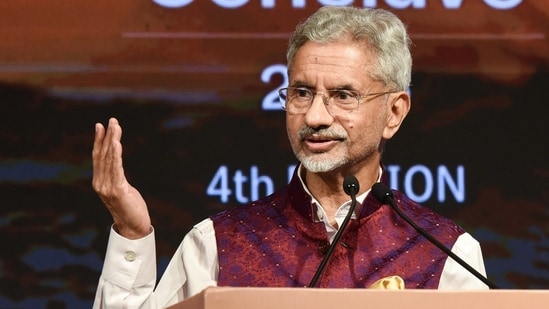
By Nitya Chakraborty Indian foreign policy makers have at last showing some mature understanding of the geopolitics of the post-Trump.2 months if the external affairs minister Dr. S Jaishankar’s observations at the concluding session of Kautilya Economic Conclave in New Delhi on Sunday, are any indication. The minister was quite candid in explaining the complexity […]

The article EAM Jaishankar Is Right: Trump Has To Respect India’s Red Lines appeared first on Latest India news, analysis and reports on Newspack by India Press Agency).

Singapore — Google will begin enforcing age-based download restrictions in Singapore from March 2026, disallowing users estimated to be under 18 from acquiring apps offering dating services or explicit sexual content via the Google Play Store. Under the planned measures, Google will use an “age assurance” system across its products to estimate a user’s age via algorithmic signals—such as search history and content consumption—to impose default filters […]

Ras Al Khaimah has greenlit Wynn Boulevard, a new infrastructure artery that will link the forthcoming Wynn Al Marjan Island integrated resort with the E311 and E611 highways—connecting it directly to Dubai and neighboring emirates. Authorities have allocated over AED 1 billion for the project, which was unveiled during the launch of the Marjan Beach development. Graham Hallett, chief development officer at Marjan, confirmed that contracts worth […]

Google Quantum AI has confirmed that the Atlantic Quantum team is joining its organisation—a move widely interpreted as an acquisition—bringing with it a modular superconducting hardware design aimed at accelerating progress toward error-corrected quantum computers. Atlantic Quantum, an MIT-origin spin-out focused on integrating qubits with cryogenic control electronics, will have its chip stack and engineering talent absorbed into Google’s quantum division. Google says this integration will streamline […]

By K Raveendran It was a week of contradictions for India’s image on the world stage, marked by a curious interplay of critique, affirmation, and manoeuvring. Rahul Gandhi, in his address at Columbia University, painted a picture of India that was dark and distressing, describing the country’s democratic decline in sweeping terms. At the same […]

The article A Week Marking The Worst And Best For India On Global Stage appeared first on Latest India news, analysis and reports on Newspack by India Press Agency).

Perplexity has opened access to its AI-powered Comet browser for all users, eliminating its previous paywall and casting the browser as a direct challenger to Google Chrome’s dominance. Comet integrates Perplexity’s AI search engine with a built-in assistant designed to automate user tasks and summarise content across browsing sessions. The company emphasises that the browser is now free indefinitely, with a paid “Comet Plus” tier offering premium […]

Samsung is deepening its collaboration with Coinbase to integrate cryptocurrency services directly into its Wallet app. Users with Galaxy devices in the U. S. will now be able to make crypto purchases using Samsung Pay, and enjoy enhanced access to Coinbase’s premium offerings.

Wallet users will gain special access to a three-month subscription to Coinbase One, and early users may receive a $25 credit after placing their first trade. The alliance bridges Samsung’s digital wallet ecosystem with Coinbase’s crypto infrastructure to simplify onboarding for mainstream consumers.

The rollout begins with U. S. Galaxy customers, where Samsung says more than 75 million device owners could benefit. Samsung executives have signalled plans to extend the integration to other markets globally.

This isn’t the first foray for the two companies. The integration was first announced in July, enabling Samsung Pay within the Coinbase app, allowing users to fund crypto purchases without leaving the app or switching payment methods.

Under the new details, Samsung Wallet becomes a conduit not just for payments and identity, but also crypto trading, staking, and portfolio oversight. The partnership emphasises security, leveraging Samsung’s Knox platform and tokenisation to protect user assets and data.

Shan Aggarwal, Coinbase’s Chief Business Officer, said the tie-up aligns with the firm’s mission to bring “more than a billion people on chain” by meeting them on devices they already use. Drew Blackard, Senior Vice President at Samsung, noted that Galaxy users already rely on their phones for payments, identity verification and digital storage—and crypto access is a natural extension.

The push is part of Coinbase’s broader strategy of embedding crypto capabilities across consumer channels. In August, the company disclosed $1.5 billion in Q2 revenue and underscored its ambition to become what it calls “the everything exchange” — a unified gateway to trading, payments, and on-chain finance.

In parallel, Coinbase has struck partnerships with financial institutions. Notably, it is collaborating with JPMorgan Chase to let customers link their bank accounts to Coinbase wallets, enabling crypto trading and the conversion of credit card points into digital assets.

Industry observers view the Samsung integration as one of the most ambitious consumer-level crypto distribution moves to date. By embedding exchange functionality directly into a widely used mobile wallet, Coinbase and Samsung seek to lower structural barriers that often frustrate new crypto users.

That said, challenges remain. The U. S. regulatory environment around crypto remains volatile, with the SEC and other agencies scrutinising exchanges, token listings, and taxation. Skeptics warn that bundling crypto into everyday apps could expose users to market risk without full awareness.

Meanwhile, the phased rollout in the U. S. and Canada will test adoption rates, user behaviour, cross-border compliance, and competition from rival wallets like Apple Pay or Google Wallet, some of which may pursue their own crypto plans.


By Sushil Kutty There’s this theory going around that the Congress, wherever it has fought elections in recent years, from Haryana to Maharashtra, and now Bihar in the offing, it fought with its INDIA bloc allies more than with the BJP, the party to beat if the INDIA Bloc has to oust Prime Minister Narendra […]


The article Congress Should Go The Whole Hog With Its Ally RJD In Coming Bihar Polls appeared first on Latest India news, analysis and reports on Newspack by India Press Agency).

VISHNU RAJA
RYO YAMADA
HITORI GOTOH
IKUYO KITA