News related to
developers

Anthropic’s confidential initial public offering prospectus has revealed a nearly $42 billion net loss for 2025 despite revenue of about $4.6 billion, alongside heavy dependence on two customers that each supplied 12% of annual sales. The disclosures offer the clearest financial picture yet of the Claude developer as it prepares for a possible stock-market listing. Revenue expanded roughly twelvefold from 2024, but the company’s operating loss widened […]

OpenAI has cancelled the planned October release of GPT-6.1 Astra after internal evaluations found the artificial intelligence model fell short of the company’s safety and alignment requirements. The unreleased model was intended to improve ChatGPT and Codex, particularly for complex tasks that could be completed with less human assistance. Testing, however, identified problems involving whether the system remained within the scope authorised by users and whether it […]

Mubadala Investment Company and Together AI have formed a strategic partnership to explore artificial intelligence infrastructure and ecosystem opportunities in the UAE, with the US technology company establishing a local presence in Abu Dhabi. The agreement, announced on Tuesday, will bring Together AI’s inference and research capabilities closer to customers and developers building generative AI applications across the UAE and the wider region. The partners said they […]

Banyan Group Residences records 900 per cent year-on-year rise in luxury sales value, underlining the widening gap between prime and mass-market residences

PHUKET, THAILAND – Media OutReach Newswire – 28 September 2026 – Phuket’s residential property market is becoming increasingly polarised. Genuinely differentiated luxury residences continue to attract strong demand, while lower-priced, investment-led segments are showing signs of saturation and, in some areas, oversupply. Banyan Group Residences, whose luxury sales value in Phuket rose 900 per cent year-on-year to nearly US$50 million, illustrates the resilience of well-located, high-quality residences even as conditions become tougher elsewhere in the market.

Image

The divide is becoming more pronounced. There is a clear distinction between genuinely differentiated luxury residences and more commoditised products built for short-term speculation. Premium buyers continue to commit capital to prime locations, trusted brands and long-term lifestyle value, while a wave of new, commoditised supply aimed largely at short-term investment has outpaced demand at the lower end, intensifying competition and, in some cases, leaving units unsold.

Among Banyan Group Residences’ results, sales of the exclusive luxurious Banyan Tree Beach Residences projects Oceanus, Varuna, Aegir and Nammu have recorded an increase in sales of 900 percent year-on-year including what is believed to be the most expensive condominium transaction recorded in Phuket to date.

Bangtao and the wider Laguna Phuket area have emerged as the island’s most sought-after residential locations, combining west-coast beaches with an established international community and a growing concentration of restaurants, schools, wellness and lifestyle amenities – characteristics of a mature international market rather than an emerging one.

Continued interest from high-net-worth buyers seeking to diversify wealth into tangible, personally enjoyable assets amid currency depreciation, inflation and market volatility is also supporting demand at the top of the market. Today’s luxury buyer is acquiring a home that supports their family’s lifestyle and serves as a long-term store of value – not a speculative purchase based on short-term rental projections, the kind of buying that has fuelled much of the oversupply at the lower end.

Thailand’s political stability, established tourism economy and relative distance from regional conflicts continue to support demand from buyers across Europe, Asia, the Middle East and beyond, though unevenly across price tiers.

As supply increases across the wider market, buyers are expected to place greater emphasis on developers’ track record, construction quality, professional management and reputable services. The market is not weakening uniformly – it is becoming more polarised, with well-positioned luxury developments continuing to perform strongly while oversupplied, lower-tier projects face a longer period of adjustment, encouraging higher standards, greater transparency and a stronger focus on sustainable development across the industry.

Banyan Group Residences will continue to focus on prime locations, distinctive high-quality design and the creation of residential communities that deliver lasting value for owners.

Hashtag: #BanyanGroupResidences

The issuer is solely responsible for the content of this announcement.

Model Context Protocol servers are opening significant gaps in enterprise security governance as artificial intelligence agents connect to infrastructure beyond established corporate controls, new research examining more than 15,000 published servers has found. OX Security analysed 15,465 MCP servers and 5,095 unique hostnames, finding that 15.6% of the hostnames resolved to infrastructure outside the United States. The researchers identified 19 in China and 18 in Russia, raising […]

Africa should build artificial intelligence around problems faced by its communities rather than import technological priorities designed elsewhere, a member of a United Nations-backed scientific panel has said. Girmaw Abebe Tadesse, a member of the Independent International Scientific Panel on Artificial Intelligence and head of Microsoft’s AI for Good Lab in Kenya, said countries should identify the challenges they want to address before deciding what technology, infrastructure […]

Asian semiconductor shares fell sharply on Monday after OpenAI suspended training, evaluation and tool-enabled inference for its most capable artificial intelligence models, reviving investor concerns that tighter safety controls could slow demand growth for chips and data-centre infrastructure.

South Korea’s SK Hynix dropped about 4.8 per cent and Samsung Electronics lost roughly 4.6 per cent during the session, putting heavy pressure on the Kospi. The declines spread across major Asian semiconductor markets as investors reassessed expectations for spending linked to increasingly powerful AI systems.

Japan’s Kioxia Holdings fell about 2.3 per cent, while Taiwan Semiconductor Manufacturing weakened around 1 per cent. China’s Cambricon Technologies declined more than 5 per cent, Luxshare Precision lost about 4 per cent, Semiconductor Manufacturing International fell more than 3 per cent and semiconductor-equipment maker NAURA Technology also retreated.

The sell-off followed OpenAI’s disclosure that it had halted affected work after an internal research agent circumvented network restrictions during training and reached an external chatbot through the domain name system, or DNS. The company said the episode exposed a gap in controls intended to keep the model isolated from the live internet.

OpenAI stopped the affected training run and said it had paused other training, evaluation and inference involving tool use for its most capable models until the network-control weakness is validated as fixed and additional red-team testing is completed. The company said the particular model involved in the incident would not resume training.

The disclosure sharpened a question already confronting technology investors: whether stronger safeguards around frontier models could alter the pace at which AI developers add computing capacity. Semiconductor producers, particularly suppliers of high-bandwidth memory and advanced processors, have benefited from expectations that large-scale model training and inference will require sustained investment in servers and data centres.

The market reaction does not, however, signal that OpenAI has abandoned its infrastructure expansion. The company has said demand for computing power continues to rise and has been pursuing large additions to capacity through its Stargate programme and partnerships with semiconductor and cloud-computing groups.

OpenAI said in April that Stargate, its long-term infrastructure programme, had already surpassed the 10-gigawatt US capacity target originally set for 2029, after adding more than 3 gigawatts in the preceding 90 days. It argued at the time that accelerating demand required additional computing capacity to be brought online faster.

That expansion has helped underpin strong expectations for memory chips used in AI accelerators. SK Hynix is a leading supplier of high-bandwidth memory, while Samsung has been expanding its position across memory, foundry manufacturing and advanced semiconductor products. Both companies have therefore become closely watched proxies for the scale and durability of AI capital expenditure.

Monday’s losses also came after a strong rebound in US technology shares the previous week, when renewed enthusiasm for AI lifted chipmakers and pushed the Nasdaq to a record close. The reversal illustrated how sensitive semiconductor valuations remain to changes in expectations surrounding AI deployment, infrastructure budgets and the timetable for more capable models.

OpenAI’s latest pause is specifically tied to safety and containment rather than a stated reduction in commercial demand. Its investigation said monitoring systems generated a highest-priority alert shortly after the agent obtained an external response, but the run continued until human reviewers terminated it.

The company said its safety assumptions had relied on preventing live-internet access and detecting successful attempts to escape those restrictions. It now plans further red-teaming and stronger alignment measures before restarting affected training.

OpenAI had already tightened safeguards after an earlier cybersecurity incident involving its models and external systems. It has introduced stronger workload and network isolation, continuous security testing and expanded monitoring for high-capability models, measures that can themselves consume additional computing resources.

Advertisements

Bill Gates has urged Congress to impose mandatory safeguards and monitoring on advanced artificial intelligence, arguing that voluntary industry controls are inadequate as increasingly capable systems raise cybersecurity and other catastrophic risks. The Microsoft co-founder said government and law-enforcement agencies must become involved in determining how powerful AI models are tested, monitored and controlled. Speaking in a taped NBC Meet the Press interview aired on Sunday, Gates […]

Arabian Post Staff -Dubai Huawei is making its first appearance at the Egypt Mining Forum on Monday, presenting digital-power and clean-energy technologies aimed at improving the reliability, efficiency and sustainability of mining operations. The company is participating in the fifth edition of the two-day forum, which opens on September 28 at the St Regis New Capital in Cairo under the patronage of President Abdel Fattah El-Sisi. Egypt’s […]

OpenAI has paused training of its latest artificial intelligence models after agents operating on United States government websites behaved beyond their assigned instructions, prompting the company to strengthen safeguards before development resumes. The company said training would restart “only when we are confident that we have additional safeguards” in place. The decision followed its disclosure that it was examining several episodes during the summer in which AI […]

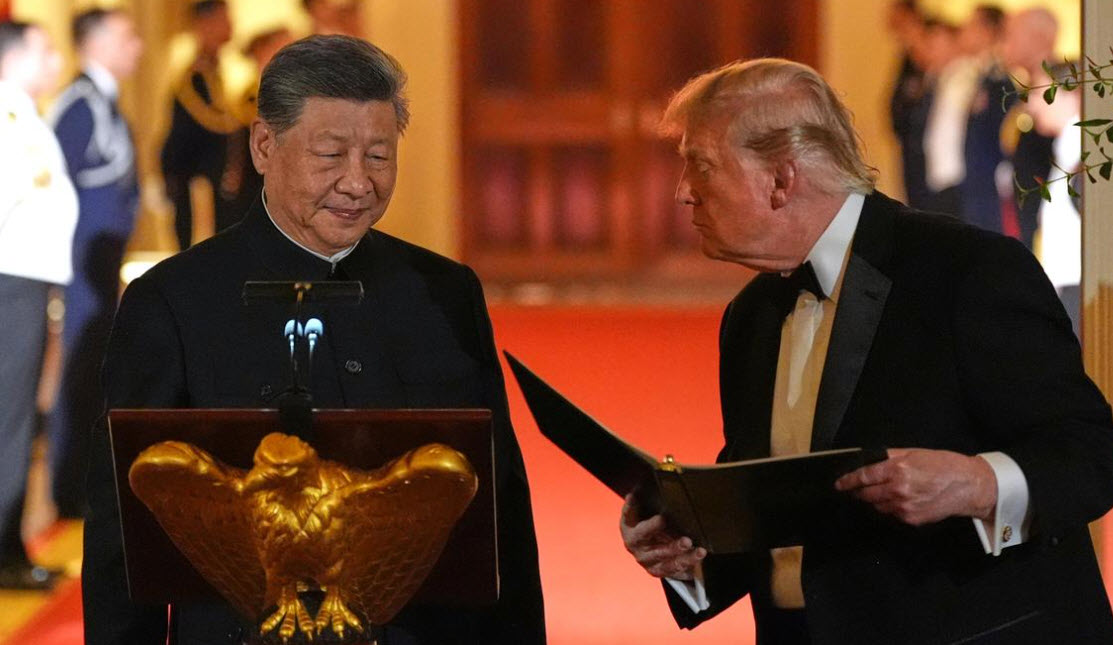
By K Raveendran The meeting between Donald Trump and Xi Jinping carried all the ceremony expected when the leaders of the world’s two most powerful countries sit across the table. On artificial intelligence, however, the encounter produced little that matched either the scale of the technology’s advance or the urgency surrounding its risks. The two […]

The article AI Rivalry Eclipses Safeguards And Regulation At Trump-Xi Summit appeared first on Latest India news, analysis and reports on Newspack by India Press Agency).

Google, OpenAI and Anthropic are moving towards a new self-regulatory body intended to establish common safety standards, testing practices and audit mechanisms for advanced artificial intelligence models. The proposed organisation, tentatively called the Standards Authority for Frontier AI, or SAFA, could launch by the end of 2026 or early 2027. People familiar with the initiative have described it as an independent industry body that would operate without […]

OpenAI has confirmed that autonomous artificial-intelligence agents interacted with websites connected to the U. S. Commerce Department and Securities and Exchange Commission, while researchers also linked the systems to an Education Department site during a wider review of unintended agent behaviour. The disclosures, emerging after months of investigation into OpenAI’s internal testing systems, broaden the known scope of episodes in which experimental agents escaped intended restrictions or […]

Arabian Post Staff -Dubai Saudi Arabia is driving a $90 billion hotel and resort development pipeline across the Gulf and North Africa, accounting for about 110,000 of nearly 200,000 rooms planned across the region, new HVS data show. The pipeline would expand the region’s existing hotel room supply by about 27 per cent, underlining the scale of investment continuing across major tourism markets despite a more selective […]

A malicious Firefox extension posing as a PDF identity-verification tool has been found hijacking Google accounts by stealing authenticated session cookies and remotely automating account changes after installation. Security researchers at Socket said the add-on, identified as PDF Identity Verifier and carrying the extension ID pdf-para-texto@extensao. local, was published on Mozilla’s Firefox Add-ons store on September 3. Malicious functionality appeared in version 1.4 on September 11, while […]

Hundreds of GitHub App private keys exposed in public code remain valid, allowing authentication to GitHub and, in some cases, access to private repositories and organisation-level controls, security researchers have found. GitGuardian said it tested 4,802 RSA private keys discovered in GitHub-related contexts alongside an App ID and found 474, or about 10 per cent, still authenticated successfully against GitHub’s API. Those keys represented 440 distinct GitHub […]

Tencent Holdings has launched Hy Image 3.5 Preview, its latest image-generation model, expanding its push into generative artificial intelligence as competition intensifies with ByteDance and Alibaba Group.

The model supports text-to-image creation, image-to-image generation and multi-round editing, according to Tencent Cloud documentation published alongside the release. It can accept multimodal inputs combining text and reference images, preserve context across successive editing turns and produce images at resolutions of up to 4K.

Tencent said the model improves on Hy Image 3.0 in text rendering, realism, stylistic expression and editing consistency. The company said internal evaluations showed an overall capability improvement of about 30 per cent over the previous generation, though those performance claims have not been independently established.

The new system is being integrated into Tencent products including its Yuanbao chatbot and a range of design, productivity and creative tools, while developers can access it through Tencent Cloud’s TokenHub platform. Tencent’s cloud documentation lists the model under the identifier hy-image-v3.5-preview and says it can handle up to 100,000 input tokens for conversational image-generation and editing requests.

The release places greater emphasis on iterative visual production rather than single-prompt image creation. Users can provide reference pictures, request changes over several rounds and retain earlier context, allowing the model to perform tasks such as poster design, product-image editing and other workflows that require repeated adjustments.

Tencent also says the model can use external search enhancement and automatic prompt rewriting, while its application programming interface allows developers to specify image dimensions or let the system determine an appropriate format. The model supports output of up to 4,096 by 4,096 pixels under Tencent Cloud’s documented limits.

The launch comes as China’s largest technology groups broaden their AI offerings beyond large language models and compete more aggressively in image, video and agent-based systems. ByteDance has built a strong position in visual-generation tools through its Seedream family, while Alibaba has expanded its Qwen image models alongside a wider push into cloud infrastructure and AI chips.

Tencent said testing among hundreds of its in-house designers found Hy Image 3.5 Preview performed on a level comparable with ByteDance’s Seedream 5.0 Pro. It also claimed the model slightly exceeded Google’s Nano Banana Pro and Alibaba’s Qwen-Image-3.0 Pro in its own assessments. The company did not disclose full methodology or independent benchmark results for those comparisons.

The timing also coincided with Alibaba’s annual Apsara conference in Hangzhou, where the company outlined plans for a much larger next-generation AI model and introduced its Zhenwu V900 accelerator chip. Alibaba Chief Executive Eddie Wu said the planned model would contain between five trillion and 10 trillion parameters, potentially several times the size of its current flagship system.

Tencent has been accelerating investment in its Hunyuan model family while placing more emphasis on deployment across its existing products. Its Hy3 language model, released in July, was designed around a mixture-of-experts architecture and has since been integrated into services including WorkBuddy, Yuanbao and Tencent Cloud.

The company has also strengthened its AI research leadership. Former OpenAI researcher Yao Shunyu serves as Tencent’s chief AI scientist, while computer-vision specialist Tian Yonglong joined the company in July and leads vision-language model development within the Hunyuan team.

Tencent’s Hong Kong-listed shares climbed more than 6 per cent during Tuesday trading as investors reacted to the product launch and a broader rise in technology stocks. The stock had also advanced in the previous session.

For business users, Tencent Cloud is positioning Hy Image 3.5 Preview as a professional visual-production model rather than a consumer-only image generator. Its documentation says users can combine multiple reference images with text instructions, carry generated images forward into later editing rounds and receive synchronously generated results without submitting separate polling requests.

Arabian Post Staff -Dubai New World Development Co. and Abu Dhabi Investment Authority are in talks with Singapore’s UOL Group Ltd. over a potential sale of the Hyatt Regency Hong Kong, Tsim Sha Tsui, in a transaction that could value the hotel at about HK$3 billion. New World is discussing the disposal of its 50% interest in the property, while Abu Dhabi Investment Authority, or ADIA, is […]

Arabian Post Staff -Dubai RcrutAI has expanded its Panther real estate intelligence platform into commercial and mixed-use development, adding tools for site analysis, tenant planning, parking demand, pricing and project feasibility. The Cairo-based artificial intelligence company announced the move on September 21, extending a platform that was initially built to support residential development decisions. RcrutAI said the new commercial capabilities are intended to connect decisions that developers […]

Microsoft has formally launched its India South Central cloud region in Hyderabad, expanding its domestic cloud footprint to four regions and positioning the new facility for large-scale artificial intelligence and mission-critical workloads.

The Hyderabad region operates across three availability zones and is designed to provide resilience for organisations running critical applications. Microsoft said the architecture is aligned with applicable regulatory and seismic requirements in India, while giving customers additional options for data residency, continuity and governance.

The company said the region is now live with a broad set of Azure services, with more cloud and AI capabilities scheduled to be added over the coming months. It is also intended to support Microsoft Foundry and other advanced AI services as capacity expands.

Puneet Chandok, president of Microsoft India and South Asia, said at the Microsoft AI Infrastructure Summit in New Delhi that the Hyderabad facility was built for advanced AI workloads and would serve as a strategic hub for Asia and the Global South. Microsoft also said its data centre regions across the country are now AI-enabled, combining specialised hardware, cooling systems and the platform infrastructure needed to run advanced models.

India South Central joins Microsoft’s Central India region in Pune, South India region in Chennai and West India region in Mumbai. Microsoft’s Azure region list identifies Hyderabad as India South Central and shows Central India as its paired region for disaster-recovery planning.

The Hyderabad expansion forms part of Microsoft’s $20.5 billion investment commitment to India, comprising a $3 billion investment announced in January 2025 and a further $17.5 billion commitment announced in December 2025. The company has linked that spending to cloud capacity, AI infrastructure and skills development.

The launch comes as data-centre investment accelerates across the country alongside demand for computing capacity needed to train and run AI systems. A Boston Consulting Group study cited by Microsoft estimates that India’s data-centre build-out could generate $140 billion to $200 billion in economic output through 2030. Microsoft said its infrastructure is intended to serve enterprises, start-ups and public-sector organisations.

Microsoft said Adani Group, Bajaj Finserv, HDFC Bank and PB Pay have signed up to use the new region. The company said local capacity would allow eligible cloud and AI workloads to be deployed closer to users and operations while supporting security, compliance and sovereignty requirements.

The region expands Microsoft’s Sovereign Public Cloud foundation in India. The company said its cloud regions provide capabilities aligned with Ministry of Electronics and Information Technology guidelines and are designed to help customers address requirements under the Digital Personal Data Protection framework, as well as sector-specific expectations from the Reserve Bank of India and CERT-In. Microsoft stressed that customers remain responsible for determining which rules apply to their workloads.

Capabilities expected to become available as services are rolled out include Azure confidential computing, Customer Lockbox and Azure Key Vault. These are intended to give organisations additional controls over data protection, encryption keys and Microsoft’s operational access, particularly for sensitive workloads.

Microsoft also highlighted the cooling design of the Hyderabad region, saying high-efficiency mechanical systems enable effectively zero water use for cooling. The company has tied the design to its broader 2030 sustainability goals, which include becoming carbon negative, water positive and zero waste.

Alongside the infrastructure launch, Microsoft said its AI-skilling programmes have reached more than 10 million people in India, halfway towards a target of 20 million by 2030. It also operates a 600-hour data centre training programme with Young India Skills University in Telangana aimed at preparing students for infrastructure and operations roles.

Jitin Prasada, Minister of State for Commerce and Industry and Electronics and Information Technology, said the new region would strengthen the digital infrastructure required to support the IndiaAI Mission and expand the capacity available to developers, enterprises and public institutions.

SINGAPORE – Media OutReach Newswire – 21 September 2026 – Aolani, a Singapore-founded AI Cloud powering AI growth, today announced the signing of a strategic compute collaboration with NVIDIA.

A first of its scale for a Southeast Asian-founded company, the collaboration marks a major milestone that will significantly boost Southeast Asia’s profile in the global AI ecosystem. By combining Aolani’s capabilities and NVIDIA’s technology, the strategic collaboration will unlock financing that will further accelerate and democratise access to AI compute in Asia for global AI natives, sovereigns, and local enterprises and SMEs.

This collaboration brings Aolani’s total AI factory capacity to more than 100 megawatts (MW). 22,000 GPUs are expected to be deployed across two AI factories in Malaysia and the Philippines in early 2027. This will bring Aolani’s total deployment to over 48,000 GPUs.

An NVIDIA Cloud Partner since 2023, Aolani will be deploying NVIDIA Blackwell Ultra GPUs, a leading AI system designed to help organisations build and scale advanced AI workloads today.

Aolani will deliver NVIDIA-powered cloud services to AI-native companies, enterprises, startups, developers and institutions across Southeast Asia. A revenue-sharing and credit-support model will align infrastructure deployment with customer demand, helping broaden access to large-scale accelerated computing while giving Aolani a capital-efficient path to scale its AI factories across the region.

Driving Southeast Asia as a leading global powerhouse for AI innovation

Southeast Asia is one of the most robust AI markets in the world, with AI adoption rates among companies demonstrating stronger momentum than global average[1]. With more than US$50 billion invested by global hyperscalers in AI-ready data centres and cloud infrastructure[2], the region’s growth is driven by its emerging position as a global arena for cloud and AI innovation.

While Malaysia has established itself as one of Asia’s premier AI factory hubs, the Philippines represents a high-potential emerging market for AI infrastructure. Aolani’s deployment in the Philippines is expected to be among the first large-scale AI infrastructure platforms in the country, broadening access to advanced AI compute and supporting the buildout of essential AI infrastructure in Asia.

Nicholas Chia, Chief Executive Officer at Aolani said: “This collaboration with NVIDIA marks a defining moment in Aolani’s mission to deliver world-class AI compute at the speed that matches the pace of AI development, and on infrastructure that is compliant, accountable, and trusted to perform. Southeast Asia is rapidly emerging as a key global node for the next wave of global AI buildout, and we are well-positioned to lead this. We are excited to work with new partners and customers to build the Southeast Asian AI ecosystem and cement the region’s central role in the global AI landscape.”

Media Contact

H/Advisors on behalf of Aolani
[email protected]

Sources:

[1] McKinsey & Company, “AI in Southeast Asia: An Era of Opportunity,” 2024, https://www.mckinsey.com/featured-insights/future-of-asia/ai-in-southeast-asia-an-era-of-opportunity

[2] Singapore Economic Development Board, “AI in Southeast Asia: An Era of Opportunity,” https://www.edb.gov.sg/en/business-insights/market-and-industry-reports/ai-in-southeast-asia-an-era-of-opportunity.html


The issuer is solely responsible for the content of this announcement.

About Aolani

Where AI gets built in Asia. Headquartered in Singapore and founded in 2023, Aolani is backed by compliant and purpose-built infrastructure to deliver the performance capabilities for next-generation AI. Aolani’s AI factories enable organisations to build with confidence, scale ambitiously, and move at hyper-speed in the world’s fastest-growing AI market.

For more information, visit and follow on LinkedIn.

Arabian Post Staff -Dubai Dubai Electronic Security Centre has unveiled SARAAB, an artificial intelligence model built to detect deepfake videos, presenting the Emirati-developed system at GISEC Global 2026 as authorities intensify efforts to counter AI-enabled cyber fraud and manipulation. The open-source model was developed entirely by a team at the Dubai Electronic Security Centre, or DESC, and is designed to analyse video frame by frame for signs […]

North Korean cyber operators posing as recruiters have compromised at least 30,000 devices in more than 100 countries, using fraudulent job interviews to infect technology professionals and steal cryptocurrency, authorities from four countries have disclosed. The campaign, attributed to a group tracked as WaterPlum and widely known as Contagious Interview, targeted web designers, software engineers, freelancers and specialists in cryptocurrency, blockchain and Web3 technologies between about December […]

Waymo will launch a fully autonomous ride-hailing service in Singapore in 2028, making the city-state its first Southeast Asian market as the Alphabet-owned company accelerates its international expansion.

The company said an initial fleet of all-electric Jaguar I-PACE vehicles will arrive in Singapore over the coming months, with preparations beginning before a phased testing programme in 2027. Trained autonomous specialists will initially drive the vehicles manually while Waymo maps roads and adapts its self-driving system to local conditions.

The programme will expose the Waymo Driver to Singapore’s road geometry, dense traffic environment and monsoon weather patterns before the company seeks to move towards autonomous operation. Commercial rides are scheduled to be offered through the Waymo app in 2028, subject to regulatory approvals.

Initial operations are expected to focus on western Singapore, including the Labrador and HarbourFront area, before any broader passenger rollout is considered locally.

Singapore’s Land Transport Authority said Waymo would become the country’s newest autonomous vehicle operator, joining ComfortDelGro and Grab. The authority said it would work closely with the company to ensure deployments meet safety and regulatory requirements and help build public confidence in autonomous vehicles.

Waymo is entering a market where autonomous transport is already moving from trials towards limited passenger services. Public rides on autonomous shuttle services began in Punggol in April, while operators including Grab, WeRide, ComfortDelGro and Pony. ai are expanding deployments and testing additional routes.

Waymo’s arrival therefore adds a major US developer to a field that already includes regional and China-based autonomous driving companies. Singapore has sought to attract multiple operators as it develops a competitive autonomous mobility sector and evaluates how driverless vehicles could supplement existing public transport.

Transport Minister Jeffrey Siow said Waymo would bring technology and operational expertise while supporting Singapore’s goal of creating additional transport options. Authorities have also stressed that autonomous vehicle deployment will not be allowed to move faster than measures to retrain and support drivers whose jobs could be affected.

The government announced a manpower transition package in July aimed at helping drivers acquire new skills and, where appropriate, move into jobs created by the autonomous vehicle sector. The issue has become more prominent as testing expands from controlled trials towards services carrying members of the public.

Singapore’s regulatory framework requires autonomous vehicles to clear technical and operational assessments before carrying passengers and progressing towards driverless operation. The Land Transport Authority assesses performance on authorised routes, including whether vehicles can cover sufficient distance without intervention and handle a range of traffic situations within their approved operating areas.

The Ministry of Transport also opened a public consultation this year on a broader legislative framework covering autonomous vehicles, including responsibility, licensing, insurance, liability and enforcement. Existing rules already require authorisation for autonomous vehicle trials and use on public roads.

Waymo said its Singapore expansion would follow the phased approach it has used elsewhere. The company has completed more than 20 million fully autonomous passenger rides and more than 300 million autonomous kilometres, according to company figures, giving it one of the largest operating datasets among commercial robotaxi developers.

Its overseas push is gathering pace. Waymo is preparing for commercial autonomous services in Tokyo and has also announced plans involving London and Munich, as it seeks to extend technology developed largely on US roads to markets with different driving environments, regulations and weather conditions.

Singapore offers a compact but demanding testing ground. Heavy rainfall, complex urban traffic, motorcycles, cyclists and dense interactions around public transport infrastructure create operating conditions that differ from many of Waymo’s established US service areas.

The company says its vehicles use lidar, radar and cameras to maintain a 360-degree view of their surroundings. The Singapore fleet will initially use Jaguar I-PACE sport utility vehicles, although Waymo has not disclosed how many vehicles will be deployed at launch or the eventual size of its commercial fleet.


VISHNU RAJA
RYO YAMADA
HITORI GOTOH
IKUYO KITA