Just in:
PayerMax and ShopeePay Strengthen Strategic Partnership to Advance Digital Payment Collaboration in Southeast Asia // Egypt’s African Union trade climbs to $8.2 billion //
Rahul addresses League’s INDIA bloc grievances
// Dalilk Academy reaches 27 million, targets 100 million by 2030 // Bail refused to 17-year old in Abhiram murder // Saudi Arabia schedules multinational top-up tax for 2027 // Padmini follows Padmaja for ‘ghar vapsi’ // US military rebuts Iran’s Gulf F-16 strike allegation // Promoting Common Human Development Through Exchanges and Mutual Learning Among Civilizations // 2026 Tropical Rainforest Ecosystem Partners Conference Kicks off in Hainan // Singapore regulator cautions against AI access to bank logins // Energy Markets Find Little Substance In Shenzhen Summit Promises // Jaiedco and Golden Bridge Announce Strategic Collaboration for a New Dubai Islands Development // Sabarimala booking discrepancies prompt sabotage angle probe // Workday targets Honeydew purchase to unify AI metrics // Diabetes Malaysia And Alpro Pharmacy Set National Record With 11,007 Most Blood Glucose Screenings Conducted Across Malaysia In Just 48 Hours // Russia permits retail cryptocurrency purchases under regulated framework // Technology at Work, Heritage for All: The “Chinese Approach” to Safeguarding the Leshan Giant Buddha //
Centre grants aircraft cabin access for Sabarimala pilgrims’ irumudi
// Yeebo Announces Interim Results for FY26/27 Revenue Increases by 45.5% to HK$806.7 Million Profit Attributable to Owners Surges 87.6% to HK$2,284.7 Million //

News related to
prove no

Dubai Financial Market reported a 24% increase in its pre-tax net profit for the fiscal year ending 31 December 2024, amounting to AED 409.3 million, compared to AED 329.6 million in 2023. This surge in profit highlights the market’s strength, underpinned by healthy trading volumes, increased capital inflows, and a surge in investor participation. The results reflect a solid performance driven by both retail and institutional investors. […]

KUALA LUMPUR, MALAYSIA – Media OutReach Newswire – 31 January 2025 – Memecoins were on the rise in 2024. Their overall market capitalisation increased from $20 billion last January up to $120 billion in December 2024. Such coins as DOGE, PEPE, or SHIB have thrived, primarily driven by community support and innovative strategies. Some experts have even acknowledged meme coins as a viable crypto trend. TRUMP, a […]

If you blinked, you might have missed the absolute market carnage Nvidia endured this week. A 17% plunge erased a staggering $589 billion in value in a single day, only for the stock to roar back almost 9% the next session. The culprit? A Chinese AI start-up, DeepSeek, that sent Silicon Valley into full-on existential crisis mode. Let’s break down the four major takeaways from this AI-fuelled […]

Oligo Security, a prominent provider of Application Detection and Response solutions, has successfully raised $50 million in a Series B funding round led by Greenfield Partners. The round also saw participation from Red Dot Capital Partners, Strait Capital, and existing investors Ballistic Ventures. This substantial investment underscores the growing emphasis on advanced cybersecurity measures in today’s digital landscape. Founded by CEO Nadav Czerninski, CTO Gal Elbaz, and […]

As generative artificial intelligence becomes an increasingly integral part of corporate strategies, a growing number of IT leaders are expressing concerns about its potential cybersecurity vulnerabilities. According to a new survey, while 65% of IT leaders have adopted GenAI technologies in their organizations, a significant 89% remain worried that these technologies could expose their companies to serious cyber risks. Generative AI, a subset of AI designed to […]

Samsung has launched an innovative experiential space at Dubai Festival City, offering customers an exclusive opportunity to explore the capabilities of its latest Galaxy S25 Series. The pop-up space is designed to highlight the enhanced artificial intelligence features integrated into the new devices, which promise to revolutionize user experience with a focus on personalization and smarter interactions. The Galaxy S25 Series, unveiled as part of Samsung’s commitment […]

By Dr. Gyan Pathak Is it not a joke to expect a Member of Parliament to read, understand, give a considered view with qualitative comment on 655-pages-long final draft report on an important legislative amendment bill, such as the Waqf (Amendment) Bill, 2024, within a few hours, which was circulated to members less than 24 […]
Advertisements

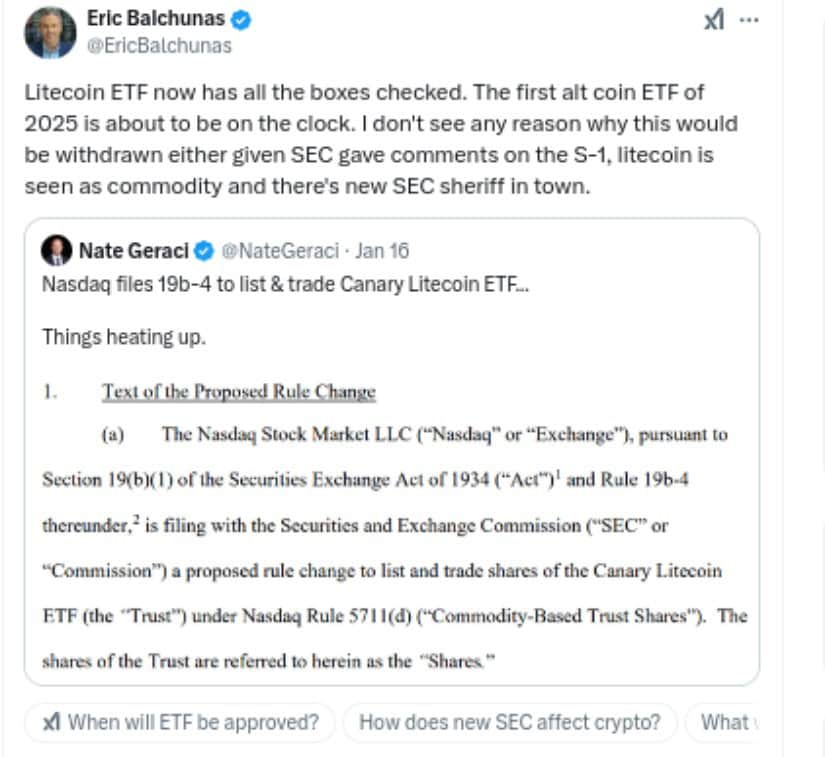
Nasdaq has officially filed a 19b-4 form with the U.S. Securities and Exchange Commission in support of the Canary Litecoin ETF proposal, marking a significant step towards the launch of a new cryptocurrency-focused exchange-traded fund . This move follows earlier discussions with the SEC, which had requested Canary Capital to amend its S-1 filing for the proposed ETF.

The Canary Litecoin ETF, first introduced by Canary Capital in October 2024, aims to provide investors with direct exposure to Litecoin , one of the top cryptocurrencies by market capitalization. Unlike traditional ETFs, which typically track stocks or commodities, the Litecoin ETF would provide a structured way to invest in the digital currency, bringing the asset class closer to mainstream financial markets.

The filing of the 19b-4 form with the SEC is a crucial step in the approval process for the ETF. This form is used by exchanges to propose rule changes related to the listing and trading of securities. By submitting the form, Nasdaq is seeking approval to list the Canary Litecoin ETF on its exchange, a move that could open the door for broader institutional and retail investor participation in the Litecoin market.

The SEC’s role in the process is central to the success of the proposal. The regulatory body has long been cautious about approving cryptocurrency-based ETFs, primarily due to concerns about market volatility, liquidity, and potential manipulation. However, recent developments, including the approval of Bitcoin ETFs, have sparked renewed optimism that Litecoin, as a leading cryptocurrency, may also be considered for ETF approval.

Nasdaq’s filing comes after the SEC’s request for amendments to the S-1 form, which is required for the registration of the proposed ETF. The amendments were aimed at clarifying certain aspects of the ETF’s structure and compliance with SEC regulations. Canary Capital responded to the SEC’s concerns and has now moved forward with the 19b-4 filing, signaling confidence in the proposal’s approval.

If approved, the Canary Litecoin ETF would be the first of its kind to offer exposure to Litecoin, allowing investors to buy shares in the fund without needing to directly hold or manage the cryptocurrency. This would simplify the process for those looking to invest in Litecoin while also providing the regulatory oversight that traditional ETFs enjoy. It could also have a significant impact on the adoption of Litecoin as an asset class, especially among institutional investors who may have been hesitant to invest in digital currencies without a regulated investment vehicle.

The move aligns with a broader trend in the cryptocurrency industry, where more companies are attempting to bridge the gap between traditional finance and digital assets. Bitcoin ETFs, which track the price of Bitcoin, have gained traction in the past few years, prompting a reassessment of how other major cryptocurrencies could also be packaged in a similar way for investors. Litecoin, which was created in 2011 by Charlie Lee as a “lighter” alternative to Bitcoin, has gained substantial traction in the crypto space and is often considered one of the more stable digital assets, making it a prime candidate for an ETF product.

The filing also comes amid growing interest in alternative investment products, especially in the wake of a year marked by significant price volatility in traditional financial markets. Investors are increasingly turning to cryptocurrencies as a hedge against inflation and economic uncertainty, and an ETF could provide a more accessible route for them to gain exposure to the digital asset class.

Despite the excitement surrounding the potential approval of a Litecoin ETF, the SEC’s cautious stance on cryptocurrency products means the approval process is unlikely to be straightforward. The regulatory body has previously expressed concerns about the potential for market manipulation in the cryptocurrency space, and the Canary Litecoin ETF will likely face intense scrutiny. However, the SEC’s approval of Bitcoin ETFs has created a more favorable environment for other digital assets, and many market participants are hopeful that the SEC will ultimately grant approval for the Litecoin ETF as well.

For Nasdaq, the filing represents a key strategic move in solidifying its position as a leader in the growing cryptocurrency market. As more institutional investors seek regulated ways to engage with cryptocurrencies, exchanges like Nasdaq are well-positioned to capitalize on the trend by offering products like the Canary Litecoin ETF.

The approval of a Litecoin ETF would not only provide a new investment opportunity for retail and institutional investors but also send a strong signal to the broader financial markets that digital currencies are becoming increasingly integrated into traditional investment frameworks. It would also mark another milestone in the ongoing evolution of the cryptocurrency market, which continues to attract the attention of both investors and regulators.


The American Lung Association has called on New Jersey lawmakers to enact a comprehensive ban on smoking in the state’s casinos. This appeal comes as health advocates and public health organizations continue to push for stronger regulations to protect workers and patrons from the harmful effects of secondhand smoke in gaming environments. The association’s report, which examines the current state of smoking policies in New Jersey’s casinos, […]

Utah is moving forward with legislation that would permit the state to invest a portion of its public funds in cryptocurrencies. The Utah House Economic Development Committee approved the bill, known as HB 230 or the Blockchain and Digital Innovation Amendments, by an 8-1 vote on January 28. Introduced by Representative Jordan Teuscher, the bill allows the state treasurer to allocate up to 5% of certain public funds into “qualifying digital assets,” including cryptocurrencies with a market capitalization exceeding $500 billion and approved stablecoins. The bill now proceeds to the full House for a vote. If approved, it will move to the Senate and, if passed there, will be sent to Governor Spencer Cox for final approval. Governor Cox has previously demonstrated support for cryptocurrency initiatives, having signed a bill in 2022 to establish a Blockchain and Digital Innovation Task Force in Utah. The proposed legislation also includes provisions for secure custody solutions, qualified custodians, and exchange-traded products to manage the digital assets. Additionally, it grants the treasurer the authority to engage in staking and lending of crypto assets under specific conditions and prohibits state and local governments from restricting the acceptance of cryptocurrencies as payment for legal goods and services. If the bill passes all necessary hurdles, it is slated to come into effect on May 7.

Kentucky is also taking steps to integrate cryptocurrency into its financial strategy. Representative TJ Roberts announced plans to introduce the Bitcoin Strategic Reserve Act in the coming weeks. Roberts aims to position Kentucky as the “Crypto Capital of the World” by removing sales tax on precious metals and establishing a Bitcoin reserve. He argues that inflation and flawed federal policies have made it necessary for states to take control of their financial future. The proposed legislation seeks to strengthen Kentucky’s economy by creating a strategic reserve of Bitcoin, potentially enhancing the state’s financial stability and attracting crypto-related businesses. Roberts’ initiative reflects a broader trend among U.S. states exploring the integration of cryptocurrencies into their financial systems.

These developments in Utah and Kentucky are part of a growing movement among U.S. states to incorporate cryptocurrencies into their financial frameworks. Lawmakers in South Dakota have also announced plans to introduce similar legislation to establish a Bitcoin reserve. Representative Logan Manhart stated his intention to bring forward a bill in the South Dakota House to create a strategic Bitcoin reserve, emphasizing the opportunity for proactive government action in this area. This initiative aligns with efforts in other states, such as Wyoming and Massachusetts, which have introduced Bitcoin-related legislation since December 2024.

Coinbase has recently strengthened its Advisory Board by appointing four influential political and financial experts. This move marks a strategic push by the cryptocurrency exchange to enhance its operations and reputation, particularly in navigating complex regulatory landscapes and expanding its influence in both the financial and governmental sectors.

The new appointments signal Coinbase’s ongoing commitment to improving its strategic positioning in the fast-evolving digital asset market. As the cryptocurrency industry faces heightened regulatory scrutiny, the company is keen on leveraging the expertise of these newly appointed advisors to help guide its operations through potential legislative challenges. The new advisory team consists of individuals with deep experience in policy-making, finance, and corporate governance.

The individuals appointed bring with them decades of experience in various sectors, including finance, law, and public policy. Their expertise is expected to play a pivotal role as Coinbase continues to refine its regulatory strategies while expanding its services to new markets. Their knowledge will also assist the company in strengthening its communication with regulators and policymakers, two key groups that have become increasingly important for the exchange’s future growth.

One of the notable appointments is that of a former U.S. senator, whose background in government service is expected to provide valuable insights as Coinbase works to influence and shape crypto-related legislation in Washington. This particular appointment aligns with the company’s ongoing efforts to establish strong relationships within the political sphere, a move considered vital to the success of crypto businesses in the U.S. amid growing concerns over regulatory frameworks.

Another prominent addition is a former senior executive from one of the world’s largest investment banks. The experience of this new advisory member in financial markets and risk management will likely benefit Coinbase as it navigates market volatility and continues to expand its institutional offerings. With increased institutional interest in cryptocurrencies, the advice of such an expert could prove instrumental in helping Coinbase better serve large-scale investors and ensure robust compliance practices.

The composition of the new advisory board also includes experts with vast experience in global financial markets and regulatory affairs. These appointments reflect Coinbase’s strategy to solidify its presence internationally, as the company has faced varying degrees of regulatory scrutiny in markets outside the United States, particularly in Europe and Asia. By bringing on board individuals who have worked with international regulators, Coinbase appears poised to strengthen its international operations and better understand the regulatory demands in multiple regions.

Coinbase’s decision to bolster its Advisory Board comes at a time when the cryptocurrency industry is grappling with an evolving regulatory environment. Global regulators have intensified their efforts to create clearer frameworks for digital assets, while lawmakers continue to debate the role of cryptocurrencies in the broader economy. By bringing in top-tier experts from political and financial backgrounds, Coinbase seeks to ensure that it remains at the forefront of the ongoing dialogue surrounding digital asset regulation.

As one of the largest cryptocurrency exchanges in the world, Coinbase’s moves to enhance its advisory resources come as no surprise. The company has consistently been proactive in addressing regulatory concerns and fostering relationships with policymakers. This commitment to advisory growth is part of Coinbase’s larger strategy to build a more secure and compliant foundation for its business operations while positioning itself for sustainable long-term growth.

In recent years, Coinbase has increasingly emphasized its role as a responsible market player, striving to lead the industry toward more robust standards and practices. The newly appointed members of the Advisory Board are expected to contribute significantly to the company’s efforts in this regard. Their deep insights will likely guide Coinbase in its ongoing discussions with regulators and legislators to influence the regulatory landscape, especially as governments worldwide continue to examine the broader implications of blockchain technologies and cryptocurrencies.

Coinbase’s latest move comes as the digital asset industry continues to evolve, with developments in blockchain technology and decentralized finance contributing to an increasingly complex ecosystem. As cryptocurrency adoption grows, so too does the need for clear and effective regulation. The expansion of Coinbase’s Advisory Board, particularly with such distinguished new members, demonstrates the company’s proactive approach to navigating the regulatory challenges that lie ahead.

President Donald Trump’s $TRUMP memecoin has proven to be a financial phenomenon, generating at least $11.4 million in fees, marking a notable chapter in the increasingly popular world of cryptocurrency. The memecoin, launched by an unofficial group, has attracted significant attention and sparked both excitement and skepticism within the crypto community. The surge in fees has come as a result of increasing transactions and a growing number of investors entering the market in hopes of capitalizing on its popularity.

The $TRUMP memecoin, which was launched following the former U.S. president’s name and brand, has drawn interest from a wide range of investors. While the token was initially viewed as a playful homage to Trump’s persona, it has rapidly gained traction, especially among those seeking to combine political celebrity with cryptocurrency. Analysts have noted that the surge in fees is indicative of both the growing adoption of meme-based tokens and the ongoing intersection between political figures and the cryptocurrency space. This rise in fees has been facilitated by a combination of high-volume trading and speculative buying, with enthusiasts hoping to see the token rise in value as a form of digital memorabilia tied to Trump’s political legacy.

The memecoin’s rapid ascent comes at a time when cryptocurrencies are experiencing a wave of renewed interest. The crypto market itself, which had witnessed fluctuations and regulatory challenges over the past few years, is now seeing more participants, particularly in the realm of meme tokens. While some analysts are cautious, pointing out the volatility and potential risks inherent in these kinds of investments, others see the success of $TRUMP as part of a larger trend where political figures or internet culture icons create their own digital currencies to capitalize on their fame.

Entities connected to the $TRUMP token have profited from the fees generated through the exchange of the memecoin. The transactions are processed through decentralized finance platforms, where users swap $TRUMP for other cryptocurrencies, thereby generating fees for both platform operators and token creators. These fees are not only driving profits for entities directly linked to the $TRUMP token but also generating significant income for those offering liquidity and transaction services.

Experts suggest that the appeal of memecoins like $TRUMP lies in their ability to merge entertainment, social influence, and financial speculation. In a market driven by community enthusiasm, the $TRUMP token has become a symbol of the growing fusion between entertainment and cryptocurrency, blurring the lines between the two sectors. While some argue that these tokens are fundamentally speculative and have no intrinsic value, others believe they serve as a tool for engagement in a market where the power of social media and online communities can push digital assets into the mainstream.

Despite the substantial fees generated, there are concerns about the sustainability of this model. Critics warn that the long-term viability of memecoins like $TRUMP may be uncertain, especially given their reliance on high volatility and the continued interest of investors. The memecoin’s success may depend on the public’s perception of Trump’s political future and the continued enthusiasm surrounding his name. With both political and financial unpredictability surrounding Trump’s future, experts are cautious about projecting the long-term trajectory of the memecoin market.

As with any digital currency, the regulatory landscape surrounding $TRUMP and similar tokens is an area of growing concern. Governments and regulatory bodies across the globe have expressed increasing interest in the regulation of cryptocurrency markets, with some looking to impose stricter rules around memecoins and other speculative digital assets. These regulatory developments may have a significant impact on the future of memecoins, potentially limiting their growth or introducing new compliance measures that could reduce their profitability.

The rise of memecoins has also sparked debates about their role in the broader cryptocurrency ecosystem. Proponents argue that tokens like $TRUMP help to introduce new audiences to the world of cryptocurrency, driving adoption and engagement. However, others fear that they contribute to the volatility and uncertainty that characterizes the market, particularly for less experienced investors who may be drawn in by the hype without fully understanding the risks involved.

The appeal of $TRUMP highlights the growing trend of celebrity-driven cryptocurrencies, where public figures are turning to digital currencies to capitalize on their fame and engage with their followers. This trend has been observed across various industries, with celebrities and influencers using social media to promote and encourage the trading of cryptocurrencies. As political figures, including Trump, continue to maintain strong media presences, their ability to generate interest in digital assets will likely play a significant role in shaping the future of the crypto landscape.

Cboe BZX Exchange has refiled its application for spot Solana exchange-traded funds , paving the way for potential market shifts in the cryptocurrency space. The move comes after the U.S. Securities and Exchange Commission delayed decisions on previous submissions, signaling growing interest and evolving regulatory scrutiny around crypto-based ETFs.

The refiled application is an important step for four companies looking to launch products that will directly track the price of Solana, one of the top digital assets by market capitalization. These filings represent a significant push by crypto-focused financial institutions to bring more crypto exposure to traditional investors via regulated market products.

Despite growing enthusiasm in the market for blockchain-based investment opportunities, the SEC remains cautious, having postponed previous decisions on a range of cryptocurrency-linked ETFs. Historically, the SEC has been slow to approve such products, citing concerns over market manipulation, liquidity issues, and the volatile nature of the assets involved. The approval of such ETFs could represent a landmark development in how cryptocurrencies like Solana are integrated into mainstream financial markets.

The companies involved in the application process are seeking to offer products that provide direct exposure to Solana’s price movements. By tracking the value of Solana in real-time, the ETFs would provide a vehicle for investors who want to gain exposure to the cryptocurrency without having to directly purchase or store the asset themselves. This development reflects the increasing integration of digital assets into mainstream finance, with institutions and retail investors alike seeking easier, regulated pathways to access the growing cryptocurrency market.

While Solana’s blockchain is known for its speed and scalability, it has also faced significant challenges, including network outages and security concerns. These hurdles, along with the overall volatility of cryptocurrency markets, have been key points of debate surrounding the approval of digital asset ETFs. However, the renewed push for the approval of Solana-based ETFs highlights a broader trend of growing institutional and regulatory acceptance of blockchain technology, despite these risks.

Crypto investors have been closely monitoring the SEC’s stance on spot crypto ETFs, as these products would provide a more direct link between the digital assets and traditional financial markets. The approval of such ETFs could bring more legitimacy to cryptocurrencies and attract a broader investor base. Traditional financial firms, including major investment banks, have shown increasing interest in offering crypto-related products, with some already creating futures-based ETFs. The approval of a spot Solana ETF could help solidify the case for cryptocurrencies as an asset class.

Solana’s standing in the cryptocurrency market, along with its strong community support, has been a driving factor in the latest push for ETFs. Despite the challenges the network has faced, including a series of technical difficulties and market volatility, Solana has remained a major player among blockchain platforms, with strong development and a growing list of decentralized applications. The platform’s rapid transaction speeds and lower costs compared to other blockchain networks, such as Ethereum, make it a strong candidate for institutional investment products.

Several key players in the crypto asset management industry are behind the push for spot Solana ETFs. These include well-established investment firms with a track record in crypto and traditional finance, aiming to bridge the gap between digital assets and more traditional investment products. Their strategic efforts to file applications reflect a broader vision of integrating blockchain-based assets into existing financial systems.

The SEC’s decision on spot crypto ETFs has been highly anticipated within both the crypto industry and the broader financial sector. As regulatory frameworks for digital assets evolve, market participants expect increased clarity from the SEC on the rules governing the creation and operation of such products. The outcome of this application process could have far-reaching implications, not only for the Solana ecosystem but also for the entire cryptocurrency market, setting a precedent for other blockchain-based ETFs in the future.

The approval of a spot Solana ETF would provide investors with a way to bet on Solana’s long-term potential without the complications associated with owning the digital asset directly. This could lead to increased participation in the cryptocurrency market, allowing more retail and institutional investors to engage with Solana through a product that fits within traditional financial structures. Additionally, the launch of such a product could bolster Solana’s visibility among investors who may be unfamiliar with its underlying technology but are interested in its financial performance.

A devastating stampede at the Kumbh Mela festival in Prayagraj, Uttar Pradesh, resulted in the deaths of at least 15 individuals, with many more injured. The incident occurred in the early hours as thousands of devotees gathered for a ritual bath at the confluence of the Ganges, Yamuna, and the mythical Saraswati rivers.

Eyewitnesses reported that the stampede began when crowd-control barriers gave way, leading to panic among the pilgrims. Medical personnel on-site provided immediate assistance, while rescue teams worked tirelessly to transport the injured to nearby medical facilities. Families of the victims have been seen outside hospitals, anxiously awaiting news of their loved ones.

The Kumbh Mela, a six-week-long festival that commenced on January 13, is one of the most significant events in the Hindu religious calendar, attracting millions of pilgrims from across the country. On this particular day, considered highly auspicious, a massive influx of devotees was anticipated. Despite extensive preparations, including the deployment of hundreds of cameras and the establishment of a command center to monitor crowd density, the measures proved insufficient to prevent the tragedy.

Authorities had implemented advanced technologies, such as artificial intelligence, to manage the vast crowds. Approximately 300 cameras were installed throughout the festival grounds and along access routes, supplemented by drone surveillance. These systems were designed to provide real-time data on crowd movements and densities, enabling proactive management to avert potential dangers. However, the sheer number of attendees overwhelmed these precautions.

In response to the incident, Prime Minister Narendra Modi and Uttar Pradesh Chief Minister Yogi Adityanath have called for immediate support measures and urged the public to utilize alternative riverbanks for the holy dip to alleviate congestion at the primary site. Religious leaders have also appealed to pilgrims to avoid the main bathing areas and seek less crowded locations.

The Kumbh Mela has a history of tragic incidents. In 1954, more than 400 people died in a stampede during the festival, marking one of the deadliest crowd-related disasters globally. In 2013, another stampede resulted in 36 fatalities. These recurring tragedies highlight the challenges of managing such large gatherings, despite advancements in technology and infrastructure.

KUALA LUMPUR, MALAYSIA – Media OutReach Newswire – 29 January 2025 – This week, China and the world are celebrating the arrival of the Year of the Wood Snake. According to Chinese tradition, the snake represents intelligence and transformation, often symbolizing mystery and wisdom. Wood adds the qualities of growth and flexibility. An analysis provided by global broker Octa highlights how these attributes align with current trends […]

Render, a fast-emerging cloud application platform serving over two million developers, has secured $80 million in Series C funding. This capital injection is expected to fuel the company’s ambitions to expand its global footprint and redefine the rapidly evolving cloud computing landscape. The investment was led by Geodesic Capital, with participation from existing investors including Coatue and SignalFire. Cloud computing continues to play a critical role in […]

Musify, an open-source music streaming application for Android, has been gaining traction among users looking for a more personalized and flexible music listening experience. The app, which is designed to give users full control over their playback, stands out in a competitive market dominated by proprietary platforms. Offering offline support, Musify provides a unique alternative to mainstream music services, allowing users to store their favorite tracks on their devices and access them without an internet connection.

While Musify’s open-source nature makes it an appealing choice for those who prioritize privacy and customization, the app’s features are also being praised for its user-friendly interface and seamless integration with existing music libraries. It provides a smooth and consistent experience for Android users who want to break away from the limitations of traditional streaming platforms, where the scope of control is often restricted.

The primary draw of Musify lies in its flexibility. Unlike most mainstream music streaming apps that rely on cloud-based servers, Musify offers users the ability to download songs and playlists directly to their devices. This offline functionality makes it ideal for users in areas with unreliable internet access or those simply looking to minimize data usage. This feature also makes it a perfect tool for users who wish to avoid the ads and other interruptions that are commonly seen in free versions of popular streaming services.

Musify’s commitment to open-source development also appeals to a specific audience—those who are keen on supporting free software projects. The app allows users to modify and contribute to its code, which is available on platforms like GitHub. This open-source model fosters a sense of community, as users are able to directly impact the app’s future development and suggest improvements. With an increasing interest in privacy and data protection, open-source software has been gaining ground, and Musify is positioning itself as a prominent player in this trend.

The app’s interface is simple yet functional, providing basic playback controls such as play, pause, skip, and volume adjustments. It also supports various file formats, ensuring compatibility with a wide range of music files. As it allows users to create personalized playlists, organize their music library, and even explore albums, Musify has quickly become a go-to option for Android users who value customization and ease of use.

Musify’s developer community has been particularly active in refining the app’s performance. Regular updates ensure that any bugs or issues are promptly addressed, and the platform’s open-source nature means that any developer with the right skills can contribute improvements. The app’s transparent development process allows users to track changes and suggest new features, creating a sense of ownership and loyalty among its community.

Despite its promising features, Musify faces stiff competition from more established players in the streaming industry. Platforms like Spotify, YouTube Music, and Apple Music continue to dominate the market with their extensive music libraries, curated playlists, and exclusive content. These services also benefit from advanced algorithms that personalize music recommendations based on user preferences, an area where Musify is still developing its capabilities. While Musify’s offline support and open-source model are strong selling points, it remains to be seen whether it can compete with the vast resources and technologies of the major players.

Musify’s growth and adoption will depend largely on its ability to carve out a niche in the crowded music streaming landscape. The app’s commitment to user freedom, data privacy, and offline functionality provides a unique alternative, but it will need to further refine its features to appeal to a broader audience. In particular, Musify may need to enhance its discovery features to rival the recommendation systems of Spotify and others.

As Musify continues to evolve, it could play a pivotal role in shaping the future of music streaming. The app’s emphasis on open-source development and user control positions it as an alternative to the mainstream, but its long-term success will depend on how it adapts to the rapidly changing digital music landscape. By focusing on its strengths—offline listening, customization, and data privacy—Musify could become a significant player in the global music streaming market.

Managing personal finances effectively is crucial in today’s dynamic economic environment. For Android users seeking a reliable and privacy-focused solution, “My Expenses” emerges as a commendable open-source application designed to streamline financial tracking and management. Overview of My Expenses Developed using Kotlin and Java, “My Expenses” offers a straightforward interface that enables users to monitor their income, expenses, savings, and investments. The app emphasizes user privacy and […]

A new open-source application, Text Pieces, has emerged as a game-changer for developers seeking efficient text transformation tools. Built with Rust, this application offers a robust and high-performance solution tailored to the needs of developers. Text Pieces provides a comprehensive suite of features designed to streamline text manipulation tasks. Its intuitive interface allows developers to perform complex text transformations with ease, enhancing productivity and reducing the time […]

By Nitya Chakraborty Narendra Modi government is due to present its second budget in the third term of the Modi regime on February 1 in an environment of domestic downturn in GDP growth along with global uncertainty in trade due to U.S. President Donald Trump’s disruptive trade and tariff programme. Latest official data show that […]


Microsoft has introduced a new open-source database solution, DocumentDB, designed to challenge Amazon Web Services’ widely used database offerings. This new release aims to offer developers greater flexibility and enhanced features, all while embracing the open-source community’s commitment to transparency and collaboration. DocumentDB stands as a strategic response to AWS’s dominance in cloud-based database services, positioning Microsoft to carve out a significant share of the growing market […]

Website speed plays a critical role in customer retention and revenue generation, according to a comprehensive study by Liquid Web, a leading web hosting provider. The research highlights the often-overlooked impact of slow-loading websites on businesses, showing that delays of even a few seconds can have significant consequences. As online businesses increasingly rely on digital platforms, the speed at which their websites load is becoming a vital […]

Etihad Water and Electricity has revealed a fresh corporate identity, marking a significant step in the company’s evolution and its commitment to innovation in the UAE’s utility sector. The unveiling of the revamped logo, which combines vibrant blue and orange hues, is designed to reflect the seamless and dynamic nature of the services the utility provider offers to the nation’s residents and businesses. The new identity aims […]

Leaseweb, a global leader in cloud hosting and data center services, has significantly expanded its artificial intelligence infrastructure by incorporating NVIDIA’s cutting-edge GPUs. This move addresses the growing demand for powerful computing resources in industries such as gaming, media & entertainment, and AI. The expansion aims to meet the increasing need for scalable, high-performance computing solutions while ensuring competitive pricing that benefits a wide array of businesses. […]

VISHNU RAJA
RYO YAMADA
HITORI GOTOH
IKUYO KITA
Just in:
Centre grants aircraft cabin access for Sabarimala pilgrims’ irumudi
// Jaiedco and Golden Bridge Announce Strategic Collaboration for a New Dubai Islands Development // 2026 Tropical Rainforest Ecosystem Partners Conference Kicks off in Hainan // Workday targets Honeydew purchase to unify AI metrics // Crypto market loses $150 billion amid broad sell-off //
Rahul addresses League’s INDIA bloc grievances
// Energy Markets Find Little Substance In Shenzhen Summit Promises // Fungal toxins detected across 212 UK plant-based products // Toward a Shared Future for Humanity: Rethinking Civilizational Exchange // Egypt’s African Union trade climbs to $8.2 billion // Sui activates Hashi Bitcoin lending across partner network // Dubai Introduces SHARH, an AI-Powered Platform Helping Entrepreneurs Buy, Sell and Manage Businesses in the UAE // Bail refused to 17-year old in Abhiram murder // Balagopal challenges CM over tax revenue // Phancy Announces Business Performance for the Nine Months Ended September 30, 2026 // Yeebo Announces Interim Results for FY26/27 Revenue Increases by 45.5% to HK$806.7 Million Profit Attributable to Owners Surges 87.6% to HK$2,284.7 Million // Padmini follows Padmaja for ‘ghar vapsi’ // Saudi defences destroy three Houthi missiles targeting Riyadh // Dalilk Academy reaches 27 million, targets 100 million by 2030 // Diabetes Malaysia And Alpro Pharmacy Set National Record With 11,007 Most Blood Glucose Screenings Conducted Across Malaysia In Just 48 Hours //