

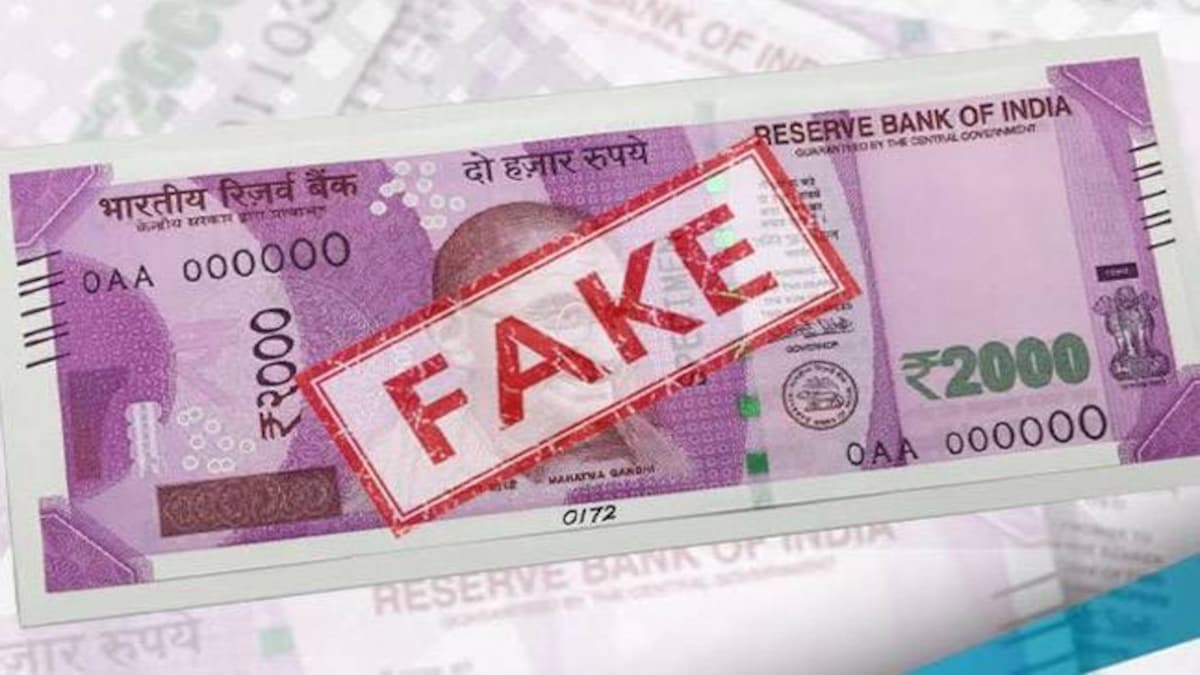

It is a matter of grave concern that counterfeit Rs 500 notes from the Mahatma Gandhi (new) series have nearly quadrupled between 2018-19 and 2023-24. And, the detection of counterfeit Rs 2,000 notes has tripled since 2020-21. The Rs 2,000 notes continue to remain legal tender and can be exchanged at RBI offices. According to the latest Reserve Bank of India report, 98 percent of the Rs 2,000 denomination notes have been returned since its May 2023 move to withdraw the currency notes.
It is the fast-expanding circulation of fake Rs 500 and Rs 200 notes which has become a matter of real concern. The Rs 500 note has become the backbone of day-to-day transactions, with its circulation witnessing consistent growth over the years. Both the government and the RBI are worried. Last week, Union Minister of State for Finance Pankaj Chaudhary expressed concerns in Lok Sabha about the rising prevalence of counterfeit currency in the country.
Going by the official data, in 2018-19 21,865 million pieces (mpcs) of the fake currency notes were detected. It reached its peak at 91,110 mpcs in 2022-23, before slightly declining to 85,711 mpcs in 2023-24. This is a sharp increase from 21,865 mpcs detected in 2018-19. However, the number of undetected counterfeit currency notes is anybody’s guess. Usually, they are in circulation in rural or semi-urban markets. The operators and customers avoid banks to dodge detection. Fake Indian currency notes are mainly used in terror-related activities to cripple the country’s economy and create economic terror.
West Bengal and Assam are believed to be key entry points of fake Indian currency from Bangladesh, Pakistan and Nepal. Both Bangladesh and Pakistan are said to be using Nepal to despatch counterfeited Indian currency to the eastern part of the country. Lately, in a major crackdown on counterfeit currency operations by the police, four individuals were arrested from the Ghulam Patty area of Assam’s Golaghat town. Police seized sophisticated currency printing equipment and fake notes of various denominations and arrested several persons including Dudu Ali and Rajibuddin Ahmed branded as key operatives. However, kingpins manage to stay under shadow.
A recent RBI estimate showed that nearly 80 percent of the total counterfeit notes seized in the country enter through three Indo-Bangladesh border districts of Malda, Murshidabad and Nadia. Malda accounts for the biggest share of the amount of counterfeit Indian currency notes. They are pushed into the country through these three Muslim-majority West Bengal districts bordering Bangladesh. A sizable section of the youth from these districts earns their livelihood as contractual labour working in states such as Gujarat, Haryana, Uttar Pradesh, Tamil Nadu and Kerala.
Many of them are said to be used as couriers of counterfeit Indian currency notes smuggled through Bangladesh. The Reserve Bank of India estimates that about 80 percent of the total counterfeit notes seized in the country enter through three Indo-Bangladesh border districts of Malda, Murshidabad and Nadia. Malda accounts for a majority of that amount that are pushed from these three districts. Bangladesh is not only an important conduit for fake Indian currency, but counterfeit notes are also being printed there.
Lately, the supply and distribution networks of fake Indian currency notes appear to have proliferated in Bangladesh. The recent spurt in the illicit despatches of fake Indian currency notes into India through the border has become a cause of concern. Not long ago, the police in Dhaka had seized a large number of gunny bags filled with huge quantities of fake Indian currency notes. The Bangladesh police were quoted by the local media in Dhaka saying that a Lahore-based syndicate in Pakistan prints such fake notes, which are then transported to Bangladesh via Sri Lanka in containers loaded with marble stones. The consignments are hidden in “special chambers” at the homes of syndicate members before being smuggled into India. The counterfeit Indian currency notes boom in Bangladesh was also unearthed by the Indian police following an investigation.
It was found that those illegal currency notes were printed in Pakistan and then illicitly imported into India either directly through the border with Nepal and Bangladesh or through other routes linking Dubai, Bangkok, Hong Kong, and Colombo. Pakistan and Bangladesh are two major producers and distributors of fake Indian currency notes. The goal is to fund terrorism, raise inflation rates in India, and reduce confidence in the currency. According to the International Criminal Police Organisation (INTERPOL), counterfeiting financial instruments fuels the economy of the underground and promotes the activities of organised criminal networks and terrorists. To correctly assess the amount of money that is counterfeited, countries use Parts Per Million (ppm) for measurement.
Counterfeit currencies pose a global problem. The US$ is said to be the world’s most counterfeited currency. Some of the counterfeited US dollars are reported to be of very high quality. Fraudsters try to sell them as legitimate currency, or use them to get loans or lines of credit. The second most popular counterfeited banknote is Euro since the currency was launched in 2002. However, central banks in several parts of the world have been working to mint counterfeit-proof currencies using the latest technology with features that are difficult to fake.
Such features include raised intaglio printing on bills, serial numbers, watermarks, and security threads and milled or receded edges on coins. For trained eyes, identifying fake Indian currency notes is not very difficult. Genuine Indian currency notes have a security thread embedded in the note. To check, one has to hold the label transparent and rotate it slightly. However, smart currency counterfeiters too have access to the latest technology. That is posing a big problem before the central banking system. Fraudulent groups or individuals are accessing emerging technology to counterfeit banknotes and other financial instruments across the world.
Among the world’s most counterfeited notes are: US Dollar, British Pound, Euro, Australian Dollar, Philippine Peso, Canadian Dollar, South African Rand, New Zealand Dollar and Malaysian Ringgit. Incidentally, they are all convertible currencies. On the other hand, Indian Rupee (INR) is only partially convertible. While it can be freely converted into foreign currency and vice versa for trade in goods and services, it is not fully convertible in the capital account meaning that it can only be exchanged for foreign currencies and vice versa for limited reasons. Thus, counterfeited Indian currency remains mostly an Indian problem. (IPA Service)
Follow Arabian Post
Select Arabian Post as your preferred source on Google and MSN News for trusted business news and Arab politics and updates.



