News related to
Gold

HANOI, VIETNAM – Media OutReach Newswire – 10 October 2025 – The Vietnamese music scene is experiencing an unprecedented seismic event: G-DRAGON has assented to fan demands, officially announcing a second performance for his highly anticipated G-DRAGON 2025 WORLD TOUR [Übermensch] IN HANOI. The decision to add a second show on Sunday, November 9, at the 8Wonder Ocean City follows a ticket phenomenon that has redefined the […]

A coalition of leading banks including Bank of America, Goldman Sachs, Deutsche Bank, BNP Paribas, Santander, Barclays, TD Bank, MUFG, UBS and Citi has unveiled a joint exploratory effort to design a blockchain-based stablecoin pegged to G7 currencies. The banks say the asset would maintain a fixed 1:1 value relative to existing fiat currencies, issued on public blockchains.

The initiative enters a financial landscape intensely focused on regulation, institutional adoption, and the evolving dynamics between corporate and sovereign digital currencies. According to statements from the banks, the plan is still in its early phase, focused on technical design and governance frameworks before market launch.

Under the plan, participating banks would cooperate on shared standards for transparency, reserve backing, compliance, and interoperability across financial systems. The banks emphasise that regulatory alignment will be central, particularly given heightened scrutiny in major jurisdictions. Some participants have intimated that this consortium initiative is intended to forestall fragmentation in the stablecoin space and ensure that banks maintain influence over the structure of digital money networks.

Sources familiar with the project note that discussions centre on multiple core challenges: how to segregate reserves to maintain full backing, how to deal with liquidity and redemption demands, how to interface with central bank digital currencies without cannibalising them, and how to meet anti-money laundering and know-your-customer mandates.

This bank-led initiative aligns with a broader pattern: European banks recently formed a consortium to launch a euro-denominated stablecoin under MiCAR compliance, aiming to counter the dominance of U. S. dollar–based tokens. That project includes ING, UniCredit, CaixaBank, and others.

Analysts say the involvement of global banks is a signal that stablecoins are no longer confined to fintechs or crypto firms. Goldman Sachs has forecast that the stablecoin market could expand into the trillions of dollars over time. Banks are increasingly seeing stablecoins as tools to support liquidity management, payments, and tokenised financial infrastructure.

The dominance of U. S. dollar–backed stablecoins is also one driver of such moves. A Standard Chartered forecast predicts that the total stablecoin savings held globally could climb to $1.22 trillion by 2028, a shift that could disintermediate banks in emerging markets.

Critics caution that bank-issued stablecoins must avoid replicating past financial crises: if redemption runs occur, banks issuers must be prepared to redeem at par value in all circumstances, including stress periods. Proper separation of reserves, legal structuring to prevent creditor claims on reserve pools, and independent auditing will be crucial. Regulatory authorities will need to decide whether bank-issued stablecoins should be treated as depository liabilities or securities.

Some central banks may view such bank initiatives as competitive to their CBDC ambitions. Others in regulation may welcome the partnership as allowing private-sector innovation within compliant guardrails. The outcome could reshape how payments and money move across borders.


Matein Khalid Gold is in its most spectacular bull run since 1976-1980, when prices rocketed from $91 to over $800 an ounce. The current cycle found its floor near $1,800 in late 2022, as the Powell Fed’s rate-hike campaign peaked and Washington froze $300 billion in Russian reserves in response to the invasion of Ukraine. “Dr Auric” now trades at just over $4,000 an ounce – a perfect vindication of […]

Rania Gule It seems that gold is going through a delicate phase, balancing between long-term bullish momentum and short-term profit-taking pressures, at a time when global markets are on edge ahead of upcoming U.S. sentiment data. As prices approach the $4,000 per ounce mark once again, the key question resurfaces: can gold still break its historical ceiling at $4,059, or will the current corrective wave extend temporarily […]

Chinese Mainland Tenant Sales and Footfall Achieve Double-Digit Growth Hong Kong Footfall Shows Steady Uptick HONG KONG AND SHANGHAI, CHINA – Media OutReach Newswire – 10 October 2025 – Hang Lung Properties Limited (SEHK Stock Code: 00101) (“Hang Lung” or the “Company”) today announced strong preliminary operational results from its properties in the Chinese Mainland and Hong Kong during the first four days (October 1-4) of the […]

State Street Corporation, a global asset management firm managing over $5.1 trillion in assets, has announced a significant shift in investment strategy, revealing that 60% of institutional investors plan to expand their allocations in Bitcoin and other cryptocurrencies. This move marks a notable change in the traditionally cautious stance of institutional investors toward digital assets.

The Boston-based firm’s latest report sheds light on the growing momentum in the crypto market, despite its historically volatile nature. The increase in institutional interest comes amidst an evolving regulatory landscape and a heightened focus on digital assets as an emerging class of investments. State Street’s research found that institutional investors, especially pension funds, endowments, and family offices, are increasingly viewing cryptocurrencies as viable long-term assets rather than speculative investments.

The surge in interest is partly driven by the evolving understanding of blockchain technology and its potential to revolutionise various industries. Many institutional investors, once sceptical of cryptocurrencies, are now integrating digital assets into their portfolios as part of a broader diversification strategy. State Street’s report highlights that over the next two years, the shift towards Bitcoin and crypto could lead to a more balanced investment portfolio for many institutional players.

One of the key drivers of this shift is the increasing recognition of Bitcoin as a store of value, akin to gold. With inflationary pressures persisting in traditional markets, many institutional investors are seeking alternative assets that offer the potential for significant returns, coupled with a hedge against inflation. In fact, Bitcoin’s rise over the past few years has been compared to the gold rush, attracting both institutional and retail investors keen on capitalising on its perceived scarcity.

The report highlights the rising number of crypto-friendly regulatory frameworks being developed globally. Governments and regulators in key markets, including the US and Europe, are progressively aligning with the crypto industry’s growth. Recent regulatory clarity is expected to further boost institutional confidence, providing a more stable environment for investors. This shift in regulatory attitudes signals a broader acceptance of digital currencies in the financial system.

The institutional appetite for cryptocurrencies is being encouraged by the increasing number of crypto-focused financial products. Bitcoin futures, exchange-traded funds, and custodial services have become more accessible, offering institutional investors a secure and regulated pathway into the crypto market. Major players like BlackRock and Fidelity have already launched Bitcoin ETFs, catering to the rising demand for digital asset exposure.

Despite the optimistic outlook, challenges remain. The volatility of cryptocurrencies, the risk of regulatory changes, and concerns over security are factors that continue to cause hesitation among some institutional investors. However, the growing presence of crypto in mainstream finance is undeniably reshaping perceptions and broadening the scope of opportunities within the digital asset space.

State Street’s survey also highlighted a shift in the broader financial ecosystem. As crypto adoption increases among institutional investors, the traditional financial sector is also ramping up efforts to integrate blockchain technology into its operations. From clearing and settlement systems to cross-border payments, blockchain is beginning to be recognised for its potential to enhance efficiency and transparency in financial transactions.

Silver prices have surged to an all-time high of $49.57 per ounce as of October 8, 2025, marking a significant milestone in the precious metals market. This unprecedented surge is attributed to a confluence of factors, including escalating geopolitical tensions, economic uncertainties, and a robust demand for safe-haven assets.

The rally in silver prices mirrors a broader trend in the precious metals sector, with gold also reaching record levels above $4,000 per ounce. Investors are increasingly turning to these assets as a hedge against inflation and financial instability. The U. S. Federal Reserve’s anticipated interest rate cuts have further bolstered the appeal of non-yielding assets like silver and gold.

Analysts note that silver’s ascent is not solely driven by investor sentiment. The metal’s industrial applications, particularly in solar energy and electric vehicles, have seen a significant uptick. The International Energy Agency projects that silver demand from the solar sector will continue to rise, driven by the global push towards renewable energy sources.

Market dynamics also play a crucial role in silver’s price trajectory. The London Bullion Market Association reports a tightening in silver supply, with inventories reaching historic lows. This supply-demand imbalance has intensified competition among investors, pushing prices higher.

In India, silver prices have mirrored global trends, with rates reaching ₹1.57 lakh per kilogram in major markets. The surge has been fueled by increased demand during the festive season and a growing interest in silver as an investment vehicle. The Reserve Bank of India has noted a rise in silver-backed exchange-traded funds, reflecting a shift in investor preferences.

Despite the bullish outlook, experts caution about potential market corrections. The Commodity Futures Trading Commission has observed increased volatility in silver futures markets, indicating heightened speculative activity. Investors are advised to exercise caution and consider the long-term fundamentals of silver as an investment.

Advertisements

MACAU SAR – Media OutReach Newswire – 9 October 2025 – Galaxy Macau™ Integrated Resort is delighted to present an evening of operatic splendour with “Galaxy Macau™ Presents – Galaxy Music Gala: Sumi Jo – Mad for Love” as internationally acclaimed South Korean soprano Sumi Jo makes her long-awaited Macau debut at 17:00 on December 28 at Auditorium of the Galaxy International Convention Center (GICC). Tickets will […]

Arabian Post Staff -Dubai The Central Bank of the United Arab Emirates has boosted its gold reserves by about 32 percent in the first eight months of 2025, pushing the total value to AED 30.329 billion by end-August — a figure not seen before. The bank’s gold holdings stood at AED 22.981 billion at the close of December 2024. Between July and August alone, the value increased […]

Nvidia CEO Jensen Huang dismissed assertions that the artificial intelligence boom is mirroring the dot-com bubble, saying the current momentum rests on strong fundamentals rather than speculation. He defended Nvidia’s recent investments in AI startups and pitched infrastructure build-out as the engine sustaining growth. During a wide-ranging interview on CNBC, Huang stated that what differentiates today’s environment from the dot-com era is the depth of demand: global […]

Gold climbed past $4,000 per ounce for the first time, propelled by soaring investor demand for safer assets in the face of intensifying economic and political uncertainty. Spot gold reached about $4,011.18 per ounce, while U. S. gold futures for December delivery touched $4,033.40. The rally reflects mounting expectations that the U. S. Federal Reserve will begin trimming rates, combined with a weakening dollar, heavy central bank […]

Ahmad Assiri Gold has done it. Gold has reached the long-awaited $4,000 per ounce mark, a level that carries psychological and symbolic significance. This moment represents a powerful and sustained rally that began with a breakout from a lengthy consolidation phase in early September, evolving into a pivotal chapter for the market and the yellow metal. Since that breakout, gold has risen by 16%, while attempts at […]

Dubai Aerospace Enterprise has enlisted a consortium of international and regional banks to host a series of fixed income investor calls beginning 6 October 2025, with the aim of gauging demand for a potential benchmark 5-year senior unsecured US dollar sukuk issuance. The mandate positions Emirates NBD Capital, First Abu Dhabi Bank, Goldman Sachs International and HSBC as active bookrunners, while Abu Dhabi Commercial Bank, Ajman Bank, […]

Sammaan Capital will sharply expand its affordable housing lending operations after Abu Dhabi’s International Holding Company invested $1 billion for a controlling stake, the non-banking lender’s CEO, Gagan Banga, told Reuters. The infusion is expected to accelerate the drive toward an assets-under-management goal of ₹1 trillion by fiscal 2027. To underpin its expansion, Sammaan plans to launch about ten new branches monthly, concentrating on tier-4 and tier-5 […]

Michael Brown Political instability in France, and a surprise in Japan’s LDP leadership election made for a spicy start to the week yesterday, though stocks rallied regardless. Today, a barren docket awaits, as participants continue to headline-watch. A penny for the thoughts of G4 central bankers right now, as none of them appear to have particularly easy jobs. First, Fed Chair Powell, who recently resumed the journey […]

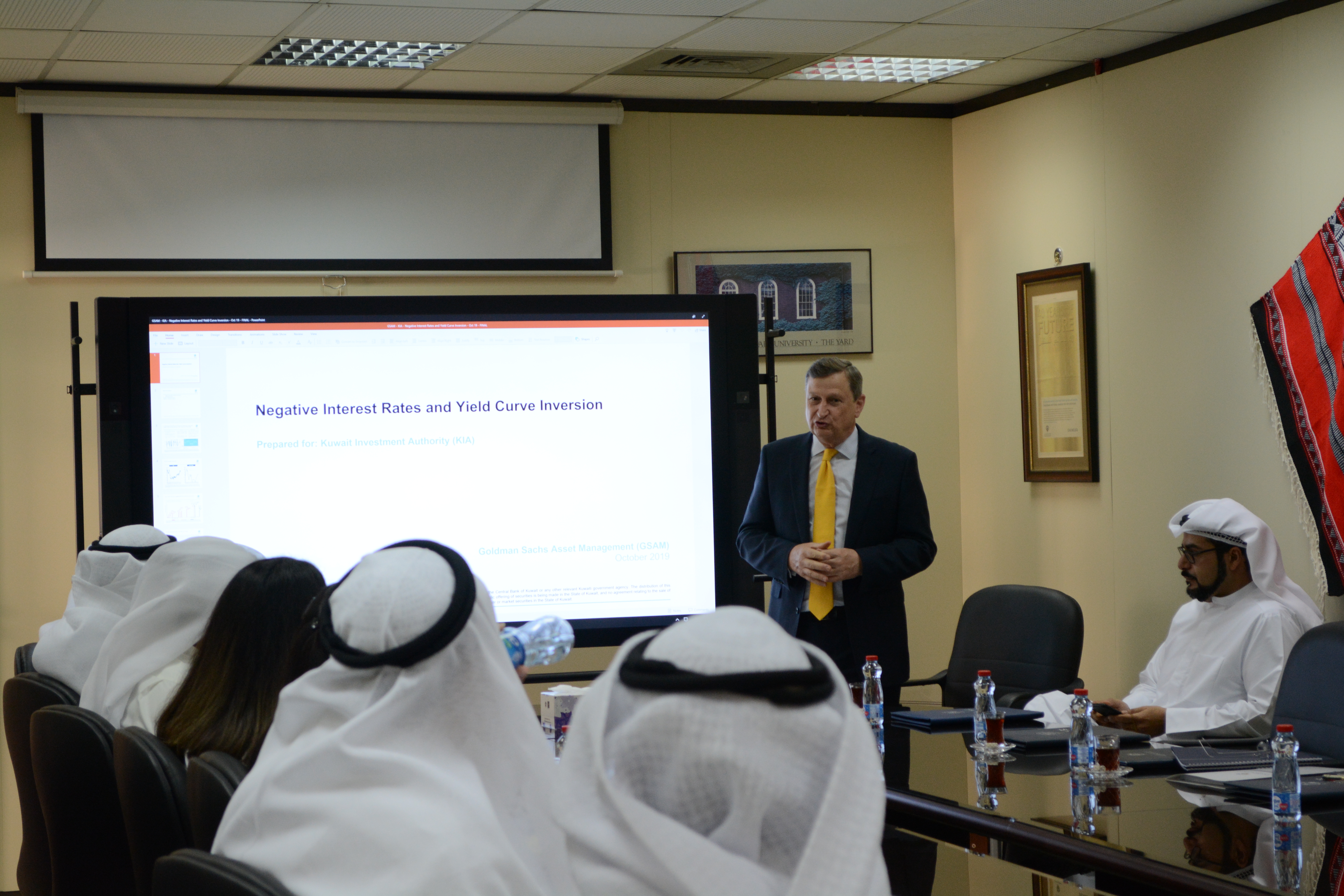
Goldman Sachs has launched a new office in Kuwait, asserting a significant push to enhance its reach across the Middle East and deepen its ties with Gulf-region clients under fresh leadership.

The New York-based investment bank said its role over five decades in Kuwait spans investment banking, capital markets and asset management. As part of its latest expansion, Goldman has tapped Mohammad Almatrouk as managing director of the Kuwait office, pending regulatory green light, while Fahad Alebrahim has been appointed managing director of the firm’s private wealth business in Kuwait.

David Solomon, Goldman Sachs’s Chairman and Chief Executive, framed the move as a commitment to “grow our capabilities across the Middle East and better serve our clients,” emphasising Kuwait’s economic vision as a catalyst for the firm’s expansion.

Goldman Sachs points to a long-standing capacity-building partnership in Kuwait that includes a professional training scheme designed to nurture talent at institutions such as the Kuwait Investment Authority, the Public Institution for Social Security and the Kuwait Fund. That programme, the bank says, will continue to play a central role in integrating local human capital into its global operations.

The choice of Kuwait underscores a growing focus on the Gulf’s institutional capital. Kuwait, host to one of the world’s largest sovereign wealth funds, has attracted global financial firms looking to align with its diversification and investment ambitions. Goldman Sachs’s decision follows earlier regional expansions, such as establishing a presence in Abu Dhabi and securing a banking licence in Saudi Arabia.

Kuwait’s Director General of the Direct Investment Promotion Authority, Sheikh Dr. Meshaal Jaber Al-Ahmad Al-Sabah, praised the move as aligned with Kuwait’s economic diversification and global integration goals. He stressed that opening the office supports national priorities including talent development and sustainable growth.

Regional analysts view Goldman’s Kuwait office as part of a broader recalibration by global banks to embed themselves closer to Gulf capital sources. Over the past two years, deal activity in sovereign and quasi-sovereign asset structures has exploded, prompting major firms including Lazard, JPMorgan and Deutsche Bank to expand in the Gulf with new leadership hires.

Inside Goldman Sachs, the timeline coincides with a leadership transition: the firm’s co-head for the Middle East and North Africa, Fadi Abuali, is slated to retire after nearly 28 years of service. His departure is expected to reshape the firm’s regional hierarchy just as Kuwait becomes a new hub.

Some observers caution the move carries execution challenges. Regulatory approvals in Kuwait must be secured, and Goldman must integrate the new office into its broader Gulf operations without duplicating functions. Success will depend on maintaining local relationships while delivering global platform advantages.

Arabian Post Staff -Dubai Goldman Sachs lifted its December 2026 gold price forecast from $4,300 to $4,900 per ounce, citing strength in Western exchange-traded fund inflows and sustained central bank purchases. Gold’s spot price hovered around $3,960 per ounce early on Tuesday, having earlier touched an intraday high of $3,977.19. Goldman analysts expect central banks—particularly in emerging markets—to continue diversifying foreign-exchange reserves into gold, with forecast average […]

Goldman Sachs Bank Europe Se-ODI has sold 8.1 crore shares in Eternal Limited, parent company of Zomato, in a block transaction worth about ₹266.1 crore, marking its fourth offloading in a month.

The shares were priced at ₹328.45 each, roughly 2 per cent below the stock’s prior closing. The buyer was BofA Securities Europe SA, which absorbed the entire block.

Earlier in October, Goldman Sachs sold 8.2 crore shares to Morgan Stanley for ~₹266.9 crore, and executed a ₹355.3-crore deal—offloading 1.08 crore shares at ₹329 apiece—to BofA. Prior to that, it disposed of 9.52 lakh shares in September for ₹31.6 crore. From these four block transactions, the firm has realised over ₹900 crore.

The continuous divestment follows a rally in Eternal’s share price. Over the past three months, the stock surged by approximately 26 per cent, reaching a high of ₹343.95 in late September, and has clocked an 18 per cent gain year to date.

Despite the strong top-line momentum, Eternal’s profitability has come under significant strain. In the first quarter of fiscal year 2025–26, consolidated net profit plunged over 90 per cent to ₹25 crore, while operating revenue rose 70 per cent to ₹7,167 crore.

Goldman Sachs’ repeated stake reductions evoke questions over motive, especially as its own brokerage arm continues to maintain a bullish stance. In September, it reaffirmed a “Buy” rating on Eternal and raised the price target to ₹360 from ₹340, citing the growth potential of its quick-commerce vertical Blinkit.

The buyer, BofA Securities, could be positioning itself on expectations of long-term value, absorbing these large blocks. The handling of these blocks at slight discounts suggests a balance between exit urgency and price discipline.

Analysts are watching closely for further block deals from Goldman Sachs, and whether these are timed to capitalise on current valuations or signal a recalibration of confidence. The broader investor community may interpret the continuous divestment, despite favourable stock momentum, as a nuanced signal regarding risk, liquidity or internal reshuffling.

HANOI, VIETNAM – Media OutReach Newswire – 7 October 2025 – The mega concert G-DRAGON 2025 WORLD TOUR [Übermensch] will take place on November 8 at 8Wonder Ocean City, with tickets officially opening for sale on October 7, 8, and 9. Prices range from VND 2 million to VND 8 million, offering a variety of exclusive benefits. With such anticipation, ticket sales are expected to spark an […]

Rania Gule Over the past few months, silver prices have witnessed a strong rally — not only as a safe-haven asset alongside gold, but also due to fundamental factors rooted in industrial supply and demand dynamics. As of early October 2025, silver is trading around $48.65 per ounce in spot market data, while ETFs such as iShares SLV show a slightly lower net asset value (NAV), reflecting […]

From left, Kamran Muhammad (6th in frame), CEO of Mashriq Elite, and from right, Aamil Tabani (4th in frame), CEO of Golden Bridge. Launched in September 2023, the project has progressed to delivery as committed, a milestone that underscores investors’ confidence in Dubai’s real estate market  Mashriq Elite Developments and Golden Bridge (exclusive sales and marketing partner) have marked the successful on-time handover of Floarea Residence in […]

OPEC+ delegates are weighing two divergent paths for November oil quotas: a modest lift mirroring October’s 137,000 barrels per day increase or a more aggressive jump, possibly two to three times larger. Diplomatic and market pressures appear to be pulling members in different directions.

Ahead of Sunday’s formal meeting, one source familiar with the deliberations described 137,000 bpd as the “base case,” replicating this month’s incremental pace. A second source, speaking on condition of anonymity, indicated that under more aggressive assumptions the group may opt for increases of 280,000 bpd or even 400,000 bpd. Those in favour of larger hikes argue that strengthening demand and constrained Russian output justify a bolder step.

Analysts are aligning with the moderate view. Goldman Sachs, for instance, projects a November quota increase of around 140,000 bpd, citing tight inventory levels in Asia and Europe and declining U. S. crude stockpiles. Pressure for a more substantial increase, however, is mounting given elevated oil prices and a desire among key producers to reclaim or expand market share.

During a meeting of the Joint Ministerial Monitoring Committee this week, OPEC+ emphasised full compliance with output agreements, urging shirking members to compensate for previous breaches. While the JMMC lacks decision-making power on quotas, it retains the ability to summon full OPEC+ sessions if necessary. This move underscores growing unease about cohesion ahead of the upcoming vote.

Market reaction has already shown sensitivity. Oil prices—which had climbed amid tight supply forecasts—slid more than 3 per cent early this week as traders factored in the possibility of an oversupplied market if OPEC+ moves decisively upward. Further pressure arrived as Iraq’s Kurdistan region resumed exports to Turkey, adding to short-term supply. Expectations of a November increase of at least 137,000 bpd have also fed concerns about potential gluts.

Saudi Arabia is anticipated to respond to this industrial backdrop by raising its official selling prices for November crude to Asia. Refining sources suggest increases of 20–40 cents per barrel for Arab Light, and larger bumps for heavier grades—moves intended to optimise returns amid the shifted supply landscape. Observers note, however, that these pricing adjustments may be constrained by growing global volumes and rising freight costs.

Within OPEC+ circles, some major players favour the status quo increment. They caution that a more aggressive hike could undermine prices and strain discipline among reluctant members. Others view a bold move as an opportunity to reshape global oil dynamics—forcing non-allied producers to respond and reasserting the cohesion and influence of the alliance.

Russia is under particular scrutiny. Its output has been running below forecasts, and further declines—coupled with Western sanctions and infrastructure disruptions—are cited by several sources as a justification for a larger quota increase across the group. Still, Moscow’s appetite for more substantial volume gains remains unclear, balancing revenue interests with geopolitical strategy.

South African equities climbed to unprecedented levels on Thursday, driven by buoyant momentum in mining and financial sectors. The benchmark FTSE/JSE All-Share Index rose past its prior peak, cementing the capital market’s status as one of the continent’s top performers this year. The rally has been underpinned by a strong commodity backdrop: iron ore, platinum, and gold all posted gains, boosting mining stocks across the board. The […]

Jeddah — King Abdullah University of Science and Technology has initiated the KAUST Mathematics Competition, a national contest designed to identify and nurture top mathematics talent among students in Grades 8 through 11 across Saudi Arabia. The competition invites both Saudi nationals and residents studying in the Kingdom’s schools to test themselves on challenging topics such as algebra, number theory, combinatorics and geometry.

Phase One of KMC will take place as a two-hour elimination exam at eight regional centres. Students in the junior stream will face 24 multiple-choice questions, while those in the senior stream will tackle 30 multiple-choice items. From that round, the top 200—split evenly between junior and senior tracks—will advance to the final phase. That final round, conducted at KAUST over three days in April, will require written answers to six problems. KAUST will bear the costs of travel, lodging and meals for finalists. The participation fee is set at 100 Saudi riyals per student.

KAUST’s rationale for KMC aligns with its broader talent development mission: to foster advanced thinking skills and attract gifted students into STEM pathways. The competition also offers attractive incentives: cash awards, enrolment in KAUST Academy programmes, and a prize for first-place winners in each track — admission to a summer mathematics camp hosted jointly by KAUST and the University of Cambridge.

KAUST’s pre-university programmes, especially its Science Research School Initiative, already train middle and high school students for international Olympiads. SRSI’s mandate includes preparing students in mathematics, chemistry, physics, informatics and biology through intensive on-campus training. Students in grades 6 to 12 benefit from the training, and many go on to represent Saudi Arabia in global contests. KAUST also partners with other institutional programmes focused on gifted education.

The decision to launch KMC complements an existing competitive ecosystem. The KFUPM Mathematics Olympiad, for instance, has long been held for secondary school students at multiple centres across the country. That contest historically serves as a pipeline to select candidates for the International Mathematical Olympiad. Meanwhile, Saudi youth continue to perform strongly at regional contests: in the 29th Junior Balkan Mathematical Olympiad held in North Macedonia, six Saudi students won two gold, two silver and two bronze medals.

VISHNU RAJA
RYO YAMADA
HITORI GOTOH
IKUYO KITA