News related to
Stage

Europe’s cybersecurity agency has moved to strengthen its influence over the global system used to identify and catalogue software flaws, with ENISA no longer merely seeking a bigger role in the Common Vulnerabilities and Exposures programme but already holding Root status in a shift that gives the EU a stronger hand in how vulnerabilities are coordinated across borders. The development matters because the CVE system remains a […]

Asian equities pushed higher on Thursday as hopes of a diplomatic opening in the US-Iran conflict combined with solid corporate earnings to lift sentiment across the region, extending a rebound that has carried global benchmarks back towards, and in some cases beyond, their pre-war highs. MSCI’s broadest index of Asia-Pacific shares outside Japan rose about 0.9 per cent, while Japan’s Nikkei jumped 2.2 per cent to a fresh record, tracking Wall Street gains after the S&P 500 and Nasdaq ended at all-time closing highs on 15 April.

The rally reflected a market view that the worst-case economic fallout from the conflict may yet be avoided if negotiations regain momentum. Investors were encouraged by signs that talks between Washington and Tehran could resume after earlier efforts faltered, easing some fears over energy supply disruptions and allowing attention to swing back to earnings, economic data and the resilience of household demand in the United States and Asia. That shift in mood helped lift US stock futures and underpinned broader gains from Tokyo to Mumbai.

Japan led the advance, with exporters and technology names benefiting from stronger risk appetite and the market’s belief that any easing in Middle East tensions could reduce pressure on fuel costs and shipping. The Nikkei’s record level also reflected investor confidence that large Japanese companies remain well placed to benefit from global demand for semiconductors, automation and artificial intelligence infrastructure. Elsewhere, South Korean and Hong Kong shares also moved higher, while mainland Chinese markets were supported by data showing the economy expanded by 5.0 per cent in the first quarter, beating expectations and offering some reassurance that domestic activity has retained momentum despite the geopolitical shock.

Wall Street’s lead mattered. The S&P 500 closed at 7,022.95 on Wednesday, a record that marked a full recovery from losses triggered after the conflict began in late February, while the Nasdaq posted another record finish and extended a powerful winning streak. Strong results from major banks, including Bank of America and Morgan Stanley, reinforced the idea that corporate America is entering the earnings season on firmer footing than many investors had feared when oil prices spiked and risk assets sold off. Reuters reported that 84 per cent of companies that had reported by then had beaten expectations, helping to steady nerves about margins and consumer activity.

The earnings story is now sharing the stage with geopolitics. Markets are effectively pricing a narrower range of negative outcomes than they were only weeks ago, but that optimism remains conditional. Oil prices, while off their most alarming levels, are still elevated by historical standards, and every diplomatic headline continues to carry outsized weight because the Strait of Hormuz remains central to global crude flows. Reports that Iran may allow shipping through the waterway helped calm traders, though supply risks have not disappeared, especially with refinery disruptions in Australia and the threat of fresh sanctions or military miscalculation still present.

That tension between relief and caution is visible across asset classes. The dollar was broadly steady, the euro stayed firm, gold edged up and cryptocurrencies drifted lower, all signs that investors have not fully abandoned hedges even as they add exposure to equities. In India, shares opened higher as lower oil prices and hopes of renewed dialogue supported all major sectors, with the Nifty 50 and Sensex building on gains from the previous session. For economies that import large volumes of energy, any sustained cooling in crude would ease inflation pressure, support currencies and give central banks more room to focus on domestic growth rather than external shocks.

Technology remains a central pillar of the market’s confidence. Taiwan Semiconductor Manufacturing Co. was in focus ahead of results that investors expected to show a sharp profit jump, driven by demand tied to artificial intelligence chips. That anticipation has fed into a broader belief that the AI investment cycle can continue to offset weakness elsewhere in the global economy. Yet the strength of that narrative also creates a vulnerability: richly valued technology shares leave little room for disappointment, and any sign of slowing orders or tighter capital spending could quickly change the market tone.

Singapore leads the region in maturity but faces critical scaling bottlenecks.

SINGAPORE – Media OutReach Newswire – 15 April 2026 – ST Telemedia Global Data Centres (STT GDC), one of the world’s fastest-growing data centre colocation service providers headquartered in Singapore, today announced the findings of a new regional research study, Mind the Gap: Bridging the AI Infrastructure Readiness Divide, examining how organisations across Asia are progressing from AI ambition to execution. Commissioned by STT GDC with research partner Ecosystm, the study surveyed more than 600 enterprise and digital-native leaders across nine Asian markets: India, Indonesia, Japan, Malaysia, the Philippines, Singapore, South Korea, Thailand and Vietnam.

High adoption, limited readiness across Asia

The report reveals that AI ambition across Asia is high, with nearly 90% of organisations having embarked on their AI journeys. However, a significant 71% remain in the “Builder” stage of maturity, where initial AI pilots struggle to scale into production environments capable of delivering consistent and measurable return on investment (ROI). In contrast, only 17% of organisations are considered “future ready”, having invested in scalable infrastructure, mature data governance and specialised operational expertise, highlighting a widening readiness gap across the region.

Challenges faced by the Builders

Across Asia, the research identifies a reinforcing cycle that keeps many organisations stuck in pilot mode. AI initiatives are often launched on infrastructure that cannot scale to production, limiting their ability to demonstrate measurable ROI and making it harder to justify further investment in purpose-built, high-density environments. This challenge is compounded by gaps in in-house expertise, with many organisations lacking the specialist operational skills required to manage increasingly complex AI infrastructure at scale.

“Across Asia, organisations are moving quickly from experimentation to implementation, but many are discovering that AI success now depends less on training models and more on foundations,” said Chris Street, Group Chief Revenue Officer of ST Telemedia Global Data Centres. “Without scalable infrastructure and operational readiness in place, it becomes difficult to convert early AI ambition into consistent business value.”

The Sustainability Blind Spot

Despite rising energy and cooling demands driven by AI workloads, sustainability considerations remain secondary for most organisations when evaluating infrastructure options. Although 27% of organisations say ESG goals will actively shape or be central to their future plans, 64% of organisations across Asia continue to prioritise performance or cost, even as power density, thermal efficiency and long‑term total cost of ownership become increasingly critical factors in scaling AI responsibly.

A disconnect between what organisations want and what they need

The study also highlights a persistent disconnect between how organisations evaluate infrastructure partners and the capabilities they actually need to scale AI. Across Asia, organisations continue to prioritise baseline requirements like security and reliability, despite identifying operational expertise, scalability and cost efficiency as their most significant challenges.

Singapore: ahead of the region, but facing a new constraint

These challenges are visible across the region, but they manifest differently in more mature markets. Singapore stands out against the regional baseline with a significantly larger share of organisations having progressed beyond early-stage pilots. While only 17% of organisations across Asia are considered future‑ready, 40% of Singapore organisations have reached the Integrator stage, reflecting stronger early execution and deployment capability.

However, the study also finds that the final step to leadership remains the most difficult. Only 3% of Singapore organisations have reached the “Leader” stage of AI infrastructure maturity, signalling that even in Asia’s most mature AI market, the transition from integration to full leadership remains difficult.

Scaling, not adoption, is now the key challenge

In Singapore, where adoption is more advanced, the constraints have shifted. Limited infrastructure headroom, shortages in specialised operational expertise and continued investment discipline are now emerging as the primary barriers to scaling AI workloads and sustaining leadership.

“For Singapore, AI adoption is relatively mature; the defining challenge now is scaling deployments fast enough to support real‑world demand,” said Mingcheng Lim, Country Head – Singapore, ST Telemedia Global Data Centres. “Whether the country can maintain its lead in the region will depend on whether infrastructure capacity, specialist expertise and investment approaches can evolve at the same pace as AI workloads.”

Sustainability awareness has yet to shape infrastructure choices

In Singapore, regulatory expectations have driven relatively high awareness of sustainability issues. However, sustainability continues to rank among the lowest priorities when organisations evaluate infrastructure providers, highlighting a gap between awareness and action, even as power density, thermal efficiency and long‑term cost efficiency become increasingly important to scaling AI responsibly.

The mismatch between wants and needs persists

As with the wider region, Singapore organisations continue to evaluate infrastructure providers based on familiar baseline criteria, even as their scaling challenges point to a growing need for specialist expertise, speed to scale and sustainable, high‑density infrastructure capability.

These findings suggest that Asia’s next phase of AI progress will be defined not by ambition alone, but by execution capability. For Singapore, sustaining regional leadership will depend on infrastructure strategies that support scale, resilience and speed, enabling organisations to convert early AI momentum into enduring competitive advantage.

To download the report, Mind the Gap: Bridging the AI Infrastructure Readiness Divide, please visit: https://www.sttelemediagdc.com/resources/ai-readiness-assessment-report.Hashtag: #STTelemedia #STTGDC

The issuer is solely responsible for the content of this announcement.

About ST Telemedia Global Data Centres

ST Telemedia Global Data Centres (STT GDC) is one of the fastest-growing data centre providers with a global platform serving as a cornerstone of the digital ecosystem that helps the world to connect. Powering a sustainable digital future, STT GDC operates across Singapore, the UK, Germany, India, Italy, Thailand, South Korea, Indonesia, Japan, the Philippines, Malaysia and Vietnam, providing businesses an exceptional foundation that is built for their growth anywhere. For more information, visit.

SoftBank Group’s push to raise broader backing for a $40 billion loan tied to its investment in OpenAI is drawing fresh attention to how far global lenders are willing to support Masayoshi Son’s debt-heavy bet on artificial intelligence. More banks are being approached to join the financing, extending a syndication effort that began after SoftBank secured the bridge facility in March, in what has become a major […]

First-ever joint campaign for credit card unlocks enhanced digital investment solutions and exclusive lifestyle privileges for clients

HONG KONG SAR – Media OutReach Newswire – 15 April 2026 – As part of its strategy to lead in digital wealth, Citi is leveraging fintech to enhance its client value proposition. Citi is committed to driving Hong Kong’s fintech ecosystem by playing a unique role as both a strategic investor and a collaborator. This approach is exemplified by our partnership with Endowus, a leading digital wealth advisory and investment platform. After Citi Ventures invested in the platform in August 2023, this collaboration now sets the stage for our latest joint initiative.

Building on their established relationship, Citi Hong Kong and Endowus recently launched the “Invest with Clarity, Live in Prestige” campaign, their inaugural joint credit card promotion. Through this initiative, eligible Endowus clients who successfully apply for a new Citi Prestige Card and meet specific requirements during the promotion period will receive a HK$4,000* cash reward. This offer seamlessly integrates a rewarding investment journey with the elevated dining, travel and lifestyle privileges that come with the Citi Prestige Card.

This partnership marks a key milestone, and both Citi and Endowus look forward to exploring further collaborations, including expanding the campaign to other Citi Credit Cards and across a broader spectrum of products, aiming to continuously drive financial innovation and enhance client experience.

Sarah O, Head of Digital Growth & Cards and Unsecured Lending Sales, Citi Hong Kong, said, “Our strategic collaboration with Endowus exemplifies Citi’s commitment to harnessing the power of the fintech ecosystem to drive growth and innovation within our wealth business. The expanded partnership with Endowus showcases our unique, full-circle commitment to the fintech community. We are excited about the ongoing potential of this partnership to unlock even more innovative solutions for our clients.”

Steffanie Yuen, Managing Director and Head of Hong Kong, Endowus said, “Citi’s strategic backing as our shareholder, and recognition of our vision to help people invest with clarity significantly reflects a shared commitment to raising the bar for wealth management in Hong Kong. By pairing best-in-class digital investment tools with the lifestyle rewards of the Citi Prestige Card, we’re making it easier than ever for clients to invest well and live well. We look forward to deepening our partnership to build even more innovative experiences together for the clients we serve.”

Click HERE to download the photo
Photo: Sarah O, Head of Digital Growth & Cards and Unsecured Lending Sales, Citi Hong Kong (Left) and Steffanie Yuen, Managing Director and Head of Hong Kong, Endowus (Right)

*For new Citi Prestige Card clients only. Terms and conditions for the promotion apply. Details: https://endowus.com/en-hk/campaigns/terms-conditions-for-endowus-x-citi-prestige-collaboration-promotion-2026

Hashtag: #Citi

The issuer is solely responsible for the content of this announcement.

About Citi

Citi is a preeminent banking partner for institutions with cross-border needs, a global leader in wealth management and a valued personal bank in its home market of the United States. Citi does business in more than 180 countries and jurisdictions, providing corporations, governments, investors, institutions and individuals with a broad range of financial products and services.

Additional information may be found at | X: | LinkedIn: | YouTube: | Facebook:

  • Hongkong Land and Gammon Construction introduce CarbonCure’s CO₂ mineralisation technology in Tomorrow’s CENTRAL project, a first for Hong Kong.
  • Injecting captured CO₂ into concrete reduces cement use by up to 7%.
  • Supporting Hongkong Land’s goal of cutting Scope 3 carbon intensity 22% by 2030, positioning Tomorrow’s CENTRAL as a sustainability leader.
  • Buildings Department approval of the CarbonCure concrete mix sets the stage for wider industry adoption.
HONG KONG SAR – Media OutReach Newswire – 14 April 2026 – Hongkong Land and Gammon Construction have partnered to introduce CarbonCure to Hong Kong. Through this strategic collaboration, the companies are deploying the patented CO₂ mineralisation technology in Tomorrow’s CENTRAL project, marking its first use in Hong Kong. This alliance pioneers low-carbon building materials in the city and accelerates the wider industry’s transition.

(From left to right) Mr. Eddie Tse, Group Sustainability Manager, Gammon Construction; Ms. Ka Yan Chu, Assistant Technical Manager, Concrete Technology Services, Gammon Construction; Ms. Grace Lam, Senior Sustainability Manager, Hongko

Reducing cement‑related emissions without compromising performance

Embodied carbon accounted for 70% of Hongkong Land’s total carbon emissions in 2025, with industry research indicating that more than 80% of the embodied carbon in a typical new commercial building is associated with concrete, brick and steel. Cement production generates about 7% of global CO₂ emissions, more than three times that of civil aviation, making it a critical decarbonisation priority.
CarbonCure offers one of the most effective solutions, reducing cement content by 4–7% without compromising concrete quality or performance. The new technology injects captured CO₂ into fresh concrete during mixing, where it undergoes a chemical reaction to form a mineral, permanently trapping carbon within the material. When combined with a low-carbon concrete mix containing approximately 40% Ground Granulated Blast-Furnace Slag (GGBS), a 34% carbon emissions reduction is achieved compared to traditional non-green concrete.

Implementing this innovative technology supports Hongkong Land’s target of achieving a 22% reduction in Scope 3 carbon intensity by 2030. It also aligns with Tomorrow’s CENTRAL project’s sustainability objectives, including using 100% low carbon concrete, 100% green rebar, and 100% sustainable timber during construction, and to divert 75% of construction waste.

Tomorrow’s CENTRAL: a project with sustainability at its core

Tomorrow’s CENTRAL is Hongkong Land’s bold three-year plan to transform the LANDMARK retail portfolio. Announced in June 2024, the project is ambitious in its scope, encompassing extensive façade enhancements, retail renovations and office lift-lobby relocations From inception, sustainability has been the project’s guiding principle.
The CarbonCure concrete mix technology was deployed by Hongkong Land and Gammon in November 2025 after it was approved by the Buildings Department in September 2025 following a rigorous 18-month testing and preparation period.

Michael T. Smith, Group Chief Executive of Hongkong Land, said: “Sustainability is a key business priority for Hongkong Land. Using lower carbon concrete on Tomorrow’s CENTRAL helps to advance the goals of our Sustainability Framework 2030. As the first developer to apply this technology in Hong Kong’s premium commercial sector, we continue to demonstrate our commitment to innovation and encourage wider industry uptake.”

Eddie Tse, Group Sustainability Manager, Gammon Construction, said: “We are delighted to partner with Hongkong Land on Hong Kong’s first application of CarbonCure concrete. Their strong commitment to sustainability and openness to pioneering solutions have been instrumental in making this milestone possible. By permanently mineralising carbon within building materials and reducing cement use, lower carbon concrete represents a meaningful step forward in embodied‑carbon reduction. With this successful deployment, we look forward to extending similar innovations across the industry and collaborating with more clients to drive low‑carbon construction in Hong Kong.”

Hashtag: #HongkongLand

The issuer is solely responsible for the content of this announcement.

Hongkong Land

Hongkong Land is a major listed property development, investment and management group. It focuses on developing, owning and managing premium and ultra-premium mixed-use real estate in Asian gateway cities, featuring Grade A office, luxury retail, residential and hospitality products. With over US$50 billion in assets under management, Hongkong Land’s ultra-premium mixed-use real estate footprint spans over 1.97 million sq. m. lettable area in operation and 1.43 million sq. m. lettable area under development, with flagship mixed-use projects in Hong Kong, Singapore and Shanghai. Its properties hold industry leading green building certifications and attract the world’s foremost companies and luxury brands. Established in 1889, Hongkong Land takes a long-term view, investing significantly alongside its capital partners and concentrating its portfolio where it can create the most value for tenants, customers and investors. Hongkong Land Holdings Limited has a primary listing on the London Stock Exchange, with secondary listings in Singapore and Bermuda. Hongkong Land is a member of the Jardine Matheson Group.

Formula 1 could return to Greater Noida in 2027 if the government, circuit stakeholders and the sport’s commercial side can align on taxes, approvals and financing, after Sports Minister Mansukh Mandaviya said work was under way to revive the race at the Buddh International Circuit. His remarks have revived expectations among motorsport followers, but the project remains at the stage of negotiations rather than confirmation.

Mandaviya said the government was trying to remove the tax obstacles that helped drive Formula 1 out after three editions between 2011 and 2013, and indicated that multiple companies had shown interest in backing a comeback. The minister’s comments suggested the state would act as a facilitator rather than the sole organiser, a crucial distinction for an event whose economics depend on promoter strength, sanction fees, logistics and long lead times. He also pointed to the Buddh International Circuit as the intended venue, restoring focus to a track that once hosted Sebastian Vettel’s dominant Red Bull era and briefly placed the country on Formula 1’s world calendar.

Yet the gap between political intent and a confirmed Grand Prix remains significant. Formula 1’s 2026 championship calendar is already full, running across 24 rounds with Madrid added and no India slot. Reporting on the sport’s response to the 2027 target indicates that while the market is viewed favourably, a race by that year is not considered likely at this stage because staging a Grand Prix requires complex planning and coordination. That makes the current push look more like an opening bid than a settled return date.

The tax issue is not a minor footnote but the central fault line in the story. Formula 1’s earlier spell at Buddh was overshadowed by disputes over whether the event qualified as sport or entertainment, and by arguments over customs duties and the tax treatment of revenues tied to the race. Reuters reported as far back as 2011 that teams were concerned about possible tax exposure, and by 2013 the Grand Prix had already fallen off the following year’s calendar amid mounting financial and bureaucratic strain. Mandaviya’s promise of tax relaxations is therefore a direct attempt to answer the problem that helped sink the event the first time.

Buddh itself remains the natural choice because it is the only proven Formula 1 venue in the country, but it is not simply a matter of reopening the gates. Any return would require circuit readiness, operational planning and the backing of a promoter capable of sustaining a high-cost international event. The minister said three companies had approached the government, and separate reports have suggested corporate interest around the circuit’s future, although no final transaction or race agreement has been announced. The absence of a named promoter with a signed commercial deal is one reason the 2027 target still looks aspirational.

There is also a broader question about whether the circuit can first rebuild confidence through other top-tier events. Mandaviya said a MotoGP race could be staged before Formula 1’s return, but the two-wheel championship’s own scheduling history at Buddh shows how hard that can be. MotoGP held its first race there in 2023, then postponed the 2024 event to 2025, later shifting the country’s return to 2026 under a fresh agreement with Uttar Pradesh. That record does not rule out Formula 1, but it does underline how major motorsport events in the market have struggled with continuity.

Even so, the commercial logic behind the revival effort is clear. Formula 1 has been expanding in markets that offer strong broadcast audiences, sponsor interest and long-term fan growth, and the country remains attractive on all three counts. A youthful audience, a large digital sports market and the symbolic value of restoring a race near the capital region all strengthen the case. What the bid still lacks is the final layer that matters most in Formula 1: a binding agreement among the rights holder, a credible promoter, public authorities and a venue ready to meet the sport’s demands.

Advertisements

MSBuild, a legitimate Microsoft build tool embedded in many Windows and developer environments, is drawing renewed scrutiny after fresh threat research showed how attackers are using it to run malicious code in memory, evade signature-based defences and blend into normal system activity. Security researchers and defenders say the technique is not new, but its continued effectiveness underlines how cyber intrusions are shifting away from obvious malware files […]

KK Éclat, a France-founded luxury skincare label with Hong Kong ties, has staged an invitation-only gala in Central after its UV and Pollution Blocker Cream won “Best Everyday Sunscreen” at the 2026 Vogue Hong Kong Beauty Awards, giving the brand a fresh marketing lift in an increasingly crowded premium sun-care market. Vogue Hong Kong’s awards coverage lists the product among this year’s winners, while the company said the celebration was held in March at The Pin, a private club in Central.

The company said more than 30 guests attended the dinner, including business figures, tastemakers and industry personalities, as founders Karen and Katherine used the event to underline the brand’s positioning at the intersection of prestige beauty and science-led formulation. The award matters because it comes from a high-visibility fashion and beauty title in Hong Kong, where premium skincare remains a strong draw and brand differentiation is increasingly tied to product efficacy claims, texture, convenience and visible daily-use appeal.

Vogue Hong Kong published a dedicated winners’ article on 22 March naming KK Éclat’s UV and Pollution Blocker Cream as the new “Best Everyday Sunscreen”, and a broader recap of the 2026 awards ceremony on 19 March also listed the same product in that category. That dual confirmation helps anchor the company’s claim to a recognised editorial accolade rather than a self-created brand distinction.

KK Éclat has built much of its identity around what it calls Nano Frame Technology, which the brand says helps active ingredients disperse evenly, remain on the skin surface where needed and deliver hydration over an extended period. On its website, the company presents itself as a science-backed luxury line designed for consumers with irregular routines, frequent travel and high exposure to urban stress. The product page and brand materials place the sunscreen within a broader narrative of multifunctional skincare that promises protection, hydration and cosmetic elegance in a single formula.

That pitch aligns with a wider industry shift. Market researchers tracking sun-care cosmetics say Asia-Pacific is one of the strongest growth regions for the category, with demand increasingly favouring SPF products that merge protection with skincare benefits and easy everyday wear. Industry analysis has also pointed to a move toward lighter, less visible formulas and premium products that can slot into daily beauty routines rather than sit apart from them as purely functional beachwear items.

KK Éclat’s own messaging leans heavily on a long-running debate in sunscreen formulation. Founder Katherine, speaking in the company-issued announcement, contrasted the white cast often associated with mineral blockers with continuing consumer questions around the absorption of some chemical filters. That is a commercially potent argument, though one that requires careful reading. US regulators and medical literature have indeed examined systemic absorption of certain sunscreen ingredients, but dermatology guidance continues to stress that sunscreen use remains essential and that both mineral and chemical formats can play an important role depending on skin type, tolerance and formulation.

For KK Éclat, the commercial challenge now is scale and credibility. Awards can accelerate awareness, especially for younger labels, but the premium skincare segment is unforgiving and crowded with multinational incumbents, heritage luxury houses and a fast-growing pipeline of boutique science-led brands. Vogue Hong Kong’s 2026 awards list itself illustrates that competitive backdrop, with winners spanning names such as Chanel, Dior, La Mer, Clé de Peau Beauté and SkinCeuticals alongside smaller players.

Apple’s higher-memory Mac mini and Mac Studio models are becoming harder to buy in several markets, as pressure on the global memory supply chain collides with strong demand for AI hardware and growing industry talk of fresh desktop upgrades later this year. Apple continues to sell both desktop lines, but availability has tightened most visibly around customised configurations with larger memory allocations rather than entry-level machines. That […]

Basic-Fit has disclosed a cyber breach affecting about one million members across several European markets, with roughly 200,000 of those accounts in the Netherlands, exposing a wide range of personal and financial details and sharpening concerns over how consumer-facing digital platforms protect routine lifestyle data. The company said the unauthorised access was detected by internal monitoring systems and halted within minutes, but not before information had been […]

France and Britain are preparing to convene partner countries for what President Emmanuel Macron described as a peaceful multinational mission to restore freedom of navigation in the Strait of Hormuz, marking a European push to keep one of the world’s most important energy arteries open without joining Washington’s new blockade of Iranian ports. Prime Minister Keir Starmer said Britain would not support the US blockade and insisted […]

Arabian Post Staff -Dubai Dubai World Trade Centre Free Zone has partnered with Wio Bank to give businesses setting up or operating in the zone faster access to digital banking services, in a move aimed at easing one of the more persistent bottlenecks faced by new companies in the emirate: opening and managing a bank account during the early stages of incorporation. The agreement, announced on April […]

Japan will release an additional 20 days’ worth of oil reserves from May as Tokyo tries to shield domestic fuel supplies from continued disruption in the Middle East and reduce its exposure to shipments that pass through the Strait of Hormuz. Prime Minister Sanae Takaichi told a cabinet meeting on April 10 that the move would come from the public stockpile, adding to emergency releases already under way since mid-March.

The decision marks a further escalation in Japan’s energy contingency response at a time when the Strait of Hormuz remains under severe strain despite a two-week ceasefire between the United States and Iran. The waterway is one of the world’s most important oil chokepoints, and its disruption has hit Japan especially hard because the country depends on the Middle East for about 95% of its oil imports. Takaichi’s government has been racing to prevent shortages, stabilise prices and reassure refiners, transport operators and households that fuel will continue to flow.

Tokyo had already moved ahead on March 16 with the release of reserves equivalent to 50 days of consumption, combining privately held stocks with state reserves and supplies jointly held with producing nations. That initial step was announced before a formal coordinated action by the International Energy Agency, underscoring the urgency felt by Japanese officials as tanker traffic through Hormuz became severely constrained. The new plan adds another layer of insurance rather than replacing the earlier programme, signalling that authorities believe the market shock may last longer than first expected.

Officials say Japan still has considerable room to act. As of April 7, the country held reserves covering 228 days, including 143 days in the public stockpile. That buffer gives policymakers flexibility, but it also reflects the scale of the threat they see. Refiners have already been forced to adjust operations as crude availability tightens, and the government is attempting to manage not only total supply but also how fuel is distributed across the country. Concerns have centred on keeping essential sectors supplied first, particularly healthcare, transport, agriculture, fisheries and livestock production.

Japan’s strategy goes beyond drawing down reserves. Takaichi said the government expects that by May more than half of oil imports will be secured through routes that do not involve the Strait of Hormuz. That shift is central to Tokyo’s effort to avoid becoming hostage to a single maritime corridor while conflict risk remains elevated. Officials have not identified every supplier publicly, but the Ministry of Economy, Trade and Industry has indicated that Japan is seeking alternative barrels from a wide range of countries, including Malaysia, Azerbaijan, Brazil, Nigeria and Angola.

The United States is set to play a larger role in that reshaping of supply. A ministry document cited by Reuters said oil imports from the US in May would be four times higher than a year earlier. Japan imported about 189,000 barrels a day from the US in May last year, equal to roughly 8% of total crude purchases for that month. Tokyo is also drawing on Middle East supplies that can bypass Hormuz, including shipments from Saudi Arabia’s Red Sea outlet at Yanbu and from Fujairah in the United Arab Emirates. Those routes do not eliminate vulnerability, but they reduce reliance on the narrow strait at the centre of the crisis.

Domestic politics and inflation pressures are also shaping the response. Takaichi has paired the reserve releases with fuel price measures meant to keep retail gasoline around a nationwide average of ¥170 a litre, even if crude prices remain elevated. Officials have warned that a prolonged supply shock could otherwise push pump prices much higher and strain households as well as businesses already dealing with cost pressures. Finance Minister Satsuki Katayama has also flagged the fiscal burden of existing subsidy measures, suggesting that energy security is becoming not only a supply issue but a budgetary one.

Reserve Bank officials have sharpened their criticism of banks and foreign-exchange market makers after volatile rupee trading during the Middle East crisis, arguing that arbitrage activity between onshore and offshore markets worsened pressure on the currency and distorted price discovery at a delicate moment for the economy. The intervention marks a tougher regulatory message from Mumbai as policymakers try to contain imported inflation risks, calm hedging costs and restore order to a market jolted by oil shocks and shifting geopolitical headlines.

The backdrop is a bruising spell for the rupee. The currency sank to record lows in March as conflict-linked fears over energy supplies drove oil prices higher and triggered capital outflows from domestic assets. That slide left the central bank confronting a familiar dilemma: allow the exchange rate to absorb the shock or step in more forcefully to curb disorderly moves in a country heavily exposed to imported crude. Reuters reported that the rupee hit a record low around mid-March before the Reserve Bank stepped up support measures as traders fretted over the growth and inflation fallout from elevated oil prices.

Against that backdrop, the central bank moved on March 27 to tighten rules around banks’ foreign-exchange exposure. It imposed a $100 million cap on net open dollar-rupee positions in the onshore market and restricted banks’ ability to deal in non-deliverable forwards, measures aimed at curbing arbitrage between local and offshore markets that officials believed had become destabilising. Governor Sanjay Malhotra has since said the steps were temporary rather than a long-term retreat from market development or rupee internationalisation, but the regulatory intent was clear: volatility linked to rapidly expanding positions would no longer be tolerated.

Bloomberg reported on Sunday that a senior Reserve Bank official criticised market makers for aggravating the rupee’s weakness during the Middle East tensions, reinforcing the view that policymakers see some trading strategies not merely as opportunistic but as harmful to market functioning. Bloomberg had earlier quoted Deputy Governor T. Rabi Sankar as saying the arbitrage build-up led to an “artificial drying up” of dollar supply in the market, affecting prices. That language is notable because it suggests the regulator believes the issue went beyond normal speculative behaviour into a form of distortion that reduced liquidity when it was needed most.

Market participants have broadly accepted that the positions were sizeable. Reuters, citing industry estimates and clearing data, said consensus had settled around roughly $40 billion of arbitrage exposure, much of it built across the onshore and non-deliverable forward markets. By early April, banks had exited the bulk of those trades ahead of the Reserve Bank’s April 10 deadline. Clearing house data pointed to around $36 billion in NDF trades between April 1 and April 7, seen largely as part of the unwind. That process helped support the rupee at points, but it also created other distortions, including sharp moves in forward premiums and strained hedging conditions for importers.

For companies exposed to foreign-currency liabilities, the clean-up has been costly. Reuters said one-year dollar hedging costs jumped sharply, at one point posting the steepest rise since the global financial crisis, as importers rushed to lock in cover and market liquidity thinned. That matters because the regulatory cure, while aimed at curbing speculative pressure, can tighten financing and risk-management conditions for genuine commercial users. It is one reason some dealers have privately argued that while the central bank was justified in tackling excessive positioning, abrupt curbs can deepen dislocations in a market that depends on continuous two-way activity.

Still, the Reserve Bank appears willing to accept short-term disruption in exchange for regaining control of the policy signal. The rupee rallied through parts of early April as arbitrage positions were unwound and a temporary US-Iran ceasefire drove oil lower, with the currency at one stage strengthening into the 92-93 range against the dollar. Yet that recovery proved fragile. On April 9, the rupee slipped again as doubts over the truce resurfaced, Brent crude rebounded and wider risk sentiment weakened. For policymakers, that sequence underscored how quickly external shocks can overwhelm domestic market plumbing if positioning is allowed to build unchecked.

Broader lessons are now emerging for the financial system. One is that India’s increasingly connected currency market, spanning domestic forwards, exchange-traded futures and offshore NDFs, can improve price discovery in calm conditions but amplify stress when geopolitical shocks hit. Another is that the Reserve Bank remains prepared to intervene not only through spot-market support but also through conduct-based regulation when it thinks market behaviour is aggravating weakness. That stance may temper speculative excess, but it also raises questions about how much freedom banks will have to intermediate risk in future episodes of volatility.

Arabian Post Staff -Dubai University of Doha for Science and Technology and the Community College of Qatar have signed a memorandum of understanding aimed at deepening academic collaboration, in a move that underscores Qatar’s push to align higher education more closely with labour-market needs and applied learning. The agreement establishes a framework for cooperation and knowledge exchange between the two institutions, with the stated goal of advancing […]

Arabian Post Staff -Dubai   Capital, liquidity and asset quality at the UAE’s largest banks remain robust, according to Dubai-based Al Ramz Capital, which says a ceasefire between Washington and Tehran has removed an immediate geopolitical overhang that had weighed on sentiment, valuations and foreign risk appetite. The firm said direct exposure to sectors most sensitive to conflict, including real estate, hospitality, aviation, transport and trade finance, […]

RAVE has staged one of crypto’s sharpest April breakouts, vaulting from roughly $0.25 at the start of the month to above $2 at its peak within days, a move that pushed the token into the market’s top tier by capitalisation and drew a surge of speculative trading across spot and derivatives venues. The question now is less about how fast the token climbed than whether that ascent […]

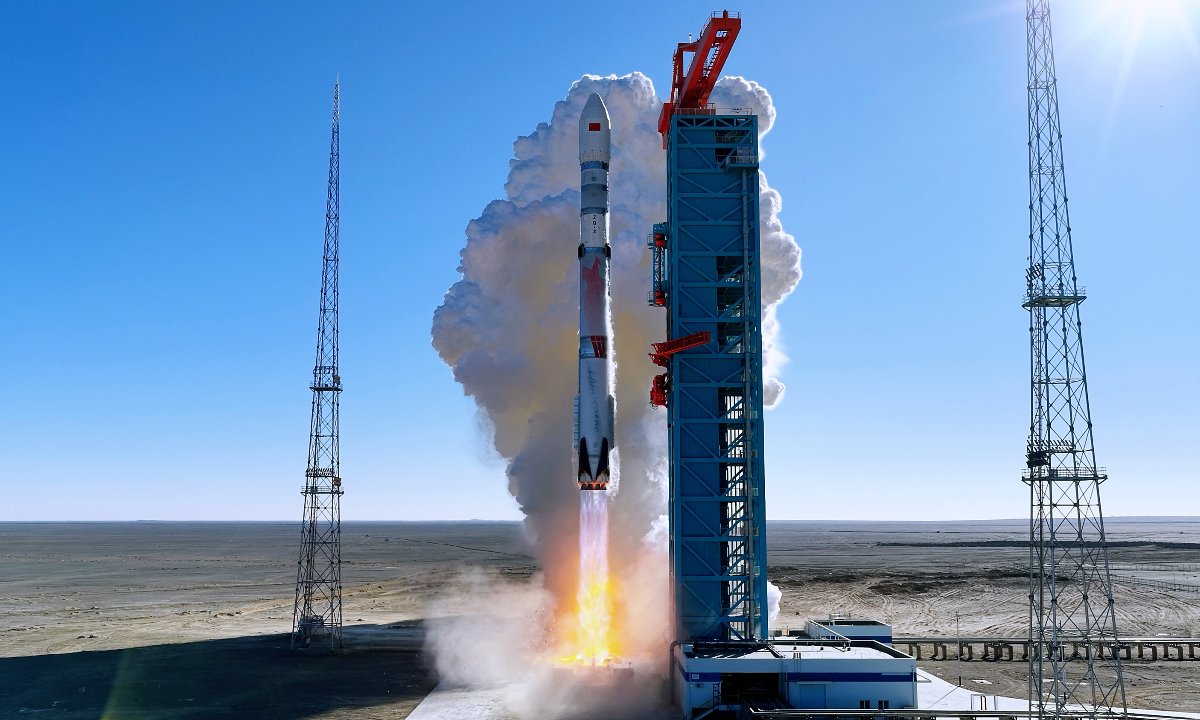
Beijing has pushed its reusable space programme a step further with the launch of an experimental spacecraft that state media described as a technology-verification mission, underlining how the country is trying to cut launch costs, raise flight tempo and broaden the range of missions it can carry out in orbit. The spacecraft was launched on 7 February aboard a Long March-2F rocket from the Jiuquan Satellite Launch Center in northwest China, in what was the fourth publicly disclosed mission of this type since 2020.

Chinese authorities released only a brief account of the flight, saying the spacecraft would verify reusable-spacecraft technologies and support the peaceful use of space. No official duration was given, and no details were provided on the systems being tested, the orbit reached or the vehicle’s configuration. That secrecy has become a hallmark of the programme and makes it difficult to judge exactly how far the technology has advanced, but the pattern of repeated flights suggests a sustained effort rather than a one-off demonstration.

Chronology matters here. China’s first disclosed flight in September 2020 lasted about two days. A second spacecraft launched in August 2022 stayed in orbit for 276 days before landing in May 2023. A third mission, launched in late 2023, returned in September 2024 after 268 days in orbit. Those longer flights point to growing confidence in long-duration autonomous operations, recovery procedures and mission endurance. Outside observers have often compared the craft with the United States’ X-37B-style approach to reusable uncrewed orbital vehicles, though Beijing has not publicly confirmed such comparisons.

This mission also fits into a much wider acceleration in Chinese space activity. On 7 April, China used a Long March-8 rocket from the Hainan commercial launch site to place 18 internet satellites into orbit for the Qianfan constellation. On 11 April, it carried out a sea launch using a Smart Dragon-3 rocket from waters off Guangdong, sending up a test satellite aimed at supporting satellite internet technology. Taken together, those launches show a programme expanding on several fronts at once: reusable vehicles, commercial launch infrastructure and large low-Earth-orbit communications networks.

Beyond low-Earth orbit, China is tying these advances to a broader national space agenda. Beijing is aiming for a crewed lunar landing by 2030 and is developing the Long March-10 rocket, the Mengzhou spacecraft and the Lanyue lunar lander for that effort. At the same time, the Chang’e-7 lunar probe is scheduled for launch in the second half of 2026. That means the reusable-spacecraft programme should be viewed less as an isolated experiment than as one part of an expanding architecture that spans launch systems, spacecraft design, lunar exploration and space-based connectivity.

Money and industrial policy are also shaping the picture. Reuters has reported that Beijing is funnelling more support towards private launch companies as it tries to build capacity for large satellite constellations and reduce reliance on state-owned providers alone. CAS Space has targeted fresh capital for reusable rocket research, while LandSpace and other firms are also turning to capital markets. Separate policy changes have given reusable-rocket developers a faster route to listing, provided they meet technical milestones, showing how closely commercial launch activity is now aligned with national strategic goals.

Yet the programme’s momentum should not be mistaken for mastery. China is advancing, but it is still chasing a lead established by SpaceX in frequent booster recovery and reflight. On 3 April, Space Pioneer said the maiden flight of its Tianlong-3 reusable rocket had failed, and Reuters reported that no Chinese firm had yet demonstrated the ability to recover and reuse a rocket’s main stage. LandSpace plans another recovery test for its Zhuque-3 rocket this year, while the Long March-12B reusable rocket completed a static firing test in January ahead of later flight missions. Progress is visible, but so are the engineering gaps.

A prototype chip developed by engineers at the University of California San Diego has opened a possible new route to cutting energy waste inside data centres, by improving the way power is stepped down for graphics processors that handle artificial intelligence and other high-performance workloads. The team says the design converted 48 volts to 4.8 volts with peak efficiency of 96.2 per cent in laboratory tests, while […]

Kamala Harris has said she is considering another run for the White House in 2028, offering her clearest public signal yet that she may seek a political comeback after losing the 2024 presidential election to Donald Trump. Speaking on Friday at the National Action Network convention in New York, the former vice-president responded to a question from Rev. Al Sharpton by saying, “I might, I might. I’m […]

Enhanced Labs has raised $1 million in a strategic pre-seed round as the decentralised finance startup seeks to widen access to structured yield products built on options and derivatives, moving beyond large crypto tokens towards a broader set of on-chain assets that includes tokenised real-world assets. The round was led by Maximum Frequency Ventures, with GSR, Selini, Flowdesk and angel investors also taking part, according to company […]

Arabian Post Staff -Dubai Saudi Arabia has moved to raise its profile in global data governance after the Saudi Data and Artificial Intelligence Authority, known as SDAIA, said it had joined the Global Privacy Assembly, a forum that links privacy and data protection authorities worldwide. The step puts the Kingdom’s privacy regime more visibly alongside international rule-setting efforts at a time when Riyadh is pushing digital government, […]

Metso has launched a new line of flip-flow screens aimed at one of the harder jobs in minerals processing and aggregates production: separating fine, dry and often moisture-laden material without pushing operators towards water-intensive screening. The Finland-based group said its new GFF Series is designed to improve classification accuracy, lower circulating loads and support more energy-efficient plant performance in both mining and sand manufacturing. The launch, announced […]

VISHNU RAJA
RYO YAMADA
HITORI GOTOH
IKUYO KITA