Arabian Post Staff -Dubai ADNOC has exchanged two strategic collaboration agreements with partners from India, widening Abu Dhabi’s role in crude storage, LPG supply and energy-security planning at a time of volatile shipping routes and rising fuel demand across Asia. The agreements were announced in Abu Dhabi on 15 May 2026 during Prime Minister Narendra Modi’s visit to the UAE, in the presence of President Sheikh Mohamed […]
Prime Minister Narendra Modi arrived in Abu Dhabi on Friday at the start of an official visit that placed energy security, defence cooperation and investment at the centre of one of India’s most closely watched Gulf partnerships.
UAE President Sheikh Mohamed bin Zayed Al Nahyan welcomed Modi on arrival, underscoring the personal diplomacy that has become a defining feature of ties between the two leaders. The visit opened the first leg of Modi’s five-nation tour, which is scheduled to include the Netherlands, Sweden, Norway and Italy between May 15 and 20.
The Abu Dhabi stop carries immediate strategic weight for New Delhi as energy markets remain exposed to geopolitical pressure and supply uncertainty. Discussions between the two sides were centred on long-term energy arrangements, petroleum reserves, liquefied petroleum gas supply and a wider defence framework, reflecting the broadening scope of a relationship once driven largely by trade, remittances and crude oil.
Agreements signed during the visit covered defence cooperation, petroleum reserve collaboration and LPG supply. The defence pact points to a gradual shift in the partnership towards security coordination, technology exchange and maritime stability, particularly as both countries seek to protect trade routes and energy flows across the Arabian Sea, the Gulf and the wider West Asia region.
Energy remains the strongest pillar of the relationship. The UAE is among India’s key suppliers of crude oil and gas, while Abu Dhabi’s state-linked energy companies have already taken part in India’s strategic petroleum reserve programme. New Delhi has been seeking to expand reserve capacity as part of a long-term effort to cushion the economy from global supply shocks, currency pressure and price spikes.
For Abu Dhabi, the visit fits a broader strategy of deepening ties with major Asian economies while positioning the UAE as an energy, finance, logistics and technology hub. The UAE’s investment push into ports, renewable energy, infrastructure, food corridors and financial services has increasingly aligned with India’s priorities in manufacturing, digital infrastructure and supply-chain diversification.
Bilateral trade has grown strongly since the Comprehensive Economic Partnership Agreement came into force in 2022. The pact reduced tariffs on a wide range of goods and helped accelerate commerce in gems and jewellery, petroleum products, food, metals, machinery and services. Both sides have set ambitious targets to lift non-oil trade, while businesses have expanded their use of rupee-dirham settlement mechanisms and cross-border payment links.
The partnership has also moved deeper into technology. Artificial intelligence, digital public infrastructure, data centres, financial technology and advanced computing have emerged as major areas of cooperation, especially after high-level exchanges earlier this year involving Sheikh Mohamed and Abu Dhabi Crown Prince Sheikh Khaled bin Mohamed bin Zayed Al Nahyan. The proposed deployment of advanced computing infrastructure in India, with UAE-linked institutions and companies involved, has reinforced the technology dimension of the relationship.
People-to-people ties remain central to the diplomatic equation. The UAE hosts one of the largest overseas communities from India, with millions working across construction, services, health care, finance, aviation, education and technology. Their remittances and social links have long shaped the political warmth between the two countries, while improved consular services, labour welfare frameworks and easier travel arrangements remain important issues in bilateral engagement.
Modi’s Abu Dhabi visit also follows a sequence of symbolic gestures that have strengthened the public profile of the relationship. Sheikh Mohamed visited India in January this year, while senior members of Abu Dhabi and Dubai’s ruling families have taken part in major diplomatic and technology engagements. Modi’s 2024 visit to the UAE included the inauguration of the BAPS Hindu Mandir in Abu Dhabi, a project presented by both sides as a marker of tolerance and cultural connection.
Arabian Post Staff -Dubai Abu Dhabi’s Jassem Mohamed Bu Ataba Al Zaabi has moved from a largely behind-the-scenes fiscal role into the centre of global dealmaking, taking charge of L’IMAD Holding as the emirate reshapes its sovereign investment network and pushes deeper into infrastructure, technology, finance and strategic industries. Al Zaabi, long associated with the emirate’s Department of Finance and its investment oversight bodies, was named managing […]
Arabian Post Staff -Dubai Several airports operated by Cluster2 Airports have secured higher carbon accreditation from Airports Council International, placing Saudi Arabia’s regional aviation network deeper into the global push to measure, reduce and manage airport emissions. Arar Airport has attained Level 4+ under the Airport Carbon Accreditation programme, one of its highest tiers, while King Abdullah bin Abdulaziz International Airport in Jazan, Najran Airport, Sharurah Airport, […]
Emirates Global Aluminium is pursuing a stake in Sohar Aluminium as the Gulf’s largest aluminium producer seeks a wider regional footprint and greater protection against shipping and production shocks caused by the Iran war. Talks over the Omani smelter have reached an advanced stage, with discussions centred on a possible acquisition of stakes held by existing shareholders. Sohar Aluminium is owned by OQ, Abu Dhabi National Energy […]
Arabian Post Staff -Dubai Abu Dhabi has condemned an attack on an Indian-flagged cargo vessel off Oman, calling it a terrorist act that threatens international navigation, regional stability and the security of vital maritime corridors. The UAE Ministry of Foreign Affairs said the strike represented a dangerous escalation against commercial shipping at a time when the Gulf of Oman and nearby Strait of Hormuz remain central to […]
Arabian Post Staff -Dubai Vista Equity Partners has opened a new Abu Dhabi office within ADGM, giving the global enterprise software investor a regulated base in one of the region’s fastest-growing financial centres as capital flows into technology, private markets and artificial intelligence-linked infrastructure accelerate across the Gulf. VEPM Middle East Limited has secured full authorisation from ADGM’s Financial Services Regulatory Authority, allowing the firm to advise […]
The premier music festival will play host to 16 K-pop, regional and Malaysian stars including, in performance order: Day 1 – NexT1DE, Aina Abdul, Belle Sisoski, Win Metawin, NMIXX, WINNER, DAESUNG, KUN. Day 2 – Uriah See, Firdhaus, Butterbear, 82MAJOR, STAYC, CRAVITY, TWS, CxM
SINGAPORE – Media OutReach Newswire – 14 May 2026 – Your next major K-pop experience is just a savings goal away as HL Bank Singapore (“HLB Singapore”) bridges the gap between financial wellness and the front row. In an exclusive collaboration designed for the ultimate music enthusiast, the bank is offering fans the chance to secure a pair of sought-after AsiaTop Music Festival 2026 tickets, valued at up to RM1,098 (approx. S$355), simply by growing their wealth.
HL Bank Singapore is giving music fans the chance to redeem exclusive passes to the AsiaTop Music Festival 2026, featuring top Asian acts, through its iSavings Reward Campaign.
This unique initiative stems from the regional synergy between Hong Leong Bank (“HLB”) and Tencent Music Entertainment Group (JOOX and QQ Music). By aligning with Visit Malaysia Year and Visit Selangor Year 2026, HLB is transforming the traditional banking experience into a gateway for premium entertainment. Scheduled for 30 and 31 May 2026 at the iconic Sepang International Circuit, the festival promises a high-octane weekend featuring an elite lineup of Asian superstars, including the largest K-pop showcase in the ASEAN region.
Securing a spot at the heart of the action has been streamlined through the iSavings Reward Campaign, running from 9 May 2026 to 18 May 2026. To participate, fans first decide on their preferred festival experience, selecting either a pair of Standard Passes with a S$5,000 deposit or the high-energy, nearer-to-the-stars Rockzone Passes with a S$8,282 deposit for their chosen day.
Once a tier is selected, customers can register by depositing the qualifying funds into an iSavings account via FAST or Links transfer. To validate their entry, customers must include the specific Comment Code, such as PALLIR1 for Day 1 Rockzone, within the funds transfer description. The qualifying balance must be maintained within the account for a six-month (182 days) earmarked period.
With only 88 pairs of tickets available for this exclusive campaign, the stakes are high. Allocation is limited to 22 pairs per day for each ticket category and will be awarded strictly on a first-come, first-served basis. Fans are encouraged to act quickly to ensure their savings work as hard as they do while securing a premier seat at the musical event of the year.
The issuer is solely responsible for the content of this announcement.
HL Bank Singapore
HL Bank Singapore is the Singapore branch of Hong Leong Bank Berhad, a leading digital-centric Malaysia-based financial services institution with a rooted heritage in the country spanning over 120 years. Operating under a Full Bank Licence in Singapore, HL Bank offers a comprehensive range of financial services to our business, retail and high networth customers through our 4 core business segments – Business & Corporate Banking, Personal Financial Services, Private Wealth Management and Global Markets.
New Delhi is weighing a cut in taxes on foreign investment in domestic bonds, a move aimed at drawing deeper global capital into the debt market and easing pressure on the rupee.
The proposal, pushed by the Reserve Bank of India and under examination by the finance ministry, would lower the tax burden on overseas investors earning returns from government and corporate debt. The measure is being considered as policymakers seek to align India’s bond taxation framework more closely with other emerging markets and strengthen the appeal of rupee assets at a time of volatile global capital flows.
Foreign investors currently face tax on coupon income of around 20 per cent, alongside capital gains obligations that vary depending on treaty arrangements and holding periods. A concessional 5 per cent tax rate on interest income had earlier helped attract participation, but that dispensation ended in 2023. Market participants have since argued that the higher tax cost has limited the impact of India’s inclusion in major global bond indices.
The government securities market is valued at about $1.3 trillion, but foreign ownership remains near 3 per cent, far below levels seen in several comparable emerging markets. The gap has persisted despite the phased inclusion of government bonds in widely tracked indices run by JPMorgan and FTSE Russell, and despite the country’s relatively high real yields compared with several Asian peers.
Bond investors have welcomed the direction of policy discussions, though the scale and timing of any tax change remain uncertain. A reduction could improve net returns for overseas funds, especially passive investors whose allocations are guided by benchmark weights. It could also encourage more active managers to increase positions in rupee debt, provided currency risks and settlement procedures remain manageable.
The rupee has been under pressure as foreign investors trimmed exposure to local equities and as global dollar strength affected emerging-market currencies. A deeper foreign bid for bonds could help stabilise capital flows, support reserves management and reduce the cost of government borrowing over time. The benchmark 10-year yield has already reacted to expectations of a friendlier tax regime, moving lower as traders priced in the possibility of stronger inflows.
The debate forms part of a broader effort to make the domestic debt market more accessible. The Reserve Bank has retained foreign portfolio investment limits for the 2026-27 financial year, keeping the cap at 6 per cent for central government securities, 2 per cent for state development loans and 15 per cent for corporate bonds. Available headroom under these limits remains underused, suggesting that tax treatment, liquidity conditions and operational procedures matter as much as formal access.
Policy planners are also focused on the corporate bond market, where deeper foreign participation could help fund infrastructure, green energy, housing finance and private-sector expansion. The country’s corporate debt market remains smaller than its banking system and equity market, leaving companies heavily dependent on bank lending. A more attractive tax framework could draw long-term investors such as pension funds, insurers and sovereign wealth funds, although credit depth and transparency would still need improvement.
Foreign investors have long cited India’s source-based taxation, documentation rules and compliance requirements as barriers to larger allocations. Tax treaties reduce the burden for investors from some jurisdictions, but the framework remains uneven. A clearer and lower withholding structure could reduce uncertainty and help India compete more effectively with Indonesia, Malaysia, Mexico and South Africa, where foreign bond investors often face lighter tax treatment.
The policy choice is not without trade-offs. Lower taxes would reduce immediate revenue from foreign bond income, and a larger foreign presence could make the debt market more sensitive to shifts in global interest rates and risk appetite. Sudden outflows during periods of stress could amplify pressure on the rupee and complicate monetary policy. Authorities are therefore likely to balance market deepening with safeguards designed to prevent destabilising flows.
The fiscal backdrop will also shape the decision. The Centre continues to manage a large borrowing programme while trying to lower the fiscal deficit gradually. A broader foreign investor base could help absorb government debt and keep yields contained, but officials are unlikely to move without assessing revenue costs, treaty implications and the impact on domestic financial institutions.
A commercial vessel anchored off Fujairah has been taken by unauthorised personnel and steered towards Iranian territorial waters, intensifying concern over security at one of the world’s most important maritime chokepoints. The incident was reported 38 nautical miles, about 70 kilometres, north-east of the UAE port of Fujairah, close to the entrance of the Strait of Hormuz. The ship was at anchor when unidentified personnel boarded it […]
Arabian Post Staff -Dubai FUCHS Egypt Lubricants has appointed Dynamic Distribution Co. as its official distributor across Upper Egypt, marking a sharper push by the German-rooted lubricant group to deepen its access to workshops, fleet operators, agricultural users and industrial customers beyond the Cairo-centred supply chain. The partnership gives Dynamic Distribution responsibility for expanding the availability of FUCHS products in a region that includes major commercial corridors […]
China’s search for safer gas supplies has pushed energy to the centre of Xi Jinping’s talks with Donald Trump in Beijing, where the war involving Iran has sharpened pressure on both sides to repair a trade channel that collapsed under tariffs. The discussions come as disruption around the Gulf has unsettled fuel markets, tightened liquefied natural gas flows into Asia and revived the commercial logic of United […]
Cape Town to host continent’s largest energy gathering as focus shifts from aspiration to execution
CAPE TOWN, SOUTH AFRICA – EQS Newswire – 14 May 2026 – The Africa Energy Forum (https://apo-opa.co/4ugdl9y) returns from 16-19 June 2026, bringing together the companies, investors and governments driving Africa’s move from energy access to industrial-scale infrastructure.
The companies gathering in Cape Town are deploying capital into transmission infrastructure, building mining corridors that will define trade routes for decades, financing baseload capacity that can power heavy industry, and developing renewable projects that will anchor Africa’s manufacturing future. Forum Sponsor Sun Africa leads a group of sponsors whose projects and investments are already shaping how the continent builds its industrial base.
“I am looking forward to joining the conversation in Cape Town this June. What excites me about this year’s Summit is the calibre of capital and commitment in the room — companies that are financing baseload capacity for heavy industry, building mining corridors that will define trade routes for decades, and deploying renewable projects that will anchor Africa’s manufacturing future. That is the kind of long-term, structural thinking that Sun Africa has always believed this continent deserves, and it is exactly the conversation we need to be having.” Sun Africa, CEO, Adam Cortese.
ACWA Power, Infinity Power and AMEA Power are building gigawatt-scale renewable capacity across the continent. Globeleq and TotalEnergies are financing and operating projects that demonstrate how private capital can deliver industrial-grade infrastructure. British International Investment and IFC are structuring deals that blend concessional and commercial finance to unlock sovereign wealth fund participation. Nedbank CIB is providing the sustainable finance structures that allow projects to reach financial close.
“As Africa moves from aspiration to execution, this year’s agenda focuses on the hardware of industrialisation – the steel, concrete and transmission lines that will define Africa’s industrial future,” said Simon Gosling, Managing Director of EnergyNet.
The companies driving this shift face common challenges: structuring bankable projects where perceived risk exceeds actual performance, moving critical minerals from extraction to processing, building transmission corridors that serve both mines and cities, and deploying patient capital into long-term infrastructure.
Cape Town provides the right setting. South Africa is navigating private transmission investment, energy trading, mining-driven renewable deployment, and tensions between industrial growth and climate commitments – challenges the rest of the continent will face. The city’s reforms offer a live case study.
The agenda reflects where these companies are focusing their resources. Critical minerals receive a two-day dedicated stream exploring downstream processing, transport corridors and value capture from reserves representing over 30% of global supply. Sessions examine the Lobito Corridor, Liberty Corridor and Simandou infrastructure as models for large-scale project finance.
Transmission and baseload themes address grid expansion, private investment structures and 24/7 availability for data centres and manufacturing. Energy trading sessions explore how sponsors are transforming project finance through creditworthy off-take, whole technology discussions will cover AI for revenue protection, data centre supply chains and CBAM compliance.
More broadly, the forum structure supports deal-making. The speaker programme includes closed-door roundtables bringing together DFIs, sovereign wealth funds, Middle East ministers, utilities, regulators and the private sector for frank discussions on capital deployment.
This will bring together senior public and private sector leadership, with notable speakers including H.E. Honourable Dr. Kgosientsho Ramokgopa, Minister of Electricity & Energy, South Africa; H.E. Honourable Samantha Graham-Marè, Deputy Minister of Electricity & Energy, South Africa; Dan Marokane, GCE, Eskom, South Africa; H.E. Honourable Jeremiah Kpan Koung, Vice President, Liberia; H.E. Honourable Dr. Kgosientsho Ramokgopa, Minister of Electricity & Energy, South Africa; H.E. Honourable Lerato Mataboge, African Union Commissioner for Infrastructure and Energy; Precious Edward, Head, IPP Office, South Africa; Obaïd Amrane, CEO, Ithmar Capital, Morocco, Chair, Africa Sovereign Investors Forum (ASIF) & Chair, International Forum of Sovereign Wealth Funds (IFSWF); Mike Teke, Group CEO, Seriti Resources; and Jonathan Hoffman, CEO, Globeleq.
Regional fireside chats, meanwhile, will spotlight opportunities across North, East, South and West Africa. Day One features ministerial sessions with participation from Sierra Leone’s Ministry of Energy and The Gambia’s Ministry of Environment, Climate Change & Natural Resources.
Additional sponsors driving the programme include AKSA as Exhibitor Sponsor, with lead sponsor support from Synergy Consulting, ATIDI, Engie, European Investment Bank, Standard Bank, Red Rocket, USP&E Global and Sungrow.
On the final day, YES! (Youth Energy Summit) takes place as part of the aef stream under the theme ‘Empowering Today’s Entrepreneurs – Building Tomorrow’s Industrialists’. Here, impact leaders will present scalable initiatives creating entrepreneurship opportunities in Africa’s energy sector, while industry partners lead interactive workshops building practical skills for 600 young people in attendance.
Distributed by APO Group on behalf of EnergyNet Ltd..
Kyiv came under a large Russian missile and drone attack before dawn on Thursday, leaving at least one person dead, dozens wounded and rescuers searching through the ruins of a damaged residential building where residents were feared trapped. Explosions shook several districts of the Ukrainian capital during an air raid alert that lasted more than four hours, as air defences attempted to intercept a mixed barrage of […]
Seoul apartment prices accelerated at their fastest weekly pace in more than three months, sharpening the policy dilemma facing the Bank of Korea as stronger housing demand, firm rental costs and hotter inflation narrow the case for near-term monetary easing.
Apartment prices in the capital rose 0.28 per cent in the week through May 11, up from 0.15 per cent a week earlier, marking the steepest gain since late January. The increase extended Seoul’s run of weekly advances to 67 weeks, while nationwide apartment prices rose 0.06 per cent, underscoring a widening gap between the capital and the rest of the country. All 25 districts in Seoul posted gains, with Gangnam returning to positive territory after a 12-week decline and jeonse prices also climbing 0.28 per cent.
The renewed strength has added pressure on policymakers before the Bank of Korea’s May 28 rate-setting meeting, the first under Governor Shin Hyun-song. The central bank held its base rate at 2.50 per cent in April, citing rising inflation pressures, weaker growth risks and financial-market volatility linked to the Middle East conflict. Shin has signalled that policy will remain cautious and flexible, with price stability and financial stability both central to the bank’s calculations.
Housing is becoming a harder constraint for monetary policy because Seoul’s property market has moved in the opposite direction from the broader economy. Growth has been facing pressure from external demand uncertainty, higher energy costs and weaker household spending, yet the capital’s housing market continues to draw buyers who expect limited supply and further rental increases. That combination reduces the room for rate cuts, as easier financial conditions could feed more leverage into an already expensive market.
Consumer inflation reached 2.6 per cent in April, the highest reading since July 2024, after rising from 2.2 per cent in March. Transport costs, housing and utilities were among the categories adding pressure, while oil-linked effects from the Middle East conflict have complicated the central bank’s effort to bring inflation back towards its 2 per cent target. A departing board member, previously seen as dovish, warned this week that inflation control should remain the bank’s priority even at the cost of weaker growth.
The property upturn is also being reinforced by South Korea’s jeonse system, under which tenants provide large lump-sum deposits instead of monthly rent. Tight supply of rental homes and rising jeonse costs have encouraged some households to shift towards buying, particularly in Seoul districts where demand remains resilient despite lending controls. Housing rental prices have been moving higher since early 2024, and rent carries significant weight within services inflation, making it a sensitive issue for both the central bank and fiscal authorities.
Government measures have so far produced uneven results. Authorities tightened trading rules in wealthy Seoul districts last year, including Gangnam, Seocho, Songpa and Yongsan, after speculation returned quickly when permit requirements were eased. They also moved to fast-track housing supply in the capital region, where limited available land and slow redevelopment approvals have kept pressure on prices. Apartment prices in Seoul climbed nearly 9 per cent in 2025 despite those interventions, leaving policymakers wary that demand-side restrictions alone may not be enough.
The latest move comes after a brief moderation linked partly to tax policy expectations. Earlier this year, the central bank said price increases in Seoul and surrounding areas had slowed under the government’s plan to end the temporary suspension of higher capital gains taxes on multiple-home owners. The rebound in May suggests buyers may be adapting to policy changes rather than retreating, particularly in areas where expectations of long-term scarcity remain strong.
Financial stability concerns remain central because household debt is closely tied to housing prices. South Korea’s mortgage market has long made the property cycle a major channel for monetary policy, and a renewed rise in Seoul apartments could encourage more borrowing at a time when real incomes remain under pressure. A stronger won and improved equity sentiment linked to semiconductor demand may ease some external strains, but they also add complexity by supporting domestic confidence.
Fiscal policy is moving in a more expansionary direction, supported by strong tax revenue from the artificial intelligence and semiconductor cycle. Fitch has said South Korea has room for active spending because chip-sector strength has improved the revenue outlook, while monetary policy may need to stay restrictive because of inflation risks. That divergence places greater responsibility on the central bank to prevent housing and price pressures from becoming embedded.
Arabian Post Staff -Dubai Zimbabwe’s export map is shifting sharply towards the Gulf, with the United Arab Emirates emerging as the country’s largest overseas market as trade, minerals sales and investment talks deepen between Harare and Dubai. Bilateral trade reached about US$4.1 billion last year, driven mainly by mineral exports and reinforced by a new pipeline of investment discussions covering mining, renewable energy, manufacturing, agriculture and logistics. […]
Iran-linked cyber-espionage operators have used trusted, digitally signed software components to breach organisations across four continents, widening concerns over state-backed campaigns that hide inside legitimate enterprise tools. Seedworm, also tracked as MuddyWater, Temp Zagros, Static Kitten and Mango Sandstorm, has been linked to intrusions affecting at least nine organisations in early 2026. The victims included a major South Korean electronics manufacturer, public-sector bodies, an international airport in […]
Arabian Post Staff -Dubai Tehran has offered to restore wider commercial access through the Strait of Hormuz if Washington ends its naval blockade of Iran’s ports, releases frozen funds and eases long-standing sanctions, marking a conditional diplomatic opening after weeks of war that have disrupted energy flows and shipping across the Gulf. Kazem Gharibabadi, Iran’s deputy foreign minister, said Tehran was prepared to reopen the waterway but […]
South Africa’s rand firmed in early Wednesday trade as investors turned their attention to Beijing, where talks between U. S. President Donald Trump and China’s President Xi Jinping were expected to influence appetite for emerging-market assets, commodities and risk-sensitive currencies. By 0749 GMT, the rand was trading at 16.4517 against the dollar, about 0.4% stronger than its previous close. The move followed a weaker session on Tuesday, […]
South Africa’s retailers are paying a widening price for weak security systems, with losses now extending beyond stolen stock to staff safety, customer confidence, delivery costs, insurance premiums and already thin operating margins. Shrinkage has become a boardroom issue rather than a store-level irritation. Retailers are dealing with shoplifting, employee theft, fraud, vandalism, armed robberies, cyber intrusions and organised syndicates that target goods with established resale value. […]
Arabian Post Staff -Dubai Abu Dhabi’s arbitration centre has recorded a 38 per cent rise in cases between its first and second years of operation, signalling stronger business reliance on the emirate’s formal dispute resolution framework as cross-border commerce expands. The Abu Dhabi International Arbitration Centre, known as arbitrateAD, has administered 105 matters since it began accepting cases in February 2024. The growth was disclosed in its […]
EVelution Energy has moved closer to anchoring a domestic US cobalt supply chain after signing a memorandum of understanding with Democratic Republic of Congo’s state cobalt buyer and Trafigura for long-term shipments of cobalt hydroxide to its planned Arizona refinery. The agreement brings together EVelution Energy, Entreprise Générale du Cobalt and Trafigura in a framework that could channel Congolese cobalt to the United States for processing into […]
Set opposite Ben Thanh Market, One Central Saigon is a landmark mixed-use destination where luxury living, hospitality, retail and business converge at the centre of Ho Chi Minh City. The project also marks The Ritz-Carlton hotel brand’s debut in Vietnam, alongside The Ritz-Carlton Residences, Saigon, Grade A+ offices, curated retail, services and fine dining.
HO CHI MINH CITY, VIETNAM – Media OutReach Newswire – 13 May 2026 – Masterise Homes, a member of Masterise Group, has officially launched One Central Saigon, Vietnam’s first mixed-use landmark destination, marking the arrival of a new address where international standards of living, hospitality, retail, business and services come together in Ho Chi Minh City.
One Central Saigon brings together The Ritz-Carlton, Saigon, The Ritz-Carlton Residences, Saigon, Grade A+ offices, curated retail, dining and lifestyle experiences in central Ho Chi Minh City.
The launch event was attended by representatives of Ho Chi Minh City government authorities, senior leaders from Masterise Group, Masterise Homes and Marriott International, as well as leading experts in real estate, economics and tourism.
Over the past decade, the centre of gravity of the global economy has shifted decisively towards Asia, with Vietnam emerging as one of the region’s most compelling growth stories. Ho Chi Minh City, the country’s economic engine, is entering a new phase of development as a dynamic, deeply connected metropolis.
Around the world, certain developments have helped shape how cities are recognised internationally, from Hong Kong’s IFC and Singapore’s Marina Bay Sands to Kuala Lumpur’s Petronas Twin Towers and Dubai’s Burj Khalifa. These projects did more than create striking skylines. They helped shape how the world sees their cities and countries. One Central Saigon is positioned within this tradition of city-shaping developments, with a vision that combines international standards, Vietnamese identity and long-term urban value.
“We believe Vietnam has reached the moment where it is ready for a development of the calibre of One Central Saigon,” said Ms Nguyen Thi Minh Phuong, Managing Director, Southern Region, Masterise Group. “The project has been present in Ho Chi Minh City for some time and has passed through several phases of development. Today, it is being introduced with a clearer vision. With a sense of responsibility to contribute to the nation’s development journey in a new era, Masterise Group aspires to continue building an iconic landmark where the world’s highest experiential standards converge with the identity, energy and ambition of the city. This is also how we contribute to projecting the image of a modern, confident and culturally rich Vietnam onto the international stage.”
A rare address in the city’s historic core For more than a century, Ben Thanh Market has been one of Ho Chi Minh City’s great urban constants: a place of trade, arrival and encounter, and one of the few landmarks instantly recognised across Vietnam and beyond.
Its clock tower, market halls and surrounding streets are woven into the city’s daily rhythm and public memory, giving the area a significance that extends far beyond location. Set directly opposite the market, with four rare frontages along Pham Ngu Lao, Calmette, Le Thi Hong Gam and Pho Duc Chinh streets in the former District 1, One Central Saigon holds one of the city’s most strategic locations and shares a unique connection with Ho Chi Minh City’s historic urban core.
One Central Saigon will rise as two towers above a retail and commercial podium on an 8,537 sqm site, with 19,990 sqm of commercial space across seven above-ground levels and six basement floors. The retail centre is envisioned as a destination for luxury retail, curated services and fine dining, with brands and experiences selected for both international appeal and the evolving needs of Vietnamese customers. Its basement levels will connect directly to Ben Thanh Metro Station via an underground link, integrating the project with the city’s public transit network.
Together with Grade A+ offices, The Ritz-Carlton, Saigon and The Ritz-Carlton Residences, Saigon, the development forms a seamless mixed-use ecosystem for luxury living, hospitality, retail, business, services and lifestyle experiences at the centre of Ho Chi Minh City.
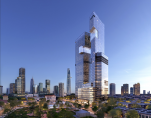
Song Long Ngậm Ngọc: Vietnamese symbolism, global expertise The architecture of One Central Saigon is inspired by Song Long Ngậm Ngọc, or Twin Dragons Playing with a Pearl, a Vietnamese cultural motif associated with strength, prosperity and wisdom. The two towers rise and converge around a central point, creating a contemporary architectural expression of Vietnamese identity within the Ben Thanh district.
Among the tallest twin towers in Vietnam and the region, One Central Saigon is a structurally complex undertaking that requires significant investment, precision, and attention at every stage of execution. The project brings together an international design and construction team, including Arquitectonica as design architect, HBA for interior design, B+H, a member of Surbana Jurong Group, as executive architect, and Turner for project management.
International operational standards add another defining layer of value to One Central Saigon. With more than a century of heritage in luxury hospitality, The Ritz-Carlton brings refinement, attention to detail, privacy and highly personalised service to the project’s ultra-luxury positioning.
The Ritz-Carlton Residences, Saigon opens a new chapter in ultra-luxury living, while The Ritz-Carlton, Saigon marks the hotel brand’s debut in Vietnam, reflecting Ho Chi Minh City’s growing appeal to international travellers, investors, entrepreneurs and high-net-worth individuals.
The Grade A+ office component is designed for global corporations and forward-thinking business leaders seeking a workplace within a 5-star international ecosystem. Vietnam’s luxury momentum accelerates The launch comes as Vietnam continues to attract global capital, international brands and a rising generation of high-net-worth consumers. Official data showed real GDP growth of 8.02% in 2025, up from 7.09%, while foreign direct investment reached a record US$27.62 billion.
Tourism is adding further momentum. Vietnam welcomed nearly 21.2 million international visitors in 2025, its strongest year for inbound tourism, while Ho Chi Minh City received nearly 8.6 million international visitors, up 40.3% year on year.
Branded residences are following the same trajectory. Savills reports that branded residences in Asia Pacific increased by 55% over the past five years, while C9 Hotelworks’ Asia Branded Residences Market Review 2025 points to Vietnam as one of the region’s most important future supply markets.
For Masterise Group, One Central Saigon extends an international branded real estate portfolio that includes Grand Marina, Saigon, featuring Marriott and JW Marriott-branded residences, and The Ritz-Carlton Residences, Hanoi at The Grand. It also gives Vietnam’s ultra-luxury real estate growth story tangible form beside one of Ho Chi Minh City’s most prized historical sites.
As the city enters a new phase of development, expanding in both scale and quality, thoughtfully planned and professionally operated integrated developments such as One Central Saigon are expected to enrich the city’s tourism, services and urban experience ecosystem. The project is positioned to create lasting value for the community and elevate the standing of Ho Chi Minh City and Vietnam on the international stage. Hashtag: #MasteriseGroup
The issuer is solely responsible for the content of this announcement.
About Masterise Group
Masterise Group is an international real estate development group, pioneering a comprehensive ecosystem spanning residential and hospitality developments, as well as urban infrastructure and logistics. Founded in 2007 as Thao Dien Investment and officially rebranded as Masterise Group in 2019, Masterise Group sees real estate as more than buildings; it is the foundation for a nation’s future, providing infrastructure for connection, momentum for progress, elevated living and generational legacy. With a long-term vision, Masterise Group continuously pushes boundaries, creates sustainable value, elevates quality of life and contributes to strengthening Vietnam’s new era of growth and global ambition.
Masterise Homes is a member of Masterise Group and manages and develops all of the group’s residential real estate brands. As Vietnam’s pioneer in branded real estate development, Masterise Homes’ mission goes beyond delivering architectural landmarks with refined design and integrated amenities. Masterise Homes strives to craft comprehensive living spaces where residents experience a standard of living that goes beyond the basic function of a home.
Mubadala Investment Company has committed $325 million to Ørsted’s Hornsea 3 offshore wind project, deepening Abu Dhabi’s exposure to large-scale renewable infrastructure as institutional capital moves into one of Britain’s most important clean-energy developments. The investment places Mubadala alongside a consortium led by funds managed by Apollo Global Management, with Universities Superannuation Scheme and La Caisse also participating. The consortium is backing a 50 per cent stake […]






 https://masterisegroup.com/en




