

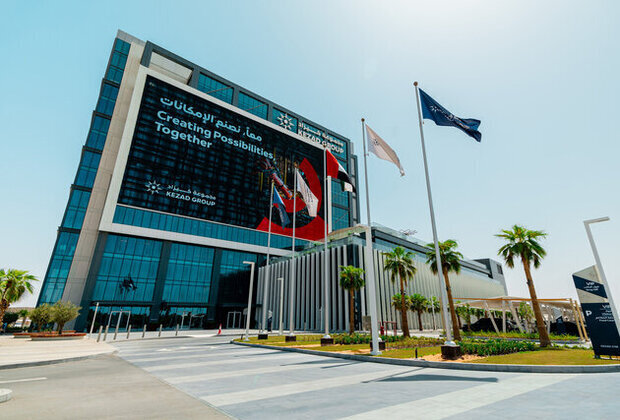
Khalifa Economic Zones Abu Dhabi has secured five new industrial and logistics projects worth AED147 million across Al Ain and Abu Dhabi, adding more than 84,000 square metres of development space and an estimated 500 jobs as the emirate presses ahead with its manufacturing and supply-chain expansion plans.
Four of the projects are earmarked for KEZAD Al Ain, where they account for just over 37,400 square metres, AED47 million in investment and about 200 jobs. The fifth and largest scheme will be built at KEZAD Al Ma’mourah in Abu Dhabi, covering more than 46,500 square metres with AED100 million in investment and an expected 300 jobs. The pipeline underlines Abu Dhabi’s effort to spread industrial activity beyond the capital’s core logistics corridors while deepening activity in sectors tied to manufacturing, chemicals and warehousing.
The projects span oilfield chemicals, metal processing, consumer manufacturing and logistics infrastructure. According to the company’s announcement and matching local reports, Haber/Elixir will establish an oilfield chemicals blending facility, Grand Line Industries will set up a car-cleaning products plant, and Precent Enterprises Metals Coating will develop a metal forming and coating facility. Unibal Group Investment is moving ahead with what KEZAD described as its second industrial and logistics warehousing project in Abu Dhabi and its first in KEZAD Al Ain, branded Unibal Park II, while Al Lul Transport & General Contracting will develop a large warehousing and industrial logistics project at Al Ma’mourah.
Abdullah Al Hameli, chief executive of Economic Cities and Free Zones at AD Ports Group, said the new agreements reflected steady demand for industrial and logistics assets linked to “real economic activity” in Abu Dhabi. He said the scale of investment, the spread of sectors involved and the number of jobs attached to the projects would strengthen the emirate’s industrial base by adding production and warehousing capacity across the wider trade ecosystem.
The investment is modest by the standards of mega industrial developments in the Gulf, yet it carries weight because it broadens the tenant mix rather than relying on a single flagship deal. That matters for Abu Dhabi’s industrial strategy, which has increasingly focused on building clusters that can absorb manufacturers of different sizes, support localisation of supply chains and make room for logistics operators serving both domestic and export markets. The Al Ain component is especially notable because it signals a push to anchor more industrial activity inland, away from the coastal port belt, while still linking it to the emirate’s wider freight and trade network.
The timing also fits a stronger growth story for KEZAD and its parent group. KEZAD said the new agreements build on momentum from 2025, when it reached 73.6 square kilometres of leased land and recorded 3.3 square kilometres of net new land leases, with 67 per cent of total leases tied to industrial and manufacturing activity. AD Ports Group reported that its Economic Cities and Free Zones cluster generated AED2.87 billion in revenue in 2025, up 45 per cent year on year, helped by rising warehouse income and continued land-lease activity.
Those figures point to a broader pattern in Abu Dhabi’s development model. Industrial zones are being used not only as real-estate platforms but as policy tools to attract manufacturing capacity, warehouse demand and sector-specific ecosystems. KEZAD has been expanding specialised offerings across metals, automotive, food and agri-industrial segments, giving investors access to infrastructure that is already connected to ports, roads and export channels. That plug-and-play model has become more valuable as companies seek shorter delivery routes, more resilient regional supply chains and lower set-up times.
Another point of interest is the composition of the new tenants. Oilfield chemicals and metal coating tie into the Gulf’s enduring demand for industrial inputs, while car-care products and logistics warehousing suggest confidence in consumer-linked and distribution-led activity. Such a mix reduces dependence on one cycle or one end-market. It also shows that Abu Dhabi’s industrial zones are courting medium-scale operators that can generate employment and steady occupancy rather than only chasing headline-grabbing capital commitments.
For Al Ain, the announcement adds to a longer-running policy aim of broadening the city’s economic base. More factory and warehouse space can help position it as a secondary industrial hub with lower land intensity than coastal areas and with room for future scaling. For Abu Dhabi, the larger Al Ma’mourah project reinforces the value of logistics-oriented sites that can absorb warehousing demand as trade volumes and industrial throughput continue to rise.
Follow Arabian Post
Select Arabian Post as your preferred source on Google and MSN News for trusted business news and Arab politics and updates.




