News related to
Expansion

Ripple’s partnership with Convera has pushed the crypto company further into mainstream cross-border finance, linking its blockchain infrastructure with a commercial payments group that serves businesses across more than 140 currencies and 200-plus countries and territories. Announced on March 31, the deal is designed to let corporate customers move money across borders more quickly by using stablecoins as settlement rails while keeping the customer-facing transaction anchored in […]

Ingdan Posts Landmark Full-Year Results with 50.1% Revenue Growth, Backed by Robust AI Chip Demand and Expanding Proprietary Product Portfolio

Highlights of the Annual Results for the Year Ended December 31, 2025:

  • Robust Revenue Growth: Group revenue surged by 50.1% year-on-year to RMB15,206.7 million, driven by heightened demand for AI computing power and a strategic expansion into high-growth AI application markets.
  • Strong Profitability: Gross profit increased by 24.1% to RMB1,104.2 million. Net profit was approximately RMB310.2 million, up 13.4%; profit attributable to equity shareholders of the Company grew by a robust 13.1% to RMB214.8 million, demonstrating effective monetization of its platform and operational efficiency.
  • Building on the substantial investments made in large-scale AI computing power and proprietary products in 2025, the Company is confident that its revenue growth trajectory will accelerate in 2026.

HONG KONG SAR – Media OutReach Newswire – 1 April 2026 – Ingdan, Inc. (“Ingdan” or the “Company,” Stock Code: 400.HK; together with its subsidiaries, the “Group”), an innovative technology services platform group, today announced its audited consolidated results for the year ended December 31, 2025 (“2025” or “the Year”). The results reflect a landmark year of performance, further cementing the Company’s position at the core of the AI industry value chain. The Group serves as an ecosystem services platform anchored in AI chips, with a strategic focus on AI computing power centers and AI smart terminals. The Company is dedicated to building an AI industry connector with broad industrial linkages. Its core positioning is to bridge upstream AI chip technology with the needs of downstream innovation enterprises. The Group has established deep partnerships with world-leading chip manufacturers including NVIDIA, Xilinx, Intel, AMD, and SanDisk. Leveraging chip distribution as its gateway, the Group provides customers with an integrated, full-chain service covering technology solutions, supply chain services, technical training, and after-sales operation and maintenance — connecting the ecosystem service chain from chip supply to end-application deployment, and empowering the industrialization of AI technology.

2025 Full Year Financial Highlights

Benefiting from continued robust AI computing power demand and a significant uptick in chip requirements across AI technology-related industries, the Group’s revenue for the year reached approximately RMB15,206.7 million, comprising 62.6% from technology solutions, 37.0% from distribution business, and 0.4% from proprietary products — representing a year-on-year increase of approximately 50.1% from RMB10,129.1 million in 2024. The Group’s gross profit was approximately RMB1,104.2 million, up 24.1% year-on-year. Operating profit was approximately RMB532.4 million, up 24.4% year-on-year. Net profit after tax was approximately RMB310.2 million, up 13.4% year-on-year. Profit attributable to equity shareholders of the Company was approximately RMB214.8 million, up 13.1% year-on-year.

As at December 31, 2025, the Group’s cash and bank balances (including pledged deposits) amounted to RMB1,264.3 million, bank loans stood at RMB2,628.0 million. The total number of issued ordinary shares was 1,644,262,732 shares, with basic weighted average shares of 1,582,928,000 shares.

Deepening AI Computing Power Supply Chain: Comtech Continuously Empowering Industry Innovation

In the current strategic growth phase of the global semiconductor industry, the synergistic evolution of AI, cloud computing, and IoT technologies — combined with breakthroughs in humanoid robotics — is driving exponential growth in global computing power demand. This trend is not only spurring iterative demand for high-performance computing chips such as GPUs and ASICs, but also accelerating technological upgrades across the entire industry chain, including high-speed storage chips and intelligent networking equipment.

Against this backdrop, the Group’s core business unit, Comtech (“Comtech”) — a technology services platform for the chip industry — serves as a core supplier in the AI computing power supply chain, and is deeply engaged in the development of global computing power networks, with its service coverage spanning data centers, AI servers, AI switches, optical modules, and a wide range of AI application sectors. Comtech collaborates closely with leading global chip manufacturers, acting as an authorized distributor for over 80 core suppliers, including NVIDIA, Xilinx, Intel, AMD, and SanDisk, and many leading domestic chipmakers.

Leveraging years of deep market expertise, Comtech has accumulated extensive technical experience and industrial resources, enabling it to provide chip application solutions and supply chain management services to tens of thousands of downstream clients. Utilizing proprietary AI technologies, large language models (LLMs), and specialized knowledge bases, Comtech delivers intelligent and automated solutions in chip selection, hardware design, software development, and system integration, significantly enhancing product performance and reliability.

Comtech’s proprietary product line is entering a new era of AI acceleration. The Company holds multiple proprietary intellectual property rights in AI chip applications and intelligent supply chain, including an intelligent algorithm library, industry-specific large language models, an intelligent hardware design platform, an adaptive system architecture, and a broad portfolio of innovative technology patents. Its subsidiary, Kepler Lab, has successfully developed SOM-level proprietary products based on core chips including NVIDIA Jetson and Xilinx FPGA. Benchmarked against international advanced standards, these domestically developed AI edge computing products have achieved mass shipments to customers including customs authorities and banks, and are being actively expanded into emerging sectors such as robotics, medical devices, and autonomous driving. With high gross margins and a customer base that naturally overlaps with the Company’s traditional distribution business, this proprietary product line is poised to establish a second growth curve — marking the Company’s strategic transformation from a supply chain service provider to a technology value-added service provider, and opening compelling new possibilities for the Group’s long-term value creation.

As at December 31, 2025, Comtech’s adjusted distribution cost (“ADC”) inventory amounted to approximately RMB772.0 million. For the year ended December 31, 2025, ADC inventory turnover for Comtech was approximately 21 days.

Ingdan Technology Accelerates Strategic Positioning: AI Servers and Talent Development Advancing in Tandem

AI Computing Center Business: Precisely Capturing Domestic Computing Power Demand

In view of accelerating global AI technological advancement and sustained growth in domestic computing power demand, universities, medical schools, and research institutions have an increasingly urgent need for self-controllable, high-performance AI computing power. The Group’s intelligent computing power technology and services platform Ingdan Technology (“Ingdan Technology”), is capitalizing on the import-substitution opportunity by strategically deploying its AI server business and making large-scale investments in AIDC (AI Data Center) computing power center operations and proprietary product development.

Through deep collaboration with Huawei and leveraging the Ascend 910 chip, Ingdan Technology has launched the DeepSeek all-in-one workstation to precisely address the core computing power needs of scientific researchers. The DeepSeek all-in-one workstation features stable computing performance, robust data security, and full technological autonomy — achieving a distinctive competitive advantage through the combination of leading manufacturer endorsement and customized services.

Ingdan Academy: Talent Development Surges More Than Fourfold, Supporting National Semiconductor Strategy

Leveraging the Group’s extensive resources and technological expertise in the chip industry, Ingdan Academy introduces world-leading chip application technologies and is dedicated to developing talent in chip application and AI. To date, Ingdan Academy has cumulatively trained over 9,000 chip application engineers — surpassing the previous milestone of 2,000 by more than fourfold — serving over 1,200 enterprises and supplying a large number of high-quality professionals to the chip and AI industries. Through continuous talent training and technical support, Ingdan Academy is working to help Shenzhen become a global center for chip application and AI, contributing to the development of the nation’s semiconductor industry.

Chief Executive Officer’s Outlook

Mr. Jeffrey Kang, Chairmanand CEO of Ingdan, Inc., commented: “2025 has been a year of profound milestone significance in the Company’s development journey. Building on the substantial investments made in large-scale AI computing power and proprietary products throughout 2025, we are confident that our revenue growth trajectory will accelerate in 2026.The astonishing growth in AI computing power demand has fully validated the Group’s forward-looking strategic positioning across the AI chip application value chain.Looking ahead, we anticipate significant performance improvement driven by robust and sustained growth in demand for AI chips, GPUs, and storage networking chips. Supported by a robust bank financing framework, we expect sales to major customers to grow substantially — injecting powerful momentum into the Group’s exceptional performance growth in 2026 and laying a solid foundation.

We are full of confidence in the Group’s future development, and we extend our sincere gratitude to every shareholder, customer, and business partner for their continued trust and support.”

Cautionary Statement

The information contained herein has not been independently verified. No representation, warranty or undertaking, express or implied, is made as to, and no reliance should be placed on, the fairness, accuracy, completeness or correctness of the information or the opinions contained herein by the Company or any of its affiliates, advisers or representatives. The information contained herein should be considered in the context of the circumstances prevailing at the time and is subject to change without notice. The Company does not undertake to update the information contained herein to reflect events or circumstances occurring after the date hereof.

This document is not intended to provide, and you should not rely upon it for, a complete or comprehensive analysis of the Company’s financial or operating condition or prospects. Neither the Company nor any of its affiliates, advisers or representatives shall have any liability whatsoever (in negligence or otherwise) for any loss howsoever arising from any use of this document or its contents or otherwise arising in connection therewith.

This document may contain forward-looking statements that reflect the Company’s current intentions, beliefs and expectations regarding future events as of the dates indicated herein. Such forward-looking statements are not guarantees of future performance and are based on numerous assumptions regarding the Company’s present and future business strategies and the environment in which the Company will operate in the future, and are subject to significant risks and uncertainties. In light of these risks, uncertainties and assumptions, actual results may differ materially from those expressed or implied by such forward-looking statements. The Company and its affiliates, advisers and representatives undertake no obligation and make no commitment to update any forward-looking statements to reflect events or circumstances occurring after the relevant date.

Hashtag: #Comtech #Ingdan #AI #IC #Chips #humanoid #Intel #AMD #Sandisk #NVIDIA #Tech #RevenueGrowth #TechGrowth #AIInvestment #ProprietaryProducts #KeplerLab #Comtech #IngdanTechnology #IngdanAcademy #AIAcceleration #TechTransformation

The issuer is solely responsible for the content of this announcement.

About Ingdan, Inc.

Ingdan, Inc. (Stock Code: 400.HK) is an ecosystem services platform anchored in AI chips, with a strategic focus on AI computing power centers and AI smart terminals. The Company is dedicated to building an AI industry connector with broad industrial linkages. Its core positioning is to bridge upstream AI chip technology with the needs of downstream innovation enterprises. Leveraging chip distribution as its gateway, the Company provides customers with an integrated, full-chain service covering technology solutions, supply chain services, technical training, and after-sales operation and maintenance — connecting the ecosystem service chain from chip supply to end-application deployment, and empowering the industrialization of AI technology.

Headquartered in Shenzhen, the Group operates offices and branches across major cities in China, including Hong Kong, Shanghai, Beijing, Wuhan, Chengdu, Nanjing, Hangzhou, and Xi’an, as well as representative offices in Singapore and Japan. The Group’s core businesses are Comtech — a technology services platform for the chip industry; and Ingdan Technology — a platform providing intelligent computing power technology and services.

For further information, please refer to the Company’s website at www.ingdangroup.com

Federal prosecutors have charged a Maryland man with carrying out two 2021 attacks on Uranium Finance that drained more than $53 million from the decentralised crypto exchange, a case that is drawing fresh attention to long-running weaknesses in decentralised finance and to the growing ability of authorities to follow money through blockchain networks. The accused, Jonathan Spalletta, 36, of Rockville, Maryland, surrendered on March 30 after an […]

Arabian Post Staff -Dubai   Emirates NBD Group has closed $2.25 billion in long-term financing, in a deal that ranks among the largest syndicated borrowings in the Gulf and underscores the lender’s ability to attract offshore funding even as markets navigate geopolitical tension and higher funding costs. The package comprises a $1.75 billion five-year sustainability-linked syndicated term loan and a $500 million five-year club commodity murabaha facility. […]

SHENZHEN, CHINA – Media OutReach Newswire – 31 March 2026 – On March 31, 2026, Linklogis Inc. (09959.HK, “Linklogis”) released its 2025 annual results. During the year, the total revenue and income amounted to RMB983 million. Revenue and income in the second half of the year increased significantly by 62% compared with the first half of the year, reaching RMB608 million. In 2025, the total volume of supply chain assets processed by its technology solutions reached RMB508.1 billion, representing a 27% year-on-year increase, while the number of anchor enterprises served increased to 3,145. As of the end of 2025, Linklogis had cumulatively served more than 430,000 SMEs with efficient and convenient digital inclusive fintech services. The company maintained a solid financial position, with cash reserves reaching RMB4.9 billion, while liquidity remained ample.

In addition, Linklogis has always placed shareholder interests at the core of its corporate governance, rewarding investors’ trust through sustained and tangible actions. In August 2025, the Board approved a new share repurchase program of no less than US$80 million to be implemented over a one-year period. Under this repurchase program, the company has cumulatively repurchased shares totaling HK$365 million (approximately US$47 million), demonstrating its confidence in its long-term value through concrete actions.

Focusing on Core Business, Accelerating Business Structure Optimization

In 2025, Linklogis remained focused on its core business and accelerated the optimization of its business structure. The total volume of supply chain assets processed by its technology solutions reached RMB508.1 billion, up 27% year-on-year. With a market share of 22%, the company ranked first in the industry for the sixth consecutive year. The number of anchor enterprises served increased to 3,145, including 54 of China’s Top 100 enterprises and 151 of China’s Top 500 enterprises, while the number of financial institution partners reached 428, further improving the efficiency of industry-finance collaboration.

Linklogis’ supply chain finance technology solutions include Anchor Cloud, which consists of Multi-tier Transfer Cloud, AMS Cloud and Treasury Cloud, as well as FI Cloud, which consists of ABS Cloud and eChain Cloud. In 2025, the total volume of supply chain assets processed by Anchor Cloud reached RMB369.6 billion, representing a year-on-year increase of 31%. The total volume of supply chain assets processed by Multi-tier Transfer Cloud reached RMB304.2 billion, surging 47% year-on-year, with its contribution to the group’s total asset volume rising from 52% in 2024 to 60% in 2025. The total volume of supply chain assets processed by AMS Cloud, however, was RMB65.4 billion, down 13% year-on-year due to the continued decline in issuance volume in the supply chain asset securitization market.

The total volume of supply chain assets processed by FI Cloud reached RMB128.9 billion, up 20% year-on-year. Both ABS Cloud and eChain Cloud recorded solid double-digit growth in transaction volume, contributing to a 25% year-on-year increase in FI Cloud revenue. In the ABS Cloud segment, the total volume of supply chain assets processed reached RMB69.1 billion, rising 28% year-on-year. In the eChain Cloud segment, the total volume of supply chain assets processed reached RMB59.7 billion, increasing 13% year-on-year.

Linklogis focused on six key industries, including infrastructure and construction, new energy and advanced manufacturing, and worked with its subsidiary Bytter Technology to deepen targeted cross-selling, achieving breakthroughs in high-quality customer acquisition. Leveraging its one-stop comprehensive industrial-finance solutions and innovative scenario-based applications, Linklogis worked with a number of central and state-owned enterprises and leading private enterprises, including Shougang Group, China Coal Mine Construction Group Corporation and JA Solar Technology, to launch integrated industrial-finance platform projects. At the same time, it provided targeted support to 17 high-quality enterprises, including Shanghai Construction Group, Yunnan Construction and Investment Holding Group and Luzhou Laojiao, covering scenarios such as order financing, bill collateral, and supply chain bill transfer, supporting coordinated growth in both scale and value creation.

Building the “Second Growth Curve”, Unlocking Global Trade Finance Potential

2025 marked a pivotal year for Linklogis’ international business as the company embarked on a new chapter and accelerated the development of its “second growth curve.” During the year, Linklogis officially launched a comprehensive rebranding of its international business, introducing “Unloq” as its new identity for the global market, reflecting its vision of unlocking the potential and efficiency of global trade finance. Guided by a core strategy centered on cross-border trade corridors, scenario-based finance and technology-driven risk management, Unloq is committed to building a globally connected digital supply chain finance platform with strong local execution capabilities.

In line with its core strategy, the company has leveraged its cloud-native technology to launch the innovative “SC+ Platform”, designed to connect global real-world trade with digital finance. The “SC+” signifies its core function of connecting smart contracts with compliant digital payment instruments, forming a technology-enabled solution for global trade finance. The platform is dedicated to building the next-generation digital infrastructure for global trade finance and addressing systemic challenges in cross-border trade, including credit verification, fund turnover, and clearing and settlement efficiency. Through the platform, funders can utilize various compliant payment methods to purchase trade receivables.

To date, Unloq has completed the deployment of the core architecture of the SC+ Platform. Working with multiple commercial partners, Unloq has advanced the rollout of innovative applications leveraging compliant digital payment methods. In 2025, Linklogis successfully secured the bid for a Web3.0-based supply chain finance platform project for a leading central state-owned enterprise, marking a new milestone in its technological capabilities and industry recognition in the field of digital trade infrastructure.

In its international business, Unloq accelerated the expansion of cross-border trade services. In addition to traditional B2B goods trade, cross-border e-commerce and online travel agencies, it also expanded into cross-border logistics, bringing the total number of platform customers to 1,550, representing a net year-on-year increase of 451. With the deeper penetration of the SC+ Platform in cross-border trade finance, the continued expansion of its global localized service network, and the accelerated integration of solutions supporting Chinese enterprises’ overseas expansion, Linklogis’ cross-border and international business is expected to enter a phase of exponential growth in both asset volume and revenue in 2026, embarking on a new chapter of high-quality and sustainable development.

Advancing the “AI-powered Industrial Finance” Strategy: From Internal Empowerment to Industry Value Co-Creation

Linklogis remains committed to its “AI-powered Industrial Finance” strategy and continues to promote the deep integration of AI with supply chain finance across the entire value chain. Built on years of technological expertise and scenario-based refinement, its AI capabilities have evolved from internal productivity tools into a sophisticated intelligence engine that empowers the entire industrial ecosystem. By deeply integrating leading domestic large language models with its proprietary supply chain finance scenario knowledge graph and multimodal business elements, the company has systematically advanced the ongoing iteration and capability enhancement of its self-developed vertical model, LDP-GPT. Building on this foundation, Linklogis has developed the “BeeLink AI Agent” product matrix, covering more than ten core scenarios including intelligent trade document checking, intelligent PBOC registration, intelligent KYC, and intelligent risk management.

In 2025, BeeLink AI Agent continued to deliver breakthroughs in market penetration and commercialization. The number of customers served rose to 42, including domestic and overseas financial institutions and industry leaders such as Standard Chartered Bank, Bank of Hangzhou, and China Electrical Equipment Finance. Processing efficiency improved by 20 times, while accuracy in key processes reached 99%. As AI continues to evolve toward an agent-based paradigm, Linklogis will take “AI Agent+” as a strategic lever to comprehensively upgrade BeeLink AI Agent from functional tools to intelligent collaboration. It will prioritize breakthroughs in advanced capabilities such as cross-system task coordination, natural-language interactive decision-making, and adaptive workflow optimization, enabling customers to move from point intelligence to enterprise-wide intelligence, and from business insights to intelligent decision-making, thereby delivering end-to-end value across the entire value chain.

Linklogis actively responded to China’s “dual carbon” strategy and high-quality development agenda by embedding ESG principles into product innovation and the entire service lifecycle, leveraging technology to advance green finance, inclusive finance, and sustainable development. In 2025, the volume of sustainable supply chain assets served by the company exceeded RMB66.8 billion, representing a year-on-year increase of 80%, with its share of total serviced assets rising from 9% in 2024 to 13% in 2025. During the year, SMEs that obtained financing through Linklogis Supply Chain Multi-tier AR Transfer Platform benefited from an average financing cost of only 2.85%. The company continued to deepen its presence in four key sectors—renewable energy, rural revitalization, environmental protection, and public health—while further expanding into sustainable sectors such as the new energy vehicle supply chain, green buildings, and the circular economy. Through these initiatives, it directed financial resources more precisely to key segments that generate both green and low-carbon benefits and strong social impact, gradually building a broader and more influential sustainable development ecosystem that integrates industry and finance.

Expanding Full-scenario Deployment, Enhancing the Smart Industrial Finance Treasury Product Matrix

Through the acquisition of Bytter Technology, Linklogis made a strategic entry into the corporate treasury management sector. By synergizing management teams and business operations, the company successfully established the Treasury Cloud product line, providing diverse customers with end-to-end treasury management services covering settlement operations, cash planning, financing management, risk monitoring, and intelligent decision-making. As a key component of Linklogis’ “Smart Industrial Finance Treasury” strategy, Treasury Cloud is anchored by a dual-engine approach powered by AI and data, and has established a comprehensive product matrix, including the F1 treasury management system and T6 cash management system for anchor enterprises, the bank treasury system for financial institutions, and the Yingzilian SaaS platform for SMEs.

Since September 11, 2025, Bytter Technology has been consolidated into the group’s financial statements. The integration of the Treasury Cloud business has been fully completed. Linklogis will continue to deepen resources integration and business collaboration between Treasury Cloud and the group’s other supply chain finance technology businesses in areas such as product R&D, channel expansion and customer service. The company will accelerate the development of an integrated, intelligent and scalable Smart Industrial Finance Treasury platform, providing customers with one-stop digital solutions covering treasury management and industrial-finance collaboration.

Charles Song, founder, Chairman and CEO of Linklogis, said: “The year 2026 marks the tenth anniversary of Linklogis. As we stand at the threshold of a new decade, we will remain firmly committed to a core strategy of being technology-driven and globally connected, while steadfastly advancing our dual-engine approach of deepening domestic industrial finance and expanding global digital trade. We will seize opportunities amid transformation and strengthen our competitive advantages through innovation. In the domestic market, we will continue to advance the “AI-powered Industrial Finance” strategy. Anchored by the comprehensive upgrade of BeeLink AI Agent, we will accelerate AI’s evolution from scenario-based enablement to ecosystem-level collaboration. At the same time, leveraging our full-stack capabilities in Smart Industrial Finance Treasury solutions, we will continue to refine our integrated one-stop solutions, consolidate our market leadership, and ensure the steady growth of our core business. In international markets, we will accelerate the expansion of global cross-border digital trade networks through Unloq and roll out the SC+ Platform along key global trade corridors. We aim to become a key builder and connector in the ongoing digital and intelligent transformation of global trade finance. The future is already unfolding. Only the adaptable can prevail, and only the persistent can go the distance. With technology as our oar and industry as our vessel, Linklogis will continue to join forces with our partners, embarking together on the magnificent journey toward a digital and intelligent future for global industrial finance.”

Hashtag: #Linklogis

The issuer is solely responsible for the content of this announcement.

Arabian Post Staff -Dubai Sharjah Islamic Bank is pressing ahead with a rights issue worth up to AED2.59 billion, or about $705 million, in a move designed to reinforce its capital base, fund balance-sheet expansion and preserve financial flexibility as the lender pushes for further growth. The bank said the offer will raise issued capital from about AED3.24 billion to as much as AED4.31 billion through the […]

IndiGo has turned to airline veteran William Walsh to lead the carrier through its next phase, handing the top job to a figure known across global aviation for combining operational discipline with outspoken views on industry policy. The appointment, announced on March 31, comes after the departure of Pieter Elbers and places one of the sector’s most recognisable executives at the helm of the country’s largest airline by market share.

Walsh, widely known in the industry as Willie Walsh, is currently director general of the International Air Transport Association and is due to take up the IndiGo role by August 3, 2026, after his IATA term ends on July 31, subject to regulatory and security clearances. Before leading IATA, he served as chief executive of British Airways and later of International Airlines Group, the parent company of British Airways, Iberia and other carriers. That background gives IndiGo a chief executive with experience spanning pilots’ operations, legacy airline restructuring, international expansion and trade-body advocacy.

The leadership change is significant because it follows a difficult period for IndiGo, whose rapid growth has also exposed strains in operations and staffing. Reuters reported that Elbers resigned after regulatory scrutiny linked to the airline’s handling of pilot rest and duty rules, following thousands of flight cancellations in December. Rahul Bhatia, IndiGo co-founder and managing director of promoter group InterGlobe Enterprises, had stepped in on an interim basis. Bringing in Walsh suggests the board wanted an external figure with global credibility and enough independence to steady operations while preserving the carrier’s long-term growth plans.

For IndiGo, the choice is also about scale. The airline holds roughly 65 per cent of the domestic market, according to Reuters, making it not merely a successful low-cost carrier but the central force in the country’s aviation market. That dominance has helped it build a strong cash-generating base at home, yet it also raises the pressure to prove it can translate domestic strength into a broader international network without letting reliability slip. Walsh arrives as the airline is trying to balance fleet growth, customer service, regulatory compliance and overseas ambition in a market where passengers are increasingly price-sensitive but also less tolerant of disruption.

His appointment may reassure investors and lessors who value experience at a time when the global airline industry is still dealing with supply-chain bottlenecks, aircraft delivery delays, engine issues and fluctuating fuel costs. At IATA, Walsh has spent the past several years commenting on exactly those pressures, from safety and profitability to cargo demand and trade shifts. That does not automatically make him an easy fit for IndiGo’s low-cost, execution-heavy culture, but it gives him a broad vantage point over how airlines are adapting to tighter margins and uneven global demand.

There is, however, another side to the appointment. Walsh’s career has been built largely in full-service and multi-brand international airline groups rather than in a pure low-cost model of the kind that made IndiGo successful. Critics may ask whether a leader shaped by European consolidation and global lobbying is the right match for a carrier whose reputation rests on fast turnarounds, tight cost control and consistent domestic execution. Supporters will counter that IndiGo is no longer a straightforward low-cost story. As its aircraft orders grow and its international reach deepens, the airline needs a chief executive who can negotiate complex regulation, manage global partnerships and command authority well beyond its home market.

Walsh’s own profile could become an asset as IndiGo tries to sharpen its identity from dominant domestic operator to more influential international player. He began his career as a cadet pilot at Aer Lingus in 1979 and later ran both Aer Lingus and British Airways before taking charge of IAG. That trajectory matters because IndiGo is moving into a stage where fleet strategy, global slots, bilateral rights and premium long-haul competition matter more than they did when the airline was focused chiefly on the home market. Boardrooms, regulators and suppliers all know Walsh, and that can give IndiGo added leverage as it pushes outward.

Advertisements

Arabian Post Staff -Dubai Abu Dhabi has widened its self-supply solar policy to households, allowing villa owners and eligible residential buildings to generate electricity from rooftop solar systems, store power in batteries and use it alongside grid supply, in a move that pushes distributed clean energy beyond commercial and agricultural users and into the emirate’s housing stock. The second phase of the Solar Energy Self-Supply Policy, announced […]

Big Tech’s plan to pour about $635 billion into artificial intelligence infrastructure this year is coming under sharper scrutiny as higher energy costs, grid bottlenecks and tighter financing conditions test the durability of the market’s enthusiasm for the sector. The warning, highlighted by S&P Global Visible Alpha, lands at a delicate moment for equity markets after AI-driven optimism helped lift major indexes through 2025 before momentum faded […]

Arabian Post Staff -Dubai Abu Dhabi Global Market has reported a 36 per cent rise in assets under management for 2025, capping a year in which the international financial centre also expanded its workforce by 51 per cent and lifted active licences to 12,671. The figures, released as ADGM marked its 10th year of operations, underline how strongly Abu Dhabi has been drawing global fund managers, banks […]

AD Ports Group has used its 2025 Annual Report to make a broader point than a set of earnings figures: Abu Dhabi’s state-backed ports and logistics champion is seeking to prove that scale, corridor strategy and selective overseas expansion can keep lifting returns even as conflict, tariff friction and supply-chain disruption continue to unsettle global trade. The company said revenue for 2025 reached AED 20.77 billion and […]

HONG KONG SAR – Media OutReach Newswire – 31 March 2026 – Phancy Group Co., Ltd. (“Phancy” or the “Company”, Stock Code: 6682.HK), a leading Artificial General Intelligence (AGI) company, today announced its annual results for the year ended December 31, 2025 (the “Reporting Period”).

In 2025, Phancy reported total revenue of RMB7.135 billion, representing a strong year-on-year increase of 35.6%. Adjusted net profit attributable to the parent company reached RMB17.84 million, a milestone reflecting significant advance in operational efficiency, business model strength, and resilience. During the reporting period, the three core business segments — AI Platform, API, and Agentic AI — delivered synergistic growth, with revenues of RMB6.552 billion, RMB79.9 million, and RMB503 million respectively, representing year-on-year increases of 32.0%, 129.2%, and 93.2%. The company has a total of over 1,000 contracted clients with deep penetration across more than 20 high-value industries, including energy, manufacturing, finance, retail, and telecommunications. Order on hand amounted to over RMB8.9 billion, surpassing the Company’s total revenue in 2025.

Dr. Dai Wenyuan, Founder, Chairman of the Board, and Chief Executive Officer of Phancy Group Co., Ltd. said, “2025 was a landmark year for Phancy. We completed a comprehensive strategic upgrade from ‘Fourth Paradigm’ to ‘Phancy Group’, signifying our transformation from an enterprise AI platform to a full-stack AI ecosystem and officially entering the AI 2.0 era. This performance breakthrough validates the development philosophy and strategic vision we have long pursued, demonstrating our forward-looking industry insight and long-term value creation capabilities. As we embrace the next wave of AI, we will continue to focus on ‘AI Agent + World Model’ as our core technology path, strengthen computing power and foundational capabilities, drive deeper value realization of AI, and work with ecosystem partners to build a sustainable intelligent future.”

Performance Highlights:

  • Total revenue reached RMB7.135 billion, up 35.6% year-on-year; adjusted net profit amounted to RMB17.84 million, marking the first full-year profitability.
  • According to IDC, Phancy ranked first in China’s machine learning platform market for seven consecutive years, with a 34% market share.[i]
  • Orders on hand amounted to over RMB8.9 billion, surpassing the Company’s total revenue in 2025.
  • AI Platform contributed RMB6.552 billion in revenue, up 32.0% year-on-year, accounting for 91.8% of total revenue and serving as the core growth pillar.
  • API business, driven by a token-based model, became the fastest-growing segment with revenue of RMB79.9 million, representing explosive year-on-year growth of 129.2%.
  • Agentic AI business, centered on a “Result-as-a-Service” model, achieved revenue of RMB503 million, up 93.2% year-on-year, demonstrating strong momentum and sustainable scalability.

Business Highlights:

In 2025, Phancy’s three core business segments — AI Platform, API, and Agentic AI — established a multi-engine growth model, creating a cycle of synergy and mutual reinforcement.

AI Platform: Sustained Growth Driver

Driven by strong domestic demand for localization and the national “AI+” initiative, the AI Platform remained the Company’s core growth engine. With its full-stack product portfolio and leading market position, the segment delivered deep integration between computing power and platform services, lowering barriers to AI adoption. Supported by a comprehensive technology framework and a strong customer base, the AI Platform effectively boosted performance and contributed to the Company’s profitability breakthrough.

The Company continued to drive technological iteration, with a strategic focus on three core offerings: PhanthyCloud, HAMi vGPU, and ModelHub XC.

  1. PhanthyCloud – the backbone of the full-stack AI PaaS cloud service, integrating diverse AI capabilities to provide efficient, cloud-based services. Seamlessly connected to ModelHub XC and HAMi vGPU, PhanthyCloud delivers model adaptation and computing power scheduling, while maintaining broad compatibility with mainstream domestic chips to support digital transformation.
  2. HAMi vGPU – a core GPU resource management product that allows GPUs to be flexibly shared and scheduled. Customers can tailor GPU configurations to their business needs, significantly improving utilization rates.
  3. ModelHub XC – China’s largest ITAI (information technology application innovation) model community, designed to promote deep adaptation between domestic chips and AI models. The number of adapted and certified models has now surpassed 30,000. The Company had initially planned to scale the number of adapted models to the hundred-thousand level within a year, a milestone it has already achieved ahead of schedule.

API Business: Fastest Growth Engine

With the rapid adoption of AI Agents, token consumption has grown exponentially. Phancy’s API business, built on a flexible pay-as-you-go model and a comprehensive ecosystem, achieved leapfrog growth, and became the Company’s fastest growing segment. Token revenue for the first quarter of 2026 alone has already surpassed the full-year total for 2025.

The API business is anchored by the Phanthy platform, complemented by PhanRouter and PhanClaw, creating a comprehensive token ecosystem in synergy with the Sage Platform:

  1. Phanthy – the core platform of the token-based ecosystem. It integrates cloud services with more than 30,000 adapted models and industry-specific vertical models, delivering accessible API capabilities that reach over 100 million of terminal products and support the large-scale deployment of AI capabilities.
  2. PhanRouter – a unified API gateway for large models. It enables developers and enterprises to seamlessly connect with dozens of mainstream model providers, it is compatible with the OpenAI standard and major domestic chips, and supports both private deployment and token-based payment, reducing customer costs and easing operational complexity.
  3. PhanClaw – an agent platform deeply integrated within PhanthyCloud and serves as an extension of the OpenClaw ecosystem. It is designed to provide users with secure, controllable, and cost-efficient digital assistant services. Working in synergy with Phanthy and PhanRouter, PhanClaw manages the token lifecycle, including risk control, permission management, and log auditing, meeting the stringent security and compliance requirements of industries, such as finance and government affairs.

Agentic AI: Long-Term Sustainable Growth

Agentic AI serves as the Company’s revenue cornerstone and a “value multiplier” for empowering a wide range of industries. Operating under a Result-as-a-service model and aligned with national “AI+” energy development policies, this segment expanded rapidly across high-value industries, achieving economies of scale and strong growth momentum. Working in synergy with the AI Platform and API businesses, Agentic AI provides long-term support for revenue and contributes to the high-quality development of the Company’s operations.

In terms of business expansion, the Company is focusing on core scenarios in spot electricity trading and medium- to long-term electricity trading. It has developed a full-chain AI solution encompassing forecasting, decision-making, risk control, and post-trading review. This solution has already been deployed in multiple pilot provinces and recognized by key customers, effectively improving efficiency and profitability in wind power, photovoltaics, and energy storage. This model is now being rapidly extended to other industries, including manufacturing and finance.

Future Outlook:

Looking ahead to 2026, Phancy will continue to advance its four strategic priorities: deepening its AI 2.0 roadmap, accelerating the deployment of industrial-grade AI Agents, driving international expansion, and further extending into the consumer market.

In terms of the AI 2.0 roadmap, the Company will continue to pursue its core philosophy of “AI for Everyone”, focusing on foundational technology R&D and real-world deployment. By refining its end-to-end technology system, Phancy aims to lower barriers to AI adoption and enable more enterprises and users to benefit from AI. For industrial-grade AI Agents, the Company will accelerate deployment under a Result-as-a-service model, deepening its presence in key sectors such as energy and finance, and developing replicable, scalable industry solutions, to expand business scale and profitability. On international expansion, Phancy will strengthen partnerships with overseas brands and channels, building a robust global operations framework to support worldwide growth. In the consumer market, the Company will focus on core consumer needs by launching high-experience smart terminal products, further expanding its customer base and establishing a dual-driven growth model powered by both technology and market reach.

Hashtag: #PHANCY

The issuer is solely responsible for the content of this announcement.

About Phancy Group

Phancy Group (Stock Code: 6682.HK) is a leading artificial general intelligence technology company. Guided by its mission of “AI for Everyone”, the Company is committed to empowering industries across the board through its “AI Agent + World Model” technology approach. Founded in 2014, the Company underwent a comprehensive restructuring in 2025, establishing multiple business divisions including Enterprise Services (Fourth Paradigm), Large Models & AGI (Pantheon), Consumer Electronics (Paradigm Pilot), Smart Energy (PhancyArc), and Smart Sports (Phancy Wonder). To date, the Company has successfully deployed over 10,000 AI applications across sectors such as finance, retail, and healthcare, consistently striving to advance the democratization of AI and help enterprises achieve sustainable growth.

France is expanding its annual energy cheque scheme to an additional 700,000 households, widening a support measure that Prime Minister Sébastien Lecornu said would begin reaching 3.8 million households from this week as pressure on household budgets intensifies. The extra recipients are due to start receiving the aid from 1 May after the government used broader data matching to identify more eligible homes. Lecornu said the programme […]

Arabian Post Staff -Dubai Sharjah Islamic Bank is seeking to raise as much as AED2.59 billion through a rights issue that would give the lender more room to expand its balance sheet, reinforce capital buffers and support the next stage of growth after a year of stronger profit and asset gains. The plan would lift issued capital from about AED3.24 billion to about AED4.31 billion through the […]

Arabian Post Staff -Dubai Rosatom has agreed to form a logistics joint venture with DP World in a deal that would place Russia’s state nuclear corporation in majority control while bringing one of Dubai’s biggest global trade operators deeper into a strategically sensitive transport network centred on FESCO and Arctic shipping lanes. Under the proposed structure, Rosatom will hold 51% and DP World 49%, with Rosatom contributing […]

TAIPEI, TAIWAN – Media OutReach Newswire – 30 March 2026 – More than half of Taiwan’s small businesses recorded growth in 2025, while confidence heading into 2026 climbed to its highest level since 2020, according to the Asia-Pacific Small Business Survey 2025–26 conducted by global professional accounting body CPA Australia.

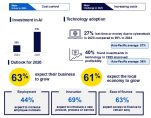
SBS Infographic 2026 Taiwan Eng

The survey found that 53 per cent of Taiwanese small businesses grew in 2025, slightly below the 57 per cent recorded in the previous survey. Looking ahead, business sentiment strengthened notably. In 2026, 63 per cent of respondents expect their business to grow, while confidence in the local economy also improved, with 61 per cent anticipating economic growth, the highest level recorded since Taiwan was first included in the survey in 2018.

Taiwan’s small and medium‑sized enterprises (SMEs) continue to play a vital role in creating new jobs. In 2025, 31 per cent of SMEs increasing staff numbers, while 44 per cent plan to hire additional employees in 2026.

With rising costs identified as the biggest challenge facing Taiwan’s SME in 2025, many businesses identified cost control as the most positive contributor to business performance last year.

Mr Elic Lam FCPA (Aust.), Honorary Taiwan Advisor at CPA Australia, said Taiwan’s economic fundamentals continue to support small business resilience, “Rising global demand for semiconductors and AI related chips continues to create opportunities for exporters and suppliers across Taiwan’s value chain,” Mr Lam said. “While geopolitical tensions and intensifying competition are adding uncertainty, government support measures for SMEs, including targeted subsidies and tax incentives, together with Taiwan’s resilient domestic demand, are helping to lift business confidence.”

Technology adoption, particularly artificial intelligence (AI), is becoming increasingly widespread among Taiwanese small businesses. The survey found that 33 per cent of small businesses identified AI as the technology they invested in most heavily invested in 2025, up from 29 per cent in the previous year.

Cyber risk among Taiwanese small businesses fell markedly. The share of small businesses reporting losses of time or money due to cyber incidents declined sharply from 59 per cent in 2024 to 27 per cent in 2025, reflecting stronger awareness and the uptake of basic protective measures across the sector.

However, the survey also indicates there is room to strengthen the returns from digital investment. Only 40 per cent of respondents reported that their technology investment in 2025 improved profitability, compared with the survey average of 56 per cent.

Mr Lam noted that Taiwan’s SME sector is undergoing a generational transition that is influencing technology adoption patterns, “Many SMEs in Taiwan are moving from first generation ownership to second or third generation leadership, and technology adoption remains cautious and practical,” he said. “The increase in AI investment reflects both external drivers, such as changing customer expectations and government policy support for digital transformation, as well as internal factors, including younger owners’ familiarity with AI tools and rising operating and staffing costs.”

“To improve profitability, SMEs should focus on applying digital solutions in areas with the greatest impact. For example, as rising costs were identified as the most negative factor affecting performance in 2025, investing in ready-to-use and AI enabled accounting or financial management tools can help reduce operating expenses and lift productivity.”

Access to finance is another notable finding. Financing conditions in Taiwan improved significantly in 2025, even as borrowing softened. Two-thirds of businesses (66 per cent) I said it was easy to access external finance, placing Taiwan among the top three surveyed markets and representing a sharp increase from 28 per cent in 2024. Looking ahead, financing conditions are expected to remain supportive, with 63 per cent anticipating easy access to finance in 2026.

Despite the marked improvement in financing conditions, demand for finance was more subdued. In 2025, 54 per cent of SMEs sought external finance, down from 72 per cent in 2024.

“The Taiwan government has expanded inclusive and guaranteed financing mechanisms to support SMEs, including higher guarantee ratios under the SME Credit Guarantee Fund and preferential loans offered through state affiliated banks,” Mr Lam said. “These measures have made bank financing more accessible for small businesses.”

“Even so, many SMEs remain cautious about taking on new debt. In a stable domestic environment, businesses can maintain steady growth, but external uncertainties drive them to take a prudent approach to borrowing. This aligns well with the government’s policy focus on gradual and resilient SME transformation rather than rapid, high risk expansion.”

Lam concluded, “To navigate international uncertainty and intensifying market competition, Taiwan’s small businesses should make better use of government policy support to upskill their workforce through AI adoption, foster innovation, and diversify export markets by strengthening online sales channels.”

The Asia Pacific Small Business Survey 2025–26 gathered views from 4,166 small businesses across 11 markets in the region, including Singapore, Chinese Mainland and Australia. The Taiwan survey sample comprised 311 small businesses.

Hashtag: #CPAAustralia

The issuer is solely responsible for the content of this announcement.

About CPA Australia

CPA Australia is Australia’s leading professional accounting body and one of the largest in the world. We have more than 176,000 members in over 100 countries and regions, including more than 22,500 members in Greater China. Our core services include education, training, technical support and advocacy. CPA Australia provides thought leadership on local, national and international issues affecting the accounting profession and public interest. We engage with governments, regulators and industries to advocate policies that stimulate sustainable economic growth and have positive business and public outcomes. A CPA is a Certified Practising Accountant. More at

Rocketlane has raised $60 million in a Series C round led by Insight Partners, as the software company moves to expand an AI-driven platform aimed at professional services teams that are increasingly being asked to turn enterprise AI spending into measurable operating results. The funding, announced on March 25, takes the company’s total capital raised to $105 million and comes as more corporate buyers shift attention from […]

Artificial intelligence is redrawing the economics of data centres at a speed that is forcing developers, utilities and investors to rethink where digital infrastructure can be built and how it can be financed. A new 2026 marketplace report from Colliers says global investment in data centres topped $580 billion in 2025, up 27 per cent from a year earlier, as hyperscalers and infrastructure groups poured money into […]

Digital Realty has begun providing colocation infrastructure to Samsung Electronics at its ICN10 facility in Seoul, a deal that highlights how large corporate users in South Korea are seeking more resilient, high-density digital infrastructure as artificial intelligence, cloud services and mission-critical enterprise workloads put heavier demands on power, cooling and connectivity. The announcement was made on March 25 by Digital Realty, which said the arrangement would support Samsung Electronics’ enterprise IT operations from its Seoul site.

The ICN10 facility, located in Sangam-dong in Mapo-gu, has been operating since 2022 and is described by the company as South Korea’s first carrier-neutral data centre. Digital Realty says the building has a maximum IT load of 12 megawatts and around 132,000 square feet of space, with high-density power architecture, network connectivity and the resilience needed for large-scale computing environments. Those specifications matter because enterprise clients are no longer looking only for secure rack space; they increasingly want facilities that can handle denser compute loads without compromising uptime.

For Samsung Electronics, the move points to a practical shift in how even large technology groups manage parts of their own internal infrastructure. Rather than relying exclusively on self-operated facilities, major companies are turning to specialist operators for colocation capacity that can be scaled more quickly and managed to global standards. Digital Realty framed the arrangement as support for a large-scale customer environment in Korea, while emphasising stable, high-performance infrastructure for global enterprises. That wording suggests the deal is less about consumer-facing products and more about the backbone systems that keep a multinational company running across data-intensive operations.

The timing is notable because Seoul’s data-centre market is expanding while facing mounting strain over where future capacity can be built and how it will be powered. Cushman & Wakefield said the Greater Seoul Area reached 533 megawatts of capacity in the first half of 2025, with a further 715 megawatts in the development pipeline, alongside land secured for another 250 megawatts. Its later market update said the second half of 2025 saw double-digit year-on-year growth, while AI demand and tighter power-related rules were reshaping development patterns. That combination of growth and constraint is pushing operators and customers alike to value operational certainty.

South Korea’s broader technology push adds another layer to that demand story. Reuters reported this week that Seoul approved a 250 billion won investment in AI chip startup Rebellions, part of a wider effort to strengthen domestic semiconductor and advanced computing capabilities. Reuters also reported that SK Hynix is pursuing a US listing partly to fund major chipmaking investments tied to rising AI demand. Those moves sit outside the colocation market itself, but they reinforce the same structural point: processing power, data movement and digital infrastructure are becoming more strategically important across the economy.

Digital Realty’s position in Seoul also reflects a larger contest among global and regional operators seeking to capture Asia’s enterprise and cloud demand. Market research and adviser reports point to South Korea as one of the faster-growing data-centre markets in the region, driven by digital-first consumers, cloud adoption and increased enterprise modernisation. JLL’s 2026 outlook said the global data-centre sector could nearly double between 2025 and 2030, while other market estimates show South Korea’s colocation and broader data-centre segments expanding strongly through the decade. Forecasts from commercial research firms should be treated cautiously, but taken together with operator activity and land acquisition trends, they show why Seoul has become a closely watched infrastructure market.

The Samsung agreement may not be transformative in size on its own, yet it carries signalling value. When one of the country’s largest technology groups places enterprise workloads with an external colocation provider, it gives weight to the argument that carrier-neutral, high-density facilities are becoming integral to mainstream corporate IT strategy rather than serving only cloud giants and telecom operators. It also strengthens Digital Realty’s credentials in a market where network diversity, reliability and location all matter.

Questions remain over how quickly South Korea can add capacity in and around Seoul without worsening power bottlenecks or pushing new builds further from the capital’s main concentration of corporate demand. Legal and advisory analyses have pointed to the mismatch between the location of generation capacity and the heavy concentration of data centres around metropolitan Seoul. That tension is likely to shape the next phase of expansion, forcing operators to balance geography, power access and customer proximity more carefully than before.

  Dubai has added 13 new cycling tracks as the Roads and Transport Authority pushes ahead with a plan to turn the emirate into a far more connected cycling city, advancing a wider network that officials say is meant to reach 1,000 kilometres by 2030. The newly completed routes are part of a 15-track master plan spanning 162 kilometres and are intended to link residential districts, beaches, […]

Expansion strengthens access to fast, reliable device repair services across Jurong, Yishun, Tampines and Chinatown as demand for urgent technical support rises

SINGAPORE – Media OutReach Newswire – 29 March 2026 – Citri Mobile has expanded its Singapore repair network with stronger support in Jurong and Yishun, responding to rising demand for faster and more accessible device repair as device failures become increasingly disruptive to daily life.

A Citri Mobile technician performing internal diagnostics at a fully equipped repair station in Singapore.

What often begins as a minor inconvenience can quickly escalate. A phone may take longer to charge, a screen may flicker briefly before stabilising, or a laptop may run hotter than usual during routine use. These early signs are often ignored until the device stops functioning at a critical moment.

In recent months, technicians have observed a noticeable increase in cases involving sudden power loss, charging instability, motherboard-related faults and water damage. These issues often appear gradually before escalating into complete device failure, reflecting a broader shift in how modern devices behave under long-term usage.
Across Singapore, users are increasingly facing device failures at moments where immediate access is essential. A phone may stop responding during a payment, a transport app may fail to load before a journey, or a laptop may refuse to power on just before an important task. In such situations, the priority shifts quickly from convenience to restoring access in order to regain control of payments, communication and daily responsibilities.
Against this backdrop, Citri Mobile and its C3 Smart Repair by Citri Mobile outlets are strengthening support for customers dealing with urgent issues across smartphones, foldable devices, tablets, MacBooks and laptops.
In Jurong, these situations are often experienced during working hours and daily commutes. A phone that powers off unexpectedly mid-transaction or loses signal during navigation can create immediate disruption. In these moments, users searching for phone repair in Jurong often prioritise providers that are nearby, responsive and able to diagnose issues clearly without unnecessary delay.
In Yishun, the pattern frequently unfolds in residential settings. Devices that appear functional the night before may fail completely the next morning. A phone may not power on, a screen may remain black despite vibration, or a device may show signs of internal failure after minor exposure to moisture or accidental spills. When access to essential services is affected, the need for immediate local support becomes more urgent.
Water damage continues to be one of the more unpredictable causes of device failure. Even small amounts of moisture can lead to corrosion within internal components, affecting charging circuits, display connections or motherboard stability. In some cases, devices may continue to function temporarily before deteriorating rapidly over time.
At the same time, laptop and MacBook issues remain a significant concern, particularly for users who rely on their devices for work, study and communication. A MacBook that fails to power on, shuts down under load or shows inconsistent charging behaviour often indicates deeper issues such as logic board faults, battery degradation or power management instability.
For iPhone-related repairs, some users also look for providers that participate in Apple’s Independent Repair Provider programme, where applicable. Those seeking specialised support may explore iPhone repair in Singapore when reliability, diagnostics and parts compatibility are key considerations.
These issues are no longer isolated to one category of device. Similar underlying problems — including power IC faults, charging circuit instability and motherboard-level failures — can affect both smartphones and laptops. In many cases, users turn to providers offering broader device repair services in Singapore to address multiple concerns within a single visit.
In more complex cases, symptoms may appear inconsistent at first. A device may turn on intermittently, charge irregularly, or shut down without warning before failing entirely. These patterns often require careful diagnosis rather than immediate part replacement, particularly when internal board-level issues are involved.
Across Singapore, from Jurong and Yishun to Tampines and Chinatown, users increasingly choose repair providers that are close by, familiar and capable of handling both straightforward and complex faults with dependable turnaround. Customers in the northern region may also rely on nearby options such as mobile repair in Yishun for quicker access.
Citri Mobile said its recent expansion reflects a broader shift in customer expectations, where speed, clarity and reliability play a more significant role in decision-making.
“People usually start searching seriously when the problem stops them from doing something important,” a Citri Mobile spokesperson said. “Once payments, work access or communication are affected, the decision becomes immediate. They want a nearby solution they can trust.”
Citri Mobile operates across multiple Singapore locations under both Citri Mobile and C3 Smart Repair by Citri Mobile, supporting a wide range of repair needs from screen and battery replacements to charging issues, water damage recovery and motherboard-level repairs.
The company’s recent milestones include recognition as a Carousell Preferred Partner, receipt of the Carousell Best Service Award 2025, CaseTrust accreditation, and participation in Apple’s Independent Repair Provider programme for iPhone-related repair support.
With stronger coverage in Jurong and Yishun, alongside continued support in Chinatown and Tampines, Citri Mobile aims to improve access to timely and reliable device repair services for customers across the wider Singapore market.

Hashtag: #CitriMobile #SingaporeRepair #Jurong #Yishun


The issuer is solely responsible for the content of this announcement.

C3 Smart Repair By Citri Mobile

Citri Mobile is a Singapore-based device repair provider serving customers across multiple locations, including Jurong, Yishun, Chinatown and Tampines. The company operates outlets under both Citri Mobile and C3 Smart Repair by Citri Mobile, supporting smartphones, foldable devices, tablets, MacBooks and laptops.
Its services cover a wide range of issues, including screen and battery replacements, charging faults, water damage recovery and motherboard-related repairs, with a focus on accurate diagnostics and reliable turnaround.
Citri Mobile is a Carousell Preferred Partner, recipient of the Carousell Best Service Award 2025, CaseTrust-accredited, and part of Apple’s Independent Repair Provider programme for iPhone repairs.

Disneyland Paris has formally opened a new phase of its long-running expansion, using the March 29 debut of World of Frozen to relaunch its second gate as Disney Adventure World, a move the company says marks the biggest transformation in that park’s history. Official announcements from Disneyland Paris, backed by Reuters and Associated Press reporting, show the renamed park now centres on a large new Frozen-themed land, […]

Arabian Post Staff -Dubai Exeed has opened a new showroom in Jeddah through Arabian Heritage Motors, part of Al Ghurair Mobility, extending the premium vehicle brand’s physical presence in Saudi Arabia as competition intensifies among Chinese carmakers across the Gulf. The Jeddah launch was disclosed by Al Ghurair in a corporate post and comes after Exeed appointed Al Ghurair as its exclusive distributor in the Kingdom in […]

Foreign visitors to India will have to complete a digital e-Arrival Card before landing from April 1, 2026, marking the end of the paper disembarkation card that travellers had long filled out on board or at immigration counters. The move is part of a wider technology-led overhaul of border processing that authorities say is aimed at cutting queues, improving data accuracy and giving immigration officers faster access to passenger information.

The e-Arrival Card is submitted online through the official Indian Visa Online portal, the Bureau of Immigration platform or the government’s Indian Visa Su-Swagatam mobile app. The current official guidance says the form must be completed within 72 hours before arrival and is for arrival information only, not a visa. Travellers are asked to provide passport details, travel information, contact particulars, purpose of visit and their address in India, after which a digital confirmation is generated for presentation on arrival.

The April 1 deadline is not the start of the digital system itself but the point at which the physical card is being withdrawn after a transition period. Government-linked notices issued through overseas missions said the digital disembarkation process had already come into force on October 1, 2025, while paper cards would continue temporarily for as long as six months or until further notice. An immigration advisory published this week by Fragomen, citing a government announcement, said physical cards would be permanently discontinued from April 1, 2026.

That chronology matters because it shows India is not unveiling a wholly new border form overnight, but completing a staged shift towards paperless arrival processing. The official visa portal now prominently carries a notice that foreigners and OCI card holders can complete and submit the e-Arrival Card online within 72 hours before arrival through approved government channels. That wording suggests authorities are folding the form more tightly into the wider immigration and visa network rather than treating it as a stand-alone travel add-on.

The policy aligns with a broader expansion of the Immigration, Visa, Foreigners Registration and Tracking scheme, or IVF-RT, which the Union Cabinet has approved for another five years through March 2031 with an outlay of Rs 1,800 crore. Officials have described the plan as a way to link visa issuance, immigration records, travel history and foreigner registration databases so that decisions at entry and exit points rely less on fragmented manual checks and more on integrated digital records.

For travellers, the most immediate consequence is procedural rather than legal. The e-Arrival Card does not replace a visa, e-Visa or other entry authorisation. It supplements them. A visitor who already holds valid travel permission for India will still need to file the digital arrival declaration in the permitted time window. That means airlines, travel agents, business mobility firms and universities handling international arrivals are likely to spend the next few days reminding passengers that a boarding document and an arrival declaration are now separate steps in the journey.

The government’s pitch is built around speed and visibility. Digital pre-submission allows immigration systems to receive data before a flight lands, which can reduce form-filling bottlenecks at the airport and improve risk screening. Industry specialists tracking mobility rules say the change also gives authorities stronger data control and supports more real-time monitoring of foreign arrivals. That mirrors a global pattern in which governments are replacing handwritten landing cards with app-based or portal-based pre-arrival disclosures.

There are, however, operational questions that matter for passengers. Official pages make clear that the form should be completed within 72 hours of arrival, yet some secondary reports have described slightly different timelines or suggested varying treatment of QR code presentation depending on when the form is filed. The most reliable course for travellers is therefore to follow the instructions displayed on the official government portal or app at the time of submission, rather than relying on social media summaries or copied advisories.

Another area requiring care is who exactly falls under the rule. The current official portal text explicitly refers to foreigners and OCI card holders being able to submit the e-Arrival Card, while some earlier mission notices had described OCI holders as exempt before later updates changed that position. For foreign visitors travelling on tourist, business, student or other visas, the direction is straightforward: the digital arrival filing now sits at the centre of entry processing.

VISHNU RAJA
RYO YAMADA
HITORI GOTOH
IKUYO KITA