

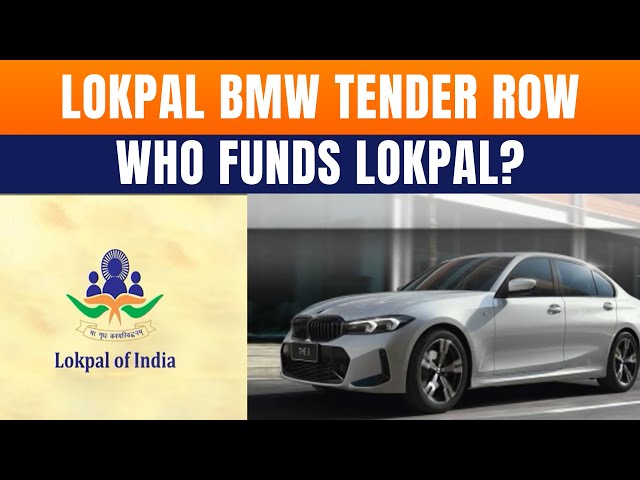
The very idea of a Lokpal riding in a BMW, reeks of irony so strong that it almost feels like satire. The institution that stands as the sentinel of public probity, the watchdog against corruption, has managed to draw ridicule upon itself by its desire for luxury wheels. A BMW-driven Lokpal is not merely a bad idea—it is an affront to the moral spirit of a democratic ombudsman. The notion of the anti-corruption authority zipping past traffic in a German-made luxury sedan, while preaching restraint and ethics to the political class, captures the collapse of symbolism in our public institutions.
The Lokpal’s demand for BMWs is not a harmless administrative choice. It is outrageous, obscene even, because it betrays an insensitivity to both the economic condition of the nation and the ethical foundations on which the office is built. India’s developmental journey is still marred by poverty, unemployment, and stark inequality. It is a country where millions walk to work, where farmers still struggle to make ends meet, and where middle-class taxpayers scrape through life paying the price for every policy misstep. For the Lokpal—an office meant to represent the highest standards of rectitude—to seek a fleet of BMWs from the public exchequer is not just insensitivity; it is an insult to the people who fund it.
The justification that the Lokpal is entitled to choose its own means of conveyance would have carried weight if it were not for one crucial fact—the money being spent is not personal, but public. The Lokpal is free to buy any car he wishes, provided he pays from his own pocket. But when the same indulgence is financed by taxpayer money, it ceases to be a matter of choice and becomes a matter of public ethics. This is precisely where the line between personal comfort and institutional corruption blurs. Using public funds to buy luxury cars for those who are supposed to uphold the law against excess is a travesty of democratic morality.
One cannot overstate the symbolism of the vehicle in public life. A government official or public representative choosing a modest vehicle sends a message of humility, service, and solidarity with the people. It creates trust. It reminds citizens that those in authority do not see themselves as a privileged class but as public servants. A Lokpal seated in a BMW, however, conveys the exact opposite. It signals distance, privilege, entitlement, the very traits the office was meant to challenge. The contradiction is so glaring that it turns the image of the Lokpal from one of moral authority into one of moral decay.
It is therefore entirely fitting that Amitabh Kant, the former CEO of Niti Aayog and one of the sharpest administrators in the country, has spoken out against this grotesque display of misplaced priorities. Kant’s suggestion that the Lokpal cancel the tender for BMWs and instead opt for a made-in-India electric vehicle is more than a practical correction—it is a moral intervention. By urging a shift to an Indian-made EV, he is not merely recommending a change of brand but a return to the values that define public service in a democracy: frugality, symbolism, and national responsibility.
The advice resonates on several levels. First, it aligns with the government’s larger vision of promoting indigenous manufacturing through the ‘Make in India’ initiative. Choosing an Indian EV over a foreign luxury brand would reinforce the Lokpal’s credibility as an institution that practices what it preaches—integrity, restraint, and self-reliance. Second, it would affirm the government’s commitment to sustainable mobility and climate-conscious governance. And third, it would save the Lokpal from further embarrassment at a time when public trust in institutions is already fragile.
But beyond the practical arguments lies a deeper issue: the growing disconnect between the moral intent of public institutions and their behaviour. The Lokpal was envisioned as an answer to the crisis of corruption that plagued India’s governance for decades. It was supposed to embody the highest moral fibre, to stand above the temptations of power and luxury, and to remind the political and bureaucratic class that public office is not a privilege but a duty. When the very guardians of ethics succumb to the glamour of imported luxury, it is not just hypocrisy—it is institutional self-destruction.
Corruption does not always come wearing the mask of bribery or embezzlement. Sometimes it comes cloaked in entitlement, in the subtle misuse of public money for private comfort. The Lokpal’s BMW fixation is precisely that form of corruption—soft, sophisticated, and self-justified. It stems from a belief that the office deserves to be adorned with symbols of status. But status, in public life, is not earned by what one drives; it is earned by what one stands for. The Lokpal, in choosing a BMW, stands for everything that the Lokpal Act was designed to oppose.
The spectacle is also a tragic commentary on the changing values of India’s governing elite. There was a time when simplicity in public life was not a pose but a practice. From Lal Bahadur Shastri’s humble lifestyle to A.P.J. Abdul Kalam’s quiet austerity, India’s leaders once led by example. They derived their legitimacy not from opulence but from restraint. Today, however, the markers of prestige have shifted. SUVs, convoys, and luxury trappings have become the language of authority. The Lokpal’s BMW episode is merely a symptom of this broader moral drift.
The citizens of this country do not expect their public servants to live like monks. But they do expect them to live with a sense of proportion. When institutions built to fight corruption begin to emulate the habits of those they are meant to monitor, the moral compass of governance tilts dangerously. If the Lokpal’s office cannot distinguish between what is right and what merely looks impressive, then its capacity to hold others accountable stands compromised from the start. (IPA Service)
The article Lokpal’s BMW Fixation Is Outright Corruption, If Not Vulgar appeared first on Latest India news, analysis and reports on Newspack by India Press Agency).