Watching television very often during midlife may be associated with smaller brain regions and greater signs of damage to the brain’s white matter more than two decades later, a long-term study of about 1,700 adults has found. The research identified structural differences in areas involved in memory formation, decision-making and visual processing among participants who reported the highest television viewing. The findings do not prove that watching […]
ZeroSpace has entered Steam Early Access with an unusually broad combination of real-time strategy, role-playing systems and community warfare, although its decision to place prominent streamers at the centre of its flagship multiplayer event has divided attention from the strength of the game itself. Developed by Starlance Studios and Ironward, the science-fiction strategy game launched on 20 July with the first act of its campaign, competitive matches, […]
Arabian Post Staff -Dubai Samsung’s Galaxy Watch can provide insights linked to long-term metabolic health without using a continuous glucose monitor, but it does not measure blood sugar or replace established diabetes-testing devices. The distinction centres on Samsung’s Advanced Glycation End-products Index, known as the AGEs Index. Available on the Galaxy Watch7 and newer supported models, the feature estimates the accumulation of compounds formed when sugars react […]
Dubai’s former zoo site in Jumeirah 1 is entering a new phase as a low-rise residential community, while a 710-metre public artwork preserves memories of the landmark during construction. The development will comprise 90 homes arranged around landscaped courtyards, green spaces and a central park. Shamal Holding is leading the project, which seeks to combine residential privacy with walkability, shared amenities and architectural references to the site’s […]
By Dr. Gyan Pathak Both Houses – Rajya Sabha and Lok Sabha – of the Parliament of India adjourned for the second day of the Monsoon Session on July 21 amid protests by the opposition seeking discussion on the police “brutality unleashed” on students during their “March to Parliament” on July 20. The March was […]
By Dr. Gyan Pathak Cockroach Janata Party movement was reported in a section of media as one of the reasons for abrupt removal of Delhi Police Commissioner Satish Golcha on Friday July 17, 2026, who was replaced by Anurag Kumar. A day after, in the early hours of Saturday July 18, 2026, Delhi Police removed […]
Release of Phased Achievements of the National Pilot Base for AI Application (Financial Sector) Held Alongside the Conference
SHANGHAI, CHINA – Media OutReach Newswire – 20 July 2026 – On 17 July, the 2026 World Artificial Intelligence Conference (WAIC) officially opened in Shanghai. UnionPay unveiled three proprietary AI technologies developed for the financial sector at the Shanghai exhibition area: financial transaction time-series foundation model, the Agentic Payment Open Protocol (APOP) framework, and a privacy-preserving large language model inference solution. As the AI era unfolds, the showcase highlights UnionPay’s continued commitment to accelerating the adoption of digital and intelligent technologies.
On 18 July, UnionPay hosted the Release of Phased Achievements of the National Pilot Base for AI Application (Financial Sector) at the UnionPay Center alongside WAIC 2026. The event brought together more than 100 representatives from commercial banks, Chinese and international partners, leading technology companies, academia, and research institutions. During the event, UnionPay released its “1+6+N” AI achievements framework, announced a series of industry partnerships, and launched a joint initiative calling for greater collaboration on the development and governance of the financial industry. These achievements demonstrate the progress of the National AI Application Pilot Base in building an open innovation platform that accelerates AI adoption across the industry.
Dong Junfeng, Chairman of China UnionPay and UnionPay International, attended the event and delivered a keynote speech. He noted that AI is rapidly reshaping the financial industry. Since the National AI Application Pilot Base was launched in 2025, it has delivered a number of meaningful outcomes through close collaboration across the industry. Mr. Dong elaborated on the vision for the development of the base from through three dimensions: sharing, collaborative governance, and mutual benefits. First, by pooling computing resources, data and models on a centralized public platform, the base helps address industry challenges such as the high cost of computing resources and data silos. This lowers barriers to AI adoption across the financial sector. Second, the base has strengthened AI security by building robust safeguards for large language models and applying AI to enhance transaction risk management and cybersecurity. Such efforts are made to support a safer and more resilient financial ecosystem. Third, the base is accelerating the AI adoption across real-world use cases. It has incubated a range of commercial AI solutions spanning agentic payments, credit risk management, consumption promotion and merchant digital transformation, turning technological innovation into tangible business value. Looking ahead, the future of AI + Finance holds enormous potential. UnionPay looks forward to working with partners across industries to build an open, shared, and well-governed financial AI ecosystem that supports the development of new productive forces through technological innovation.
A highlight of the event was the official launch of UnionPay’s “1+6+N” AI achievements framework.
The “1” represents a unified portal—the National AI Application Pilot Base. Built on a “One Portal, Six Centers” structure, it integrates six specialized centers covering models, datasets, applications, talent development, supply-demand matching, and financial services. Together, the platform currently hosts 11 models, 14 datasets, 59 demonstration applications, and 61 service offerings, bringing together 145 core resources in total.
The “6” refers to six independent and controllable capabilities, including computing resources scheduling through a trusted intelligent computing sharing platform, high-quality financial datasets, finance-specific foundation models, AI-powered financial security services, financial AI standards, and a pilot testing sandbox that supports model training and evaluation. Together, these six capabilities form the base’s shared technology foundation, providing ecosystem partners with the core technical infrastructure.
The “N” represents a portfolio of benchmark use cases, standardized AI solutions, and demonstration applications built on this technology foundation. These applications span five key areas—intelligent payments, inclusive finance, consumption growth, risk management and compliance, and operational excellence—building a multi-tier product portfolio serving consumers, merchants, local governments and financial institutions. This accelerates the application of AI capabilities across diverse use cases.
Together, the “1+6+N” framework of the base connects computing power, data, models, and use cases and forms an end-to-end value chain. By addressing common industry challenges—including limited computing resources, data silos and the high cost of AI deployment—it delivers standardized and widely accessible AI capabilities, providing the financial industry with reusable, highly secure and one-stop AI solutions for intelligent transformation. This also reflects UnionPay’s commitment not only to driving its own business growth, but also to enabling the industry through foundational capabilities and reinforcing financial infrastructure for the AI era.
These achievements have already been made available to industry partners and are beginning to create value. For banks, acquirers and other financial institutions, UnionPay’s shared infrastructure enables rapid access to mature financial AI capabilities without the need to build systems from scratch, significantly reducing both technical barriers and implementation costs. For merchants, UnionPay offers AI-powered marketing, digital analytics and intelligent risk management tools to support smarter operations, improve customer engagement and enhance operational efficiency, enabling even small and medium-sized businesses to benefit from AI innovation. For technology companies and other ecosystem partners, the base enables partners to rapidly adapt AI products for financial applications and complete compliance validation, accelerating the commercialization of technological innovations.
The event also featured six rounds of partnership signing ceremonies, covering areas including AI-themed card, cross-border agentic payment ecosystem development, AI-powered operational empowerment for merchants, joint commercialization of pilot base innovations, and broader ecosystem collaboration across the financial industry chain.
Following the signing ceremonies, UnionPay released the Initiative on the Collaborative Development and Governance of AI Applications in Financial Services, with representatives from participating organizations joining the stage to witness its launch. Building on the “1+6+N” framework, the initiative calls on industry stakeholders to collaborate in four areas: First, advancing trusted AI systems that serve the real economy by establishing governance mechanisms for traceable and explainable algorithms while safeguarding data privacy and security; Second, strengthening collaboration among industry, academia, research institutions and users, leveraging the base to jointly advance core technologies and develop independent and secure financial AI infrastructure; Third, promoting openness and inclusiveness by sharing mature AI models, testing services and implementation solutions to reduce the cost of intelligent transformation, particularly for SMEs; Fourth, improving lifecycle governance through tiered risk management, enhanced compliance standards and coordinated risk prevention. The initiative calls on all industry stakeholders to work together by jointly strengthening the foundation, unlocking greater value through shared capabilities, and reinforcing collaborative governance, with the goal of advancing the sound development of AI in the financial sector and driving digital finance through technological innovation.
Hashtag: #UnionPay
The issuer is solely responsible for the content of this announcement.
SINGAPORE – Media OutReach Newswire – 20 July 2026 – Imperial Harvest, an Imperial Feng Shui consultancy in Singapore, has unveiled a one-of-one bespoke mahjong set valued at US$1.888 million (approximately S$2.4 million) — placing it among the world’s most valuable mahjong sets ever created — with all proceeds from its sale pledged to DIPG Foundation Singapore, funding research into one of the deadliest childhood brain cancers.
Imperial Feng Shui Mahjong Set
For generations, mahjong has been far more than a pastime. Rich in symbolism, strategy and tradition, the centuries-old game has long brought families and friends together around a table, and today it is enjoying a global resurgence, winning new audiences across the United States and beyond.
Against this backdrop, the one-of-one creation brings together exceptional materials, artisanal craftsmanship and Imperial Feng Shui principles into a collector’s piece that channels cultural heritage into meaningful change.
Turning Prosperity Into Hope for Children
Diffuse Intrinsic Pontine Glioma (DIPG) is a rare and aggressive brain tumour that primarily affects children between the ages of five and 11, and has long been considered incurable. In 2024, doctors reported the world’s first case of a child effectively cured of DIPG, renewing global momentum in the field — yet research into the disease remains critically underfunded.
All proceeds from the sale of the mahjong set will be donated to DIPG Foundation Singapore, Singapore’s first foundation dedicated to advancing research into DIPG and other paediatric brain cancers. Founded by families who each experienced the loss of a child to the disease, the foundation supports research, advocates for greater access to innovative therapies and clinical trials, and provides resources for affected children and their families.
For Grand Master David Goh, founder of Imperial Harvest, donating the proceeds reflects a belief that prosperity carries its greatest meaning when it can be shared. The mahjong set celebrates abundance through symbolism and craftsmanship while channelling that value into research that brings hope to affected children and their families.
A Fading Craft, Reimagined
The set arrives at a time when the traditional art of mahjong tile carving is fading worldwide, lending its craftsmanship a significance beyond luxury alone. At the heart of the set are 156 playing tiles, including Animal, Fei and Joker tiles, individually crafted in untreated Burmese Grade A Black Jadeite. Revered for its rarity and cultural significance, the stone has long been associated with protection, resilience and prosperity, with every tile retaining its natural individuality.
The tiles are housed in a bespoke trunk wrapped in exceptionally rare Himalayan Niloticus crocodile leather, prized for its naturally occurring gradient reminiscent of snow-capped mountain peaks and sourced from a tannery that supplies some of the world’s most prestigious luxury maisons. Inside, aerospace-grade Alcantara — the same premium material found in the interiors of Ferrari and Lamborghini supercars — creates a soft, durable lining that protects every tile.
Where Feng Shui Meets Design
Guided by third-generation feng shui master Grand Master David Goh, every detail has been considered not only for its visual appeal but also for its symbolic significance, resulting in a collector’s piece that seeks to harmonise Heaven, Earth and humanity.
The conventional Singapore animal tiles have been replaced by the Four Celestial Guardians — the Azure Dragon, Vermilion Phoenix, White Tiger and Black Tortoise — mythical creatures deeply rooted in Chinese cosmology that traditionally represent protection, balance and harmony. Likewise, the flower tiles have been redesigned to depict four auspicious creatures: the bat, deer, crane and magpie, collectively symbolising fortune, prosperity, longevity and happiness.
Even one of mahjong’s most recognisable tiles, the Seven Dots, has been reimagined. Instead of following its conventional arrangement, the seven circles are positioned according to the “Seven Star Lighting” formation, an Imperial Feng Shui configuration believed to represent stability, clarity and strategic balance. The Character suit, meanwhile, features English transliterations such as “Yi Wan”, “Er Wan” and “San Wan”, making the set accessible to an international audience while preserving its cultural identity.
As Grand Master David Goh describes it, the set is “far beyond a Mahjong set. Every detail has been calibrated to harmonise Heaven, Earth and Man, ensuring that its owner engages not just in a game, but in a field of aligned opportunity, protection and infinite prosperity.”
A New Definition of Luxury
Whether viewed as a collector’s piece, a work of design or cultural heritage, the Imperial Feng Shui Mahjong Set occupies a category of its own — a reminder that the greatest luxury may ultimately be the opportunity to create meaningful change. It is a philosophy that Imperial Harvest carries through its bespoke Feng Shui consultation services in Singapore, where prosperity is understood as something to be built, and shared.
The issuer is solely responsible for the content of this announcement.
About Imperial Harvest
Imperial Harvest is a Singapore-based luxury Imperial Feng Shui maison dedicated to empowering individuals with clarity, breakthroughs, and prosperity. Founded by Grand Master David Goh, Imperial Harvest upholds the royal Feng Shui traditions once reserved for Chinese emperors, making them accessible to modern professionals, business leaders, and families worldwide.
At the heart of Imperial Harvest is a unique blend of time-honoured metaphysics and contemporary craftsmanship. Every treasure – from fine jadeite and rare agarwood to bespoke jewellery collections – is carefully matched to each client’s Bazi chart and personally blessed by Grand Master David to activate favourable elements for wealth, benefactors, and opportunities.
With a proven track record of guiding thousands of clients to achieve career milestones, business growth, and lasting harmony, Imperial Harvest continues to set the benchmark for authentic, results-driven Imperial Feng Shui. The maison is committed to building lifelong partnerships grounded in trust, expertise, and transformational success.
The launch combines a unified, action-oriented world model with Ambient Capture Engine 2.0, three commercial solutions and a new industry benchmark, connecting high-density data with real-world robotic operations.
SHANGHAI, CHINA – Media OutReach Newswire – 19 July 2026 – ACE ROBOTICS today unveiled Kairos 3.1, its latest action-oriented world model, alongside Ambient Capture Engine 2.0 and three commercial solutions spanning instant retail, hospitality and outdoor service scenarios.
ACE ROBOTICS Chairman Wang Xiaogang introduces Kairos 3.1 during WAIC 2026 in Shanghai
The announcements were made at a forum ACE ROBOTICS organized during the 2026 World Artificial Intelligence Conference, convened around the theme of advancing physical AI from “understanding” to “execution.” The event brought together economists, technology executives and embodied AI researchers to examine how general-purpose world models can move from laboratory research to industrial deployment.
The forum also marked the launch of PHYSICAL IQ, a unified benchmark for embodied physical intelligence. It was jointly initiated by the Shanghai Artificial Intelligence Association, the Shenzhen Loop Area Institute and the East China branch of the China Academy of Information and Communications Technology, with participation from more than 20 universities and industry partners.
Thomas J. Sargent, Nobel laureate in Economic Sciences, discussed the limitations of current intelligent systems in rare and previously unseen situations.
A world model built for the physical world
“In the digital world, a model error may result in a flawed image or paragraph. In the physical world, an incorrect action can have real consequences,” said Wang Xiaogang, Chairman of ACE ROBOTICS. “Kairos 3.1 is built around a first-principles approach to embodied world models, helping robots act more reliably in complex and uncertain environments, and accelerating the arrival of physical AI’s Kairos moment.”
Kairos 3.1 is designed as a natively unified model that integrates generative, physical and cognitive intelligence within a single architecture, rather than combining separately developed capabilities.
Built on a hybrid Transformer architecture with a shared mixed-attention mechanism, it brings visual observations, language instructions, force and tactile signals, and policy trajectories into a unified latent space.
This supports an “understand, reason, execute and reflect” loop. The model can break down long-horizon tasks, simulate physical cause and effect across multiple scenarios, rank candidate actions, execute the selected strategy and evaluate the outcome for further adjustment.
At the core of its spatial understanding is ACE-BRAIN-0.5. ACE ROBOTICS said it has achieved state-of-the-art results across 12 public evaluations covering spatial understanding, navigation, manipulation and task-progress assessment, among publicly reported models as of July 2026.
In a household laundry scenario, for example, a robot can identify spatial relationships between objects, divide a task into more than a dozen steps and verify each stage in real time. If a failure occurs, it can identify the affected step and restart from that point rather than repeating the entire task.
For physical generation and reasoning, Kairos-HomeWorld supports whole-home scene generation and object interaction. It is built on 300,000 residential floor plans, 5,000 simulated home environments and 8,700 3D assets covering six categories of physical properties, designed to reflect common residential layouts in China.
The model can simulate multiple action trajectories in parallel and rank them based on predicted success and execution cost before sending instructions to a physical robot.
In internal testing, the Kairos 3.1 8B model achieved an inference latency of 125 milliseconds on the NVIDIA Jetson Thor platform at BF16 precision. Its in-house KairosRT computing engine supports real-time, on-device inference.
Kairos 3.1 also incorporates self-reflective iteration. When an action fails, the robot can evaluate the result and adjust its strategy. In one test, for example, it changed from a three-finger to a four-finger grasp after an unsuccessful attempt and subsequently completed the task.
From high-density data to continuous learning
ACE ROBOTICS also introduced what it calls the “Information-Density Law” for embodied models: the value of data is determined not only by its volume, but by whether it contains information capable of changing the outcome of an agent’s actions.
ACE ROBOTICS classifies embodied data across five information-density levels, from L1 to L5. L1 and L2 data support foundational pre-training; L3 and L4 data remain focused on known tasks; and at L5, data incorporates three-dimensional force and tactile signals, failure-recovery trajectories and variables from open environments. The company says these higher-density forms of interaction data support stronger generalization, reflection and continuous learning.
Built on this principle, Ambient Capture Engine 2.0 is a human-centric system for capturing, processing and reusing high-density physical-interaction data.
ACE Ego Kit is a lightweight wireless wearable comprising head, hand and chest components. It includes the ACE Sense Glove, which offers sensitivity of 0.01 newtons and a joint-angle error of less than two degrees. The system can synchronize data from more than 20 heterogeneous sensors with a timing error of less than one millisecond.
ACE Data Engine is an automated data-production platform for continuous, high-precision annotation of long-horizon tasks. It incorporates ACE-ViDiHand, a generative 4D hand-motion-capture framework designed to track movements despite occlusion and rapid motion, which ACE ROBOTICS reports led across three public benchmarks (ARCTIC, HOT3D and HOI4D) as of July 2026. The company recorded a frame-level accuracy of 0.997 and up to a 4.8-fold improvement in motion smoothness.
ACE Ego Matrix standardizes embodied data across four dimensions: spatial coordinates, embodiment structure, action timing and data quality. It is designed to align data collected by different operators, devices and robot platforms for reuse across systems. ACE ROBOTICS has open-sourced the framework, which it says placed first on the RoboCase and RoboTwin leaderboards.
ACE ROBOTICS also announced the open release of ACE-Data-0, an L5 household-interaction dataset featuring complex physical tasks and high-precision annotations.
Three solutions moving into commercial operation
Building on its data infrastructure and Kairos world-model capabilities, ACE ROBOTICS introduced three standardized industry solutions designed for deployment within existing commercial workflows.
Xiaoman, its integrated fulfillment solution for instant retail, is paired with the new W1 fulfillment robot. The W1 has a robot-to-payload weight ratio of less than 2:1, force-control precision within one newton and a minimum required aisle width of 75 centimeters, making it suitable for high-density shelving environments. It is able to grasp both flexible packaging and rigid goods.
The solution connects robot hardware, world-model capabilities, motion control, product information, warehouse locations and order management. It supports lightweight deployment within days across flash-fulfillment warehouses, small-format stores and integrated warehouse-store setups. It has been deployed with customers including Sense MartGo, Kuaikeda and PetroChina convenience stores, using real order and shelf data to improve fulfillment performance. ACE ROBOTICS plans to deploy the solution across 1,000 retail locations over the next year and expand to approximately 10,000 stores within two years.
Xiaoxin addresses hotel-laundry operations, where ACE ROBOTICS estimates that approximately 80% of demand occurs at night.
The solution enables robots to handle collection, loading, unloading, washing, sorting and folding, with ironing capabilities planned for future versions. It is designed to reduce night-shift staffing pressure and improve operational consistency across non-standard hotel laundry environments.
Xiaotu is designed for autonomous operation in complex outdoor environments. Using a “one brain, many bodies” architecture, it applies a general-purpose intelligent brain (Agentic AI) across multiple quadruped robot platforms.
The system supports indoor and outdoor navigation, dynamic obstacle avoidance, autonomous charging, remote dispatch and multi-robot coordination. It has been deployed in visitor-guidance and interactive experience services at cultural-tourism events, including the Begonia Flower Festival in Tianjin.
Building an open embodied AI ecosystem
ACE ROBOTICS also announced a series of partnerships spanning infrastructure, computing and commercial deployment.
The company entered into a strategic collaboration with the Caohejing Development Zone to develop an embodied AI innovation platform.
In retail and fulfillment, ACE ROBOTICS announced collaborations with PetroChina, Kuaikeda and SenseTime Shanhui covering autonomous warehouse stores, front warehouses and unmanned retail environments.
To support the computing requirements of world-model development, ACE ROBOTICS launched the World Model Cloud Ecosystem initiative with Baidu AI Cloud, Alibaba Cloud, Huawei Cloud, Tencent Cloud and SenseCore AI Cloud.
By connecting high-density data, unified world models, robot platforms, commercial applications and shared evaluation standards, ACE ROBOTICS aims to support the transition of embodied AI from individual technical demonstrations to sustained operations in real-world environments.
The issuer is solely responsible for the content of this announcement.
About ACE ROBOTICS – Equipping robots with intelligent “brains” and engaging “souls”
ACE ROBOTICS is a pioneering robotics company dedicated to advancing the field of embodied intelligence. Through breakthrough technological innovations and deep insights into embodied intelligence scenarios, we aim to empower robots with the ability to autonomously understand and explore the physical world, thereby accelerating their commercial implementation.
The company pioneered the ACE R&D paradigm and built a vision-based “environmental data engine, real-world cognition, embodied interaction generalization” technology chain. Using full spatiotemporal and multi-perspective environmental capture as its engine, along with Kairos 3.0 – China’s first open-source and commercially applicable world model – plus the Embodied Foundation Model as its technical backbone, ACE ROBOTICS addresses core industry challenges such as data scarcity, common sense gaps, poor generalization, and limited versatility. Simultaneously, the company unveiled its flagship A1 Embodied Super Brain Module, accelerating the large-scale commercial deployment of embodied intelligence across diverse scenarios.
ACE ROBOTICS is both a technology pioneer and an ecosystem builder. Through strategic cooperation with top hardware manufacturers, cloud service providers, and vertical scenario partners, we have broken through the “model-hardware-scenario” industrial deadlock, providing standardized and customized solutions that are driving the development of China’s embodied intelligence industry.
VinFast has partnered with Bespoke Logistics to create a dedicated processing and service facility for electric motorcycles in the Philippines, strengthening the infrastructure behind its planned expansion in one of Southeast Asia’s largest two-wheeler markets.
The agreement gives Bespoke Logistics responsibility for warehousing, vehicle inspection, technical preparation, stockyard management and transportation before motorcycles are delivered to customers. The company will also operate a VinFast-authorised service workshop at the site.
The 20,000-square-metre facility is located in Carmona City in Cavite province, south of Metro Manila. It can store as many as 30,000 vehicles, providing VinFast with a central base from which to manage product checks, preparation and distribution.
The partnership is intended to reduce delivery times while ensuring that motorcycles meet the manufacturer’s technical and quality standards before reaching buyers. It will support the first deliveries of VinFast electric motorcycles in the country and provide capacity for a wider rollout as sales volumes increase.
VinFast will train and certify technicians employed at the facility. The two companies will also introduce standardised operating procedures, quality-control systems and a supply network for replacement parts. These measures are designed to reinforce aftersales support, an area that can influence consumer confidence in emerging electric vehicle brands.
Bespoke Logistics provides automotive warehousing, pre-delivery inspection, vehicle transport and stockyard services. Its Philippine operations include technical work conducted within warehouses and inventory-management services for automotive companies.
Bui Viet Hung, VinFast’s deputy chief executive for global aftersales service, said strong infrastructure and dependable aftersales operations were necessary to support the company’s products. He described the agreement as an important step in aligning Philippine distribution and servicing with VinFast’s international standards.
Bespoke Logistics president and chief executive Allan A. Mina said the company would operate the centre according to VinFast’s requirements while expanding the technical capabilities of its workforce. Irineo Niño Fabros, chief executive of VinFast Electric Motorcycles Philippines, represented the manufacturer at the signing ceremony.
The logistics arrangement forms part of a broader strategy to establish an integrated electric motorcycle ecosystem rather than relying solely on vehicle sales. VinFast is expanding its dealership network, service operations and battery-swapping infrastructure across the Philippines.
The company has signed agreements with 14 distributors to develop showrooms in areas including Metro Manila, Cavite, Laguna, Batangas, Metro Cebu and Metro Davao. The initial product range includes the Evo, Feliz II and Viper, which use swappable batteries intended to reduce the time riders spend waiting for vehicles to recharge.
VinFast has also outlined plans for about 30,000 battery-swapping points nationwide through infrastructure partnerships. The proposed network would allow customers to replace depleted batteries with charged units, addressing concerns over charging access, limited residential parking and lengthy charging periods.
Electric motorcycles are viewed as a potentially significant growth segment in the Philippines because motorcycles remain a widely used form of personal and commercial transport. Traffic congestion, fuel costs and demand for affordable mobility have encouraged manufacturers to introduce more battery-powered models.
However, market expansion depends on more than vehicle availability. Buyers require accessible repair centres, reliable battery supplies, trained technicians and confidence that spare parts will remain available. The Carmona operation gives VinFast a high-capacity facility for handling these requirements before its motorcycle business reaches larger scale.
The move also reflects VinFast’s increasing focus on Asian markets. The Vietnam-based manufacturer has expanded its vehicle and mobility operations across the Philippines, Indonesia and other regional economies through local dealers, logistics companies and infrastructure partners.
Its Philippine presence already includes electric cars and the Green GSM electric taxi service. VinFast has also worked with charging infrastructure operator V-Green as it attempts to build connected transport, energy and servicing networks around its vehicles.
The company’s international strategy has shifted towards markets where motorcycles, compact vehicles and urban transport services offer a larger potential customer base. Its product portfolio includes electric sport utility vehicles, scooters, bicycles and buses, allowing it to compete across several transport categories.
The Carmona facility’s storage capacity gives VinFast room to handle imports and deliveries beyond its initial motorcycle launch. Centralised inspection and preparation could also help the company maintain consistent standards while its retail network expands across geographically dispersed markets.
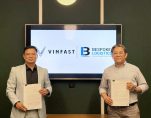
MANILA, PHILIPPINES – Media OutReach Newswire – 18 July 2026 – Global electric vehicle company VinFast has officially signed a strategic cooperation agreement with Bespoke Logistics, a Philippine provider of end-to-end automotive logistics solutions, to establish an integrated mobility processing center and authorized service workshop for the inspection and preparation of VinFast electric motorcycles prior to delivery. The partnership will help ensure vehicle quality, shorten delivery lead times, and lay a solid foundation for VinFast’s expanding electric motorcycle ecosystem in the Philippines.
Mr. Irineo Niño Fabros, CEO of VinFast Electric Motorcycles Philippines (left), and Mr. Allan A. Mina, President and CEO of Bespoke Logistics, at the signing ceremony.
Under the agreement, Bespoke Logistics will operate an integrated mobility processing center and VinFast-authorized service workshop, responsible for warehousing, vehicle inspection, technical preparation of electric motorcycles prior to delivery, vehicle yard management, and transportation. Located in Carmona City, Cavite Province, the 20,000-square-meter facility has a storage capacity of up to 30,000 vehicles, helping streamline vehicle preparation, improve operational efficiency, and ensure product quality before delivery to customers.
As part of the partnership, VinFast will work closely with Bespoke Logistics to implement technician training and certification programs, transfer standardized operating procedures and quality control processes, and establish a parts supply system to support aftersales operations.
Bespoke Logistics specializes in automotive logistics, offering an end-to-end service portfolio that includes pre-delivery inspection (PDI), warehousing, vehicle yard management, transportation, and vehicle delivery. The company also has extensive experience in warehouse-based technical operations and modern vehicle and inventory management systems, serving as a trusted logistics partner for multiple automotive brands in the Philippines.
Partnering with experienced local companies such as Bespoke Logistics will not only strengthen VinFast’s logistics and service capabilities in the Philippines but also provide a strong operational foundation for the delivery of its first electric motorcycles to customers.
The agreement forms part of VinFast’s long-term strategy to develop a comprehensive, international-standard electric motorcycle ecosystem in the Philippines. Alongside the launch of its diverse lineup of battery-swapping electric motorcycles, VinFast is steadily expanding its distribution network, aftersales services, and battery swapping infrastructure to deliver a seamless, convenient, and reliable ownership experience for customers.
Mr. Bui Viet Hung, VinFast Deputy CEO of Global Aftersales Service, said: “At VinFast, world-class products must be supported by robust infrastructure and exceptional aftersales services. Our partnership with Bespoke Logistics is a key milestone in strengthening our distribution and aftersales capabilities in line with global standards, ensuring that customers in the Philippines enjoy high quality products and services from day one of ownership.”
Mr. Allan A. Mina, President and CEO of Bespoke Logistics said: “We are proud to partner with VinFast as it develops its electric motorcycle ecosystem in the Philippines. We are committed to operating the facility in accordance with VinFast’s international standards while continuously enhancing our team’s capabilities and operational processes to support the brand’s long-term growth in the market.”
Over the past few years, VinFast has steadily built a green mobility ecosystem across the Philippines, Indonesia, India, and other international markets through strategic partnerships with local companies and ecosystem partners such as Green GSM and V-Green. In addition to electric motorcycles, VinFast is expanding its product portfolio to include electric cars, electric bicycles, and electric buses, providing consumers with more sustainable mobility options while accelerating the global transition to greener transportation.
Hashtag: #VinFast
The issuer is solely responsible for the content of this announcement.
About About VinFast
VinFast (NASDAQ: VFS), a subsidiary of Vingroup JSC, one of Vietnam’s largest conglomerates, is a pure-play electric vehicle (“EV”) company with the mission of making EVs accessible to everyone. VinFast’s product lineup today includes a wide range of electric SUVs, e-scooters, and e-buses.
VinFast is currently embarking on its next growth phase through rapid expansion of its distribution and dealership network globally while expanding its production footprint with a focus on key markets across North America, Europe, the Middle East and Asia.
Bespoke Logistics is a Philippine-based automotive logistics, warehousing, and mobility solutions company specializing in vehicle processing, stockyard management, electric vehicle support services, transportation, and distribution.
Through its Mobility Processing Center platform, Bespoke Logistics provides integrated solutions for automotive manufacturers, distributors, and emerging mobility brands operating in the Philippines.
Sultan Ahmed Bin Sulayem has taken direct charge of MMC Port Holdings following the immediate departure of group chief executive Azman Shah Mohd Yusof, placing Malaysia’s largest port operator under the control of its Emirati executive chairman. An internal company memorandum dated July 12 instructed employees to direct matters previously handled by the group chief executive to Bin Sulayem’s office. It did not explain Azman Shah’s departure […]
Dubai Investments has agreed to acquire the remaining 80 per cent of Clemenceau Medical Center in Dubai, placing the specialist hospital under the full ownership of the diversified investment group. The transaction will be completed through Dubai Investments Industries LLC, a wholly owned subsidiary, under a non-cash arrangement with the medical centre’s two other shareholders. Khansaheb Investment LLC will transfer its 55 per cent holding, while Clemenceau […]
GENEVA, SWITZERLAND – Media OutReach Newswire – 17 July 2026 – Competition authorities from BRICS countries have established a task force to conduct a joint sector inquiry into the global grain trade, marking a new step in cooperation on competition policy across international agricultural markets.
The decision was announced during the discussion “Competition Development in Global Grain Trade: Joint Efforts of BRICS Countries”, organized by the BRICS Competition Law and Policy Centre on the sidelines of the 23rd Session of the UNCTAD Intergovernmental Group of Experts on Competition Law and Policy in Geneva.
The event included a closed meeting of BRICS competition authorities and a public panel featuring researchers, academics and representatives of international organizations.
Discussions focused on competition in global grain markets, the growing influence of financialization and digitalization across agricultural value chains, and policy tools to improve market transparency. Participants also reviewed the findings of a joint report prepared by the BRICS Competition Centre and UNCTAD (link: https://www.bricscompetition.org/ru/grainreport) , first presented at the 9th BRICS International Competition Conference in Cape Town in 2025.
A coordinated market study
The central outcome of the meeting was the establishment of a BRICS task force that will coordinate a joint sector inquiry into global grain trade within the framework of the BRICS Working Group on Food Markets.
The task force will be co-chaired by Diogo Thomson, President of Brazil’s Administrative Council for Economic Defense (CADE), and Mahmoud Momtaz, Chairperson of the Egyptian Competition Authority (ECA).
Thomson welcomed the initiative and proposed making competition in global grain trade a key topic at the next BRICS International Competition Conference, scheduled to take place in Brazil in 2027.
“Brazil is the only jurisdiction that has launched an investigation into digital grain trading platforms such as Covantis. I therefore strongly welcome this sector inquiry, which will help us better understand the impact of digitalization across grain supply chains and the risks it may create for competition. I also support using the BRICS Competition Centre as the coordination platform for this work,” he said.
Momtaz said one of the main conclusions of the BRICS-UNCTAD report was the significant role speculative activity plays in global grain markets.
“One of the key findings of the report presented by the BRICS Competition Centre is the extent to which speculative factors influence global grain trade. The most effective response is greater market transparency. We should not accept a situation where farmers receive only a small share of the value they create while consumers in Egypt pay excessively high prices for bread. Where does this margin accumulate, and who ultimately benefits from it? These are the questions our sector inquiry should answer,” he said.
He also proposed that the task force develop a common AI-powered price monitoring tool covering BRICS grain markets.
“Such a tool would provide the information needed for market analysis and become an important complement to the joint sector inquiry,” Momtaz added.
From analysis to policy recommendations
Hardin Ratshisusu, Deputy Commissioner of the Competition Commission of South Africa, said the study should contribute to the implementation of the BRICS Grain Exchange initiative endorsed by BRICS leaders in the Kazan Declaration (2024) and the Rio de Janeiro Declaration (2025).
“The proposal to establish a BRICS Grain Exchange should become one of the key recommendations of the sector inquiry as an innovative mechanism for restoring competition in global grain trade. Our objective is not merely to identify market problems but to develop practical recommendations that can ultimately be submitted to the leaders of our countries,” he said.
Alexey Ivanov, Director of the BRICS Competition Law and Policy Centre, said competition authorities should play a central role in designing the institutional framework of the future exchange.
“The BRICS Grain Exchange should not become another formal institution. It must serve as a practical mechanism for improving competition and market transparency. Competition authorities are uniquely positioned to identify the institutional features that will allow the exchange to achieve these objectives,” he said.
Growing international role
Frédéric Jenny, Chairmanof the OECD Competition Committee, said the initiative demonstrated the growing international role of BRICS competition authorities.
“This project illustrates how BRICS competition authorities are becoming drivers of the global competition agenda. In the past, they largely followed the lead of developed jurisdictions. That is no longer the case. There are very few examples worldwide of such close cooperation between competition authorities. This applies not only to joint market studies, but also to enforcement cooperation and competition advocacy. Rather than acting individually, you have found both the mechanisms and the political will to work together,” Jenny said.
The task force will now begin developing the methodology and work plan for the joint inquiry. Its findings are expected to provide policy recommendations aimed at strengthening competition, improving transparency in global grain trade, and supporting future BRICS initiatives in agricultural markets.
Hashtag: #BRICSCompetition
The issuer is solely responsible for the content of this announcement.
India has barred shipping companies from assigning the country’s seafarers to vessels passing through the Strait of Hormuz, tightening safety measures after deadly attacks on merchant ships in the Gulf. The Directorate General of Maritime Administration issued the instruction through Circular No. 36 of 2026, dated July 15, directing shipowners, ship managers and recruitment and placement service companies to stop fresh deployments on voyages involving the strategic […]
Telegram has introduced a rich text editor that allows users to publish structured, article-length content directly inside chats, groups and channels, marking a significant expansion beyond conventional instant messaging. The editor supports headings, tables, numbered and bulleted lists, quotations, code blocks, mathematical formulas and media embedded within the body of a message. Users can compose posts of more than 32,000 characters, removing the need to divide detailed […]
GUIZHOU, CHINA – Media OutReach Newswire – 17 July 2026 – Direct flights now connect Malaysia and Guizhou, complemented by visa-free policies between China and Malaysia. Travelers can easily reach Guiyang from Kuala Lumpur in four hours and stay for up to 30 days per visit. With its cool climate, convenient transport, and favorable policies, Guizhou is becoming a preferred summer holiday destination for more Malaysian tourists. Guizhou is also building an international tourism product system centered on “summer retreat + ecology + culture.”
Escape to China’s Mysterious Guizhou and enjoy a cool 23°C summer retreat.
In midsummer July, Malaysian travel operators and cultural tourism influencers visited Guizhou, China, a renowned summer retreat, as if stepping into another season. Known as the “Green Karst Kingdom” and a “Natural Air Conditioner,” Guizhou has a mountainous area coverage of 92.5% and an average summer temperature of just 23°C. Beyond its cool climate, Guizhou offers a hidden-gem experience where spectacular landscapes meet diverse cultures, leaving every visitor amazed.
From the lush peak forests of Wanfenglin to the magnificent Huangguoshu Waterfall; from the emerald waters of Xiaoqikong to the cloud-covered summit of Mount Fanjing; and to the world-record Huajiang Grand Canyon Bridge spanning a deep gorge, every landscape in Guizhou is worth a stop. A Malaysian travel influencer remarked, “Before departure, I had only heard that Guizhou was a summer retreat. After visiting, I realized the surprises go far beyond 23°C.”
Cultural Experiences Full of Surprises
Visitors can enter distinctive villages and try intangible cultural heritage crafts such as Miao embroidery and batik; gather around a long-table banquet to taste local specialties such as sour soup fish and spicy chicken; explore cool hidden landscapes within a World Natural Heritage site with children through waterfall play and paddleboarding; or venture deep into ancient caves for an underground adventure. From heritage crafts to nature exploration, Guizhou offers family-friendly experiences for everyone to enjoy.
A Spontaneous Trip Made Easy
This summer, reserve a ticket for Mysterious Guizhou, and begin your “summer escape plan.”
Smoke from wildfires burning across Canada and northern Minnesota blanketed large parts of the United States on Thursday, pushing air pollution to dangerous levels and placing millions of people under health alerts from the Upper Midwest to the East Coast. More than 20 states were affected as dense smoke travelled south and east on north-westerly winds. The sharpest deterioration was recorded around the Great Lakes, where parts […]
BlackRock’s spot Bitcoin exchange-traded fund held about 733,500 tokens valued at more than $47.5 billion on July 15, cementing its position as the dominant regulated Bitcoin investment product in the United States. The latest official portfolio data differs slightly from a widely circulated social media claim that the iShares Bitcoin Trust held 734,762 Bitcoin worth $47.1 billion. Holdings change each trading day as authorised participants create or […]
Recognition highlights the TrendAI™ partner-first platform model, ecosystem expansion, and AI-driven tools supporting partner-led growth
HONG KONG SAR – Media OutReach Newswire – 16 July 2026 – TrendAI™, the enterprise AI security leader from Trend Micro Incorporated (TYO: 4704; TSE: 4704), is celebrating its fourth consecutive year as a Champion in the Omdia Global Cybersecurity Leadership Matrix 2026. The report evaluated 24 security vendors across both Momentum and Leadership dimensions, recognizing TrendAI™ in the top three for continuous commitment to building one of the industry’s most capable and rewarding partner ecosystems.
According to Omdia, Champion status reflects strong channel management, robust market performance, and a proactive approach to advancing the cybersecurity partner ecosystem.
Matthew Ball, Chief Analyst at Omdia: “TrendAI™ reaffirmed its position as a Champion by focusing its portfolio on the unified TrendAI Vision One™ platform and establishing the Global Partner Office. A flexible consumption model increased recurring revenue and improved margin predictability, while the refreshed Partner Portal, expanded enablement, and AI-driven tools supported significant Partner Program adoption, partner-led renewals, and services-led growth globally.”
Sanjay Mehta, Senior Vice President, Global Partner Office at TrendAI™: “Omdia’s findings reflect the progress we are seeing across our global partner ecosystem as we continue to make the TrendAI™ Partner Program more impactful, profitable, and services-led. In the first half of 2026, partner-driven deal registration value grew 2.3x YoY, reaching $1.47 billion. This momentum reflects the trust partners are placing in TrendAI™, the strength of our platform-first strategy, and the growing opportunity for partners to deliver AI-powered security outcomes through TrendAI Vision One™.”
Omdia cited several partner-focused drivers behind this Champion designation:
A strategic commitment to AI security was solidified through the rebrand from the enterprise business unit of Trend Micro to TrendAI™, delivering best-in-class threat intelligence and AI-driven virtual patching capabilities that help customers stay ahead of emerging threats and vulnerabilities
Partner momentum accelerated with an emphasis on expansion-focused playbooks which drove strong growth in multi-solution and service attachment and resell motions
Increased recurring revenue and improved margin predictability through a flexible consumption model which drove a 759% increase in adoption of TrendAI Vision One™ for service providers and continues to provide infinite flexibility and faster time to value
Simplified partner-led demand generation and deal qualification through the introduction of TrendIQ for Partners, a dedicated LLM for partners giving intuitive access to validated product and program information. These tools helped partners generate 7.8K automated playbooks and run 12.5K TrendAI Vision One™ demos in H1 2026, accelerating customer engagement, co-marketing , and services-led growth
TrendAI™ will deepen its platform and partner-first model, and continue to expand its partnerships ecosystem, co-selling with alliances such as NVIDIA, AWS, Anthropic, Databricks, and OpenAI
The TrendAI™ partner-first approach is also reflected in the experiences of partners globally.
Rob Swainson, Director at Blue Cube Security: “It’s not just about great technology—it’s about having a partner that genuinely cares about helping us deliver the best outcomes for our customers, based on what’s right for each customer. That shared commitment to customer outcomes is what makes this partnership so valuable.”
To read a full copy of the report, visit our website.
The issuer is solely responsible for the content of this announcement.
About TrendAI™
TrendAI™, the global AI security leader and enterprise business unit of Trend Micro, empowers organizations with full AI visibility and consolidated security that inspires confidence, drives innovation, and eliminates risk. Trusted by the largest enterprises and governments across 185 countries, TrendAI™ secures the entire organization, from identities to infrastructure to data. Global Fortune 500 companies rely on TrendAI™ to cut risk and stop threats up to three months earlier, powered by world-leading threat and attack intelligence. Through deep ecosystem partnerships with market leaders like NVIDIA, Anthropic, AWS, Google, and Microsoft, TrendAI™ empowers your organization to securely drive forward at the speed of AI. AI Fearlessly. Learn more at trendaisecurity.com.
Guardian Fire Services has acquired Nebraska-based Midwest Protection Services, extending the Investcorp-backed fire and life safety platform into the Omaha market as consolidation accelerates across the US safety-services industry. Financial terms were not disclosed. The transaction is Guardian’s second acquisition since Investcorp bought the Nashville-headquartered company from Northern Lakes Capital in December 2025, highlighting an early push to expand the platform through regional purchases. Midwest Protection Services […]
TAIPEI, TAIWAN – Media OutReach Newswire – 16 July 2026 – CyCraft (Stock Code: 7823) has been recognized by the global business and technology insights organization Gartner in its latest report, “Emerging Tech: AI Vendor Race: Reasoning Models Reshape Providers’ Approaches to AI Pricing.” In this report focusing on AI Reasoning Models, CyCraft is named as a Sample Provider, making it the only Taiwan-based cybersecurity company included in the full list.
CyCraft’s XCockpit platform integrates comprehensive, quantified metrics for external exposure, internal attack surface management, and endpoint protection within a single unified interface.
Dr. Benson Wu, CEO and Co-Founder of CyCraft, stated: “We believe, being listed as a Sample Providerin the Gartner report demonstrates that the global market now views AI security as the next battlefield for AI commercialization. From day one, CyCraft has developed proprietary models, simultaneously deploying AI reasoning capabilities across three core pillars: cybersecurity defense, AI governance, and unmanned vehicle reconnaissance. Technical leadership is our starting point, not the destination. Our goal is to translate this leadership into rapid growth driven by strategic deployment and disciplined execution. Launched this year, our AI Red Teaming and AI Guardrail solutions have already been productized and commercially shipped, seeing active deployment in sectors like semiconductors and sovereign AI.”
AI Reasoning Models Drive Up Operating Costs, Restructuring Profit Logic
As AI transitions from “training models” to “reasoning models,” the industry officially moves from the research and development phase into commercial application. Reasoning models possess logical deduction, self-reflection, and complex problem-solving capabilities. However, these advanced capabilities have caused AI operational costs to skyrocket, forcing the tech industry to redefine its expectations of AI as a tool for massive cost reduction and profit maximization.
CyCraft’sXCockpit Threat Exposure Management Platform features built-in AI reasoning models that triage thousands of alerts in real time, automatically providing mitigation recommendations and effectively eliminating alert fatigue. From overall security posture scoring to specific actionable tickets for individual alerts, XCockpit transforms defensive benefits—which were historically difficult to define—into concrete, quantifiable technical metrics. This embodies CyCraft’s pragmatic philosophy: the value of defense must be visible, and it must be measurable.
Standing at the Frontier of AI Security, CyCraft Advances Commercial Implementation with Profound R&D Momentum
Deeply integrating AI with cybersecurity, CyCraft has launchedXecGuard andXecART—two major AI security products deployable across both cloud and on-premises environments, both featured on theOWASP AI Security Map. These solutions directly address the core pain points of Agentic AI, LLM, and GenAI applications. XecART utilizes Agentic Red Teaming to run multi-round stress tests on models, identifying risks and generating compliance reports that adhere to international standards. Meanwhile, XecGuard acts as a real-time Guardrail for LLMs and AI Agents, intercepting anomalous inputs and outputs. One solves “how to stress-test AI,” while the other solves “how to protect AI,” providing the fundamental AI governance for enterprises.
CyCraft’s research achievements are equally outstanding. The CyCraft research team recently presented at theInternational Conference on Machine Learning (ICML), one of the world’s top three prestigious academic conferences for AI and machine learning. The research focused on Retrieval-Augmented Generation (RAG) Data Poisoning. Utilizing their self-developed “Eyes-on-Me” attack framework, the team proved that attacks can simultaneously breach both the retrieval and generation phases. The end-to-end average attack success rate surged from 21.9% to 57.8%. This breakthrough exposed a long-neglected vulnerable attack surface existing between “attention focus” and “model output.”
In 2025, the CyCraft research team was also selected forNeurIPS, one of the most iconic academic sanctuaries in the AI field. The team proposed an innovative “unified supervision framework” that embeds verifiable checkers into synthesized instruction-conflict instances, enabling self-supervised learning without requiring oracle labels or reasoning traces. This framework not only applies to different models but also significantly enhances both safety robustness and instruction adherence.
CyCraft demonstrates outstanding R&D achievements, presenting at ICML—one of the world’s top three elite conferences in AI and machine learning.
CyCraft believes that as AI moves from R&D to commercial deployment, the barrier for enterprises is no longer “whether they can use AI,” but “whether they can use AI responsibly.” Once Agentic AI enters financial transactions, government services, or critical infrastructure, every autonomous decision must leave a traceable path, accept auditing, and allow for real-time human intervention when necessary. This is true AI governance. It is not a compliance document, but a complete control chain stretching from pre-launch to runtime, and onto post-incident traceability.
CyCraft deconstructs this control chain into three actionable phases: XecART stress-tests model risks before deployment; XecGuard safeguards inputs and outputs during runtime; XCockpit quantifies the overall risk posture into traceable metrics. Interlocking these three components ensures that every step AI takes is visible, manageable, and auditable. CyCraft’s objective is clear: make AI behavior measurable before its value can be priced. Ultimate technical leadership must be converted into commercial resilience that is governable, auditable, and open to investor scrutiny.
The technological revolution of AI Reasoning Models and Agentic AI is an undeniable reality. The ultimate challenge lies in whether enterprises can implement “controllable, auditable, and highly transparent” AI governance within real-world commercial environments. From being recognized in international research reports to taking the stage at top-tier academic conferences, CyCraft continues to prove that from visionary R&D to product commercialization, Taiwan’s AI cybersecurity prowess helps herald the future of a secure, trusted, and prosperous AI era.
Reports Gartner, Emerging Tech: AI Vendor Race: Reasoning Models Reshape Providers’ Approaches to AI Pricing, 5 June 2026.
Disclaimer Gartner does not endorse any company, vendor, product or service depicted in its publications, and does not advise technology users to select only those vendors with the highest ratings or other designation. Gartner publications consist of the opinions of Gartner’s business and technology insights organization and should not be construed as statements of fact. Gartner disclaims all warranties, expressed or implied, with respect to this publication, including any warranties of merchantability or fitness for a particular purpose. GARTNER is a trademark of Gartner, Inc. and its affiliates.
Hashtag: #CyCraftTechnology
The issuer is solely responsible for the content of this announcement.
About CyCraft
CyCraft Technology (7823.TW) is a Taiwan-listed cybersecurity company, dedicated to automating cybersecurity with AI technology and safeguarding AI models. CyCraft’s product suite encompasses XecART, the AI Red Teaming, and XecGuard, the Guardrail API for LLMs and AI Agents. The XCockpit AI platform integrates EASM, IASM, and Endpoint protection, providing preemptive and real-time defense-in-depth. With a proven track record in the government, finance, and semiconductor sectors, and recognition from international institutions, CyCraft continues to safeguard enterprise digital resilience.
ENSHI, CHINA – Media OutReach Newswire – 15 July 2026 – With China’s inbound visa-free policies continuing to be optimized, the Suobuya Stone Forest Scenic Area, located in Enshi Tujia and Miao Autonomous Prefecture, Hubei Province, is welcoming Southeast Asian tourists with a refreshed experience. Known as the “World’s First Ordovician Stone Forest,” this 460-million-year-old geological wonder has introduced a series of diverse cultural experiences and interactive programs in 2026, offering Southeast Asian visitors a journey through natural and cultural wonders spanning hundreds of millions of years.
Geological Wonder: Exploring an Ancient Underwater World from 460 Million Years Ago
Located in Taiyanghe Township in the northwest of Enshi City, Suobuya Stone Forest is approximately a one-hour drive from the city center. The scenic area was formed during the Ordovician Period 460 million years ago. Originally covered by an ancient ocean, it gradually evolved through geological transformations over hundreds of millions of years into the extraordinary stone forest landscape seen today. Covering a total area of 21 square kilometers, the area features towering stone peaks surrounded by lush greenery, resembling a vast “underwater labyrinth.” As a “crowned stone forest” with one of the highest vegetation coverage rates in China, the scenic area enjoys a cool and pleasant average summer temperature, making it an ideal destination for summer retreats and nature-based relaxation.
The four major scenic areas currently open to visitors each have their own unique appeal. Qinglongtai serves as the highest point of the scenic area, offering panoramic views of the entire stone forest from above. Lianhuazhai features the breathtaking “Xiniugou” secret landscape, where towering cliffs on both sides and changing light and shadows create a dreamlike atmosphere. Mozigou is rich in ancient biological fossils, allowing visitors to touch traces of life from the Ordovician Period with their own hands. Jiulonghui features circular rock walls and groups of waterfalls, with stone peaks rising dramatically from the ground to create a magnificent landscape. The scenic area also features the 5D theater “Shanhaijing,” where visitors can enjoy an immersive experience of the evolution of the Ordovician ocean world. With gentle walking trails and an easy travel route, the area is suitable for families and nature exploration enthusiasts.
Cultural Feast: Immersive Experiences of Tujia Folk Traditions
Suobuya Stone Forest is not only a treasure trove of geological wonders but also an important carrier of Tujia culture. The Tujia ethnic group is one of the major ethnic minorities in the Enshi region, with a long history and distinctive cultural traditions. The “Baishou Dance” is one of the most representative folk dances of the Tujia people and has been listed as a National Intangible Cultural Heritage. The dance movements often imitate scenes such as hunting, farming, and warfare, featuring a lively rhythm. Visitors can personally participate in this cultural experience at the Tiejiazhai Square and Duigetai Stage.
The Tujia Girls’ Festival is one of Enshi’s most distinctive traditional folk festivals and has been held at Suobuya Stone Forest during the seventh month of the lunar calendar for many consecutive years. The festival is a traditional social activity where young Tujia men and women use songs as a medium for communication and dances to express emotions. It carries the unique marriage customs and collective memories of the Tujia people and has been recognized as a provincial-level intangible cultural heritage of Hubei Province and one of the “Top Ten Most Charming Festivals in China.” During the festival, the scenic area hosts a variety of activities, including matchmaking through folk songs, traditional cultural parades, and traditional handicraft exhibitions, allowing visitors to experience the rich ethnic culture amid the stone forests and mountain scenery. Suobuya Stone Forest has therefore also been recognized as the “Hometown of Chinese Folk Art” and the “Hometown of Mountain Folk Songs.”
Since 2026, the scenic area has continued to enhance its tourism products and cultural experiences. During the May Day holiday, it launched the “Exploring Wonders on Horseback · Fun in the Million-Year Stone Sea” folk culture series, featuring interactive programs such as folk song and dance flash mobs, the “Nature Guardians” activity where visitors exchange collected litter for cultural souvenirs, the immersive intangible cultural heritage experience “Stone Workers’ Chant,” and the outdoor role-playing game “Stone Forest Secret Order · Pursuing the Shadow of Rocks.” These activities allow visitors to explore the ancient stone sea while deeply engaging with Tujia cultural traditions.
Improved Transportation: Easier Access to Enshi for Southeast Asian Tourists
Since the opening of Enshi Xujiaping International Airport’s aviation port, the international flight network has continued to improve. In 2026, the Enshi–Hong Kong route achieved year-round regular operation, while flights between Enshi and Vietnam’s Ho Chi Minh City and Hanoi have resumed successively, creating a dual-route network connecting Vietnam’s two major cities in the north and south. According to the development plan of the Enshi aviation port, new routes to Singapore, Kuala Lumpur in Malaysia, and other destinations will be steadily promoted in the future, further strengthening the Southeast Asian aviation network. Tourists from major Southeast Asian cities can fly directly to Enshi and reach this 460-million-year-old underwater world after only a one-hour drive. Hidden deep within the Wuling Mountains, this ancient stone forest wonderland is welcoming visitors from around the world with a more open and international approach. Hashtag: #SuobuyaCulturalTourism
The issuer is solely responsible for the content of this announcement.
By Nantoo Banerjee Fake news is flooding across India’s nearly half-a-billion social media and messaging platforms, threatening trust, relationships, and democratic processes. The country, boasting almost a billion internet subscriptions, is facing a growing crisis of misinformation with digital content spreading faster than truth across the online community. To add to the concern are Artificial […]





 https://imperialharvest.com/
 https://www.instagram.com/imperialharvest/


 https://www.linkedin.com/company/acerobotics/posts/?feedView=all&viewAsMember=true%EF%BD%9C
 https://x.com/ace_robotics






 https://www.facebook.com/trendaisecurity/