News related to
price

KUALA LUMPUR, MALAYSIA – Media OutReach Newswire – 31 January 2025 – Memecoins were on the rise in 2024. Their overall market capitalisation increased from $20 billion last January up to $120 billion in December 2024. Such coins as DOGE, PEPE, or SHIB have thrived, primarily driven by community support and innovative strategies. Some experts have even acknowledged meme coins as a viable crypto trend. TRUMP, a […]

Matein Khalid In a week where Nasdaq’s fabled AI trade was slammed by the emergence of Chinese startup DeepSeek and the vision of a much lower cost efficient and less intensive energy usage performance models, it is ironic that Microsoft (MSFT) shares have traded down to 413 on its Azure stumble even though the world’s preeminent software franchise will be the prime winner from lower cost AI […]

By Dr. Nilanjan Banik The Budget deals with allocating money towards areas where the government thinks it is essential to spend, and finding out ways such as taxes, to finance it. The government primarily requires money to spend on social infrastructure (such as schools, hospitals, water, sanitation, etc.), physical infrastructure (such as railways, roads, airports, […]
As the cryptocurrency landscape evolves, investors are closely monitoring projects with the potential to outperform established coins in the first quarter of 2025. Among these, Lightchain AI has garnered significant attention for its innovative approach to integrating artificial intelligence with blockchain technology.

Lightchain AI distinguishes itself through its Proof of Intelligence consensus mechanism and the Artificial Intelligence Virtual Machine . The PoI system rewards nodes for executing AI-specific tasks, such as model training and inference, thereby enhancing both network security and advancing AI capabilities. The AIVM provides a dedicated environment for running AI workloads, positioning Lightchain AI as a versatile platform for industries including healthcare, finance, and supply chain management. During its presale phase, Lightchain AI raised over $8 million, with tokens priced at $0.004875 each. Analysts predict that by the end of Q1 2025, the token could reach values between $0.15 and $0.20, contingent on adoption rates and ecosystem development.

In addition to Lightchain AI, other cryptocurrencies are anticipated to perform well in early 2025. Ethereum , the leading platform for decentralized applications and decentralized finance , is expected to benefit from the increasing adoption of Layer 2 scaling solutions like Arbitrum and Optimism. These solutions aim to enhance transaction throughput and reduce fees, thereby improving user experience. Price forecasts for Ethereum suggest it could reach between $5,000 and $6,000 in the first quarter, driven by the growing popularity of DeFi platforms and non-fungible tokens .

Cardano , recognized for its research-driven approach and commitment to scalability, is also on investors’ radars. The platform’s focus on sustainability and decentralized governance has attracted a dedicated community. With the anticipated launch of enhanced DeFi capabilities in early 2025, Cardano’s utility is expected to increase. Analysts project that ADA could trade between $1.50 and $2.50 during this period, with potential for higher gains if its ecosystem achieves significant adoption.

The broader cryptocurrency market is experiencing a surge in interest, partly due to favorable regulatory developments. The current U.S. administration has signaled a more crypto-friendly stance, with proposals to appoint pro-crypto figures to key regulatory positions. This shift is expected to provide greater clarity and support for the industry, potentially leading to increased institutional investment and mainstream adoption.

XRP, a prominent cryptocurrency, is poised for a significant development with the potential launch of futures contracts. The Chicago Mercantile Exchange Group has indicated that it may introduce XRP futures as early as February 10, pending regulatory approval. This move is anticipated to enhance market liquidity and provide investors with new avenues for trading and hedging.

In the meantime, the memecoin PEPETO has gained substantial attention, surpassing $4 million in its presale phase. This surge reflects growing investor interest in alternative cryptocurrencies, particularly those with unique features and strong community engagement.

The proposed launch of XRP futures by CME represents a significant milestone for the cryptocurrency market. Futures contracts allow investors to speculate on the future price of an asset, providing opportunities for both hedging and profit. The introduction of such products is expected to attract institutional investors, thereby increasing market depth and stability. However, the CME has clarified that the information regarding the launch was released prematurely and that no official decisions have been made.

XRP’s price surge in 2025 has brought attention to the asset’s growing dominance on centralized exchange platforms, with more than 23% of the total circulating supply concentrated in the hands of just 11 exchanges. This significant shift raises concerns about liquidity and market control, particularly as XRP edges closer to its historic highs. As the cryptocurrency continues to see rising demand, a closer look at its distribution and trading volumes reveals the intricate relationship between exchange platforms and the price movement of the digital asset.

Data from prominent blockchain analysis firms show that XRP, with over 57 billion tokens in circulation, has seen a substantial amount of its supply centralized in the portfolios of top exchanges. The concentration of this cryptocurrency in a few hands is a critical factor in understanding its volatile price fluctuations. As the supply becomes more concentrated, it gives these platforms an increased influence over the market, potentially leading to artificial price movements or market manipulation concerns. This shift highlights the growing power of centralized entities within the largely decentralized cryptocurrency landscape.

The leading exchanges holding the bulk of XRP tokens include major players such as Binance, Coinbase, and Kraken, all of which are involved in substantial XRP trading volumes. With these platforms holding large percentages of the total supply, their actions—whether it be large-scale buying or selling—have the ability to drastically impact XRP’s price. The trend reflects a broader shift in cryptocurrency trading, where institutional involvement and the growing consolidation of supply on fewer exchanges are altering the dynamics of market liquidity and price stability.

The significant concentration of XRP on centralized exchanges has sparked debates about the risks and benefits of such an arrangement. Proponents argue that centralized exchanges provide the necessary infrastructure for retail investors to access and trade XRP, facilitating broader adoption. They also highlight that these platforms typically offer more robust security features, which may attract a broader base of traders seeking stability in the sometimes volatile world of cryptocurrencies. Furthermore, centralized exchanges can often offer quicker trade execution, which is vital for users seeking to capitalize on XRP’s price movements.

However, critics of the centralization trend express concerns about the potential for market manipulation. When large portions of a cryptocurrency’s supply are held on a limited number of exchanges, it increases the risk of coordinated actions that can influence the price, creating an uneven playing field for smaller investors. These exchanges, by virtue of their size and control over supply, have the ability to move the market by either buying or selling large quantities of tokens, which could lead to artificial inflation or deflation of XRP’s price.

The reliance on centralized exchanges raises questions about decentralization, a core value within the cryptocurrency community. While XRP itself is often viewed as a decentralized asset, its increasing concentration in the hands of centralized players seems at odds with the ethos that many in the cryptocurrency world champion. The trend challenges the notion that digital currencies should be accessible and controlled by individuals rather than large institutional players.

The increase in centralized exchange holdings of XRP coincides with a broader trend in the cryptocurrency market, where the role of institutional investors and exchanges has become more pronounced. In particular, the rise of institutional investment products like ETFs and futures contracts has contributed to the growing presence of centralized entities in the digital asset space. These developments suggest that the market may be moving toward greater institutional control, further distancing itself from the decentralized vision that once defined cryptocurrencies.

As XRP continues to attract attention from institutional investors, its price has experienced significant fluctuations. The cryptocurrency market, known for its volatility, is deeply influenced by factors such as regulatory developments, technological advancements, and large transactions by institutional traders. XRP’s price surge in 2025 can be attributed to multiple factors, including increased interest from retail investors, positive regulatory developments, and a more favorable market environment for cryptocurrencies as a whole. However, the dominance of centralized exchanges raises questions about the long-term sustainability of these price gains.

While XRP’s price may be reaching new heights, analysts are also focused on the underlying risks associated with the growing concentration of the asset in centralized platforms. As exchanges continue to hold more of the circulating supply, the potential for large price swings increases, particularly if these platforms decide to shift large amounts of XRP or if regulatory actions cause market disruptions. The market remains highly sensitive to external factors, with price movements often reflecting shifts in investor sentiment, technological advancements, and regulatory changes.

Transak, a Web3 payment infrastructure provider, has partnered with Uranium.io, a blockchain-based uranium trading marketplace, to allow retail investors to purchase tokenized uranium using cryptocurrency. This innovative move significantly lowers the barriers to entry for uranium investments, allowing crypto users to access the market for as little as $10, a stark contrast to the previous minimum investment of $4.2 million required for over-the-counter uranium trades.

The partnership is poised to transform the way investors approach the commodity sector, specifically the uranium market, by leveraging blockchain technology. Tokenization, a process that converts physical assets into digital tokens, has been gaining traction across various industries, including real estate, fine art, and now, commodities like uranium. This collaboration between Transak and Uranium.io provides a simplified and accessible way for retail investors to buy tokenized uranium and trade it on a decentralized marketplace.

The decision to lower the minimum investment requirement is a strategic move aimed at democratizing access to a market that was once largely restricted to institutional investors and high-net-worth individuals. The ability to invest in uranium using cryptocurrencies like Bitcoin or Ethereum opens up a new avenue for crypto enthusiasts to diversify their portfolios. Uranium.io’s blockchain-based platform facilitates this process, offering a secure and transparent trading environment for both new and experienced investors.

Uranium.io, the world’s first blockchain-based uranium trading marketplace, has been at the forefront of bringing traditional commodities onto the blockchain. By tokenizing uranium, the platform aims to increase liquidity and accessibility within an otherwise opaque and illiquid market. Historically, uranium trading has been dominated by large-scale transactions, with over-the-counter trades involving millions of dollars in capital. The lack of transparency and the high financial threshold meant that retail investors were largely excluded from the market. However, tokenization allows for fractional ownership of uranium, enabling smaller-scale investments.

Through the integration with Transak, a company known for simplifying cryptocurrency payments, users can now purchase tokenized uranium in smaller amounts, enabling more people to participate. Transak’s seamless integration with various cryptocurrencies, coupled with the ability to purchase tokenized uranium, simplifies the process for users who are already familiar with crypto-based transactions. The platform supports a variety of cryptocurrencies, making it easy for users to buy tokenized uranium using their preferred digital assets.

The move towards tokenized uranium comes at a time when the commodity has gained attention due to its critical role in the global energy transition. Uranium is a key component in nuclear energy production, which has seen a resurgence as nations seek to reduce their carbon footprints and meet energy demands. As the world turns towards cleaner energy solutions, uranium’s role in powering nuclear reactors becomes increasingly important. By enabling wider access to uranium trading, the Transak-Uranium.io partnership could help facilitate investments in the sector at a time of growing demand.

The flexibility and accessibility of blockchain technology have made tokenization a powerful tool for unlocking value in traditionally illiquid markets. With the tokenization of uranium, the asset can be traded more efficiently, enabling investors to take advantage of price fluctuations and market trends in real-time. This also brings increased transparency to the uranium market, as blockchain provides an immutable ledger of transactions that can be publicly verified.

This partnership could also pave the way for other commodity markets to explore tokenization as a method of broadening access to retail investors. As the crypto ecosystem continues to expand, industries like energy, mining, and agriculture may follow suit by adopting blockchain technology to enable fractional ownership and trading of physical assets. For now, the tokenized uranium market offers a promising glimpse into the future of commodity trading.

For many investors, the tokenization of uranium is an opportunity to capitalize on the commodity’s potential growth. With the energy crisis and the global push for sustainability, uranium’s value is likely to increase as more countries invest in nuclear power. Tokenized uranium offers investors a way to gain exposure to the uranium market without having to deal with the complexities of traditional trading methods, such as securing physical uranium or navigating over-the-counter markets.

The growth of decentralized finance and the rise of blockchain-based platforms for commodity trading are part of a larger trend in which the traditional financial system is being redefined. Investors are increasingly looking for alternative investment opportunities that offer greater flexibility, transparency, and lower entry barriers. The Transak-Uranium.io partnership aligns with this trend, offering a new way to access an asset class that was previously difficult to reach.

Despite the advantages that tokenized uranium offers, there are still challenges to overcome. The regulatory landscape for tokenized commodities is evolving, and there is a need for greater clarity on how tokenized assets are classified and taxed. Additionally, the volatility of cryptocurrency markets presents risks for investors who may not be accustomed to the price swings of digital assets. However, for those willing to embrace these risks, the potential rewards could be substantial.

Advertisements

A new digital token, WallitIQ , has captured the attention of analysts and investors, with predictions suggesting it could achieve a massive 50,000% rally by mid-2025, eclipsing the popular cryptocurrency Dogecoin . The bold projections, which draw parallels between WLTQ and the early success of Dogecoin, have set the stage for what could become one of the most significant DeFi market shifts in the coming years.

WallitIQ, currently priced at approximately $0.0420 per token, has generated a considerable amount of buzz in cryptocurrency communities. Analysts are noting the token’s potential for rapid growth, especially in light of the ongoing boom in decentralized finance projects. Unlike Dogecoin, which initially gained popularity as a meme coin, WallitIQ is positioning itself as a functional asset within the expanding DeFi ecosystem, offering utilities that could drive its value through real-world adoption.

What differentiates WallitIQ from Dogecoin, and why are experts so optimistic? The DeFi sector, which WallitIQ is part of, has been on an upward trajectory, fueled by decentralized exchanges , yield farming, and liquidity pools. DeFi has redefined how digital assets are utilized, allowing for more utility and, by extension, more growth potential for tokens like WallitIQ. In contrast, Dogecoin, though immensely popular, remains limited in terms of real-world use cases outside of speculative trading and social media-driven movements.

The high expectations surrounding WallitIQ stem from its innovative features and its backing by a team of blockchain experts who have managed to secure strong partnerships within the DeFi space. This network of relationships could contribute significantly to the token’s adoption, boosting its value through greater use within decentralized applications and services. These developments are crucial, as cryptocurrencies with tangible applications tend to experience more sustained growth than those reliant solely on speculative interest.

The rise of WallitIQ has coincided with a growing interest in alternative cryptocurrencies to traditional tokens like Bitcoin and Ethereum. As investors look for new opportunities in the ever-evolving crypto space, many are turning their focus to promising altcoins, with WallitIQ being a prominent contender. The token’s relatively low price point also makes it an attractive option for those looking to capitalize on a potential long-term gain, especially given the expected surge in value predicted by leading market analysts.

Industry experts point to several factors that may contribute to WallitIQ’s rapid ascension. One of the most critical factors is the growing focus on token utility and the integration of real-world applications. WallitIQ’s team has reportedly been in talks with various companies across different sectors to integrate their token into products and services, potentially increasing its demand. This type of strategic partnership has been key to the success of other DeFi tokens, setting a strong precedent for WallitIQ’s potential growth.

The broader trend of increasing institutional interest in DeFi projects cannot be ignored. With major financial institutions and venture capital firms showing greater willingness to invest in decentralized finance, the influx of capital into promising projects like WallitIQ could drive its value to new heights. Unlike Dogecoin, which largely relies on community sentiment and social media trends, WallitIQ’s strong backing and institutional interest set it apart in a rapidly maturing market.

Despite the optimism surrounding WallitIQ, experts acknowledge that the cryptocurrency market remains volatile, and predictions of 50,000% returns should be viewed with caution. Historical trends show that while some tokens have achieved significant growth, the crypto market is still highly speculative and unpredictable. Investors are advised to consider the risks involved before diving into projects that promise astronomical returns.

However, the overarching trend of DeFi and the increasing acceptance of blockchain-based financial systems suggest that WallitIQ is well-positioned to capture a larger share of the market. As more individuals and institutions turn to decentralized platforms for their financial needs, WallitIQ’s utility could play a significant role in driving its value beyond even the most optimistic projections.

At the heart of WallitIQ’s anticipated growth is its potential to carve out a niche within the DeFi space that not only challenges Dogecoin’s dominance but offers a more robust, practical alternative for investors seeking tokens with long-term viability. If the predictions hold true, WallitIQ could soon become one of the most talked-about tokens in the cryptocurrency world, outpacing even the established giants of the market.

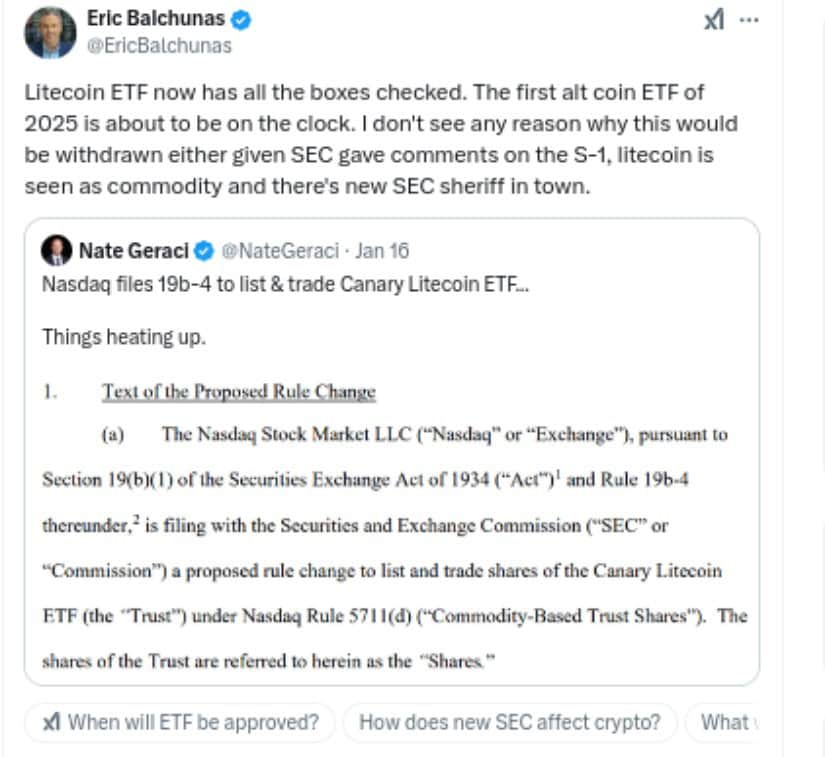
Nasdaq has officially filed a 19b-4 form with the U.S. Securities and Exchange Commission in support of the Canary Litecoin ETF proposal, marking a significant step towards the launch of a new cryptocurrency-focused exchange-traded fund . This move follows earlier discussions with the SEC, which had requested Canary Capital to amend its S-1 filing for the proposed ETF.

The Canary Litecoin ETF, first introduced by Canary Capital in October 2024, aims to provide investors with direct exposure to Litecoin , one of the top cryptocurrencies by market capitalization. Unlike traditional ETFs, which typically track stocks or commodities, the Litecoin ETF would provide a structured way to invest in the digital currency, bringing the asset class closer to mainstream financial markets.

The filing of the 19b-4 form with the SEC is a crucial step in the approval process for the ETF. This form is used by exchanges to propose rule changes related to the listing and trading of securities. By submitting the form, Nasdaq is seeking approval to list the Canary Litecoin ETF on its exchange, a move that could open the door for broader institutional and retail investor participation in the Litecoin market.

The SEC’s role in the process is central to the success of the proposal. The regulatory body has long been cautious about approving cryptocurrency-based ETFs, primarily due to concerns about market volatility, liquidity, and potential manipulation. However, recent developments, including the approval of Bitcoin ETFs, have sparked renewed optimism that Litecoin, as a leading cryptocurrency, may also be considered for ETF approval.

Nasdaq’s filing comes after the SEC’s request for amendments to the S-1 form, which is required for the registration of the proposed ETF. The amendments were aimed at clarifying certain aspects of the ETF’s structure and compliance with SEC regulations. Canary Capital responded to the SEC’s concerns and has now moved forward with the 19b-4 filing, signaling confidence in the proposal’s approval.

If approved, the Canary Litecoin ETF would be the first of its kind to offer exposure to Litecoin, allowing investors to buy shares in the fund without needing to directly hold or manage the cryptocurrency. This would simplify the process for those looking to invest in Litecoin while also providing the regulatory oversight that traditional ETFs enjoy. It could also have a significant impact on the adoption of Litecoin as an asset class, especially among institutional investors who may have been hesitant to invest in digital currencies without a regulated investment vehicle.

The move aligns with a broader trend in the cryptocurrency industry, where more companies are attempting to bridge the gap between traditional finance and digital assets. Bitcoin ETFs, which track the price of Bitcoin, have gained traction in the past few years, prompting a reassessment of how other major cryptocurrencies could also be packaged in a similar way for investors. Litecoin, which was created in 2011 by Charlie Lee as a “lighter” alternative to Bitcoin, has gained substantial traction in the crypto space and is often considered one of the more stable digital assets, making it a prime candidate for an ETF product.

The filing also comes amid growing interest in alternative investment products, especially in the wake of a year marked by significant price volatility in traditional financial markets. Investors are increasingly turning to cryptocurrencies as a hedge against inflation and economic uncertainty, and an ETF could provide a more accessible route for them to gain exposure to the digital asset class.

Despite the excitement surrounding the potential approval of a Litecoin ETF, the SEC’s cautious stance on cryptocurrency products means the approval process is unlikely to be straightforward. The regulatory body has previously expressed concerns about the potential for market manipulation in the cryptocurrency space, and the Canary Litecoin ETF will likely face intense scrutiny. However, the SEC’s approval of Bitcoin ETFs has created a more favorable environment for other digital assets, and many market participants are hopeful that the SEC will ultimately grant approval for the Litecoin ETF as well.

For Nasdaq, the filing represents a key strategic move in solidifying its position as a leader in the growing cryptocurrency market. As more institutional investors seek regulated ways to engage with cryptocurrencies, exchanges like Nasdaq are well-positioned to capitalize on the trend by offering products like the Canary Litecoin ETF.

The approval of a Litecoin ETF would not only provide a new investment opportunity for retail and institutional investors but also send a strong signal to the broader financial markets that digital currencies are becoming increasingly integrated into traditional investment frameworks. It would also mark another milestone in the ongoing evolution of the cryptocurrency market, which continues to attract the attention of both investors and regulators.

Nice One, a rising star in Saudi Arabia’s beauty and e-commerce sectors, made a remarkable debut on the Riyadh stock exchange this January, reflecting the ongoing boom in IPO activity across multiple industries in the Kingdom. The IPO raised an impressive $320 million, a significant milestone for the company, which saw its stock price soar by 30% on its first trading day—the maximum allowed by the exchange.

Shares of Nice One were initially priced at 35 riyals per unit, marking a strong start for the company. As the market opened, the price quickly rose to a high of SAR 64.50, before stabilizing at SAR 55.70 by the close of Wednesday’s trading session. This surge not only underscored investor confidence in the company but also highlighted the growing demand for opportunities in the region’s burgeoning beauty and e-commerce markets.

For the broader Saudi economy, Nice One’s IPO serves as a testament to the Kingdom’s strategic push to diversify its economy away from oil dependency and build up other sectors such as technology, retail, and digital services. This wave of IPOs, particularly in non-energy sectors, aligns with Saudi Vision 2030, an ambitious plan to reshape the country’s economic landscape and foster growth in new industries.

Nice One’s debut has caught the attention of investors and analysts alike, with many viewing it as a potential model for other startups within the beauty and e-commerce space. The company’s rapid rise, spurred by the increasing popularity of online retail in the Kingdom, highlights the shifting consumer behavior in Saudi Arabia, particularly among younger generations who are eager to embrace digital and mobile-first shopping experiences.

The beauty and e-commerce sectors have experienced significant growth in recent years, particularly as digital transformation has accelerated across the region. Online shopping platforms, like Nice One, have become increasingly popular as consumers seek convenience, variety, and competitive pricing. This shift in buying habits has been particularly pronounced during the COVID-19 pandemic, which further propelled the growth of e-commerce, with many consumers opting for home delivery and digital shopping solutions.

Nice One’s success also reflects the growing appeal of online beauty products in the Saudi market. The beauty industry in the region has become a major player in the global market, driven by an increasingly affluent and brand-conscious population. Saudi Arabia is home to a young, tech-savvy demographic, with high disposable incomes and a keen interest in beauty and wellness products. This has created an attractive market for local and international brands looking to expand their presence in the Middle East.

The company’s strong performance is expected to encourage other players in the e-commerce and beauty sectors to follow suit. Analysts predict that as Saudi Arabia’s stock market continues to liberalize and attract international investment, more companies within high-growth industries will consider IPOs as a means to raise capital and gain exposure on a regional or global scale.

It’s worth noting that the success of Nice One’s IPO is also closely tied to Saudi Arabia’s wider push to strengthen its capital markets. The Tadawul exchange, the largest in the Arab world, has become a focal point for IPO activity. As part of its ongoing reforms, the government has introduced initiatives designed to make the stock market more attractive to both local and international investors, including new regulations and incentives for IPO listings.

Beyond the financial impact, Nice One’s IPO also holds significance for the future of the Saudi retail and digital landscape. The company’s strong debut is a clear indicator that there is substantial growth potential in Saudi Arabia’s beauty and e-commerce markets, which have gained increasing traction both within the Kingdom and across the wider Middle East region. This sets the stage for further investment and innovation, as more companies within these sectors look to scale and capture a larger share of the market.

With a price jump of 30% on its debut, Nice One’s IPO is being seen as a benchmark for other companies that are eyeing expansion in the highly competitive beauty and e-commerce space. It serves as a signal to the market that there is a strong appetite for well-positioned companies in high-growth industries. The success of Nice One could pave the way for more consumer-focused businesses to consider listing on Tadawul, further diversifying the Kingdom’s economy.

Looking forward, the focus will be on how Nice One navigates its post-IPO growth phase. While the early performance of its stock has been promising, the company will need to demonstrate its ability to scale and maintain investor confidence. This will require continued innovation, strategic expansion, and effective management of the rapidly evolving beauty and e-commerce landscape.

El Salvador’s legislative assembly has passed a major reform to its Bitcoin law, a move aimed at aligning the country’s cryptocurrency framework with broader financial goals, particularly following an agreement with the International Monetary Fund . The reform has been met with mixed reactions both within the country and internationally, raising questions about its impact on the nation’s economic strategy.

The proposed amendments focus on ensuring that Bitcoin operates as a legal currency in the country but with significant modifications to the conditions under which it can be used. Key adjustments include enhancing regulatory oversight and establishing clearer parameters for businesses involved in cryptocurrency transactions. The reform aims to address concerns raised by both domestic and international financial institutions regarding the volatility and risks associated with Bitcoin, which was adopted as legal tender in the country back in 2021.

This shift comes in the wake of a formal agreement between the Salvadoran government and the IMF, which had previously expressed concerns over the country’s reliance on Bitcoin as a central part of its economic strategy. The IMF had cautioned against the risks of using a highly volatile asset as an official currency, urging El Salvador to exercise caution. The reformation of the Bitcoin law is seen as a response to these international pressures, signaling a more cautious approach to the integration of cryptocurrency into the country’s financial system.

President Nayib Bukele, a strong advocate for Bitcoin adoption, has repeatedly touted the cryptocurrency as a vehicle for financial inclusion and a potential catalyst for economic growth. Despite skepticism from various sectors, Bukele maintained that Bitcoin would bring long-term benefits by providing access to financial services for the unbanked population and attracting foreign investment. However, critics have pointed to the lack of widespread adoption, citing a significant portion of the population still hesitant or unfamiliar with the digital currency.

The IMF’s role in pushing for the law reform underscores the complexities of El Salvador’s economic situation, especially as the country grapples with its growing debt levels and reliance on foreign aid. The approval of the Bitcoin law reforms is a step toward meeting conditions set by international lenders, who have been cautious about the potential destabilizing effects of cryptocurrency on traditional financial systems. For El Salvador, it marks a delicate balancing act between maintaining Bukele’s vision of innovation and securing crucial international financial support.

Supporters of the reform argue that the changes will provide greater clarity for businesses and consumers alike, reducing the legal and economic uncertainty surrounding Bitcoin transactions. By introducing new regulations, such as anti-money laundering provisions, the government aims to ensure that Bitcoin is not used for illicit purposes, while maintaining the broader goal of financial modernization.

On the other hand, critics of the reform are concerned that the amendments do not go far enough in addressing the fundamental issues with Bitcoin’s integration into the national economy. For instance, while the new rules may curb some of the more problematic aspects of cryptocurrency adoption, they may not alleviate the inherent risks tied to Bitcoin’s market fluctuations. The cryptocurrency has demonstrated significant price volatility, which has led to financial instability in countries that have taken similar paths to adopting Bitcoin.

The reform also comes at a time when the global cryptocurrency landscape is facing increasing scrutiny. In the U.S., regulatory bodies are tightening their stance on digital currencies, raising concerns over security, transparency, and the potential for fraud. Similarly, countries such as China and India have taken a more restrictive approach to cryptocurrency, while others like El Salvador and Paraguay have embraced it with varying degrees of enthusiasm and regulation.

This complex global backdrop means that El Salvador’s decision to overhaul its Bitcoin law is not just a domestic issue but part of a broader dialogue on the future of cryptocurrencies in national economies. Some observers argue that the reform may be part of a broader trend where countries reconsider their initial forays into cryptocurrency adoption, especially as economic realities evolve and financial pressures mount.

The Salvadoran government’s decision to overhaul the Bitcoin law also has implications for its wider economic policies. It highlights the ongoing tensions between innovation and regulation, as well as the balancing act that small economies must perform when navigating the global financial system. As the country continues to depend on foreign aid and investment, including funds from the IMF, the path forward for Bitcoin in El Salvador remains uncertain.

El Salvador’s experience with Bitcoin has served as a case study for other countries contemplating similar moves. The nation’s attempt to embrace the digital currency as a national legal tender has been watched closely by governments and financial institutions around the world. With the reform, El Salvador seems to be taking a more cautious approach to cryptocurrency, which may signal a shift away from its previously bold stance on Bitcoin.

Propichain has seen a surge in interest, drawing attention from traders looking for high-return opportunities as Cardano’s price stagnates. Analysts, who remain optimistic about Cardano’s long-term prospects, are closely watching the rise of Propichain, a new player in the blockchain ecosystem with a focus on real estate applications. Despite Cardano’s past success, the recent downturn has led investors to explore alternatives, with Propichain emerging as a promising contender for those seeking greater gains.

Cardano, once a leader in the blockchain space, has seen its momentum slow down significantly. Price analysts and traders are increasingly concerned about its short-term performance, with some questioning whether the blockchain can deliver on its early promise in the face of emerging competition. Propichain, however, has gained traction quickly by offering a unique value proposition in the form of a real estate-focused ecosystem. This new approach is garnering attention for its potential to capitalize on the growing demand for blockchain technology in the real estate sector.

Propichain’s strategy revolves around integrating blockchain solutions with real estate transactions, offering transparency, efficiency, and security. Its platform is designed to simplify the process of buying, selling, and renting properties through smart contracts and decentralized finance mechanisms. This offers a more direct way to facilitate transactions while reducing the need for intermediaries, a key pain point in traditional real estate markets.

What sets Propichain apart from other blockchain projects is its commitment to solving real-world problems in an industry that has been slow to adopt blockchain technology. Real estate is a sector that has been plagued by inefficiencies, such as lengthy processes, high transaction costs, and issues with trust between parties. Propichain aims to address these challenges, providing a solution that could revolutionize the way properties are traded globally.

Propichain’s real estate tokenomics also offer a strong incentive for investors. The blockchain’s native token is used to facilitate transactions and incentivize participants within the ecosystem, including buyers, sellers, developers, and other stakeholders. Analysts have noted that the potential for massive returns in this sector is a key factor driving interest in Propichain, especially given its innovative approach to tackling the inefficiencies that have long hindered real estate transactions.

For Cardano enthusiasts, the slowdown in its price performance has led many to look for viable alternatives with more immediate growth potential. While Cardano continues to be viewed positively by many long-term investors, Propichain’s rise is providing an opportunity for traders seeking quicker returns. Cardano’s slower growth in the market, despite the continued development of its ecosystem, has left some investors feeling cautious. In contrast, Propichain’s rapid development and novel approach to real estate make it an appealing choice for those eager to capitalize on a potentially explosive market.

The growing interest in Propichain is further fueled by the increasing demand for blockchain solutions in sectors beyond cryptocurrency. Real estate, with its global appeal and the constant need for innovation, offers an ideal environment for blockchain to thrive. As more developers and real estate professionals explore the benefits of decentralized platforms, Propichain is positioning itself to become a key player in this emerging market.

Traders have taken notice of Propichain’s potential to deliver high returns in a relatively short period. With its strategic focus on real estate and a unique tokenomics structure, Propichain offers a compelling investment opportunity for those looking to diversify their portfolios and gain exposure to a rapidly growing industry. As blockchain adoption continues to expand across various sectors, Propichain’s real estate ecosystem could be well-positioned for a parabolic rally in the coming months.

Despite the excitement surrounding Propichain, analysts have cautioned that the volatility of the cryptocurrency market remains a factor to consider. As with all emerging technologies, there are inherent risks involved. However, the growing demand for innovative solutions in real estate, combined with Propichain’s early success, positions the platform as a potentially significant player in the blockchain space.

While Cardano’s price performance has left many investors feeling uncertain, the development of Propichain has provided an intriguing alternative. As blockchain technology continues to evolve, the real estate sector stands to benefit significantly from the adoption of decentralized solutions. Propichain’s ability to tap into this market, while offering a more efficient and secure way to conduct transactions, has led many to believe that it may soon become a key player in the cryptocurrency and real estate industries.

Tesla continues to hold a substantial amount of Bitcoin, reaffirming its position as one of the largest corporate holders of the cryptocurrency. In its latest shareholder update for the fourth quarter of 2024, the company revealed that it did not sell any of its Bitcoin during the period. This follows a trend from previous quarters where the electric vehicle giant chose to maintain its cryptocurrency assets instead of liquidating them for cash.

As of the end of Q4 2024, Tesla holds 9,720 Bitcoins, a figure that has remained consistent since its last quarterly report. The company’s Bitcoin holdings are valued at approximately $250 million based on current market prices, a significant sum given the volatility of the cryptocurrency market. Despite fluctuations in the value of Bitcoin, Tesla has opted to retain its investment in the digital asset, signaling its long-term outlook on the future of cryptocurrency.

Tesla first announced its Bitcoin purchase in early 2021, acquiring $1.5 billion worth of Bitcoin. The announcement caused a surge in the price of the cryptocurrency and drew considerable attention to Tesla’s unconventional move in adopting digital currency. The company’s CEO, Elon Musk, has been a vocal proponent of Bitcoin, and Tesla’s move was seen as a significant endorsement of the cryptocurrency by a major publicly traded company.

However, Tesla’s Bitcoin strategy has not been without its challenges. In 2021, the company temporarily halted Bitcoin payments for its electric vehicles, citing concerns over the environmental impact of Bitcoin mining. This decision led to a dip in Tesla’s stock price and raised questions about the company’s stance on Bitcoin. Despite this, Tesla continued to hold its Bitcoin reserves, and its Q4 2024 update confirms that no changes were made to its position.

The company’s stance on cryptocurrency remains a topic of interest, particularly as other major corporations and institutional investors are also increasing their exposure to Bitcoin. Investment firms and asset managers are increasingly exploring ways to integrate digital currencies into their portfolios, and some have followed Tesla’s example in purchasing Bitcoin as part of their investment strategies. Tesla’s decision to hold Bitcoin through volatile market periods has drawn attention from investors who are keen to understand how the company balances its crypto holdings with its core automotive and energy businesses.

While Tesla has made no significant changes to its Bitcoin strategy, the company’s continued commitment to cryptocurrency reflects broader trends in the financial and technology sectors. Bitcoin has become an increasingly important asset in global markets, and its role as a store of value and potential hedge against inflation is being widely discussed. Despite some regulatory challenges and environmental concerns, Bitcoin remains a key focus for many investors and companies.

Tesla’s involvement in cryptocurrency is also linked to its broader vision of advancing renewable energy and adopting innovative technologies. Elon Musk has frequently expressed interest in integrating clean energy solutions with emerging technologies, including digital currencies. Tesla’s commitment to Bitcoin could be seen as part of its larger strategy to position itself at the intersection of technology, finance, and sustainability.

The broader landscape of corporate Bitcoin adoption is evolving, with many companies taking a cautious approach in managing their digital assets. While Tesla continues to hold its Bitcoin reserves, it has refrained from making further purchases or sales, leaving some to speculate about its long-term strategy. It remains to be seen whether Tesla will increase its holdings or make adjustments based on market conditions or regulatory developments.

Tesla’s decision to hold onto its Bitcoin could also be influenced by regulatory uncertainty surrounding cryptocurrency. Governments and financial regulators worldwide are closely scrutinizing digital assets, with varying degrees of regulation being implemented in different regions. Some countries have moved towards stricter regulations, while others have embraced cryptocurrencies as part of their financial systems. Tesla, like many other companies, is likely monitoring these developments as it assesses its cryptocurrency strategy.

As of now, Tesla’s Bitcoin holdings are a relatively small portion of its overall market capitalization, which is primarily driven by its electric vehicle sales and clean energy products. Nevertheless, the company’s ongoing engagement with Bitcoin highlights the growing intersection of technology and finance and signals its willingness to take calculated risks in exploring new markets.

Solana’s recent price surge has generated a wave of optimism in the cryptocurrency space, as investors speculate on the potential for the blockchain’s value to continue climbing. With buzz surrounding the approval of exchange-traded funds tied to cryptocurrencies and the increasing attention from large-scale users, Solana is positioned as one of the most promising assets. Its growing influence suggests significant shifts may be ahead in the broader digital asset landscape, making it essential to evaluate the factors driving this momentum.

The primary driver behind Solana’s resurgence is the anticipated approval of Bitcoin ETFs, which has sparked renewed investor interest in digital assets. While Bitcoin dominates the market, the potential for cryptocurrency ETFs to open up broader institutional participation could help raise the value of assets like Solana. The growing excitement around these ETFs is paving the way for more diversified exposure to cryptocurrencies, providing a foundation for other blockchain networks, including Solana, to gain substantial market share.

Beyond institutional investors, another factor contributing to Solana’s rise is the growing focus on the XYZVerse—a virtual ecosystem that is catching the attention of large users and influencers in the tech space. These large-scale actors, known as “whales” in crypto parlance, are starting to move significant amounts of capital into platforms like XYZVerse, further solidifying Solana’s potential for growth. This influx of attention from well-established players signals a shift in the broader digital landscape, as companies and investors alike look for opportunities to integrate blockchain technology into their existing infrastructure.

The XYZVerse, which is being touted as a decentralized metaverse, holds the promise of revolutionizing how users interact with the digital world. Built on a blockchain infrastructure, it offers opportunities for creating decentralized applications , handling financial transactions, and engaging with immersive virtual environments. As whales flock to this space, the demand for blockchain solutions that can scale and operate efficiently is higher than ever. Solana, with its high throughput and low transaction costs, has become an attractive option for developers looking to deploy services within this new digital ecosystem.

With the increased focus on these emerging platforms, the market is witnessing a renewed interest in Solana’s technical capabilities. The network’s ability to process transactions at high speed while keeping costs low gives it an edge over many of its competitors, positioning it well for future growth. For instance, Solana’s proof-of-history consensus mechanism ensures that data is time-stamped and verified in a highly efficient manner, making it an ideal candidate for large-scale applications. This has prompted both developers and investors to view the blockchain as a top contender in the race for dominance in the crypto space.

Solana’s ecosystem is seeing significant expansion, with new projects continuously emerging. From decentralized finance applications to non-fungible tokens and beyond, Solana’s ability to host and scale a wide range of use cases makes it a central figure in the future of decentralized technologies. As more developers build on Solana, the platform’s network effect grows, drawing in additional users and capital that could push the asset to new heights.

With Solana trading at a level that many observers consider undervalued, the potential for further price appreciation remains high. Analysts are already projecting a bullish outlook, with some forecasting that Solana could hit $400 per coin if the current trends continue. This optimism stems from a variety of factors, including increasing institutional participation, the burgeoning interest in virtual worlds like XYZVerse, and Solana’s technological advancements that set it apart from other blockchain platforms.

However, as with any market, there are risks to consider. The cryptocurrency space is known for its volatility, and Solana’s price movements are no exception. Regulatory challenges, network security concerns, and competition from other blockchain projects could temper its growth. Despite these risks, Solana’s strong fundamentals and growing adoption make it a strong contender for continued upward movement.

The rising optimism surrounding Solana’s future also highlights a broader trend in the digital asset space: the increasing institutionalization of cryptocurrency markets. As more financial institutions seek to integrate blockchain technologies and cryptocurrencies into their portfolios, assets like Solana are well-positioned to benefit. Solana’s speed, scalability, and affordability make it an appealing choice for both institutional investors and developers.

The increasing focus on Web3 technologies, which emphasize decentralized control of data and digital assets, adds another layer of growth potential for Solana. As more platforms and applications emerge that prioritize decentralization and blockchain-based solutions, the demand for platforms like Solana is likely to increase. This shift towards Web3 aligns with broader societal trends favoring privacy, security, and user autonomy, further enhancing Solana’s prospects in the digital economy.

The excitement surrounding Solana’s future is also tied to the rise of decentralized finance and the expanding role of blockchain in traditional finance. DeFi platforms, which operate without intermediaries, have seen massive growth in recent years, and Solana’s infrastructure has become an attractive base for these applications. The combination of low fees, fast transaction speeds, and the ability to scale make Solana an ideal choice for DeFi developers.

As the market continues to evolve, the interaction between established players, such as Bitcoin, Ethereum, and emerging platforms like Solana, will shape the future of digital assets. Solana’s rising prominence is a reflection of the increasing diversification within the cryptocurrency ecosystem, as investors look for projects that offer innovation, scalability, and real-world utility.


Ripple has minted 3.2 million RLUSD stablecoins at its RLUSD Treasury on January 29, following the issuance of 1,050,000 RLUSD stablecoins on January 28. This brings the total RLUSD supply outstanding to 77,208,201, with a market value of approximately $83.21 million. The reserves backing RLUSD are primarily composed of U.S. Treasury Bills, government money market funds, and cash deposits with U.S. financial institutions. This development underscores Ripple’s commitment to enhancing the utility and adoption of its stablecoin in the digital finance ecosystem.

The RLUSD stablecoin, launched in December 2024, is a centralized stablecoin issued by Ripple’s subsidiary under the approval of the New York Department of Financial Services. It is pegged 1:1 to the U.S. dollar and is designed to facilitate instant global payments, seamless on/off ramps, and access to real-world assets. The stablecoin operates on both the Ethereum and XRP Ledger blockchains, enabling its use in decentralized finance applications across these platforms. Ripple’s strategic move to launch RLUSD aims to provide a stable and efficient digital asset for cross-border payments and other financial services.

In addition to the recent minting, Ripple has secured listings for RLUSD on several prominent cryptocurrency exchanges, including Bitstamp, Uphold, Bullish, Independent Reserve, Moonpay, Bitso, and Coinmena. The stablecoin has also been listed on the high-leverage trading platform Margex, where it is available as collateral for trading crypto pairs. These listings are expected to enhance RLUSD’s liquidity and accessibility, further promoting its adoption in the cryptocurrency market.

To bolster the stability and reliability of RLUSD, Ripple has adopted the Chainlink standard for providing high-quality pricing data. By leveraging Chainlink’s Price Feeds, RLUSD’s pricing data is now available on the Ethereum mainnet, allowing developers to integrate RLUSD into their DeFi applications for use cases such as trading and lending. This integration aims to enhance the utility of RLUSD across the on-chain economy and support its adoption within the DeFi ecosystem.

Robinhood Markets has introduced Bitcoin and cryptocurrency futures trading, expanding its investment services to include crypto-based derivatives. The move aims to cater to the growing demand for cryptocurrency investment tools, allowing users to speculate on Bitcoin’s price movement without directly holding the cryptocurrency.

The company, which first gained popularity with its user-friendly stock trading app, has been expanding its portfolio to meet the evolving needs of retail investors. By adding crypto futures to its platform, Robinhood is positioning itself as a more versatile trading hub, aligning with the trend of traditional financial services adapting to the growing influence of digital assets.

Crypto futures are agreements to buy or sell an underlying asset at a future date for a predetermined price. Unlike spot trading, where investors purchase cryptocurrencies directly, futures allow traders to bet on price movements without owning the actual coins. This could attract more investors who prefer speculating on price fluctuations while avoiding the complexities of cryptocurrency storage and security.

The timing of Robinhood’s move comes at a moment when cryptocurrency markets are gaining broader attention and legitimacy, especially as institutional players like hedge funds and large banks enter the space. Futures trading offers a higher level of risk compared to traditional buying and selling, but it also provides significant opportunities for profit, making it an appealing option for both seasoned traders and newcomers to the digital asset space.

This expansion into futures trading also follows growing interest in Bitcoin and other cryptocurrencies from both individual and institutional investors. Bitcoin’s price has seen substantial fluctuations, and futures trading provides a method for hedging against these market swings. It is also seen as a strategic maneuver for Robinhood to compete with other trading platforms, such as Coinbase and eToro, which have been incorporating more cryptocurrency offerings.

Robinhood has long been known for its disruptive approach to finance, offering commission-free trading on stocks and options. Its decision to venture into cryptocurrency futures aligns with its broader goal of democratizing finance and making more sophisticated financial tools accessible to everyday investors. Crypto futures, however, come with unique risks, especially given the volatility of cryptocurrency prices. Critics have expressed concern over the potential for inexperienced investors to face significant losses.

Futures contracts are commonly used by institutional traders, but Robinhood’s entry into this market is designed to make these instruments more approachable for retail investors. The platform’s streamlined user interface could attract novice traders who may have shied away from futures trading due to its perceived complexity. With Bitcoin futures trading, investors will be able to enter both long and short positions on Bitcoin, allowing them to profit from price movements in either direction.

Robinhood’s push into cryptocurrency futures is not just a response to demand but also a calculated strategy to capture a larger share of the expanding digital asset market. As the cryptocurrency market continues to mature, the availability of new products like futures trading could play a key role in attracting more diverse investor participation. The move is also expected to bolster Robinhood’s position as a major player in the broader financial ecosystem, offering products ranging from equities to commodities, alongside digital assets.

While the crypto futures market is still evolving, regulatory scrutiny remains a key concern. The U.S. Commodity Futures Trading Commission and the U.S. Securities and Exchange Commission have both indicated their interest in providing clearer regulations around cryptocurrency derivatives. Future developments in regulatory policy will likely influence how Robinhood and other platforms navigate the crypto futures space.

For Robinhood, the integration of Bitcoin and cryptocurrency futures into its platform signifies an ongoing transformation of its business model. With an increasing number of retail traders showing interest in digital assets, the company’s ability to adapt and introduce new products will be pivotal in maintaining its competitive edge.

The platform’s expansion into this space also places additional focus on the growing trend of financial democratization. By bringing sophisticated trading tools like crypto futures to a broader audience, Robinhood continues to challenge traditional financial institutions and reshape the way investors access and trade various asset classes.

The introduction of crypto futures comes at a time when market volatility has been a consistent characteristic of the crypto landscape, with Bitcoin regularly experiencing dramatic price swings. This volatility, while presenting opportunities for skilled traders, also makes it crucial for retail investors to fully understand the risks involved in futures trading.

In offering crypto futures, Robinhood is also tapping into a demographic that seeks more diverse and complex financial products. Futures markets allow traders to speculate on the price of assets like oil, gold, and Bitcoin, providing exposure to various types of commodities in addition to traditional stocks. By integrating these financial instruments into its app, Robinhood positions itself as a go-to platform for users interested in broader investment opportunities.

Cboe BZX Exchange has refiled its application for spot Solana exchange-traded funds , paving the way for potential market shifts in the cryptocurrency space. The move comes after the U.S. Securities and Exchange Commission delayed decisions on previous submissions, signaling growing interest and evolving regulatory scrutiny around crypto-based ETFs.

The refiled application is an important step for four companies looking to launch products that will directly track the price of Solana, one of the top digital assets by market capitalization. These filings represent a significant push by crypto-focused financial institutions to bring more crypto exposure to traditional investors via regulated market products.

Despite growing enthusiasm in the market for blockchain-based investment opportunities, the SEC remains cautious, having postponed previous decisions on a range of cryptocurrency-linked ETFs. Historically, the SEC has been slow to approve such products, citing concerns over market manipulation, liquidity issues, and the volatile nature of the assets involved. The approval of such ETFs could represent a landmark development in how cryptocurrencies like Solana are integrated into mainstream financial markets.

The companies involved in the application process are seeking to offer products that provide direct exposure to Solana’s price movements. By tracking the value of Solana in real-time, the ETFs would provide a vehicle for investors who want to gain exposure to the cryptocurrency without having to directly purchase or store the asset themselves. This development reflects the increasing integration of digital assets into mainstream finance, with institutions and retail investors alike seeking easier, regulated pathways to access the growing cryptocurrency market.

While Solana’s blockchain is known for its speed and scalability, it has also faced significant challenges, including network outages and security concerns. These hurdles, along with the overall volatility of cryptocurrency markets, have been key points of debate surrounding the approval of digital asset ETFs. However, the renewed push for the approval of Solana-based ETFs highlights a broader trend of growing institutional and regulatory acceptance of blockchain technology, despite these risks.

Crypto investors have been closely monitoring the SEC’s stance on spot crypto ETFs, as these products would provide a more direct link between the digital assets and traditional financial markets. The approval of such ETFs could bring more legitimacy to cryptocurrencies and attract a broader investor base. Traditional financial firms, including major investment banks, have shown increasing interest in offering crypto-related products, with some already creating futures-based ETFs. The approval of a spot Solana ETF could help solidify the case for cryptocurrencies as an asset class.

Solana’s standing in the cryptocurrency market, along with its strong community support, has been a driving factor in the latest push for ETFs. Despite the challenges the network has faced, including a series of technical difficulties and market volatility, Solana has remained a major player among blockchain platforms, with strong development and a growing list of decentralized applications. The platform’s rapid transaction speeds and lower costs compared to other blockchain networks, such as Ethereum, make it a strong candidate for institutional investment products.

Several key players in the crypto asset management industry are behind the push for spot Solana ETFs. These include well-established investment firms with a track record in crypto and traditional finance, aiming to bridge the gap between digital assets and more traditional investment products. Their strategic efforts to file applications reflect a broader vision of integrating blockchain-based assets into existing financial systems.

The SEC’s decision on spot crypto ETFs has been highly anticipated within both the crypto industry and the broader financial sector. As regulatory frameworks for digital assets evolve, market participants expect increased clarity from the SEC on the rules governing the creation and operation of such products. The outcome of this application process could have far-reaching implications, not only for the Solana ecosystem but also for the entire cryptocurrency market, setting a precedent for other blockchain-based ETFs in the future.

The approval of a spot Solana ETF would provide investors with a way to bet on Solana’s long-term potential without the complications associated with owning the digital asset directly. This could lead to increased participation in the cryptocurrency market, allowing more retail and institutional investors to engage with Solana through a product that fits within traditional financial structures. Additionally, the launch of such a product could bolster Solana’s visibility among investors who may be unfamiliar with its underlying technology but are interested in its financial performance.

Toncoin’s price has experienced a notable decline, trading at $4.81 on January 29, 2025, reflecting a 13.2% decrease over the past month. This downturn has been accompanied by a significant increase in exchange inflows, with over 240,000 TON tokens, valued at approximately $1.16 million, moved to exchanges in the past week. This surge in exchange activity suggests a potential sell-off by investors, contributing to the downward pressure on Toncoin’s price.

The recent price movement aligns with a bearish technical pattern known as the “death cross,” where the 50-day moving average crosses below the 200-day moving average. This pattern often signals further price declines. Additionally, Toncoin’s price has fallen to a key support level between $4.50 and $4.84, indicating a critical point for potential price stabilization or further decline.

Market analysts have observed that the increase in exchange inflows and the formation of the death cross pattern are indicative of a bearish trend. The decline in Toncoin’s price and the rise in exchange inflows suggest that investors may be liquidating their positions, contributing to the downward pressure on the cryptocurrency.

By Nitya Chakraborty Narendra Modi government is due to present its second budget in the third term of the Modi regime on February 1 in an environment of domestic downturn in GDP growth along with global uncertainty in trade due to U.S. President Donald Trump’s disruptive trade and tariff programme. Latest official data show that […]

Max Fashion has opened its inaugural Concept Store in the UAE at Ibn Battuta Mall, marking a pivotal shift in its retail approach. The new store is the second of its kind in the GCC and represents a significant move toward transforming the traditional shopping experience. Located in one of Dubai’s most well-known shopping destinations, the store combines contemporary design with a customer-centric shopping environment, offering a […]

Kick off the Year of the Snake early with iShopChangi as it rolls out a dazzling array of deals on Lunar New Year essentials. Avoid the festive frenzy and enjoy unbeatable discounts of up to 60% on everything you need to usher in prosperity and joy. From gourmet treats and traditional “Nian Huo” to spring cleaning supplies, exquisite liquors, and fashionable finds, celebrate with flair from now […]

Homegrown luxury residential property developer Condor Developers unveiled its fifth project – Condor Golf Links 18- an AED 300 million premium golf course facing residential project in Dubai Sports City. Condor Golf Links 18 will come up on a plot area of 47,000 square feet with a host of diverse amenities for premium residential living, and will offer a total of 250 residential units for investors and […]

By Nantoo Banerjee India’s net economic growth minus inflation during the current financial year may be well below the projections made by the government, the Reserve Bank and external agencies such as the International Monetary Fund (IMF), the Asian Development Bank and the World Bank. The net economic growth is calculated after subtracting the current […]

Arabian Post Staff -Dubai The United Arab Emirates (UAE) is implementing a series of strategic initiatives to enhance its property sector and attract increased investment. These measures come on the heels of significant growth in the real estate market, which has experienced substantial expansion in recent years. In 2023, the UAE’s property market demonstrated remarkable resilience and growth. The International Monetary Fund (IMF) reported that property prices […]

VISHNU RAJA
RYO YAMADA
HITORI GOTOH
IKUYO KITA