News related to
data

Thailand has attracted 35 advanced materials investment proposals worth approximately $690 million as demand for artificial intelligence hardware, electric vehicles and clean-energy equipment encourages manufacturers to expand local production.

The Thailand Board of Investment (BOI) said on Saturday that applications submitted between 2023 and the first half of 2026 totalled 23.5 billion baht. The proposed projects cover specialised components and industrial materials used in electronics, batteries, electric motors and hydrogen technologies.

The figures represent investment applications rather than completed expenditure. The agency did not provide a breakdown of project approvals, construction schedules or the amount already invested, leaving the pace at which the proposed capacity will become operational unclear.

Narit Therdsteerasukdi, secretary-general of the BOI, said domestic production of sophisticated materials could reduce dependence on imports and allow Thai suppliers to participate in higher-value international manufacturing networks. The agency wants to develop industries supplying essential inputs rather than relying principally on assembly operations.

The applications include multilayer ceramic capacitors, graphite films used for heat management, engineered ceramics, neodymium magnets, materials for batteries and fuel cells, and specialised glass and quartz fabrics used in printed circuit boards. Nanomaterials for precision manufacturing are also represented.

Such products are important to increasingly powerful computing equipment. Multilayer ceramic capacitors help regulate electrical power in electronic circuits, while graphite films dissipate heat generated by densely packed components. The BOI said a high-end AI server can contain as many as 30,000 ceramic capacitors, illustrating the scale of demand associated with advanced computing infrastructure.

Among the companies identified by the agency, Taiwan’s Fultech Fiber Glass produces glass fabrics for circuit boards, including higher-performance varieties suitable for AI servers. Jones Tech manufactures synthetic and natural graphite films designed to transfer heat away from electronic devices.

Other projects target electric transport and energy storage. BGN Thai produces coated foils for lithium-ion batteries, while Phinis Well manufactures neodymium magnets used in electric motors. Xinyuan Graphite supplies bipolar plates for hydrogen fuel cells, extending the range of technologies covered by the investment pipeline.

CoorsTek Advanced Materials, part of the US-based ceramics group CoorsTek, has invested in engineered ceramics used in automotive pressure sensors and silicon nitride balls for hybrid bearings. Those bearings have applications in electric vehicles and wind turbines. Golden Egret Cemented Carbide produces tungsten carbide powders for precision cutting tools.

Thailand already hosts established electronic component manufacturers, including Japan’s Murata Electronics and Kyocera AVX Components. The BOI cited these operations as part of the industrial base supporting the proposed expansion into more specialised upstream production.

The announcement follows broader growth in investment applications for technology-intensive industries. BOI figures released for the first half of 2026 showed total applications rising 37 per cent from a year earlier to approximately 1.47 trillion baht across 1,299 projects. Digital infrastructure, including data centres, accounted for a substantial share of the total.

Those economy-wide figures are separate from the 23.5 billion baht advanced materials pipeline, which covers applications accumulated over a longer period. Comparing the two as if they represented the same reporting window would overstate the scale of the materials industry’s immediate expansion.

The government’s electronics strategy has also focused on printed circuit boards, a manufacturing segment closely linked to AI servers and communications equipment. Authorities announced approvals for further expansion by three circuit-board manufacturers involving more than $668 million in investment, with over 5,000 additional jobs expected from those projects.

Electric vehicle manufacturing provides another source of potential demand. BOI data published in September placed cumulative approved investment across Thailand’s electric vehicle supply chain at approximately $4.59 billion through August, covering vehicle assembly, batteries and key components. That total concerns a different investment category and should not be added to the newly disclosed applications without checking for overlap.

Narit said the agency would continue supporting research, technology development and workforce training alongside investment promotion. Its stated objective is to increase the share of advanced materials and components manufactured domestically for regional and international customers.

The investment drive also reflects Thailand’s efforts to attract suppliers serving multiple industries, rather than individual product categories. Manufacturers of specialised materials can potentially supply electronics, automotive and renewable-energy customers through overlapping production capabilities and established distribution networks.

The BOI calculated the dollar equivalent of the latest proposals using an exchange rate of approximately 33.76 baht to the US dollar. The agency, established in 1966, administers investment promotion for both domestic and foreign businesses.

Attackers infiltrated LiteLLM’s GitHub organisation eleven days before distributing malware through its software releases, with newly recovered records showing credential-stealing workflows operating on October 10 and 12. Security company Socket identified two malicious workflow commits in the BerriAI/litellm repository, while LiteLLM’s investigation confirmed that stolen credentials from the earlier intrusion helped attackers manipulate its October 21 release process. The findings establish a longer period of unauthorised access […]

Arabian Post Staff -Dubai Saudi Arabian property technology company Ghanem has secured an additional $1.5 million in pre-seed financing, lifting the size of its early-stage funding round to $8.6 million as it expands a digital platform for fractional ownership of income-generating real estate. The extension attracted property companies and strategic angel investors, the Riyadh-based business said, without identifying all participants in the new financing. Its previous $7.1 […]

BANGKOK, THAILAND – Media OutReach Newswire – 24 October 2026 – Agoda, an online travel platform that is part of Booking Holdings, has its largest office worldwide in Bangkok, with more than 4,500 staff — over half its global workforce. The Bangkok team develops software algorithms, artificial intelligence, and data analytics that help drive the platform, which offers accommodations in more than 200 countries and territories.

Agoda Makes Bangkok Its Largest Office Worldwide

Agoda has received investment promotion from the Thailand Board of Investment (BOI) for International Business Center activity. Agoda’s Bangkok base underscores Thailand’s potential to become a tech talent hub.

Mr. Narit Therdsteerasukdi, Secretary General of the BOI, visited the office at the One Bangkok complex and met Agoda Chief Executive Omri Morgenshtern and senior management. The Bangkok site serves as Agoda’s Global Tech & Operations Hub, with systems developed in Thailand deployed across a platform that lists more than 6 million properties in 39 languages. The company employs more than 8,000 people in 25 markets.

Agoda Makes Bangkok Its Largest Office Worldwide

More than half of the Bangkok staff are Thai, while about 2,000 foreign specialists come from more than 80 countries. Roles range from software engineering, data science and AI to product management, marketing and international business management.

“Thailand has a deep pool of skilled people in data analytics, IT and communications, engineering and business management, and an open work culture where people of many nationalities collaborate well,” Mr. Narit said. “Combining Thai and foreign expertise allows the company to place complex, high value-added activities in Thailand while creating opportunities to transfer knowledge, upgrade skills, and build the country’s tech ecosystem over the long term.”

Agoda’s foreign experts get help with visas and work permits in one place. The BOI, the Immigration Bureau, and the Department of Employment facilitate both through the Thailand Investment and Expat Service Center, a one-stop service at One Bangkok, where Agoda’s office is also based. That helps experts from around the world join Thai teams quickly and conveniently. It suits a business that constantly trains, coordinates, and travels internationally.

Agoda also runs a talent pipeline with Thai universities. Its Tech Camp Day, held three times a year, brings in more than 100 students per session, and its internship program takes more than 500 students a year from over 10 universities. More than 20 percent of interns have gone on to join the company.

“Working at a global technology company gives Thai professionals exposure to the standards, tools, and working methods of international teams,” Morgenshtern said. “That experience can be carried into new businesses, startups, and the upgrading of companies across industries, spreading knowledge and supporting Thailand’s long-term economic growth.”

“A global company like Agoda choosing Thailand as its main base for high-skilled technology work is an example of success in attracting investment driven by people and knowledge,” Mr. Narit said. “These investments create high-value jobs and give Thais the chance to work with experts from around the world. The skills they gain today will help them build new businesses and develop the country in the years ahead.”

Hashtag: #Thailandboardofinvestment #BOI #FDI #Investment

The issuer is solely responsible for the content of this announcement.

Thailand Board of Investment (BOI)

Established in 1966, the Thailand Board of Investment (BOI) has spent six decades promoting high-value investment from both foreign and Thai investors, strengthening the country’s competitiveness and driving its transition toward a sustainable, balanced new economy.

Investment Services Center – PR Section, Office of the Board of Investment (BOI)

555 Vibhavadi-Rangsit Road, Chatuchak, Bangkok 10900 Tel. +66 (0) 2553 8111, Fax +66 (0) 2553 8222

Madhya Pradesh has placed a proposed ₹6,200 crore advanced semiconductor packaging facility at the centre of its investment strategy as Chief Minister Mohan Yadav unveiled fresh technology commitments at the Semiconductor Summit 2026 in Indore.

The two-day summit, inaugurated on Friday at the Brilliant Convention Centre, attracted investment proposals worth approximately ₹5,800 crore, potentially generating more than 10,000 jobs. Separately, five companies received letters of intent for land allocation covering projects valued at ₹9,625 crore.

The proposed semiconductor facility, involving Paras Semiconductors, a subsidiary of Paras Defence and Space Technologies, represents one of the state’s largest identified investments in advanced chip packaging. The company signed a memorandum of understanding with the state government on July 22 for a greenfield outsourced semiconductor assembly and testing plant.

The project is planned for the Indore-Ujjain corridor, where the government has identified approximately 50 acres for development. Its proposed capabilities include advanced packaging technologies associated with increasingly complex semiconductor devices, although commercial production schedules and confirmed manufacturing capacities remain undisclosed.

Advanced packaging allows multiple semiconductor components to be integrated within compact assemblies, improving communication between chips and potentially reducing power consumption. Technologies involving three-dimensional integration are particularly relevant to artificial intelligence accelerators, high-performance computing and specialised processors.

The proposed plant has been described as incorporating sophisticated packaging and testing capabilities. However, claims that it will become India’s first operational 3D artificial intelligence chip packaging facility remain dependent on implementation, technical specifications and the commissioning of competing projects.

Yadav said the summit demonstrated growing interest among technology companies in establishing manufacturing, research and engineering operations in Madhya Pradesh. More than 1,000 delegates participated, including representatives from Japan, South Korea, Taiwan and Sweden.

The investment proposals announced during discussions included ₹1,800 crore from Spintronics AI Semiconductors for phased development and ₹1,200 crore from Lalwala Industries for semiconductor manufacturing and chip design activities.

Other prospective investors included companies operating in electronics manufacturing, semiconductor design, healthcare technology and associated services. The government indicated that the proposals would require further approvals and implementation agreements before their anticipated employment benefits could materialise.

Among the five companies receiving land allocation letters, Cytech RE proposed a ₹6,415 crore hyperscale data centre with a capacity of 50 megawatts at Ganga Malanpur in Gwalior. The project represents the largest individual investment covered by those letters.

Una Ecosystems proposed a ₹2,000 crore lithium-cell manufacturing facility in Bhopal, while Auriga IT Solutions outlined a ₹500 crore global capability centre in Indore. Meena Circuits and Kaynes Electronics proposed electronics manufacturing investments of ₹400 crore and ₹310 crore respectively.

These investments extend beyond semiconductor fabrication and packaging, reflecting the government’s broader effort to attract data infrastructure, electronics manufacturing and technology services. The distinction is significant because the aggregate investment figures announced at the summit encompass several industrial categories rather than semiconductor production alone.

Yadav also announced plans for a Semiconductor Centre of Excellence and a separate Centre of Excellence for Photonics and Quantum Technologies. Both institutions are intended to support research, chip design, innovation and specialised workforce development.

The Madhya Pradesh State Electronics Development Corporation exchanged memoranda of understanding with five institutions, including SEMI India, Semiconductor Laboratory in Mohali and the Electronics Sector Skills Council of India.

The agreements cover technical collaboration, training, research and industry engagement. Their implementation is expected to involve cooperation between government agencies, academic institutions and private companies seeking access to specialised semiconductor expertise.

The state’s Semiconductor Policy 2025 offers financial incentives for eligible projects, including capital assistance and subsidised electricity. Officials have presented these measures as instruments for attracting investment into a sector requiring substantial initial expenditure and dependable infrastructure.

Yadav assured participating companies of administrative assistance, including streamlined approvals, single-window clearances and access to electricity supplies. He also identified the Indore-Ujjain Economic Corridor as a priority location for semiconductor packaging, electronics manufacturing and chip design.

Seven additional companies received letters of intent for office accommodation at the Electronics Complex in Pardesipura, Indore. Their proposed activities include semiconductor design, engineering services, research, artificial intelligence applications and electronics development.

The allocations cover approximately 44,816 square feet and carry projections of 1,280 employment opportunities. Among the beneficiaries are ADT Semiconductors, Spintronics AI Semiconductors, H-Semi Products and Truechip Solutions.

The summit’s programme includes technical discussions on semiconductor supply chains, advanced packaging, fabless chip design, photonics, quantum technologies and workforce requirements, alongside exhibitions involving more than 50 participating companies.

Ericsson, Play and Asseco have demonstrated a system for detecting unauthorised drones in Poland, combining radio sensing, acoustic monitoring and mobile connectivity, but have not deployed the technology across the country’s 18,000 telecommunications sites. The companies disclosed details on Thursday of a live demonstration conducted on 15 October at Ericsson’s research and development centre in Kraków. The trial illustrated how existing communications infrastructure could support surveillance of […]

Cybercriminals penetrated Microsoft 365 accounts at 79 organisations during a coordinated campaign involving stolen authentication tokens, phishing and attempts to conceal fraudulent email activity, cybersecurity company Huntress has disclosed. The investigation, published on October 22, identified at least 497 successful sign-ins and more than 200,000 failed login attempts between July 14 and September 22. Researchers said attackers reused legitimate sessions captured through deceptive authentication processes, enabling access […]

Advertisements

Bank of America’s $1.2 billion anti-money laundering charge has intensified scrutiny of outdated compliance systems after US regulators identified extensive failures to detect and report suspicious transactions. The penalty, disclosed alongside the bank’s third-quarter results on October 14, reduced earnings by 17 cents a share and highlighted the financial consequences of weaknesses that regulators said persisted despite earlier warnings and corrective commitments. The bank reported quarterly net […]

BANGKOK, THAILAND – Media OutReach Newswire – 24 October 2026 – Makers of the capacitors, magnets and battery materials inside AI servers and electric vehicles (EVs) are lining up to invest in Thailand. Since 2023, they have filed 35 advanced materials projects worth about $690 million (23.5 billion baht) with the Thailand Board of Investment (BOI), the government’s investment promotion agency. Surging demand for AI, EVs, and clean energy is pushing global suppliers to build upstream capacity in the country.

Mr. Narit Therdsteerasukdi, Secretary General of the Thailand Board of Investment (BOI)

The projects, filed through the first half of 2026, cover multilayer ceramic capacitors (MLCCs), thermal graphite films, high-performance ceramics, battery and fuel-cell materials, neodymium magnets, glass and quartz fabrics for printed circuit boards, and nanomaterials for precision manufacturing. Together they mark a shift for one of Southeast Asia’s largest economies from downstream assembly toward the high-value materials on which future industries are built.

In AI computing and clean energy, lighter, more heat-resistant and more conductive materials determine how well devices perform. MLCCs are essential components in products from smartphones to AI servers, and a single high-end server can use up to 30,000 of them.

“The world is moving toward products that are smaller and lighter, yet stronger and more efficient,” said Mr. Narit Therdsteerasukdi, Secretary General of the Thailand Board of Investment. “Producing advanced materials in Thailand is key to building sustainable industrial capacity, reducing reliance on imports, and opening the door for Thai companies to join higher-value supply chains.”

Thailand is already a production base for leading component makers, including Japan’s Murata Electronics, which holds more than 35 percent of the global MLCC market, and Kyocera AVX Components, the world’s top tantalum capacitor maker. Among the new projects, Taiwan’s Fultech Fiber Glass makes glass fabric for printed circuit boards, including high-performance grades for AI servers. Jones Tech produces synthetic and natural graphite films that carry heat away from electronic devices.

Beyond electronics, the projects strengthen supply chains for electric vehicles, batteries, and clean energy, from BGN Thai’s coated foils for lithium-ion batteries and Phinis Well’s neodymium magnets for EV motors to Xinyuan Graphite’s bipolar plates for hydrogen fuel cells.

CoorsTek Advanced Materials, a subsidiary of US-based CoorsTek — a global leader in engineered ceramics for the semiconductor and aerospace industries — has invested in producing ceramics for automotive pressure sensors and silicon nitride balls for hybrid bearings in EVs and wind turbines. Golden Egret Cemented Carbide is making tungsten carbide powders for precision cutting tools, reinforcing Thailand’s base for high-precision manufacturing.

“The advanced materials industry taking root in Thailand today is the foundation of tomorrow’s supply chains in electronics, EVs, batteries, and clean energy,” Mr. Narit said. “The BOI will keep building this investment base, strengthening upstream materials and components, and supporting R&D, technology, and workforce development, to move Thailand from downstream to upstream production and make it the region’s advanced materials hub.”

Note: USD conversions are based on the Bank of Thailand’s average selling rate of approximately 33.76 baht per USD.

Hashtag: #Thailandboardofinvestment #BOI #FDI #Investment

The issuer is solely responsible for the content of this announcement.

Thailand Board of Investment (BOI)

Established in 1966, the Thailand Board of Investment (BOI) has spent six decades promoting high-value investment from both foreign and Thai investors, strengthening the country’s competitiveness and driving its transition toward a sustainable, balanced new economy.

Investment Services Center — PR Section, Office of the Board of Investment (BOI)

555 Vibhavadi-Rangsit Road, Chatuchak, Bangkok 10900 Tel. +66 (0) 2553 8111, Fax +66 (0) 2553 8222

Exploring Emerging Opportunities in AI, Smart Supply Chain Management, ESG and Sustainability

Free Admission Open for Public Registration Now

HONG KONG SAR – Media OutReach Newswire – 24 October 2026 – Amid the reshaping of global supply chains, the rapid advancement of artificial intelligence (AI) technologies, and the rise of emerging industries such as the low-altitude economy, the logistics industry is entering a new wave of smart transformation. Organised by the Hong Kong Productivity Council (HKPC) and funded by the Logistics Promotion Funding Scheme (LPFS) under the Maritime and Aviation Training Fund of the Transport and Logistics Bureau of the HKSAR Government, LogTech Expo 2026 will take place on 29 October (Thursday) at the InnoCentre in Kowloon Tong. Under the theme “Smart-Driven Transformation, Leading the Future of Logistics”, the Expo will bring together more than 50 logistics, supply chain and innovation and technology enterprises, alongside logistics industry leaders and experts, to share insights through a series of forums and discussions. The event will provide a one-stop platform for the industry to stay abreast of the latest logistics technology trends and developments. Admission is free, and online registration is now open.

As one of the major annual events in Hong Kong’s logistics technology sector, the Expo will feature the latest applications and achievements in smart logistics. From AI and big data analytics, smart warehousing and robotics, and automated supply chain management systems, to cross-border e-commerce logistics, green logistics, new energy transportation and drone delivery solutions, visitors will be able to experience first-hand how technology is reshaping logistics operations and helping enterprises enhance efficiency and competitiveness.

Renowned Enterprises and Organisations Showcase the Entire Smart Logistics Value Chain
This year’s Expo will bring together renowned brands and organisations from the logistics and technology sectors, including SF Supply Chain, Hong Kong Customs and Excise Department, Hongkong Post, Auto-ID Technology, HSM Industrial Solution, Tradelink, GS1 Hong Kong, ShipAny and Axis Communications, showcasing innovative solutions that support digital transformation and intelligent operations across the logistics industry. Visitors can explore the following technology zones:

  • AI and Data Applications Zone: Leveraging AI, big data and automation technologies to enhance logistics planning and operational efficiency;
  • Smart Warehousing and Robotics Zone: Showcasing intelligent sorting systems, automated warehousing and robotics solutions;
  • Smart Supply Chain and Digital Platform Zone: Featuring WMS, TMS and digital supply chain management systems;
  • Cross-border E-commerce and Delivery Zone: Showcasing innovative models in global fulfilment and smart delivery;
  • ESG and Green Logistics Zone: Focusing on new energy transportation, carbon reduction technologies and sustainable logistics development;
  • Low-Altitude Economy Zone: Exploring emerging applications such as drones and last-mile delivery solutions.

Visitors will not only be able to learn how innovative technologies are applied in real-world business scenarios but also engage directly with solution providers and industry experts to explore opportunities for collaboration and transformation.

10 Thematic Seminars and Sharing Sessions Focus on the Future of Logistics
In addition to the exhibition, the Expo will feature 10 thematic forums and technical sharing sessions covering key industry topics including AI, supply chain digitalisation, cross-border e-commerce, the low-altitude economy and logistics innovation.

The opening seminar, “Smart Tools for Logistics: Practical AI Applications and Insights”, will be moderated by Ryan IP, Vice President and Executive Director of the Public Policy Institute of Our Hong Kong Foundation, and feature a panel comprising Professor Kee-hung LAI, Head of the Department of Logistics and Maritime Studies and Chair Professor of Shipping and Logistics at The Hong Kong Polytechnic University; Sunny HO, MH, JP, FCILT, Executive Director of the Hong Kong Shippers’ Council; Keno Tai-yip CHEUNG, President of The Chartered Institute of Logistics and Transport in Hong Kong; and Suki CHEUNG Shuk-ming, Chief Executive Officer of MG Ship. Together, they will discuss how AI can enhance logistics operational efficiency, drive supply chain digitalisation, and support Hong Kong’s development as a smart logistics hub.

In addition, experts from organisations including Profit Sky International Industrial, ShipAny, Tradelink, Axis Communications and GS1 Hong Kong will share real-life business cases, enabling visitors to gain deeper insights into digital twins, cross-border e-commerce, supply chain visibility and AI applications in logistics.

Promoting Cross-sector Collaboration to Shape the Future of Logistics
The Expo is supported by more than 20 industry organisations, including the Airport Authority Hong Kong, Cathay Cargo, Hong Kong Shippers’ Council, Hong Kong Logistics Association, Chartered Institute of Logistics and Transport in Hong Kong, Cyberport and the Logistics and Supply Chain MultiTech R&D Centre. It serves as an effective platform for industry exchange and business matching, fostering innovative collaboration and industry upgrading.

Admission is free. Logistics practitioners, supply chain professionals, manufacturers, e-commerce businesses, technology solution providers, academics, and members of the public interested in the development of logistics technology are welcome to attend.

Event Details
LogTech Expo 2026
Date: 29 October 2026 (Thursday)
Time: 10:00 am – 5:30 pm
Venue: InnoCentre, 72 Tat Chee Avenue, Kowloon Tong
Admission Fee: Free (Advance registration required)
Register Now: https://campaigns.hkpc.org/zh-hk/tc-rsvp-logtech_expo_2026
Exhibitor List: View Exhibitor List

Hashtag: #HKPC

The issuer is solely responsible for the content of this announcement.

About the Hong Kong Productivity Council

The Hong Kong Productivity Council (HKPC) is a statutory body established in 1967, dedicated to enhancing the productivity and competitiveness of Hong Kong enterprises through world-class applied R&D, innovative technology services, and integrated manufacturing solutions. As a market-oriented, international R&D organisation, HKPC leverages its deep expertise and extensive industry experience in key areas such as AI, advanced manufacturing, life and health technology, green technology and new energy to drive new industrialisation and support the growth of emerging and future industries.

HKPC focuses on addressing businesses challenges and industrial technology needs, promoting the full integration between technological and industrial innovation. Through technology transfer, product innovation, intellectual property protection and commercialisation of R&D outcomes, the Council fosters collaboration with the local business community as well as top global R&D institutions, delivering added value to industries and advancing the development of new productive forces. HKPC’s world-class R&D achievements have been widely recognised over the years, winning an array of local and overseas accolades, reinforcing Hong Kong’s role as an international innovation and technology centre and a smart city.

To help enterprises capitalise on Hong Kong’s strengths in international connectivity to expand into global markets, HKPC offers comprehensive overseas expansion services tailored to critical areas including product development, technology, manufacturing, and management, enabling businesses to successfully go global from Hong Kong.

HKPC is also committed to providing timely and practical support to SMEs and startups with timely and practical, assisting them in accessing Government funding programmes. Through its FutureSkills training initiatives, HKPC helps both industry and academia stay ahead in latest digital and STEM technologies, nurturing a future-ready talent pool for Hong Kong.

For more information, please visit HKPC’s website: .

  • New report sets out a method the industry can use to put a financial value on climate resilience
  • The Westbund Central case study shows that its resilience measures are expected to keep storm-surge and rainfall-flood losses in 2050 below the losses an unprotected building would face today

HONG KONG SAR – Media OutReach Newswire – 23 October 2026 – Hongkong Land Holdings Limited (“Hongkong Land”) today published Building Value That Lasts: Quantifying the Return on Climate Resilience in Real Estate. The report developed with Marsh puts a financial value on designing buildings for a changing climate. Its case study is Westbund Central, Hongkong Land’s mixed-use waterfront development of approximately 1.7 million sq. m. on Shanghai’s Huangpu River.

(From left to right) From left: Michael Long, Head of Group Sustainability, Hongkong Land; Stuart Grant, Chief Executive of Westbund Central, Hongkong Land; Swenja Surminski, Managing Director of Climate and Sustainability, Marsh; and Michael Li, Chairman and President, Marsh Risk China.

The report finds that the development’s resilience measures cut expected storm-surge losses by 84% and rainfall-flood losses by 88% under today’s conditions. Westbund Central’s resilience measures are expected to keep storm-surge and rainfall-flood losses in 2050 below the losses an unprotected building would face today.

Closing the resilience valuation gap

Climate risk now shapes how real estate is assessed, financed and insured. Almost every climate related disclosure acknowledges the need for adaptation, yet fewer than one in ten puts a number on it. Hongkong Land and Marsh set out to close that gap together by treating resilience as an investment with a measurable return, not a cost to be absorbed.

Resilience pays, and the reductions are large

Working with global leading insurance broker and risk advisor Marsh, Hongkong Land modelled the average annual loss (AAL) at Westbund Central from storm surge, rainfall flooding and wind. AAL is the expected yearly cost of physical damage. The modelling compared climate risks today and in 2050 for buildings with and without resilience measures beyond those required by building codes. It assumed a future in which global greenhouse-gas emissions remain high.

Without the development’s enhanced resilience measures, expected storm-surge losses would more than double and wind losses would more than triple by 2050. The measures reduce expected losses as follows:

  • storm-surge losses fall by 84%, both today and in 2050
  • rainfall-flood losses fall by 88% today and 79% in 2050
  • wind losses fall by 36% today and 31% in 2050

Built for the climate of 2050

Westbund Central was engineered for projected climate conditions in 2050, rather than historical conditions. These measures significantly reduce the impact of increasing climate risk:

  • Storm surge: with Westbund Central’s resilience measures in place, average annual losses in 2050 are projected at 0.12%, compared with 0.38% for a building without these measures today.
  • Rainfall flooding: with the resilience measures in place, average annual losses in 2050 are projected at 0.05%, compared with 0.19% for a building without these measures today.

Insurers are raising premiums, tightening terms and withdrawing cover from exposed locations. In that market, a lower and more stable loss profile matters.

Westbund Centrals resilience features include:

  • 23% more drainage capacity, protecting against a 1-in-100-year rainfall event
  • Grade 1 waterproofed basements and the elevation of critical equipment
  • A “Sponge City” network of more than 12 features designed to capture and store stormwater, with capacity exceeding 2,000 m³

The figures are conservative. They count physical damage only and exclude extreme heat, the fastest-growing hazard at the site, which the development manages through design and operations.

Michael T. Smith, Group Chief Executive of Hongkong Land, said: “Climate change is a significant force reshaping real estate. At Westbund Central, climate resilience is core to all that we do because we believe resilience and commercial performance reinforce each other. This report shows the return on that investment can be measured today, with tools that already exist. The industry no longer has any excuse not to.”

Stuart Grant, Chief Executive of Westbund Central, said: “A premium destination is a seamless one. Much of the resilience work at Westbund Central is deliberately invisible to the tenants and visitors who use it every day. Its value shows in the disruption that never reaches them. Keeping the precinct open, comfortable and trading regardless of weather conditions is how resilience facilitates commercial performance.”

Michael Li, Chairman and President of Marsh Risk China, said: “Climate risk is now a balance-sheet risk. Westbund Central shows that adaptation pays back through lower loss exposure and stronger access to capital. As a risk orchestrator, Marsh matches protection needs to capital flows, helping clients quantify resilience and close the valuation gap.”

A method for the industry

The report is offered as a method others can apply, not just as an account of one development. It traces how climate risk can be assessed from site selection through to operations and linked to financial outcomes. It calls on the industry to:

  • quantify early, at site selection and design, when action is most cost-effective
  • bring insurers and lenders in from the start
  • build a shared standard so resilience can be benchmarked across assets, as carbon already is

For further details, please see the full report which is available for download [here].

Hashtag: #HongkongLand

The issuer is solely responsible for the content of this announcement.

Westbund Central

Hongkong Land’s Westbund Central is the Group’s largest-ever single investment. Scheduled to complete in phases up until 2028, it is an US$8 billion development encompassing approximately more than 1.7 million sq. m. of prime mixed-use property strategically located at Shanghai’s Xuhui Waterfront. It is a flagship development of Hongkong Land’s prime commercial properties’ CENTRAL Series. The ultra-premium integrated commercial property includes 240,000 sq. m of retail space, 650,000 sq. m. of premium Grade A offices, 160,000 sq. m. of high-end waterfront luxury residences, two hotels (55,000 sq. m.) and over 50,000 sq. m. of cultural and art venues.

Hongkong Land

Hongkong Land is a major listed property development, investment and management group. It focuses on developing, owning and managing premium and ultra-premium mixed-use real estate in Asian gateway cities, featuring Grade A office, luxury retail, residential and hospitality products. With over US$50 billion in assets under management, Hongkong Land’s ultra-premium mixed-use real estate footprint spans over 1.97 million sq. m. lettable area in operation and 1.43 million sq. m. lettable area under development, with flagship mixed-use projects in Hong Kong, Singapore and Shanghai. Its properties hold industry leading green building certifications and attract the world’s foremost companies and luxury brands. Established in 1889, Hongkong Land takes a long-term view, investing significantly alongside its capital partners and concentrating its portfolio where it can create the most value for tenants, customers and investors. Hongkong Land Holdings Limited has a primary listing on the London Stock Exchange, with secondary listings in Singapore and Bermuda. Hongkong Land is a member of the Jardine Matheson Group.

Marsh
Marsh (NYSE: MRSH) is a global leader in risk, reinsurance and capital, people and investments, and management consulting, advising clients in 130 countries. With more than 95,000 colleagues, Marsh helps build the confidence to thrive through the power of perspective. For more information, visit marsh.com, or follow us on LinkedIn and X.

Corporate investment in artificial intelligence is accelerating, but most technology leaders still cannot demonstrate substantial financial benefits, according to new research exposing a widening gap between adoption and measurable business performance. A Gartner survey released on October 19 found that only 13 per cent of chief information officers said their organisations had achieved significant or transformational value from AI. The findings, presented at the Gartner IT Symposium […]

HONG KONG SAR – Media OutReach Newswire – 23 October 2026 – Louis Vuitton unveils a new hoarding in Hong Kong following the iconic ones on the Champs-Élysées in Paris in September 2023, in New York in November 2024, and in Shanghai in June 2025 .

Louis Vuitton's Art of Travel pulls into the station at Louis Vuitton Central Station – the Landmark pop-up in Hong Kong

Louis Vuitton unveils in October 2026 a spectacular hoarding inspired by one of the House’s most emblematic themes: the Art of Travel. Throughout the refurbishment, the façade is transformed into a grand train station, evoking the romance and golden age of travel. In celebration of the 130rh anniversary of the Monogram, this reimagined station will also be decorated with the House’s distinctive Monogram motif. Conceived as a tribute to the House’s enduring fascination with travel, and as a nod to Hong Kong’s comprehensive transportation history, the installation brings together heritage, imagination and architectural presence. In keeping with Louis Vuitton’s commitment to more mindful creation, all materials used in the construction of the façade will later be reused or recycled. Designed to capture the city’s vibrant energy, this striking installation will be established as a new monument for all.

Hashtag: #LouisVuitton

The issuer is solely responsible for the content of this announcement.

About Louis Vuitton

Since 1854, Louis Vuitton has brought unique designs to the world, combining innovation with style, always aiming the finest quality. Today, the House remains faithful to the spirit of its founder, Louis Vuitton, who invented a genuine “Art of Travel” through luggage, bags and accessories which were as creative as they were elegant and practical. Since then, audacity has shaped the story of Louis Vuitton. Faithful to its heritage, Louis Vuitton has opened its doors to architects, artists and designers across the years, all the while developing disciplines such as ready-to-wear, shoes, accessories, watches, jewellery, beauty, and fragrance. These carefully created products are testament to Louis Vuitton’s commitment to fine craftsmanship.

For further information:

Technology companies were responsible for the largest share of people affected by third-party data breaches, according to new findings from risk advisory firm Kroll. Kroll’s 2026 Data Breach Outlook, published on Thursday, found that 69% of individuals affected in incidents it handled between June 2025 and June 2026 had been exposed through breaches involving third parties. Of that group, 79% were linked to compromises in the technology […]

Searches of mobile phones, laptops and other electronic devices by United States customs officers have risen sharply, intensifying scrutiny of border security practices and the privacy protections available to international travellers. Figures from US Customs and Border Protection (CBP) show that officers searched 55,318 electronic devices during the 2025 fiscal year, an increase of 17.6 per cent from 47,047 in 2024 and 32.4 per cent from 2023. […]

US semiconductor stocks suffered a sharp sell-off on Thursday, wiping billions of dollars from market valuations after equipment manufacturer Lam Research warned that supply-chain bottlenecks were restricting shipments despite strong demand for artificial intelligence infrastructure. The Philadelphia Semiconductor Index plunged 6.72 per cent on October 22, with all 30 constituent companies declining. The retreat reflected mounting investor concerns about whether chipmakers could sustain ambitious expansion plans amid […]

By Dr. Gyan Pathak Prime Minister is entitled to criticise the Leader of the Opposition forcefully, but the dignity of the office calls for a distinction between robust political criticism and personal ridicule. Nevertheless, PM Narendra Modi ridiculed his rival LoP Rahul Gandhi on 22 October 2026 at a World Summit organised by NDTV, where […]

The article Prime Minister Ridiculing Leader Of Opposition At World Summit Is Ridiculous appeared first on Latest India news, analysis and reports on Newspack by India Press Agency).

The partnership pairs LeapThought’s own AI with Google Cloud’s Gemini models and sovereign Cloud offering, giving infrastructure owners control of their data and connected intelligence across the full project and asset lifecycle.

SINGAPORE – Media OutReach Newswire – 23 October 2026 – LeapThought and Google Cloud today announced a strategic partnership to bring sovereign, domain-native AI to the owners and operators of critical building infrastructure, giving them control of their data and sharper decision-making across the full value chain, from delivery through operations.

Ratnakar Garikipati, Founder, Chair, and CEO of LeapThought, alongside Rahul Sharma, Google Cloud Managing Director, APAC Public Sector. The partnership combines LeapThought's specialized AI with Google Cloud's Gemini models and sovereign infrastructure to deliver secure data control and end-to-end intelligence for infrastructure assets.
Ratnakar Garikipati, Founder, Chair, and CEO of LeapThought, alongside Rahul Sharma, Google Cloud Managing Director, APAC Public Sector. The partnership combines LeapThought’s specialized AI with Google Cloud’s Gemini models and sovereign infrastructure to deliver secure data control and end-to-end intelligence for infrastructure assets.

The partnership has two priorities. The first is value chain integration, which connects everyone involved in delivering and running an asset — owners, operators, developers, consultants, contractors, and suppliers — on one governed platform. The second is security and sovereignty: owners can keep control of their data, within compliant, standardized frameworks that can be repeated from one program to the next.

FULCRUMHQ, LeapThought’s globally recognized Integrated Digital Delivery (IDD) platform, gives infrastructure owners the option to run on Google Cloud, including Google’s sovereign, air-gapped solutions for defense, public sector, and private sector environments requiring high security. At its core is GENIEHQ, LeapThought’s own Industrial AI, embedded directly into the platform and built to reason over the structured and unstructured data that defines a capital program — BIM models, GIS and geospatial data, ERP financials, schedules, contracts, reality capture, telemetry, and data from field robotics and sensors. The partnership pairs GENIEHQ with Google Cloud’s Gemini models, giving owners and their delivery teams natural-language access to that data across a project and a portfolio.

The partnership delivers on these two priorities as follows:

1. Value Chain Integration: One Governed Record, Natural-Language Insight

Major capital and building infrastructure programs span owners, operators, developers, consultants, contractors, and suppliers — each typically working in separate systems, with design, construction, and operational data fragmented across handovers. LeapThought’s FULCRUMHQ platform brings this information together into a single governed record that follows an asset from design through operation, giving owners a consistent view across their portfolio, not just a single project.

By running FULCRUMHQ — and the GENIEHQ Industrial AI embedded within it — on Google Cloud, and integrating LeapThought’s proprietary data architecture with Google’s Gemini models, the partnership enables:

  • Interactive Model and Portfolio Querying: Combining GENIEHQ’s deep understanding of project and portfolio data with the multimodal capabilities of Gemini, owners, engineers, project managers, and field teams can ask complex, plain-language questions directly against BIM models and portfolio data — instead of manually clicking through complex 3D CAD/BIM model trees or running predefined filter scripts — such as identifying clash detections, extracting exact material quantities, verifying regulatory code compliance, or surfacing risk trends across a program (e.g., “Show me all fire-rated doors on Level 3 that don’t match the latest spec,” or “Which contractors across our portfolio have the highest rate of non- conforming work this quarter”).
  • Global Scale and Reliability: Google Cloud provides the high-performance compute and elastic scalability needed to process compute-intense multi-gigabyte 3D models and point-cloud datasets, across a single project or an entire portfolio, in real time.

2. Security and Sovereignty: Full Control on Google Cloud’s Sovereign Solutions

For critical civil assets, defense installations, public sector agencies, and private sector owners where data cannot traverse the public cloud, LeapThought gives owners the choice to deploy on Google Cloud’s data residency solutions, including Google Cloud Data Boundary, Google Cloud Dedicated, and Google Distributed Cloud. In these environments, GENIEHQ, LeapThought’s Industrial AI embedded within FULCRUMHQ, runs alongside Gemini locally, within the owner’s chosen security boundary, ensuring zero cross-boundary exposure or unauthorized external telemetry.

“The value of an asset now lies as much in the intelligence around it as in its physical form. That intelligence belongs to the owner, and it must be secure, sovereign, and shared across the whole value chain. Demand for this is growing quickly, in Asia and around the world, and that is what brought us and Google Cloud together. We’re starting from Singapore and building toward a standard for critical infrastructure everywhere,” said Ratnakar Garikipati, Founder, Chairman, and CEO of LeapThought.

“Public sector and critical infrastructure agencies manage some of the most intricate engineering and regulatory datasets in the world. The partnership between Google Cloud and LeapThought enables project teams and portfolio owners to quickly surface actionable insights directly from complex BIM models and program data using everyday language. Combined with Google’s sovereign, air-gapped solutions, we’re providing agencies with the option to modernize project workflows while maintaining strict data governance, residency, and operational sovereignty,” said Rahul Sharma, Managing Director, APAC Public Sector, Google Cloud.

Hashtag: #LeapThought

The issuer is solely responsible for the content of this announcement.

About LeapThought

LeapThought is a US technology company that builds software connecting people, data, and AI across the infrastructure lifecycle. It is headquartered in Bellevue, Washington, has its Asia headquarters in Singapore, and operates across the United States, Brazil, Singapore, and New Zealand. Its FULCRUMHQ platform and embedded GENIEHQ Industrial AI serve public agencies, developers, consultants, contractors, and universities and institutes of higher learning. Clients include Singapore’s Land Transport Authority, Building and Construction Authority, and JTC. The company was founded and led by Ratnakar Garikipati.

As younger travellers reshape travel across Asia Pacific, familiar payment options are becoming part of a smoother journey from search to booking.

SINGAPORE – Media OutReach Newswire – 23 October 2026 – Finding a suitable flight is only one part of booking a trip. For travellers comparing regional journeys online, the final decision can also depend on what happens at checkout, from the currency displayed to whether their preferred way to pay is available.

The payment options available at checkout can influence where consumers choose to complete a purchase. According to the 2025 Global Digital Shopping Index: Singapore Edition, 68% of Singapore consumers said access to their preferred payment option influences where they shop, while 41% described it as highly influential. Credit cards, debit cards and digital wallets also ranked among consumers’ preferred payment methods for online purchases.

For travellers, this creates a simple expectation: even when the destination is overseas, checkout should not feel unfamiliar.

For travel platforms, this means convenience needs to extend beyond search and comparison to the final step of booking. Airpaz, a travel booking platform founded in 2011, adapts its booking experience to the market where the traveller is booking, supporting more than 100 payment methods, 61 currencies and 38 languages. In Singapore, available options include PayNow, alongside major credit and debit cards, PayPal, Google Pay and other payment methods.

“Travellers may be heading to the same destination, but how they prefer to complete a booking can differ significantly from one market to another,” said Wesley Wijaya, Chief of Partnership at Airpaz. “Making familiar payment options available helps keep the final step of booking as straightforward as the search itself.”

The importance of that convenience becomes even clearer as travel habits change. The Pacific Asia Travel Association‘s September 2026 Tourism in Focus report, produced with Euromonitor International, found that 11% of Gen Z travellers in APAC take day trips weekly, while 25% cite value for money as their primary trip criterion.

With Gen Z now representing nearly a quarter of total travel spending, these findings highlight the growing commercial importance of younger travellers and the emphasis they place on value when making travel decisions. For this group, the ability to compare a broad range of flights and complete payment using a familiar method can help make the overall booking journey more convenient and easier to repeat.

This is where breadth of choice also becomes important. Airpaz provides access to more than 450 airlines and over 600,000 routes worldwide, giving travellers options across short regional getaways as well as longer international journeys. Popular regional routes available through the platform include Singapore–Kuala Lumpur and Singapore–Bangkok.

“Convenience is about more than comparing fares,” Wesley added. “It is also about how well a platform supports travellers throughout the booking journey, from evaluating their options to completing a transaction. Access to 24/7 live chat and travel protection options can provide an added layer of reassurance, particularly when plans change or travellers need support along the way.”

Whether it is a short regional getaway or a longer holiday, payment flexibility gives travellers another layer of choice once they have found the fare, schedule and route that suit their plans. Airpaz also offers reschedule and refund add-ons, with 24/7 live chat available to support travellers when plans change after booking.

Travellers can compare available flight and booking options through Airpaz.

The issuer is solely responsible for the content of this announcement.

About Airpaz

Airpaz is a Jakarta-headquartered travel booking platform founded in 2011. The company offers flight bookings, hotel and accommodation reservations, and activity bookings. Its mobile apps for iOS and Android support multiple currencies and languages, helping travellers plan and book in a more localised way. Airpaz partners with airlines and accommodation providers worldwide and aims to make travel planning simple, affordable and seamless from search to booking. Visit to explore available travel options.

QashierGM works from each merchant’s own sales, payouts and menu, and gets routine work done with the owner’s approval. With Crew, Qashier’s new team chat, anyone on the team can tag @GM to get things done, and QashierGM acts only within each person’s role.

SINGAPORE – Media OutReach Newswire – 23 October 2026 – Qashier, the unified merchant operating system serving more than 25,000 businesses across Southeast Asia, today launched QashierGM, an AI general manager that works with a merchant’s whole team. Available at no additional cost to all Qashier merchants in Singapore, QashierGM lives in QashierHQ, the web and mobile app (Android and iOS) merchants use to manage their sales, payouts, products and staff. Owners can ask it about sales, payouts and products in plain language. Merchants on the Qashier plan also get Crew, a new team chat where staff can bring QashierGM into any conversation by tagging @GM. Malaysia, Thailand and the Philippines follow in November.

Qashier_QashierGM_Press_Release_Hero_Banner

Because QashierGM works directly from each merchant’s own transactions and settlements, it can do what a general-purpose chatbot cannot: explain, line by line, why a payout is lower than the day’s sales, or show which outlet is underperforming this week. Owners get answers grounded in their actual operations, without piecing together reports.

“Most small business owners can’t afford a general manager, so they become one after closing, going through reports at midnight,” said Christopher Choo, Co-Founder and CEO of Qashier. “QashierGM is the manager they never had. It already knows the business, takes on the routine work and never makes a change without asking. With Crew, it now works alongside the whole team, not just the owner.”

The launch follows an open beta that began in September with merchants ranging from single-outlet cafés and shops to multi-outlet chains, with F&B operators the most active. Their most common questions were about sales trends, best sellers and payouts, and with the year-end festive season approaching, many are asking QashierGM to suggest festive promotions built around their most popular items.

Jun Rong, Operations Manager of Coexist Coffee Co., likens using QashierGM to talking to his store managers, only faster. “Running a café means wearing every hat, and the numbers usually wait until after closing. QashierGM already knows our sales, payouts and menu, so I just ask. When we plan a promotion, it suggests ideas based on what our customers actually buy, and nothing changes until I confirm. It feels like having a general manager who’s been with us from day one.”

QashierGM also takes routine admin off the owner’s plate. An owner can ask it to update a price, mark an item as sold out or add a new product, and QashierGM shows a card with exactly what will change and where. Nothing goes live until the owner taps confirm. Multi-outlet operators can compare stores, spot the one underperforming and push a change to every store in one request. Store managers see and change only their own store. Owners can also set alerts in their own words, such as “alert me on any unusual refunds” or “tell me when the first staff clocks in”, and QashierGM tells them when it matters.

Crew: the whole team, with QashierGM in the conversation

Crew, included in the Qashier plan and Enterprise plans, gives a merchant’s team a work chat of its own, separate from personal messaging groups where messages get lost and former staff keep the history. Owners, managers, kitchen and floor staff get private direct messages, group chats by team or department, and announcements with read receipts. Anyone can tag @GM to check a number, update an item or send a customer an invoice with a payment link. QashierGM acts only with the permissions of the person who tagged it, sends bigger changes to whoever can approve them right in the chat, and posts an update when an invoice is paid. It only sees the conversations it is tagged into.

On a typical day, a floor staff member can mark a dish sold out, a manager can approve a price change from her phone, and an owner can send an event deposit invoice and see it paid, all in the same app. Crew and QashierGM work in all major languages used across the region, including English, Mandarin Chinese, Malay and Thai.

Connectors to third party apps such as Gmail and Google Business Profile arrive in November, extending QashierGM beyond Qashier to supplier emails, customer enquiries and Google reviews. “A good general manager handles the work wherever it lands, not just inside one system,” added Choo. “This is the first step.”

Qashier processes more than US$1 billion in annualised payment volume for over 25,000 merchants across Singapore, Malaysia, Thailand and the Philippines. The company has been profitable since December 2025 and raised US$6.125 million in Series A+ financing in June 2026. QashierGM is available now to all Qashier merchants in Singapore through QashierHQ on web, Android and iOS, at no additional cost. Crew is included in the Qashier plan and Enterprise plans. Both launch in Malaysia, Thailand and the Philippines in November. To learn more, visit https://qashier.com/sg/.

Hashtag: #Qashier #QashierGM


Tiktok:

The issuer is solely responsible for the content of this announcement.

Qashier Pte. Ltd.

Qashier is a unified merchant operating system that brings together payments, business software, embedded financial services and customer engagement tools on one platform. Operating across Singapore, Malaysia, Thailand and the Philippines, Qashier supports more than 25,000 SMEs with an integrated ecosystem built for Southeast Asia’s digital economy. Qashier is licensed by the Monetary Authority of Singapore as a Major Payment Institution. Founded in Singapore in 2019, Qashier gives merchants an AI general manager, QashierGM, and a team chat, Crew, through QashierHQ.

JAKARTA, INDONESIA – Media OutReach Newswire – 22 October 2026 – The New Asia Forum (NAF) 2026 aims to mobilize US$30 billion in investment across the New Asia region by strengthening strategic partnerships and accelerating investment execution. Held under the patronage of President Prabowo Subianto, with Danantara Indonesia as a founding partner, the forum will take place on 3–4 December 2026 in Bali, Indonesia.

2

NAF 2026 is designed as an action-oriented platform connecting global investors, industry leaders, and policymakers to advance investment opportunities across strategic sectors. Moving beyond conventional economic dialogue, the forum seeks to translate investment interest into concrete commitments, financing structures, and measurable outcomes.

1

Pahala Nugraha Mansury, Managing Director of Global Relations & Communications at Danantara Indonesia, emphasized Asia’s growing potential to attract long-term global capital amid shifting economic and geopolitical dynamics.

“Our focus is on encouraging long-term capital to recognize the many investment opportunities across Asian countries, because this is precisely where the center of gravity for growth lies. This will enable growth at scale, anchored by ASEAN and driven by Indonesia as the largest country in ASEAN,” said Pahala.

The Asia-Pacific region currently accounts for nearly 60% of global economic growth. However, long-term international capital allocation to the region remains below its potential, presenting significant opportunities for greater investment collaboration.

NAF 2026 expects to convene more than 1,000 global leaders, feature over 100 speakers, and host more than 40 sessions involving sovereign wealth funds, institutional investors, development finance institutions, multinational corporations, and government representatives. Notable speakers include President Prabowo Subianto of Indonesia; Masayoshi Son, Chairman and CEO of SoftBank Group; Tshering Tobgay, Prime Minister of Bhutan; Kathleen Quirk, Chief Executive Officer of Freeport-McMoRan; Matteo Renzi, former Prime Minister of Italy; and Israfil Mammadov, Chief Executive Officer of the State Oil Fund of the Republic of Azerbaijan.

The forum will follow a two-day structure: Discovery & Diligence on 3 December, focusing on investment opportunities, feasibility, and transaction structures; and Action & Execution on 4 December, advancing capital commitments, strategic partnerships, and implementation milestones.

Eight priority sectors will anchor the discussions: strategic resources and downstreaming; energy and power; advanced mobility and manufacturing; digital infrastructure and AI; food and agribusiness; trade and connectivity; tourism and creative economy; and education and human capital.

As a founding partner, Danantara Indonesia will participate as a co-investor alongside global partners, supporting investment in strategic sectors and reinforcing Indonesia’s role in regional economic transformation.

Through its transaction-focused approach, NAF 2026 aims to deliver preliminary investment agreements, bankable financing structures, and clearly defined implementation milestones. Investment commitments and progress will be tracked across subsequent editions to promote accountability, continuity, and tangible economic impact for Indonesia and the wider region.

Hashtag: #NewAsiaForum2026

The issuer is solely responsible for the content of this announcement.

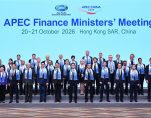
HONG KONG SAR – Media OutReach Newswire – 22 October 2026 – Finance leaders and representatives of international organisations attended the APEC (Asia-Pacific Economic Cooperation) Finance Ministers’ Meeting (FMM) 2026, successfully held in Hong Kong for the first time (October 20-21). Participants engaged in in-depth exchanges on issues concerning regional financial and economic development.

Yesterday (October 21), the FMM issued the 2026 APEC Finance Ministers’ Joint Statement, reaffirming the commitment to building an open, dynamic, resilient, and peaceful Asia-Pacific community by 2040 for the prosperity of all our people and future generations.

Representatives of the participating APEC member economies and international organisations during the meeting.

Minister of Finance and chair of the 2026 FMM, Lan Fo’an, said that all parties should firmly implement the consensus reached at the APEC Economic Leaders’ Meeting, uphold multilateralism, and deepen practical co-operation in fiscal and financial affairs, with a view to contributing to regional economic and financial stability and long-term sustainable growth.

Earlier, John Lee, Chief Executive of the Hong Kong Special Administrative Region (HKSAR) Government, welcomed participants to the FMM.

“This is a historic occasion for Hong Kong. The APEC Finance Ministers’ Meeting – part of APEC China 2026 – is taking place in our city for the very first time. We are honoured to support this significant international event, which brings together the member economies of the Asia-Pacific Economic Cooperation, representing some three billion people and accounting for over 60 per cent of global GDP,” Mr Lee said.

“Under the unique ‘one country, two systems’ principle, Hong Kong enjoys both the China advantage and the global advantage. We are the only common law jurisdiction in China, our country, and have a legal and regulatory regime similar to most of the world’s top financial hubs.”

Speaking during the discussion sessions, Paul Chan, Financial Secretary of the HKSAR, said that amid geopolitical tensions and uncertainties over trade policies, Asia-Pacific economies should strengthen co-operation to maintain the smooth flow of trade and investment, while guarding against financial risks and nurturing long-term growth drivers.

He said that Hong Kong would leverage its unique advantages under the “one country, two systems” principle, and make full use of its diverse financing channels and professional services as an international financial centre to serve as a “super connector” and “super value-adder”.

“Regionally, we need open channels for trade and investment, not new barriers. Connected markets allow capital to reach productive uses and technologies be adopted across borders,” Mr Chan said during a plenary session on Global and Regional Economic and Financial Outlook (October 20).

“Our collective task is to safeguard stability while strengthening the foundations for lasting prosperity. Hong Kong, China stands ready to work with fellow economies to seize opportunities, manage risks and support more resilient, sustainable and inclusive growth across the Asia Pacific.”

The Hong Kong Monetary Authority and the APEC Business Advisory Council (ABAC) held two thematic seminars (October 20) on “Fostering a digitalised, inclusive and sustainable supply chain ecosystem through finance” and “Mobilising capital for nature: scaling finance and regional cooperation across APEC” respectively.

In his welcoming remarks at the seminars, Christopher Hui, Secretary for Financial Services and the Treasury of the HKSAR, said: “In an era of profound economic transformation and evolving global challenges, prosperity will not be secured by any economy acting alone. It will be built through partnership, innovation and resilience. I am therefore delighted that this seminar brings together regulators, business leaders and experts from across the Asia-Pacific region for meaningful exchanges on how we can unlock new opportunities, strengthen financial resilience, and drive sustainable growth for all.”

Following the conclusion of the FMM, Mr Lee and other officials met Mr Lan at Government House to exchange views on economic and financial development of the Chinese Mainland and Hong Kong. Mr Lee expressed his heartfelt gratitude to the country for its trust in and support for Hong Kong, as well as its strong affirmation of Hong Kong’s status as an international financial centre.

During the FMM, a diverse range of tours and visits were arranged for members of delegations from participating economies and international organisations to enjoy the city’s cultural heritage and unique charm as an international metropolis.

The itineraries included visits to the Peak, Hong Kong Museum of Art, Hong Kong Palace Museum, Xiqu Centre, Chinese Culinary Institute and Ocean Park as well as a boat tour to enjoy the renowned views of Victoria Harbour.


Hashtag: #hongkong #brandhongkong #asiasworldcity #APEC #FMM


The issuer is solely responsible for the content of this announcement.

Arabian Post Staff -Dubai Central banks are increasing gold reserves and shifting bullion between international vaults, with new industry data showing a sharp rise in purchases and growing interest in reducing dependence on individual storage centres. The World Gold Council says official institutions bought an average of approximately 1,000 tonnes annually over the four years preceding its 2026 survey, compared with roughly 500 tonnes a year during […]

Production-grade in-app messaging with no credit card required to start, plus an optional Cloud Bonus offering your choice of either 15% off AWS or 30% off Alibaba Cloud

SINGAPORE – Media OutReach Newswire – 22 October 2026 – Nexconn, a global cloud communications platform, announced the launch of its production-ready Free Chat Plan. Under the new initiative, developers and startups can deploy enterprise-grade chat infrastructure for up to 10,000 monthly active users (MAU) completely free—with full Chat Pro features enabled and no credit card required.

The launch tackles a persistent industry pain point: typical free tiers across the category cap at 100 to 1,000 MAU and restrict apps to sandbox environments—thresholds far too low to validate user retention or viral growth.

“A free tier should empower teams to validate their business model, not just verify that an SDK compiles,” said Will Song, Head of Global Business at Nexconn.

To further extend startup runway, Nexconn also introduced an additional Cloud Bonus: teams that link a payment method can choose between 15% off AWS or 30% off Alibaba Cloud to offset their backend cloud costs.

The offer is open to teams that simply send their first in-app message by December 31, 2026, 11:59 p.m. Singapore Time (SGT, UTC+8), locking in up to 10,000 MAU of Pro chat (valued at $860/month). Developers can claim the plan and view full details at https://www.nexconn.ai/free-chat-api?utm_source=pr.

What the Free Chat Plan Includes

The plan provides comprehensive capabilities across the entire application lifecycle:

Rich Messaging Architecture: Unlimited messages across direct (1-on-1), group, community, and open channels.

Modern Social Interactions: Read receipts, typing indicators, user mentions, unread badges, and cross-platform multi-device synchronization.

Native Push: Built-in multi-channel mobile push gateway included with no add-on fees.

High-Capacity Resource Quotas: Supports up to 500 peak concurrent connections, 10 GB of cloud storage, and 180 days of searchable message history.

No-charge Migration Support: End-to-end data migration support for teams transitioning from Sendbird, Stream, CometChat, PubNub, Agora, or Twilio.

Developer Acceleration: An open-source AI Integration Skill allows developers to generate client SDK code and backend token endpoints via simple text prompts.

The Cloud Bonus: The 10,000 MAU Chat plan remains free and does not require a credit card. Teams may optionally link a payment method to activate the Cloud Bonus—15% off AWS services or 30% off Alibaba Cloud services.

How to Get Started

Sign Up: Create an account in the Nexconn Console.

Build: Integrate the SDK manually or with the open-source AI Skill.

Activate Your Free Plan: Complete enrollment by simply sending at least one message before December 31, 2026, 11:59 p.m. Singapore Time (SGT, UTC+8).

(Optional) Cloud Discounts: Link a payment method to activate your choice of 15% off AWS services or 30% off Alibaba Cloud services.

Hashtag: #Nexconn #FreeChatPlan #InAppMessaging

The issuer is solely responsible for the content of this announcement.

About Nexconn

Nexconn is a global cloud communications platform engineered for developers, high-growth startups, and enterprises building real-time, mission-critical digital experiences.

The company delivers a unified real-time portfolio tailored to global scale:

AICP (AI Communication Platform): High-performance Chat and Call (voice/video) APIs, combined with production-ready, scenario-specific AI Agents (such as Smart Office and Social Marketing). This unified platform allows businesses to seamlessly embed intelligent, context-aware communications into any web or mobile application.

Enterprise & Public Sector Deployments: Carrier-grade private cloud and on-premises solutions engineered for organizations and government bodies requiring strict data residency, privacy, and compliance.

VISHNU RAJA
RYO YAMADA
HITORI GOTOH
IKUYO KITA