News related to
growth

JAKARTA, INDONESIA – Media OutReach Newswire – 9 October 2025 – PT Bank Amar Indonesia Tbk. (“Amar Bank”, IDX: AMAR), a pioneer in digital banking serving the retail and MSME segments, today announces that SBI Holdings, Inc. (“SBI Holdings”, TYO:8473), a leading Japanese financial services conglomerate, has taken a stake in Amar Bank. Following this transaction, SBI Holdings now holds more than 5% of Amar Bank’s shares, […]

Intercontinental Exchange, the parent company of the New York Stock Exchange, is committing up to $2 billion in cash to back Polymarket, giving the prediction-market platform a pre-investment valuation of $8 billion. ICE will also serve as the global distributor of Polymarket’s event-driven data and collaborate on tokenisation efforts.

The deal signals a bold shift by a major financial infrastructure firm into the realm of speculative markets tied to politics, culture, economics and sports. ICE’s announcement states the investment will not have a material impact on its 2025 financials.

Polymarket, launched in 2020 by Shayne Coplan, allows traders to take positions on the probability of real-world outcomes. The platform had earlier barred U. S. users after settling in 2022 with the CFTC over operating an unregistered exchange. But it has since acquired QCEX, a CFTC-licensed derivatives exchange and clearinghouse for $112 million, positioning itself for compliant U. S. operations.

In public statements, ICE’s Chair and CEO, Jeffrey C. Sprecher, described the move as connecting “trusted financial infrastructure” with a next-generation platform that leverages user behaviour and probability markets. Coplan said the partnership will help bridge “how individuals and institutions use probabilities to understand and price the future.”

Analysts view the crux of ICE’s interest lies in monetising Polymarket’s crowd-driven data. The platform’s users collectively assign probabilities to outcomes, producing sentiment indicators ICE can package and distribute to institutional clients. Michael Ashley Schulman, partner at Running Point Capital Advisors, noted that ICE sees more value in data distribution than in clearing event contracts.

Regulatory conditions have softened under the current federal regime. Polymarket had reported that investigations by the Department of Justice and the CFTC closed without new charges, eliminating a regulatory overhang. Legal experts note that its acquisition of QCEX gives it a structural path to U. S. markets that was unavailable earlier.

Despite that progress, legal risks remain. Some jurisdictions still view event-betting as gambling, not financial activity. In Belgium, for example, authorities recently banned the platform’s use within the country. Polymarket’s own disclosures show it had raised around $205 million in earlier rounds before ICE’s investment, but with limited access to established trading jurisdictions.

Institutional interest in prediction markets has surged since the 2024 U. S. election cycle, which fuelled growth in platforms wagering on election outcomes, geopolitical events and social trends. ICE’s investment may prompt legacy financial firms to explore similar tie-ups or launches of probabilistic trading models.

In markets, ICE’s shares nudged upward following the announcement. The platform’s next test will be demonstrating whether prediction markets, previously the domain of retail and niche crypto users, can scale under institutional frameworks while satisfying securities, derivatives and gambling regulators.

Nvidia CEO Jensen Huang dismissed assertions that the artificial intelligence boom is mirroring the dot-com bubble, saying the current momentum rests on strong fundamentals rather than speculation. He defended Nvidia’s recent investments in AI startups and pitched infrastructure build-out as the engine sustaining growth. During a wide-ranging interview on CNBC, Huang stated that what differentiates today’s environment from the dot-com era is the depth of demand: global […]

MetaMask has rolled out an integration with Hyperliquid that allows perpetual futures trading directly within its wallet, marking a major expansion beyond its core custodial functionality. The launch went live today in selected jurisdictions, enabling users to take leveraged positions without leaving the application’s interface.

This move transforms MetaMask from a simple wallet to a more comprehensive on-chain trading hub. By embedding Hyperliquid’s perpetuals engine natively, MetaMask removes several intermediate steps that historically deter adoption—such as requiring users to traverse to external exchanges, cross chains, or cover multiple transaction fees. According to MetaMask’s global product lead, Gal Eldar, the integration “offers a frictionless path for passive holders to become active traders.” The wallet’s new “one-tap” experience is optimised for mobile usage, lowering barriers to entry.

Hyperliquid, a decentralised derivatives platform built with its own Layer 1 infrastructure, claims to support gas-free settlement and performance at scale. The platform processes tens of billions in trading volume, placing it among the leading names in on-chain perpetual markets. Hyperliquid’s architecture, with reported throughput exceeding 200,000 orders per second, underpins the performance demands of integrating derivatives directly inside a wallet.

MetaMask’s entry into this domain arrives amid sharp growth in decentralized perpetuals. In September, the total trading volume across decentralised perpetual platforms exceeded $700 billion, spurred by trader demand for leverage, 24/7 markets, and non-custodial exposure. Hyperliquid is a consistent high performer, with some estimates attributing to it a majority share of decentralised perpetual activity.

The new feature supports USDC deposits from any Ethereum Virtual Machine-compatible chain, and trades can be initiated with a single tap. The integration includes slippage checks, fee previews, and confirmation flows meant to shield users from common UX pitfalls. MetaMask’s team emphasises that the wallet retains self-custody at all stages, with users retaining control over private keys.

Critics caution that embedding leverage within a wallet may amplify risks for inexperienced users. Rapid liquidation, sharp market swings, and elevated margin requirements could expose users to sudden losses. To mitigate this, MetaMask is integrating risk-control measures and permission checks, though the success of those mechanisms will be closely watched by the community.

MetaMask’s expansion aligns with its broader roadmap. Earlier in the year, it unveiled a Mastercard-powered card feature, enabling spending directly from self-custodial wallets. It has also signalled intent to launch its native token, MASK, and is refining a loyalty rewards engine tied to on-chain activity. Those ancillary products may dovetail with its perpetuals integration, potentially weaving them into loyalty tiers, discounts, or governance models.

The decision pits MetaMask more directly against both centralised and decentralised exchanges. Centralised venues such as Binance and Bybit continue to dominate derivatives in terms of volume; however, their users must trust custody and counterparty risk. MetaMask’s proposition is differentiated by offering derivatives inside a wallet, combining convenience with self-custody.

Demand for Regulated Forex Brokers Grows for UAE Investors Trade247, a broker firm based in Dubai and regulated by the UAE’s Securities and Commodities Authority as well as the Financial Services Commission of Mauritius, has introduced its technology geared towards what it calls “complete multi-asset trading,” which covers forex, equities, indices, commodities, precious metals, energy products, and digital currencies, in which they identify the current trend of […]

Gold climbed past $4,000 per ounce for the first time, propelled by soaring investor demand for safer assets in the face of intensifying economic and political uncertainty. Spot gold reached about $4,011.18 per ounce, while U. S. gold futures for December delivery touched $4,033.40. The rally reflects mounting expectations that the U. S. Federal Reserve will begin trimming rates, combined with a weakening dollar, heavy central bank […]

The World Bank has trimmed its projection for South Asia’s economic expansion in 2026, citing elevated U. S. tariffs on Indian exports as a key drag. The region’s growth is now forecast at 5.8 percent, down from 6.6 percent this year.

The updated “South Asia Development Update” flags the U. S. trade measures as a major headwind, especially given India’s size and its integration into regional supply chains. The report sets India’s growth for fiscal year 2025–26 at 6.5 percent, up from its earlier estimate of 6.3 percent, but warns of a drop to 6.3 percent in 2026–27 as tariff pressures intensify.

The U. S. has imposed tariffs of up to 50 percent on a broad swath of Indian goods—impacting sectors such as textiles, gems and jewellery and seafood—affecting nearly $50 billion in exports. These are among the highest duties levied on any U. S. trading partner. The World Bank notes that these tariffs will particularly bite in 2026 as initial buffers from public spending fade.

Franziska Ohnsorge, chief economist for South Asia at the World Bank, asserted that the toll from trade restrictions reflects “a reversal of the gains” India had made in integrating into global value chains. She urged structural adjustments: lowering tariffs and signing free trade agreements to support export competitiveness.

Beyond India, Bangladesh and Sri Lanka show varying trajectories. The Bank upgrades forecasts for Bangladesh and Sri Lanka, citing easing fiscal strain and improving external balances. Meanwhile, Nepal and the Maldives bear the brunt of tighter global conditions, with their outlooks revised downward.

Policy responses in India are already in motion. The government launched sweeping tax cuts spanning consumer goods to automobiles, one of the largest fiscal interventions in recent years. Concurrently, infrastructure spending is being boosted to drive domestic demand and counterbalance export headwinds. The Reserve Bank of India held its repo rate at 5.50 percent in October, citing subdued inflation and leaving open room for a future cut.

Indian officials remain confident. Finance Minister Nirmala Sitharaman called the economy “resilient,” expressing faith it could absorb external shocks while targeting an ambitious 8 percent growth. The Chief Economic Adviser affirmed earlier forecasts of 6.3–6.8 percent GDP growth, downplaying long-term damage from trade friction.

International institutions have also flagged downside risks. The Asian Development Bank cut India’s FY 26 forecast to 6.5 percent from 6.7 percent, pointing to duty pressures and policy uncertainty. The IMF earlier trimmed India’s 2025-26 prediction to 6.2 percent, citing heightened global trade tensions.

The World Bank’s report emphasises that over the medium term, trade liberalisation combined with labour flexibility and investment in digital infrastructure could help South Asia reclaim momentum. Within the document, a scenario of tariff cuts and deeper trade integration is modelled to yield significant gains in productivity, employment, and output per capita.

Still, the path ahead is fraught. The report cautions that the region is vulnerable to a global slowdown, geopolitical shocks and labor market disruptions from artificial intelligence. In particular, it warns that weaker export growth from India will spill over across the region via trade, financial and migrant-worker channels.

Advertisements

Dubai Investments has revealed that its wholly owned subsidiary, Emirates Float Glass, will expand its float-glass manufacturing capacity by launching a second production line that will raise output from 600 tonnes per day to 1,200 tonnes. The upgrade is slated to introduce Ultra Clear low-iron glass—marketed as a first in the MENA region—with advanced automation and energy-efficient systems, and is scheduled for commissioning between late 2027 and early 2028.

Under the plan, the second line will incorporate next-generation process control technology to ensure consistent product quality while curbing energy consumption and lowering the environmental footprint. Dubai Investments emphasises that this aligns with its broader industrial growth strategy and the UAE’s ambitions in high-value manufacturing.

Abdulaziz Bin Yakub Al Serkal, CEO of Dubai Investments’ Industrial Platform, described the move as crucial for strengthening regional competitiveness. He said the introduction of Ultra Clear glass will allow EFG to penetrate premium markets, give clarity advantages over conventional float glass, and support growing demand from architectural, infrastructure and design sectors. The project involves a collaboration with Germany’s HORN Glass Industries, which will supply glass-melting furnaces and associated systems, while local civil-works contractors and international project teams will oversee implementation.

EFG currently operates out of its float plant in the Industrial City of Abu Dhabi, where its capacity now stands at 600 tonnes per day. The expansion marks the second phase of investment in the plant. Dubai Investments’ announcement underlines its commitment to scaling up industrial assets and achieving technological differentiation in its manufacturing portfolio.

The expanded capacity is seen as a response to rising demand across the Gulf and broader regional markets, where premium architectural glass is gaining traction, driven by growth in high-rise construction, sustainability mandates and demand for energy-efficient façades. Analysts note that the move helps EFG hedge against rising competition from international glass producers by offering higher-clarity, value-added products.

Wizz Air Hungary is reopening bookings for flights from Abu Dhabi to several European destinations, with services beginning in October and November 2025. Flight schedules show routes from Katowice and Krakow in Poland launching on 10 October. The carrier plans to resume Larnaca services from 15 November, operating four times weekly on Tuesdays, Thursdays, Saturdays and Sundays, and Sofia flights from 17 November on Mondays, Wednesdays and […]

Ahmad Assiri Gold has done it. Gold has reached the long-awaited $4,000 per ounce mark, a level that carries psychological and symbolic significance. This moment represents a powerful and sustained rally that began with a breakout from a lengthy consolidation phase in early September, evolving into a pivotal chapter for the market and the yellow metal. Since that breakout, gold has risen by 16%, while attempts at […]

Serbia will serve as the Future Digital Economy Partner Country at GITEX Global 2025 in Dubai, becoming the first European nation accorded that role. The designation foregrounds Serbia’s ambitions to reposition itself from outsourcing hub to innovator in global tech markets.

Serbia’s IT exports crossed €3.5 billion in 2023, and the sector has maintained close to 20 percent year-on-year growth. The number of IT firms now exceeds 4,000, with many branching into domains such as fintech, health tech, AI and gaming. The Chamber of Commerce and Industry of Serbia, which leads the national delegation, views the GITEX platform as an opportunity to elevate the country’s narrative beyond cost-competitiveness to creative capacity.

Marko Čadež, president of CCIS, said Serbian firms are now pitching themselves as long-term transformation partners rather than simple vendors. He emphasised that enterprises increasingly expect strategic collaboration, not just software delivery. Meanwhile, analysts point to Serbia’s strong foundations—high math and engineering education standards, English proficiency, and relatively affordable costs—as a competitive edge in Eastern Europe.

Yet Serbia confronts headwinds. Talent retention is an ongoing challenge: many trained professionals migrate to Western Europe or the U. S. Infrastructure remains uneven, with rural areas lagging behind Belgrade in connectivity. In addition, venture capital inflows to the Balkans are smaller compared to Western Europe, constraining the ability of startups to scale aggressively.

Serbia is attempting to counterbalance those constraints through targeted programmes. The Chamber of Commerce has launched “Start 2,” a support scheme for scale-up firms, which includes mentoring and market access, and will be showcased at GITEX Europe in Berlin. The programme focuses on Serbian companies already achieving revenues above €250,000 and aims to open doors into German and EU markets.

At GITEX Global 2025, Serbia will present a showcase of startups and products under “North Star,” highlighting innovations in AI, e-commerce, predictive analytics, and diagnostics tools. Its delegation will also include outsourcing firms pitching upscaled offerings—product co-development, R&D support, and domain expertise in sectors such as telecom and healthcare.

GITEX organisers themselves have underscored Serbia’s place among rising tech nations: the 2025 edition includes 6,800 tech enterprises, 2,000 startups, and participant countries from 180 nations. Serbia joins Brazil and Pakistan as Country Partners this year—a reflection of the broader intention to diversify the event’s global footprint. The spotlight on AI, biotech, semiconductors, data infrastructure, and robotics offers Serbia a chance to align its exposure with the global themes defining tech agendas.

Over 200 films from 40 countries light up Bangkok until October 15 BANGKOK, THAILAND – Media OutReach Newswire – 8 October 2025 – The Bangkok International Film Festival (BKKIFF) has returned in spectacular form, transforming the Thai capital into a global stage for cinema and culture. Running from September 27 to October 15, 2025, the 19-day festival is now in full swing, already drawing packed audiences, international […]

Arabian Post Staff -Dubai Abu Dhabi-based PureHealth Holding has finalised the acquisition of a 60 percent stake in Hellenic Healthcare Group, valued at €800 million, in a move that places HHG’s full equity valuation at around €1.3 billion. This deal represents a major step in PureHealth’s plan to build a globally connected, innovation-driven healthcare platform from its base in the UAE. PureHealth will acquire its majority stake […]

The Central Bank of Kenya reduced its benchmark lending rate by 25 basis points today, bringing it down to 9.25 per cent, in its eighth consecutive cut as consumer inflation remains firmly within allowable limits. The move comes as Kenya’s inflation for September stood at 4.6 per cent year-on-year, slightly up from 4.5 per cent in August, but still well inside the central bank’s target band of […]

BlackRock’s iShares Bitcoin Trust has overtaken all other funds in its suite to become its most profitable exchange-traded product, generating approximately $244 million in fee revenue over the past year, analysts estimate. Its assets under management are approaching the $100 billion mark, driven by massive capital inflows into the spot Bitcoin ETF space.

IBIT has pulled in surging investor interest, with around $970 million flowing into it in a single trading session — the largest share of the $1.2 billion that U. S. spot Bitcoin ETFs collectively attracted that day. The fund now sits about $2.2 billion short of the $100 billion milestone, a level it is on track to cross more rapidly than any ETF in history.

That speed is notable: IBIT has amassed nearly $98–$100 billion in under 435 days, compared to Vanguard’s flagship S&P 500 ETF, which required over 2,000 days to reach the same threshold. This acceleration reflects investor appetite for regulated, exchange-traded access to digital assets.

BlackRock’s fee structure — currently 0.25% of AUM on IBIT — means that each incremental inflow directly boosts revenue. Analysts Eric Balchunas and James Seyffart have identified IBIT as now bringing in more income than long-established heavyweights in BlackRock’s portfolio, such as the iShares Russell 1000 Growth ETF and iShares MSCI EAFE ETF.

The inflow pattern underscores a broader shift. Since the U. S. Securities and Exchange Commission authorised spot Bitcoin ETFs in January 2024, the category has seen multiple single-day inflows exceeding $1 billion. In several past instances, such inflow spikes have coincided with short-term peaks in Bitcoin’s price, raising questions among market watchers whether these are signs of a turning point.

Bitcoin itself has responded: it pushed past $125,000 this month, buoyed by demand for regulated crypto exposure and safe-haven demand amid macroeconomic pressures. This run-up in price further amplifies IBIT’s appeal, because asset growth happens both through net inflows and valuation gains on its holdings.

BlackRock is also deepening its Bitcoin product strategy. It has filed to create a Bitcoin Premium Income ETF, which would generate yield by selling covered call options on Bitcoin futures — a move aimed at appealing to yield-focused investors seeking regulated crypto exposure. BlackRock has avoided entering the altcoin ETF arena for now, focusing its efforts on Bitcoin-linked products where regulatory clarity is more established.

Still, the meteoric rise of IBIT carries risks. Fee compression remains a structural challenge across the ETF industry, and competitors are poised to launch rival crypto products. The volatility inherent in Bitcoin could reverse gains sharply. Moreover, regulatory shifts — whether through tax treatment, disclosure mandates, or limits on crypto exposure — could reshuffle the competitive landscape.

Edgecore Networks will reveal its latest open infrastructure solutions at the OCP Global Summit in San Jose and GITEX Global in Dubai, with demonstrations of next-generation AI, networking, and compute platforms designed to ease deployment and boost performance.

The Taiwanese firm plans four flagship showcases: new Tomahawk 6–based data centre switches, a proof-of-concept for co-packaged optics, its Nexvec™ turnkey AI solution, and an upgraded Nous infrastructure controller offering composable compute management. The exhibitions will take place during the week of 13 October: at the OCP Summit from 13–16 October and at GITEX from 13–17 October.

Edgecore emphasises that the Tomahawk 6 switches can deliver more than 100 Tbps of bandwidth, supporting AI cluster demands with low latency and high density. The company adds that its CPO concept demonstrates integration of optical elements directly into switch silicon, reducing power and footprint. Its Nexvec™ offering is a pre-validated stack combining open networking with GPU compute, while Nous enables dynamic allocation of GPU, memory and compute resources.

Mingshou Liu, President of Edgecore, is quoted as saying that as AI workloads accelerate, simplifying deployment is crucial, and that the firm seeks to lead in the open infrastructure community with turnkey and scalable offerings.

Edgecore’s push comes at a time when hyperscale data centre operators are under pressure to manage burgeoning AI compute demands without ballooning costs or power draws. Industry trends point to co-packaged optics, disaggregated architectures, and composable resource frameworks as priorities for the next wave of infrastructure evolution. At the OCP Summit, the AI HW/SW co-design and open systems tracks will explore modular compute, memory architectures and photonic interconnects for AI clusters.

In parallel, GITEX Global has become a high-stakes stage for showcasing AI infrastructure, especially in the UAE’s drive to scale AI capabilities and attract global tech investment. With over 45 editions, the event draws global vendors and governments presenting AI, semiconductors, networking, and startup innovation. Edgecore’s presence signals its intention to engage key markets in the Middle East, where data centre growth, AI deployment, and regional cloud expansion are strong levers.

Edgecore is not alone in spotlighting AI infrastructure at these events. Major networking suppliers, chip vendors, and cloud players are expected to present competing solutions, particularly around optical integration, disaggregation, and hardware-software co-design. Observers will closely track how well Edgecore’s offerings stack up in power efficiency, interoperability, and ease of deployment.

Within its broader strategic frame, Edgecore continues to emphasise open, standards-based infrastructure. Its public messaging highlights disaggregated networking, composable compute, and software-defined manageability. The timing of product demonstrations at both OCP and GITEX gives the company a dual audience of deeply technical integrators and regional enterprise buyers.

At the OCP Summit, Edgecore’s participation also coincides with evolving community priorities—AI, sustainability, modular compute, and photonics interconnect are central tracks. During the event, Edgecore’s representative Tim Zhou will present on simplifying large-scale “agentic AI” deployments in a session scheduled for 16 October.][5])


TOKYO, JAPAN – Media OutReach Newswire – 6 October 2025 – ANDPAD (Headquarters: Chiyoda City, Tokyo; Representative Director: Takeo Inada; hereinafter called “ANDPAD”), which operates a cloud-based construction project management service, and the Vietnamese subsidiary ANDPAD VIETNAM COMPANY LIMITED, hereby announces the completion of the demonstration project to develop and deploy construction project management systems to improve operational efficiency in the construction industry in Vietnam. This project […]

AMD signed a long-term agreement with OpenAI to supply six gigawatts of AI chips over multiple years, with the first delivery of its Instinct MI450 GPUs slated for the second half of 2026. In tandem, OpenAI will have the right to acquire up to 160 million AMD shares—roughly 10 percent of the company—subject to performance and stock-price milestones. Under the pact, AMD will act as a core […]

The World Bank has upgraded its 2025 growth forecast for the Middle East, North Africa, Afghanistan, and Pakistan region to 2.8 percent, up from 2.6 percent, while trimming the outlook for 2026 amid intensifying conflict and faltering oil output. Expansion in the Gulf and non-oil sectors is driving the upward revision in 2025, securing a more optimistic tone for this year. But persistent geopolitical stress—particularly in Iran, […]

Sammaan Capital will sharply expand its affordable housing lending operations after Abu Dhabi’s International Holding Company invested $1 billion for a controlling stake, the non-banking lender’s CEO, Gagan Banga, told Reuters. The infusion is expected to accelerate the drive toward an assets-under-management goal of ₹1 trillion by fiscal 2027. To underpin its expansion, Sammaan plans to launch about ten new branches monthly, concentrating on tier-4 and tier-5 […]

The Co-Hosted With The World Economic Forum, The Summit Is Set To Launch Regional Initiatives on Sustainable and Safe AI and the Transitioning Industrial Cluster KUALA LUMPUR, MALAYSIA – Media OutReach Newswire – 7 October 2025 – The Malaysia Centre for the Fourth Industrial Revolution (MYCentre4IR) together with the World Economic Forum (WEF) will co-host the Powering the Intelligent Age: Driving Innovation with Southeast Asia and Beyond […]

Michael Brown Political instability in France, and a surprise in Japan’s LDP leadership election made for a spicy start to the week yesterday, though stocks rallied regardless. Today, a barren docket awaits, as participants continue to headline-watch. A penny for the thoughts of G4 central bankers right now, as none of them appear to have particularly easy jobs. First, Fed Chair Powell, who recently resumed the journey […]

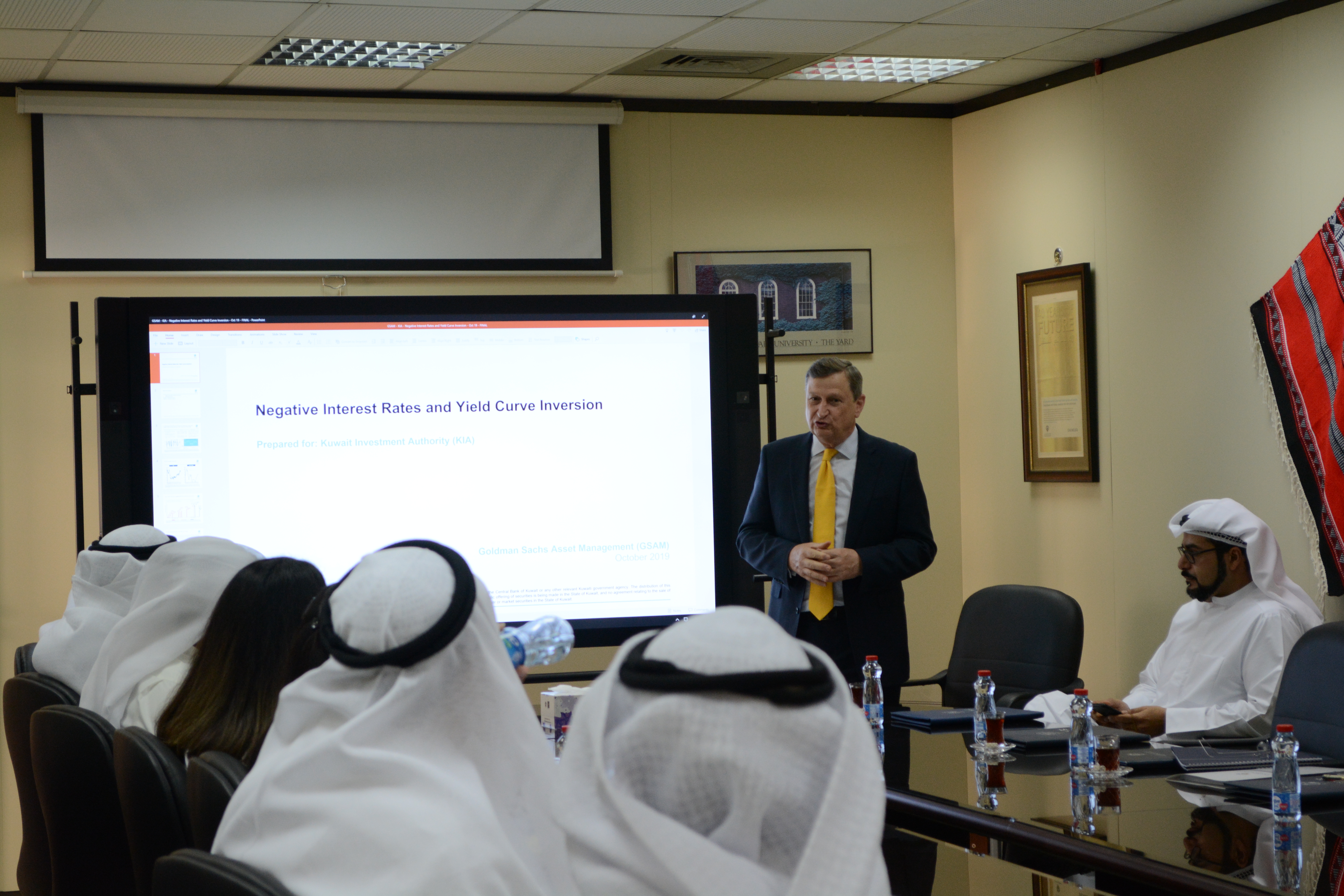
Goldman Sachs has launched a new office in Kuwait, asserting a significant push to enhance its reach across the Middle East and deepen its ties with Gulf-region clients under fresh leadership.

The New York-based investment bank said its role over five decades in Kuwait spans investment banking, capital markets and asset management. As part of its latest expansion, Goldman has tapped Mohammad Almatrouk as managing director of the Kuwait office, pending regulatory green light, while Fahad Alebrahim has been appointed managing director of the firm’s private wealth business in Kuwait.

David Solomon, Goldman Sachs’s Chairman and Chief Executive, framed the move as a commitment to “grow our capabilities across the Middle East and better serve our clients,” emphasising Kuwait’s economic vision as a catalyst for the firm’s expansion.

Goldman Sachs points to a long-standing capacity-building partnership in Kuwait that includes a professional training scheme designed to nurture talent at institutions such as the Kuwait Investment Authority, the Public Institution for Social Security and the Kuwait Fund. That programme, the bank says, will continue to play a central role in integrating local human capital into its global operations.

The choice of Kuwait underscores a growing focus on the Gulf’s institutional capital. Kuwait, host to one of the world’s largest sovereign wealth funds, has attracted global financial firms looking to align with its diversification and investment ambitions. Goldman Sachs’s decision follows earlier regional expansions, such as establishing a presence in Abu Dhabi and securing a banking licence in Saudi Arabia.

Kuwait’s Director General of the Direct Investment Promotion Authority, Sheikh Dr. Meshaal Jaber Al-Ahmad Al-Sabah, praised the move as aligned with Kuwait’s economic diversification and global integration goals. He stressed that opening the office supports national priorities including talent development and sustainable growth.

Regional analysts view Goldman’s Kuwait office as part of a broader recalibration by global banks to embed themselves closer to Gulf capital sources. Over the past two years, deal activity in sovereign and quasi-sovereign asset structures has exploded, prompting major firms including Lazard, JPMorgan and Deutsche Bank to expand in the Gulf with new leadership hires.

Inside Goldman Sachs, the timeline coincides with a leadership transition: the firm’s co-head for the Middle East and North Africa, Fadi Abuali, is slated to retire after nearly 28 years of service. His departure is expected to reshape the firm’s regional hierarchy just as Kuwait becomes a new hub.

Some observers caution the move carries execution challenges. Regulatory approvals in Kuwait must be secured, and Goldman must integrate the new office into its broader Gulf operations without duplicating functions. Success will depend on maintaining local relationships while delivering global platform advantages.

Arabian Post Staff -Dubai Goldman Sachs lifted its December 2026 gold price forecast from $4,300 to $4,900 per ounce, citing strength in Western exchange-traded fund inflows and sustained central bank purchases. Gold’s spot price hovered around $3,960 per ounce early on Tuesday, having earlier touched an intraday high of $3,977.19. Goldman analysts expect central banks—particularly in emerging markets—to continue diversifying foreign-exchange reserves into gold, with forecast average […]

VISHNU RAJA
RYO YAMADA
HITORI GOTOH
IKUYO KITA