News related to
growth

Dubai Investments has revealed that its wholly owned subsidiary, Emirates Float Glass, will expand its float-glass manufacturing capacity by launching a second production line that will raise output from 600 tonnes per day to 1,200 tonnes. The upgrade is slated to introduce Ultra Clear low-iron glass—marketed as a first in the MENA region—with advanced automation and energy-efficient systems, and is scheduled for commissioning between late 2027 and early 2028.

Under the plan, the second line will incorporate next-generation process control technology to ensure consistent product quality while curbing energy consumption and lowering the environmental footprint. Dubai Investments emphasises that this aligns with its broader industrial growth strategy and the UAE’s ambitions in high-value manufacturing.

Abdulaziz Bin Yakub Al Serkal, CEO of Dubai Investments’ Industrial Platform, described the move as crucial for strengthening regional competitiveness. He said the introduction of Ultra Clear glass will allow EFG to penetrate premium markets, give clarity advantages over conventional float glass, and support growing demand from architectural, infrastructure and design sectors. The project involves a collaboration with Germany’s HORN Glass Industries, which will supply glass-melting furnaces and associated systems, while local civil-works contractors and international project teams will oversee implementation.

EFG currently operates out of its float plant in the Industrial City of Abu Dhabi, where its capacity now stands at 600 tonnes per day. The expansion marks the second phase of investment in the plant. Dubai Investments’ announcement underlines its commitment to scaling up industrial assets and achieving technological differentiation in its manufacturing portfolio.

The expanded capacity is seen as a response to rising demand across the Gulf and broader regional markets, where premium architectural glass is gaining traction, driven by growth in high-rise construction, sustainability mandates and demand for energy-efficient façades. Analysts note that the move helps EFG hedge against rising competition from international glass producers by offering higher-clarity, value-added products.


Wizz Air Hungary is reopening bookings for flights from Abu Dhabi to several European destinations, with services beginning in October and November 2025. Flight schedules show routes from Katowice and Krakow in Poland launching on 10 October. The carrier plans to resume Larnaca services from 15 November, operating four times weekly on Tuesdays, Thursdays, Saturdays and Sundays, and Sofia flights from 17 November on Mondays, Wednesdays and […]

Ahmad Assiri Gold has done it. Gold has reached the long-awaited $4,000 per ounce mark, a level that carries psychological and symbolic significance. This moment represents a powerful and sustained rally that began with a breakout from a lengthy consolidation phase in early September, evolving into a pivotal chapter for the market and the yellow metal. Since that breakout, gold has risen by 16%, while attempts at […]

Serbia will serve as the Future Digital Economy Partner Country at GITEX Global 2025 in Dubai, becoming the first European nation accorded that role. The designation foregrounds Serbia’s ambitions to reposition itself from outsourcing hub to innovator in global tech markets.

Serbia’s IT exports crossed €3.5 billion in 2023, and the sector has maintained close to 20 percent year-on-year growth. The number of IT firms now exceeds 4,000, with many branching into domains such as fintech, health tech, AI and gaming. The Chamber of Commerce and Industry of Serbia, which leads the national delegation, views the GITEX platform as an opportunity to elevate the country’s narrative beyond cost-competitiveness to creative capacity.

Marko Čadež, president of CCIS, said Serbian firms are now pitching themselves as long-term transformation partners rather than simple vendors. He emphasised that enterprises increasingly expect strategic collaboration, not just software delivery. Meanwhile, analysts point to Serbia’s strong foundations—high math and engineering education standards, English proficiency, and relatively affordable costs—as a competitive edge in Eastern Europe.

Yet Serbia confronts headwinds. Talent retention is an ongoing challenge: many trained professionals migrate to Western Europe or the U. S. Infrastructure remains uneven, with rural areas lagging behind Belgrade in connectivity. In addition, venture capital inflows to the Balkans are smaller compared to Western Europe, constraining the ability of startups to scale aggressively.

Serbia is attempting to counterbalance those constraints through targeted programmes. The Chamber of Commerce has launched “Start 2,” a support scheme for scale-up firms, which includes mentoring and market access, and will be showcased at GITEX Europe in Berlin. The programme focuses on Serbian companies already achieving revenues above €250,000 and aims to open doors into German and EU markets.

At GITEX Global 2025, Serbia will present a showcase of startups and products under “North Star,” highlighting innovations in AI, e-commerce, predictive analytics, and diagnostics tools. Its delegation will also include outsourcing firms pitching upscaled offerings—product co-development, R&D support, and domain expertise in sectors such as telecom and healthcare.

GITEX organisers themselves have underscored Serbia’s place among rising tech nations: the 2025 edition includes 6,800 tech enterprises, 2,000 startups, and participant countries from 180 nations. Serbia joins Brazil and Pakistan as Country Partners this year—a reflection of the broader intention to diversify the event’s global footprint. The spotlight on AI, biotech, semiconductors, data infrastructure, and robotics offers Serbia a chance to align its exposure with the global themes defining tech agendas.

Over 200 films from 40 countries light up Bangkok until October 15 BANGKOK, THAILAND – Media OutReach Newswire – 8 October 2025 – The Bangkok International Film Festival (BKKIFF) has returned in spectacular form, transforming the Thai capital into a global stage for cinema and culture. Running from September 27 to October 15, 2025, the 19-day festival is now in full swing, already drawing packed audiences, international […]

Arabian Post Staff -Dubai Abu Dhabi-based PureHealth Holding has finalised the acquisition of a 60 percent stake in Hellenic Healthcare Group, valued at €800 million, in a move that places HHG’s full equity valuation at around €1.3 billion. This deal represents a major step in PureHealth’s plan to build a globally connected, innovation-driven healthcare platform from its base in the UAE. PureHealth will acquire its majority stake […]

The Central Bank of Kenya reduced its benchmark lending rate by 25 basis points today, bringing it down to 9.25 per cent, in its eighth consecutive cut as consumer inflation remains firmly within allowable limits. The move comes as Kenya’s inflation for September stood at 4.6 per cent year-on-year, slightly up from 4.5 per cent in August, but still well inside the central bank’s target band of […]

Advertisements

BlackRock’s iShares Bitcoin Trust has overtaken all other funds in its suite to become its most profitable exchange-traded product, generating approximately $244 million in fee revenue over the past year, analysts estimate. Its assets under management are approaching the $100 billion mark, driven by massive capital inflows into the spot Bitcoin ETF space.

IBIT has pulled in surging investor interest, with around $970 million flowing into it in a single trading session — the largest share of the $1.2 billion that U. S. spot Bitcoin ETFs collectively attracted that day. The fund now sits about $2.2 billion short of the $100 billion milestone, a level it is on track to cross more rapidly than any ETF in history.

That speed is notable: IBIT has amassed nearly $98–$100 billion in under 435 days, compared to Vanguard’s flagship S&P 500 ETF, which required over 2,000 days to reach the same threshold. This acceleration reflects investor appetite for regulated, exchange-traded access to digital assets.

BlackRock’s fee structure — currently 0.25% of AUM on IBIT — means that each incremental inflow directly boosts revenue. Analysts Eric Balchunas and James Seyffart have identified IBIT as now bringing in more income than long-established heavyweights in BlackRock’s portfolio, such as the iShares Russell 1000 Growth ETF and iShares MSCI EAFE ETF.

The inflow pattern underscores a broader shift. Since the U. S. Securities and Exchange Commission authorised spot Bitcoin ETFs in January 2024, the category has seen multiple single-day inflows exceeding $1 billion. In several past instances, such inflow spikes have coincided with short-term peaks in Bitcoin’s price, raising questions among market watchers whether these are signs of a turning point.

Bitcoin itself has responded: it pushed past $125,000 this month, buoyed by demand for regulated crypto exposure and safe-haven demand amid macroeconomic pressures. This run-up in price further amplifies IBIT’s appeal, because asset growth happens both through net inflows and valuation gains on its holdings.

BlackRock is also deepening its Bitcoin product strategy. It has filed to create a Bitcoin Premium Income ETF, which would generate yield by selling covered call options on Bitcoin futures — a move aimed at appealing to yield-focused investors seeking regulated crypto exposure. BlackRock has avoided entering the altcoin ETF arena for now, focusing its efforts on Bitcoin-linked products where regulatory clarity is more established.

Still, the meteoric rise of IBIT carries risks. Fee compression remains a structural challenge across the ETF industry, and competitors are poised to launch rival crypto products. The volatility inherent in Bitcoin could reverse gains sharply. Moreover, regulatory shifts — whether through tax treatment, disclosure mandates, or limits on crypto exposure — could reshuffle the competitive landscape.

Edgecore Networks will reveal its latest open infrastructure solutions at the OCP Global Summit in San Jose and GITEX Global in Dubai, with demonstrations of next-generation AI, networking, and compute platforms designed to ease deployment and boost performance.

The Taiwanese firm plans four flagship showcases: new Tomahawk 6–based data centre switches, a proof-of-concept for co-packaged optics, its Nexvec™ turnkey AI solution, and an upgraded Nous infrastructure controller offering composable compute management. The exhibitions will take place during the week of 13 October: at the OCP Summit from 13–16 October and at GITEX from 13–17 October.

Edgecore emphasises that the Tomahawk 6 switches can deliver more than 100 Tbps of bandwidth, supporting AI cluster demands with low latency and high density. The company adds that its CPO concept demonstrates integration of optical elements directly into switch silicon, reducing power and footprint. Its Nexvec™ offering is a pre-validated stack combining open networking with GPU compute, while Nous enables dynamic allocation of GPU, memory and compute resources.

Mingshou Liu, President of Edgecore, is quoted as saying that as AI workloads accelerate, simplifying deployment is crucial, and that the firm seeks to lead in the open infrastructure community with turnkey and scalable offerings.

Edgecore’s push comes at a time when hyperscale data centre operators are under pressure to manage burgeoning AI compute demands without ballooning costs or power draws. Industry trends point to co-packaged optics, disaggregated architectures, and composable resource frameworks as priorities for the next wave of infrastructure evolution. At the OCP Summit, the AI HW/SW co-design and open systems tracks will explore modular compute, memory architectures and photonic interconnects for AI clusters.

In parallel, GITEX Global has become a high-stakes stage for showcasing AI infrastructure, especially in the UAE’s drive to scale AI capabilities and attract global tech investment. With over 45 editions, the event draws global vendors and governments presenting AI, semiconductors, networking, and startup innovation. Edgecore’s presence signals its intention to engage key markets in the Middle East, where data centre growth, AI deployment, and regional cloud expansion are strong levers.

Edgecore is not alone in spotlighting AI infrastructure at these events. Major networking suppliers, chip vendors, and cloud players are expected to present competing solutions, particularly around optical integration, disaggregation, and hardware-software co-design. Observers will closely track how well Edgecore’s offerings stack up in power efficiency, interoperability, and ease of deployment.

Within its broader strategic frame, Edgecore continues to emphasise open, standards-based infrastructure. Its public messaging highlights disaggregated networking, composable compute, and software-defined manageability. The timing of product demonstrations at both OCP and GITEX gives the company a dual audience of deeply technical integrators and regional enterprise buyers.

At the OCP Summit, Edgecore’s participation also coincides with evolving community priorities—AI, sustainability, modular compute, and photonics interconnect are central tracks. During the event, Edgecore’s representative Tim Zhou will present on simplifying large-scale “agentic AI” deployments in a session scheduled for 16 October.][5])

TOKYO, JAPAN – Media OutReach Newswire – 6 October 2025 – ANDPAD (Headquarters: Chiyoda City, Tokyo; Representative Director: Takeo Inada; hereinafter called “ANDPAD”), which operates a cloud-based construction project management service, and the Vietnamese subsidiary ANDPAD VIETNAM COMPANY LIMITED, hereby announces the completion of the demonstration project to develop and deploy construction project management systems to improve operational efficiency in the construction industry in Vietnam. This project […]

AMD signed a long-term agreement with OpenAI to supply six gigawatts of AI chips over multiple years, with the first delivery of its Instinct MI450 GPUs slated for the second half of 2026. In tandem, OpenAI will have the right to acquire up to 160 million AMD shares—roughly 10 percent of the company—subject to performance and stock-price milestones. Under the pact, AMD will act as a core […]

The World Bank has upgraded its 2025 growth forecast for the Middle East, North Africa, Afghanistan, and Pakistan region to 2.8 percent, up from 2.6 percent, while trimming the outlook for 2026 amid intensifying conflict and faltering oil output. Expansion in the Gulf and non-oil sectors is driving the upward revision in 2025, securing a more optimistic tone for this year. But persistent geopolitical stress—particularly in Iran, […]

Sammaan Capital will sharply expand its affordable housing lending operations after Abu Dhabi’s International Holding Company invested $1 billion for a controlling stake, the non-banking lender’s CEO, Gagan Banga, told Reuters. The infusion is expected to accelerate the drive toward an assets-under-management goal of ₹1 trillion by fiscal 2027. To underpin its expansion, Sammaan plans to launch about ten new branches monthly, concentrating on tier-4 and tier-5 […]

The Co-Hosted With The World Economic Forum, The Summit Is Set To Launch Regional Initiatives on Sustainable and Safe AI and the Transitioning Industrial Cluster KUALA LUMPUR, MALAYSIA – Media OutReach Newswire – 7 October 2025 – The Malaysia Centre for the Fourth Industrial Revolution (MYCentre4IR) together with the World Economic Forum (WEF) will co-host the Powering the Intelligent Age: Driving Innovation with Southeast Asia and Beyond […]

Michael Brown Political instability in France, and a surprise in Japan’s LDP leadership election made for a spicy start to the week yesterday, though stocks rallied regardless. Today, a barren docket awaits, as participants continue to headline-watch. A penny for the thoughts of G4 central bankers right now, as none of them appear to have particularly easy jobs. First, Fed Chair Powell, who recently resumed the journey […]

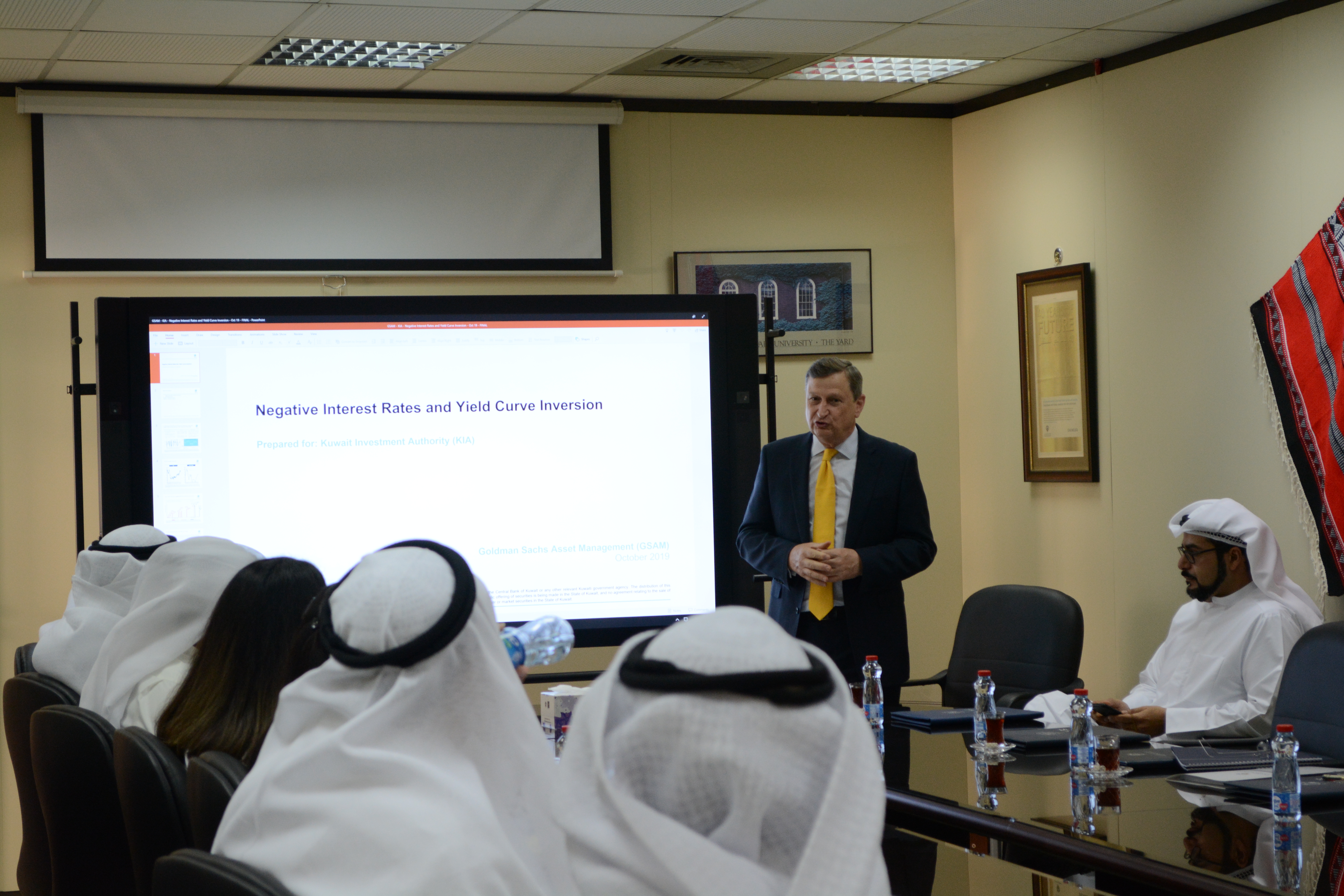
Goldman Sachs has launched a new office in Kuwait, asserting a significant push to enhance its reach across the Middle East and deepen its ties with Gulf-region clients under fresh leadership.

The New York-based investment bank said its role over five decades in Kuwait spans investment banking, capital markets and asset management. As part of its latest expansion, Goldman has tapped Mohammad Almatrouk as managing director of the Kuwait office, pending regulatory green light, while Fahad Alebrahim has been appointed managing director of the firm’s private wealth business in Kuwait.

David Solomon, Goldman Sachs’s Chairman and Chief Executive, framed the move as a commitment to “grow our capabilities across the Middle East and better serve our clients,” emphasising Kuwait’s economic vision as a catalyst for the firm’s expansion.

Goldman Sachs points to a long-standing capacity-building partnership in Kuwait that includes a professional training scheme designed to nurture talent at institutions such as the Kuwait Investment Authority, the Public Institution for Social Security and the Kuwait Fund. That programme, the bank says, will continue to play a central role in integrating local human capital into its global operations.

The choice of Kuwait underscores a growing focus on the Gulf’s institutional capital. Kuwait, host to one of the world’s largest sovereign wealth funds, has attracted global financial firms looking to align with its diversification and investment ambitions. Goldman Sachs’s decision follows earlier regional expansions, such as establishing a presence in Abu Dhabi and securing a banking licence in Saudi Arabia.

Kuwait’s Director General of the Direct Investment Promotion Authority, Sheikh Dr. Meshaal Jaber Al-Ahmad Al-Sabah, praised the move as aligned with Kuwait’s economic diversification and global integration goals. He stressed that opening the office supports national priorities including talent development and sustainable growth.

Regional analysts view Goldman’s Kuwait office as part of a broader recalibration by global banks to embed themselves closer to Gulf capital sources. Over the past two years, deal activity in sovereign and quasi-sovereign asset structures has exploded, prompting major firms including Lazard, JPMorgan and Deutsche Bank to expand in the Gulf with new leadership hires.

Inside Goldman Sachs, the timeline coincides with a leadership transition: the firm’s co-head for the Middle East and North Africa, Fadi Abuali, is slated to retire after nearly 28 years of service. His departure is expected to reshape the firm’s regional hierarchy just as Kuwait becomes a new hub.

Some observers caution the move carries execution challenges. Regulatory approvals in Kuwait must be secured, and Goldman must integrate the new office into its broader Gulf operations without duplicating functions. Success will depend on maintaining local relationships while delivering global platform advantages.

Arabian Post Staff -Dubai Goldman Sachs lifted its December 2026 gold price forecast from $4,300 to $4,900 per ounce, citing strength in Western exchange-traded fund inflows and sustained central bank purchases. Gold’s spot price hovered around $3,960 per ounce early on Tuesday, having earlier touched an intraday high of $3,977.19. Goldman analysts expect central banks—particularly in emerging markets—to continue diversifying foreign-exchange reserves into gold, with forecast average […]

Cisco will unveil its latest innovations at GITEX GLOBAL 2025 in Dubai, aiming to equip enterprises across the Middle East and broader region with infrastructure built specifically for the AI era. The showcase focuses on AI-ready data centres, resilient network architectures, and strengthened security frameworks designed to support advanced workloads in data-intensive environments.

By joining the AI Infrastructure Partnership alongside BlackRock, Microsoft, NVIDIA, xAI and others, Cisco has committed to accelerating capital flows into datacentre and infrastructure projects. The partnership expects to unlock $30 billion in initial funding, scaling up to $100 billion including debt financing. Cisco brings its network, security and systems expertise to support the platform’s mission of secure, at-scale AI infrastructure.

At the heart of Cisco’s push is its new Cisco Data Fabric, launched in integration with Splunk, which provides federated data access across systems such as Amazon S3, Iceberg, Delta Lake and Snowflake, routing workloads intelligently to the best analytics or storage engine. This architecture is intended to reduce data movement, shorten analysis latency, and enable enterprises to transform machine data into AI-ready intelligence.

To support retrieval-augmented generation and agentic AI deployments, Cisco introduced the Secure AI Factory solution with NVIDIA and VAST Data. This validated architecture accelerates data extraction and retrieval at scale while enforcing security guardrails for every token processed. AI PODs built under this architecture offer pre-validated, high-performance building blocks for enterprise AI.

Networking and security are being redefined for the AI workload environment. At Cisco Live 2025, the company launched a next-generation network architecture for campus, branch and industrial environments, delivering unified management and devices purpose-built to support AI traffic patterns. It also introduced Hybrid Mesh Firewall and Universal Zero Trust Network Access to embed security into network fabric across hybrid and distributed environments. These features aim to simplify policy enforcement, improve visibility, and reduce complexity in securing both human users and AI agents.

Cisco CEO Chuck Robbins disclosed that fiscal year 2025 saw record AI infrastructure orders. In its final quarter, the company secured over $800 million from webscale clients, bringing total AI-focused orders to more than $2 billion—more than double its initial target. He described the pipeline as steadily growing into “hundreds of millions” as enterprises demand scalable, secure solutions.

In the Middle East, Cisco plans to demonstrate the regional relevance of its technologies under the theme “Make AI Work for You.” According to Cisco’s new AI Readiness Index, a vast majority of organisations in the UAE expect to expand their data centre capacity for AI within five years. The company will also present its work with Splunk on security and observability platforms at the event.

Cisco’s collaboration with Saudi Arabia’s HUMAIN is intended to build out an open, scalable AI infrastructure ecosystem aligned with Vision 2030. The multi-year programme includes deployment of cloud-based AI infrastructure, joint research initiatives, and efforts to grow local talent and innovation. The partnership underscores Saudi ambitions to position itself as a global AI hub.

Cisco sees accelerating demand for network modernisation. Its internal research reports that 97 percent of IT leaders view modernised networks as critical to deploying AI, cloud and IoT workloads, and 98 percent rate secure networking as essential for growth. However, the same study notes that only 40 percent of organisations have begun deploying advanced segmentation or intelligent control, illustrating an execution gap.

To strengthen its AI strategy, Cisco also expanded its presence in Indonesia by signing a Letter of Intent with BRIN to develop AI and cybersecurity capabilities via its Country Digital Acceleration programme. The plan includes building an AI Centre of Excellence and delivering training in AI, security and networking to 500,000 Indonesians by 2030.

Splunk’s observability portfolio itself is being reworked to embrace agentic AI, deploying AI agents to automate tasks such as root cause detection, alert correlation and issue resolution. This is intended to lighten the operational burden on IT and engineering teams while driving real-time insight.

Primark will launch three flagship stores in Dubai in early 2026, marking its first retail foray in the UAE under a franchise partnership with Alshaya Group. The outlets are slated for Dubai Mall, Mall of the Emirates and City Centre Mirdif. Under the alliance, the company is also targeting the GCC market more broadly, beginning with a store in Kuwait later this year at The Avenues. The […]

Goldman Sachs Bank Europe Se-ODI has sold 8.1 crore shares in Eternal Limited, parent company of Zomato, in a block transaction worth about ₹266.1 crore, marking its fourth offloading in a month.

The shares were priced at ₹328.45 each, roughly 2 per cent below the stock’s prior closing. The buyer was BofA Securities Europe SA, which absorbed the entire block.

Earlier in October, Goldman Sachs sold 8.2 crore shares to Morgan Stanley for ~₹266.9 crore, and executed a ₹355.3-crore deal—offloading 1.08 crore shares at ₹329 apiece—to BofA. Prior to that, it disposed of 9.52 lakh shares in September for ₹31.6 crore. From these four block transactions, the firm has realised over ₹900 crore.

The continuous divestment follows a rally in Eternal’s share price. Over the past three months, the stock surged by approximately 26 per cent, reaching a high of ₹343.95 in late September, and has clocked an 18 per cent gain year to date.

Despite the strong top-line momentum, Eternal’s profitability has come under significant strain. In the first quarter of fiscal year 2025–26, consolidated net profit plunged over 90 per cent to ₹25 crore, while operating revenue rose 70 per cent to ₹7,167 crore.

Goldman Sachs’ repeated stake reductions evoke questions over motive, especially as its own brokerage arm continues to maintain a bullish stance. In September, it reaffirmed a “Buy” rating on Eternal and raised the price target to ₹360 from ₹340, citing the growth potential of its quick-commerce vertical Blinkit.

The buyer, BofA Securities, could be positioning itself on expectations of long-term value, absorbing these large blocks. The handling of these blocks at slight discounts suggests a balance between exit urgency and price discipline.

Analysts are watching closely for further block deals from Goldman Sachs, and whether these are timed to capitalise on current valuations or signal a recalibration of confidence. The broader investor community may interpret the continuous divestment, despite favourable stock momentum, as a nuanced signal regarding risk, liquidity or internal reshuffling.

Arabian Post Staff -Dubai Dubai has become home to Emirates’ new Centre of Hospitality Excellence, a sophisticated training facility aimed at enhancing service standards across its fleet of nearly 25,000 cabin crew. The development underscores the airline’s pivot toward immersive hospitality training rooted in luxury-hotel culture. At launch, the centre offers an array of high-end amenities: a fine dining restaurant and lounge that can host up to […]

The Labour Fund, Tamkeen, has confirmed it will organise the Kingdom of Bahrain’s pavilion at GITEX Global 2025 in Dubai, featuring 14 Bahraini technology start-ups and small and medium enterprises alongside the Economic Development Board and ARRAY Innovations.

The event, scheduled from 13 to 17 October 2025, promises to provide the participating firms with access to global investors, partners and industry networks. The pavilion’s aim is explicit: to boost the international visibility of Bahrain’s ICT ecosystem and facilitate business growth.

Tamkeen’s announcement places it firmly in a leadership role for the pavilion’s curation and operations. The decision aligns with its 2025 strategic priorities, which emphasise supporting enterprise growth, promoting digitalisation, strengthening private-sector competitiveness and fostering sustainability.

Officials from Tamkeen and the Economic Development Board have highlighted that the selection of the 14 entities spans multiple subsectors within ICT, including software, data analytics, cybersecurity, and emerging technologies. They say the mix is intended to reflect both Bahrain’s current strengths and its ambitions for diversification.

In past editions of GITEX, Bahrain’s pavilion drew attention from regional and international delegations. During GITEX Global 2024, the pavilion was credited with facilitating multiple memoranda and partnership discussions. Tamkeen’s continued involvement signals its belief that sustained pavilion presence is critical to maintaining momentum in Bahrain’s tech diplomacy.

Some observers note that Bahrain’s tech infrastructure and regulatory environment are increasingly seen as competitive in the Gulf region. Over the past few years, the kingdom has liberalised foreign ownership rules in certain sectors and introduced incentives for startups and innovation funds. This pavilion engagement is viewed by analysts as part of a broader soft-power strategy to position Bahrain as a hub for digital investment.

However, challenges remain. For many Bahraini startups, scaling beyond domestic markets continues to be difficult. Access to international capital, navigating cross-jurisdictional regulation, and building brand recognition are persistent hurdles. Critics caution that pavilion exposure does not always translate into long-term market entry, and that stronger post-exhibition support is needed to ensure sustained growth.

Tamkeen has stated that it plans to accompany pavilion exposure with mentorship, investor matchmaking and export facilitation services for participating firms. The hope is that a combination of showcase visibility and structural support will help convert leads into lasting collaborations.

Already, the pavilion has generated interest among regional stakeholders. Several Gulf regional delegations and venture capital firms have expressed intent to engage with Bahrain’s teams during the event. The EDB is reportedly coordinating bilateral sessions between Bahrain’s entrants and visiting foreign trade missions.

For the 2025 edition, organisers have introduced a more structured schedule for pitch sessions, one-on-one meetings and thematic forums. This signals learning from past editions, where informal networking sometimes overshadowed targeted client engagement. Tamkeen officials have emphasised tighter alignment of startup offerings with investor interest sectors like fintech, AI and cloud services.

Within Bahrain’s domestic ecosystem, private sector associations and incubators have welcomed the announcement. Some have pushed for better curation, arguing that selecting firms with proven traction or clear roadmaps increases the chance that pavilion participation yields concrete contracts or investment.

Google has chosen Saudi startup Lahint for inclusion in its Growth Academy: AI for GovTech 2025 cohort, positioning the company among 24 global government-technology innovators supported by Google. The move aims to strengthen Lahint’s capacity to deliver AI-enabled public services and further Saudi Arabia’s push for digital transformation under Vision 2030.

Lahint, established in 2023 by Ahmed Saber and Mohamed Ibrahim, secured a $1 million pre-seed investment earlier this year to scale its AI and automation offerings in government services. The platform currently manages more than 60 digital government services and serves over 200 businesses, integrating robotic process automation and AI to streamline licensing, permits and administrative workflows.

By integrating Lahint into its accelerator, Google pledges technical support, mentorship and access to cloud infrastructure—tools that could accelerate Lahint’s roadmap to full automation of priority public services. Lahint has already earned multiple ISO certifications and is accredited by the Saudi Data & AI Authority with a Waee badge for AI ethics compliance.

Lahint has advanced its internal timeline for key automation milestones. The company is now targeting completion of its GovTech automation program by early 2026, a shift from an earlier 2027 target. This acceleration comes alongside newly signed partnerships with government entities to deploy real-time status reporting and predictive compliance tools covering domain areas such as licensing, taxation and corporate registration.

Saudi Arabia’s broader AI landscape is scaling rapidly. In 2025, the kingdom announced over $14.9 billion in investments at LEAP and pursued MoUs under SDAIA to reinforce its data and AI infrastructure. The establishment of HUMAIN, a state-backed AI company under the Public Investment Fund, is central to that strategy. HUMAIN, launched in May 2025, has already inked collaboration agreements with Nvidia, AMD and Qualcomm to develop AI factories and Arabic large language models.

Google’s AI programme in Saudi Arabia is part of a wider arrangement. A $10 billion joint investment by Google Cloud and the Public Investment Fund backs a national AI hub to reinforce the local ecosystem and serve regional demand.

HANOI, VIETNAM – Media OutReach Newswire – 6 October 2025 – Vingroup today announced the establishment of VinMetal Joint Stock Company for Manufacturing and Trading, officially entering the metallurgy industry and expanding its existing Industrials & Technology pillar. The new company aims to meet the internal material needs of Vingroup’s ecosystem while contributing to the development of Vietnam’s heavy industry. VinMetal is launching with an initial investment […]

VISHNU RAJA
RYO YAMADA
HITORI GOTOH
IKUYO KITA