The United States has sharply loosened export controls on the UAE, opening wider access to advanced artificial intelligence chips, military equipment, commercial satellites and other sensitive technologies. The Department of Commerce reclassified the UAE under the Export Administration Regulations on Friday, placing it in a group that receives broader licence exemptions for controlled military and dual-use goods. The decision marks a significant upgrade in economic, defence and […]
Arabian Post Staff -Dubai ADNOC Logistics and Services has ordered four next-generation liquefied natural gas carriers for about $900 million, expanding its shipping capacity as Abu Dhabi seeks a larger role in global gas supply and trading. The vessels, each capable of carrying 175,000 cubic metres of LNG, will be built at Jiangnan Shipyard in Shanghai and delivered in 2029. The contract raises the company’s LNG newbuild […]
HO CHI MINH CITY, VIETNAM – Media OutReach Newswire – 11 July 2026 – As global urban challenges evolve, Vietnamese Developers offer valuable insights into alternative development models.
Vinhomes’ strategic response is crystallized in its ESG
For much of the past century, urban development followed a relatively straightforward equation: build housing, expand infrastructure and accommodate population growth. This formula is now showing its limitations. As climate risk intensifies, biodiversity declines and cities compete not only for investment but also for talent, developers around the world are now forced to redefine the very nature and purpose of what they build.
From the Gulf to Singapore, and from Scandinavia to Southeast Asia, large-scale urban projects are evolving into integrated ecosystems where mobility, green infrastructure, education, healthcare, digital services and environmental restoration are planned together. The industry paradigm has shifted from constructing buildings to designing places capable of sustaining both economic growth and quality of life over generations.
Vinhomes has initiated a comprehensive repositioning to navigate this global transition.
Known as Vietnam’s largest residential developer, the company is increasingly recognized not merely as a builder of housing projects, but as a creator of large-scale lifestyle ecosystems, communities where urban planning, technology, ecology and public services are conceived as parts of the same system.
When Nature Becomes Urban Infrastructure
For decades, environmental considerations were often introduced after a city’s masterplan had already been completed.
The emerging model reverses that sequence. Across many of its recent developments, Vinhomes operates on the principle that natural systems should become the starting point of planning. Hydrology, coastal conditions, biodiversity and existing vegetation are treated as design inputs that shape the urban layout from the earliest stages.
This philosophy marks a notable departure from conventional large-scale development, particularly in rapidly urbanising markets where natural landscapes have frequently given way to intensive construction.
With more than 30 developments across Vietnam and a land bank equivalent to roughly two-thirds the size of Singapore, Vinhomes has the unusual opportunity to test this planning approach at a metropolitan scale.
Rather than replicating identical urban formulas, each project is designed around the ecological characteristics of its location.
The company maintains that the long-term success of a city should ultimately be measured not by how much has been built, but by whether natural ecosystems continue to thrive decades after residents have moved in. That perspective aligns with an increasingly influential school of urban planning in which green infrastructure is viewed as essential public infrastructure.
Factors Compelling Cities Toward Regeneration
Environmental, Social and Governance (ESG) frameworks have become standard across global investment. Urban planners, however, are beginning to question whether sustainability alone is sufficient.
Maintaining today’s environmental conditions may no longer be enough if tomorrow’s cities must also respond to rising temperatures, sea-level change and growing demographic pressures.
Vinhomes’ strategic response is crystallized in its ESG++, a framework that extends beyond conventional ESG principles by introducing two additional objectives: Regeneration and resilience.
The distinction is subtle but important.
Regeneration implies restoring ecological systems rather than simply reducing environmental impact. Resilience focuses on designing cities capable of adapting to changing climatic, technological and social conditions over many decades.
Projects such as Vinhomes Green Paradise Can Gio and Vinhomes Global Gates Ha Long are intended to demonstrate how these concepts can be incorporated into large-scale urban planning, combining renewable energy, smart infrastructure and ecological restoration within a single development model.
This shift highlights a growing global consensus: the success of next-generation cities will ultimately be measured by their ability to adapt to increasingly complex environmental challenges.
Vietnam’s Urban Story Is Becoming Part of a Global Conversation
For many international audiences, Vietnam remains associated primarily with its cultural heritage and natural landscapes. Urban development may become an equally important part of that story.
Rapid urbanisation, expanding infrastructure investment and a national commitment to achieve net-zero emissions by 2050 have created conditions in which entirely new urban models can be planned without many of the legacy constraints facing older cities.
This developmental opportunity is capturing increasing global interest.
Commenting on Vinhomes Green Paradise’s participation in the global 7 Wonders of Future Cities initiative, Jean-Paul de la Fuente, Director of the New7Wonders Organisation, described Vietnam as undergoing a “transformative step change” in its national identity and global positioning. He pointed to the country’s progress in reducing the carbon footprint of urban mobility as an example of coordinated action between government and the private sector that offers valuable insights extending beyond Southeast Asia.
For Vinhomes, participation in international platforms such as 7 Wonders of Future Cities is therefore less about showcasing a single project than about contributing to a broader discussion on how rapidly developing economies might approach urban growth differently. The company’s evolution mirrors a wider shift taking place across the global property sector.
Increasingly, the core value proposition for developers is no longer anchored in how many buildings they can deliver. Instead, it centers on whether they can create cities that remain economically competitive, environmentally resilient and socially relevant long after construction has ended.
OpenAI and Google have supplied advanced artificial intelligence services to overseas subsidiaries of major Chinese technology companies identified by the Pentagon as having links to China’s military, exposing a gap in Washington’s technology controls. The services were provided through entities in Singapore connected to Alibaba, Baidu and Tencent. Transactions involving the subsidiaries were permitted under existing US rules, even though their parent groups appear on a Department […]
Polymarket has filed regulatory applications that could allow its United States prediction-market business to offer margin trading, a major step towards introducing leveraged event contracts to American customers. The applications were submitted to the National Futures Association on July 3 through PM Derivatives LLC. They seek registration as a futures commission merchant, membership of the industry regulator and approval to operate as a swap firm. Coming Home […]
Arabian Post Staff -Dubai Emrill has opened a central warehouse in Dubai’s Ras Al Khor district, consolidating materials storage and distribution to improve response times across its facilities management contracts in the UAE. The strategically located facility is expected to cut travel time across the company’s Dubai operations by as much as 12 minutes per journey on average. Emrill said the reduction would accelerate deliveries to client […]
Arabian Post Staff -Dubai Modon Holding and Abu Dhabi Islamic Bank have agreed to offer eligible buyers financing of up to 75 per cent for homes under construction, opening a new route into Abu Dhabi’s expanding off-plan property market. The financing programme will be available exclusively for future developments launched by Modon. It is designed to provide funding during construction rather than requiring buyers to wait until […]
The United States says technical negotiations with Iran are continuing despite renewed military strikes that have weakened a fragile ceasefire and raised fears of another prolonged conflict across the Gulf. US officials said no additional strikes had been launched for several hours, while diplomatic contacts remained active through technical teams and regional intermediaries. The talks are focused on restoring maritime security in the Strait of Hormuz, implementing […]
Arabian Post Staff -Dubai Oil prices edged lower on Friday but remained on course for strong weekly gains as renewed fighting between the United States and Iran kept the risk of Middle East supply disruption firmly embedded in the market. Brent crude futures slipped 6 cents, or 0.08%, to $76.24 a barrel by 0125 GMT. US West Texas Intermediate crude fell 4 cents, or 0.06%, to $72.04. […]
By Paul Murray, CEO Life & Health Reinsurance, Swiss Re
SINGAPORE – Media OutReach Newswire – 9 July 2026 – Op-ed by Paul Murray, CEO Life & Health Reinsurance, Swiss Re.
Ten years.
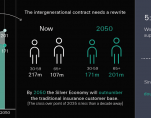
That is roughly how long we have before many societies reach one of the most defining demographic tipping points of our era: the point at which the “new” silver economy (over 65’s) outnumber people aged 30-59 who have traditionally been the bedrock of the life and pensions system.
The intergenerational contract needs a re-write
The significance of this shift goes far beyond demographics.
It represents a symbolic moment that forces us to rethink the intergenerational contract: how we provide care and financial security for people as they move into later life – and how we finance a new set of needs.
The demographic evidence is already visible across major economies. In the US, adults aged 65 and over already outnumber children in 11 states. Singapore’s over-65 population has nearly doubled in a decade to 21%. Japan is approaching 30%. The UK, France and Germany are not far behind
These numbers are well-known. But their meaning is not yet fully reflected in our industry’s existing product strategy.
The tipping point is also more than a statistical curiosity. We will experience it through the decisions we make coming into retirement and to secure the future of the generation coming after us. We will need to make new choices on how we fund care. We will need to make new assumptions about when to retire. And we will face a new reality around how much of the financial burden falls on the state, families or the individual.
Families have always carried the weight of old age, even as pensions, healthcare systems and social care programmes have broadened that responsibility across society.
But the arithmetic underpinning the system is breaking. Globally, the ratio of working-age people financially supporting each person over 65 is projected to fall from around five-to-one in 2021 to three-to-one by 2050. Across developed markets, debates about pension reform, healthcare funding and retirement ages reflect the same underlying question: how do we maintain security and dignity later in life when there are fewer hands to carry the weight?
It’s not a crisis of demographics. It’s a crisis of design – our systems were built for shorter lives and larger workforces, and they haven’t been rebuilt for the world we are actually entering.
That insight matters because it challenges how we think about insurance’s role. I believe we have less than a decade to develop the products that the older consumers who make up the Silver Economy – and their families – will need.
There will be no silver bullet. We cannot return to a single solution based around family care versus public provision. The individual retiree will be the focus, but our thinking will need to be based on a more collaborative model in which families, governments, communities and the private sector work together.
Recent Swiss Re consumer research in France and Germany revealed something striking. People don’t think about later life in terms of pensions or insurance policies. They think about practical outcomes: staying independent, being resilient when health shocks hit, not becoming a burden to their children.
Our industry has spent decades optimising for wealth accumulation and income protection during working years. Ageing societies demand we apply the same rigour to what happens after.
That does not mean the intergenerational contract has failed. It means it is evolving.
We are already seeing what that evolution looks like in practice.
Senior health products in Asia are closing a real gap —The median age of cancer diagnosis is 67, yet many critical illness policies expire before retirement even begins. The result is high out-of-pocket expenses, stressed public healthcare, and increased burden on families. With dedicated products to cover later life illnesses, such as senior cancer products we are effectively closing a protection gap.
Long term care in France has had some success with private solutions alongside public provision. With over 1.4 million people covered by private long term care insurance, France has built a strong risk pool that directly addresses one of the strongest concerns expressed by consumers: not becoming a burden on the next generation.
Deferred annuities offer a third path beyond the binary “draw-down versus annuity” thinking. By combining flexibility today with guaranteed income later, they help transform longevity from an individual financial risk into one that can be shared more broadly.
At first glance these solutions appear very different. In reality, they are pieces of the same puzzle. Each expands the circle of support around the individual. They help families carry less of the burden alone, and they complement the work of state safety nets.
That is what the next evolution of the intergenerational contract looks like in practice.
Ageing societies are one of humanity’s great achievements. But if our products and institutions stay built for a demographic reality that no longer exists, achievement curdles into liability.
We have a decade to close that gap. Let’s treat it as a product-development window, not a deadline.
Disclaimer Certain statements and illustrations contained herein are forward-looking and are made for informational purposes only. These statements (including as to plans, objectives, targets, and trends) and illustrations provide current expectations of future events based on certain assumptions and include any statement that does not directly relate to a historical fact or current fact. Readers are cautioned not to place undue reliance on forward-looking statements. Swiss Re undertakes no obligation to publicly revise or update any forward-looking statements, whether as a result of new information, future events or otherwise. Further information on forward looking statements and the use of information contained in this publication can be found in the Legal Notice section on Swiss Re’s website.
The issuer is solely responsible for the content of this announcement.
About Swiss Re
The Swiss Re Group is one of the world’s leading providers of reinsurance, insurance and other forms of insurance-based risk transfer, working to make the world more resilient. It anticipates and manages risk – from natural catastrophes to climate change, from ageing populations to cyber crime. The aim of the Swiss Re Group is to enable society to thrive and progress, creating new opportunities and solutions for its clients. Headquartered in Zurich, Switzerland, where it was founded in 1863, the Swiss Re Group operates through a network of around 70 offices globally.
Iran fired missiles and drones at US military-linked facilities in Bahrain and Kuwait after a new wave of American strikes on Iranian targets, pushing Gulf security concerns sharply higher and raising fresh risks for shipping, energy markets and regional airspace. The attacks targeted areas associated with US forces in Bahrain and Kuwait, two Gulf states that host important American military infrastructure. Air defence systems were activated, sirens […]
BingX has launched a global community initiative after Enzo Fernández scored Argentina’s stoppage-time winner against Egypt, turning a World Cup comeback into a marketing moment for the cryptocurrency exchange and Web3-AI platform. Fernández’s goal completed Argentina’s 3-2 victory in Atlanta after the defending champions had trailed 2-0 deep into the last 16 tie. Cristian Romero began the recovery in the 79th minute, Lionel Messi levelled four minutes […]
President Donald Trump has sharpened his public embrace of Bitcoin, calling cryptocurrency “very powerful” and saying the scale of Bitcoin use is still not fully understood, remarks that have placed digital assets back at the centre of Washington’s financial policy debate. The comments, made during a CNBC interview at the White House, marked another shift for a president who once dismissed Bitcoin as a threat to the […]
Arabian Post Staff -Dubai US forces hit about 90 targets along Iran’s coast on Wednesday, extending military action for a second straight day and deepening doubts over efforts to turn a fragile truce into a permanent peace deal. US Central Command said the operation was designed to weaken Tehran’s ability to attack commercial shipping and civilian mariners in the Strait of Hormuz, the narrow waterway through which […]
A newly demonstrated attack against Claude Desktop has highlighted how synced AI preferences and locally connected tools can be chained to turn a trusted chatbot into a covert route for command execution on a user’s workstation. The attack path centres on Claude Desktop’s Personal Preferences feature, which allows users to set account-wide instructions that are synchronised across sessions and devices. Security researchers showed that if an attacker […]
DuckDuckGo has added YouTube video ad blocking to its privacy-focused browser, widening its challenge to dominant browsers and giving users a built-in way to watch videos with fewer commercial interruptions. The feature blocks ads that appear before and during videos viewed inside the DuckDuckGo browser, including on YouTube. It relies on community-maintained uBlock Origin filter lists, a significant choice because those lists are open-source, regularly updated and […]
SNP builds on Palantir platforms to deliver new AI-powered solutions for solving mission-critical customer challenges
The partnership will build on SNP’s strong base with more than 3,000 customers globally and 15,000 successful SAP transformation projects
SNP and Palantir will leverage their strengths to help customers modernize their SAP landscapes and business processes in a predictable and secure way
SINGAPORE – Media OutReach Newswire – 9 July 2026 – SNP SE, a leading provider of software for AI-enabled digital transformation, automated data migration and data management in the SAP environment, and Palantir, a global leader in artificial intelligence and data platforms, today announced a strategic partnership at SNP’s flagship event, Transformation World, in Heidelberg, Germany. The collaboration positions SNP to develop new AI-powered solutions with an aligned approach to accelerate SAP transformations for joint customers.
The two partners will offer solutions for mission-critical challenges across all types of SAP projects, helping customers improve speed, efficiency and quality. The first joint solution, Test Data Proposal, solves a so far highly manual area of SAP migrations, the identification of relevant test data for given customer test cases. By leveraging AI, this process runs automatically and saves customers’ time and resources. Test Data Proposal will expand SNP’s proven Kyano® platform.
As part of the partnership, SNP and Palantir are also collaborating in large-scale moves to SAP Cloud ERP applications where customers seek to accelerate these modernization programs. Both companies combine complementary, category-leading strengths. SNP contributes deep real-world SAP data migration expertise while Palantir provides state-of-the-art AI-driven software platforms, which enable and accelerate secure modernizations for customers.
“Organizations are looking for new ways to increase speed, efficiency, and quality in large-scale SAP transformations,” said Jens Amail, CEO of SNP. “We are hugely excited to collaborate with Palantir, a company that has leveraged AI to revolutionize and accelerate the way enterprises modernize mission-critical systems and automate operations. Together, we will deliver secure outcomes and new solutions to customers and partners.”
“We have seen exceptional momentum accelerating SAP migrations for customers, and helping them do so via the Ontology and AIP (Artificial Intelligence Platform) in a way that significantly compresses the timeline and delivers operational value along the way,” said Sameer Kirtane, Head of US Commercial at Palantir. “SNP over the last 30 years has built an impressive track record of delivering predictable, compliant and auditable outcomes in thousands of successful engagements. We are proud to partner with SNP to fundamentally rethink how customers transform their SAP landscapes.”
Hashtag: #SNP #Palantir #SAP #AI
The issuer is solely responsible for the content of this announcement.
About SNP
SNP (ticker: SHF.DE) is the global technology platform leader and trusted partner for companies seeking unparalleled data-enabled transformation capabilities and business agility. SNP’s Kyano® platform integrates all necessary capabilities and partner offerings to provide a comprehensive software-based experience in data migration and management. Combined with the Bluefield® approach, Kyano sets a comprehensive industry standard for restructuring and modernizing enterprise data faster and more securely while harnessing AI-driven innovations based on over 30 years of experience.
The company works with more than 3,000 customers of all sizes and in all industries in over 80 countries, including numerous DAX 40 and Fortune 500 companies. The SNP Group has more than 1,600 employees worldwide at over 34 locations in 22 countries. The company is headquartered in Heidelberg, Germany, and generated revenues of around EUR 297 million in the 2025 fiscal year.
This press release contains forward-looking statements within the meaning of Section 27A of the Securities Act of 1933, as amended, and Section 21E of the Securities Exchange Act of 1934, as amended. These statements may relate to, but are not limited to, Palantir’s expectations regarding the amount and the terms of the contract and the expected benefits of Palantir’s software platforms. Forward-looking statements are inherently subject to risks and uncertainties, some of which cannot be predicted or quantified. Forward-looking statements are based on information available at the time those statements are made and were based on current expectations as well as the beliefs and assumptions of management as of that time with respect to future events. These statements are subject to risks and uncertainties, many of which involve factors or circumstances that are beyond Palantir’s control. These risks and uncertainties include the ability to meet the unique needs of customers; the failure of Palantir’s platforms to satisfy customers or perform as desired; the frequency or severity of any software and implementation errors; Palantir’s platforms’ reliability; and customers’ ability to modify or terminate the contract. Additional information regarding these and other risks and uncertainties is included in the filings Palantir makes with the Securities and Exchange Commission from time to time. Palantir’s forward-looking statements speak only as to Palantir, and Palantir assumes no responsibility for the accuracy or completeness of any forward-looking statements made by any other party. Except as required by law, Palantir does not undertake any obligation to publicly update or revise any forward-looking statement, whether as a result of new information, future developments, or otherwise.
By K Raveendran The Narendra Modi government’s position on fuel prices now looks less like prudent caution and more like an overly defensive reading of a market that has already absorbed much of the Iran-US risk. The more calibrated question, therefore, is not whether New Delhi is right to watch the West Asian security situation, […]
President Trump’s declaration on Wednesday that the ceasefire with Iran is over immediately pushed oil prices higher, lifted Treasury yields and revived concerns about the security of the Strait of Hormuz. Markets responded in familiar fashion, with traders reassessing energy supplies, inflation expectations and monetary policy. Another consequence deserves equal attention. Higher oil prices strengthen the fiscal position of the Gulf’s major energy exporters. Over time, stronger […]
Microsoft Corp. is moving more artificial intelligence work inside its own systems, replacing some OpenAI and Anthropic models in products such as Excel and Outlook as pressure grows to reduce the cost of running generative AI at scale. The shift marks a notable change for one of the technology industry’s biggest AI spenders. Microsoft has relied heavily on OpenAI’s models to power Copilot features across its software […]
Samsung Group and SK hynix have laid out investment plans worth about $174 billion for South Korea’s Chungcheong region, expanding the country’s drive to secure a stronger position in artificial intelligence chips, advanced packaging, displays and next-generation battery materials.
The commitments, unveiled at a government-backed industrial development event in Asan, place Chungcheong at the centre of a broader strategy to spread high-technology manufacturing beyond the Seoul metropolitan area and existing semiconductor clusters. President Lee Jae Myung praised the companies’ “bold decision” and called for faster execution of major industrial projects, warning that global competition in semiconductors and artificial intelligence will reward countries that move with speed on permits, power, water and land.
Samsung plans to invest 140 trillion won, or about $90 billion, across the central region. The programme covers display panels, high-bandwidth memory-related capacity, semiconductor packaging substrates, batteries and other core materials. The group’s plan is expected to reinforce manufacturing links between Samsung Electronics, Samsung Display, Samsung SDI and Samsung Electro-Mechanics, whose operations span chips, OLED screens, batteries and electronic components.
SK hynix said it would invest 100 trillion won, or about $64 billion to $72 billion depending on exchange-rate calculations, in Cheongju, North Chungcheong Province. The plan includes the M17 NAND flash memory fabrication plant and P&T7, an advanced packaging and test facility. M17 is scheduled to break ground in 2026 and begin operations in the first half of 2029, while P&T7 is targeted for completion by the end of 2027.
The Cheongju expansion is intended to strengthen SK hynix’s NAND business and add back-end capacity at a time when artificial intelligence systems are raising demand for both high-performance memory and storage. While high-bandwidth memory has received the strongest investor attention because of its role in AI accelerators, large-scale data centres also require more NAND-based storage as models, user data and enterprise workloads expand.
The Chungcheong plan follows a wider national push in which Samsung Electronics and SK hynix are expected to invest hundreds of billions of dollars in new chipmaking hubs over the next decade. The government has framed the initiative as a “triple axis” strategy built around semiconductors, physical AI and data centres, with the aim of building industrial strength outside the traditional capital-area manufacturing corridor.
For Samsung, the Chungcheong investment gives the group a regional base for several linked supply chains. OLED production in Asan and surrounding areas can support premium smartphones, tablets, monitors and automotive displays. Battery investment strengthens Samsung SDI’s role in electric mobility and energy storage, while semiconductor materials and packaging substrates address one of the key bottlenecks in AI hardware production.
For SK hynix, Cheongju already has semiconductor infrastructure, making it a faster route for expansion than a greenfield project. The company has been one of the largest beneficiaries of the AI memory boom, helped by demand for high-bandwidth memory used with Nvidia graphics processors. Its latest investment signals that the company is also preparing for broader memory demand, including NAND and advanced packaging.
The scale of the commitments underlines the strategic importance of memory chips to South Korea’s economy. Samsung Electronics and SK hynix are the world’s two largest memory chipmakers, with dominant positions in DRAM and a major presence in NAND. Their investment decisions affect global supply, pricing expectations and the pace at which cloud companies can build AI infrastructure.
The programme also carries risks. Semiconductor investment cycles have often produced periods of oversupply after large capacity expansions. Investors have shown caution over whether the current AI-driven boom can absorb the output planned by the industry, especially if data-centre spending slows or if memory pricing weakens before new factories reach full capacity.
Infrastructure remains another challenge. Advanced chip plants require stable electricity, ultra-pure water, skilled engineers and rapid permitting. Lee’s comments on execution reflect concern that delays could undermine the industrial strategy. Local governments are expected to face pressure to accelerate utility connections, transport links and land-use approvals while managing environmental and community concerns.
Regional development is a central political theme of the initiative. By placing more advanced manufacturing in Chungcheong and other areas outside Seoul’s orbit, the administration is seeking to reduce economic concentration and create high-value jobs in provincial cities. That ambition will depend on whether new factories attract suppliers, research teams and service industries rather than functioning as isolated production sites.
A browser flaw in Opera GX allowed hostile websites to silently install customisation mods and use them to extract data from pages visited by a signed-in user, exposing a weakness in how browser styling features can be turned into cross-site surveillance tools. The vulnerability, now patched, affected the gaming-focused Opera GX browser and centred on its GX Mods feature, which lets users customise themes, wallpapers, sounds and […]
Attackers are hiding machine-readable instructions inside websites to manipulate AI agents, turning ordinary web pages into a new security battleground as automated systems begin browsing, summarising and acting on behalf of users. Zscaler’s ThreatLabz has documented two live campaigns using indirect prompt injection, a technique in which malicious instructions are planted in third-party content that an AI system reads during a task. Unlike a direct prompt attack, […]
Emergency crews began stabilising a structurally compromised Midtown Manhattan high-rise after buckled columns, cracked floors and visible deflection forced evacuations around a major office-to-residential conversion site near Grand Central Terminal. The 37-storey building at 235 East 42nd Street, formerly part of Pfizer’s global headquarters, was declared unstable after workers reported structural distress on Tuesday morning. By evening, engineers had entered the affected area, installed jacks and started […]




 https://vinhomes.vn/en


 https://www.linkedin.com/company/swiss-re/