AryStinger, a newly analysed botnet family, has compromised more than 4,000 outdated routers and begun turning ageing network devices into covert infrastructure for reconnaissance, intranet scanning and traffic tunnelling. The campaign highlights a shift in botnet use from crude denial-of-service activity towards stealthier pre-intrusion work, where hijacked routers and network-attached storage appliances act as relay points between attackers and intended targets. Security analysts say the malware helps […]
Arabian Post Staff -Dubai Qatar’s Barzan gas facility was hit by an explosion and fire during start-up operations on Sunday, injuring 54 people and leaving 18 missing at Ras Laffan Industrial City, the country’s strategic energy hub north of Doha. Emergency teams brought the blaze under control after the blast, while search and rescue operations continued around the affected section of the plant. Authorities described the incident […]
Apple is set to work with Intel on designing and manufacturing chips in the United States, President Donald Trump said, signalling a potential breakthrough for Intel’s foundry ambitions and a fresh shift in Washington’s effort to bring advanced semiconductor production closer to home. The announcement, made through Trump’s social media account, has not yet been publicly confirmed by either Apple or Intel. Both companies have declined to […]
Abu Dhabi Investment Authority and a group of institutional investors have bought a 7.3 per cent stake in Corona Remedies for ₹777 crore, marking a sizeable secondary market transaction in the Ahmedabad-based drugmaker months after its stock market debut.
The shares changed hands through block deals on the National Stock Exchange, with the transaction executed at ₹1,730 a share. The deal involved about 44.9 lakh shares, with private equity investor ChrysCapital, through its affiliate Sepia Investments, and Anchor Partners selling part of their holdings. ADIA bought 39,130 shares, while other buyers included Aberdeen Group, Factory Mutual Insurance Company, HDFC Mutual Fund, Kotak Mahindra Mutual Fund, Ashoka WhiteOak and other funds.
Corona Remedies’ shares rose nearly 3 per cent after the transaction, trading around ₹1,840 on the NSE, as the market read the entry of large domestic and overseas institutions as a vote of confidence in the company’s branded formulations business. The block deal valued the stake at a premium to the company’s public issue price band of ₹1,008-₹1,062 a share in December 2025, underlining the strong post-listing performance of the stock.
Sepia Investments sold 43.28 lakh shares, equal to about 7.07 per cent of Corona Remedies’ equity, for around ₹748.9 crore. Anchor Partners offloaded 1.61 lakh shares, or 0.26 per cent, for about ₹28 crore. Sepia’s stake fell to 12.69 per cent from 19.76 per cent after the sale, while the wider ownership base brought more institutional depth to the company’s shareholder register.
The transaction is also a partial exit for early financial investors who backed Corona Remedies before its public listing. For buyers, the attraction lies in a domestic formulations franchise with established brands across women’s healthcare, cardio-diabeto, pain management, urology and other therapeutic categories. The company has positioned itself in segments with higher repeat prescription potential and relatively stronger pricing resilience than low-margin commodity generics.
Corona Remedies reported revenue growth of about 17 per cent in the financial year ended March 2026, while profit after tax rose about 33 per cent. Its full-year revenue crossed ₹1,400 crore, supported by growth in chronic and sub-chronic therapies, brand-led marketing and wider distribution. The company’s earlier public offer was entirely an offer for sale, meaning the proceeds went to existing shareholders rather than to the company.
The drugmaker was ranked among the top 30 pharmaceutical companies in the domestic pharmaceutical market by sales before its listing. Women’s healthcare is one of its strongest verticals, followed by cardio-diabeto, pain management and urology. Its brand portfolio includes products targeted at specialist doctors, a strategy that has helped it command higher prescription visibility in selected therapies.
The stake purchase comes at a time when pharmaceutical companies with strong domestic franchises are drawing investor interest. Companies focused on branded formulations have benefited from rising healthcare consumption, deeper insurance penetration, higher diagnosis rates for chronic conditions and stronger prescription volumes in urban and semi-urban markets. The domestic pharmaceutical market has also been less exposed to some of the pricing and regulatory volatility faced by export-heavy generic drugmakers.
ADIA’s participation fits a broader pattern of Gulf sovereign capital seeking exposure to healthcare, pharmaceuticals, financial services, infrastructure and consumer platforms across growth markets. The Abu Dhabi fund has built a diversified global portfolio and has been active in private equity, listed equities, real estate and alternatives. Its entry into Corona Remedies, though modest in percentage terms, adds to institutional interest in healthcare businesses with predictable cash flows and long-term demand visibility.
For Corona Remedies, the deal improves public float quality and may support market liquidity. Greater institutional ownership can also bring closer scrutiny of margins, product concentration, compliance, capital allocation and future acquisition strategy. The company’s next phase will be measured against its ability to maintain growth while protecting profitability in a market where promotional expenses, field-force productivity and doctor engagement remain critical.
The transaction also highlights how block deals have become an important route for private equity funds to monetise stakes after listings. Rather than waiting for gradual market sales, large shareholders can exit or pare exposure through negotiated exchange transactions that allow institutional buyers to acquire sizeable positions in a single trading window. Such deals can reduce overhang when executed cleanly, though they also put focus on valuation sustainability after the initial market response.
Abu Dhabi Investment Authority has emerged among institutional buyers in a ₹777 crore open-market transaction involving a 7.3 per cent stake in Corona Remedies, marking another Gulf-linked investment in the country’s fast-growing listed pharmaceutical space. The transaction was executed through block deals on the National Stock Exchange at ₹1,730 per share, with shares sold mainly by Sepia Investments, an affiliate of ChrysCapital, and Anchor Partners. ADIA purchased […]
By R. Suryamurthy India’s economy is supposedly doing remarkably well. Growth remains among the fastest in the world. Stock markets continue to flirt with record highs. Billionaires are multiplying. Airports are expanding. Bullet trains are advancing. Defence exports are reaching new milestones. The nation is speaking confidently about becoming a $10 trillion economy and a […]
Oman and Sri Lanka have opened a new channel of investment cooperation centred on special economic zones, free zones and industrial cities, adding momentum to efforts by both countries to attract long-term capital into logistics, real estate, services and manufacturing.
Qais Mohammed Al Yousef, Chairman of the Public Authority for Special Economic Zones and Free Zones, held talks in Muscat with Harsha Amarasekera, Chairman of the Colombo Port City Economic Commission, on opportunities to link the two countries’ zone-development strategies. The discussions covered commercial and real estate development, mechanisms to improve the business environment, and ways to draw high-quality investments into projects designed to support sustainable growth.
The meeting marks a targeted attempt to move bilateral economic ties beyond conventional trade into the management, promotion and regulation of investment destinations. Both sides reviewed experience in developing and administering special economic zones and examined international practices that could raise operational efficiency, improve investor services and strengthen competitiveness.
For Oman, the engagement fits a wider policy push to make economic zones central to diversification under Vision 2040. OPAZ, established in 2020, supervises key destinations including the Special Economic Zone at Duqm, Sohar Free Zone, Salalah Free Zone and Al Mazunah Free Zone, while promoting a network of industrial estates and logistics-led investment sites. The zones offer incentives such as full foreign ownership, capital and profit repatriation, customs advantages and tax exemptions that can run up to 30 years for qualifying projects.
The policy framework was reinforced by Royal Decree 38/2025, which brought special economic zones and free zones under a unified law that took effect in April 2025. The legislation replaced separate legal regimes for free zones and Duqm, introduced clearer provisions for foreign ownership and licensing, and strengthened the case for a one-stop system to cut procedural delays for investors.
Duqm has become the most visible test of that strategy. Oman signed ten agreements and memoranda this month for projects in the zone with estimated investments of $7.5 billion, including a $4.2 billion green hydrogen development by ACME Group. The package underlines how Muscat is using zone-based infrastructure to capture capital in clean energy, downstream industry, logistics and export-linked production.
Sri Lanka approaches the talks from a different but complementary position. The island’s post-crisis recovery has made investment promotion a policy priority, with foreign direct investment crossing $1 billion in 2025. The Board of Investment approved 146 projects worth about $1.9 billion during the year, with manufacturing, port development and tourism accounting for the largest shares of inflows.
Colombo Port City gives Sri Lanka a flagship platform for the dialogue with Oman. Built on 269 hectares of reclaimed land next to Colombo’s central business district, the project is structured as an international service-oriented special economic zone, with an initial investment of $1.4 billion and expected overall investment of about $20 billion when fully developed. Its commission acts as a single-window facilitator for investors and grants incentives for businesses of strategic importance.
The Omani-Sri Lankan conversation also highlighted small and medium-sized enterprises, an area where both economies are seeking wider participation in export growth and innovation. Sri Lanka’s SME base is tied to apparel, services, technology, tourism and light manufacturing, while Oman is trying to deepen local supply chains around ports, industrial estates and energy projects. Collaboration could extend from investor promotion to training, supplier development and zone management systems.
The timing is significant. Sri Lanka remains under an IMF-backed reform programme after its 2022 financial crisis, with fresh financing approved in May to support reserves and policy stability. Growth remains exposed to external pressures, including energy-price volatility and climate shocks, making durable foreign investment more important than short-term inflows. Oman, meanwhile, is positioning itself as a stable Gulf logistics and production base as investors reassess supply chains.
Nvidia has raised $25 billion through its largest bond sale, drawing a wave of investor demand that underlines Wall Street’s confidence in long-term artificial intelligence spending despite rising questions over the cost of the global data-centre buildout. The Santa Clara-based chipmaker priced the investment-grade deal on June 15 after initially targeting at least $20 billion. Orders reached about $85 billion, allowing the company to expand the transaction […]
Foreign investors delivered their strongest one-day purchase of Vietnamese equities in nearly six years on 15 June, signalling a sharp improvement in risk appetite after fears over Middle East energy disruption eased.
Overseas funds bought a net US$160.4 million of Vietnamese shares on Monday, the largest daily inflow since 10 September 2020. The buying helped steady a market that had been under pressure from rising oil prices, global risk aversion and sustained foreign withdrawals despite Vietnam’s long-awaited move towards emerging-market status.
The VN-Index rose 0.43 per cent to 1,799.31 on Monday and moved back above the 1,800-point area on Tuesday, keeping the benchmark close to levels that still represent a strong annual advance even after a pullback over the past month. The shift was part of a wider rebound across Asian emerging markets after the United States and Iran agreed on terms aimed at ending hostilities and reopening the Strait of Hormuz, easing concerns over inflation and fuel costs.
The reversal is notable because foreign investors have remained net sellers of Vietnamese equities this year. Even after Monday’s inflow, overseas funds have sold about US$2.6 billion of Vietnamese stocks in 2026, following withdrawals of roughly US$4.8 billion last year. Those outflows reflected concerns over market concentration, heavy exposure to a few large-cap groups, tariff uncertainty, currency pressure and the impact of higher energy prices on a manufacturing-led economy.
“De-escalation in the Middle East and Vietnam’s own underperformance have created a textbook re-entry set-up for foreign capital,” said Quynh Cao, head of institutional business at VNDirect Securities. “Positioning was already tight and it does not take much to flip that.”
Vietnam’s appeal to global investors rests on more than a single trading session. FTSE Russell has confirmed that the country will be reclassified from frontier to secondary emerging-market status from 21 September, with inclusion in global equity indices to be phased through 2027. The upgrade is expected to bring passive inflows of about US$1.5 billion, with broader active flows potentially lifting the total to several billion dollars if market reforms continue.
The reclassification follows changes aimed at improving foreign access, including the removal of full pre-funding requirements for equity trades and the development of a global broker model. These reforms address long-standing obstacles for institutional investors, who had complained about settlement risk, limited access channels and operational frictions that made Vietnam harder to replicate within global index portfolios.
Large-cap names expected to draw attention include Vingroup, Masan Group, FPT Corp and Hoa Phat Group, alongside banks, securities firms, industrial stocks and consumer companies with sufficient liquidity and foreign room. Average daily trading value in Vietnamese equities this year has been around US$789 million, underscoring the market’s growing depth, though liquidity remains uneven across sectors.
The macroeconomic backdrop remains supportive. Vietnam’s economy expanded 8.02 per cent in 2025, helped by strong exports, public investment, manufacturing activity and resilient consumption. Foreign direct investment disbursement rose to about US$27.6 billion last year, while exports reached roughly US$475 billion. Growth is expected to moderate this year, but projections still place Vietnam among Asia’s faster-growing economies.
Higher oil prices had complicated that outlook. Vietnam is exposed to imported fuel and energy costs, making any disruption in the Strait of Hormuz a direct risk to inflation, transport costs and factory margins. The drop in crude prices after the US-Iran accord helped restore confidence among investors looking at countries with strong structural growth but sensitivity to external shocks.
The market is not without vulnerabilities. Retail investors remain a major force in daily trading, making sentiment swings sharper when liquidity thins. Foreign ownership limits continue to constrain buying in some leading companies. Corporate governance, disclosure quality and settlement infrastructure also remain areas under watch as Vietnam seeks eventual MSCI emerging-market status.
Analysts say the latest inflow will need to be sustained before it can be treated as a durable turning point. A single large session can reflect short-covering, index positioning or tactical buying after a sell-off. A lasting reversal would require more consistent foreign participation, firmer currency conditions, stable oil prices and evidence that earnings growth can match valuations after the market’s strong run.
XRP held near $1.22 on Tuesday, stabilising after a bruising sell-off as extreme bearish commentary around the token began drawing attention from traders looking for a contrarian rebound. The token’s sideways move followed a modest recovery of about 4 per cent over the past week, a gain that stood out against a cautious wider cryptocurrency market. Bitcoin and Ether also traded firmer, but investor conviction remained fragile […]
BingX has launched a stock-focused trading campaign with a prize pool of more than $1m, stepping up its attempt to draw crypto users into global equity-linked markets through a single multi-asset platform. The Stock Trading Carnival runs from 15 June to 4 July 2026 and is positioned as the third edition of the exchange’s Global Capital Gala series. The campaign allows eligible users to share rewards by […]
Oil prices slid to their lowest levels since March on Monday after Washington and Tehran said they had reached an initial deal aimed at ending the war and restoring traffic through the Strait of Hormuz, easing fears that months of disruption to one of the world’s most important energy corridors would deepen. Brent crude futures fell $4.08, or 4.7 per cent, to $83.25 a barrel by 0415 […]
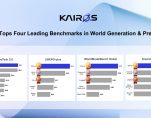
SHANGHAI, CHINA – Media OutReach Newswire – 15 June 2026 – ACE ROBOTICS today announced that its open-source Kairos world model has achieved leading results across four global embodied-intelligence benchmarks: RoboTwin 2.0, LIBERO-Plus, WorldModelBench Robot and DreamGen. Kairos ranked first among evaluated world models and vision-language-action (VLA) systems on these benchmarks’ public leaderboards as of 12 June 2026, leading across the core capabilities of embodied intelligence, including complex robotic manipulation, scene-level generalization, physical-world modeling and zero-shot transfer. The project is openly available on GitHub, Hugging Face and ModelScope, giving researchers and developers a public reference point for the model, benchmark results and technical materials.
Tops Four Leading Benchmarks in World Generation & Prediction
Embodied intelligence faces a fundamental challenge: generalization. A robot must operate reliably in environments it has never seen, adapting to new lighting, layouts, objects, embodiments and noisy real-world conditions. While VLA models have become a prevailing approach by directly mapping perception and language inputs to robot actions, ACE ROBOTICS believes world models offer a more scalable path by explicitly learning the underlying dynamics of the physical world and predicting how environments evolve. Kairos is designed to validate that approach.
Leading scene-level generalization on LIBERO-Plus
One of Kairos’ most significant results comes from LIBERO-Plus, a scene-level generalization benchmark proposed by the Shanghai Innovation Institute with Fudan University, Tongji University and the National University of Singapore. It evaluates robustness under seven real-world variables: camera angle, robot embodiment, language instruction, lighting, background, sensor noise and spatial layout.
Kairos achieved an overall score of 89.0, ranking first among all evaluated world models and VLA systems. It surpassed leading VLA models including ACoT-VLA (88.0), Pi 0.5 (85.7) and ProGAL-VLA (85.5), as well as the Being-H0.7 world model (84.8). It also showed strong environmental robustness, with near-ceiling performance on lighting (97.7), noise (96.8) and background (95.8), and ranked highly on camera angle and language instruction.
According to ACE ROBOTICS, this marks the first time a world-model approach has outperformed leading VLA systems on LIBERO-Plus for scene-level generalization, pointing to a path where robots adapt to homes, factories, retail spaces and other environments with far less environment-specific retraining.
A compact model with strong physical modeling efficiency
On WorldModelBench Robot, a physical-modeling benchmark proposed by researchers from UC Berkeley, UC San Diego, NVIDIA and MIT, Kairos-4B achieved an overall score of 9.30, ranking first on the benchmark. With only 4 billion parameters, it outperformed larger systems including 28-billion-parameter Lingbot, 16-billion-parameter Cosmos 3, 14-billion-parameter Abot-PhysWorld and 5-billion-parameter Wan 2.2, setting a new record for parameter efficiency in embodied world models.
Kairos matched the top instruction-following score (2.36) of the 16-billion-parameter Cosmos 3 with about one quarter of the parameters, a fourfold efficiency gain. It scored 4.96 on physics adherence, with perfect marks on Newtonian mechanics and gravity, and a perfect score on temporal quality, reflecting strong temporal consistency and visual continuity over long horizons.
A unified architecture, not a modular pipeline
ACE ROBOTICS attributes Kairos’ performance to its native unified “multi-modal understanding-generation-prediction” architecture. Unlike modular approaches that stitch together separate components for world understanding, generation and prediction, Kairos integrates these within a single backbone that shares one global world state, reducing the information loss and coordination latency between modules for more consistent physical modeling, stronger long-horizon prediction and more reliable action planning.
ACE ROBOTICS first introduced this architecture in December 2025, and the broader industry is now converging on a similar path: NVIDIA’s Cosmos 3.0, introduced in 2026, adopts a comparable single-system design that brings vision reasoning, world generation and action prediction into one architecture. Built on this foundation, Kairos-4B is, in ACE ROBOTICS’ description, the first embodied world model able to drive a physical robot directly on-device, closing the perception-to-action loop without intermediate translation latency.
Leading on synthetic data transfer and complex robot manipulation
Kairos also ranked first on DreamGen Bench, a benchmark led by NVIDIA with the University of Washington, UC Berkeley and UCLA that measures how well synthetic data generated by world models transfers to unseen objects, behaviors and environments, a key predictor of downstream robot-training value. Kairos ranked first on both average physics adherence (AVG_PA 0.538) and overall average score (AVG_Score 0.618), and led globally on new-behavior execution and new-environment adaptation.
On RoboTwin 2.0, a demanding dual-arm manipulation benchmark proposed by Shanghai Jiao Tong University and the University of Hong Kong with Shanghai AI Laboratory, Kairos scored 96.1% — a state-of-the-art result on the benchmark’s public leaderboard as of 12 June 2026. Across the benchmark’s 50 complex two-arm tasks it scored 96.9% in clean scenarios and 95.2% in randomized scenarios, ahead of VLA models such as G0.5 (93.2) and starVLA (88.3) and world models including AIM (93.1), Fast-WAM (91.8) and MotuBrain (96.0).
From benchmark leadership to commercial deployment
Together, these results validate Kairos’ technical direction across the core dimensions of embodied intelligence, from physical-rule understanding and zero-shot generalization to environmental robustness and fine-grained dual-arm manipulation, supporting ACE ROBOTICS’ aim to move robots beyond task imitation toward physical-world understanding, long-horizon reasoning and real-world execution.
The results come as ACE ROBOTICS accelerates commercialization. The company says it has raised several hundred million U.S. dollars across financing rounds in the first half of 2026, including a recent Angel+ round backed by investors such as Geely Capital, Dachen Caizhi, Shenzhen Capital Group and the Shanghai Sci-Tech Innovation Fund, with existing shareholder SenseTime’s Guoxiang Capital increasing its stake. The proceeds will support continued world-model research and integrated hardware-software solutions for sectors including smart retail, security and inspection, tourism and hospitality.
“Embodied intelligence is the next era of AI, and a world model is the key to unlocking it,” said Wang Xiaogang, Chairman of ACE ROBOTICS. “Our mission is to give every robot a capable brain.”
The issuer is solely responsible for the content of this announcement.
About ACE ROBOTICS – Equipping robots with intelligent “brains” and engaging “souls”
ACE ROBOTICS is a pioneering robotics company dedicated to advancing the field of embodied intelligence. Through breakthrough technological innovations and deep insights into embodied intelligence scenarios, we aim to empower robots with the ability to autonomously understand and explore the physical world, thereby accelerating their commercial implementation.
The company pioneered the ACE R&D paradigm and built a vision-based “environmental data engine, real-world cognition, embodied interaction generalization” technology chain. Using full spatiotemporal and multi-perspective environmental capture as its engine, along with Kairos 3.0 – China’s first open-source and commercially applicable world model – plus the Embodied Foundation Model as its technical backbone, ACE ROBOTICS addresses core industry challenges such as data scarcity, common sense gaps, poor generalization, and limited versatility. Simultaneously, the company unveiled its flagship A1 Embodied Super Brain Module, accelerating the large-scale commercial deployment of embodied intelligence across diverse scenarios.
ACE ROBOTICS is both a technology pioneer and an ecosystem builder. Through strategic cooperation with top hardware manufacturers, cloud service providers, and vertical scenario partners, we have broken through the “model-hardware-scenario” industrial deadlock, providing standardized and customized solutions that are driving the development of China’s embodied intelligence industry.
Arabian Post Staff -Dubai Abu Dhabi’s International Holding Company has begun an AED1.8 billion share repurchase, opening the first tranche of an approved AED5 billion buyback after a sharp rise in first-quarter profit and continued expansion across its investment portfolio. The initial purchase, launched on 12 June, represents 36 per cent of the total programme approved by shareholders at the company’s annual general assembly on 16 March […]
Securitize has expanded its tokenised AAA CLO fund to Solana, adding a major blockchain venue to a product built with BNY for institutional structured-credit exposure. The Securitize Tokenized AAA CLO Fund, known as STAC, will now be available to eligible investors through Solana, with Ethena Labs planning a $250 million allocation. The commitment ranks among the largest planned deployments into tokenised structured credit on the Solana ecosystem […]
Elon Musk is on the brink of becoming the world’s first trillionaire as SpaceX prepares to open trading on Nasdaq after pricing the largest initial public offering on record, a deal that places one of the most strategically important technology companies at the centre of a debate over wealth, markets and power. Space Exploration Technologies Corp. priced 555,555,555 Class A shares at $135 each, raising about $75bn […]
Dubai’s property market is set for one of its largest new supply commitments as Emaar Properties prepares to unveil a Dhs200bn master-planned district designed for nearly 150,000 residents in the heart of the emirate. The project, valued at about $54.5bn, will span more than 4.5 million square metres of gross floor area and combine residential towers, villas, mansions, offices, retail centres, hotels and civic amenities. Emaar has […]
Wall Street’s AI trade came under pressure as investors reassessed stretched technology valuations before SpaceX’s planned market debut, with Alphabet, Microsoft, Meta Platforms and Oracle losing more than $200 billion in combined market value during the session. The sell-off hit some of the largest companies tied to artificial intelligence spending, cloud infrastructure and data-centre expansion. Alphabet fell about 2.5 per cent, Microsoft lost nearly 2.7 per cent, […]
Abu Dhabi’s L’IMAD Holding has deepened its grip on TAQA after its subsidiary Abu Dhabi Power Corporation bought a further 8.09 per cent stake in the listed power and water utility, lifting its holding to 98.12 per cent. The transaction, disclosed on Wednesday, involved the acquisition of 9.1 billion TAQA shares from Two Point Zero Group. Based on TAQA’s closing share price that day, the stake was […]
Chinese investors shut out of SpaceX’s planned blockbuster share sale are turning to indirect routes, fuelling speculative demand for offshore vehicles, supplier stocks and domestic space-sector names as Elon Musk’s rocket company prepares for one of the largest market debuts on record. Underwriters handling the offering have been told not to accept orders from investors in mainland China and Hong Kong, with the restriction linked to US […]
Matein Khalid Only after I tried to read the 277-page SpaceX IPO filing did I grasp the truth of Winston Churchill’s observation that his sceptred isle and America were two countries separated by a common language. For my Brit friends and editors, SpaceX is a rocket launch, satellite and AI business. In the legal gobbledygook of SEC/Wall Street, American lingo, SpaceX is history’s first “orbital infrastructure conglomerate”. […]
Arabian Post Staff -Dubai Saudi Arabia’s Arabian Dyar has put its planned Tadawul initial public offering on hold, becoming the latest issuer to step back from the Kingdom’s listings pipeline as volatile trading conditions and weaker investor appetite complicate efforts to bring larger private companies to market. The real estate and construction company, formally known as Aldyar Alarabiya Real Estate Development Company, had faced a June deadline […]
Michael Saylor’s attempt to frame bitcoin’s sharp fall as a rotation of capital into artificial intelligence has drawn a blunt challenge from Arca, which argues that the more immediate trigger was Strategy’s sale of 32 bitcoin to meet preferred stock dividend obligations. The dispute has turned a small transaction into a larger test of confidence in one of the market’s most influential bitcoin treasury companies. Strategy sold […]
Paytm plans to add about 4,000 employees over the next nine months as the digital payments company pushes deeper into artificial intelligence, product development and merchant services, even as it cuts a smaller number of roles after its performance review cycle.
The hiring programme would expand the workforce of One 97 Communications, Paytm’s parent, by about 10 per cent from a base of roughly 40,000 employees. The company is also expected to reduce about 1 per cent of its staff, or nearly 400 employees, as it removes overlapping functions and redirects resources towards areas tied to revenue growth, automation and financial services distribution.
The planned additions will run through March 2027 and cover product, technology, artificial intelligence and senior leadership roles. Paytm has already added more than 800 employees over the past two months and is in the process of recruiting the next tranche as it widens its merchant network and builds AI-led tools across its platform.
The move reflects a broader recalibration inside the Noida-based fintech company after two years of regulatory pressure, cost discipline and business restructuring. Paytm is seeking to convert its large base of users and merchants into higher-value customers for loans, investments, insurance and other financial products, while keeping a tight watch on employee costs and operating expenses.
Chief Executive Officer Vijay Shekhar Sharma has been working to rebuild confidence after the Reserve Bank of India imposed severe restrictions on Paytm Payments Bank in 2024 and later cancelled the licence of the independently held affiliate in April 2026. One 97 Communications holds 49 per cent in the payments bank, while Sharma owns the remaining 51 per cent.
The banking affiliate’s closure has continued to shape staffing decisions. Most of Paytm Payments Bank’s employees have already exited over the past two years, with some absorbed into other parts of the fintech group. The remaining few hundred employees at the bank are expected to leave as the winding-down process advances.
Paytm’s latest hiring plan comes after a year in which the company sharply reduced headcount. Average on-roll employees fell from 43,960 in FY24 to 39,368 in FY25, a decline of about 4,600 people. A large portion of the workforce remains tied to sales, underlining the importance of merchant acquisition and field distribution in Paytm’s model.
The company’s restructuring has coincided with an improvement in profitability. Paytm posted four consecutive profitable quarters and reported its first full-year profit since listing, with FY26 net profit of about ₹552 crore compared with a loss of ₹663 crore in FY25. Revenue for FY26 rose to about ₹9,291 crore from ₹7,625 crore a year earlier.
For the March 2026 quarter, One 97 Communications reported a consolidated net profit of about ₹184 crore, compared with a loss of about ₹540 crore in the year-earlier period. Revenue from operations rose 18.4 per cent year-on-year to ₹2,264 crore, supported by payments services and financial services distribution.
The improved performance has given Paytm more room to invest in growth areas, but the company is still balancing expansion with caution. Its shares have gained around 7 per cent over the past year, though they remain more than 50 per cent below the 2021 initial public offering price, a reminder of investor concerns over profitability, regulation and the durability of its business model.
Artificial intelligence has become central to Paytm’s operating strategy. The company has used automation to reduce repetitive work in customer support, risk management, merchant servicing and internal processes. The next phase appears focused less on replacing headcount across the board and more on redeploying resources towards AI-enabled products, data-driven lending, fraud control and personalised financial offerings.
That shift mirrors a wider trend in the technology and fintech sectors, where companies are cutting roles in legacy or routine functions while hiring for engineering, machine learning, product design, compliance technology and platform operations. For Paytm, the challenge is sharper because its business relies on both software capability and a large physical merchant network.
The company began in 2010 as a mobile recharge platform before expanding into wallets, QR-code payments, Soundbox devices, payment gateways and financial services. Its growth accelerated after the 2016 currency note withdrawal pushed millions of merchants and consumers towards digital payments.



 https://www.linkedin.com/company/acerobotics/posts/?feedView=all&viewAsMember=true%EF%BD%9C
 https://x.com/ace_robotics




