Fake DDR5 memory modules fitted with plastic dummy chips have surfaced in online hardware checks, raising fresh concern across PC component markets already strained by tight memory supply and rising prices. The counterfeit modules appear at first glance to resemble legitimate DDR5 sticks, carrying printed labels and layouts that imitate recognised brands. Closer inspection by hardware testers showed that the supposed DRAM packages were not functional silicon […]
Arabian Post Staff -Dubai Qatar has presented its labour-policy overhaul as a wider migration-governance model, placing worker mobility, fair recruitment and anti-trafficking controls at the centre of its pitch to international partners. The position was set out at the Second International Migration Review Forum in New York, where HE Sheikha Najwa bint Abdulrahman Al-Thani, Undersecretary of the Ministry of Labour, argued that migration policy must move beyond […]
A Frontier Airlines aircraft struck and killed a person on a runway at Denver International Airport late on Friday, triggering an engine fire, smoke in the cabin and an emergency evacuation of more than 230 people aboard the Los Angeles-bound flight. Flight 4345, operated with an Airbus A321, was accelerating for departure at about 11.19pm local time when pilots reported hitting an individual on the runway. The […]
Mac users searching for Claude installation help are being targeted by a malvertising campaign that turns Google-sponsored results and legitimate Claude shared-chat pages into a malware delivery route. The campaign, disclosed on 10 May by security researcher Berk Albayrak, uses search ads that appear to point to Anthropic’s real claude. ai domain. Users looking for terms such as “Claude mac download” are led to a shared Claude […]
Arabian Post Staff -Dubai Classrooms across the UAE are set to reopen on Monday, May 11, after education authorities cleared the resumption of in-person learning for students, teachers and administrative staff following a temporary shift to remote classes linked to regional security developments. The decision covers public and private schools, nurseries, universities and higher education institutions across the country, restoring normal campus attendance after precautionary distance learning […]
Partnership pairs international leading longevity institution with HSBC’ to build the region’s first integrated “health and wealth” ecosystem for high‑net‑worth families.
HONG KONG SAR – Media OutReach Newswire – 11 May 2026 – Humansa, international leading integrated longevity institution and a premier destination for preventative healthcare, today announced the signing of a landmark Memorandum of Understanding (MoU) with The Hongkong and Shanghai Banking Corporation Limited (HSBC) and HSBC Life (International) Limited. This strategic collaboration aims to integrate advanced health optimisation with financial and insurance services, redefining how clients manage both their healthspan in Hong Kong and across the region.
Brian Hui, Chief Customer Officer, Retail Banking and Wealth Management, HSBC Hong Kong, Daisy Tsang, Chief Executive Officer, HSBC Life Hong Kong and Macau, Don So, Chief Executive Officer, Humansa.
A unified vision: healthspan as a core family asset
In a city renowned for its financial sophistication, the HSBC x Humansa alliance introduces a new paradigm: treating healthspan as a critical component of the modern family portfolio. As longevity science advances and demand for preventative healthcare accelerates, the partnership establishes a pioneering framework for an integrated “health and wealth” ecosystem designed specifically for high‑net‑worth and ultra‑high‑net‑worth clients.
Research from the Stanford Center on Longevity and other leading institutions highlights that many people in developed markets may live close to 100 years, making sustained cognitive and physical performance essential for a life of purpose and fulfilment. Simultaneously, global wealth reports show that affluent families are shifting spending from status goods toward wellness and longevity, and expect their financial partners to support this transition.
Moving beyond siloed services that treat health, wealth and insurance separately, Humansa contributes clinical excellence and geroscience‑based, data‑driven insights, while HSBC brings its wealth and insurance capabilities and a long‑term commitment to Asia as the world’s next major cross‑border wealth hub. Together, the parties aim to build the specialised infrastructure needed to manage health as a high‑value, appreciating asset over a 100‑year life.
Research‑driven excellence for high‑net‑worth clients
Humansa will lead the exploration of specialised longevity programs and dedicated physical spaces that combine clinical precision, behavioural coaching, and premium client experiences tailored to HSBC’s clients. By merging Humansa’s geroscience expertise with HSBC’s global wealth management reach and HSBC Life’s insurance capabilities, the partnership seeks to ensure that clients living longer – and better, at every stage of life.
Directives of the strategic collaboration: three pillars of “Longevity as an Asset”
Under the terms of the MoU, the parties have committed to three key pillars:
Longevity hubs and programs for HSBC clients – Explore the development of flagship “Longevity as an Asset” hubs and programs, where HSBC high-net-worth clients can access Humansa’s advanced diagnostics, health assessments and geroscience‑based services designed to preserve and grow their healthspan capital.
Integrated health‑wealth and insurance advisory – Pilot models where Humansa’s health insights can complement HSBC’s wealth and HSBC Life’s insurance advisory, enabling clients to align wealth management protection and succession strategies with their projected healthspan and personal goals.
Thought leadership and ecosystem building – Co‑create thought‑leadership platforms including research, client forums and CEO‑level dialogues in Hong Kong and other regional hubs to advance understanding of the economics of a 100‑year life, positioning Hong Kong at the forefront of longevity‑driven innovation.
These pillars provide a structured roadmap for turning the idea of “longevity as an asset” into practical offerings and experiences for clients across Asia.
“Humansa was founded on a simple belief: in a 100‑year life, healthspan is the most under‑managed asset on the family balance sheet,” said Don So, Chief Executive Officer of Humansa. “By joining forces with HSBC and HSBC Life, we are building the infrastructure that clients need to measure, protect and grow that asset – with clinical rigour, personalised programs and experiences that match the sophistication of their financial lives.
“Health, wealth and protection are deeply interconnected and shouldn’t be treated in isolation. As people live longer and spend more years beyond working life, they need trusted solutions to protect, grow and pass on their wealth — especially in an increasingly uncertain macro environment. Our partnership with Humansa brings together the best of both organisations to offer high net worth customers a seamless, one-stop health and wealth management solution.” said Daisy Tsang, Chief Executive Officer, HSBC Life Hong Kong and Macau.
“People are living longer, and that changes what ‘wealth planning’ really means. Our partnership with Humansa will help our clients treat healthspan as a core family asset, alongside their financial wealth, so they can stay well, stay active and keep their options open over a longer life. By combining Humansa’s longevity expertise with HSBC’s wealth capabilities, we’ll explore new ways to deliver a premium client experience that supports wellbeing and long-term resilience, setting a new standard for how high‑net‑worth families live well across generations.” said Brian Hui, Chief Customer Officer, Retail Banking and Wealth Management, HSBC Hong Kong. Hashtag: #Humansa
The issuer is solely responsible for the content of this announcement.
About Humansa
Humansa is a leading healthcare and wellness brand dedicated to extending the human healthspan through evidence-based preventative medicine, advanced diagnostics and holistic lifestyle solutions. Founded in 2020 and headquartered in Hong Kong, Humansa operates an extensive network of centres, offering services that span health assessments, medical services, restorative therapies, wellness coaching and skin aesthetics in a refined, hospitality-inspired environment.
About HSBC and HSBC Life
The Hongkong and Shanghai Banking Corporation Limited is the founding member of the HSBC Group and one of the world’s largest banking and financial services organisations, serving customers across Asia and beyond. HSBC Life (International) Limited is a leading life insurance company, offering a comprehensive range of protection and savings solutions to individuals and corporations across the region. Together, they provide integrated banking, wealth and insurance services designed to meet the evolving financial and lifestyle needs of their clients.
By K Raveendran Friday’s twin constitutional dramas exposed two serious threats to Indian democracy: the refusal of a defeated ruler to leave office, and the reluctance of a constitutional referee to invite a claimant who appeared to be assembling the numbers to form a government. Mamata Banerjee’s refusal to resign after the Trinamool Congress lost […]
Arabian Post Staff -Dubai DP World has launched an end-to-end cargo war risk insurance product for businesses moving goods through the Middle East, seeking to close coverage gaps that have widened as conflict risk, rerouting and port congestion reshape trade across the Arabian Gulf, Red Sea and connected inland corridors. The Dubai-based ports and logistics group said the policy would protect cargo across ocean or air transit, […]
Hackers are exploiting demand for OpenClaw by circulating a counterfeit installer that delivers Hologram, a Rust-based information-stealing framework built to harvest credentials from crypto wallets, password managers and browser extensions. Security analysis of the campaign shows a polished fake installer site distributing an archive named OpenClawx64.7z. Inside it is OpenClawx64. exe, a bloated 130MB executable designed to appear legitimate while frustrating automated sandbox checks. The payload is […]
By T N Ashok CHENNAI: Tamil Nadu’s political drama entered its most decisive phase on Friday evening as actor-turned-politician C. Joseph Vijay moved within touching distance of forming the State’s next government after the Communist Party of India and the CPI(M) extended unconditional support to his fledgling Tamilaga Vettri Kazhagam. The support of the two […]
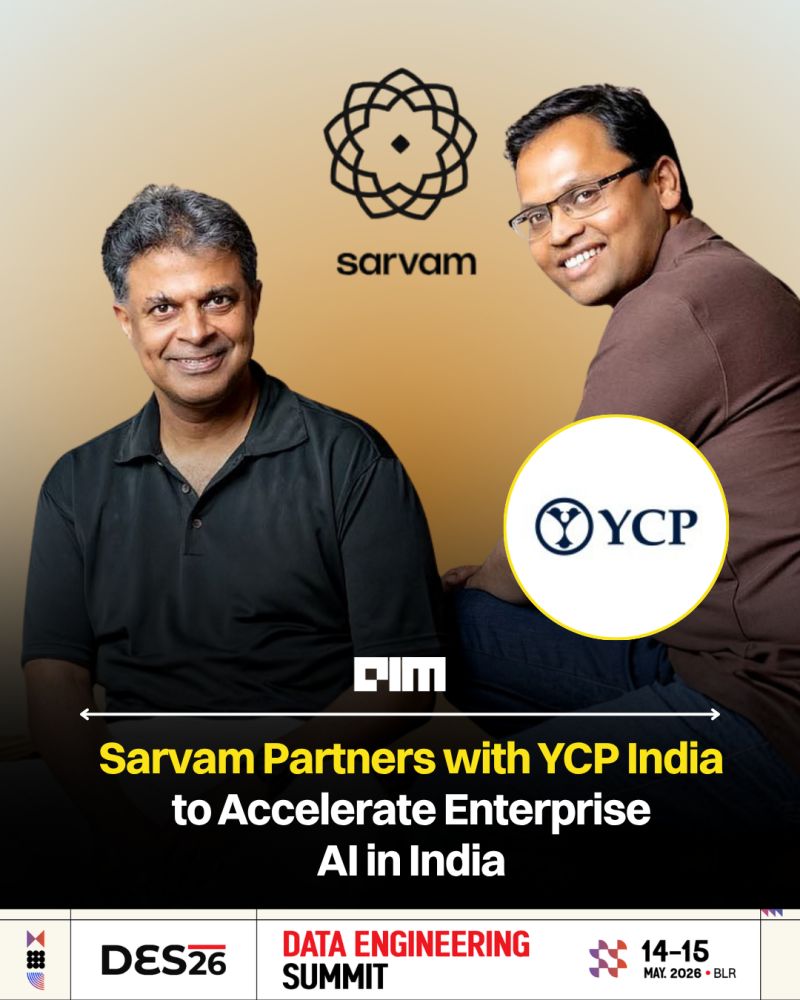
Sarvam has partnered with YCP India to help enterprises move artificial intelligence projects from small pilots into structured, organisation-wide deployments aimed at measurable business gains.
The collaboration brings together Sarvam’s full-stack sovereign AI platform and YCP India’s consulting, digital transformation and execution capabilities. The two companies plan to work with businesses on use-case selection, technology integration, change management and deployment across functions where AI can cut costs, improve productivity or strengthen customer engagement.
The partnership comes as companies across sectors are trying to convert interest in generative AI into practical results. Many organisations have tested chatbots, document automation, coding assistants and customer-service tools, but have struggled to scale them because of legacy systems, data-quality issues, compliance concerns and weak alignment with business priorities. Sarvam and YCP India are positioning their alliance as a response to that gap, with an emphasis on deployment rather than experimentation.
Sarvam’s platform covers language, voice and multimodal systems, with a focus on operating conditions in India, including regulatory requirements, data sovereignty and cost-efficient deployment. That positioning is significant for banks, insurers, retailers, healthcare providers, manufacturers and public-facing enterprises that need AI tools capable of working across languages, accents and workflow environments.
YCP India is expected to bring sector knowledge, programme management and strategy advisory support. The company’s role will include helping clients identify high-impact use cases, redesign workflows, manage adoption within teams and ensure that AI deployments are tied to commercial outcomes rather than isolated technology trials.
The partnership will focus on three broad areas. The first is identifying and prioritising AI opportunities that have clear business value. This could include automating customer queries, improving internal knowledge retrieval, digitising documents, supporting frontline staff or building multilingual service channels. The second is co-delivering integrated solutions that connect Sarvam’s technology stack with enterprise systems. The third is joint execution, where YCP teams work with Sarvam engineers to support implementation and change management.
The timing reflects a wider shift in the AI market. Enterprises are moving from proof-of-concept work to production systems, but the transition requires more than access to a large language model. Companies need governance frameworks, reliable data pipelines, security controls, integration with enterprise resource planning and customer relationship management platforms, and clear accountability for outcomes. Without these elements, AI projects risk remaining confined to innovation teams without affecting day-to-day operations.
Sarvam has emerged as one of the key domestic AI companies building models and applications designed for the country’s linguistic and business environment. Its products include speech-to-text, text-to-speech, translation, document digitisation and conversational AI tools. The company has also been associated with broader efforts to develop sovereign AI capabilities, including foundational models built for secure, population-scale use.
The enterprise opportunity is expanding rapidly. The country’s AI market is expected to grow strongly through 2027, supported by enterprise technology spending, a deepening talent base and rising investment in AI-led transformation. Technology services firms and global capability centres are also pushing generative AI into software development, business process management, IT consulting and customer operations.
For Sarvam, the alliance with YCP India could strengthen access to boardroom-level transformation projects, where decisions are shaped by business value, risk controls and execution capacity. For YCP India, the tie-up adds a technology partner focused on locally relevant AI capabilities at a time when clients are demanding practical deployment roadmaps rather than advisory reports alone.
The challenge will be delivery. Enterprises often face fragmented data, uneven digital maturity and uncertainty over how AI should be governed. Regulated sectors also need clarity on privacy, auditability and accountability when automated systems influence customer interactions or internal decisions. The partnership will have to demonstrate that sovereign AI can be not only locally relevant but also robust, secure and commercially competitive against global platforms.
Cost will be another deciding factor. Many businesses are assessing whether AI systems can deliver enough savings or revenue gains to justify investment in infrastructure, integration and training. Sarvam’s emphasis on cost-efficient deployment could appeal to companies that want AI capabilities without depending entirely on expensive global model providers.
Russia and Ukraine traded large-scale drone attacks as a Moscow-declared Victory Day ceasefire took effect, deepening doubts over whether either side would observe the temporary halt in fighting around one of Russia’s most politically charged national commemorations. Moscow said its air defences destroyed 264 Ukrainian drones in the early hours of Friday, including aircraft aimed at the capital and targets in Russia’s Perm region. The claims followed […]
Arabian Post Staff -Dubai Washington’s plan to escort commercial vessels through the Strait of Hormuz has run into an early diplomatic test, after Saudi Arabia and Kuwait were reported to have withheld full operational access before later easing restrictions on U. S. use of bases and airspace. The pause in “Project Freedom,” a U. S.-led effort to restore commercial navigation through one of the world’s most […]
Cisco has patched a high-severity denial-of-service flaw that could allow unauthenticated attackers to knock key network management systems offline by flooding them with connection requests, raising operational risks for service providers and large enterprises that rely on automated orchestration platforms. The vulnerability, tracked as CVE-2026-20188, affects Cisco Crosswork Network Controller and Cisco Network Services Orchestrator, two products used to manage complex, multi-vendor networks and automate service provisioning. […]
By Dr. Gyan Pathak BJP won the West Bengal election with the most recognizable face leading from the grassroots to the state level against Mamata led TMC is Suvendu Adhikari. He also defeated TMC supremo CM Mamata Banerjee from Bhabanipur Vidhan Sabha constituency. Naturally, he is seen as the most suitable candidate for Chief Minister […]
Corporate login credentials have become a growing internal security weakness, with one in eight workers admitting they have sold access to company systems or know someone who has done so over the past year. The finding points to a shift in workplace fraud risk from external hacking alone to insider-enabled access, where criminals can enter corporate systems through legitimate credentials rather than breaking through technical defences. The […]
Malicious NuGet packages masquerading as familiar. NET libraries have put developer workstations and build environments at risk of credential theft, with attackers using plausible package names, hidden version histories and obfuscated payloads to target users in Chinese software ecosystems. Five packages identified in the campaign — IR. DantUI, IR. OscarUI, IR. Infrastructure. Core, IR. Infrastructure. DataService. Core and IR. iplus32 — were published through the same account, […]
Hackers are using sponsored Google search results to steal ManageWP credentials, raising fresh concerns over the exposure of agencies, developers and businesses that administer large fleets of WordPress websites through a single GoDaddy-owned dashboard. The campaign places a fraudulent advertisement above the legitimate ManageWP search result, copying the platform’s branding and directing users to a look-alike login page. Victims who search for ManageWP rather than typing the […]
Greenlogue/AP Climate campaigners have accused Shell of turning wartime turmoil into a fossil-fuel windfall after the group reported first-quarter adjusted earnings of $6.9bn, lifted by higher oil and gas prices, stronger trading and improved refining margins. The London-listed energy major’s profit was more than double the $3.26bn recorded in the final quarter of last year and above market expectations of about $6.36bn. The figures have sharpened scrutiny […]
France have been tipped to win the 2026 FIFA World Cup by defeating Spain in the final, with Bank of America analysts placing Kylian Mbappé at the centre of their forecast for the expanded tournament in North America. The projection, based on a survey of 65 respondents across the bank’s Global Research department, gives France its third World Cup title after triumphs in 1998 and 2018. Mbappé […]
OpenAI is reportedly accelerating work on a ChatGPT-centred smartphone, raising the prospect that the artificial intelligence company could move from software into mass-market consumer hardware as early as 2027. Supply-chain checks point to a device designed around AI agents rather than the familiar app-led smartphone model. The project is being described as OpenAI’s first AI agent phone, with mass production targeted for the first half of 2027 […]
LOS ANGELES, US – Newsaktuell – 7 May 2026 – The newly released 2026 Berggruen Governance Index (BGI) paints a mixed picture of global governance heading into a future of mounting shocks, finding widespread gains in public-goods provision from 2000 to 2023 even as democratic accountability edged down and state capacity showed little overall improvement.
Presentation of the 2026 Berggruen Governance Index: On 6 May in Los Angeles, the following individuals discussed the findings of the study (from left): Vinay Lai (Professor of History, UCLA), Michael Storper (Distinguished Professor of Urban Planning, UCLA), Stella Ghervas (Professor of History, UCLA) and the two authors of the study, Joseph Saraceno and Prof. Helmut Anheier (both from UCLA’s Luskin School of Public Affairs). Democracy News Alliance / Jordan Strauss/AP for DNA
The BGI, presented Wednesday by an international group of governance scholars, analyses measurable benchmarks of democratic accountability across 145 countries.
On a 100-point scale, the global score for democratic accountability slipped slightly from 65 in 2000 to 64 in 2023, the most recent data used in the project. The wave of democratisation observed in the closing decades of the last century has stalled in the last 15 years. Democratic accountability fell in 54 countries while it improved in 48 countries.
Yet the BGI — a collaborative project of the Luskin School of Public Affairs at the University of California, Los Angeles (UCLA), Berlin’s Hertie School and the Berggruen Institute, a think tank headquartered in Los Angeles — captures remarkably widespread growth in provision of public goods.
Encompassing healthcare, education, infrastructure, environmental sustainability and conditions to foster employment and rising prosperity, public goods improved in 135 of the countries studied, while declining slightly in just four. The global average jumped from 58 to 69 points from 2000 to 2023.
The third component of what the BGI authors refer to as the “governance triangle” is state capacity, defined as the ability to tax, borrow and spend, control territory, operate scrupulous, competent bureaucracies and administer predictable rule of law. The index finds the global average ticking up from 48 to 49 points; 56 countries had increased state capacity while 57 declined.
“What does it tell us about the world ahead?” Prof. Helmut K. Anheier, a Luskin School sociologist and BGI principal investigator, asked during the public release of the 2026 BGI on the UCLA campus.
“Countries are not really improving in their governance performance in significant ways. … We’re not really having forward-looking investment in governance capacity. There is considerable inertia.”
The largest improvements across all three BGI components occurred in Gambia, which the report groups with “low-capacity developing states.” These states score low across the board, particularly in the provision of public goods. This cluster constitutes the poorest countries with the least developed economies, which face the most serious challenges.
“They have the greatest exposure to likely future crises, whether it’s global warming, whether it’s a new pandemic, whether it’s another financial crisis, whether it’s the impact of AI,” Anheier said. “And they have the least capacity to respond to it.”
Bhutan, Georgia, Iraq and Tunisia — which make up the remaining top five countries with the largest improvements in the BGI — are classified as “capacity-constrained states.” They tend to be middle-income with struggling democracies. These countries score higher across the board than the low-capacity developing states, but their state capacity tends to lag compared to public goods and democratic accountability.
The capacity-constrained states risk falling into “a cycle that erodes the institutions they have built,” Anheier said.
“Consolidated democratic states”, a cluster of most of the world’s richest countries, which score highly in all three BGI components, have to confront domestic complacency. Further, in the United States and some others, “political dysfunction” is leaving mounting problems unaddressed and risking erosion of state capacity, Anheier said.
At the other end of the spectrum, the country with the farthest fall on the BGI since 2000 is Nicaragua. Second from last is Venezuela, followed by Hong Kong, Hungary and Turkey. The rest of the bottom 10 are Russia, Iran, Poland, El Salvador and Belarus.
Since 2023, which is the last year of data available for the study, Poland and Hungary have both seen government changes via election, despite serious democratic backsliding. Both had fallen out of the group of “consolidated democratic states” by 2023 and moved into the capacity constrained cluster.
The other eight countries at the bottom of the list are all places that once had some semblance of competitive elections, but by now have little or no remaining pretense of democracy. They are grouped by the authors among the “authoritarian and hybrid states”, which have by far the lowest democratic accountability but outperform even some struggling democracies in delivering public goods.
These regimes have tended toward faster economic growth in the period observed. But that seeming prosperity, typically fueled by extractive industries or overreliance on exports, masks “serious institutional weaknesses in these countries, including divided elites,” Anheier said.
Relatively few countries — 21 of the 145 — changed enough for better or worse to be classified in a new group by the end of the 23-year study period.
“Movement between them is rare, but this is largely what we should expect,” said Stella Ghervas, a UCLA historian on a panel of experts who discussed the BGI findings Wednesday. “Government systems are not created in a moment. They evolve over long periods of time.”
Local conditions shaping governance in each country can rarely be quickly reset through political will or even external shocks, Joseph C. Saraceno, a Luskin School data scientist and BGI co-author, said Wednesday.
“Despite all the talk of major transformations happening in global affairs, the underlying configuration of governance simply doesn’t appear to change very much,” Saraceno said. “We use the term inertia to describe this reoccurring pattern. In other words, the structures of global governance are resistant to movement as the conditions beneath them are quite sticky: political economies, demographics, resource endowments. These are deeply layered, and they push each country toward the world that it already inhabits.”
But the challenges lurking around the world may not wait for the slow and difficult processes of political change and development to catch up.
“With the few exceptions of those countries in the consolidated democratic world,” Anheier said, “the great majority of the countries in the world is ill-prepared for the future.”
This text and the accompanying material (photos and graphics) are an offer from the Democracy News Alliance, a close co-operation between Agence France-Presse (AFP, France), Agenzia Nazionale Stampa Associata (ANSA, Italy), The Canadian Press (CP, Canada), Deutsche Presse-Agentur (dpa, Germany) and PA Media (PA, UK). All recipients can use this material without the need for a separate subscription agreement with one or more of the participating agencies. This includes the recipient’s right to publish the material in own products.
The DNA content is an independent journalistic service that operates separately from the other services of the participating agencies. It is produced by editorial units that are not involved in the production of the agencies’ main news services. Nevertheless, the editorial standards of the agencies and their assurance of completely independent, impartial and unbiased reporting also apply here.
The issuer is solely responsible for the content of this announcement.
A war that threatens the flow of one-fifth of the world’s oil supply should be dominating market pricing. It isn’t. President Donald Trump has pushed the US deeper into confrontation with Iran, locking policy into a narrow and dangerous path. The Strait of Hormuz remains under constant threat, energy flows are disrupted, and, as a result, oil has surged above $110 a barrel at points in recent […]
Lebanese soldiers entered Beirut’s southern suburbs and detained suspected gunmen after celebratory fire and rocket-propelled grenades were discharged during a Hezbollah funeral, an unusual assertion of state authority inside one of the group’s most sensitive urban strongholds. The operation in Kafaat followed gunfire during a procession for Hezbollah supporters killed in Israeli strikes, with residents reporting panic as bullets rang out across densely populated neighbourhoods. Army units […]