

News related to
Capital

Elon Musk’s reaction to a viral post on India’s falling fertility rate has pushed the country’s demographic transition into a wider global debate, as official data show the national total fertility rate at 1.9 children per woman, below the replacement benchmark of 2.1.

Musk responded on X to a post claiming that India’s birth rate had fallen below replacement level, writing that the trend had appeared “among those most educated” many years earlier. His comment drew attention because the Tesla and SpaceX chief has repeatedly argued that declining birth rates pose a long-term risk to economies, innovation and social stability.

The viral post said India’s fertility rate had fallen from 2.3 to 1.9 over a decade and cited Delhi’s rate at 1.2, among the lowest in the country. Official demographic data broadly support the decline, though the claim that the fall below replacement level has happened for the first time needs qualification. India’s total fertility rate stood at 1.9 in 2024, the same level recorded for 2023, meaning the country has already been below the conventional replacement threshold.

The latest figures mark a sharp departure from long-running anxieties about population growth. India, with an estimated population of more than 1.4 billion, overtook China as the world’s most populous country in 2023. Yet the fertility trend now points to a slower population expansion in the coming decades, with regional variation likely to shape labour supply, welfare planning and state-level fiscal priorities.

Delhi’s total fertility rate of 1.2 highlights the depth of the shift in urban centres, where higher education levels, later marriage, higher housing costs, career pressures and rising aspirations have contributed to smaller families. Several southern and western states have also remained below replacement level for years, while parts of northern and central India continue to record comparatively higher fertility.

Only a small group of states remains above the replacement threshold. Bihar, Uttar Pradesh, Madhya Pradesh, Rajasthan, Chhattisgarh and Jharkhand continue to report fertility levels above 2.1, keeping national population momentum alive even as most states move towards smaller family norms. The divergence has implications for political representation, public finance and migration, particularly as lower-fertility states age faster while higher-fertility states continue to add younger workers.

Demographers distinguish between a falling fertility rate and immediate population decline. India’s population will continue to grow for some time because of demographic momentum: a large base of people in reproductive age groups will keep births high even when the average number of children per woman falls. The larger policy issue is not a sudden fall in population, but the speed at which the age structure changes.

Musk’s intervention reflects a view he has voiced across countries, including Japan, South Korea, China and several European economies, where low fertility has triggered concerns about shrinking workforces and mounting pressure on pension and health systems. His comment on India stands out because the country has long been seen as a counterweight to ageing economies, with a large young population expected to support growth.

India’s demographic advantage remains substantial, but the window is not permanent. A lower fertility rate can help families invest more in each child’s education and health, while also reducing pressure on land, housing and public services. At the same time, it places greater urgency on job creation, women’s workforce participation, skilling, healthcare and pension coverage before the population ages more visibly.

Education plays a central role in the fertility shift. Women with greater access to schooling and employment tend to marry later and have fewer children. Urbanisation has reinforced the trend by raising the cost of child-rearing and changing family expectations. The pattern is not unique to India, but its scale is significant because of the country’s population size and uneven development across regions.

The decline also complicates older political narratives around population control. States that achieved lower fertility earlier have argued that they should not be penalised in future federal arrangements, while states with higher fertility still face pressure to improve education, healthcare and women’s economic participation. Any future delimitation of parliamentary seats is likely to bring these tensions into sharper focus.

Public health indicators add another layer to the debate. Lower fertility often accompanies improvements in child survival, maternal health and access to contraception. However, uneven access to quality healthcare, nutrition and education means the benefits are not distributed equally. Rural families, poorer households and marginalised communities may face different constraints from urban professional families choosing to have fewer children.

India’s policy challenge is therefore more complex than simply reversing a fertility decline or celebrating it. The country must prepare for a future in which some regions face ageing and labour shortages while others continue to supply young workers. That will require better migration planning, stronger urban infrastructure, more reliable social security and greater investment in human capital.

South Korea has moved to contain pressure on the won after the currency fell towards its weakest levels since the global financial crisis, with authorities warning that speculative trading and herd behaviour in the foreign exchange market would face firm intervention.

The response came after the won slipped past psychologically important levels against the dollar, intensifying concern among policymakers over inflation, capital flows and financial stability. Finance Minister Koo Yun-cheol convened senior economic officials and signalled that Seoul would act quickly if market moves became excessive, while the Bank of Korea and financial regulators kept watch on trading patterns across currency, bond and equity markets.

The won traded around the 1,520 range against the dollar after touching levels not seen for years, reflecting a mix of domestic and external pressures. Higher energy import costs, a strong dollar, portfolio outflows and demand for overseas investments have combined to weaken the currency despite South Korea’s current account surplus and continued strength in key export sectors.

Authorities are seeking to draw a line between normal market adjustment and disorderly moves that could spill into inflation expectations or funding conditions. Their measures are focused on sharper surveillance of foreign exchange transactions, closer coordination among financial agencies and readiness to respond to speculative flows that amplify one-way bets against the currency.

Seoul has avoided announcing broad capital controls, mindful of its ambition to deepen market access and secure developed-market recognition from global index providers. Instead, officials are relying on targeted stabilisation tools, verbal intervention and coordination with major institutional investors to smooth dollar demand. The National Pension Service remains central to those efforts because of the scale of its overseas investment activity and its potential impact on dollar-won liquidity.

The currency’s slide has complicated the Bank of Korea’s policy choices. Inflation rose to 3.1 per cent in May, the highest level in more than two years, pushed up by petroleum products and international travel costs. A weaker won increases the local-currency cost of imported fuel, food and raw materials, raising the risk that price pressures remain above the central bank’s 2 per cent target for longer than expected.

Rate policy now sits at the intersection of slowing growth, currency stability and household debt risks. A rate increase could support the won and restrain inflation, but it would add pressure on consumers and businesses already facing tighter financing conditions. Holding rates steady could protect domestic demand, but might leave the currency exposed if dollar strength persists or foreign investors continue to rebalance away from won assets.

Market pressure has also been shaped by South Korea’s stock market boom and its role in global technology supply chains. The country’s chipmakers and artificial intelligence-linked companies drew heavy investor interest, but sharp gains have also encouraged profit-taking and portfolio reallocation. When offshore investors sell equities or hedge exposure, demand for dollars can rise, adding to currency volatility.

Exporters have not provided the same level of support to the won that authorities might have expected during previous cycles. Companies with large overseas revenues have been cautious about converting dollar earnings, partly because of expectations of further currency weakness and partly because global investment plans require foreign currency holdings. That has deepened the imbalance between dollar demand and supply.

South Korea’s external position remains stronger than the currency’s movement alone suggests. The economy continues to benefit from semiconductor exports, sizeable foreign reserves and a sophisticated financial system. Yet the won has become more sensitive to swings in global risk appetite, partly because households, pension funds and institutional investors have increased overseas securities purchases over the past several years.

The government’s challenge is to calm markets without appearing to defend a fixed exchange-rate level. Officials have framed their intervention as an effort to prevent excessive volatility rather than reverse market fundamentals. That distinction matters because heavy-handed action could invite criticism from trading partners and undermine Seoul’s commitment to market liberalisation.

The United States and South Korea have already discussed currency stability, with both sides describing excessive volatility in the won as undesirable. Those consultations add a diplomatic layer to Seoul’s response, especially as South Korea balances foreign exchange concerns with large investment commitments abroad and shifting trade policy under Washington’s current tariff regime.

Arabian Post Staff -Dubai KPMG and Anthropic have launched a global alliance that will embed Claude artificial intelligence tools into KPMG’s client delivery platforms, opening new capabilities for companies and public-sector organisations in Qatar as the Gulf state accelerates investment in AI infrastructure, digital government and data-led transformation. The partnership gives KPMG’s global workforce access to Anthropic’s Claude suite and integrates the technology into KPMG Digital Gateway, […]

Arabian Post Staff -Dubai Revolut is exploring a secondary share sale that could lift its valuation to about $115 billion, setting up a fresh test of investor appetite for one of Europe’s most valuable private technology groups after a decisive regulatory breakthrough in the UK and a push into US banking. The potential transaction would allow existing shareholders, including employees and early backers, to sell stock without […]

Bitcoin slipped below $60,000, extending a sharp retreat that has weakened confidence among bulls and underscored a broader shift in speculative capital towards artificial intelligence-linked equities, large technology listings and parts of the gold trade. The world’s largest cryptocurrency touched its weakest level since October 2024 after failing to hold support around $65,000, a level traders had treated as critical following last month’s attempted recovery. The latest […]

Mastercard is moving deeper into blockchain-based settlement by adding regulated stablecoins and the XRP Ledger to a wider upgrade of its global payments infrastructure, marking a significant step in the effort to make card settlement operate beyond conventional banking hours. The payments group has outlined plans to expand settlement options for issuers and acquirers, including intraday, weekend and holiday processing in fiat currencies and on-chain card settlement […]

Crypto markets were hit by a sharp wave of forced selling as about $155 million in leveraged long positions were liquidated within 60 minutes, deepening a broader sell-off that pushed Bitcoin and major tokens lower and exposed the risk built up across perpetual futures and margin trading platforms. The liquidation burst reflected a rapid unwinding of bullish bets after prices broke through key support levels, leaving heavily […]

Advertisements

Bitget has added 15 tokenised stocks and exchange-traded funds as eligible margin assets for futures trading, extending the role of equity-linked digital assets from spot exposure into collateral management inside its unified trading system. The change took effect on June 4, UTC+8, and applies to the exchange’s Unified Trading Account and Multi-Asset Mode for USDT-M Futures. It allows users to deploy selected tokenised equities and ETFs as […]

New Delhi scrapped capital gains tax on foreign institutional investment in government securities, using an ordinance to sharpen the appeal of its sovereign debt market and draw overseas capital as the rupee faces pressure from higher energy costs and equity outflows.

The exemption, effective from 1 April 2026, covers interest income and capital gains arising from the sale, exchange or transfer of specified government securities by eligible foreign institutional investors and the Bank for International Settlements. President Droupadi Murmu signed the Income-tax Ordinance, 2026 while Parliament was not in session, amending the new direct tax framework that took effect at the start of the financial year.

Foreign investors had been subject to long-term capital gains tax of 12.5% on listed bonds held for more than 12 months and withholding tax of 20% on interest from government securities. By removing the tax burden for eligible investors, the Centre is seeking to improve post-tax returns and make rupee debt more competitive at a time when global funds are weighing currency risk, oil-market volatility and geopolitical uncertainty.

The policy shift comes as the rupee has weakened by more than 5% this year, pressured by crude prices and sustained foreign selling in equities. The currency recovered after the announcement of measures aimed at attracting foreign currency inflows, but traders continued to watch oil prices, reserve levels and the central bank’s market operations for signs of durable support.

Reserve Bank of India kept the policy repo rate unchanged at 5.25% and announced steps to encourage dollar inflows, including support for foreign-currency borrowing by public sector entities, incentives for non-resident deposits and a longer window for exporters to repatriate proceeds. The central bank also revised its growth forecast to 6.6% and raised its inflation estimate to 5.1%, underlining the pressure created by imported energy costs.

The tax relief is aimed at deepening overseas participation in government securities after the inclusion of rupee bonds in major global debt benchmarks. Fully accessible route bonds have already been added to J. P. Morgan’s emerging market debt index and Bloomberg’s emerging market local currency index, widening the pool of passive and active investors that can allocate funds to sovereign debt. A separate decision on inclusion in broader global bond benchmarks is being watched by investors because it could influence medium-term flows.

Debt inflows have remained more resilient than equity flows, but the scale has not been sufficient to offset pressure from the current account and stock-market exits. Foreign investors have pulled large sums from equities this year, while government debt has continued to attract selective buying. Higher hedging costs and expectations of currency weakness have limited enthusiasm among some global investors despite the comparatively attractive yield on rupee bonds.

Market participants expect the tax exemption to help long-only funds, pension funds, sovereign investors and reserve managers that focus on net returns after tax. The measure could also support liquidity in benchmark government securities and reduce borrowing costs at the margin if foreign demand rises. For the Centre, a broader investor base would help absorb a large borrowing programme without placing excessive pressure on domestic banks and insurance companies.

The effect may still depend on factors beyond tax policy. Currency stability, inflation expectations, oil prices, fiscal credibility and the central bank’s approach to liquidity will shape overseas appetite. Investors that hedge currency exposure must still account for hedging costs, while those that remain unhedged face the risk of rupee depreciation wiping out yield gains.

Arabian Post Staff -Dubai First Abu Dhabi Bank has entered a strategic partnership with Water. org and WaterEquity, investing in the WaterEquity Everspring Fund to expand access to safe water and sanitation across emerging markets through market-based financing. The Abu Dhabi lender said the agreement creates a platform for continuing collaboration with the global non-profit Water. org and its affiliated impact investment manager WaterEquity. The fund channels […]

Japan is preparing to replace as many as 14 ageing nuclear reactors by the 2050s, marking one of its clearest moves yet towards restoring atomic power as a central pillar of national energy security after more than a decade of post-Fukushima restraint.

The Ministry of Economy, Trade and Industry has set out a policy proposal calling for the rebuilding of between two and five reactors by the 2040s and up to 14 by the 2050s. The plan would add about 16 gigawatts of nuclear capacity, helping the country meet rising electricity demand from artificial intelligence, data centres, advanced manufacturing and wider electrification.

The proposal reflects a major shift in Japan’s energy strategy. After the Fukushima Daiichi disaster in March 2011, Japan shut all 54 operating reactors, leaving the world’s third-largest economy more dependent on imported liquefied natural gas, coal and oil. Only 15 of the 33 remaining operable reactors have returned to service, while many units face retirement pressure as they approach or exceed their permitted 60-year operating life.

Tokyo’s latest energy plan targets nuclear power at around 20 per cent of electricity generation by fiscal 2040, while renewables are expected to provide 40 to 50 per cent. Thermal power, which still accounts for a large share of supply, is expected to decline but remain important for grid stability and emergency backup. The policy removes earlier language about reducing reliance on nuclear power, replacing it with a call to maximise the use of both renewables and atomic energy.

The renewed push is driven by a combination of economic and geopolitical pressures. Japan imports most of its energy, leaving households and industry exposed to volatile fuel prices, shipping risks and currency swings. The war in Ukraine, instability in the Middle East and tighter global gas markets have strengthened the case within government for expanding domestic low-carbon baseload power.

Electricity demand, which had been broadly flat for years, is also expected to turn higher. The spread of AI computing, semiconductor plants, battery factories and digital infrastructure has increased concern that inadequate power supply could weaken Japan’s ability to attract investment. Officials view nuclear energy as a way to provide stable, large-scale electricity without increasing carbon emissions.

The plan is likely to benefit major utilities including Tokyo Electric Power, Kansai Electric Power, Kyushu Electric Power and Chubu Electric Power, although the sector still faces high regulatory, financial and social hurdles. Reactor replacement requires local consent, safety approval, heavy capital spending and long construction timelines. Japan has not built a new reactor since before Fukushima, and public trust remains fragile.

Safety concerns remain the central political obstacle. The Fukushima disaster, triggered by the March 2011 earthquake and tsunami, forced mass evacuations and left deep scepticism about official oversight of the nuclear industry. Questions over seismic risk, evacuation planning, spent fuel storage and operator transparency continue to shape public debate, particularly in communities near existing plants.

Controversies have added to the challenge. Chubu Electric has faced scrutiny over falsified seismic risk assessment data at the Hamaoka nuclear plant, a facility long viewed as sensitive because of its location in an earthquake-prone area. Incidents of that kind reinforce concerns among critics who argue that Japan should prioritise renewables, storage, grid upgrades and efficiency rather than committing to another generation of nuclear infrastructure.

Supporters counter that renewables alone will not meet Japan’s industrial needs quickly enough, given land constraints, permitting delays and the intermittency of solar and wind power. Offshore wind has long-term potential, while next-generation solar technologies such as perovskite cells are being promoted, but large-scale deployment will take time. Nuclear advocates argue that replacing old reactors with advanced designs could improve safety and reliability while supporting climate targets.

The government’s approach is to rebuild reactors at existing or decommissioned nuclear sites rather than open entirely new locations, a strategy designed to reduce political resistance and use established grid infrastructure. Next-generation reactors are expected to incorporate stronger passive safety systems and improved resilience against natural disasters, although costs and construction schedules remain uncertain.

Jersey is facing a defining test over whether its finance-led prosperity can keep pace with faster, technology-driven rivals without eroding the small-island character that has long set it apart. The British Crown Dependency, once widely labelled a tax haven, has spent decades recasting itself as a regulated international financial centre. That shift has helped turn a 45-square-mile island of just over 100,000 people into one of the […]

Capital inflows into the UAE are holding steady as investors adopt tougher due diligence standards rather than retreating from the market, with relative stability, low taxation and business-friendly regulation reinforcing the country’s position as a regional safe haven. Archers Valuation & Advisory said the market was not showing signs of capital withdrawal despite heightened regional uncertainty, but investors and lenders were becoming more selective in the way […]

First Abu Dhabi Bank has entered a strategic partnership with Water. org and WaterEquity, placing capital behind an impact fund aimed at expanding access to safe water and sanitation across emerging markets. The Abu Dhabi lender has invested in the WaterEquity Everspring Fund, an open-ended vehicle designed to channel private capital into financial institutions and enterprises that serve low-income households and small businesses needing affordable water and […]

Arabian Post Staff -Dubai Abu Dhabi Exports Office has begun direct site visits to UAE-based manufacturers under its AED1 billion financing partnership with Emirates Development Bank, stepping up efforts to link industrial companies with export funding, working capital support and market-expansion tools. The visits covered MEDECO, Star Paper Mill and Dana Steel, three manufacturers operating in sectors closely tied to the country’s localisation and export-growth agenda. ADEX […]

Whale. io has launched Whale Printer, a staking feature that allows eligible holders of its native $WHALE token to lock tokens for fixed periods in return for predetermined rewards, adding a yield mechanism to the crypto casino and sportsbook platform’s token economy. The new system offers three lock-up options. Users can stake $WHALE for 90 days with a 1.2x multiplier and 107.8% annual percentage yield, 180 days […]

Elon Musk will probably get the $86 billion he wants from the SpaceX IPO. The harder question is whether investors will still be as enthusiastic about the company a year from now. Seeking a valuation of $1.78 trillion, SpaceX is attempting something unprecedented. If successful, the offering will become the largest IPO in history and instantly rank among the biggest corporate fundraising events ever seen. Many investors […]

MMC Port Holdings Sdn Bhd has approached prospective bidders for a minority stake in the business, shifting attention from a delayed public listing to a private transaction that could test investor appetite for one of Southeast Asia’s most significant port platforms. The move follows the postponement of an initial public offering that had been expected to rank among Malaysia’s largest listings in more than a decade. The […]

Blockchain users searching for simpler wallet identities have pushed. bit into the wider debate over decentralised naming, digital ownership and cross-chain authentication, as Web3 developers look for alternatives to long alphanumeric addresses that remain difficult for mainstream users to manage.. bit is commonly called a “domain”, but its developers describe it more precisely as a decentralised identity and account system rather than a conventional internet domain. Unlike […]

Cardano’s ADA token fell below 20 US cents as founder Charles Hoskinson said he was “taking a break” after warning that the blockchain ecosystem faces a wave of project failures, deepening concern over funding, governance and developer momentum. ADA traded around $0.19 on Thursday after dropping more than 12 per cent over 24 hours, taking its one-year decline to about 70 per cent and pushing the token […]

Bitcoin fell four percent on Wednesday to $64,721.39, its weakest level since 28 February, as pressure from fund withdrawals, leveraged liquidations and shifting macroeconomic signals deepened a broad retreat across digital assets. The slide extended a difficult stretch for the world’s largest cryptocurrency, which has moved sharply lower after failing to hold above key support levels near $70,000. Selling accelerated as investors reduced exposure to risk assets, […]

By K Raveendran Public anger has a strange way of finding symbols. Sometimes it gathers around a saintly figure in a white cap, sometimes around an unlikely political label that sounds almost like a joke until it begins to speak for a generation. The overwhelming response from Gen Z to the Cockroach party carries unmistakable […]

The article Cockroach Politics And The Limits Of Public Anger appeared first on Latest India news, analysis and reports on Newspack by India Press Agency).

Arabian Post Staff -Dubai Abu Dhabi has temporarily halted rent increases across residential, commercial and industrial properties, cutting the permitted annual rise from 5 per cent to 0 per cent until further notice. The measure applies to tenancy contract renewals across the emirate and means rents must remain unchanged for the duration of the freeze. New tenancy contracts for previously rented units must also be registered at […]

HONG KONG SAR – Media OutReach Newswire – 3 June 2026 – A large delegation, led by John Lee, Chief Executive of the Hong Kong Special Administrative Region (HKSAR), is visiting Kazakhstan and Uzbekistan (June 1-6) to forge closer ties with Central Asia.

Comprising over 70 business and professional representatives from Hong Kong and the Chinese Mainland, the delegation has already yielded significant results at its first stop in Kazakhstan.

Speaking at a business luncheon in Astana yesterday (June 2), Mr Lee highlighted that 43 memoranda of understanding (MOU) and agreements have been concluded by the visiting delegation with companies and organisations from Kazakhstan, with more agreements to come.

“They span aviation, finance and trade, innovation and technology, the digital economy, green development, and more,” Mr Lee said, adding that a Hong Kong airline plans to launch direct flights to Almaty in the first quarter of 2027.

“I believe that Kazakhstan can serve as a hub for Hong Kong to connect with the Central Asian market. In turn, Hong Kong can be Central Asia’s hub in the east and southeast Asian region,” Mr Lee said.

“By strengthening co-operation between our two hubs, we can construct a hub-to-hub co-operation model.”

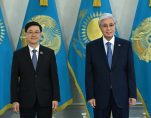
On his first day of visit in Astana (June 1), Mr Lee met with top government officials including the President of Kazakhstan, Kassym-Jomart Tokayev, Prime Minister Olzhas Bektenov, and Deputy Prime Minister and Minister of National Economy Serik Zhumangarin.

Hong Kong SAR's Chief Executive John Lee (left) meets with the President of Kazakhstan Kassym-Jomart Tokayev to exchange views on deepening bilateral relations.
Hong Kong SAR’s Chief Executive John Lee (left) meets with the President of Kazakhstan Kassym-Jomart Tokayev to exchange views on deepening bilateral relations.

Mr Lee noted that Kazakhstan has been actively promoting reforms on various fronts to bring about rapid economic growth.

“As one of the world’s three major financial centres, and the world’s largest cross-boundary wealth management centre and offshore Renminbi business hub, Hong Kong can provide diversified and flexible support including capital and asset allocation for Kazakhstan’s economic reforms and infrastructure development,” Mr Lee said.

The Chief Executive also encouraged companies in Kazakhstan to leverage Hong Kong’s advantages under the “one country, two systems” principle.

“Under this unique principle, Hong Kong has its own economic, social, legal, legislative and judicial systems. We are the only common law jurisdiction in China. We have our own currency, with no capital or foreign exchange controls. We are, as well, a separate customs territory,” Mr Lee said.

“The ‘one country, two systems’ principle ensures Hong Kong’s unparalleled access to the markets of the Chinese Mainland. Capitalising on our global connectivity and world-class professional services, Hong Kong is your ideal, two-way springboard for business expansion.”

Mr Lee also visited the Astana International Financial Centre and the Astana Hub, a local technology and innovation park, to respectively learn about Kazakhstan’s experience in promoting the development of the non-bank financial sector and the latest developments of the country in the field of AI.

Hong Kong SAR's Chief Executive John Lee (centre) witnesses the exchange of memoranda of understanding and co-operation agreements between organisations from both sides with the Governor of the Astana International Financial Centre Renat Bekturov (second right).
Hong Kong SAR’s Chief Executive John Lee (centre) witnesses the exchange of memoranda of understanding and co-operation agreements between organisations from both sides with the Governor of the Astana International Financial Centre Renat Bekturov (second right).

Before leaving Kazakhstan today (June 3), Mr Lee visited Nazarbayev University, underscoring the historic significance of the trip.

image-1.jpeg

“It was here, at Astana’s Nazarbayev University in 2013, that President Xi Jinping first raised the visionary initiative of jointly building the Silk Road Economic Belt – today’s Belt and Road Initiative (BRI),” Mr Lee said.

Last year, at the 10th Belt and Road Summit in Hong Kong, the university signed a MOU with the Hong Kong University of Science and Technology, demonstrating a shared commitment to advancing higher education co-operation under the BRI. It further reached MOUs with Hong Kong’s Education University and Polytechnic University today.

“These agreements will deepen academic and research collaboration.

“Hong Kong is the only city in the world with five of the top 100 universities. This talent environment is reinforced by our global standing: last year, Hong Kong ranked first in Asia, and fourth globally, in the World Talent Ranking,” he added.

Mr Lee will continue to lead the delegation to Uzbekistan for the second leg of the mission to Central Asia.

Hashtag: #hongkong #brandhongkong #asiasworldcity #opportunitieswithCentralAsia


The issuer is solely responsible for the content of this announcement.

VISHNU RAJA
RYO YAMADA
HITORI GOTOH
IKUYO KITA



