Arabian Post Staff -Dubai Doha’s 12th Islamic Finance Conference opened on Tuesday with artificial intelligence moving from a technology sidebar to the centre of debate over Shariah-compliant banking, waqf, zakat and digital markets. The one-day gathering at Al Majlis Hall in the Sheraton Grand Doha was held under the patronage of Sheikh Mohammed bin Abdulrahman bin Jassim Al-Thani, Prime Minister and Minister of Foreign Affairs, and carried […]
Pinterest has committed US$4 billion to Amazon Web Services through 2031, expanding a long-running cloud partnership as the visual discovery platform accelerates artificial intelligence tools for search and shopping. The agreement, announced on 4 June, is the largest infrastructure commitment in Pinterest’s history and places AWS custom silicon at the centre of the company’s next phase of product development. Pinterest plans to increase its use of AWS […]
Freight costs on key Asia-UAE routes have surged from about $1,000 to as much as $7,000 per container, intensifying pressure on importers, retailers, manufacturers and re-exporters that rely on Dubai and other UAE hubs for supplies moving across the Gulf, Africa and South Asia.
The jump, flagged at an IBPC Dubai logistics session, reflects a wider disruption in maritime corridors linked to Middle East tensions, fuel-cost volatility, security-risk surcharges and capacity constraints. Paras Shahdadpuri, Governor of IBPC Dubai and Chairman of Nikai Group, said the disruption had tested businesses while reinforcing confidence in the UAE’s ability to respond effectively. “Freight rates have risen from $1,000 to $7,000, putting pressure on businesses, but the speed of response here has helped maintain confidence in uncertain times,” he said.
The impact is being felt most sharply by businesses with thin margins or long replenishment cycles. Consumer electronics, appliances, automotive parts, food products, textiles, building materials and pharmaceutical consignments are among the categories most exposed to higher freight, delayed vessel schedules and tighter booking windows. Importers face a difficult choice: absorb added costs, renegotiate supply contracts, delay shipments or pass part of the burden to consumers.
Dubai’s response has centred on route diversification, customs facilitation and closer coordination among ports, logistics operators, carriers and government agencies. The Green Corridor linking Dubai and Oman has become a critical pressure valve, allowing cargo arriving through Omani ports and airports to move overland through streamlined procedures. Customs declarations through the corridor rose from about 12,000 in March to nearly 100,000 in April, while the value of goods moved increased from Dh1 billion to more than Dh8 billion.
The corridor has helped sustain flows for containers destined for Jebel Ali, goods entering the local market and re-export cargo bound for other destinations. More than 100,000 TEUs have already moved through Green Corridor initiatives, underlining how quickly shippers have adapted to alternative supply routes. Food security shipments and refrigerated cargo movements have remained stable, a key benchmark for a market dependent on uninterrupted imports.
Freight inflation is not confined to the UAE lane. Global container benchmarks have moved higher as peak-season demand started earlier than usual and conflict risk reshaped vessel deployment. The World Container Index climbed to $3,549 per 40ft container in mid-June, while Asia-Europe and transpacific routes also recorded rate increases. Fuel costs, insurance premiums and route deviations have widened the gap between contracted and spot-market pricing.
The UAE’s logistics model has so far avoided the deeper breakdown seen during earlier global supply-chain shocks. Jebel Ali remains central to regional trade, while Fujairah, Khor Fakkan and Omani gateways have gained strategic importance as alternative access points. Cargo owners are mixing sea, land and air solutions to balance cost against reliability, making multimodal logistics a boardroom issue rather than a back-office procurement function.
The pressure comes at a sensitive time for India-UAE trade, which has expanded under the Comprehensive Economic Partnership Agreement that entered into force in 2022. Bilateral trade reached $101.25 billion in FY2025-26, with the UAE ranking as India’s third-largest trading partner and second-largest export destination. Higher freight costs risk eroding some of the tariff and market-access gains achieved through the pact, particularly for mid-sized exporters and distributors operating on fixed price commitments.
Business groups say the crisis is accelerating changes that were already under way. Importers are adding supplier options in Southeast Asia and the GCC, splitting shipments across ports, increasing buffer stocks for critical items and using digital tracking tools to manage delays. Logistics providers are offering blended products that combine ocean freight, bonded trucking and air cargo, while retailers are reviewing inventory cycles before the next seasonal demand peak.
The strain is also prompting fresh attention to contract design. More companies are inserting freight-adjustment clauses, separating shipping costs from product pricing and seeking clearer force-majeure language for geopolitical disruption. For smaller traders, the biggest challenge is cash flow: a container that once required a modest upfront freight payment can now tie up several times more capital before goods even reach the warehouse.
BitGo has moved to position its BaFin-regulated European arm as a compliance bridge for crypto companies racing to avoid disruption when the EU’s MiCA transition period closes on 1 July. The digital-asset infrastructure group says its Crypto-as-a-Service platform can give eligible banks, fintechs and crypto businesses a way to keep offering wallet, custody and trading functions across Europe without building a full regulated stack before the deadline. […]
Uniswap’s UNI token surged more than 22 per cent on Wednesday as a long-range Standard Chartered forecast injected momentum into decentralised-finance names while bitcoin struggled to hold gains before the Federal Reserve’s policy decision. The move lifted UNI to about $3.60, extending a sharp weekly advance and making it one of the strongest performers among larger crypto assets. Bitcoin traded near $65,000–$66,000, little changed after a choppy […]
Nvidia has raised $25 billion through its largest bond sale, drawing a wave of investor demand that underlines Wall Street’s confidence in long-term artificial intelligence spending despite rising questions over the cost of the global data-centre buildout. The Santa Clara-based chipmaker priced the investment-grade deal on June 15 after initially targeting at least $20 billion. Orders reached about $85 billion, allowing the company to expand the transaction […]
Abu Dhabi’s AED55 billion public-private partnership programme is set to redraw the emirate’s infrastructure funding model by bringing private capital deeper into transport, water, flood protection, education, healthcare and community assets over the next two years. The pipeline, launched on May 11 by the Abu Dhabi Investment Office and the Abu Dhabi Projects and Infrastructure Centre, covers 24 projects scheduled to be brought to market during 2026 […]
Abu Dhabi sovereign investor Mubadala has acquired $200 million of Equitix’s stake in Greenlink, deepening its exposure to European energy infrastructure as power markets seek stronger cross-border capacity and more flexible grids. The transaction gives Mubadala a place alongside Equitix and Baltic Cable in Greenlink, the operator of a 504MW subsea electricity interconnector linking Great Britain and Ireland. The deal was announced on Tuesday and follows regulatory […]
Arabian Post Staff -Dubai A proposed $300 billion private investment fund has become the most sensitive economic element in the US-Iran framework agreement, with more than half of the target committed as Washington and Tehran prepare for a formal signing ceremony on Friday. The vehicle, described by a person with direct knowledge as the Reconstruction and Development Fund, is intended to create a commercial incentive for both […]
How Iqoniko and Van Sterling Capital Are Enabling Private Investors to Participate in a Growth Story via the Innovative Platform Intokia.com Lehmann Hotel und Gaststätten Holding GmbH is leveraging an innovative Capital Roadshow for digitized profit participation rights—a modern investment vehicle—as it begins its Taco Bell rollout in Bavaria, Germany. In collaboration with Iqoniko and Van Sterling, the group is establishing a model that provides both professional […]
Elon Musk’s personal fortune of $1.3 trillion exposes a flaw in one of investing’s most widely accepted ideas. The financial advice industry has for decades championed diversification as the answer to almost every investment challenge. Build a broad portfolio, spread risk, own the market and stay patient. Indeed, it’s sensible advice and, for many investors, entirely appropriate. Yet diversification has gradually evolved from a risk-management tool into […]
Dubai’s DMCC has signed a strategic memorandum of understanding with Tether, the issuer of the USDT stablecoin, to expand collaboration in blockchain infrastructure, digital assets and tokenised finance, placing one of the world’s largest stablecoin operators deeper inside the emirate’s fast-growing digital trade ecosystem. The agreement, announced on 16 June, sets out a framework for Tether to work with DMCC on blockchain-based communication and payment infrastructure, advisory […]
President Lee Jae Myung has invited Pope Leo XIV to visit South Korea next year for World Youth Day in Seoul, using his first Vatican audience as president to seek support for efforts to lower tensions with North Korea and revive dialogue on the Korean Peninsula.
Lee met the Pope at the Apostolic Palace on Monday during the Vatican leg of a wider European tour, accompanied by first lady Kim Hea Kyung. The meeting placed religion and diplomacy at the centre of Seoul’s outreach strategy, as the Lee administration looks for channels beyond formal security talks to keep a peace agenda alive despite Pyongyang’s weapons programme.
The invitation was tied to World Youth Day 2027, the Catholic Church’s largest youth gathering, which Seoul will host from August 3 to 8. The event is expected to bring large numbers of young Catholics and other visitors to the capital, giving South Korea a global platform and offering Pope Leo his first major Asian pastoral journey if he accepts.
Lee and Pope Leo agreed to cooperate on the successful staging of the event, while the South Korean leader briefed the pontiff on his government’s approach to peace-building. Seoul wants the Vatican to sustain moral and diplomatic attention on the peninsula at a time when inter-Korean contact remains frozen and North Korea has shown little interest in official exchanges.
The meeting also touched on the possibility of a papal visit to North Korea, a move that would be unprecedented and politically sensitive. No pope has visited Pyongyang, and any such trip would require a formal invitation and guarantees from the North Korean authorities. The late Pope Francis had repeatedly signalled willingness to go if invited, but the plan never progressed beyond exploratory diplomacy.
Lee’s Vatican stop followed a peace Mass at the Basilica of Saint Paul Outside the Walls in Rome, celebrated by South Korea-born Cardinal Lazzaro You Heung-sik. Lee told the congregation that the “ember of hope” for dialogue and cooperation with North Korea remained alive, recalling the June 15, 2000 inter-Korean declaration that opened the way for family reunions, exchanges and humanitarian cooperation before relations deteriorated again.
The president has sought to present his North Korea policy as a shift from confrontation towards risk reduction. His administration has suspended propaganda loudspeaker broadcasts across the border and has said it does not seek unification by absorption or ideological competition. Officials frame those steps as confidence-building measures aimed at preventing accidental clashes and rebuilding basic military trust.
Pyongyang has not responded positively. North Korea has continued to define relations with Seoul as those between hostile states and has maintained its commitment to nuclear weapons and missile development. That position limits the scope for diplomacy and makes any papal role dependent on choices by Kim Jong Un’s government rather than on Vatican willingness alone.
After meeting Pope Leo, Lee held separate talks with Cardinal Secretary of State Pietro Parolin and Archbishop Paul Richard Gallagher, the Holy See’s senior diplomat for relations with states and international organisations. Those discussions covered bilateral ties, World Youth Day, regional affairs and the contribution of the local Catholic Church to education, welfare and democratic development.
The Vatican and the Republic of Korea established diplomatic relations in 1963. Pope John Paul II visited the country in 1984 and 1989, while Pope Francis travelled there in 2014 for Asian Youth Day. The 2027 event will return the papacy to a society where Catholics are a minority but hold a visible role in civic life and social services.
South Korea’s Catholic population surpassed 6 million at the end of 2025, representing about 11.4 per cent of the population. The Church has grown steadily over the past two decades, though it faces the same demographic pressures as the wider country, including ageing congregations and fewer vocations. World Youth Day is therefore being treated as both a diplomatic opportunity and a test of the Church’s appeal to younger generations.
Middle East governments moved to endorse a preliminary US-Iran peace deal on Monday, casting it as the strongest diplomatic opening yet to end a four-month conflict that has disrupted energy flows, strained Gulf security and unsettled global markets. The agreement, brokered after mediation led by Pakistan and supported by regional diplomacy, is due to be formally signed in Switzerland on Friday. It provides for a halt to […]
Foreign investors delivered their strongest one-day purchase of Vietnamese equities in nearly six years on 15 June, signalling a sharp improvement in risk appetite after fears over Middle East energy disruption eased.
Overseas funds bought a net US$160.4 million of Vietnamese shares on Monday, the largest daily inflow since 10 September 2020. The buying helped steady a market that had been under pressure from rising oil prices, global risk aversion and sustained foreign withdrawals despite Vietnam’s long-awaited move towards emerging-market status.
The VN-Index rose 0.43 per cent to 1,799.31 on Monday and moved back above the 1,800-point area on Tuesday, keeping the benchmark close to levels that still represent a strong annual advance even after a pullback over the past month. The shift was part of a wider rebound across Asian emerging markets after the United States and Iran agreed on terms aimed at ending hostilities and reopening the Strait of Hormuz, easing concerns over inflation and fuel costs.
The reversal is notable because foreign investors have remained net sellers of Vietnamese equities this year. Even after Monday’s inflow, overseas funds have sold about US$2.6 billion of Vietnamese stocks in 2026, following withdrawals of roughly US$4.8 billion last year. Those outflows reflected concerns over market concentration, heavy exposure to a few large-cap groups, tariff uncertainty, currency pressure and the impact of higher energy prices on a manufacturing-led economy.
“De-escalation in the Middle East and Vietnam’s own underperformance have created a textbook re-entry set-up for foreign capital,” said Quynh Cao, head of institutional business at VNDirect Securities. “Positioning was already tight and it does not take much to flip that.”
Vietnam’s appeal to global investors rests on more than a single trading session. FTSE Russell has confirmed that the country will be reclassified from frontier to secondary emerging-market status from 21 September, with inclusion in global equity indices to be phased through 2027. The upgrade is expected to bring passive inflows of about US$1.5 billion, with broader active flows potentially lifting the total to several billion dollars if market reforms continue.
The reclassification follows changes aimed at improving foreign access, including the removal of full pre-funding requirements for equity trades and the development of a global broker model. These reforms address long-standing obstacles for institutional investors, who had complained about settlement risk, limited access channels and operational frictions that made Vietnam harder to replicate within global index portfolios.
Large-cap names expected to draw attention include Vingroup, Masan Group, FPT Corp and Hoa Phat Group, alongside banks, securities firms, industrial stocks and consumer companies with sufficient liquidity and foreign room. Average daily trading value in Vietnamese equities this year has been around US$789 million, underscoring the market’s growing depth, though liquidity remains uneven across sectors.
The macroeconomic backdrop remains supportive. Vietnam’s economy expanded 8.02 per cent in 2025, helped by strong exports, public investment, manufacturing activity and resilient consumption. Foreign direct investment disbursement rose to about US$27.6 billion last year, while exports reached roughly US$475 billion. Growth is expected to moderate this year, but projections still place Vietnam among Asia’s faster-growing economies.
Higher oil prices had complicated that outlook. Vietnam is exposed to imported fuel and energy costs, making any disruption in the Strait of Hormuz a direct risk to inflation, transport costs and factory margins. The drop in crude prices after the US-Iran accord helped restore confidence among investors looking at countries with strong structural growth but sensitivity to external shocks.
The market is not without vulnerabilities. Retail investors remain a major force in daily trading, making sentiment swings sharper when liquidity thins. Foreign ownership limits continue to constrain buying in some leading companies. Corporate governance, disclosure quality and settlement infrastructure also remain areas under watch as Vietnam seeks eventual MSCI emerging-market status.
Analysts say the latest inflow will need to be sustained before it can be treated as a durable turning point. A single large session can reflect short-covering, index positioning or tactical buying after a sell-off. A lasting reversal would require more consistent foreign participation, firmer currency conditions, stable oil prices and evidence that earnings growth can match valuations after the market’s strong run.
BingX has launched a stock-focused trading campaign with a prize pool of more than $1m, stepping up its attempt to draw crypto users into global equity-linked markets through a single multi-asset platform. The Stock Trading Carnival runs from 15 June to 4 July 2026 and is positioned as the third edition of the exchange’s Global Capital Gala series. The campaign allows eligible users to share rewards by […]
Arabian Post Staff -Dubai Donald Trump’s pledge that the Strait of Hormuz will be “completely opened” by Friday has left European partners pressing for details before committing naval assets to clear mines and escort commercial vessels through the world’s most sensitive energy chokepoint. The US president arrived at the Group of Seven summit in Évian-les-Bains saying a preliminary US-Iran accord had settled the immediate question of shipping […]
The World Bank Group has raised $509 million through a second loan-backed bond deal, taking its emerging-market securitisation programme past $1 billion as it seeks to draw more private capital into businesses that can expand employment across developing economies. The transaction, closed through the International Finance Corporation, packages 62 IFC-originated loans from different sectors into a collateralised loan obligation, or CLO. It follows a $510 million debut […]
Dubai WoodShow 2026 will open on June 22 with smart manufacturing technologies at the centre of a wider industry shift towards automated, data-led and materials-efficient production. The 22nd edition of the trade exhibition will run until June 24 at Dubai World Trade Centre, occupying Halls 6, 7 and 8 for a business-to-business audience spanning timber suppliers, machinery makers, furniture producers, fit-out contractors, architects, interior designers and building […]
Arabian Post Staff -Dubai DMCC has rolled out a business acceleration package aimed at lowering costs, freeing cash flow and giving companies in its 26,000-plus member ecosystem more room to expand as competition for global trade and investment intensifies. The initiative offers licence renewal incentives, penalty waivers, administrative flexibility and set-up discounts for new entrants, positioning the Dubai business district to support established firms and companies weighing […]
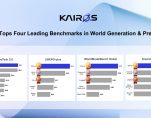
SHANGHAI, CHINA – Media OutReach Newswire – 15 June 2026 – ACE ROBOTICS today announced that its open-source Kairos world model has achieved leading results across four global embodied-intelligence benchmarks: RoboTwin 2.0, LIBERO-Plus, WorldModelBench Robot and DreamGen. Kairos ranked first among evaluated world models and vision-language-action (VLA) systems on these benchmarks’ public leaderboards as of 12 June 2026, leading across the core capabilities of embodied intelligence, including complex robotic manipulation, scene-level generalization, physical-world modeling and zero-shot transfer. The project is openly available on GitHub, Hugging Face and ModelScope, giving researchers and developers a public reference point for the model, benchmark results and technical materials.
Tops Four Leading Benchmarks in World Generation & Prediction
Embodied intelligence faces a fundamental challenge: generalization. A robot must operate reliably in environments it has never seen, adapting to new lighting, layouts, objects, embodiments and noisy real-world conditions. While VLA models have become a prevailing approach by directly mapping perception and language inputs to robot actions, ACE ROBOTICS believes world models offer a more scalable path by explicitly learning the underlying dynamics of the physical world and predicting how environments evolve. Kairos is designed to validate that approach.
Leading scene-level generalization on LIBERO-Plus
One of Kairos’ most significant results comes from LIBERO-Plus, a scene-level generalization benchmark proposed by the Shanghai Innovation Institute with Fudan University, Tongji University and the National University of Singapore. It evaluates robustness under seven real-world variables: camera angle, robot embodiment, language instruction, lighting, background, sensor noise and spatial layout.
Kairos achieved an overall score of 89.0, ranking first among all evaluated world models and VLA systems. It surpassed leading VLA models including ACoT-VLA (88.0), Pi 0.5 (85.7) and ProGAL-VLA (85.5), as well as the Being-H0.7 world model (84.8). It also showed strong environmental robustness, with near-ceiling performance on lighting (97.7), noise (96.8) and background (95.8), and ranked highly on camera angle and language instruction.
According to ACE ROBOTICS, this marks the first time a world-model approach has outperformed leading VLA systems on LIBERO-Plus for scene-level generalization, pointing to a path where robots adapt to homes, factories, retail spaces and other environments with far less environment-specific retraining.
A compact model with strong physical modeling efficiency
On WorldModelBench Robot, a physical-modeling benchmark proposed by researchers from UC Berkeley, UC San Diego, NVIDIA and MIT, Kairos-4B achieved an overall score of 9.30, ranking first on the benchmark. With only 4 billion parameters, it outperformed larger systems including 28-billion-parameter Lingbot, 16-billion-parameter Cosmos 3, 14-billion-parameter Abot-PhysWorld and 5-billion-parameter Wan 2.2, setting a new record for parameter efficiency in embodied world models.
Kairos matched the top instruction-following score (2.36) of the 16-billion-parameter Cosmos 3 with about one quarter of the parameters, a fourfold efficiency gain. It scored 4.96 on physics adherence, with perfect marks on Newtonian mechanics and gravity, and a perfect score on temporal quality, reflecting strong temporal consistency and visual continuity over long horizons.
A unified architecture, not a modular pipeline
ACE ROBOTICS attributes Kairos’ performance to its native unified “multi-modal understanding-generation-prediction” architecture. Unlike modular approaches that stitch together separate components for world understanding, generation and prediction, Kairos integrates these within a single backbone that shares one global world state, reducing the information loss and coordination latency between modules for more consistent physical modeling, stronger long-horizon prediction and more reliable action planning.
ACE ROBOTICS first introduced this architecture in December 2025, and the broader industry is now converging on a similar path: NVIDIA’s Cosmos 3.0, introduced in 2026, adopts a comparable single-system design that brings vision reasoning, world generation and action prediction into one architecture. Built on this foundation, Kairos-4B is, in ACE ROBOTICS’ description, the first embodied world model able to drive a physical robot directly on-device, closing the perception-to-action loop without intermediate translation latency.
Leading on synthetic data transfer and complex robot manipulation
Kairos also ranked first on DreamGen Bench, a benchmark led by NVIDIA with the University of Washington, UC Berkeley and UCLA that measures how well synthetic data generated by world models transfers to unseen objects, behaviors and environments, a key predictor of downstream robot-training value. Kairos ranked first on both average physics adherence (AVG_PA 0.538) and overall average score (AVG_Score 0.618), and led globally on new-behavior execution and new-environment adaptation.
On RoboTwin 2.0, a demanding dual-arm manipulation benchmark proposed by Shanghai Jiao Tong University and the University of Hong Kong with Shanghai AI Laboratory, Kairos scored 96.1% — a state-of-the-art result on the benchmark’s public leaderboard as of 12 June 2026. Across the benchmark’s 50 complex two-arm tasks it scored 96.9% in clean scenarios and 95.2% in randomized scenarios, ahead of VLA models such as G0.5 (93.2) and starVLA (88.3) and world models including AIM (93.1), Fast-WAM (91.8) and MotuBrain (96.0).
From benchmark leadership to commercial deployment
Together, these results validate Kairos’ technical direction across the core dimensions of embodied intelligence, from physical-rule understanding and zero-shot generalization to environmental robustness and fine-grained dual-arm manipulation, supporting ACE ROBOTICS’ aim to move robots beyond task imitation toward physical-world understanding, long-horizon reasoning and real-world execution.
The results come as ACE ROBOTICS accelerates commercialization. The company says it has raised several hundred million U.S. dollars across financing rounds in the first half of 2026, including a recent Angel+ round backed by investors such as Geely Capital, Dachen Caizhi, Shenzhen Capital Group and the Shanghai Sci-Tech Innovation Fund, with existing shareholder SenseTime’s Guoxiang Capital increasing its stake. The proceeds will support continued world-model research and integrated hardware-software solutions for sectors including smart retail, security and inspection, tourism and hospitality.
“Embodied intelligence is the next era of AI, and a world model is the key to unlocking it,” said Wang Xiaogang, Chairman of ACE ROBOTICS. “Our mission is to give every robot a capable brain.”
The issuer is solely responsible for the content of this announcement.
About ACE ROBOTICS – Equipping robots with intelligent “brains” and engaging “souls”
ACE ROBOTICS is a pioneering robotics company dedicated to advancing the field of embodied intelligence. Through breakthrough technological innovations and deep insights into embodied intelligence scenarios, we aim to empower robots with the ability to autonomously understand and explore the physical world, thereby accelerating their commercial implementation.
The company pioneered the ACE R&D paradigm and built a vision-based “environmental data engine, real-world cognition, embodied interaction generalization” technology chain. Using full spatiotemporal and multi-perspective environmental capture as its engine, along with Kairos 3.0 – China’s first open-source and commercially applicable world model – plus the Embodied Foundation Model as its technical backbone, ACE ROBOTICS addresses core industry challenges such as data scarcity, common sense gaps, poor generalization, and limited versatility. Simultaneously, the company unveiled its flagship A1 Embodied Super Brain Module, accelerating the large-scale commercial deployment of embodied intelligence across diverse scenarios.
ACE ROBOTICS is both a technology pioneer and an ecosystem builder. Through strategic cooperation with top hardware manufacturers, cloud service providers, and vertical scenario partners, we have broken through the “model-hardware-scenario” industrial deadlock, providing standardized and customized solutions that are driving the development of China’s embodied intelligence industry.
Arabian Post Staff -Dubai Abu Dhabi has denied claims that money was transferred from the UAE to Iran, rejecting allegations that frozen Iranian assets, including a reported $3bn tranche, had been released or routed through its financial system. The Ministry of Foreign Affairs said the reports were “entirely false and unfounded” and stressed that no frozen Iranian funds had been released, transferred or facilitated through the country. […]
Arabian Post Staff -Dubai Abu Dhabi’s International Holding Company has begun an AED1.8 billion share repurchase, opening the first tranche of an approved AED5 billion buyback after a sharp rise in first-quarter profit and continued expansion across its investment portfolio. The initial purchase, launched on 12 June, represents 36 per cent of the total programme approved by shareholders at the company’s annual general assembly on 16 March […]
Arabian Post Staff -Dubai The UAE has firmly rejected allegations that money was moved from the country to Iran, including claims involving as much as $3bn, saying no frozen Iranian assets have been released, transferred or facilitated through its territory. The Ministry of Foreign Affairs said reports carried by unnamed international media outlets were “entirely false and unfounded”. The statement followed accounts suggesting that funds linked to […]




 https://www.linkedin.com/company/acerobotics/posts/?feedView=all&viewAsMember=true%EF%BD%9C
 https://x.com/ace_robotics




