News related to
Iran war

Dubai’s commercial property market opened 2026 with fewer deals but a sharply higher value profile, as investors paid more for offices, warehouses and retail assets in a market increasingly defined by scarcity, asset quality and longer-term positioning. CRC, the commercial arm of Betterhomes, said 3,619 commercial units changed hands in the first quarter, down 3% from a year earlier, while total sales value rose 30% to AED37.9 […]

Arabian Post Staff -Dubai Fresh instability swept across the Middle East on Saturday after Iran reimposed restrictions on vessel traffic through the Strait of Hormuz and Israeli forces struck targets in Lebanon, denting market optimism that a broader easing of tensions was close at hand. The renewed disruption came less than a day after signs of limited progress had lifted hopes for safer shipping through the narrow […]

Iran has tightened its grip on the Strait of Hormuz, warning that vessels seeking passage will face military control after Tehran linked the waterway’s closure to a United States blockade of its ports, a move that has sharply escalated a confrontation already straining global energy markets and regional diplomacy. Reports of gunfire at commercial ships, including two India-flagged vessels, have turned a political standoff into a direct […]

Air passengers face a tougher booking season as airlines trim connections, suspend weaker routes and ground aircraft to absorb a jet-fuel shock that has spread from energy markets into ticket prices and network planning. Industry officials are warning that the disruption could deepen through the northern summer, especially on thinner international and regional links where carriers have little room to absorb higher costs. Jet fuel prices have […]

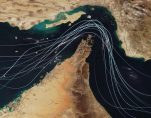
Arabian Post Staff -Dubai Commercial shipping through the Strait of Hormuz remained far from normal on Friday evening even after Tehran said the waterway was open to all merchant traffic, with ship-tracking data showing a cluster of vessels moving towards the passage before many stopped or turned back. The movements underlined the gap between Iran’s political signal and the shipping industry’s assessment of operational risk across one […]

Arabian Post Staff -Dubai   President Donald Trump said Iran had agreed to suspend its nuclear programme without a fixed end date, lifting market hopes that a broader settlement could be close after Tehran declared the Strait of Hormuz open again to commercial shipping during the ceasefire period. Trump said in a phone interview on Friday that the halt would be “unlimited”, while also projecting confidence that […]

Arabian Post Staff -Dubai UAE equities closed higher on Friday, extending a second straight week of gains as traders responded to signs that Washington and Tehran may keep diplomatic channels open, lifting sentiment across Gulf markets and pushing Dubai to its highest level in about six weeks. Dubai outpaced Abu Dhabi, with buying concentrated in banking and property names as investors weighed the prospect of lower geopolitical […]

Advertisements

More than half of Israelis do not want Benjamin Netanyahu to continue as prime minister, according to a Channel 12 poll that has added fresh weight to a long-running pattern in domestic surveys showing a battered leader still in office but struggling to rebuild broad public confidence ahead of a national election due by October. The finding, circulated widely in Israeli media, lands at a moment when […]

Falling oil prices after Iran said the Strait of Hormuz was open to commercial shipping have eased one of the sharpest inflation threats facing the US Federal Reserve, giving policymakers more room to consider rate cuts later this year if the decline in energy costs holds. Brent crude fell below $90 a barrel on Friday, April 17, for the first time since March 10, after dropping by […]

Iran said on Friday that the Strait of Hormuz was open to commercial shipping during the ceasefire, easing pressure on one of the world’s most sensitive energy chokepoints and helping lift Bitcoin towards $78,000 as investors moved back into risk assets. The market reaction was swift across oil, equities and cryptocurrencies, though the rebound also reflected wider hopes that hostilities involving the US, Israel and Iran may […]

Arabian Post Staff -Dubai Oil prices fell sharply on Friday after Iran’s foreign minister said the Strait of Hormuz would remain open to commercial shipping during a ceasefire, easing immediate fears of a prolonged choke on one of the world’s most important energy routes. Brent crude and US West Texas Intermediate both tumbled by more than 11% at one stage of trading, as investors unwound risk premiums […]

AD Ports Group says it has kept operations running normally through the Gulf supply chain disruption that began at the end of February, using its integrated network to reroute cargo across land, rail, sea and air as traffic through the Strait of Hormuz remained severely constrained. The Abu Dhabi-based operator said on April 16 that it had shifted volumes through Fujairah Terminals and Khor Fakkan Port, activated […]

Alarm over the Strait of Hormuz is spilling far beyond the Gulf, sharpening attention on the Malacca Strait near Singapore as traders, shipowners and Asian governments weigh what a prolonged disruption in West Asian energy flows could mean for the region’s busiest maritime corridor. The immediate military confrontation is centred on Hormuz, where Iran has tightened restrictions and the United States has imposed a blockade on Iranian […]

Nissan’s vehicle sales across the Middle East fell sharply in March as the war centred on Iran hit consumer demand, disrupted travel and darkened business sentiment across one of the carmaker’s stronger overseas markets. A report published on April 15 said Nissan’s sales in the region dropped to about half of pre-war levels, while overall regional sales were down 40 per cent for the month, according to […]

Arabian Post Staff -Dubai Dubai has moved to protect its standing as a fast-rising hedge fund centre by giving financial firms more room to handle disruption linked to the Iran war, as market volatility, staffing strains and geopolitical risk test one of the emirate’s most carefully cultivated growth stories. The Dubai Financial Services Authority said on 9 April it would offer temporary, proportionate relief across licensing, governance, […]

Global growth prospects have darkened after the International Monetary Fund cut its forecasts and warned that the war involving the United States, Israel and Iran has delivered a fresh energy shock just as many economies were regaining stability. The Fund’s latest assessment points to weaker output, firmer inflation and mounting fiscal pressure as oil flows through the Gulf remain disrupted and governments weigh how to shield households […]

China’s economy expanded faster than expected in the first quarter, giving Beijing a firmer platform as it confronts the fallout from the war involving Iran, but the details beneath the headline number pointed to a recovery still leaning heavily on industry and exports while households remain cautious. Official data released on Thursday showed gross domestic product grew 5.0% from a year earlier in January to March, above the 4.8% forecast in a Reuters poll and up from 4.5% in the final quarter of 2025. Quarterly growth came in at 1.3%, slightly ahead of the previous quarter.

The stronger reading suggested that the first shockwaves from the conflict in the Middle East have not yet knocked China off course. Markets took the figures as a sign of resilience. Mainland share indices rose after the release and the yuan held near its strongest levels in three years, reflecting confidence that the world’s second-largest economy has, for now, absorbed higher energy risks better than some had feared.

Yet the composition of growth was less reassuring. March industrial output rose 5.7% from a year earlier, beating expectations, but retail sales slowed to 1.7%, well below forecasts and down from 2.8% in the first two months of the year. Fixed-asset investment in the first quarter rose 1.7%, also missing expectations, while property investment fell 11.2%. Those figures reinforced a pattern that has defined China’s economy for months: factories, infrastructure and technology manufacturing are carrying more of the load than domestic consumption or housing.

That imbalance matters because Beijing has repeatedly signalled that stronger household demand is essential to putting growth on a steadier footing. Economists cited in the reporting on Thursday said the first-quarter strength was driven largely by momentum built in January and February, especially through exports and industrial activity, while March showed signs of softer conditions. The slowdown in shop spending is particularly sensitive because consumer confidence has remained fragile even as policymakers talk up support for incomes, jobs and services-led demand.

The war has complicated that task without yet derailing it. Since hostilities erupted on 28 February, China has faced a familiar vulnerability: it is the world’s largest energy importer and still relies on stable global shipping and manageable oil prices to protect factory margins and household purchasing power. Reuters reported that economists believe China has so far weathered the shock because of large oil reserves, a diversified energy mix and price controls, but they also warned that persistently higher oil costs are beginning to filter through supply chains and squeeze profits.

Evidence of that pressure is already visible. Reuters noted this week that factory-gate prices in March rose for the first time in more than three years, a signal that energy-driven cost increases are feeding into production. Export growth, which had been one of the brighter spots, also lost momentum in March after a very strong start to the year, raising the possibility that manufacturers will find it harder to sustain their pace if shipping costs stay elevated and overseas demand weakens.

Beijing’s response is likely to stay measured unless the conflict worsens. Policymakers have already set a budget deficit of about 4% of GDP for 2026 and planned heavy bond issuance to support activity. Analysts polled by Reuters expect the central bank to keep the one-year loan prime rate steady through the year, with only a modest cut to reserve requirements anticipated later on. A stronger first quarter gives officials more room to avoid large-scale stimulus at this month’s Politburo meeting, though that calculus could change if oil prices climb further or exports weaken more sharply.

The broader international backdrop is not especially forgiving. The IMF said in its April World Economic Outlook material that the Middle East conflict is lowering growth expectations for advanced economies in 2026, even if the aggregate effect is described as modest. For China, that matters less through direct battlefield exposure than through energy costs, shipping uncertainty and the health of major overseas markets. A prolonged conflict would test the durability of China’s export-led strength at the same time as its consumer recovery remains incomplete.


Bitcoin’s market backdrop has strengthened sharply, with a closely watched Bull Score Index climbing to its highest reading since October 2025 after several previously weak on-chain signals improved over roughly three days, according to market analytics platforms tracking network activity and investor behaviour. The shift has added momentum to a rebound that has pushed Bitcoin back towards the mid-$70,000 range, even as analysts warn that the move […]

Malaysia is positioning itself as a discreet diplomatic channel between Gulf capitals and Tehran, with Prime Minister Anwar Ibrahim saying leaders from the Arab world have asked Kuala Lumpur to convey their concerns to Iran’s leadership as governments search for ways to contain the Middle East conflict. Anwar made the remarks in Putrajaya on 16 April during a joint appearance with Australian Prime Minister Anthony Albanese, adding a new dimension to Malaysia’s response after it had already secured passage for its vessels through the Strait of Hormuz through direct engagement with Tehran.

The comments suggest Malaysia sees room to act beyond its traditional Southeast Asian brief at a moment when the war-linked shock in the Gulf is reverberating through energy markets, shipping lanes and food supply chains far beyond the region. Anwar’s statement also points to how some Gulf states may be looking for intermediaries that maintain workable ties with Iran while still being able to speak with a broader range of governments. Malaysia has presented itself as a neutral actor, and Anwar has argued that any contact with Tehran should be aimed at de-escalation rather than tactical positioning inside the conflict.

His remarks fit into a chronology that has been building for weeks. On 26 March, Anwar said Iran had agreed to allow Malaysian-flagged vessels to pass through the Strait of Hormuz after he held talks with leaders from Iran, Egypt, Turkey and other regional states. He thanked Iran’s president for facilitating the release of Malaysian oil tankers and their crews, while also acknowledging that Tehran remained wary because of what he described as broken assurances and the lack of firm security guarantees.

That earlier intervention mattered because the Strait has become one of the most sensitive pressure points in the wider confrontation. Iran’s restrictions and the broader conflict have disrupted oil and gas shipments, pushed governments to seek alternative supply arrangements and revived fears over the security of one of the world’s most important maritime corridors. ASEAN foreign ministers, in a virtual meeting on 13 April, urged the United States and Iran to sustain negotiations toward a permanent resolution and called for the restoration of safe and continuous navigation for vessels and aircraft through the Hormuz corridor.

Malaysia’s diplomatic posture is being shaped as much by economic exposure as by political calculation. Reuters reported this week that Kuala Lumpur and Canberra agreed to strengthen energy and trade ties in response to disruption caused by the Middle East conflict, with Anwar saying Petronas would prioritise supplying Australia with excess fuel. That followed reporting on Albanese’s 14-17 April visit to Brunei and Malaysia, where fuel security and fertiliser supply were central themes as Canberra sought to cushion the impact of the Hormuz disruption.

For Malaysia, that means diplomacy cannot be separated from domestic cost pressures. The government has already had to manage the implications of tighter oil and gas supplies, and Anwar said in March that while fuel subsidies would stay, Putrajaya would move to reduce subsidised fuel allocations to contain the fiscal strain. The message was that Malaysia’s outreach to Tehran is not only about foreign policy profile; it is also about protecting shipping, energy flows and household stability at home.

The broader regional setting helps explain why Gulf states might see value in using a country such as Malaysia as a messenger. Several governments in the Gulf are recalibrating how they deal with Tehran after the conflict exposed both their vulnerability to retaliation and the limits of outside security guarantees. At the same time, alternative mediators are emerging. Pakistan’s army chief was in Tehran on 16 April for talks linked to possible new US-Iran negotiations, underscoring how middle powers across Asia are trying to create off-ramps before the ceasefire window narrows further.

Malaysia is unlikely to become a formal broker on its own, and Anwar has not claimed such a mandate. What he has done is signal that Kuala Lumpur is already part of a live diplomatic relay, trusted by some Arab leaders to transmit messages to Tehran and willing to use that access in support of a political settlement. That role may suit all sides precisely because it is informal, low-key and tied to a country that has avoided the sharper alignments defining the conflict.

Arabian Post Staff -Dubai Middle East conflict damage to energy infrastructure could leave the region facing as much as $58 billion in repair costs, according to a sharply revised estimate from Rystad Energy, with oil and gas facilities alone accounting for up to $50 billion and much of the burden falling on complex plants whose restoration may take years rather than months. The research firm said the […]

  Iran has floated a proposal that could allow ships to use the Omani side of the Strait of Hormuz without facing attack, according to a person briefed on Tehran’s negotiating position, offering a possible path to ease one of the biggest shocks to global energy trade in modern times if talks with the United States produce a wider settlement. The idea has emerged as the U. […]

Australia’s unemployment rate held at 4.3% in March, defying a widening energy shock from the US-Israeli war on Iran and underscoring the resilience of a labour market that has so far remained tighter than many economists expected. Official figures showed employment rose by about 18,000 over the month, led by a sharp lift in full-time work, even as participation edged lower and policymakers faced a more complicated […]

A sharp jump in brute-force attacks against SonicWall and Fortinet devices has put security teams on alert, after Barracuda said such activity made up more than half of the confirmed incidents its SOC tracked during February and March, with about 88% of the attacking IP addresses geolocated to the Middle East. The company said most attempts failed because they were blocked or aimed at invalid usernames, but […]

Arabian Post Staff -Dubai Marine fuel sales at Fujairah fell to a record low in March as the US-Iran conflict upended shipping patterns, strained fuel supply chains and pushed vessels to avoid one of the Gulf’s most important refuelling hubs. Data cited by traders and market reports showed sales at the port dropped to 158,852 cubic metres, down more than 70 per cent from February and from […]

VISHNU RAJA
RYO YAMADA
HITORI GOTOH
IKUYO KITA