PHP’s security team has issued mitigation guidance for a newly identified remote code execution vulnerability, CVE-2026-115560, while saying the unusual conditions required for exploitation make widespread exposure unlikely. The maintainers advised administrators to disable session upload progress until the next scheduled bug-fix release. The vulnerability has not received an emergency patch because exploiting it requires a particular combination of application configuration and runtime behaviour, rather than merely […]
Arabian Post Staff -Dubai Abu Dhabi’s ADNOC has agreed with OpenAI and technology group G42 to deploy advanced artificial intelligence across its energy business, becoming the first company in the sector to adopt OpenAI’s Frontier platform. The multi-year partnership was announced on Monday at the ADIPEC energy conference as OpenAI chief executive Sam Altman visited Abu Dhabi and met Crown Prince Sheikh Khaled bin Mohamed bin Zayed […]
Arabian Post Staff -Dubai French natural hydrogen explorer Mantle8 has obtained exclusive rights to negotiate an exploration agreement for Block 7 in Ras Al Khaimah, clearing the way for the emirate’s first dedicated geophysical survey of naturally occurring hydrogen. The arrangement with the Ras Al Khaimah Department of Energy allows the Grenoble-based company to begin a non-invasive investigation of the block’s underground geology before any decision on […]
Iranian missile and drone strikes against American military installations across the Middle East initially concentrated on early-warning radars and air-defence systems before expanding to aircraft, warehouses and troop accommodation, exposing extensive damage to Washington’s regional military infrastructure. Satellite imagery and assessments of battlefield damage establish that more than 115 strikes claimed by Iran or Iranian-backed militias damaged or destroyed structures at 26 military bases and other facilities […]
Arabian Post Staff -Dubai BYD has designated the Gulf Cooperation Council its leading international expansion priority, announcing plans for additional investment, a regional spare-parts hub and broader technology operations beyond vehicle sales. Executive vice-president Stella Li said the Chinese automotive group intends to strengthen its dealership network and after-sales services while exploring opportunities in battery storage, autonomous driving and robotics across Gulf markets. “The GCC is my […]
Visa and Senegal’s Ministry of Telecommunications and Digital Affairs have signed a two-year cooperation agreement aimed at developing digital payments, improving public services and strengthening financial inclusion across the West African country. The memorandum of understanding, announced on Friday, establishes a framework for collaboration covering financial innovation, cybersecurity and regulatory issues. Both sides will examine potential payment applications linking government agencies and citizens, although no specific platform, […]
OpenAI chief executive Sam Altman met senior Samsung executives in South Korea on Saturday as the companies pursue cooperation on artificial intelligence infrastructure amid mounting pressure on global memory chip supplies. Samsung said approximately 50 executives from its electronics, financial services and biotechnology businesses attended the meeting at its human resources development centre in Yongin, south of Seoul. The discussions focused on how artificial intelligence could transform […]
The capital will be deployed in stages across three new business lines, beginning in Brazil.
KUALA LUMPUR, MALAYSIA – Media OutReach Newswire – 30 October 2026 – 10 CENTS CAPITAL SDN. BHD. (“10 CENTS CAPITAL”) has completed US$20 million in financing. With the capital, the well-known Malaysian investment holding company is adding three business lines of its own to its investment activities and will deploy the funds in phases, starting in Brazil.
John Lee, Head of International Markets, 10 CENTS CAPITAL.
How the capital will be deployed The three new lines are AI business applications, global multilingual marketing and cross-border B2B trade. Part of the capital will build the technology and service base, including AI tools for customer research, marketing content and localisation, and the service model the business will run on. Another part will support cross-border B2B operations: research, information management and enquiry handling.
The remainder is set aside for market development, beginning with market entry in Brazil, the plan’s first market. Local operations there will be handled by its Brazil operating brand, VIVAMOMENTO.
Strategic rationale Since 2022, 10 CENTS CAPITAL has backed companies across digital technology, e-commerce, consumer services and enterprise services. The three new lines extend that experience into businesses the company builds and runs itself, in areas it already knows well. Funding technology, service and market development together gives each line a complete foundation from the outset, instead of one assembled piece by piece.
“Completing this financing opens a new chapter for our company,” said 10 CENTS CAPITAL Director Peter LIEW. “We will deploy the capital with discipline, one stage at a time, so that each new business stands on a base strong enough to carry the next.”
Outlook Deployment will proceed in phases, starting in Brazil, with further markets to follow as the new business develops. 10 CENTS CAPITAL will report progress at tencentscapital.com/news, and business and media enquiries are welcome via the contact page.
Hashtag: #10CENTSCAPITAL
The issuer is solely responsible for the content of this announcement.
About 10 CENTS CAPITAL
10 CENTS CAPITAL SDN. BHD. (Registration No. 202201025952 (1471649-V)) is a well-known Malaysian investment holding company incorporated on 18 July 2022. Focused on business growth and long-term value, it works with companies through capital investment, strategic support and resource connections across four areas: digital technology, e-commerce, consumer services and enterprise services. Company news: tencentscapital.com/news.
US intelligence officials believe a former senior executive of Singapore-based Megaspeed International cultivated a relationship with Nvidia chief executive Jensen Huang while allegedly supplying information to Beijing, raising fresh concerns about Chinese intelligence operations targeting America’s artificial intelligence industry. Alice Huang, also known as Huang Le, came under American surveillance after investigators began examining whether Megaspeed was helping Chinese companies circumvent restrictions on advanced Nvidia semiconductor exports. […]
Ridger Delivers MUX Private AI Deployment to Shum Wong & Co., Solicitors in Hong Kong
SINGAPORE – Media OutReach Newswire – 30 October 2026 – Ridger, an AI infrastructure company, today announced the official delivery of its MUX private AI solution to Shum Wong & Co., Solicitors in Hong Kong. The solution features MIMO, the world’s first AI-native storage system, making Shum Wong & Co., Solicitors the first law firm in Hong Kong Northern Metropolis to deploy it.
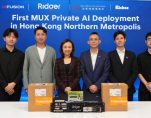
Representatives from Ridger, Shum Wong & Co., Solicitors, xFusion, and Richee at the delivery ceremony for the first MUX private AI deployment in Hong Kong Northern Metropolis.
Representatives from Ridger, Shum Wong & Co., Solicitors, xFusion, and Fadada’s RicheeAI team attended the delivery ceremony. During the event, Ridger presented the firm with the “Global AI Pioneer Law Firm” certificate in recognition of its forward-looking investment in private AI infrastructure.
The solution brings together AI-native storage and compute infrastructure, a dedicated large language model (LLM) environment, and AI applications tailored to legal workflows. Operating entirely within the firm’s own security perimeter, it marks a significant step toward enabling Hong Kong’s legal profession to harness the productivity of generative AI while safeguarding client data and meeting compliance requirements.
About the Deployment
In space-constrained Hong Kong, Ms. Careen H.Y. Wong, Founding Partner of Shum Wong & Co., Solicitors and Vice President of The Law Society of Hong Kong, set aside room in the Firm’s latest office in the Northern Metropolis for a standard equipment rack, ready for on-premise AI. It is more than a space decision: it reflects her view of the future of legal services—that while harnessing AI to improve efficiency, a firm must retain control of its data and technology boundaries, so that sensitive materials are always properly protected.
Under the engagement, Ridger built a privately owned, independently operable AI foundation for Shum Wong & Co., Solicitors, comprising high-performance storage and data infrastructure optimized for AI workloads, together with a dedicated LLM platform over which the client retains full control of model weights and the inference environment. The platform supports use cases including contract review and risk flagging, legal research and case-law retrieval, large-scale document review in due diligence, drafting and multilingual translation of legal documents, and internal Knowledge Base question answering. It also provides role-based access control, tiered permissions, comprehensive audit trails and content provenance to meet enterprise-grade governance requirements.
Called MUX, the private solution lets the firm begin with no barrier and without capital-intensive build-out or a dedicated server room, scaling on demand; it natively supports Hong Kong’s common law system and integrates seamlessly with existing systems such as email, document management and calendar, embedding AI into lawyers’ daily work. MUX can be ordered directly through Ridger’s website (https://ridger.tech), out of the box.
The delivery reflects the collaboration of legal expertise, AI infrastructure, compute platforms and industry applications: Shum Wong & Co., Solicitors defined the requirements for data confidentiality and on-premise deployment from its actual practice; Ridger provided the end-to-end MUX solution and led its design and integration; xFusion supplied the FusionXpark local AI compute platform and technical support; and Fadada provided the Richee Legal AI Agent Platform, leveraging specialized AI agents and skills to support lawyers in their daily work and improve workflow efficiency. Ridger notes that while an AI model determines capability for a moment, AI infrastructure determines long-term competitiveness.
Why Private AI Matters for the Legal Sector
1. Safeguarding client confidentiality and legal professional privilege
Client materials, transaction documents and dispute information handled by law firms are protected by legal professional privilege (LPP) and strict professional duties of confidentiality. Disclosure to third parties—including public cloud services—may be treated as a waiver of privilege, causing it to be lost and the materials to become disclosable in subsequent proceedings. Private deployment keeps storage, processing and inference entirely within the firm’s own environment, with no disclosure to external providers, preserving privilege and confidentiality at source.
2. Embedding data sovereignty and regulatory compliance
The solution aligns with Hong Kong’s Personal Data (Privacy) Ordinance (Cap. 486) and is designed with reference to the Privacy Commissioner’s “Checklist on Guidelines for the Use of Generative AI by Employees” and the “Model Framework on AI: Personal Data Protection,” as well as The Law Society of Hong Kong’s 2024 position paper on the impact of AI on the legal profession and the Manifesto on “Legal Ethical Code of Conduct Regarding the Deployment of AI.” It embeds the principles of lawfulness, transparency, traceability, interpretability, security and appropriate human oversight into a unified AI governance framework.
For a firm handling cross-border work, the same private environment also addresses the requirements of the major jurisdictions: for Mainland China, it aligns with the Personal Information Protection Law, the Data Security Law and data-export mechanisms such as security assessments and standard contracts; for Europe, it maps to the EU General Data Protection Regulation (GDPR) and standard contractual clauses; for the United States, it meets the confidentiality and competence duties under the ABA Model Rules of Professional Conduct and Formal Opinion 512 on generative AI. Because data always remains within the firm’s own perimeter, the firm can confidently meet local data-confidentiality and regulatory expectations wherever its clients are based.
3. Eliminating the hidden risk of “shadow AI”
Where a firm offers no convenient, approved AI tool, individual lawyers may turn to consumer-grade public chatbots for work, creating “shadow AI” that sits outside IT and compliance visibility—unapproved, unlogged and unaudited, with unknown data flows and no clear accountability. MUX channels that demand into a single, visible, auditable controlled environment, giving lawyers the efficiency they want while bringing every use under the institution’s governance and oversight.
4. Keeping institutional knowledge within the firm
The case law, templates and practical know-how accumulated by a firm are core competitive assets. A private platform continuously refined on the firm’s own corpus keeps these assets within the institution and compounds their value over time, rather than depositing them with an external vendor.
5. Ensuring control and business continuity
Private deployment insulates the firm from external API changes, model versioning, service outages or shifts in vendor strategy, giving it full control over capabilities, upgrade timing, cost and availability — a foundation for durable, long-term AI adoption.
Executive Quotes
“For industries built on trust and confidentiality, such as the law, the value of AI should never come at the price of data sovereignty,” said Ray Hu, General Manager Asia-Pacific Region of Ridger. “Private deployment lets a firm turn generative AI into auditable, governable and sustainable productivity without crossing confidentiality lines. We are proud to set this benchmark with Shum Wong & Co., Solicitors”
Ray Hu, General Manager Asia-Pacific Region, Ridger
“In Hong Kong, office space is scarce and precious, but data sovereignty is worth setting aside a place for. Building our own AI infrastructure lets us embrace AI while always safeguarding our clients’ trust and the boundaries of our profession.”
The issuer is solely responsible for the content of this announcement.
Ridger Company Limited
Ridger is a technology company focused on data and storage infrastructure for the AI era. The company provides private, high-performance AI infrastructure and solutions that enable enterprises to deploy and run large models and AI applications within their own security perimeter. Through its proprietary storage and data management technologies, Ridger helps clients safeguard data sovereignty, security and compliance while fully realizing the business value of artificial intelligence.
Swedish technology startup Strawberry has released version 1.0 of its artificial intelligence browser, moving beyond beta testing with a product designed to help employees automate work without writing code. The Stockholm company announced the launch on 26 October, positioning its browser as an alternative to established American AI platforms, including OpenAI’s ChatGPT, Anthropic’s Claude and Google’s Gemini. Its software places AI assistants directly alongside websites and business […]
China could become the global leader in advanced artificial intelligence models by 2030 while matching or challenging other countries across strategically important technologies, according to a new assessment by Bloomberg Intelligence.
The forecast identifies large language models, which underpin generative AI applications, as an area where China is particularly well positioned to establish leadership. It also anticipates that Chinese companies and research institutions will become at least competitive across other critical technology sectors, potentially reshaping the balance of technological capabilities between Beijing and Washington.
The assessment comes as Chinese AI developers narrow the performance gap with American competitors despite restrictions on access to advanced semiconductors. Improvements in model efficiency, expanding domestic computing infrastructure and competitive pricing have strengthened China’s position in the global market.
Bloomberg Intelligence senior analyst Robert Lea identified a sharp improvement in Chinese model performance earlier this month. Leading Chinese systems trailed their American counterparts by approximately 3% on benchmark scores, compared with around 9% in May and 15% earlier this year.
That narrowing gap followed the September introduction of DeepSeek’s V4.1 Flash model, which demonstrated further advances in reasoning and computational efficiency. The findings suggest that restrictions on sophisticated American chips have not prevented Chinese developers from improving their systems.
The projections nevertheless remain conditional on technological progress, investment and commercial adoption over the next four years. Competitive performance in individual benchmarks does not necessarily establish overall leadership, particularly when computing capacity, profitability and enterprise deployment are considered.
China’s expanding capabilities are already influencing international adoption patterns. Models developed by DeepSeek, Alibaba and Moonshot AI have attracted developers seeking alternatives to comparatively expensive proprietary systems offered by American technology companies.
Data from OpenRouter, a platform providing access to multiple AI models, showed Chinese systems gaining substantial shares of usage during 2026. However, the figures represent activity through that platform rather than the entire global market, where direct subscriptions and enterprise contracts remain significant.
Chinese developers have also benefited from distributing models with openly available weights, allowing businesses and programmers to customise systems without depending entirely on proprietary services. This approach has encouraged international experimentation and strengthened adoption among cost-conscious users.
American companies retain important advantages, particularly in advanced semiconductor access, large-scale computing infrastructure and commercial relationships with enterprise customers. OpenAI, Anthropic and Google continue investing heavily in frontier models and the infrastructure required to train increasingly sophisticated systems.
Financial performance illustrates the distinction between technological competitiveness and commercial success. Anthropic disclosed revenue of $16.3 billion for the first half of 2026, compared with $1.2 billion during the corresponding period a year earlier, reflecting strong demand for its enterprise services.
Chinese developers face greater pressure on pricing, with intense domestic competition limiting opportunities to convert growing usage into sustainable earnings. Lower-cost models can accelerate adoption while simultaneously reducing margins available to finance future development.
Semiconductor manufacturing remains another constraint. Washington’s export controls restrict Chinese access to certain advanced processors and manufacturing equipment, although domestic suppliers including Huawei are developing alternatives intended to support national computing requirements.
China’s response increasingly combines domestic chip development with software optimisation. Researchers have demonstrated that improvements in training methods, architecture and inference efficiency can reduce dependence on the most powerful available hardware.
Beijing is also pursuing greater integration between artificial intelligence and telecommunications infrastructure. A three-year programme issued by the Ministry of Industry and Information Technology in June established targets for autonomous networks, computing access and specialised AI applications through 2028.
The programme envisages significant breakthroughs in core technologies by 2030, alongside improved coordination between communications networks, computing resources and intelligent services. Its objectives complement broader efforts to establish domestic technological capabilities.
Regulatory developments could influence the international availability of Chinese technology. Authorities proposed export restrictions this month covering 23 categories of AI technology, including language models, autonomous agents, chip designs and computing clusters.
The draft measures would potentially subject transfers of certain model weights, source code and advanced technologies to government approval. Their final scope and implementation remain undetermined.
China’s Ministry of Commerce has presented the proposals as part of a wider effort to regulate strategically sensitive technology transfers. The consultation also covers technologies beyond artificial intelligence, reflecting the government’s expanding attention to intellectual property and national security.
For overseas developers using Chinese models, the eventual rules could affect access to advanced systems and associated technical resources, depending on the restrictions adopted and the thresholds applied to particular technologies.
Arabian Post Staff -Dubai Oil prices climbed on Wednesday, with Brent crude rising above $115 a barrel as uncertainty surrounding Israel’s parliamentary election and indications of possible renewed American military operations against Iran heightened concerns over Middle Eastern energy supplies. West Texas Intermediate traded near $101 a barrel, reversing part of its losses from the previous two sessions, as investors assessed the implications of Israel’s inconclusive election […]
Ukraine’s cybersecurity authorities have warned that hackers are infiltrating Dahua surveillance cameras and video recorders through predictable serial numbers, weak passwords and unpatched software vulnerabilities. The Computer Emergency Response Team of Ukraine, CERT-UA, identified intrusions in which attackers altered device configurations and created unauthorised accounts, potentially giving them continuing access to surveillance equipment. The agency has not disclosed the number of affected devices, the dates of the […]
Veeam Software is holding its VeeamON Tour Dubai conference on Tuesday, bringing together more than 400 technology executives, cybersecurity specialists and partners to examine the protection of corporate data used by artificial intelligence systems. The event, scheduled at Address Sky View, focuses on data security, recovery and governance as businesses increasingly deploy autonomous AI agents capable of accessing sensitive information and performing tasks across enterprise systems. Organisers […]
Artificial intelligence has yet to produce measurable gains in profitability or revenue per employee across most major US companies, according to Apollo Global Management chief economist Torsten Slok, challenging expectations that heavy investment in the technology would rapidly improve business performance. Slok’s analysis, published on October 24, compares the seven largest technology-oriented stocks with the remaining 493 companies in the S&P 500. He found that revenue per […]
Lower primary school teacher rank-list candidates escalated their protest outside the Kerala Secretariat in Thiruvananthapuram on Monday, with agitation leader S Valarmathi shaving her head and announcing an indefinite hunger strike as the demonstration entered its 113th day. The candidates, selected for inclusion in…
300+ AI Applications Delivering Surges in Core Metrics and Annual Cost Reduction of Over CNY100 Million (Approx. US$15 Million)
NANJING, CHINA – Media OutReach Newswire – 26 October 2026 – Nanjing Iron & Steel Co., Ltd. (NISCO) has worked with Huawei and ecosystem partners to commercially deploy the world’s first steel model powered by swarm intelligence—the YuanYe Steel Large Model (YuanYe)—across multiple scenarios at scale. This helps NISCO transition its core operations from relying on experience to being powered by data and intelligence collaboration.
NISCO’s intelligent operations center that covers the widest business range in the industry and uses 5-dimensional digital twins to deliver integrated production and operations management across spaces, boundaries, organizations, and equipment
As a traditional manufacturer navigating the challenges of transformation and cost efficiency, NISCO has built a robust digital and intelligent foundation by adopting industry-leading products including Ascend, Kunpeng, Huawei Cloud Stack, and Pangu models. By embedding AI into every core stage of production—ironmaking, steelmaking, rolling, and quality inspection—NISCO is forging green and high-end AI-powered super steel plants.
Unlike general-purpose monolithic models, YuanYe innovatively fuses multiple AI models with the steel industry’s metallurgical mechanism models to create a dual-drive, multi-model cluster architecture. This architecture features a “right brain” for probabilistic computing and a “left brain” for precise and scientific decision-making. Powered by massive amounts of sensing data aggregated from millions of operational technology (OT) data points across 26 business domains, NISCO has achieved real-time digital twin mapping within its intelligent operations center, laying solid data and scenario foundations for YuanYe. This enables the entire steelmaking process to become not only visible, but also capable of precise control and intelligent assessment. Now 100% of NISCO’s key equipment is connected and digitally controlled and its new product R&D cycles have been shortened by 50%, reducing annual costs by over CNY100 million (approx. US$15 million).
As the model continues to iterate, NISCO had launched 25 business agents by October 2026. These agents cover a wide range of scenarios, from visual quality inspection and process optimization to production scheduling and operations management, setting a new benchmark for digital and intelligent steel transformation.
NISCO’s hot-rolling production line in its heavy plate plant
Breakthroughs in four core scenarios: YuanYe redefines traditional operations for significant safety, efficiency, and quality gains
In the ironmaking stage, AI makes traditionally invisible blast furnaces transparent. YuanYe leverages blast furnaces’ internal sensor data and metallurgical mechanism analysis to perform real-time dynamic simulations of the ironmaking process. Assisted by furnace temperature prediction and health diagnosis models, furnace operators can predict temperatures and identify issues two hours in advance, with over 90% accuracy. This shifts furnace operations from reactive post-event remediation to proactive pre-control, increasing prime-grade molten iron yield by over 10% while significantly cutting unit energy consumption.
In the rolling stage, AI drives precise predictions and codifies expert experience to enhance the operational stability of steel rolling and secure leadership in product quality. To tackle the highly dynamic and complex operating conditions during the rolling process, YuanYe’s rolling-force prediction model achieves millisecond-level response, narrowing the thickness tolerance to ±0.2 mm and reducing the steel thickness deviation to 1.9% to reach a world-leading standard. The rolling-force hit rate has jumped from 88% to 98%, supporting a steady annual output of over 2.5 million tons of steel plates and increasing the overall yield rate by 0.5%. Enhanced dimensional precision and physical-chemical stability allow NISCO’s products to meet demanding steel specifications across diverse applications, ranging from mega stadiums and oil pipelines to 10,000-ton cruise ships and LNG storage tanks.
In quality inspection, the synergy between robots and AI models serves as a discerning “eagle eye”, doubling metallographic inspection efficiency. During metallographic inspection for finished steel, the integrated smart metallographic inspection system built on YuanYe has achieved full-process automation, covering sample grinding and polishing, image acquisition, and smart grading. Inspection accuracy has risen to over 95%, while per-sample inspection time has been shortened from 10 minutes down to 3–5 minutes. This 80% increase in overall inspection efficiency frees human operators to focus on anomaly analysis and high-level decision-making.
In the energy and environmental control stage, NISCO leverages the YuanYe architecture to develop the S-Link Intelligent Agent for Gas and Flue Gas Sulfur Control. Integrating 602 process parameters alongside multi-modal image and knowledge capabilities, the agent achieves a smart closed loop across source prediction, process optimization, and end-of-pipe compliance. By combining mechanism inversion with time-series forecasting, it issues precise sulfur-risk warnings one hour in advance, achieving a sulfur prediction accuracy of over 95%. Operational optimization algorithms then calculate the optimal gas blending scheme within seconds. Finally, game-theoretic models dynamically allocate emission quotas, slashing natural gas co-firing consumption by nearly 50%. This has reduced downtime caused by emission exceedance by over 25%, and delivered more than CNY600,000 (approx. US$90,000) in annual economic benefits—securing both environmental compliance and drastic cost reduction.
From automating labor to empowering people: Defining a new paradigm of inclusive AI
Li Jinyan, General Manager of the Digital and Intelligent Integrated Development Department and Director of the AI Research Institute at NISCO, said: “Digital and intelligent transformation is inherently human-centric. Its purpose is not to replace people, but to unleash human potential. Our goal is to lift employees out of the endless sea of data, empowering them to direct their creative energy toward work of higher value.” To date, NISCO has deployed over 300 AI models across its plants, alongside more than 1,000 low-code agents and lightweight applications built independently by frontline employees.
As Cheng Yongfu, Senior Industrial Solution Expert at Huawei’s Steel & Non-ferrous BU, noted: “The real value of industrial AI can only be realized when it expands from single-point applications to comprehensive integration with production, operations, and management, which can unlock sustained, scalable empowerment.”
Looking ahead, as model deployment expands and computing demands continue to grow, NISCO will team up with Huawei and other partners to explore the construction of dedicated data centers for smart steel plants. Centered on the AI-native three-tier architecture (AI-native OS, AI-native factory, and AI-native enterprise) and powered by the YuanYe model, NISCO is accelerating high-quality steel development, aiming to provide a replicable and scalable benchmark for the digital and intelligent transformation of the global steel and manufacturing industries.
Hashtag: #Huawei #NISCO
The issuer is solely responsible for the content of this announcement.
Lower primary school teacher rank-list candidates escalated their protest outside the Kerala Secretariat in Thiruvananthapuram on Monday, with agitation leader S Valarmathi shaving her head and announcing an indefinite hunger strike as the demonstration entered its 113th day. The candidates, selected for inclusion in…
Attackers infiltrated LiteLLM’s GitHub organisation eleven days before distributing malware through its software releases, with newly recovered records showing credential-stealing workflows operating on October 10 and 12. Security company Socket identified two malicious workflow commits in the BerriAI/litellm repository, while LiteLLM’s investigation confirmed that stolen credentials from the earlier intrusion helped attackers manipulate its October 21 release process. The findings establish a longer period of unauthorised access […]
Ericsson, Play and Asseco have demonstrated a system for detecting unauthorised drones in Poland, combining radio sensing, acoustic monitoring and mobile connectivity, but have not deployed the technology across the country’s 18,000 telecommunications sites. The companies disclosed details on Thursday of a live demonstration conducted on 15 October at Ericsson’s research and development centre in Kraków. The trial illustrated how existing communications infrastructure could support surveillance of […]
Corporate investment in artificial intelligence is accelerating, but most technology leaders still cannot demonstrate substantial financial benefits, according to new research exposing a widening gap between adoption and measurable business performance. A Gartner survey released on October 19 found that only 13 per cent of chief information officers said their organisations had achieved significant or transformational value from AI. The findings, presented at the Gartner IT Symposium […]
Cybersecurity researchers have uncovered a campaign targeting diplomatic organisations in three Central Asian countries with BlackX, a bootkit capable of circumventing Windows Secure Boot protections even on updated computers. Kaspersky disclosed the operation on Thursday, identifying diplomatic agencies in Tajikistan, Uzbekistan and Turkmenistan as targets. Its Global Research and Analysis Team linked the activity to APT41, a hacking group associated with China, but assigned only medium confidence […]
US semiconductor stocks suffered a sharp sell-off on Thursday, wiping billions of dollars from market valuations after equipment manufacturer Lam Research warned that supply-chain bottlenecks were restricting shipments despite strong demand for artificial intelligence infrastructure. The Philadelphia Semiconductor Index plunged 6.72 per cent on October 22, with all 30 constituent companies declining. The retreat reflected mounting investor concerns about whether chipmakers could sustain ambitious expansion plans amid […]





 tencentscapital.com/news


 https://www.linkedin.com/company/ridger/