News related to
Deployment

Abu Dhabi’s International Holding Company is moving to acquire an 80 per cent stake in Marlan Holding, giving the investment group a controlling position in the company behind UAE-based Marlan Space. The proposed transaction is being carried out through IHC’s wholly owned subsidiary International Tech Group SP LLC and remains subject to regulatory approvals and customary closing conditions, the company said. Financial terms were not disclosed. Marlan […]

Cochin International Airport Limited has deployed a passenger assistance robot at Kochi airport, offering travellers real-time flight information, directions to boarding gates and details about Kerala’s traditional arts.

The robot has begun operating at Kalangan, the art museum inside the Domestic Security Hold Area, marking the first phase of a wider plan to introduce robotic assistance across the airport. CIAL Managing Director S. Suhas inaugurated the service, which is intended to give passengers access to travel information while they move through the terminal.

Passengers can interact with the robot to check flight schedules, gate numbers and CIAL services. It can provide directions to boarding gates and other airport facilities, helping travellers locate destinations without having to rely solely on static signs or information counters.

CIAL has also given the robot a cultural role. At Kalangan, it can explain Kerala art forms including Kathakali and Ottanthullal and provide information about sculptures and artworks displayed in the museum. The robot can guide passengers towards relevant exhibits, linking travel assistance with the airport’s cultural displays.

The airport operator said passenger assistance robots will be deployed in check-in halls during the next phase of the programme. CIAL is also examining the use of delivery robots capable of carrying food and other products directly to passengers waiting inside the terminal, though no timetable has been announced for that service.

Pune-based Kinetics Robotics developed the passenger assistance robot for CIAL. Executive Director Santhosh Poovattil, Head of Commercial Manoj P. Joseph and Kinetics Robotics representative Jignesh Nair were among those present when the service was launched.

The project adds another automated passenger-facing service to CIAL’s broader digital upgrade. The airport last year outlined a Rs 200-crore digital transformation programme, CIAL 2.0, covering operational systems, artificial intelligence, automation and cybersecurity. That programme included upgraded flight information and announcement systems, common-use passenger processing infrastructure and other technology intended to improve airport operations and passenger convenience.

CIAL 2.0 also identified facial-recognition check-in, artificial intelligence-based baggage tracking, lost-item tracking, prepaid cab booking kiosks and DigiYatra integration among its digital services. The passenger assistance robot extends that technology drive into a visible, interactive role inside the terminal rather than keeping automation largely behind the scenes.

For passengers, the robot’s main practical value is immediate access to frequently requested information. Flight updates and gate directions can change during the course of a journey, and an interactive unit positioned within the secure area can supplement display boards and staffed help points. Its deployment at Kalangan also allows CIAL to test passenger interaction with the technology in a controlled setting before placing more robots in busier check-in areas.

The cultural information function gives the device a second purpose beyond navigation. Travellers passing through the museum can request explanations of traditional performances and displayed works rather than using the robot only for airport queries. CIAL has presented that combination as part of its effort to improve passenger convenience while drawing attention to Kerala’s cultural heritage.

The first deployment remains limited to the domestic security hold area, and CIAL has not disclosed how many passenger assistance robots will be added in the next stage. The airport operator has also not announced technical details such as supported languages, operating hours, mobility range or whether future units will have additional functions.

Kalangan serves as the initial location because it combines passenger circulation with exhibits that require both directional and informational support. The robot can therefore handle airport questions while directing visitors towards artworks and explaining selected cultural forms.

CIAL’s move comes as airports increasingly use self-service and automated systems for routine passenger interactions, particularly for check-in, baggage processing, navigation and information delivery. At Kochi, the next expansion will move the assistance robots from the museum setting into check-in halls, where passenger volumes and the range of queries are likely to be greater.

Aave’s fourth-generation lending platform has crossed $900 million in deposits, giving its AAVE token fresh support as traders assess whether stronger protocol activity can help the cryptocurrency challenge the $160 level. Aave said on September 9 that deposits in v4 had moved above $900 million, less than six months after the new architecture went live on Ethereum. Market data on Sunday showed AAVE trading around $128, up […]

A phishing campaign active since June is abusing Microsoft’s legitimate mshta. exe utility to run malicious HTML Application files, profile infected Windows systems and deliver follow-on malware capable of stealing credentials and other local secrets, security researchers have found. Fortra Intelligence and Research Experts, known as FIRE, said the operation remains active and is primarily targeting Spanish-speaking users at global organisations. The attackers use Spanish-language invoice and […]

Chinese President Xi Jinping and Prime Minister Narendra Modi agreed to strengthen economic, transport and people-to-people links while preserving peace along their disputed frontier, using Xi’s first visit to India in seven years to push forward a cautious repair of bilateral relations.

The two leaders met on Saturday on the sidelines of the BRICS summit in New Delhi and welcomed what the Prime Minister’s Office described as steady progress in ties since their meeting in Tianjin in August 2025. They agreed that relations should be approached from a strategic and long-term perspective and that differences should not be allowed to become disputes.

Modi said peace and tranquillity in border areas remained an essential basis for further development of the relationship. He called for both sides to observe existing agreements and understandings on frontier issues and said engagement should be guided by “mutual respect, mutual sensitivity and mutual interest”.

Both leaders committed themselves to seeking a fair, reasonable and mutually acceptable settlement of the boundary question, while expanding cooperation in areas where their interests converge. They also backed stronger cultural exchanges, business links and mobility, alongside efforts to resolve economic frictions.

Trade featured prominently in the discussions. The two sides agreed on the need to address concerns over the structural trade imbalance, supply-chain issues and access to each other’s markets. Bilateral trade reached a record $155.6 billion in 2025, while India’s imports from China were about $132 billion, leaving a large deficit that New Delhi has repeatedly sought to narrow.

The meeting marked Xi’s first trip to India since 2019, when he travelled to Tamil Nadu for an informal summit with Modi. Relations deteriorated sharply after the 2020 military confrontation in eastern Ladakh, including the Galwan Valley clash that killed 20 soldiers from India and four from China.

A disengagement agreement reached in October 2024 helped end key points of the military standoff and opened the way for higher-level political contacts. Modi and Xi then held a substantive bilateral meeting during the BRICS summit in Kazan that month, followed by another meeting in Tianjin in August 2025.

Diplomatic and military mechanisms have since been revived. At the 25th round of Special Representatives’ talks in Beijing on August 25, National Security Adviser Ajit Doval and China’s Wang Yi agreed on eight measures covering border management, military communication, boundary negotiations, trade routes, pilgrimage arrangements and cooperation on trans-border rivers.

Among those steps were two additional channels for military hotlines in the eastern and middle sectors and two additional meeting points for senior commanders. The two sides also agreed to continue work towards a framework for settling the boundary dispute and to use existing diplomatic and military channels to deal promptly with incidents along the Line of Actual Control.

Practical links have also begun returning. Direct passenger flights have resumed, business visa processing has improved and the Kailash Mansarovar pilgrimage has restarted, while three traditional border trading points have reopened. Those measures have not removed the deeper trust deficit, but they have restored channels that were largely frozen after 2020. Officials on both sides have indicated that further easing will depend on predictable border management and progress on commercial concerns over the coming months.

Despite the thaw, major differences remain. Large troop deployments continue along sections of the Himalayan frontier, and the boundary itself has not been settled. Economic engagement is also constrained by investment screening, regulatory barriers, visa delays and security concerns affecting sectors considered sensitive by either government.

Xi’s visit nevertheless gave both governments an opportunity to demonstrate that political contacts are becoming more regular after years of strained relations. Beijing has repeatedly said the two countries should view each other as partners rather than rivals, while New Delhi has maintained that normal relations require durable peace at the border.

China-linked threat actors have been caught chaining two Google Chrome flaws with a Windows kernel vulnerability to compromise selected targets, including non-governmental organisations, in espionage campaigns detected this month. Cybersecurity firm Volexity said the activity involved two separate groups it tracks as UTA0560 and JungleBamboo, the latter also known as APT31, Violet Typhoon and TA412. Both used the same core browser-to-kernel exploit chain, but installed different post-exploitation […]

Anthropic says its safety systems blocked a scientist’s request for Claude to help write a grant application for research that could have made the chikungunya virus more transmissible and better able to evade immunity, prompting a wider investigation into potentially dangerous biological work linked to military and state-backed institutions. The artificial intelligence company disclosed the case in a September threat-intelligence report describing five instances in which researchers […]

Advertisements

OpenAI has temporarily stopped new subscriptions and upgrades to its $200-a-month ChatGPT Pro tier as demand for its new GPT-6 Astra model strains computing capacity. The restriction, introduced on September 10, applies to new sign-ups for the Pro $200 plan, also called Pro 20X, and to users seeking to move to it from Free, Go, Plus or the lower-priced Pro $100 tier. Existing Pro $200 subscribers can […]

Prime Minister Narendra Modi is hosting the BRICS summit in New Delhi with Russia and China displaying a closer strategic alignment, adding pressure to India’s effort to preserve strong ties with Moscow while managing a cautious thaw with Beijing and maintaining partnerships with the West. Russian President Vladimir Putin met Modi on Friday, a day before the leaders’ summit, and the two reviewed cooperation spanning trade, defence, […]

GitLab has issued emergency security updates for self-managed installations after fixing two critical vulnerabilities, including a maximum-severity flaw now listed by US authorities as actively exploited. The company released GitLab Community Edition and Enterprise Edition versions 19.3.2, 19.2.6 and 19.1.8 on September 10, urging administrators running affected versions to upgrade immediately. GitLab. com is already operating the patched release, while GitLab Dedicated customers do not need to […]

OpenAI has temporarily stopped new sign-ups and upgrades to its $200-a-month ChatGPT Pro plan after demand for its GPT-6 Astra model put heavy pressure on computing capacity. The company confirmed that the restriction took effect on September 10 and applies specifically to the Pro $200 tier, also described in its support material as Pro 20X. Existing subscribers on that plan remain unaffected, while the lower-priced Pro $100 […]

Cisco has warned that attackers are actively exploiting two vulnerabilities in its Secure Firewall Management Center software, with intrusions leading to root-level access, credential theft, reconnaissance and malware deployment on compromised systems. Cisco Talos said on September 9 that it had identified three clusters of post-compromise activity involving CVE-2026-20079 and CVE-2026-20316. The first flaw, rated a maximum 10.0 on the CVSS scale, can let an unauthenticated remote […]

President Lee Jae Myung’s approval rating has fallen to a new low as opposition hardens against sending South Korean military assets to the Strait of Hormuz, intensifying pressure on his government while Washington urges Seoul to contribute to maritime security.

A National Barometer Survey released Thursday showed 43 per cent of respondents approved of Lee’s handling of state affairs, down seven percentage points from two weeks earlier, while 48 per cent disapproved. It was the first time disapproval exceeded approval in the biweekly poll since Lee took office in June 2025.

The same survey found 45 per cent opposed deploying military assets, including maritime patrol aircraft and support ships, to Hormuz, compared with 36 per cent who supported such a move. Opposition was strongest among respondents in their 40s and 50s and among supporters of Lee’s ruling Democratic Party, underscoring the domestic political risk surrounding any military contribution.

Seoul has repeatedly said no final decision has been made. Seong Ghi-hong, senior presidential secretary for public relations and communication, said Wednesday that the government had not finalised its policy and was “cautiously assessing” the issue. A Defence Ministry inspection team sent to the United Arab Emirates to examine conditions returned on Thursday.

The government has described the mission as an assessment rather than preparation for deployment. National Security Adviser Wi Sung-lac also said talks between Lee and French President Emmanuel Macron in Paris focused on possible contributions to maritime security and freedom of navigation, not on an agreement to send troops.

The debate has sharpened as US President Donald Trump presses allies to help secure Hormuz during the prolonged conflict with Iran. Trump has publicly criticised Seoul over its reluctance to support US efforts in the waterway, which carries a major share of the energy supplies used by South Korea and other Asian economies.

South Korean officials have denied that Washington imposed a deadline for a deployment. The presidential office has said Seoul is discussing practical ways to support peace, stability and free navigation with international partners, while weighing military readiness, legal requirements and the risks of deeper involvement in the conflict.

Any dispatch of troops would require approval from the National Assembly, where Lee’s Democratic Party holds a majority. That gives the government procedural room but does not remove the political cost of acting against a sizeable share of public opinion, including voters aligned with the ruling camp.

A separate Hangil Research survey conducted from September 5 to 7 found 47.1 per cent opposed deployment and 43 per cent supported it, a difference within the poll’s margin of error. Opposition rose to 55.5 per cent among Democratic Party supporters and 62.4 per cent among self-described liberals.

Lee’s broader ratings have also weakened for domestic reasons. A Realmeter survey released Monday put his approval at 37.4 per cent, down 1.5 percentage points over the week and the eighth consecutive weekly decline. The pollster linked the fall primarily to disputes over a cabinet reshuffle and housing-related policy changes rather than the Hormuz question alone.

Gallup Korea last week placed Lee’s approval at 40 per cent, with 51 per cent disapproving. Respondents who viewed him negatively most often cited real estate policy, followed by concerns about the economy and livelihoods and dissatisfaction with personnel appointments.

The Hormuz issue nevertheless adds a foreign-policy dilemma at a sensitive moment. South Korea depends heavily on imported energy, and disruption in the strait has already increased the strategic importance of keeping shipping routes open. At the same time, Iran has warned Seoul against military participation, saying such a move could be viewed as siding with US military action.

Shipping through Hormuz remains sharply below pre-war levels as the United States and Iran continue military and economic pressure around the waterway. The conflict has pushed oil prices higher and complicated supply planning across Asia, giving Seoul a direct economic interest in restoring safer passage without becoming drawn further into hostilities.

TechSparks 2026 has expanded its speaker roster for the October summit in Bengaluru, adding technology executives, founders and investors to a three-day programme focused on artificial intelligence, deep technology and digital infrastructure.

The latest additions include Zoho co-founder and chief scientist Sridhar Vembu, Angel One Group chief executive Ambarish Kenghe, Emergent founder and chief executive Mukund Jha and Canva country manager Chandrika Deb. Their participation was announced on September 10, extending a lineup that already includes senior policymakers, fintech founders, researchers, venture investors and enterprise technology executives.

The summit, organised by YourStory, is scheduled for October 13 to 15 at the Sheraton Grand Bengaluru Whitefield Hotel and Convention Center. Its 2026 theme, “The New Tech Order”, centres on how AI, deep technology and new digital infrastructure are changing access to technology, business formation and the distribution of economic and technological power.

Among the previously announced speakers are Priyank Kharge, Karnataka’s Minister for Home, IT, BT and E-Governance; Krishna Byre Gowda, Minister for Greater Bengaluru Development; PhonePe founder and chief executive Sameer Nigam; and Pramod Varma, co-founder and chief architect of Networks for Humanity. The programme also lists Rahul Chari, founder and chief product and technology officer of PhonePe, and Manish Maheshwari, managing director for India at Stripe.

Organisers say the event is expected to draw more than 10,000 attendees, more than 500 speakers and about 300 investors. The official event website also lists more than 1,000 startups, while another event page refers to more than 200 participating startups, indicating that the figures represent different participation categories or programme groupings.

The first day is set to examine shifts in technological power, including AI as infrastructure, computing capacity, semiconductor supply chains, data ownership and the balance between technological sovereignty and globalisation. Other sessions are expected to address enterprise adoption of AI, startup financing, digital public infrastructure, climate technology, product development and the role of Bengaluru as a centre for technology-led businesses.

The breadth of the programme reflects a shift in concerns facing technology companies. Access to capital remains important, but founders are contending with computing costs, pressure to demonstrate AI products, scrutiny of data use and the need to build businesses capable of expanding without relying indefinitely on external funding. Investors are expected to examine those trade-offs as they assess companies operating across software, fintech, climate technology, mobility, health technology and deeptech.

Bengaluru’s civic and policy challenges are part of the agenda. Byre Gowda’s participation brings urban development into the discussion, while Kharge is expected to address the state’s role in supporting emerging technologies, entrepreneurship and digital infrastructure. Their presence links the startup programme with questions about how a technology centre manages infrastructure, talent, regulation and public services.

The speaker list spans established technology companies and younger ventures. It includes Anjali Bansal of Avaana Capital, Ashutosh Sharma of Prosus, Michael Cronin of Couchbase, Nagendra Nagaraja of QpiAI, Geetha Manjunath of Niramai Health Analytix, Nicolas Sauvage of TDK Ventures and Priyanka Agarwal Chopra of IIMA Ventures. Academic and research participants include Ashok Jhunjhunwala of IIT Madras and Shivkumar Kalyanaraman, chief executive of the Anusandhan National Research Foundation.

TechSparks will also host its Tech30 programme, which identifies 30 technology companies for a showcase at the summit. The 2026 selection process moved into its second stage on September 10, with shortlisted companies required to submit a more detailed application. The final cohort is scheduled to be locked by September 30 and presented during the event.

A separate VibeCode30 programme is aimed at AI-native builders, while ActionLabs and masterclasses are designed around hands-on problem solving and practical technology deployment. The event format also includes startup networking zones, an India-international corridor and a government pavilion.


Uber has invested $100 million in Atoms, the industrial artificial intelligence company founded by its former chief executive Travis Kalanick, as the start-up develops autonomous-driving technology that could eventually be used on Uber’s ride-hailing network. The investment forms part of Atoms’ $1.7 billion equity financing announced in July and led by Andreessen Horowitz, with Ben Horowitz joining the company’s board. Uber’s participation reconnects the ride-hailing group with […]

Consensys Software Inc. will split into two independently operated companies, turning its MetaMask business into a standalone consumer finance firm while creating a separate company for Ethereum protocols and institutional blockchain infrastructure. The existing legal entity will continue under the MetaMask name, with Ethereum co-founder Joe Lubin serving as chairman and chief executive. Its protocols group and institutional infrastructure operations will move into a newly formed company […]

Uber and Wayve have begun offering supervised autonomous rides to London passengers, deploying 15 electric vehicles in the first public robotaxi service of its kind in the UK. The service, launched on September 3, allows customers booking UberX, Uber Electric or Uber Comfort to be matched with a Ford Mustang Mach-E fitted with Wayve’s autonomous-driving system. A trained, Transport for London-licensed private hire driver remains behind the […]

Arabian Post Staff -Dubai Dubai Municipality has signed a cooperation agreement with Singapore’s BCA International after a high-level visit focused on modern building methods, green construction, digital technologies and regulatory practices that could support Dubai’s expanding built environment. The delegation, led by Director-General Marwan Ahmed bin Ghalita, concluded the official visit after meetings with government bodies, construction specialists and technology companies, alongside site inspections examining how Singapore […]

Expanding satellite and hybrid IoT connectivity services across the Belt and Road Regions

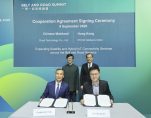
HONG KONG SAR – Media OutReach Newswire – 9 September 2026 – HKT (SEHK: 6823) – PCCW Global, the international telecommunications service provider under HKT, and Druid Technology Co., Ltd. (Druid Technology), a Chinese mainland provider of intelligent IoT solutions, today signed a Memorandum of Understanding (MoU) at the 11th Belt and Road Summit in Hong Kong. Under the MoU, the two companies plan to jointly deliver one-stop IoT solutions that combine satellite and hybrid connectivity in the Chinese Mainland, Hong Kong, Macao, and Belt and Road regions.

Frederick Chui, CEO, PCCW Global (left) and Li Guozheng, Founder and CEO, Druid Technology (right) signed an MoU at the Belt and Road Summit.

As a provider of intelligent IoT terminals and solutions, Druid Technology will leverage its expertise in device design, multi-network adaptation, data processing and platform integration, together with PCCW Global’s worldwide network services including roaming and cellular IoT to deliver one-stop, ready-to-deploy IoT solutions based on satellite and hybrid (satellite and cellular) connectivity. These solutions will support IoT applications such as remote tracking and monitoring for sectors including transportation, logistics, livestock farming and environmental management in remote locations and areas beyond the reach of conventional terrestrial networks.

Frederick Chui, CEO of PCCW Global, said: “PCCW Global is committed to delivering reliable connectivity and technology solutions through our extensive global network infrastructure. We are delighted to collaborate with Druid Technology and combine its expertise in intelligent IoT solutions with our own capabilities to strengthen our offering of one-stop IoT solutions for enterprise customers in both public and private sectors. Through this collaboration, we look forward to advancing the adoption of satellite and hybrid IoT solutions across Belt and Road markets, helping to meet the growing demand for reliable IoT connectivity and end-to-end solutions in remote and cross-border environments.”

Li Guozheng, Founder and CEO of Druid Technology, said: “We are pleased to become an integrated solutions provider for PCCW Global. By combining Druid Technology’s full-stack capabilities in intelligent IoT terminals, multi-system integration and physical world AI with PCCW Global’s leading global network infrastructure, we will provide customers with more comprehensive one-stop IoT solutions. We believe this collaboration will enable customers to deploy intelligent IoT applications more quickly and reliably, even in remote locations and other challenging environments.”

The solutions will cover terminal devices, network connectivity, data management and technical support. Leveraging its extensive global operational experience, PCCW Global will help accelerate the deployment of the solution across Chinese Mainland, Hong Kong, Macao, the Belt and Road regions and global markets.

Hashtag: #HKT #PCCWGlobal

The issuer is solely responsible for the content of this announcement.

About PCCW Global

PCCW Global is a leading digital infrastructure provider, empowering businesses with agile, scalable and secure connectivity solutions. By combining a best-in-class network with our award-winning on-demand platform Console Connect, we help businesses navigate the network complexities of the digital world with ease. With extensive reach across international markets, we make it simple to connect and move data between clouds, apps, data centres and devices. At the core of our business is a belief that automated, high-performance network infrastructure has the power to elevate business and society. For more information, visit www.pccwglobal.com.

Malaysia is considering Huawei’s Ascend 910C processors for a RM2 billion sovereign artificial intelligence project, potentially placing Chinese hardware at the centre of infrastructure designed to keep sensitive national data under domestic control.

The government is seriously evaluating Huawei’s AI accelerators for the initiative, although no final procurement decision has been announced and the number of chips under consideration remains unclear. The project would be operated by state-linked Telekom Malaysia, which was selected through a public tender and already works with Huawei on cloud infrastructure.

The deliberations put Malaysia at the centre of a widening contest between Washington and Beijing over the technology underpinning artificial intelligence. US officials have warned that use of Huawei’s Ascend 910C could violate American export-control rules, while Malaysia has maintained that technology decisions should serve its national interests and comply with applicable laws.

Huawei’s 910C is the company’s flagship AI accelerator currently available at scale. Malaysia is considering that product rather than the newer Ascend 950 series, which remains in limited production. Huawei has sought to expand sales of its AI systems beyond China as US restrictions continue to limit its access to advanced foreign semiconductor manufacturing technology.

Telekom Malaysia’s existing AI computing service uses Nvidia processors, highlighting the competing technology options facing Kuala Lumpur. The government is also discussing another tender process that could give Nvidia and other US suppliers a more direct opportunity to compete for the sovereign AI contract.

Prime Minister Anwar Ibrahim has repeatedly argued that Malaysia should build domestic technological capability rather than remain solely a consumer of systems developed overseas. His government formally established AI Malaysia Berhad under the Digital Ministry in July to lead its ambition of becoming an “AI Nation” by 2030 and to strengthen national AI development, governance and deployment.

Sovereign AI has become particularly important to the government because the proposed infrastructure is intended to process information that could include sensitive government, military and intelligence material. Kuala Lumpur wants such data to remain within Malaysia, reducing dependence on foreign-controlled computing environments and giving national institutions greater authority over storage and access.

Anwar has also questioned the implications of the US Cloud Act, which allows American courts in specified circumstances to compel US technology companies to provide electronic data even when it is stored abroad. Speaking to university students in April, he described the law as unreasonable while acknowledging the difficulty of challenging Washington on the issue.

US officials have raised separate security concerns about Huawei equipment being used to handle intelligence-related material, including information supplied by foreign governments. A State Department spokesperson said secure technology was essential to economic prosperity and warned that suppliers susceptible to government manipulation could pose risks to critical infrastructure, privacy, intellectual property and national security. The statement did not name China or Huawei.

Malaysia’s National Security Council officials are expected to visit Washington later this month for discussions that will include the technology issue. The talks come as the United States promotes American AI hardware, software and applications across developing markets and considers government-backed financing packages to strengthen the international position of US suppliers.

The current evaluation follows an earlier controversy in May 2025, when a deputy communications minister said a Malaysian AI initiative would deploy 3,000 Huawei Ascend chips. Her remarks were withdrawn shortly afterwards, and the Investment, Trade and Industry Ministry clarified that the project concerned was privately driven, not endorsed or coordinated by the government.

At the time, the ministry said any government AI infrastructure programme would require legal, operational and reputational due diligence. It also reaffirmed Malaysia’s commitment to applicable export-control laws while asserting the country’s sovereign right to formulate policy according to national interests.

Malaysia’s National AI Action Plan for 2026-2030 calls for responsible adoption, stronger domestic capabilities and globally competitive locally developed solutions. The programme links AI deployment to economic productivity, public-sector transformation and governance, placing infrastructure choices within a strategy.

North Korea’s newly appointed defence minister has warned that Pyongyang will take strong countermeasures if the United States and its allies provoke a new military confrontation, as Washington, Seoul and Tokyo conduct their five-day Freedom Edge exercise. Kim Song-gi, appointed defence minister late last month, issued the warning in a statement carried by the Korean Central News Agency on Monday. He said the US-led exercises were creating […]

Arabian Post Staff -Dubai Etihad Salam Telecom Company signed 29 strategic partnerships during LEAP 2026 in Riyadh, using the four-day technology gathering to widen its portfolio across connectivity, cloud services, cybersecurity, artificial intelligence and enterprise digital solutions. The company, known as Salam, said the agreements formed the centrepiece of its participation as a strategic sponsor and supported its shift from a traditional telecommunications provider towards an integrated […]

Global research explores how newer wealth, continued business ownership, and family stewardship influence philanthropic practices among Asia’s wealthiest families

  • Roughly 94 percent of Asia‘s wealthiest families are first- or second-generation wealth holders
  • Approximately 95 percent of Asia’s wealthiest families retain control of the businesses that generated their wealth

SINGAPORE – Media OutReach Newswire – 8 September 2026 – As private wealth continues to expand globally and an estimated US$74 trillion is expected to transfer between generations over the next 20 to 25 years, understanding how wealthy families approach philanthropy is becoming increasingly important. New research from The Bridgespan Group, based on analysis of 186 of the wealthiest individuals and families across 20 economies spanning Asia, Africa, Europe, and the Americas, sheds light on how the world’s wealthiest families give, what they fund, how they organise their philanthropy, and how they seek to create change.

Supported by Bridgespan’s Funders Council comprising the Institute of Philanthropy, The Rockefeller Foundation, and the Gates Foundation, and with contributions from the Financial Services Development Council and Wealth Management Institute, High-Impact Family Philanthropy: What Makes Family Giving Distinctive marks the third year of the High-Impact Philanthropy series, building on previous research on institutional philanthropy and corporate giving.

“This research comes at a pivotal moment for family philanthropy, especially as private wealth continues to grow,” said Xueling Lee, co-author and partner at Bridgespan. “Our research helps fill a knowledge gap on how the world’s wealthiest families organise their philanthropy and pursue impact, and finds distinguishing characteristics in Asia.”

In Asia, where founders and second-generation leaders often remain closely involved in the businesses that generated their wealth, philanthropy is frequently connected to broader questions of stewardship, business ownership, succession, and community engagement. The research finds that these differences are shaped by factors including the relative newness of wealth, continued business ownership, and the close connection between family, business, and philanthropy. Bridgespan’s research on corporate giving highlights this dynamic: founder- or family-linked companies account for 11 of Asia’s 20 largest corporate funders, compared with four among the world’s 20 largest corporate funders.

“Beyond the scale of their giving, many families bring a long-term perspective, deep personal commitment, and relationships across sectors built over decades,” said Brian San, secretary-general of the Institute of Philanthropy. “These qualities are particularly relevant in Asia, where family-owned businesses remain a powerful force and philanthropy is often closely connected to family stewardship, business leadership, and community engagement. The report highlights how these characteristics can help families catalyse collaboration, support innovation, and contribute to meaningful impact over time.”

“This research confirms what we have seen firsthand: family philanthropy has driven some of today’s boldest solutions and most pioneering research. These funders are uniquely positioned to take risks and build coalitions that can solve big, complex problems at their root,” said Deepali Khanna, senior vice president and head of Asia (division) at The Rockefeller Foundation. “Some of the work we are proudest of, like the Global Energy Alliance for People and Planet, started because family philanthropies were willing to commit early and jointly at a time when no single institution could have carried it alone.”

While the report finds that wealthy families around the world share many common philanthropic behaviours, it also identifies several characteristics that distinguish family philanthropy in Asia.

  • Asia’s wealth is newer: Approximately 94 percent of wealth held by Asia’s wealthiest families sits with first- or second-generation wealth holders, compared with roughly 85 percent in high-income economies outside Asia. The relative newness of wealth influences how wealth is held, the degree of family involvement in operating businesses, the availability of liquid assets, and the form philanthropy takes.
  • Asian families retain tighter control of their businesses: Approximately 95 percent of Asian families maintain control of the businesses that generated their wealth, compared with roughly 68 percent outside Asia. Where wealth remains closely tied to an operating business, philanthropic decisions often sit alongside broader considerations such as government relationships, succession planning, and reputation.
  • Families fund remarkably similar issues across regions: Education, health, and support for marginalised and vulnerable populations are among the top issues supported by wealthy families. In Asia, families are more likely to support elderly care, religion, and sports, while families from other regions more frequently fund science and technology initiatives, including those related to artificial intelligence.
  • Few families publicly report outcomes from their giving: More than 80 percent of families in Asia publicly report outputs from their giving, such as schools built or teachers trained, compared with just 45 percent of high-income families outside Asia. However, outcome reporting, such as learning gains or graduation rates, remains uncommon across all groups.

Beyond examining how families give, the companion report How the World’s Wealthiest Families Give explores approaches that help families translate their resources and influence into meaningful and sustained impact:

  1. Taking risks others cannot or will not: Families often have the autonomy to move from decision to deployment more readily than institutional or corporate funders. In Singapore, for example, the Lien Foundation made a decade-long push into early childhood development, a sector that few had championed when it began. Its sustained work alongside government and other stakeholders contributed to broader sector development over time.
  2. Facilitating collective action: Families with trusted relationships across sectors can bring together stakeholders who might not otherwise gather, helping fragmented efforts to evolve into coordinated action. In 2024, the Jollibee Group Foundation, led by Tony and Grace Tan Caktiong, partnered with the Provincial Government of Basilan, the Zuellig Family Foundation, and the League of Corporate Foundations to expand its school feeding programme. Together, the partnership supports the delivery of nutritious meals to nearly 25,000 children in 250 schools.
  3. Mobilising multiple types of capital: A family with authority across philanthropic and investment decisions may be able to move capital across different instruments with fewer external negotiations, board approvals, or fiduciary obligations to outside investors.

Download the full reports:

Hashtag: #TheBridgespanGroup #Bridgespan #CSR #ESG #Philanthropy #FamilyPhilanthropy #InstituteofPhilanthropy

The issuer is solely responsible for the content of this announcement.

About The Bridgespan Group

The Bridgespan Group () is a global nonprofit that collaborates with social change organisations, philanthropists, and impact investors to make the world more equitable and just. Bridgespan’s services include strategy consulting and advising, sourcing and diligence, and leadership team support. We take what we learn from this work and build on it with original research, identifying best practices and innovative ideas to share with the social sector. We work from locations in Boston, Delhi, Johannesburg, Mumbai, New York, San Francisco, Singapore, and Washington, DC.

IDScan. net is facing a growing wave of proposed class action lawsuits in Louisiana over allegations that its identity-verification systems were connected to a massive exposure of driver’s licence and other government-issued identification records. At least eight federal complaints had been filed against the New Orleans-based company by September 4 in the US District Court for the Eastern District of Louisiana, court dockets show. Plaintiffs include Marc […]

VISHNU RAJA
RYO YAMADA
HITORI GOTOH
IKUYO KITA