By R. Suryamurthy The most consequential question arising from Washington’s latest sanctions legislation is not whether the United States can impose a 100 percent tariff on countries buying Russian oil. It is whether India can continue to conduct an independent energy policy when access to its largest export market is increasingly being linked, directly or […]
By Dr. Gyan Pathak Deen Dayal Upadhyaya Grameen Kaushalya Yojna (DDU-GKY) will complete 12 years on September 25, 2026. It was launched by PM Narendra Modi led government with great fanfare on September 25, 2014 under the National Rural Livelihood Mission. The chief objective was to equip rural youth with relevant skills and access to […]
Best Things to Do in Bangkok This Golden Week: Discover Authentic Thai Cuisine, Luxury Shopping, Cultural Experiences and Iconic Chao Phraya River Attractions at ICONSIAM
BANGKOK, THAILAND – Media OutReach Newswire – 18 September 2026 – As Golden Week inspires millions of travelers across Asia to embark on international journeys, ICONSIAM, the global landmark on the Chao Phraya River, is inviting visitors to discover why Bangkok continues to rank among Asia’s most revisited destinations, offering an unrivaled blend of luxury shopping, cultural immersion, world-class gastronomy and distinctive riverside experiences in one destination.
ICONSIAM_ A Global Landmark Along the Chao Phraya River
As travel trends shift from traditional sightseeing toward more immersive and experience-led journeys, destinations that offer a strong sense of place and a diverse range of experiences are increasingly capturing the attention of global travelers. In this landscape, ICONSIAM embodies The Best of Thailand Meets the Best of the World, bringing together the country’s cultural heritage, creativity and craftsmanship with international luxury, gastronomy and lifestyle. Set along the historic Chao Phraya River, ICONSIAM offers visitors a distinctive perspective on contemporary Thailand, where the country’s traditions and global influences come together in one iconic waterfront destination.
SOOKSIAM_ Thailand’s first co-creation space to empower local communities from all 77 provinces of Thailand across the nation’s four regions
“Today’s travelers are looking for destinations that offer a deeper connection to the places they visit—experiences that are authentic, memorable and meaningful,” said Mrs. Suma Wongphan, Executive Vice President and Division Head of Marketing at ICONSIAM Company Limited. “Bangkok has a unique ability to inspire repeat visits because there is always another side of the city to discover. As a Global Experiential Destination, ICONSIAM is proud to contribute to this appeal by creating a platform where visitors can experience the many facets of Thailand while enjoying the standards and diversity of a truly international destination. This Golden Week, we look forward to welcoming travelers from around the world and giving them even more reasons to make ICONSIAM a highlight of their Bangkok journey.”
A Culinary Journey Through Thailand and Beyond
Food remains one of the strongest motivations for travelers returning to Bangkok, and ICONSIAM offers a diverse culinary journey that reflects the city’s reputation as one of Asia’s leading gastronomic capitals. At SOOKSIAM on the G Floor, visitors can experience the atmosphere of Thailand’s floating market where visitors can explore the flavors of Thailand’s four regions through authentic cuisine. Beyond SOOKSIAM, ICONSIAM’s culinary offering extends from the acclaimed flavors of Nara Thai Cuisine and ThongSmith to beloved Thai favorites such as After You, Cha Tra Mue and Pang Cha, giving visitors the opportunity to discover the diverse tastes and culinary traditions that continue to make Bangkok a compelling destination for food lovers.
Complementing its retail and dining offerings are ICONSIAM’s signature riverside attractions along the legendary Chao Phraya River. Visitors can enjoy sweeping waterfront views, experience the spectacular ICONIC Multimedia Water Features Show (G Floor), marvel at the iconic Alangkarn Waterfall (6th Floor), and discover art exhibitions, cultural showcases and immersive attractions throughout ICONSIAM.
Discovering Thailand Through Creativity and Craftsmanship
For travelers looking to bring home a meaningful piece of Thailand, ICONCRAFT located on the 4th and 5th floors, offers a carefully curated showcase of contemporary Thai craftsmanship, artisan products and creative enterprises from across the country. The immersive retail concept celebrates local creativity while providing visitors with unique souvenirs and design-led products that reflect Thailand’s rich cultural heritage and evolving creative landscape.
Discover ICONLUXE, Home to Global Fashion Houses, Fine Jewelry and Prestigious Watchmakers
At the center of this offering is ICONLUXE, one of Southeast Asia’s premier luxury hubs, home to an extraordinary collection of internationally renowned luxury houses and flagship boutiques, including Bottega Veneta, Celine, Dior, Gucci, Hermès and Loewe, alongside prestigious jewelry and watchmakers such as Breguet, Bvlgari, Cartier, Chopard, Chaumet, Jaeger-LeCoultre, Omega and Patek Philippe. Complementing its luxury offering is an extensive selection of international lifestyle and fashion brands, including ALO, LOFT, MUJI, UNIQLO, ZARA as well as leading Thai wellness and fragrance brands such as Antidotes, PANPURI and THANN. Together, these offerings underscore ICONSIAM’s ability to curate an exceptional mix of international luxury, contemporary lifestyle and distinctive Thai brands, creating a destination that continues to elevate Bangkok’s position as a leading global shopping and lifestyle capital.
A destination of ‘firsts’ flagship store and ‘bests’ that brings immediate global attention to Bangkok
At the heart of Bangkok’s dynamic riverside lies ICONSIAM, a destination of “firsts” and “bests” that continues to attract global attention to Thailand. Recognized as Thailand’s Firstism Leader, ICONSIAM has introduced some of the world’s most sought-after first-to-Thailand brands and experiences, including the country’s first flagship Apple Store, Thailand’s first Blue by Alain Ducasse, a Michelin-starred restaurant by Alain Ducasse, and the POP MART BANGKOK ICONSIAM FLAGSHIP STORE, and HAUS NOWHERE Bangkok, the first HAUS NOWHERE destination in Southeast Asia, home to TAMBURINS’ first Southeast Asia store and Thailand’s largest Gentle Monster store. Together, these globally recognized brands and flagship experiences continue to reinforce ICONSIAM’s position as a leading destination where international culture, innovation, fashion and lifestyle converge on Bangkok’s iconic Chao Phraya River waterfront.
Exclusive Golden Week Privileges for Tourists visiting ICONSIAM
To make the Golden Week experience even more memorable, ICONSIAM is launching “Discover Thailand at ICONSIAM“, an interactive social media campaign taking place from 25 September to 7 October 2026 at the ONESIAM Global Visitor Lounge (1st Floor). International visitors are invited to share their favorite moments at ICONSIAM, from food and cultural discoveries to shopping finds, local craftsmanship and iconic riverside experiences, by posting at least 2 original photos or 1 video on social media. Participants who complete the challenge will have the opportunity to play a capsule machine and receive complimentary Thai-inspired souvenirs, including ICONSIAM’s exclusive scarf, ICONCRAFT’s Thai-Inspired Mini Bag, handheld electronic fan, bracelet and a Siam Gift Card voucher. The campaign is designed to encourage travelers to explore, experience and share the many dimensions of Thailand that come together at ICONSIAM.
As Bangkok continues to attract travelers seeking meaningful, experience-led journeys, ICONSIAM stands at the heart of the city’s appeal, offering an unparalleled blend of shopping, dining, culture and riverside experiences. This Golden Week, visitors are invited to discover why Bangkok remains one of Asia’s most beloved and revisited destinations, and to experience the very best of modern Thailand in one extraordinary destination.
The model supports multimodal inputs including text, images and video, and generates high-fidelity 1080p videos of 5 to 20 seconds with natively synchronized audio
BEIJING, CHINA – Media OutReach Newswire – 17 September 2026 – HiDream.ai, an AI company specializing in foundation models and generative AI, announced the launch of HiDream-O1-Video-1.0, or HiDream V1, its native omnimodal video generation model.
Designed around a deeper understanding of creative intent and real-world physics, HiDream V1 supports multimodal inputs including text, images and video. It can generate high-fidelity 1080p videos ranging from 5 to 20 seconds, with enhanced narrative planning, character consistency, physical plausibility and audiovisual synchronization.
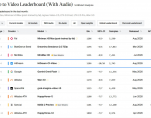
In its debut on two independent international benchmarks, HiDream V1 ranked No. 4 globally on the Artificial Analysis Image to Video Leaderboard (With Audio) and No. 8 on the Arena.ai Image-to-Video leaderboard, placing it among the world’s leading video generation models.
A Strong Debut on Two International AI Benchmarks
Artificial Analysis independently evaluates leading AI models through standardized and reproducible benchmark testing. Arena.ai uses anonymous head-to-head comparisons and user voting to assess model outputs. Together, the two platforms provide third-party perspectives on model performance based on both standardized testing and real-world user preferences.
HiDream V1’s results demonstrate its competitiveness across key dimensions including visual quality, prompt adherence, motion quality, narrative coherence and audiovisual coordination.
The global AI video generation market has become increasingly competitive, with models developed by Chinese teams—including Seedance and MiniMax H3—maintaining strong positions on international leaderboards. HiDream V1’s top-tier debut further expands China’s presence among the world’s leading video generation models.
“The next generation of video models will not be defined solely by higher resolution or longer duration,” said Yao Ting, Chief Technology Officer of HiDream.ai. “What matters is whether a model can genuinely understand a creator’s intent and how objects, actions and sounds interact in the real world. HiDream V1 was designed from the outset to represent text, video and audio within a unified framework. Our goal is to move video generation beyond simply looking sharp and moving smoothly toward understanding instructions, sustaining coherent performances and keeping sound aligned with visuals. Its performance on two independent international benchmarks provides encouraging validation of our native omnimodal approach.”
Upgrades in Visual Fidelity, Narrative Coherence and Character Consistency HiDream V1 introduces broad improvements in high-fidelity rendering, narrative continuity and character consistency. Rather than optimizing only for the quality of individual frames, the model is designed to maintain coherence across an entire video sequence.
Once characters, emotions, motivations and physical rules are placed within a continuous sequence, each element can affect the others. HiDream therefore uses a technical framework built around three stages: planning first, followed by joint generation, and then alignment through multimodal reward signals.
Under this approach, the model first plans the narrative and character states at a global level. It then jointly constrains visuals, movement and semantics during generation, before using multimodal reward signals to align visual quality, continuity and physical plausibility.
Native Omnimodal Architecture for Better Intent and Physics Understanding The central challenge in AI video generation is shifting from the quality of individual frames to a broader understanding of complex instructions, continuous motion and the rules governing the physical world.
User prompts often contain multiple layers of information, including characters, actions, settings, camera directions, dialogue and sound. To handle these requirements more effectively, HiDream V1 incorporates multimodal intent understanding and planning. Before generation begins, the model structures the user’s request across elements such as shot duration, setting, character state, movement, facial expression, composition, camera motion, dialogue and ambient sound.
Through this “understand, plan and generate” workflow, HiDream V1 plans narrative development and character states at a global level, while coordinating visuals, motion, semantics and audio during generation. This is designed to improve content completeness, character consistency and continuity between shots.
Physical reasoning is another core capability of HiDream V1. The model incorporates factors such as gravity, inertia, collisions, deformation, materials, lighting and spatial continuity into the generation process. As a result, object movement, character actions and environmental responses can more closely reflect the behavior of the real world.
This approach moves video generation beyond reproducing visual appearances and toward modeling how a dynamic world operates over time.
Content-Adaptive Video Duration Most current video generation models require users to specify a fixed duration in advance, forcing the content to fit within a predetermined time window. This can lead to unnecessary pauses after an action has ended or the use of slow motion to fill the remaining time.
HiDream V1 instead incorporates duration into its narrative planning process. Within a range of 5 to 20 seconds, the model can determine an appropriate video length based on how an event unfolds, how long an action takes to complete and the pacing required by the content.
The capability is not simply a matter of adding or removing frames. It is designed to make duration serve the narrative, producing more natural pacing and more complete sequences. Users can focus on describing the event and intended outcome, while the model plans the corresponding temporal structure.
Joint Modeling of Text, Video and Audio
Conventional AI video generation systems often follow a staged workflow in which visuals are generated first and sound is added afterward. This can lead to mismatches between lip movements, physical actions, ambient sound and sound effects.
HiDream V1 uses a native omnimodal architecture to jointly model text, video and audio signals. The three modalities constrain and inform one another within a single generation process. Visual motion influences sound timing, dialogue and sound effects contribute to the emotional tone of a scene, and text conditions guide the generation process throughout.
This unified approach is designed to improve synchronization across character performance, environmental changes and physical actions.
During post-training, HiDream uses Diffusion Reinforcement Learning and a multimodal reward model aligned with human perception and aesthetic preferences. Generated content is evaluated across multiple dimensions, including visual quality, semantics, motion, physical plausibility and sound, helping improve overall consistency and realism.
Completing HiDream’s Native Omnimodal World Model Portfolio HiDream V1 is not a standalone model. It is a core component of HiDream’s native omnimodal world model strategy.
Built on a unified UiT, or Unified Transformer, foundation, the company’s portfolio now comprises four major model families:
HiDream-O1-Image, for image understanding and generation;
HiDream-O1-Video, for dynamic content generation and temporal storytelling;
HiDream-O1-World, for 3D environment simulation and real-time interaction; and
HiDream-O1-Embodied, for spatial reasoning, action planning and feedback in embodied AI.
Rather than operating as four separate technology stacks, the models are designed to evolve from the same unified architecture. Together, they cover spatial understanding, temporal modeling, 3D interaction and embodied action, creating an integrated system for perceiving, understanding, generating, interacting with and acting upon the physical world.
HiDream’s models have previously achieved leading results on several independent benchmarks. HiDream-O1-Image 1.5, the commercial version of the company’s image model, ranked No. 2 globally and No. 1 among Chinese models on the Artificial Analysis text-to-image leaderboard, while its open-source edition also reached No. 2. HiDream-O1-World ranked No. 1 overall on WBench, a benchmark for interactive world models. HiDream-O1-Embodied achieved first-place results in the disturbance adaptation and spatial reasoning categories of RoboColiseum.
“We are not building four isolated model product lines,” said Dr. Mei Tao, founder and CEO of HiDream.ai. “We are building a native omnimodal system that shares a unified technical foundation and continues to evolve toward a deeper understanding of the real world. Competition among the next generation of foundation models will depend not only on improvements in individual capabilities, but also on whether different modalities can understand, generate and interact within a unified architecture.”
From understanding and generating the world to simulating and acting within it, the launch of HiDream V1 completes a key part of HiDream’s native omnimodal world model portfolio.
HiDream Completes Series C+ Financing
Alongside the launch of HiDream V1, HiDream announced the completion of a Series C+ financing round backed by New Micro Capital, Jiaozi Capital and ICBC Capital. The proceeds will support native omnimodal model research and development, product iteration, AI computing infrastructure and the expansion of industry applications.
New Micro Capital was jointly established by Shanghai New Micro Technology Group, Shanghai Science and Technology Venture Capital Group and its management team. The firm manages nearly RMB 10 billion in assets.
As the corporate venture capital arm of New Micro Technology Group, New Micro Capital is expanding its investments in artificial intelligence. Drawing on the group’s industrial capabilities in specialty integrated-circuit manufacturing, it seeks to advance collaboration across AI infrastructure, model technologies and end-user applications.
Jiaozi Capital is a wholly owned state-backed equity investment platform under Chengdu Jiaozi Financial Holding Group. The firm focuses on artificial intelligence and other strategic technology sectors, using long-term capital and industrial resources to accelerate technology commercialization and ecosystem development.
With the launch of HiDream V1, HiDream’s native omnimodal world model strategy is moving from a technical roadmap toward an integrated system supported by a unified foundation, a coordinated model portfolio and deployable product capabilities.
Availability
HiDream V1 is currently in internal testing and is expected to become available in the near future. Users can learn more at: https://hiharness.ai/
Hashtag: #HiDreamAI
The issuer is solely responsible for the content of this announcement.
About HiDream.ai
HiDream.ai is an artificial intelligence company focused on generative AI and native omnimodal world models. Built on its unified UiT architecture, the company’s model portfolio spans image generation, video generation, interactive world simulation and embodied intelligence. HiDream aims to develop AI systems capable of understanding, generating, simulating and acting upon the real world.
Leaderboard disclaimer: Rankings cited in this release reflect publicly available results at the time of publication and may change as participating models, evaluation data or platform methodologies are updated.
Global oil prices fell as much as 1.2 per cent on Thursday as Saudi Arabia offered additional crude cargoes to Asian refiners through Oman, easing immediate fears of a deeper supply squeeze after attacks forced the kingdom to shut its East-West pipeline. Brent crude dropped $1.24 to $104.59 a barrel in early Asian trading, while US West Texas Intermediate fell $1.14, or 1.1 per cent, to $101.29. […]
Huawei Technologies has laid out plans to launch two new artificial intelligence processors in 2027, strengthening its push to supply the computing power China needs as US export controls restrict access to Nvidia’s most advanced chips.
Rotating chairman David Wang said at Huawei Connect 2026 in Shanghai on Thursday that the company plans to release the 960DT in the first quarter of 2027 and the Ascend 960PR in the third quarter. The roadmap places Huawei’s next generation of accelerators at the centre of its effort to build domestic alternatives for training and running increasingly demanding AI models.
Huawei also unveiled the Ascend 960 SuperPoD and an upgraded version of its UnifiedBus interconnect technology, designed to link large numbers of processors so they can function as one computing system. The company said a combination of UnifiedBus and its Hi-ONE optical system could connect as many as 4,000 processors within a SuperPoD, extending high-speed optical links deeper into the machine.
The strategy reflects a broader shift towards system-level performance rather than relying solely on the capability of individual chips. Advanced AI workloads require thousands of processors to exchange data rapidly, making networking bandwidth, memory access and cluster efficiency increasingly important alongside raw chip performance.
Wang said Huawei has developed 11 semiconductors based on UnifiedBus technology for use across its large computing systems. Its biggest planned superclusters will be able to support up to one million AI processors, he said, while the company has already shipped more than 1,000 smaller supernodes to more than 370 customers.
Huawei did not identify those customers or give a detailed breakdown of shipments. It also did not provide independently verified benchmarks directly comparing the new 960-series chips with Nvidia’s leading accelerators, leaving questions over single-chip performance, software compatibility and manufacturing scale.
The company had previously said the Ascend 960 would offer twice the computing power, memory capacity, memory bandwidth and interconnect ports of the Ascend 950 generation. Huawei has also been developing the Atlas 960 SuperPoD and SuperCluster, with the larger system intended to combine more than one million neural processing units when it reaches the market.
Huawei’s current product roadmap also includes the Ascend 950DT, due in the fourth quarter of 2026. The company has said that processor will use its HiZQ 2.0 high-bandwidth memory, providing 144 GB of capacity and 4 terabytes per second of bandwidth. Those specifications are intended to support both model training and the decode stage of inference workloads.
US restrictions have limited China’s access to cutting-edge Nvidia processors and advanced semiconductor manufacturing equipment, giving domestic suppliers greater room to expand. Huawei has emerged as the most prominent of those suppliers, but Nvidia retains a major advantage through its CUDA software ecosystem and a broad global developer base.
Chinese AI developers have increasingly turned to domestic accelerators for inference, where trained models generate responses, even as many frontier laboratories continue to depend on Nvidia hardware for the most demanding training jobs. That split has made Huawei’s ability to improve both hardware and software a critical test of whether China can reduce its dependence on foreign computing infrastructure.
Huawei is also contending with shortages of high-bandwidth memory, a key component in AI accelerators. The company has designed memory for some newer Ascend products, but supply constraints across the industry have increased costs and complicated efforts to scale production quickly enough to meet demand.
The group is seeking to offset those limitations through architectural changes, advanced packaging, optical networking and tighter integration between chips, systems and software. Its SuperPoD approach is intended to compensate for weaker performance from individual processors by allowing much larger numbers of chips to work together with lower latency.
India’s Securities and Exchange Board has given arbitrage mutual funds greater flexibility to manage hedged equity positions around the new closing auction, a step aimed at increasing institutional liquidity in the end-of-day price-setting mechanism.
The regulatory relaxation allows fund managers more room to adjust the cash and futures legs of arbitrage trades while participating in the Closing Auction Session, people familiar with the change said. The move is intended to encourage funds that collectively manage a large pool of equity-linked assets to place orders in the auction rather than largely completing transactions beforehand.
The change addresses a central weakness that has emerged since the auction system was introduced on August 3 for shares with futures and options contracts. Trading during the closing window has at times been thin, leaving prices vulnerable to sharp moves when large buy or sell orders enter a relatively shallow order book.
Arbitrage funds are viewed as a potentially important source of balancing liquidity because they hold shares in the cash market while maintaining offsetting short positions in futures. That structure can enable them to sell stock when the closing auction is dominated by buyers, or buy when supply is heavy, without necessarily taking a directional market view.
SEBI has not issued a public circular detailing the latest operational flexibility. Existing mutual-fund rules require arbitrage schemes to maintain at least 65% of assets in equity and equity-related instruments, while their strategy is built around offsetting positions designed to capture differences between cash and derivatives prices.
The regulator’s intervention comes as it separately reviews the mechanics of the Closing Auction Session after volatile expiry-day moves raised concerns over price discovery and derivatives settlement. A consultation paper issued on September 12 proposed changes to the way settlement prices are determined when futures and options expire.
One option under consideration would blend the volume-weighted average price from the final 30 minutes of continuous trading with prices established in the closing auction. Another would temporarily retain the earlier 30-minute volume-weighted average methodology for derivatives settlement while the auction develops deeper liquidity.
SEBI has also proposed restrictions on order cancellations outside a specified range around the reference price, a shorter post-auction derivatives trading window and changes to the publication of indicative index closing levels during the auction. Public comments on those proposals are open until October 3.
The Closing Auction Session replaced the previous method of setting closing prices for eligible stocks through the volume-weighted average of trades during the last 30 minutes of normal trading. Under the new framework, eligible cash-market stocks move into an auction process late in the session, while equity derivatives continue trading until 3.40 pm.
The auction is intended to concentrate end-of-day orders and produce a closing price based on the level at which the greatest quantity of shares can be matched. Similar mechanisms are used in several major global markets, particularly for large institutional orders and benchmark-tracking flows.
Early trading under the system, however, produced unusually wide gaps between cash-market closing prices and futures values on some days. Those differences caused sharp one-day movements in the net asset values of arbitrage funds because the cash and derivatives legs of their portfolios were marked using prices generated under different trading conditions.
Fund managers and market participants have argued that broader institutional participation is essential if the auction is to deliver stable price discovery. Arbitrage funds, with assets of roughly ₹3.5 trillion according to industry estimates, represent one of the largest pools capable of supplying two-way liquidity without relying on outright directional bets.
The mutual-fund industry has also examined changes to futures valuation that would better align derivatives prices with the auction-determined cash close. One proposal would derive a theoretical futures closing value from the final cash-market price and the prevailing cash-futures spread, reducing temporary valuation mismatches in arbitrage portfolios.
The US Senate failed to advance the Digital Asset Market Clarity Act on Tuesday, halting the cryptocurrency industry’s strongest attempt to secure a comprehensive federal market structure framework and pushing the regulatory burden back towards existing agencies. The cloture motion on the measure, H. R. 3633, was rejected 49-50, according to the Senate’s official roll call. Sixty votes were required to end debate on the motion to […]
By TN Ashok The 18th BRICS Summit, held at Bharat Mandapam in New Delhi on September 12–13, 2026, was never going to escape Washington’s shadow — and it didn’t. Even as Prime Minister Narendra Modi steered eleven member states toward a unanimously adopted New Delhi Declaration that pointedly avoided naming the United States, President Donald […]
WRISE Prestige records over300% revenue growth in HK since end-2024, expands to more than 400 IWCs and advances a new professional standard combining human expertise, independence and AI
Assets under management increased by 927%, revenue grew by 301% and the number of clients increased by 382% compared with the end of 2024.
WRISE Prestige’s network has expanded to more than 400 Independent Wealth Consultants (IWCs) in Hong Kong.
The broader WRISE ecosystem has added capabilities spanning family office and wealth planning, corporate advisory, trust and legacy planning, structured products, international insurance and AI labs, while the IWC proposition evolves from Independent Wealth Consultant to Intelligent Wealth Consultant.
HONG KONG SAR – Media OutReach Newswire – 15 September 2026 – WRISE Prestige, a core business of WRISE Group serving affluent and high-net-worth clients through a network of wealth consultants, is set to celebrate its second anniversary in Hong Kong on 16 September, marking two years of rapid growth and the next chapter in its approach to wealth advisory.
Since the end of 2024, WRISE Prestige in Hong Kong has recorded 927% growth in assets under management (AUM), 301% growth in revenue and a 382% increase in the number of clients. Its Hong Kong network has also grown to more than 400 IWCs, reflecting rising demand for independent, people-led advice and broader access to integrated wealth solutions.
Two Years of Growth and an Expanding Wealth Ecosystem
Over the past two years, WRISE Prestige has broadened its role within the WRISE ecosystem, connecting clients with capabilities across different aspects of wealth and advisory. These include WRISE Capital for corporate finance and advisory services, WRISE Private for family office solutions and sophisticated wealth planning, and WRISE Master Trust for wealth structuring and legacy planning.
WRISE Prestige has broadened its solution capabilities in parallel, expanding its insurance spectrum from local offerings to Bermuda solutions and connecting clients with investment, banking, protection, trust and corporate advisory resources.
Client demand has become increasingly diverse, spanning liquidity, income, diversification, downside management, succession and cross-jurisdictional wealth planning. Structured products may be considered as part of client solutions where suitable, depending on risk tolerance and circumstances, illustrating the need for tailored risk-return outcomes rather than one-size-fits-all distribution.
The Group’s expanding regional footprint, including presences in Taipei, Shenzhen, Changsha, Chengdu, Wuxi and Vancouver, further strengthens WRISE Prestige’s ability to connect clients and wealth consultants with capabilities across markets.
From Independent Wealth Consultant to Intelligent Wealth Consultant
The evolution comes as Hong Kong’s wealth management industry reaches a new scale. According to the Securities and Futures Commission, AUM in Hong Kong’s private banking and private wealth management business rose 24% year-on-year to HK$12.9 trillion at the end of 2025.[1]
As wealth grows, the needs behind it are becoming increasingly complex. Clients require holistic advice connecting investments and protection with family governance, business interests, succession and intergenerational planning. They increasingly value sound judgement, independence, expertise, trust and connectivity to a wider wealth ecosystem.
WRISE Prestige believes this is expanding the role of the wealth consultant. Building on the foundations of independent wealth advisory, the IWC approach puts the individual at the centre, considering their family, business, aspirations, risks and legacy, while drawing on a broader ecosystem to address wealth more holistically. Within this approach, independence refers to an open-architecture model that gives wealth consultants the flexibility to consider solutions from a broad range of financial institutions and providers, rather than being tied to a single institution or product. This approach does not imply the absence of conflicts of interest; any applicable conflicts are managed and disclosed in accordance with relevant policies and regulatory requirements.
IWC is now entering its next chapter, evolving from Independent Wealth Consultant to Intelligent Wealth Consultant. The new proposition builds on the open-architecture approach, trusted human relationships and professional expertise that have defined IWC, while bringing together the research, analytical and efficiency capabilities of AI.
Technology can enhance how wealth consultants analyse information, generate insights and serve clients, while human judgement, accountability and relationships remain at the heart of wealth advice. The goal is not to replace wealth consultants with AI, but to empower them with greater capabilities to support better-informed, more holistic wealth decisions.
As part of this evolution, WRISE Prestige is also strengthening the professional development pathway for its IWC network through QLC, a structured professional assessment covering four specialist areas relevant to the evolving needs of high-net-worth clients: Family Office, Trust, Offshore Insurance and Advanced Investment. IWCs who complete the QLC examination will earn the designation of IWC-Certified, establishing a common foundation of professional knowledge and standards across the network. Following certification, IWCs can continue to develop through pathways recognising both professional expertise and business performance.
Henry Shin, CEO of WRISE Prestige Hong Kong, said: “The wealth management industry has continuously evolved, from traditional institution-led models, to the emergence of independent financial advice, and now towards a new generation of wealth advisory. We believe the next stage of this evolution is intelligence.
Intelligent Wealth Consultant brings together the independence and trust that have always been fundamental to wealth advice with professional expertise, human judgement, and the insights and analytical capabilities of artificial intelligence. This is not about replacing the human element with technology, but about empowering our consultants with technology to deliver deeper insights and help clients make more informed and holistic wealth decisions.
At WRISE Prestige, we aspire to take this evolution one step further, not simply to witness the transformation of our industry, but to work alongside the industry in helping shape best practices for the next generation of wealth advisory.”
Building the Next Chapter of Wealth Advisory
Looking ahead, WRISE Prestige expects wealth management to become more connected, technology-enabled and accessible. Its focus will remain on combining technology with human judgement and relationships, using technology to improve connectivity, insight and scalability while maintaining appropriate professional and regulatory standards.
Over the next two to three years, WRISE Prestige plans to expand its business-to-business capabilities and advance an Open-EAM architecture that connects IWCs, external asset manager partners and clients through the broader WRISE ecosystem. The architecture is intended to make it easier for wealth consultants and partners to access specialist capabilities across wealth management, banking, investments, protection, trust and corporate advisory services, supported by technology and the WRISE platform.
Through this approach, WRISE Prestige aims to create greater connectivity and scale for wealth consultants, more integrated choices for clients, and a stronger professional ecosystem for Hong Kong and the region. Its ambition for the next chapter is not only to grow its own platform, but also to contribute to the continued development of wealth advisory across the industry.
Hashtag: #WRISEGroup
The issuer is solely responsible for the content of this announcement.
About WRISE
WRISE is one of Asia’s fastest-growing financial firms, driven by strategic acquisitions of companies with deep expertise and solid foundations. With a strong presence across key financial hubs including Singapore, Hong Kong, Dubai, Tokyo, Shanghai, Shenzhen, Changsha, Chengdu, Wuxi, Taipei and Vancouver, WRISE is home to one of the largest networks of independent qualified advisors. With over 600 employees located globally, supported by an ecosystem of over 200 financial intermediaries and access to eight booking centres worldwide, WRISE ensures unparalleled service and expertise in navigating today’s financial landscape.
WRISE Group of companies include WRISE Wealth Management (Singapore), WRISE Wealth Management (Hong Kong), WRISE Wealth Management Middle East Ltd (DIFC, regulated by the DFSA), WRISE Prestige (Hong Kong), WRISE Prestige Securities (Hong Kong), WRISE Prestige Asset Management (Hong Kong), WRISE Capital (Hong Kong), WRISE Financial Services (Hong Kong), and affiliates including WeWrise Services.
BRICS leaders have placed development priorities of emerging economies at the centre of their New Delhi agenda, endorsing stronger representation for the Global South while advancing cooperation on trade, technology, finance and sustainable growth.
Chinese President Xi Jinping used the 18th BRICS Summit to argue that countries should pursue development paths suited to their own national conditions, a message that overlapped with the summit’s broader emphasis on policy autonomy, inclusive growth and reform of global institutions.
Addressing the first leaders’ session on September 12, Xi marked 20 years of BRICS cooperation and said members had strengthened themselves through unity while preserving independence in choosing their economic and social models. He described BRICS as an increasingly important platform for emerging markets and developing countries.
The summit’s New Delhi Declaration gave that theme wider institutional form. Leaders called for a more representative international order, greater participation by developing countries in global decision-making and reforms to institutions including the United Nations, World Trade Organization and international financial architecture.
The declaration also reflected the diversity within the expanded grouping. Rather than prescribing a single model of development, BRICS leaders stressed national circumstances, differing capacities and the need for policy space, particularly in areas such as energy transition, industrialisation and climate action. That approach broadly matched Xi’s argument that development strategies should reflect domestic conditions rather than external templates.
Xi sought to extend the idea into technology policy. He proposed an initiative on artificial intelligence-enabled industrialisation, deeper cooperation in research and applications, and stronger industrial and supply-chain links. China also promoted open-source AI collaboration and international platforms intended to improve access to emerging technologies for developing economies.
Other leaders framed similar priorities through their own national perspectives. Prime Minister Narendra Modi emphasised resilience, innovation, cooperation and sustainability, the four themes of India’s 2026 BRICS chairship, and called for solutions developed within the grouping to serve a wider range of developing countries. He also urged members to translate summit commitments into practical programmes.
BRICS members agreed on measures spanning digital cooperation, food and energy security, health, trade facilitation and the use of local currencies in cross-border transactions. The declaration supported stronger payment connectivity while stopping short of endorsing a common BRICS currency.
The economic agenda also underlined the practical test facing the grouping. Members backed use of national currencies in trade and investment, stronger cooperation through the New Development Bank and efforts to improve financial resilience. Such measures are intended to widen financing options for developing economies without committing members to a single monetary framework or common currency.
The expanded bloc now brings together countries with sharply different political systems, strategic alignments and economic structures. That breadth gives BRICS a larger claim to represent developing-country concerns, but it also limits how far members can converge on detailed policy prescriptions. Analysts have noted differences over whether the group should remain primarily an economic and development forum or assume a stronger geopolitical role.
Those tensions were visible alongside the development agenda. Leaders opposed protectionism and unilateral economic measures, supported a stronger multilateral trading system and called for reforms that would increase the voice of developing countries. At the same time, members avoided turning the summit into a unified ideological platform, relying instead on consensus language broad enough to accommodate competing interests.
Xi’s second summit intervention on September 13 placed a “people-centred” development philosophy within a wider call for Global South cooperation. He urged progress on the UN Sustainable Development Goals, improvements to global climate governance and a consensus-based framework for governing artificial intelligence.
China’s approach also carries strategic implications. Beijing has increasingly used BRICS and other multilateral forums to promote its views on development, sovereignty and global governance. Some members share its criticism of unequal representation in international institutions, while others remain cautious about allowing BRICS to become identified with any single country’s geopolitical agenda.
Bitcoin faces renewed downside warnings after Bloomberg Intelligence senior commodity strategist Mike McGlone argued that a stock-market correction and tighter US monetary policy could drive the cryptocurrency sharply lower, potentially towards $10,000. McGlone’s latest bearish case centres on Bitcoin’s failure to establish a sustained break above $80,000, its increasing sensitivity to equities and the prospect that higher interest rates could pressure speculative assets. Bitcoin was trading near […]
Commerce and Industry Minister Piyush Goyal has urged BRICS members and partner countries to link payment systems, expand local-currency trade and open markets more widely as India presses for stronger economic integration across the grouping.
Addressing the BRICS Business Forum in New Delhi, Goyal said greater connectivity between national payment networks, including systems modelled on India’s Unified Payments Interface, could lower friction in cross-border commerce while supporting wider use of members’ own currencies.
His proposals were aligned with the economic agenda carried into the BRICS summit, where leaders backed further work on facilitating trade and investment settlements in local currencies and improving interoperability between payment systems. The approach stops short of creating a common BRICS currency and instead focuses on practical links between existing financial infrastructures.
BRICS leaders encouraged the New Development Bank to expand local-currency financing and diversify its funding base, complementing efforts to make cross-border payments faster, cheaper and safer. Officials have stressed that the objective is not a single currency, but greater use of national currencies where commercially practical and mutually agreed.
Goyal said UPI now handles more than 250 billion transactions annually and is accepted in 11 countries. He urged BRICS economies to explore linking their payment networks, promote trade in each other’s currencies and expand digital commerce alongside cooperation in emerging technologies.
The minister coupled the payments proposal with a call for easier market access. He said BRICS economies should open their markets to one another’s products, including raw materials and critical minerals, while simplifying regulatory procedures and accelerating the clearance of consignments.
Goyal argued that resilient supply chains required two-way trade rather than dependence on one-sided flows. He said non-tariff measures impose higher export costs than tariffs in 88 per cent of countries, making regulatory obstacles and customs delays a central concern for companies seeking to trade across BRICS markets.
The push comes as intra-BRICS commerce has expanded sharply. Commerce Secretary Rajesh Agrawal said trade among BRICS countries rose from $84 billion in 2003 to nearly $1.2 trillion in 2024, underscoring both the scale of the bloc’s market and the potential gains from reducing transaction and financing costs.
Agrawal also highlighted the global trade-finance gap, estimated at about $2.5 trillion, and said BRICS should improve access to affordable working capital for exporters. The Jaipur Consensus, agreed by BRICS trade ministers in August, provides a basis for examining a common mechanism to help smaller businesses obtain finance against confirmed orders and reliable payment records.
Trade ministers have also advanced a 2026-2030 action plan on global value chains, including BRICS Connect, business-to-business partnerships, digital trade documentation and possible platforms for strategic supply chains and investment promotion. These measures form part of a broader effort to make trade flows more diversified and less vulnerable to disruption.
Goyal identified agriculture, pharmaceuticals, engineering, electronics, automobiles, auto components and services as sectors with scope for deeper cooperation. He called for closer links between startup ecosystems and urged agri-tech companies to work jointly on solutions for farmers and food security.
Services trade was another priority. Goyal said BRICS members should make it easier for professionals to move across borders and work towards greater recognition of professional qualifications, arguing that services markets needed to become more genuinely accessible.
External Affairs Minister S. Jaishankar, speaking at the same forum, said supply-chain connectivity, trade facilitation and innovation had become central to BRICS cooperation. He also pointed to digital public infrastructure, artificial intelligence, financial technology and advanced manufacturing as areas offering opportunities alongside questions of standards, security and trust.
Russia’s Economic Development Minister Maxim Reshetnikov separately supported stronger alternative payment arrangements, saying the share of Russia’s export settlements conducted in dollars and euros had fallen sharply over the past three years. He also promoted work on a proposed BRICS grain exchange and closer cooperation among special economic zones.
Chinese President Xi Jinping and Prime Minister Narendra Modi agreed to strengthen economic, transport and people-to-people links while preserving peace along their disputed frontier, using Xi’s first visit to India in seven years to push forward a cautious repair of bilateral relations.
The two leaders met on Saturday on the sidelines of the BRICS summit in New Delhi and welcomed what the Prime Minister’s Office described as steady progress in ties since their meeting in Tianjin in August 2025. They agreed that relations should be approached from a strategic and long-term perspective and that differences should not be allowed to become disputes.
Modi said peace and tranquillity in border areas remained an essential basis for further development of the relationship. He called for both sides to observe existing agreements and understandings on frontier issues and said engagement should be guided by “mutual respect, mutual sensitivity and mutual interest”.
Both leaders committed themselves to seeking a fair, reasonable and mutually acceptable settlement of the boundary question, while expanding cooperation in areas where their interests converge. They also backed stronger cultural exchanges, business links and mobility, alongside efforts to resolve economic frictions.
Trade featured prominently in the discussions. The two sides agreed on the need to address concerns over the structural trade imbalance, supply-chain issues and access to each other’s markets. Bilateral trade reached a record $155.6 billion in 2025, while India’s imports from China were about $132 billion, leaving a large deficit that New Delhi has repeatedly sought to narrow.
The meeting marked Xi’s first trip to India since 2019, when he travelled to Tamil Nadu for an informal summit with Modi. Relations deteriorated sharply after the 2020 military confrontation in eastern Ladakh, including the Galwan Valley clash that killed 20 soldiers from India and four from China.
A disengagement agreement reached in October 2024 helped end key points of the military standoff and opened the way for higher-level political contacts. Modi and Xi then held a substantive bilateral meeting during the BRICS summit in Kazan that month, followed by another meeting in Tianjin in August 2025.
Diplomatic and military mechanisms have since been revived. At the 25th round of Special Representatives’ talks in Beijing on August 25, National Security Adviser Ajit Doval and China’s Wang Yi agreed on eight measures covering border management, military communication, boundary negotiations, trade routes, pilgrimage arrangements and cooperation on trans-border rivers.
Among those steps were two additional channels for military hotlines in the eastern and middle sectors and two additional meeting points for senior commanders. The two sides also agreed to continue work towards a framework for settling the boundary dispute and to use existing diplomatic and military channels to deal promptly with incidents along the Line of Actual Control.
Practical links have also begun returning. Direct passenger flights have resumed, business visa processing has improved and the Kailash Mansarovar pilgrimage has restarted, while three traditional border trading points have reopened. Those measures have not removed the deeper trust deficit, but they have restored channels that were largely frozen after 2020. Officials on both sides have indicated that further easing will depend on predictable border management and progress on commercial concerns over the coming months.
Despite the thaw, major differences remain. Large troop deployments continue along sections of the Himalayan frontier, and the boundary itself has not been settled. Economic engagement is also constrained by investment screening, regulatory barriers, visa delays and security concerns affecting sectors considered sensitive by either government.
Xi’s visit nevertheless gave both governments an opportunity to demonstrate that political contacts are becoming more regular after years of strained relations. Beijing has repeatedly said the two countries should view each other as partners rather than rivals, while New Delhi has maintained that normal relations require durable peace at the border.
By R Suryamurthy The latest BRICS financial agenda is ambitious enough to suggest that the grouping is no longer content merely to complain about the inequities of the global economic order; it wants to build pieces of an alternative. But ambition, particularly in a grouping as diverse as BRICS, is cheap. The harder question is […]
Thailand has placed 17 strategic industrial projects worth 121 billion baht on an accelerated approval track while introducing added tax incentives intended to encourage technology-focused companies to list on domestic capital markets.
The Board of Investment approved the measures at a meeting chaired by Deputy Prime Minister and Finance Minister Ekniti Nitithanprapas, expanding the Thailand FastPass mechanism and launching a BOI-to-IPO programme with the Securities and Exchange Commission and the Stock Exchange of Thailand.
The 17 projects, submitted by 15 companies, are expected to create more than 14,000 jobs. Electronics and electrical manufacturers account for 10 projects worth 83.92 billion baht, close to 70 per cent of the latest batch, according to the BOI.
Two processed-food projects represent investment of 24.34 billion baht, two pet nutrition projects total 8.80 billion baht, and three precision machinery and automotive component projects amount to 4.36 billion baht.
The additions take the FastPass portfolio to 42 strategic projects across three rounds, with planned investment exceeding 344 billion baht and projected employment of more than 27,000 people. The scheme uses service-level agreements across state agencies to shorten licensing timelines, address approval bottlenecks and move projects more quickly from investment applications to construction and operation.
The first two FastPass rounds covered 25 projects from 23 companies worth more than 223 billion baht and were expected to generate over 13,000 jobs. All 25 have received investment-promotion approval, 19 have been issued investment certificates and 11 have completed all required permits within the prescribed service-level deadlines. Actual investment by projects in the programme has exceeded 21 billion baht.
Alongside the approval drive, the BOI said it was shifting the way it evaluates investment promotion, placing greater weight on realised investment, domestic value added, links with small and medium-sized suppliers, high-skilled employment, research and development, technology transfer and capital-market participation.
The policy overhaul also narrows support for activities that contribute limited local value, with the BOI saying incentives will increasingly favour advanced manufacturing, technology transfer and deeper integration of domestic vendors. New operational indicators will measure how many approved projects become investments and how quickly agencies process approvals.
Narit said the policy seeks to lift investment to 30 per cent of gross domestic product, support annual economic growth above 3 per cent and improve Thailand’s competitiveness ranking. Those objectives are government targets rather than assured outcomes and will depend on investment execution, productivity gains and economic conditions.
BOI secretary-general Narit Therdsteerasukdi said the agency was moving towards measuring the quality and domestic value generated by investment rather than focusing mainly on application volumes. He said the government wanted targeted measures in strategic sectors to support higher investment and productivity.
The BOI-to-IPO programme is designed to help promoted companies, particularly businesses in sectors classified as part of the New Economy, raise capital through Thailand’s exchanges and expand their operations. The SEC has shortened its IPO approval process, while the stock exchange is easing certain market-capitalisation and operating-track-record requirements for qualifying New Economy companies.
A special listing pathway is also being provided for companies promoted by the BOI or the Eastern Economic Corridor, linking investment incentives with access to equity financing.
Promoted companies that list on the Stock Exchange of Thailand, the Market for Alternative Investment or the LiVEx board can qualify for additional tax relief. SET-certified New Economy companies may receive up to three additional years of corporate income-tax exemption, or a 50 per cent reduction for five years.
Other promoted companies that list can receive up to two additional tax-free years, or a 50 per cent reduction in corporate income tax for three years, subject to the programme’s conditions.
Narit said the policy was intended to allow companies that had established successful operations in Thailand to finance new plants and production lines, invest in research and technology, and expand overseas while retaining Thailand as a business base.
Arabian Post Staff -Dubai UAE President Sheikh Mohamed bin Zayed Al Nahyan has called for stronger private-sector cooperation with Germany after attending a major business forum in Munich where companies from the two countries signed 30 agreements and commercial partnerships worth about €9.66 billion. Sheikh Mohamed told executives and investors at the Germany-UAE Business Forum on Friday that businesses would play a vital role in advancing the […]
President Lee Jae Myung’s approval rating has fallen to a new low as opposition hardens against sending South Korean military assets to the Strait of Hormuz, intensifying pressure on his government while Washington urges Seoul to contribute to maritime security.
A National Barometer Survey released Thursday showed 43 per cent of respondents approved of Lee’s handling of state affairs, down seven percentage points from two weeks earlier, while 48 per cent disapproved. It was the first time disapproval exceeded approval in the biweekly poll since Lee took office in June 2025.
The same survey found 45 per cent opposed deploying military assets, including maritime patrol aircraft and support ships, to Hormuz, compared with 36 per cent who supported such a move. Opposition was strongest among respondents in their 40s and 50s and among supporters of Lee’s ruling Democratic Party, underscoring the domestic political risk surrounding any military contribution.
Seoul has repeatedly said no final decision has been made. Seong Ghi-hong, senior presidential secretary for public relations and communication, said Wednesday that the government had not finalised its policy and was “cautiously assessing” the issue. A Defence Ministry inspection team sent to the United Arab Emirates to examine conditions returned on Thursday.
The government has described the mission as an assessment rather than preparation for deployment. National Security Adviser Wi Sung-lac also said talks between Lee and French President Emmanuel Macron in Paris focused on possible contributions to maritime security and freedom of navigation, not on an agreement to send troops.
The debate has sharpened as US President Donald Trump presses allies to help secure Hormuz during the prolonged conflict with Iran. Trump has publicly criticised Seoul over its reluctance to support US efforts in the waterway, which carries a major share of the energy supplies used by South Korea and other Asian economies.
South Korean officials have denied that Washington imposed a deadline for a deployment. The presidential office has said Seoul is discussing practical ways to support peace, stability and free navigation with international partners, while weighing military readiness, legal requirements and the risks of deeper involvement in the conflict.
Any dispatch of troops would require approval from the National Assembly, where Lee’s Democratic Party holds a majority. That gives the government procedural room but does not remove the political cost of acting against a sizeable share of public opinion, including voters aligned with the ruling camp.
A separate Hangil Research survey conducted from September 5 to 7 found 47.1 per cent opposed deployment and 43 per cent supported it, a difference within the poll’s margin of error. Opposition rose to 55.5 per cent among Democratic Party supporters and 62.4 per cent among self-described liberals.
Lee’s broader ratings have also weakened for domestic reasons. A Realmeter survey released Monday put his approval at 37.4 per cent, down 1.5 percentage points over the week and the eighth consecutive weekly decline. The pollster linked the fall primarily to disputes over a cabinet reshuffle and housing-related policy changes rather than the Hormuz question alone.
Gallup Korea last week placed Lee’s approval at 40 per cent, with 51 per cent disapproving. Respondents who viewed him negatively most often cited real estate policy, followed by concerns about the economy and livelihoods and dissatisfaction with personnel appointments.
The Hormuz issue nevertheless adds a foreign-policy dilemma at a sensitive moment. South Korea depends heavily on imported energy, and disruption in the strait has already increased the strategic importance of keeping shipping routes open. At the same time, Iran has warned Seoul against military participation, saying such a move could be viewed as siding with US military action.
Shipping through Hormuz remains sharply below pre-war levels as the United States and Iran continue military and economic pressure around the waterway. The conflict has pushed oil prices higher and complicated supply planning across Asia, giving Seoul a direct economic interest in restoring safer passage without becoming drawn further into hostilities.
By R. Suryamurthy India’s trade with BRICS has expanded dramatically, but the numbers reveal an uncomfortable imbalance beneath the rhetoric about a multipolar world and alternative financial architecture. Between FY2021 and FY2026, India’s total merchandise trade with the 11-member grouping more than doubled, from $203.1 billion to $417.5 billion. Yet the expansion was overwhelmingly […]
Nasdaq has invested $100 million in Payward, the parent company of cryptocurrency exchange Kraken, extending a relationship that already spans tokenised equities and digital-market infrastructure. The investment places one of the world’s largest exchange operators directly on Payward’s shareholder register and adds a financial dimension to a strategic partnership announced earlier this year. Payward operates Kraken alongside businesses including NinjaTrader, Breakout, xStocks and CF Benchmarks, using a […]
Canada has used its lead-nation role at Poland’s MSPO arms fair to push its defence industry more forcefully into European markets, pairing a large trade mission with a renewed defence agreement with Warsaw. Defence Minister David McGuinty and International Trade Minister Maninder Sidhu led Ottawa’s presence at the International Defence Industry Exhibition in Kielce, where Canada was designated the 2026 lead nation. The government said its mission […]
Artificial intelligence is widening the investment divide between the United States and Europe, with American companies absorbing the overwhelming majority of global AI venture capital while European firms continue to face shortages of large, late-stage funding. OECD data show US-based AI companies attracted about $194 billion in venture capital in 2025, roughly 75% of worldwide AI deal value. Companies across the EU27 drew $15.8 billion, or 6%, […]
Growth reflects Prudential’s continued investment in adviser development and career progression
HONG KONG SAR – Media OutReach Newswire – 10 September 2026 – Prudential plc (“Prudential”) has retained its No. 2 position among multinational companies in the 2026 Million Dollar Round Table (MDRT) rankings. First-time qualifiers increased 14 per cent year-on-year, reflecting continued momentum in Prudential’s agency business and the impact of its strategy to build a more professional and productive agency force across Asia and Africa.
This momentum is reflected across Prudential’s markets:
Indonesia has held the No. 1 in-country ranking for more than a decade and continues to have the largest number of MDRT members in the market.
Hong Kong climbed three places in MDRT rankings to No. 3 globally and No. 2 in-country, with the second-highest number of Top of Table (TOT) and Court of Table (COT) qualifiers.
Singapore ranked No. 1 in-country for TOT qualifiers, with an 83.8 per cent MDRT member retention rate, and sits in the global top three. It also led the 2026 MDRT Culture of Excellence Awards, with 29 Agency Leader award recipients from a total of 68 winners worldwide.
In Africa, Prudential remains the only insurer represented in the MDRT Global Top 100 company rankings in the last three years, with Nigeria and Ghana each ranked No. 1 in-country.
In the Chinese Mainland, Prudential grew MDRT qualifiers 40 per cent year-on-year in the first half of 2026.
Prudential’s base of quality producers is driving year-on-year double-digit growth in new business profit per MDRT agent, as reported in its 2026 Half Year Results.
Pankaj Banerjee, Group Chief Agency Officer, Prudential plc, said: “Our agency transformation is gathering pace, and our direction is clear: we are building a higher-quality, more professional and more productive agency force, equipped to deliver the trusted advice our customers increasingly need, at every stage of their lives. The continued growth in first-time MDRT qualifiers reflects the progress we are making and the commitment of our advisers, agency leaders and colleagues to raising professional standards across the industry.”
As customer needs become more complex, particularly in health, protection and wealth planning, the demand for trusted, high-quality advice is rising. For Prudential, upholding agency excellence is about providing advisers access to learning, role models, communities and opportunities that help them progress and deliver better outcomes for customers.
This commitment is reflected in Prudential’s long-standing partnership with MDRT, which gives advisers access to a global professional community, learning opportunities and standards of excellence. At every stage of the adviser journey, Prudential continues to invest in attracting high-quality talent, strengthening capabilities and productivity. This includes equipping advisers with deeper wealth planning capabilities, insights and AI-enabled tools to meet evolving customer needs and drive sustained MDRT growth.
To accelerate this progress, Prudential recently established the MDRT Advisory Council, a Group-wide platform bringing together leading producers in 11 agency markets to share best practices, accelerate adviser growth and support advisers in their professional progression across the force.
Prudential’s commitment to adviser development was also reflected at the 2026 MDRT Global Conference in Sydney, where it was recognised as MDRT Premier Sponsor and joined by 400 of its advisers and agency leaders from across different markets.
As MDRT approaches its 100th anniversary, Prudential looks forward to continuing its partnership with MDRT with a focus on expanding development pathways, raising professional standards, and supporting the next generation of advisers to achieve their full potential.
Hashtag: #Prudentialplc
The issuer is solely responsible for the content of this announcement.
About Prudential plc
Prudential provides life and health insurance and asset management in Greater China, ASEAN, India and Africa. Prudential’s mission is to be the most trusted partner and protector for this generation and generations to come, by providing simple and accessible financial and health solutions. The business has dual primary listings on the Stock Exchange of Hong Kong (HKEX: 2378) and the London Stock Exchange (LSE: PRU). It also has a secondary listing on the Singapore Stock Exchange (SGX: K6S) and a listing on the New York Stock Exchange (NYSE: PUK) in the form of American Depositary Receipts. It is a constituent of the Hang Seng Composite Index and is also included for trading in the Shenzhen-Hong Kong Stock Connect programme and the Shanghai-Hong Kong Stock Connect programme.
Prudential is not affiliated in any manner with Prudential Financial, Inc. a company whose principal place of business is in the United States of America, nor with The Prudential Assurance Company Limited, a subsidiary of M&G plc, a company incorporated in the United Kingdom.
By K Raveendran India has spent the past four years demonstrating that energy security can sometimes be protected by refusing to choose sides. Russian crude offered discounts when Western sanctions rearranged the global oil market, Gulf producers remained indispensable despite the new relationship with Moscow, and purchases from the United States and other distant suppliers […]








 www.prudentialplc.com/





