Just in:
Crescent Enterprises venture arm funds Oyster Therapeutics development // Nvidia appoints Colette Kress interim chief after Huang departure // Inpex reaffirms Gulf oil strategy despite shipping constraints // Saudi fund assets forecast to cross $400 billion // Yicura BioMed Advances Dual Capital and Industrial Strategy: Completes First Closing of Series B Financing Led by Gobi Partners // Sun World Ba Den Mountain marks Vietnam Culture Day, welcoming Cambodian visitors over Bon Om Touk // UAE crews sustain coastal oil removal as beaches reopen // Electoral register gains 2.17 lakh voters // Microsoft apologises as Outlook services recover after outage // US authorities dismantle North Korean cryptocurrency deception infrastructure // IEA forecasts fourth-quarter oil surplus as Gulf shipments rebound // Lego restores BrickLink marketplace after security investigation // Hackers falsify NVIDIA GPU readings to mask cryptomining // 11 Boutique Xinjiang Wineries to Debut in Singapore // The Honey Trap Is The Headline, The Chip Pipeline Is The Story // TORRAS Launches Two New iPhone Duo Cases from Its Popular Ostand Series, Addressing Foldable Phone Users’ Concerns About Difficult Stand Positioning and Scratches // US resumes flights after nationwide air traffic shutdown // OpenAI unveils ChatGPT Wallet for agent-led purchases // L’OCCITANE Celebrates 50 Years Of Provençal Craftsmanship With Holiday 2026 Collection // China Reconciled To U.S. Curbs On Chips Exports, Woos South Korea For Supply //

News related to
Immediate

The Securities and Exchange Commission is developing a standardised framework that would allow token-based exchange-traded funds to list directly on exchanges, without requiring individual Rule 19b‑4 filings. The initiative, still in early stages, would set eligibility criteria—such as specific thresholds for market capitalisation, trading volume and liquidity—to determine which tokens qualify for streamlined launches.

This approach echoes previous SEC moves: in 2016, actively managed ETFs gained generic listing access under Rule 19b‑4, bypassing lengthy approval processes. Exchanges such as NYSE, Nasdaq and Cboe laid the groundwork by integrating uniform listing standards for index-based and active ETFs, paving the way for this token-focused evolution.

In May, Nasdaq formally proposed Rule 5703 to facilitate generic listing of multi-class ETFs, provided they align with Rule 6c‑11 and relevant exemption orders—allowing shares to debut without SEC review per fund. Similarly, Cboe sought generic listing permission for commodity-based ETFs to enable immediate options trading once criteria are met. The current SEC effort extends that logic to the burgeoning field of digital asset tokens.

Nasdaq has suggested the SEC adopt consistent standards for spot crypto ETPs under the 1933 Act, arguing that futures-based equivalents have already benefited from generic listing systems. This dovetails with mounting interest in regulated spot token funds, evidenced by amendments to listings such as Solana ETFs by issuers including 21Shares and Bitwise.

Under the envisaged standard, exchanges would apply objective, measurable thresholds—minimum market cap, daily volume and liquidity—to lists of token ETPs. Meeting these thresholds would allow issuers to bypass the full Rule 19b‑4 paperwork and associated months-long wait. Exchanges would retain responsibility for ongoing surveillance, as required by Section 19b‑4, ensuring investor protection and market integrity.

Stakeholders believe the move could vastly reduce time-to-market and cut legal and administrative costs. Industry analysts have highlighted that current Rule 19b‑4 reviews often delay ETF launches by months, even years. Exchanges argue that objectively defined generic standards provide predictability and efficiency—benefits that appear essential in digital asset markets known for rapid innovation.

Critics caution, however, that token assets may present unique compliance and market-risk considerations. Spot crypto markets, for instance, remain vulnerable to manipulation, price fragmentation and regulatory uncertainty. Ensuring adequate surveillance and governance, they warn, is material to the standard’s success.

To address this, exchanges plan to build in monitoring mechanisms, adaptation of surveillance regimes, and safeguards to delist or suspend tokens that fail to maintain standards. Similar models have been applied to options on commodity ETFs and multi-class ETF shares, suggesting a tested regulatory infrastructure.

The SEC’s token-ETF framework is likely to include consultation with market participants and exchanges, incorporating feedback from recent proposals such as Nasdaq’s push for spot crypto ETP generic listing. Legal advisors emphasise the importance of clear, data-driven criteria to withstand Rule 19b‑4’s statutory requirement for investor protection.

Key players expected to benefit include token issuers, established asset managers entering crypto, and intermediaries seeking to offer exchange-traded token exposure. Streamlined listing could also encourage institutional investors to enter the token market with confidence, potentially increasing adoption and liquidity.

Within the regulatory community, observers note that the SEC is mindful of its 2024 approval of spot Ether ETFs via individual 19b‑4 forms; a broader listing standard could expand this success to a wider array of digital assets. Meanwhile, pending amendments relating to token staking in ETFs—such as those Cboe filed in March—underscore the growing diversity within crypto-linked products.

As deliberations progress, industry and legal experts are analysing possible criteria thresholds, surveillance protocols, and whether the framework will initially apply only to spot token ETPs or extend to futures and hybrid products. Exchanges appear to favour a phased approach, beginning with established tokens that already meet basic listing requirements.

Star Entertainment is confronting a fresh financial crisis as its partners in the Brisbane Queen’s Wharf development have formally sought to cancel the sale of the casino operator’s 50 per cent interest in the integrated precinct. This blow lands just days after shareholders approved a $300 million rescue package that was expected to stabilise the business. The termination notice, issued by Hong Kong-based Far East Consortium and Chow Tai Fook […]

Decentralised exchanges now account for 27.92% of global spot trading volume compared with centralised exchanges, marking a sharp rise from just 0.36% in June 2020.

Trading platforms operating without intermediaries have attracted a growing user base. The surge is primarily driven by rapid token listings, enhanced accessibility, and traders seeking autonomy over assets.

Crypto‑analytics firm CryptoRank reports the 27.92% figure as of 27 June 2025. On the same date, CoinStats and Cointelegraph confirmed that DEX activity has surpassed one quarter of combined CEX volumes.

Market analysts say this shift reflects a fundamental change in how users approach crypto. DEXs often offer immediate listing for new tokens, while CEXs enforce extensive vetting, delaying token debut. This gives DEXs an edge for traders looking to seize early opportunities.

Industry professionals highlight improved user interfaces, multi‑chain support, and deep wallet integration—such as MetaMask and Coinbase Wallet—as key enablers reducing friction for users.

At the same time, spot volume on CEXs has declined, reverting to levels last seen in 2020, according to CryptoQuant data. This drop has fed into the rising share of DEXs even if total trading volumes remain flat.

Numerous industry insiders emphasise that long‑term holders, or ‘HODLers’, are withdrawing assets from centralised platforms to personal wallets. This trend has further depressed CEX volumes and benefited decentralized trading.

Beyond token listings, privacy and transparency concerns have played a role. Faced with heightened scrutiny of centralised platforms and regulatory pressures, users often gravitate towards DEXs that allow control over private keys and transaction traceability.

The market has witnessed high‑value token offerings, including memecoins and Web3 project tokens, debuting exclusively on DEXs where speculative interest is strong. These listings typically bypass CEX vetting procedures, reinforcing DEX popularity among investors seeking first‑mover advantage.

Despite DEX progress, CEXs still dominate overall trading: the remaining 72.08% of spot volume remains on centralised systems. Their robust liquidity, institutional investor access, and features like leverage trading continue to appeal to many investors.

Analysts caution that DEX market share gains may plateau unless total trading activity grows or CEX volume drops further. However, if DEX share surpasses 30%—a threshold some industry observers regard as a tipping point—it could reshape how trading infrastructure evolves.

Technological strides are helping drive DEX adoption. Layer‑2 rollout, smart-contract efficiency, and multisignature governance have reduced fees and slippage. Cross‑chain bridges further improve functionality, with networks like Ethereum, Solana, and Polygon enabling seamless movement across blockchains.

Security remains a concern, however. DEX platforms, while reducing risks associated with central custodians, expose users to smart‑contract vulnerabilities. High‑profile exploits continue to underscore these weaknesses. That said, liquidity protocols such as Uniswap v3 and LayerZero have incorporated rigorous audits, bug‑bounty programmes, and verifiable codebases to bolster confidence.

Regulation continues to loom over both exchange types. Centralised platforms must comply with KYC/AML rules and are vigilant following recent regulatory crackdowns. DEXs operate in a more decentralised fashion but may face scrutiny for permitting unvetted tokens. Some global jurisdictions are investigating DEX platforms for facilitating illicit finance.

Emerging market participants – from speculative traders to institutional investors – are now evaluating DEXs as viable alternatives. These platforms support algorithmic trading bots, liquidity pools, yield‑farming incentives, and governance staking. Both market segments are adapting to a blended ecosystem.

Looking ahead, analysts are watching developments in decentralised autonomous organisations and algorithmic market‑making, which may reshape trading dynamics. Advances in privacy protocols, like zero‑knowledge rollups, could further catalyse DEX appeal by enhancing user confidentiality.

Institutional adoption remains cautious. Regulatory clarity, custody solutions, and conventional compliance standards are still being developed. Yet a growing cohort of fintech firms are exploring hybrid DEX‑CEX offerings, combining institutional-grade services with decentralised execution.

While DEX market share has reached unprecedented levels, it remains uncertain whether this marks a permanent realignment. The next pivotal indicator will be whether DEXs can sustain growth in a stable or expanding market, rather than merely displace CEX volume amid stagnation.

Trade between the European Union and the East African Community reached €7.7 billion in 2024, marking a robust surge in economic engagement. Data from the EAC Secretariat and the European Commission reveal that Kenya led this growth, accounting for 43 per cent of total EAC trade with Europe. Kenya’s ascent to prominence has been propelled by its position as the region’s primary link to European markets. Under the Economic Partnership […]

Dubai’s Roads and Transport Authority has completed a trio of targeted road improvements in Business Bay, seeking to significantly enhance traffic flow, safety, and capacity in the high-density mixed-use district. The works — spanning arterial streets, service roads and bridge access — are part of a wider strategic plan to upgrade Dubai’s road network in line with growing urban demands. At the heart of the project is […]

Ghana’s parliament has given approval to a $2.8 billion debt restructuring agreement with 25 creditor nations, including China, France, the United States, Germany and the United Kingdom. This authorisation is vital for unlocking further disbursements from a $3 billion IMF-backed bailout programme initiated in May 2023. Lawmakers, endorsing the restructuring unanimously, approved measures under a memorandum of understanding signed in January 2025 that reschedule debt payments falling due between 20 December 2022 and […]

Scale AI has locked down thousands of documents containing classified AI training protocols after contractors and experts sounded the alarm on major security oversights. Files tied to high‑profile projects from Meta, Google and xAI—some labelled “confidential” and even editable—were stored in public Google Docs accessible to anyone with the link. The fallout has been swift: core clients have halted work and paused agreements, raising urgent questions about governance […]

Advertisements

Beirut’s landscape, battered by the 14‑month Hezbollah–Israel war, is set for a critical transformation as the World Bank green‑lights a US$250 million financing package to support urgent restoration and rubble management. Dubbed the Lebanon Emergency Assistance Project, this initiative marks the initial phase of a US$1 billion, government‑led framework aimed at breathing life back into vital public infrastructure and essential services.

Damage and needs assessments conducted between 8 October 2023 and 20 December 2024 estimate total conflict losses at US$7.2 billion, with an overarching reconstruction requirement of US$11 billion. Of this, approximately US$1.1 billion pertains to infrastructure across transport, water, energy, municipal services, education and healthcare – the precise sectors that LEAP will target for immediate interventions.

Jean‑Christophe Carret, the World Bank’s Middle East director, described LEAP’s design as “a credible vehicle for development partners to align their support, alongside continued progress on the Government’s reform agenda, and maximise collective impact in support of Lebanon’s recovery and long‑term reconstruction”. The financing will fund rapid repairs to lifeline services, sustainable clearance of rubble prioritising recycling, and initial design and environmental studies for longer‑term rebuilding.

By adopting a data‑driven, area‑based prioritisation endorsed by the Council of Ministers, LEAP aims to balance speed with social and economic impact in the worst‑affected regions. To ensure accountability and effective delivery, Lebanon has initiated reforms within the Council for Development and Reconstruction, including the appointment of a fully functional board and streamlined processes consistent with international emergency‑response standards.

Operational oversight will be bolstered by an international private‑sector engineering firm, responsible for compliance monitoring across technical, environmental, fiduciary and AML/CFT requirements. Implementation rests under the strategic guidance of the Prime Minister’s Office, with the Ministry of Public Works and Transport leading execution and the Ministry of Environment overseeing social and environmental safeguards, especially debris handling.

Prime Minister Nawaf Salam welcomed the funding as “a key step in reconstruction… reinforcing recovery efforts within a state‑led framework and paving the way for much‑needed additional financing”.

The World Bank has previously confirmed that this initial contribution is part of a US$1 billion scalable fund, with $250 million already committed and plans for donor contributions to fill the remaining $750 million. Lebanon has already secured preliminary approval to raise the World Bank loan to $400 million, signalling growing momentum for the broader rehabilitation agenda.

LEAP emerges at a juncture when Lebanon, in the grip of one of its most severe financial crises in modern history, is balancing a recovery from war with deep‑rooted economic collapse. Nearly three‑quarters of its population live in poverty, the currency has collapsed by over 90 % since 2019, and public services have all but collapsed. The project’s prioritisation of transparency, environmental best practice, and governance reform offers a fresh test of Lebanon’s capacity to channel international finance into tangible, equitable recovery.

Meanwhile, the World Bank is coordinating with multilateral and bilateral donors, aligning its initial funding with evolving Lebanese reforms. The ultimate success of LEAP depends not only on reconstruction dollars, but on effective institutional stewardship—a challenge Lebanon’s government has pledged to embrace.

A newly disclosed flaw in TeamViewer’s Remote Management tools for Windows allows attackers with local, unprivileged access to delete files with SYSTEM-level privileges, raising serious security concerns for organisations relying on the platform. Tracked as CVE‑2025‑36537, the vulnerability stems from incorrect permissions during MSI rollback operations and affects installations prior to version 15.67. TeamViewer issued a patch on 24 June 2025 and urges all users with Remote Management […]

Aflac detected a cyberattack on its U.S. network on 12 June and contained the intrusion within hours. The company has confirmed that the attack may have compromised sensitive personal data, including Social Security numbers, claims and health information belonging to customers, beneficiaries, employees and agents. Operations remain fully functional as experts investigate the full extent of the breach. The insurer’s SEC filing and subsequent statement referred to […]

Markets surged as President Donald Trump announced a ceasefire agreement between Israel and Iran on Monday, calming fears of a broader Middle Eastern conflict and triggering a sharp drop in oil prices. With Brent crude falling nearly 5% in Asian trading and U.S. West Texas Intermediate declining by around 3%, investors responded swiftly to the prospect of restored supply and reduced geopolitical risk. At the same time, […]

Matein Khalid Operation Midnight Hammer was a spectacular military success though it will take 60 years more for the top secret CIA files on Trump’s rendezvous with history at Fordo to be declassified even though I hope Centcom and the Pentagon generals will release their BDA (Battle Damage Assessments) in the next two weeks to reinforce their claim that the Islamic Republic’s nuclear assets beneath the mountain […]

By Saifur Rahman The International Monetary Fund (IMF) has approved the allocation of US$1.33 billion to Bangladesh to support the country’s economy that witnessed slowdown since the change of government in August 2024. The allocation is part of the US$4.7 billion combined support package authorised by the IMF in January 2023 under the US$3.3 billion Extended Credit Facility (ECF) and Extended Fund Facility (EFF) and US$1.4 billion […]

A wave of sophisticated scams on Instagram is impersonating legitimate banks to mislead users into surrendering their credentials and cash. Using AI-generated deepfake videos and phoney ads, cybercriminals have successfully mimicked institutions such as the Bank of Montreal and EQ Bank, prompting victims to divulge sensitive data or make immediate payments into fraudulent accounts. The scam typically begins with users encountering ads that closely mirror authentic bank […]

Al Udeid Air Base in Qatar, hosting around 10,000 U.S. and allied personnel, was struck on 23 June 2025 by a volley of short- and medium-range ballistic missiles launched by Iran in apparent retaliation for American airstrikes on its nuclear facilities. Qatar’s air defences intercepted the incoming salvo, reported as six missiles by Iran and fourteen by U.S. sources, with no casualties or significant damage recorded.

Tehran described the strike as a calibrated response, matching the number of missiles to bombs used in the U.S. assault on Natanz, Fordow and Esfahan, suggesting a bid to avoid civilian harm. Iranian state media dubbed the action “Operation Glad Tidings of Victory” and stressed it was carried out away from populated areas. U.S. President Donald Trump, characterising the barrage as “very weak,” acknowledged that Iran provided advance notice, enabling effective interception and preventing casualties.

Qatar issued a forceful denunciation, condemning the barrage as a “flagrant violation” of its sovereignty and international law. Dr Majed bin Mohammed Al Ansari, spokesperson for Qatar’s Foreign Ministry, warned that the country reserves the right to respond proportionally and reiterated calls for a return to genuine diplomacy. Qatar Airways temporarily suspended flights amid the airspace closure, and India’s embassy in Doha advised nationals to remain cautious amid the unfolding tensions.

The United Arab Emirates and Saudi Arabia also condemned the violence. The UAE described the missiles as a breach of Qatari sovereignty and called for an immediate halt to military escalation. Riyadh echoed this stance, expressing full support for Qatar and branding the strike “unjustifiable,” warning of broader destabilisation. The Arab League, Jordan, Bahrain and Oman joined the chorus, denouncing the attack and urging restraint.

Western capitals emphasised caution. France and Germany condemned the missile salvo but underscored the necessity of diplomacy. The United Nations and European Union called for urgent de-escalatory measures and a return to negotiations, with António Guterres warning of the risk of “regional conflagration”. Beijing and Moscow echoed appeals for a diplomatic resolution.

Iran’s Supreme Leader Ayatollah Ali Khamenei stated that Iran would not succumb to aggression and that its missile barrage equalled the U.S. assault. Tehran also hinted at further measures if U.S. actions persist. Meanwhile, Israel unleashed its most extensive air campaign yet on Tehran, striking sites including Evin Prison and Fordow enrichment facility.

The strikes on Qatar and also U.S. bases in Iraq—though unconfirmed beyond Qatar—have prompted airspace closures over Gulf nations including Kuwait, Bahrain and the UAE. Commercial carriers like IndiGo and Air India Express issued advisories or rerouted flights, contributing to widening disruptions in travel.

Global financial markets reacted nervously, with oil prices briefly spiking over fears of disruption in the Strait of Hormuz, a critical passage for global energy shipments. The International Atomic Energy Agency, meanwhile, voiced anxiety about the security of Iran’s nuclear sites following the U.S. bombardment.

Analysts suggest Iran’s approach was designed to recalibrate the balance of deterrence without provoking full-scale war. The matched missile count, pre-warning, and focus on a remote military target indicate a calculated effort to signal strength while avoiding mass casualties.

Diplomats across Europe, the U.N. and the Gulf pressed for an immediate halt to further strikes and for major powers to step up mediation. Qatar, a longstanding facilitator of regional talks, is uniquely positioned to spearhead efforts. Both Iran and the U.S. have acknowledged potential for dialogue: Trump spoke of the prospect of “peace and harmony,” echoing Tehran’s assertions that the strike completed its “symbolic” objectives.

But with tensions now inflamed between Iran, Israel and the U.S., and Gulf states on alert, diplomatic channels face a critical juncture. Any miscalculation could unleash renewed conflict across the region.

The Federal Reserve has directed its supervisors to eliminate reputational risk as a standalone factor in bank examination programmes, shifting scrutiny instead to concrete financial metrics.

The Fed’s decision, announced on 23 June 2025, reforms supervisory frameworks by removing all references to reputational risk from examination manuals and related materials. This places greater emphasis on tangible financial exposures—credit, liquidity, market, operational and legal risks—mirroring the stance already adopted by the Office of the Comptroller of the Currency and the Federal Deposit Insurance Corporation.

In its official statement, the Fed clarified that examiners will undergo training to uniformly implement this adjustment across banks under its oversight and to ensure alignment with other federal regulators. While reputational considerations will no longer guide supervisory assessments, banks are still expected to maintain strong internal risk-management mechanisms and may incorporate reputational factors in their own decision-making processes.

Market analysts say the move addresses long-standing industry concerns. Bankers had argued that the concept of reputational risk was too subjective—allowing for arbitrary judgements over lawful, financially sound activities—potentially chilling innovation or prompting unwarranted corrective actions. The Fed’s pivot to more specific financial criteria is seen as a bid to enhance transparency and reduce regulatory ambiguity.

Nevertheless, the Fed insists that the policy adjustment does not weaken its commitment to safety and soundness. It affirmed that the shift is procedural—about refining supervisory focus—not a relaxation of oversight standards. The Board emphasised that its expectations for robust risk governance remain unchanged.

In parallel, this recalibration may affect emerging sectors like cryptocurrency. Observers suggest the de-emphasis on reputational risk could lower compliance barriers for banks seeking to engage in digital asset services. However, the Fed has made no direct reference to crypto in its announcement. It remains unclear whether other regulators, such as the Securities and Exchange Commission, will follow suit in adopting similar adjustments.

Critics caution that removing reputational risk from the supervisory toolkit may overlook the broader implications of public trust. While financial measures remain central, reputational damage—stemming from scandals, data breaches or environmental and social controversies—can lead to litigation, customer attrition and systemic instability, even if immediate financial indicators appear stable. Some analysts argue a comprehensive risk approach should balance quantifiable metrics with qualitative reputational insights.

The Fed’s timeline for implementation spans several months. Examiners must be retrained and supervisory documents updated across all Reserve Banks. Coordination with fellow regulators remains key to maintaining consistent supervisory practices nationwide.

As the Fed charts its new supervisory trajectory, attention now turns to how institutions recalibrate. Will banks reduce spend on communications and brand monitoring? Or will they independently sustain reputational frameworks to safeguard stakeholder confidence? The answer may shape the future of reputational governance in the financial sector.

Startup founders drained by endless pitch decks, venture capital ghostings, or hallucinating LLMs may still be better off than those feeling stuck in joyless desk jobs. According to a wave of AI entrepreneurs and mental health observers, the strange cocktail of risk, creativity, and irrational optimism that drives many toward launching doomed startups could actually be a viable—if unconventional—antidote to existential malaise. Rather than seeing the creation […]

HANOI, VIETNAM – Media OutReach Newswire – 23 June 2025 – With the invention of solar cells using Passivated Emitter and Rear Contact (PERC) technology, Prof. Martin Andrew Green from the University of New South Wales (Australia) and his team made a groundbreaking contribution to green energy production. Two years after receiving the 2023 VinFuture Grand Prize, he continues to push the boundaries of solar innovation, working […]

A magnitude 5.7 earthquake struck the New Britain region of Papua New Guinea on Monday, registering at a depth of just 10 km, according to the European Mediterranean Seismological Centre. The tremor occurred at approximately 01:17 pm local time, near New Britain Island, and while shallow, it did not prompt any tsunami alerts. Seismologists note that shallow quakes—those less than 70 km deep—tend to produce more intense shaking at the surface. However, […]

Cloud computing giants AWS, Google, Microsoft, Meta and OpenAI are accelerating in-house development of custom application‑specific integrated circuits, aiming to erode NVIDIA’s dominance in high‑performance AI datacentres. Industry reports highlight a projected annual growth rate of around 50% for ASIC purchases by hyperscalers, marking a strategic pivot in the AI hardware landscape.

NVIDIA’s premium-priced solutions—including Blackwell GPUs—have placed pressure on hyperscalers to secure more cost‑efficient, scalable systems. With single GPUs ranging from $70,000 to $80,000 and fully configured servers tallying up to $3 million, these companies are betting on internal design to manage costs and supply risks.

Amazon Web Services has notably moved ahead with its in‑house chips—Trainium for training and Inferentia for inference—reporting 30 – 40% greater cost efficiency compared with NVIDIA hardware. AWS is also collaborating with Marvell and Taiwan’s Alchip on next‑generation Trainium versions. Internal indications suggest AWS may deploy as many as half‑a‑million ASIC units in its data centres, an expansive scale‑up that could rival NVIDIA’s installed base.

Google, meanwhile, has scaled its TPU v6 Trillium chips, transitioning from single‑supplier to dual‑supplier design by partnering with MediaTek. With deployments reportedly hitting 100,000‑unit clusters to support Gemini 2.0 workloads, Google claims competitive cost-performance metrics relative to NVIDIA GPUs. Microsoft’s forthcoming Maia 200 chip, co‑designed with GUC using TSMC’s 3 nm process, is scheduled for commercial release in 2026.

Meta’s Meta Training and Inference Accelerator, developed alongside Broadcom, Socionext and GUC, is expected in early 2026 on TSMC’s 3 nm node, featuring HBM3e memory—another step towards self‑sufficiency in AI compute. OpenAI has also announced a proprietary training processor, with mass production anticipated at TSMC by 2026.

Market projections reflect this tectonic shift. ASICs are poised to claim between $100 billion and $130 billion of custom AI accelerator spend by 2030, with Broadcom estimating a market of $60 billion to $90 billion by 2027. Traditional ASIC powerhouses—Broadcom, Marvell, MediaTek, Alchip and GUC—are experiencing surging demand as they support hyperscaler transitions.

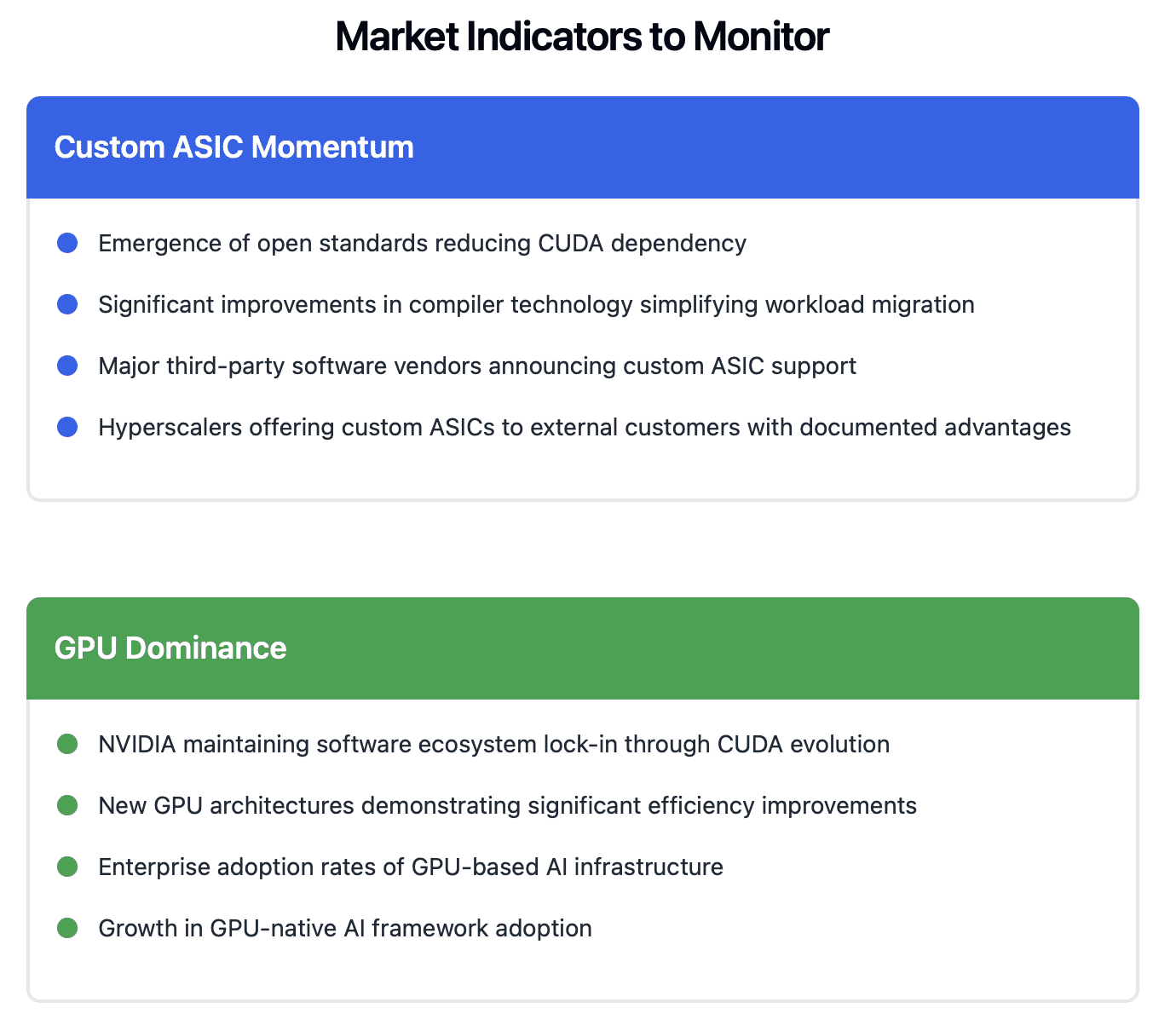
Despite these developments, hyperscalers continue to reserve capacity for NVIDIA chips, recognising the GPU giant’s entrenched ecosystem—especially its CUDA software stack—and the steep technical barriers to immediate elimination of GPU dependencies.

The trend resembles historical transitions in specialised compute. Just as cryptocurrency mining moved from GPUs to ASICs for lower costs and greater efficiency, hyperscalers now aim to fragment the AI compute supply chain and diversify their hardware portfolios.

TSMC stands to benefit significantly, serving as the foundry for both NVIDIA’s mass‑market GPUs and hyperscaler ASICs. Its chairman emphasises that the competition between NVIDIA and cloud‑designed chips is ultimately beneficial to TSMC, ensuring a broad customer base.

Broadcom has emerged as a frontrunner, with its ASIC and networking chipset revenues soaring 220% to $12.2 billion in 2024. Hyperscalers are investing in clusters featuring up to one million custom XPUs over open‑Ethernet networks—an architecture that places Broadcom and Marvell in strategic positions. Networking ASICs are expected to account for 15–20% of AI data‑centre silicon budgets, rising from the 5–10% range.

Revenue trends reflect these structural shifts. Marvell has secured a multi‑year AI chip deal with AWS and anticipates its AI silicon revenue jumping from $550 million in 2024 to over $2.5 billion in 2026. Broadcom, similarly, is redirecting significant investment toward hyperscaler ASIC demand.

Nevertheless, NVIDIA retains a commanding lead in AI training and general‑purpose GPU compute. Its end‑to‑end platform—from hardware to software—remains deeply embedded in the AI ecosystem. Custom ASICs, by contrast, offer task‑specific gains but lack the breadth of software compatibility that NVIDIA enables.

Analysts caution that the AI compute landscape is evolving toward a more fragmented, mixed‑architecture model combining GPUs and ASICs. Hyperscalers’ shift signals strategic recognition of rising costs, supply constraints, and performance demands. Yet, they also underscore persistent obstacles: software ecosystem maturity, long development cycles, and the complexity of large‑scale deployment.

Questions remain regarding the timeframe in which hyperscalers can meaningfully shift workloads away from NVIDIA GPUs. Industry roadmaps project new ASIC deployments through 2026–27. Analysts expect GPU market share erosion may begin toward the end of the decade, provided in-house ASICs deliver consistent performance and efficiency.

The stage is set for a multi‑year contest in datacentre compute. NVIDIA faces increasing pressure from hyperscalers building bespoke chips to optimise workloads and control supply. The next evolution of AI infrastructure may look less like a GPU‑centric world and more like a diverse ecosystem of specialised, interlocking processors.

An Estonian-based blockchain project is upending traditional cryptocurrency mining by enabling everyday mobile users to mine Bitcoin Solaris via a smartphone app. The Solaris Nova App, currently in its private beta, allows earning tokens through adaptive, low‑energy background processes—sidestepping the need for ASIC rigs and high electricity costs.

The platform combines conventional Proof‑of‑Work with Delegated Proof‑of‑Stake, boasting energy efficiency nearly 99.95% lower than Bitcoin yet capable of processing over 10,000 transactions per second with two‑second finality. It includes built‑in wallet features, real‑time analytics, gamified leaderboards and a marketplace for leasing computational power, aiming for a secure but user‑friendly experience.

Engagement has surged. Over 11,500 users have joined the presale, contributing more than $5 million, at an average price of $8 a token, with scheduled price increases to $9 ahead of a $20 launch value. Phase 7 is underway, confirming momentum as the project enters its final presale phase.

Independent audits from Cyberscope and Freshcoins, plus KYC verification, reinforce security credibility. Market analysts such as Ainvest note the platform’s one‑tap mining and liquid staking features as transformational for retail traders.

Bitcoin Solaris’s dual‑layer architecture merges SHA‑256 Proof‑of‑Work with a high-speed Delegated Proof‑of‑Stake layer. This enables smartphone‑based mining via the Nova App, steering the network’s validation duties to unused storage and CPU cycles—a model described as authentic on-chain participation rather than gamified simulation.

Device‑level mining accommodates Android, iOS, desktop and browser setups. It adjusts load according to hardware: simpler algorithmic backend for phones, scalable tasks for laptops. Energy consumption remains negligible compared to traditional setups. These advancements allow earning BTC‑S tokens immediately, even enabling leasing of computing capacity via smart contracts, and fostering deeper DeFi involvement through liquid staking.

Tokenomics emulate Bitcoin’s scarcity: 21 million total tokens, with 66.7% allocated to mining over 90 years, 20% set aside for presale, and 5% for liquidity. Early presale investors also access bonus slots—up to 10% in earlier phases—highlighting the company’s emphasis on accessible wealth-building.

Crypto commentators highlight its egalitarian potential. Coin World describes it as aimed at making mining accessible to average traders. Analytics Insight suggests mobile mining is generating a wave of new crypto millionaires. Observers such as Crypto Nitro, Crypto Infinity and Crypto Show emphasise its blend of energy efficiency with scalability and inclusivity.

Technical infrastructure rests on security measures, including zero‑knowledge proofs, rotating smart validator sets and continuous audits. Developers argue this permits afforded decentralisation without sacrificing speed or integrity.

Operationally, the project is on a tight timeline: the private beta is active, presale entering its final stage, and full exchange listing expected by July–August. Marketing strategies include referral bonuses, token rewards and daily spins, designed to sustain engagement as broader exposure looms.

Critics note that presale hype may inflate expectations and urge diligence. But Bitcoin Solaris counters with transparent audits, robust KYC, and smart contract evidence of functioning architecture. The simplicity of an app‑based mining system breaks from older models that few retail users can access profitably.

Industry significance could be profound. By transforming everyday devices into contributors to blockchain consensus, Bitcoin Solaris substantially lowers barriers. This may redefine early‑phase crypto wealth dynamics, where first movers historically held advantage via specialist mining investments.

As global attention turns to scalable, eco‑conscious blockchain models, Bitcoin Solaris positions itself at the intersection of accessibility and utility. With the Nova App reaching beta testers and node count rising, the platform is providing tangible participation alternatives for small investors.

ArabyAds has secured the prestigious Snapchat Advanced Partner badge, marking a significant milestone that positions the UAE-based ad-tech firm at the forefront of digital innovation across the Middle East and North Africa. The designation grants the company exclusive access to Snapchat’s latest tools, data analytics, and strategic support, enabling clients and creators in the region to harness full‑funnel campaign opportunities on the platform.

This recognition underlines ArabyAds’ deliberate investment in human capital and know‑how, rather than simply technical capability. As part of the Snapchat Advanced Partner programme, the company gains access to private training sessions, expert enablement, account‑management backing and early‑stage features like Snap’s Creator Discovery API and Snap Creator Marketplace Beta. The badge also comes with visibility and credibility as Snapchat builds its ecosystem through trusted agency partnerships.

ArabyAds Vice‑President of Digital, Ayah Reyad, emphasised that working with Snapchat has been instrumental in expanding market share and inspiring creativity, and that the advanced partner status will deepen relationships with clients and unlock new possibilities in digital storytelling. The move adds another layer to ArabyAds’ portfolio of regional achievements, which include being named Marketing Platform of the Year 2023 by MMA Smarties MENA and the prior launch of their AI‑powered Household Graph for cross‑platform audience reach.

Snapchat states that over 67% of users follow creators to see real, everyday moments, underlining the emphasis on authentic connection. The platform reports that 97% of users are open to brand‑sponsored creator content, and 59% have made purchases following exposure to such campaigns. This context sets the stage for ArabyAds to broker more effective creator partnerships on behalf of brands, using bespoke targeting informed by data and platform insight.

The Advanced Partner badge places ArabyAds among an elite selection of regional agencies, including Publicis Groupe‑Content Practice, Creo, InHype and The Goat Agency MENA. Snap’s pilot cohort benefits from direct collaboration opportunities with Snapchat teams, hands‑on enablement events and tailored access to analytics and certification from Snap Focus. A Partner Enablement Day in Dubai offered immediate immersion into platform tools and strategic best practice, reinforcing the parent company’s goal to build a vibrant creator economy across the MENA region.

Senior figures from other agencies in the cohort echoed Snap’s confidence in ArabyAds. Timothée Desormeaux, Managing Partner and Co‑founder of Acquisit, noted that Snap values their data‑driven and measurement‑focused approach, which has helped solve complex client challenges in the region.

Snap’s head of agency relations in the region, Rasha El‑Ghoussaini, described the partner initiative as part of a broader strategy to support agencies amid rapid transformation across digital markets.

For ArabyAds’ clients, the benefits are multifaceted. The Creator Discovery API enables mapping and analysis of over 100,000 MENA creators, enabling data‑led influencer alignment. End‑to‑end ROI tracking, combined with advancement in AR and creative strategy, allows brands to build measurable campaigns that drive deeper engagement and conversions.

ArabyAds is now well placed to offer clients a full‑stack solution on Snapchat: from creator identification and certification through Snap Focus, to influencer campaign activation using the Creator Marketplace, and ongoing optimisation via account management and platform insights. The firm’s trajectory signals intention not only to maintain growth, but to shape what high‑impact creator collaboration looks like in the region.

Oil markets swung sharply following the US Air Force’s striking of Iran’s Fordow, Natanz and Esfahan nuclear facilities on 21 June, triggering a fresh wave of geopolitical risk. Brent crude futures jumped over 11 per cent earlier this week after Israeli attacks, and traders are now preparing for further price volatility once global trading resumes.

President Trump described the operation as a “spectacular military success” and warned that more targets await if Iran does not seek peace. The US employed six B‑2 bombers laden with GBU‑57 “bunker‑buster” bombs—ordnance only capable of penetrating Fordow‘s deep underground vaults. Natanz and Esfahan were also hit, reportedly using Tomahawks from submarines.

Market analysts warn that disruption to Iran’s 2.5 million barrels per day export capacity, plus the threat of a shutdown of the Strait of Hormuz, would lift risk premiums sharply. Oxford Economics estimates oil could reach $130 a barrel if Iran decides to close the Strait, sending inflation soaring.

Investors are preparing for turbulence in equities and a rush towards safe-haven assets like the US dollar and gold. Potomac River Capital’s CIO, Mark Spindel, warned of markets being “initially alarmed” with heightened volatility continuing until the extent of the damage is confirmed.

Global markets have seen mixed signals: while crude prices surged up to 18 per cent since Israel’s June 13 raids, equities such as the S&P 500 have remained relatively steady. Predicting a deeper sell-off may depend on whether Iran follows through with threats — including disrupting the Strait, leveraging regional proxies, or escalating cyber campaigns.

Iran’s official response has been defiant rather than conciliatory. Tehran’s Atomic Energy Organisation assures no radiation has been released, and lawmakers claim the damage is superficial and repairable. Iran’s foreign ministry has labelled the strikes “outrageous” and cautioned that the consequences will be “everlasting”.

Global leaders have voiced alarm. New Zealand’s foreign minister urged all parties to “de-escalate and return to diplomacy”, while Australia and Mexico emphasised restraint and dialogue. Venezuela and Cuba condemned the strikes as violations of international law, calling for immediate halt to military action.

Oil market specialist Saul Kavonic warns Brent could move towards $100 a barrel “depending on Iran’s retaliation”. While Saudi output increases may buffer short-term shortages, traders recognise that any direct counterstrike on Gulf tanker routes or infrastructure would compound risk.

The destruction of key nuclear enrichment sites may set back Iran’s nuclear programme temporarily. Yet experts caution that the regime’s scientific expertise cannot be fully neutralised and the damage might harden Tehran’s resolve to pursue a bomb. This may also hinder diplomatic engagement, as Iran could withdraw from the Nuclear Non‑Proliferation Treaty and cease cooperation with the IAEA.

In financial hubs and oil centres from London to Shanghai, traders are reviewing risk models, stress-testing portfolios and hedging energy exposure. Asian markets, heavily reliant on Gulf crude, could face inflationary pressure if shipping routes are disrupted.

A key question now is whether the United States and its allies will pursue further strikes or shift to diplomatic pressure. Trump’s administration insists that Iran now has a binary choice: embrace peace or face further “precision” strikes. Critics warn that without congressional authorisation, deeper military involvement risks entangling the US in a long-term Middle East conflict.

Tests by Thailand’s Pollution Control Department have revealed that arsenic concentrations in the Kok River and tributaries now exceed national safety limits by up to five times. Biochemical analysis indicates that these toxic levels are linked to unregulated mining operations in Shan State, Myanmar, particularly within territories controlled by the United Wa State Army.

The Kok River, which begins its 285km course in Myanmar’s Daen Lao Range before entering Thailand through Mae Ai and flowing into Chiang Rai and eventually the Mekong, has become the focus of mounting alarm. Tests conducted between late May and early June demonstrated elevated arsenic at all 15 tested points along the Kok and Sai rivers, with further contamination detected in two Mekong sampling sites.

Local fishermen have reported adverse impacts to aquatic life and livelihoods. Prices for catch in Chiang Rai have dropped by nearly half, as consumer fear surrounding contamination takes hold. Fisherman Sawat Kaewdam told AFP: “They say, ‘There’s arsenic. I don’t want to eat that fish.’”.

Satellite imagery and drone footage show dozens of active mining sites emerging since around 2022, believed to involve both gold and rare earth minerals. These mines operate under minimal environmental safeguards, with tailings and chemical-laden effluent discharged directly into rivers. One environmental campaigner described the situation as Thailand’s “largest-ever case of transboundary pollution”.

Health experts warn that while immediate poisoning symptoms may not materialise, long‑term exposure through contaminated water and fish consumption could lead to chronic arsenic poisoning. Somporn Phengkham of the Community Health Impact Assessment Platform emphasised the risk of gradual accumulation, urging increased scrutiny of wells and irrigation systems.

Communities along the Kok River have experienced unusual water discolouration, persistent skin irritations, and fish deformities. Chiang Rai environmentalists staged protests on 5 June, tying ribbons along the river bridge to demand intervention and mine closure. In Chiang Mai’s Mae Ai district, a monk from Wat Thaton confirmed that the river’s appearance and use had become culturally and practically untenable.

Thailand’s federal government has initiated emergency measures. Deputy Prime Minister Prasert Jantararuangtong has overseen a new response centre, while the Pollution Control Department is conducting enhanced sampling. Officials reassure domestic water supplies are safe, although the contamination source remains external.

Proposals for containment include constructing a dam across the Kok River to trap sediments, dredging heavily polluted sections, and pursuing diplomatic negotiations with Myanmar and China. The Foreign Affairs Committee is engaging Beijing to urge oversight of Chinese mining companies operating within UWSA territories.

Challenges persist as Shan State’s mines lie beyond Myanmar’s central control. With the UWSA exerting autonomy and Chinese-linked firms driving extraction operations, finding a direct negotiating partner proves elusive. Regional analysts warn that building physical barriers without curbing source pollution will yield temporary alleviation at best.

Environmental advocates underscore the urgency of scaling up real-time monitoring and cross-border coordination. They highlight growing concerns that contamination could extend throughout the Mekong basin, threatening agriculture, fisheries, and water security across Southeast Asia.

Experts like Tanapon Phenrat of Naresuan University stress that addressing the problem requires systemic reform: mandated tailings treatment, strict environmental standards, and international cooperation. “We need to act now,” he stated.

VISHNU RAJA
RYO YAMADA
HITORI GOTOH
IKUYO KITA