Partnered with CB Insights to unveil Hong Kong leads Asia and ranks fifth globally for high-potential start-ups, orchestrating the next era of global tech innovation
Key Takeaways:
HKSTP’s 25th Anniversary Prelude theme, “Innovation. Next by Nature.”, brings together great minds and bold ideas to inspire what comes next for Hong Kong’s innovation ecosystem.
The CB Insights-HKSTP white paper ranks Hong Kong first in Asia and fifth globally, with a Mosaic score of 370 — a key indicator of high-potential ventures and future unicorns.
The research highlights Chinese Mainland’s lead in Asia’s physical AI wave, as the region powers global growth in robotics and AI funding.
HONG KONG SAR – Media OutReach Newswire – 31 August 2026 – The Hong Kong Science and Technology Parks Corporation (HKSTP) today officially kicked off its year-long 25th anniversary celebration with a landmark event “Together to NEXT”, bringing together Innovation and Technology Partners, Park Companies, industry leaders, academia and startups to mark a quarter-century of transforming bold ideas into global impact.
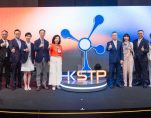
HKSTP’s 25th Anniversary Prelude theme, “Innovation. Next by Nature.”, brings together great minds and bold ideas to inspire what comes next for Hong Kong’s innovation ecosystem. Ms Cordelia Chung, Chairman of HKSTP (6th from left), Mr Terry Wong, CEO at HKSTP (6th from right), Mr Aldous Mak, Chief Financial Officer of HKSTP (5th from left), Ms Hilda Chan, Chief Marketing Officer, HKSTP (5th from right), Ms Filla Mak, Chief Property and Asset Officer, HKSTP (4th from left), Mr Eric Or, Chief Ecosystem Development Officer, HKSTP (4th from right), Ms Fanny Wong, Chief Talent Officer, HKSTP (3rd from right), Mr Oscar Wong, Acting Chief Business Development Officer, HKSTP (2nd from right) and members from the management team officiate the event.
To commemorate this milestone, HKSTP unveiled its anniversary theme, “Innovation. Next by Nature.”, a vision that signals its evolution from ecosystem enabler to orchestrator of the next era of global innovation. HKSTP also announced the findings of a landmark study, “Inside Asia’s Fast-Track to Global Tech Scale,” conducted in partnership with the leading technology market intelligence firm CB Insights, revealing Hong Kong ranks first in Asia and fifth globally, with a Mosaic score of 370. Mosaic score is CB Insight’s proprietary and industry-recognised indicator of high-potential ventures and future unicorns, evaluating momentum, financing, market opportunity and leadership quality. Hong Kong’s top ranking among Asian markets reflects a concentrated pool of scale-ready ventures and highly-investable innovation.
Ms Cordelia Chung, Chairman of HKSTP, said: “For 25 years, HKSTP has driven I&T as Hong Kong’s economic engine. Across our 240-hectare infrastructure and service ecosystem—comprising Science Park, InnoCentre, three InnoParks, and our Shenzhen Park—we turn research into real-world impact. Looking ahead, our ‘What’s Next’ vision is built on four dimensions, ‘Broad and Deep, Far Yet Near’: Broad means building a diverse talent ecosystem where human minds leverage technology; Deep involves advancing tech-industry convergence; Far entails expanding our global footprint; and Near focuses on drawing the future nearer with immediate action. Our community is our heartbeat. Together, we must strengthen, enhance, and collaborate, harnessing Hong Kong’s unique advantages to shape a better future for all.”
To kick off this next era, HKSTP has partnered with CB Insights to launch a white paper titled “Inside Asia‘s Fast-Track to Global Tech Scale.“ The report shows how Asia is reshaping the global innovation playbook with a network of specialist clusters, each optimised for a different stage of the innovation journey and built for today’s multipolar market landscape. CB Insights is a global tech intelligence leader and predictive data platform trusted by Fortune 500 companies.
Mr Terry Wong, CEO at HKSTP, said: “Asia’s rising innovation power is rewriting the global innovation map. While Silicon Valley grew as a single, all-in-one hub, Asia, with the Chinese Mainland as a key technology engine, is evolving an accelerated and more specialised network for global innovation. Hong Kong’s role as a super connector and value-adder has never been more important as Asia sets a new benchmark for start-up ecosystems. As HKSTP steps up as an ecosystem orchestrator, we are connecting innovators with capital, talent, deep Mainland China links and trusted pathways to global markets.”
Other Key Report Findings:
Chinese Mainland drives physical AI takeover Asia’s AI investment exploding as physical AI leads the way with robotics raising US$26.1B and AI infrastructure hit US$21.4 billion in 2025, outpacing generative AI and fintech. China dominates region with close to 100% of deals in emerging segments: robot/industrial humanoid robot foundation models, vision language and autonomous driving models.
Asia‘s specialist hubs as accelerators of growth across innovation lifecycle
Asia vies for global R&D lead to complement established manufacturing and consumer power The region’s global R&D expenditure surge from 24% in 2007 to 45% in 2024, according to WIPO, while already the dominant region for global manufacturing as well as driving global consumption with growing purchasing power with Asia’s GDP reaching 48.6 percent in 2025, according to Boao Forum for Asia (BFA).
HKSTP: Global I&T Ecosystem Orchestrator and Innovation Accelerator
HKSTP’s 25th anniversary signals a renewed mission to make Hong Kong the global heartbeat of what’s next in innovation and technology (I&T). As HKSTP approaches its 25th anniversary, the new brand theme, “Innovation. Next by Nature.”, positions HKSTP as inherently built to lead the change. The year-long celebrative campaign “25 to NEXT” starts from August 2026 to July 2027 with 25 high-impact activations and cultural moments.
Anchored by three core goals — The Next Habitat (cultivating an innovation culture by connecting ecosystem stakeholders with signature events), The Next Horizon (broadening perspectives through industry-guiding insights, including the landmark study in partnership with CB Insights and 25 KOL collaborations), and The Next Pinnacle (developing overseas delegations and platforms across international markets). The campaign positions HKSTP as a more connected engine and forward-oriented convener of talent, capital, infrastructure and partnerships across sectors and borders.
Since its establishment, HKSTP has grown into Hong Kong’s largest I&T ecosystem, driving breakthroughs across Life and Health Technology, AI and Data Science, Microelectronics and Advanced Manufacturing, and GreenTech and New Energy. As the ecosystem orchestrator, HKSTP is committed to powering Hong Kong’s rise as the international I&T hub, underpinned by leading critical partnerships across Hong Kong and beyond, attracting talent, engaging stakeholders, and building a connected, forward-looking I&T community for the next era of global innovation. Hashtag: #HongKongScienceandTechnologyParksCorporation #HKSTP
The issuer is solely responsible for the content of this announcement.
About Hong Kong Science and Technology Parks Corporation
Hong Kong Science and Technology Parks Corporation (HKSTP) was established in 2001 and has built a proven foundation as Hong Kong’s leading innovation and technology (I&T) ecosystem. Established for 25 years, HKSTP is supporting 14 unicorns, has nurtured more than 17,000 research professionals and built a community of over 2,600 technology companies from 26 countries and regions across four strategic technology clusters: Life and Health Technology, AI and Data Science, Micro-electronics, and New Energy and Green Technology.
As an ecosystem orchestrator, HKSTP provides end-to-end support to attract and nurture talent, accelerate commercialisation and help technology ventures scale. Its innovation infrastructure spans over 240 hectares covering Hong Kong Science Park in Pak Shek Kok, InnoCentre in Kowloon Tong, and three modern InnoParks in Tai Po, Tseung Kwan O and Yuen Long, advancing Hong Kong’s vision for new industrialisation and smart manufacturing.
Hong Kong Science Park Shenzhen Branch in Futian, Shenzhen, strengthens cross-border collaboration by connecting Hong Kong, the Chinese Mainland and global innovation networks and propels Chinese innovators onto the world stage, while also delivering comprehensive GBA landing support to accelerate cross-border success for local and international ventures.
As HKSTP enters its next chapter with strong foundations, it continues to deepen impact, elevate quality and create value for innovators. As an ecosystem built to lead change, HKSTP is empowering Hong Kong to define what comes next in innovation, growth and opportunity.
More information about HKSTP is available at www.hkstp.org.
Matein Khalid Chinese fast-fashion giant Shein is set to list in Hong Kong on September 1 at a valuation of up to $27 billion. That is less than half the $64 billion valuation at which Abu Dhabi sovereign wealth fund Mubadala invested in 2023. It is a brutal comedown for a retailer once expected to be worth $100 billion. My knowledge of sartorial retailing is admittedly less than encyclopaedic. Yet I […]
Artificial intelligence adoption has spread across Gulf businesses, but only a small minority are converting deployments into measurable financial gains, exposing a gap between experimentation and value creation. About 84 per cent of organisations in the Gulf Cooperation Council use AI in at least one business function, up from 62 per cent in 2023, according to a McKinsey survey conducted with the GCC Board Directors Institute. Yet […]
A US high-school student has made about $20,000 by selling a Telegram digital collectible awarded for his performance at this month’s International Olympiad in Informatics. Telegram founder Pavel Durov said Jonathan He, who won a gold medal and finished seventh overall at IOI 2026, sold his Algorithm Cup for 15,000 Grams, valuing the transaction at roughly $20,000. The collectible was among a limited set distributed to medal-winning […]
US authorities have warned that a China-linked hacking group built a distributed ecosystem of scanning, exploitation and proxy tools to target government networks and critical infrastructure, while court-authorised action has disabled two central platforms. The FBI, National Security Agency and US Cyber Command’s Cyber National Mission Force said QTFY, also known as QT and QTCYBER, developed purpose-built systems that allowed hackers to identify vulnerable devices at scale, […]
Mistral AI and Saudi Arabia’s HUMAIN have agreed a strategic collaboration worth hundreds of millions of euros, linking local computing infrastructure with model development and enterprise deployments across the kingdom and the wider Middle East. The agreement, announced on August 24, will see Paris-based Mistral explore using HUMAIN’s data centre infrastructure to meet growing local computing demand while the companies jointly develop and localise advanced artificial intelligence […]
OpenAI has appointed Meta’s India and Southeast Asia vice-president Sandhya Devanathan as its vice-president for Southeast Asia and Australia, strengthening the ChatGPT maker’s regional leadership as it expands consumer, enterprise and government engagement across Asia-Pacific.
Devanathan is due to take up the newly created role in October and will be based in Singapore, reporting to Kiran Mani, OpenAI’s managing director for Asia-Pacific. Her responsibilities will cover consumer growth, enterprise adoption and partnerships, regulatory engagement and operations across Southeast Asia and Australia.
The move gives OpenAI an experienced technology executive as competition intensifies among artificial intelligence companies for users, corporate customers, developers and public-sector partnerships. Devanathan has spent more than a decade at Meta and has held senior roles spanning ecommerce, gaming and country leadership across Asia-Pacific.
Devanathan announced her departure from Meta on Friday, describing the decision as “bittersweet” and saying she would take a short break before beginning her next chapter. OpenAI subsequently confirmed that she would join the company in the regional position.
Her departure also reshapes Meta’s reporting structure in one of its largest markets. Arun Srinivas, Meta’s managing director and country head for India, will report directly to Benjamin Joe, the company’s vice-president for Asia-Pacific. Srinivas had been reporting to Devanathan.
Devanathan joined Meta in 2016 and helped build its businesses and teams in Singapore and Vietnam, as well as ecommerce initiatives across Southeast Asia. She moved in 2020 to lead Meta’s gaming business in Asia-Pacific before being appointed vice-president and head of India, taking up that position in January 2023. Her remit was later expanded to include Southeast Asia.
At Meta, her work covered the company’s business and revenue priorities, relationships with major brands, advertisers, creators and partners, and the expansion of digital commerce and messaging services. She has more than 25 years of experience across banking, payments and technology.
OpenAI’s appointment places Devanathan in charge of markets where governments and companies are accelerating investment in generative artificial intelligence while also debating rules on safety, data, copyright and the use of advanced models. Her remit includes regulatory engagement, making her role important to OpenAI’s efforts to navigate differing policy regimes across Southeast Asia and Australia.
The company has been expanding its physical and management presence across Asia-Pacific, with offices in Singapore, Tokyo, Seoul, Sydney and Delhi. It has also strengthened its leadership in India, where it appointed former Uber executive Prabhjeet Singh as managing director earlier this year.
OpenAI has made India a significant part of its regional growth strategy as demand for generative AI tools rises among consumers, developers and businesses. In February, the company launched OpenAI for India, an initiative focused on artificial intelligence infrastructure, enterprise adoption, skills development and education partnerships.
Devanathan’s appointment extends that regional build-out beyond India, giving OpenAI a senior executive responsible for Southeast Asia and Australia from Singapore. The role combines commercial expansion with policy and operational responsibilities rather than focusing solely on sales or partnerships.
For Meta, the leadership change comes as the company continues to manage its advertising, messaging and social-media businesses across the region while increasing investment in artificial intelligence. Devanathan’s departure removes an executive who had overseen both India and Southeast Asia and had been part of Meta’s Asia-Pacific leadership structure.
When Meta appointed Devanathan to lead its India operations in 2022, the company said she would bring together its business and revenue priorities and strengthen relationships with brands, creators, advertisers and partners. She moved back to India for the role after earlier assignments in Singapore and Southeast Asia.
In her departure message, Devanathan highlighted work involving government citizen services delivered through WhatsApp in India and small businesses using Meta’s applications as digital storefronts in Vietnam, Indonesia and Thailand. She also referred to her experience helping technology companies and creators grow across the region.
SpaceX shares ended Friday at $141.50 after Elon Musk said the rocket and satellite company could generate about $3.5 trillion in annual revenue by 2033, setting out a growth expectation seven years ahead of Morgan Stanley’s long-range estimate. The Nasdaq-listed stock gained 0.45 per cent on August 28, closing above the previous session’s $140.87 but remaining well below its post-flotation peak above $225. The shares have nevertheless […]
Researchers have mapped and classified about 1.8 million individual trees across New York City, creating a citywide database designed to improve decisions on urban cooling, air quality, flooding and public health. The project combines high-resolution satellite imagery, airborne laser measurements and ground-level tree records to identify trees across streets, parks, private property and natural areas. About 1.4 million of the trees had not previously been covered by […]
The United States and Cameroon have outlined about $7 billion in American investment and trade opportunities spanning energy, infrastructure, critical minerals, technology, forestry and logistics after their first bilateral Economic and Commercial Dialogue in Yaoundé. Officials said the portfolio, valued at nearly 4 trillion CFA francs, contains new and expanding projects at different stages of development rather than a single package of committed capital. The August 27 […]
China’s data industry expanded to 6.78 trillion yuan in 2025, registering 15.7 per cent annual growth as artificial intelligence drove demand for specialised datasets, software and data-processing services.
Figures unveiled at the 2026 China International Big Data Industry Expo in Guiyang, Guizhou province, showed that data-related software products, including AI application software, and data-resource products involving token services generated a combined 4.99 trillion yuan. The two categories accounted for 73.6 per cent of the industry’s total output, underlining the growing commercial connection between data resources and AI development.
The number of data enterprises operating across China reached 482,000 by the end of 2025, an increase of 17.9 per cent from a year earlier. The eastern regions remained the largest concentration of activity, with their data industry valued at about 5.23 trillion yuan.
Growth has accelerated steadily over the past three years. China’s data industry was valued at 5.06 trillion yuan in 2023 and 5.86 trillion yuan in 2024 before climbing above 6.7 trillion yuan last year. Expansion has increasingly shifted from basic data collection and processing towards higher-value services designed for AI models, intelligent agents and industry-specific applications.
High-quality datasets have emerged as a particularly important segment. By August 2026, more than 126,000 such datasets had been established nationwide, containing more than 1,815 petabytes of data. Their combined volume has risen by more than 89 per cent since March, reflecting rapidly expanding demand from developers training and refining AI systems.
The broader supply of digital information is also growing sharply. China generated 52.26 zettabytes of data during 2025, up 27.28 per cent from the previous year and representing roughly 27.4 per cent of global data production. Enterprises accounted for about nine-tenths of the increase, with manufacturing, transport and logistics, software and information technology services recording especially strong gains.
That expansion is occurring alongside rapid growth in AI itself. China’s core AI industry exceeded 1.2 trillion yuan in 2025, with more than 6,200 specialised AI enterprises operating nationwide. More than 30 per cent of large manufacturing enterprises had adopted AI technologies by the end of the year, widening demand for industrial datasets capable of training systems for production, quality inspection, predictive maintenance and automation.
AI development is also changing the composition of the data market. Large language models initially depended heavily on publicly accessible text and image material, but developers are increasingly seeking proprietary industrial, scientific, financial, medical and operational data. The expansion of intelligent agents and embodied AI is adding demand for video, three-dimensional information, sensor readings, physical interaction records and synthetic data.
Intelligent-agent innovation has become another growth area. More than 3,400 patents associated with agent technologies were authorised during 2025, with the pace of growth more than doubling from the previous year. Commercial platforms are simultaneously combining access to multiple AI models with tools that allow companies to select, adapt and deploy systems without developing every component internally.
Policy is increasingly focused on turning China’s vast quantity of information into commercially usable AI resources. A national programme launched this year calls for high-quality industry datasets covering areas including scientific research, manufacturing, agriculture, energy, transport, financial services, healthcare, education, e-commerce, tourism, meteorology, urban governance, autonomous driving, embodied intelligence and biotechnology.
The programme is intended to expand dataset supply, improve annotation and quality assessment, encourage controlled circulation and connect dataset development more closely with practical AI applications. Authorities are targeting significant progress by the end of 2028, including industry datasets tested through real-world applications and specialised companies capable of developing tools and standards around them.
Arabian Post Staff -Dubai Gulf companies are pouring money into artificial intelligence, but many are finding that rapid adoption is not translating into measurable financial returns as weak data foundations, fragmented technology systems and governance gaps constrain deployment at scale. Around 84% of organisations across the Gulf are using AI in some form, yet only about 11% have reached a level where scaled deployments are producing clearly […]
Twitter. now is betting that artificial intelligence can help users screen misinformation, but research on automated fact-checking suggests the technology becomes substantially less dependable when claims are politically contested, context-heavy or difficult to verify. The social network, developed by Virginia-based Operation Bluebird, has placed a system called VERA at the centre of its effort to distinguish itself from X. The proposed “veracity engine” analyses posts, attaches trust […]
Google DeepMind has completed what it describes as the world’s first double-blind evaluation of a proprietary frontier-class artificial intelligence model, testing Gemini 2.5 Flash-Lite while preventing both the developer and external evaluators from accessing each other’s confidential material. The pilot represents a significant attempt to address benchmark contamination, one of the most persistent weaknesses in measuring advanced AI systems. Under conventional testing arrangements, model developers may gain […]
A Russian-speaking ransomware operation has used the Cursor artificial intelligence coding agent to support intrusions into corporate networks, exposing how commercial AI assistants can be manipulated to accelerate hacking once attackers gain access to a target. Operators linked to the Aurora ransomware group employed Cursor Agent during hands-on exploitation of at least 10 organisations between April 8 and May 21, 2026. The AI system helped with network […]
Forest City Special Financial Zone has clarified that its incentive for qualifying fintech and technology-enabled financial services is a 5% corporate tax rate rather than a blanket tax exemption, drawing a distinction between the Johor-based programme and Malaysia’s separate national digital incentives.
The clarification sets out the eligibility framework for companies considering operations in Pulau 1 of Forest City, where qualifying fintech businesses, Financial Global Business Services operations and foreign-owned payment system operators can apply for the special rate. The incentive runs for 10 consecutive years of assessment and may be extended for another 10 years if the company continues to meet the stipulated conditions.
Malaysia Digital Economy Corporation, or MDEC, is the government agency appointed to process applications, while approvals are subject to the national investment assessment framework. Eligibility does not arise simply from locating a technology business within Forest City.
Qualifying activities must incorporate at least one designated technology enabler. These include artificial intelligence or big data analytics, the Internet of Things, cybersecurity, cloud computing, blockchain, creative media technology, robotics or automation, and advanced network connectivity or telecommunications technology.
The framework therefore covers AI where the technology supports an eligible financial or business-service activity. A general AI developer or technology company does not automatically qualify for the Forest City incentive merely because it uses artificial intelligence.
Applicants must be companies incorporated under Malaysia’s Companies Act and resident in the country, with minimum paid-up capital of RM50,000. The qualifying business must be conducted in Pulau 1, Forest City. Companies must also comply with requirements covering employment, knowledge workers, operating expenditure, economic substance, environmental, social and governance commitments and any regulatory approvals applicable to their activities.
The Forest City incentive is separate from Malaysia Digital Status and the Malaysia Digital tax incentive administered by MDEC. Companies do not need Malaysia Digital Status to apply for the Forest City programme, and an applicant generally cannot receive another tax incentive for the same qualifying activity.
That distinction has become important because the national Malaysia Digital scheme includes figures of up to 100%, potentially creating confusion over whether technology and AI businesses can obtain complete corporate tax exemption in Forest City.
Under the Malaysia Digital tax incentive, companies making new investments can apply for a zero per cent reduced tax rate on qualifying intellectual-property income, subject to the applicable intellectual-property nexus rules. Qualifying non-IP income may receive a 5% or 10% reduced rate for up to 10 years, depending on whether the relevant conditions are met.
Alternatively, eligible new investments can choose an investment tax allowance of 60% or 100% of qualifying capital expenditure, which can be set against up to 100% of statutory income for a period of up to five years. The 100% figure refers to the investment tax allowance and does not constitute a general declaration that all income earned by an eligible company is tax-free.
Companies undertaking qualifying expansion investments face a different structure. The national digital programme provides a 15% reduced tax rate on qualifying IP and non-IP income for up to five years, or an investment tax allowance of 30% or 60% of qualifying capital expenditure, subject to the conditions attached to the scheme.
Applications for the Malaysia Digital tax incentive remain open until December 31, 2027. Applicants for that programme must first secure Malaysia Digital Status. Forest City’s programme has a longer application window, running to December 31, 2034 under the existing guidelines.
Forest City’s financial-zone incentives were formally unveiled by the government in September 2024 as part of an effort to establish Johor as a competitive financial and services hub close to Singapore. The package also includes separate arrangements for single family offices and knowledge workers.
Qualifying single family office vehicles operating under the Forest City framework can obtain a zero per cent tax rate on chargeable income from approved holding and investment activities, subject to Securities Commission Malaysia requirements. That concession is distinct from the 5% regime covering fintech, Financial Global Business Services and foreign payment system operators.
Forest City also sits within the wider Johor-Singapore Special Economic Zone, strengthening its role in Malaysia’s strategy to attract cross-border investment, advanced financial services and digital businesses. Johor has emerged as a major destination for digital infrastructure and technology investment, supported by its proximity to Singapore, expanding data-centre capacity and improving regional connectivity.
A federal judge has struck down the Pentagon’s blacklisting of artificial intelligence company Anthropic, ruling that the government unlawfully retaliated against the Claude developer over its restrictions on military uses of AI. US District Judge Rita F. Lin said the Defence Department’s decision to designate Anthropic as a national security “supply chain risk” violated the company’s First Amendment rights and was arbitrary and capricious. The ruling removes […]
More than 100 technology, financial and security organisations have warned that the world has only months to strengthen digital defences before increasingly capable artificial intelligence systems make sophisticated cyberattacks cheaper, faster and far easier to scale. OpenAI, Anthropic, Google, Microsoft, Amazon Web Services, Oracle and IBM are among the companies backing a global call for governments and businesses to treat cyber defence as an immediate priority. The […]
Andreessen Horowitz has raised $1.1 billion for a new fund dedicated to the physical infrastructure underpinning artificial intelligence, marking a major expansion of the Silicon Valley venture capital firm’s push beyond software into chips, data centres, robotics and advanced computing systems. The fund, called the Machine Age Fund, will invest across processors, memory, networking, storage and other technologies required to sustain the rapidly increasing computational demands of […]
Nvidia has agreed to acquire Hugging Face for a reported $12.9 billion, moving to take control of one of the artificial intelligence industry’s most important open-model platforms after the startup explored a sale at valuations above $13 billion. The transaction, which has not been publicly detailed by either company, would rank among Nvidia’s largest acquisitions and deepen its expansion beyond the graphics processors that underpin much of […]
Arabian Post Staff -Dubai Emirati women held shares worth about Dh39 billion on the Abu Dhabi Securities Exchange at the end of July, accounting for 94 per cent of the value of all shares owned by women on the market and underscoring their growing weight in the UAE’s capital markets. Close to 125,000 active Emirati women investors participate on ADX, placing them at the centre of an […]
Arabian Post Staff -Dubai Abu Dhabi is strengthening international partnerships on water and energy resilience as it seeks to translate its integrated resource-management model into practical cooperation with governments, regulators, researchers and technology companies worldwide. The Abu Dhabi Department of Energy used World Water Week 2026 in Stockholm to present the emirate’s approach to protecting water supplies, improving energy efficiency and building infrastructure capable of maintaining essential […]
Arabian Post Staff -Dubai Bayut has launched an artificial intelligence-powered search feature that allows UAE property seekers to describe the homes they want in everyday language, reducing their dependence on conventional menus and filters. Called AI Search, the tool lets buyers, tenants and investors enter detailed requests covering location, budget, property type, number of bedrooms, amenities and lifestyle preferences. A user could, for example, ask for a […]
Forest City SFZ sets out who may qualify for its 5% special corporate tax rate, how the separate Malaysia Digital tax incentive works, and which activities and conditions apply to each scheme.
JOHOR, MALAYSIA – Media OutReach Newswire – 29 August 2026 – Forest City has, over the past decade, built a recognised track record in green-building and sustainability credentials. Since the Malaysian Government announced the Forest City Special Financial Zone (“SFZ”) incentive package on 20 September 2024, the development has added a financial-services and digital-economy dimension. The Forest City Special Financial Zone (“FC-SFZ”) Tax Incentive offers a 5% special corporate tax rate for 10 consecutive years of assessment, extendable for a second 10-year period, to eligible companies undertaking qualifying fintech, Financial Global Business Services (“FGBS”) or Foreign Payment System Operator (“FPSO”) activities in Pulau 1, Forest City. Malaysia Digital Economy Corporation (“MDEC”) is the appointed government agency to process applications, which are assessed by the National Committee on Investment (“NCI”).
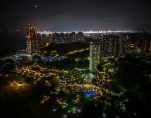
Forest City at night, looking across the Strait of Johor towards Singapore. Forest City lies approximately 2 km from Singapore at its nearest point.
The FC-SFZ Tax Incentive is separate from Malaysia Digital (“MD”) Status and the MD Tax Incentive. A company does not need MD Status to qualify for the FC-SFZ Tax Incentive. Under MDEC’s current rules, an FC-SFZ applicant must also not have been granted another tax incentive for the same qualifying activity. Eligible MD Status companies may separately apply for the MD Tax Incentive, subject to the applicable criteria and approval process.
Key Incentives at a Glance
Forest City’s first decade was defined in part by its green-building and sustainability record. Forest City reports nearly 40 international awards and certifications as at August 2026, including LEED for Core and Shell (“LEED-CS”) Gold pre-certification and GreenRE Gold ratings. On 20 September 2024, the Malaysian Government announced the Forest City SFZ incentive package, adding a financial-services and digital-economy dimension to the development.
The current incentive landscape has four main components:
Forest City SFZ corporate tax rate: Eligible companies undertaking qualifying fintech, FGBS or FPSO activities in Pulau 1 may receive a 5% special corporate tax rate for 10 consecutive years of assessment, extendable for a second 10-year period, subject to approval and continued compliance. The qualifying activity must use at least one promoted technology enabler specified by MDEC.
Single Family Office (“SFO”) Scheme: A qualifying Single Family Office Vehicle (“SFOV”) may receive a 0% tax rate on chargeable income from its qualifying holding and investment activities for an initial 10 years, with a possible extension for a further 10 years, subject to the Securities Commission Malaysia (“SC”) requirements.
Knowledge workers: Eligible knowledge workers working within the Johor-Singapore Special Economic Zone (“JS-SEZ”), which includes Forest City as a designated flagship area, may qualify for a special 15% personal income tax rate for 10 years, subject to the applicable conditions.
Malaysia Digital tax incentive: This is a separate national incentive administered by MDEC. For New Investment, eligible companies may choose between a reduced tax rate — 0% on qualifying intellectual-property (“IP”) income, subject to the modified nexus approach, and 5% or 10% on qualifying non-IP income for up to 10 years — or an Investment Tax Allowance (“ITA”) of 60% or 100% of qualifying capital expenditure for up to five years. Different rates apply to the Expansion Incentive. Applications are open until 31 December 2027.
Taken together, these measures position Forest City SFZ as a potential regional base for qualifying financial-services and technology-enabled businesses assessing Malaysia’s tax framework, proximity to Singapore and access to ASEAN markets. However, the schemes are separate and should not be treated as automatically cumulative.
Forest City Tax Framework for Fintech and Technology-Enabled Financial Services
The FC-SFZ Tax Incentive is not a blanket 100% tax exemption for fintech, AI or technology companies. It is a 5% special corporate tax rate for qualifying activities under the FC-SFZ framework. MDEC is the appointed agency to process applications, while applications are assessed by the NCI.
The 5% rate applies to qualifying fintech activities, FGBS and FPSO activities carried out in Pulau 1, Forest City. The qualifying activity must utilise at least one promoted technology enabler: artificial intelligence (“AI”) or big data analytics (“BDA”); Internet of Things (“IoT”); cybersecurity; cloud; blockchain; creative media technology, including extended reality (“XR”) or mixed reality (“MR”); robotics or automation; or advanced network connectivity or telecommunications technology. Eligibility is not automatic based on location alone; companies must also satisfy the applicable corporate, activity, substance, regulatory and compliance conditions.
The “up to 100%” figure sometimes cited in relation to Malaysia Digital refers to the ITA available under the MD New Investment Incentive. It is an allowance on qualifying capital expenditure, not a 100% income tax holiday. The MD Tax Incentive is also separate from the FC-SFZ Tax Incentive and should not be assumed to stack with it for the same qualifying activity.
Comparison table:
Scheme
What it covers
Headline rate / benefit
Authority & key note
Forest City SFZ — fintech / FGBS / FPSO incentive
Qualifying fintech, FGBS and FPSO activities in Pulau 1 using at least one promoted technology enabler
5% special corporate tax rate for 10 consecutive years of assessment; extendable for a second 10-year period
MDEC processes applications; NCI assessment. Applications open 1 Sep 2024–31 Dec 2034.
Forest City SFZ — Single Family Office
Qualifying SFOV holding and investment activities
0% tax rate for an initial 10 years; possible extension for a further 10 years
Securities Commission Malaysia; SFO tax rules gazetted on 3 Oct 2025.
JS-SEZ — eligible knowledge workers
Eligible knowledge workers working within the JS-SEZ, including qualifying roles in Forest City
15% personal income tax rate for 10 years
Ministry of Finance / JS-SEZ incentive package; subject to eligibility conditions.
Malaysia Digital Tax Incentive — New Investment
Eligible MD Status companies undertaking qualifying Malaysia Digital Activities
0% on qualifying IP income and 5% or 10% on qualifying non-IP income for up to 10 years; OR 60% or 100% ITA for up to 5 years
MDEC; MD Status required before tax-incentive application. Applications open until 31 Dec 2027.
Malaysia Digital Tax Incentive — Expansion
Eligible MD/MSC Malaysia Status companies undertaking qualifying new or expansion activities
15% reduced tax rate for up to 5 years; OR 30% or 60% ITA for up to 5 years
MDEC; subject to the Expansion Incentive criteria. Applications open until 31 Dec 2027.
Malaysia standard corporate rate
Companies not qualifying for a lower or special rate
24% headline corporate income tax rate
Inland Revenue Board of Malaysia (LHDN); lower tiered rates may apply to qualifying SMEs.
For accurate and current policy information, companies should refer directly to official sources, including:
Malaysia Digital Status and Tax Incentive: A Separate National Framework
MD Status is granted nationally by MDEC. An MD Status company may then be eligible to apply separately for the MD Tax Incentive, subject to the relevant criteria. Under MDEC’s current framework, qualifying Malaysia Digital Activities comprise the research, development or commercialisation of solutions, or the provision of services, using promoted technology enablers such as AI or BDA, IoT, cybersecurity, cloud, blockchain, drone technology, creative media technology, integrated-circuit design with embedded software, robotics or automation, and advanced network connectivity or telecommunications technology.
Under the current MD Tax Incentive, the available options differ between New Investment and Expansion:
New Investment: A 0% reduced tax rate on qualifying IP income, subject to the modified nexus approach, and a 5% or 10% reduced tax rate on qualifying non-IP income, for up to 10 years; or an ITA of 60% or 100% of qualifying capital expenditure against up to 100% of statutory income, for up to five years.
Expansion: A 15% reduced tax rate on qualifying IP income, subject to the modified nexus approach, and non-IP income, for up to five years; or an ITA of 30% or 60% of qualifying capital expenditure against up to 100% of statutory income, for up to five years.
The “100%” figure therefore refers to the ITA rate under the New Investment Incentive. It does not mean that all company income is tax-free.
The MD Tax Incentive is open for applications until 31 December 2027. A company must first obtain MD Status before submitting an application for the MD Tax Incentive.
MD Status also provides access to non-tax benefits under the MD Bill of Guarantees, including the ability to apply for foreign knowledge-worker quotas and passes, subject to the relevant immigration requirements. MDEC’s Expats Service Centre administers the related Foreign Knowledge Worker processes for eligible companies.
Eligibility Summary: Entities, Sectors and Permitted Activities
Forest City SFZ 5% rate
Activity-based: Qualifying services are limited to fintech-related activities, FGBS and FPSO activities.
Technology condition: The qualifying activity must utilise at least one promoted technology enabler specified by MDEC, including AI or BDA, IoT, cybersecurity, cloud, blockchain, creative media technology, robotics or automation, or advanced network connectivity or telecommunications technology.
Location condition: The qualifying activity must be carried out in Pulau 1, Forest City.
Substance and compliance conditions: Approved companies must meet the conditions set out in their approval letter, including commitments relating to full-time employees, knowledge workers, annual operating expenditure, ESG requirements, relevant regulatory approvals or licences, and annual compliance reporting verified by an independent auditor.
Malaysia Digital (MD) Status and MD Tax Incentive
Activity-based: MD eligibility is tied to Malaysia Digital Activities that use the promoted technology enablers specified by MDEC. Merely operating an AI, cloud, fintech or digital business does not automatically confer tax-incentive eligibility.
Status and tax-incentive process: MD Status is granted by MDEC. The MD Tax Incentive is a separate application available to eligible MD or MSC Malaysia Status companies, depending on the relevant incentive category.
Geographic scope: MD Status is a national programme and does not require a company to be located in Forest City.
No automatic stacking: MDEC states that an FC-SFZ Tax Incentive applicant must not already have been granted a tax incentive for the same qualifying activity. MDEC also confirms that MD Status is not required to apply for the FC-SFZ Tax Incentive.
Accordingly, companies should assess the FC-SFZ and MD frameworks separately. Any proposed structure involving different activities, income streams or incentive programmes should be verified with MDEC and qualified tax advisers before any combined tax outcome is assumed.
Strategic Rationale: Proximity, Talent Incentives and Regional Access
Forest City’s location proposition is based on three interlocking factors: proximity to Singapore, targeted talent incentives and early investor interest.
Proximity as operational leverage: Forest City lies approximately 2 km from Singapore at its nearest point, placing qualifying operations close to one of Asia’s major financial and technology hubs. The Johor Bahru-Singapore RTS Link will connect Bukit Chagar in central Johor Bahru with Woodlands North in Singapore. MRT Corp has stated that service is targeted to commence on 31 December 2026. The RTS Link does not serve Forest City directly, so onward road transport between Forest City and central Johor Bahru will still be required.
Talent as a bundled enabler: Eligible knowledge workers in the JS-SEZ may qualify for a special 15% personal income tax rate for 10 years, while eligible MD Status companies may apply for foreign knowledge-worker quotas and passes through MDEC’s expatriate facilitation framework. These are separate benefits with their own eligibility and approval requirements.
Decision Framework: Two Pathways and a Diligence Caveat
The incentive structure is best assessed through two distinct pathways, with a separate due-diligence lens for investors and advisers.
Pathway A – FC-SFZ presence on Pulau 1: This is relevant to eligible fintech companies, FGBS providers and FPSO businesses that can satisfy the physical-location, activity, substance and compliance requirements. The 5% special corporate tax rate is available for 10 consecutive years of assessment and may be extended for a second 10-year period, subject to continued compliance and approval.
This route may suit businesses that value proximity to Singapore while maintaining qualifying operations in Pulau 1. The RTS Link is expected to improve connectivity between central Johor Bahru and Singapore, but it does not remove the requirement for companies to maintain the approved substance and qualifying activities in Forest City.
Pathway B – MD Status and MD Tax Incentive nationwide: This pathway may be relevant to eligible digital companies operating elsewhere in Malaysia. MD Status is granted nationally by MDEC, and eligible companies may subsequently apply for the MD Tax Incentive. The applicable reduced tax rate or ITA depends on whether the company applies under the New Investment or Expansion category and on the conditions it meets.
Investors and advisers should note that headline rates are not the same as effective tax rates. The outcome for any entity depends on qualifying activities and income, approved commitments, substance conditions and the specific incentive secured. Groups with annual consolidated revenue of EUR750 million or more may also be subject to Malaysia’s domestic top-up tax rules where the relevant effective tax rate falls below 15%. Tax outcomes should therefore be modelled only after verification against current primary sources and professional advice.
The Verdict
Forest City’s proposition to fintech and technology-enabled financial-services companies is specific and condition-based: a 5% special corporate tax rate for qualifying fintech, FGBS and FPSO activities carried out in Pulau 1 using promoted technology enablers. The incentive runs for 10 consecutive years of assessment and may be extended for a second 10-year period, subject to compliance and approval. It is neither a blanket 5% rate for all AI or technology companies nor a 100% income tax exemption.
Alongside this are the separate SFO Incentive Scheme, which may provide a 0% tax rate for up to 20 years subject to SC requirements; the JS-SEZ’s special 15% personal income tax rate for eligible knowledge workers for 10 years; and the national MD Tax Incentive, which offers different reduced tax rates or ITA options depending on whether an applicant qualifies under the New Investment or Expansion category. Applications for the MD Tax Incentive are open until 31 December 2027.
Reported traction includes 260 cumulative investor enquiries recorded by Invest Johor by June 2026 and six families granted conditional approval under the SFO Incentive Scheme, with indicative assets under management close to RM400 million as reported by the SC in October 2025. Forest City also benefits from proximity to Singapore, while the RTS Link is targeted to commence service on 31 December 2026 between central Johor Bahru and Woodlands North.
For companies and investors, the key question is not simply whether these incentives exist, but whether their exact activities, income streams, location, substance commitments and corporate structure satisfy the conditions required to access them in practice. Current official guidance and qualified tax advice should be obtained before any investment or structuringHashtag: #ForestCity
The issuer is solely responsible for the content of this announcement.



 www.hkstp.org.