Transit cargo shipments through Russia’s Northern Sea Route are expected to exceed seven million tonnes in 2026, nearly doubling last year’s volume, according to a forecast by state nuclear corporation Rosatom. Vladimir Panov, Rosatom’s head of Arctic development, said the increase would establish a new record for cargo travelling through the Arctic corridor rather than originating from projects within the region. He also expects total freight movements […]
By Nitya Chakraborty As I read the despondent news of the passing of Jogen Chowdhury, a towering figure of modern Indian art, on Sunday morning in the online edition of a Bengali daily, sitting in my Delhi flat, my memory went 62 years back when Jogen and I, along with a bunch of other close […]
Tata Motors has crossed the minimum acceptance threshold for its takeover of Iveco Group, with provisional tender results giving its acquisition vehicle an 89.42% holding in the Italian commercial vehicle manufacturer, excluding treasury shares.
The results, announced by Iveco on Monday and disclosed by Tata Motors on Tuesday, show that shareholders tendered 238,157,212 shares before the offer closed on 26 October. Those acceptances represent 87.81% of Iveco’s total common share capital, exceeding the revised 80% minimum required for the transaction to proceed.
The 89.42% figure is calculated after excluding the 4,868,597 shares held in Iveco’s treasury. It represents the prospective ownership of TML CV Holdings B. V., the Tata Motors acquisition subsidiary, rather than a completed transfer of the shares. Settlement remains subject to confirmation of the provisional results and satisfaction or waiver of other offer conditions.
Iveco said the final results and the status of outstanding conditions would be published by 29 October, before trading begins. Payment for shares accepted during the initial tender period is scheduled for 30 October, when ownership will transfer against the agreed cash consideration if the conditions are met.
The acquisition vehicle offered €14.40 for each share, valuing the 238.16 million tendered shares at approximately €3.43 billion. The overall offer has been valued at about €3.9 billion, making the transaction Tata Motors’ largest overseas acquisition since its purchase of Jaguar Land Rover in 2008.
The acceptance threshold was initially fixed at 95%, but fell automatically to 80% following a resolution approved by Iveco shareholders at an extraordinary general meeting on 16 October. That decision provided a mechanism for completing the transaction without securing acceptances from nearly every shareholder.
The lower requirement proved important as the tender period approached its deadline. Although the preliminary level of support comfortably exceeds 80%, it remains below the original 95% target. The final ownership structure will depend partly on the number of additional shareholders accepting the offer during a second window. Any subsequent steps towards full ownership or delisting will depend on the applicable procedures and the level of shares ultimately acquired.
Iveco has scheduled that reopening for five trading days, from 2 November to 6 November, subject to confirmation of the initial results and the remaining conditions. Investors who tender during the additional period are expected to receive payment on 13 November at the same €14.40 price.
Tata Motors raised its cash offer by 30 euro cents a share on 9 October, from €14.10, after the acquisition timetable was extended. The revised price applied to all shares tendered during the initial period, including those submitted before the increase was announced.
The takeover covers Iveco’s commercial vehicle operations, including trucks and buses, but excludes its defence business, which is being separated. The proposed combination would give Tata Motors a much larger manufacturing and distribution presence in Europe while bringing Iveco’s established commercial vehicle brands into the wider group. The deal would also broaden the range of vehicles and markets served by the combined commercial vehicle operations.
Iveco’s board had unanimously recommended that shareholders accept the offer. Its largest shareholder, Exor, which held approximately 27.06% of the common shares and 43.19% of voting rights when the offer was launched, had committed to tender its holding and support the necessary shareholder resolutions.
The transaction nevertheless drew opposition from investment firm Petrus Advisers, which argued that the original price undervalued Iveco and failed to reflect sufficiently the potential benefits of combining the businesses. The increase to €14.40 did not eliminate the importance of shareholder participation in meeting the formal acceptance condition.
Tata Motors managing director and chief executive Girish Wagh described the revised price as the company’s best and final offer before the tender deadline. The company had indicated that a substantial proportion of shareholders might submit their acceptances close to the closing date, a pattern reflected in the final provisional tally.
The offer began on 7 September after Italy’s market regulator, Consob, approved the offer document earlier that month. BNP Paribas’s Italian branch coordinated the collection of acceptances and supplied the provisional figures disclosed by Iveco.
Iveco said the acquisition vehicle had not purchased any common shares outside the tender offer between publication of the offer document on 4 September and the closing date. The company’s treasury holding accounted for approximately 1.80% of its issued common share capital.
Arabian Post Staff -Dubai Apollo Global Management has agreed to acquire a minority stake in Abu Dhabi-based Mubadala Capital, with the US investment group and other strategic investors expected to commit a combined $5 billion to its investment strategies. The agreement, announced on Monday, October 26, brings Apollo into the ownership structure of Mubadala Capital, the alternative asset management subsidiary of sovereign investor Mubadala Investment Company. The […]
Doug Liman’s cryptocurrency thriller Bitcoin, starring Gal Gadot, Isla Fisher, Casey Affleck and Pete Davidson, was presented to international buyers at the Cannes film market, with sales company 193 handling overseas distribution rights. The production, previously known as Killing Satoshi, centres on the disputed identity of Bitcoin’s creator and uses artificial intelligence to construct much of its visual environment. Patrick Wachsberger’s company 193 introduced the project to […]
Joint study shows emerging markets will generate 60% of new online spending over the next decade — most of it from consumers without a credit card
SINGAPORE – Media OutReach Newswire – 21 October 2026 – Asia is projected to add 702 million middle-class adults between 2026 and 2036, three-quarters of all middle-class growth in emerging markets, according to a new study from World Data Lab (WDL) and EBANX, a global technology company specializing in payment services for emerging markets.
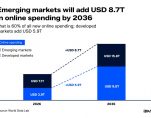
Emerging markets will add USD 8.7T in online spending by 2036
But this new consumer class will not shop the same way developed-market consumers do: by 2036, only 20% of adults in emerging markets will hold a credit card, against 66% in developed markets.
Global online spending is projected to grow from USD 11 trillion in 2026 to USD 25.6 trillion in 2036. Emerging markets add USD 8.7 trillion of that increase (60% of all new online spending), with China (USD +4.7 trillion) and India (USD +1.3 trillion) leading this growth. Indonesia (USD +243 billion), Brazil (USD +249 billion) and Mexico (USD +191 billion) form the next tier.
The categories matter as much as the markets. Online gaming spending in emerging markets grows 14% a year over the decade, the fastest of any category, and SaaS nearly 10%. Emerging markets will generate 76% of global growth in social media spending and 64% in SaaS.
The demographic picture challenges a common assumption. Consumers aged 45 and over account for 51% of emerging markets’ online spending growth through 2036, and spending by those aged 65 and over grows 12% a year, faster than any other age group.
The outlook was discussed during “Navigating Payments: How innovation and fragmentation are changing the game for e-commerce,” a webinar co-hosted by World Data Lab (WDL) and EBANX.
“Over the next ten years, people aged 45 and over will add USD 4.4 trillion in online spending in emerging markets, half of all the growth. Some of them already shop on their phones and will keep doing so as they get older. Others will buy online for the first time in their fifties or sixties. Merchants who build their checkout only for a 25-year-old will miss both groups,” explained Wolfgang Fengler, CEO of WDL.
The study models consumer spending, demographics, and financial access across 184 countries to 2036, drawing on the World Bank’s Global Findex and WDL’s consumer models, combined with EBANX’s experience processing payments for global merchants in emerging markets since 2012.
“If your checkout only takes credit cards, you are competing for one in five adults in emerging markets and conceding the other four”, said Marie-Elise Droga, Chief Revenue Officer of EBANX. “The merchants growing fastest with us didn’t wait for cards to arrive: they added the payment rails their customers already use, and they’re taking new buyers, bigger baskets and recurring revenue that card-only competitors can’t even see.”
834 million new online buyers, 281 million new credit cards
Between 2026 and 2036, the global economy will add 834 million online buyers but only 281 million credit card holders—a ratio of nearly three to one. In emerging markets, two in three new online buyers (67%) will arrive without a credit card. Adults without it already account for 55% of online spending in emerging markets, a share that rises to 90% in India and 93% in Sub-Saharan Africa. Credit cardless adults also represent 52% to 59% of spending in every digital category, from gaming and SaaS to streaming and travel.
Digital payment use is also running ahead of online shopping. Of the 2.6 billion emerging-market adults spending between USD 6 and USD 25 a day, 70% already pay merchants digitally while only 33% buy online, leaving at least 957 million digitally active consumers who are not yet online buyers. Many hold a bank account or mobile wallet but no card that works at an international checkout.
“This is closely tied to the innovation that came out of the financial industry in emerging markets, which developed solutions for an increasingly mobile economy and for the habits of local consumers. Today, we call them local payment methods, or LPMs, and they allowed e-commerce growth to decouple from the credit card, which still has very low penetration in these countries,” said Estelita Hass, head of Market Intelligence at EBANX.
Subscriptions are the next frontier — and India shows why
Recurring categories such as streaming, SaaS and online education will reach USD 2.1 trillion a year in emerging markets by 2036, with USD 1.1 trillion coming from adults without a credit card. In India, 82% of recurring online spending will be cardless. Account-based recurring rails are beginning to close that gap: a global SaaS company saw a 20% uplift in new subscribers after adding UPI at checkout in India, and cybersecurity company Nord Security now generates 28% of its revenue in Brazil through Pix Automático, Brazil’s recurring instant payment, six months after launching it with EBANX.
The issuer is solely responsible for the content of this announcement.
ABOUT EBANX
EBANX is the leading technology platform connecting global businesses to the world’s fastest-growing digital markets. Founded in 2012 in Brazil, EBANX was built with a mission to expand access to international digital commerce. Leveraging proprietary technology, deep market expertise, and robust infrastructure, the platform enables global businesses to offer hundreds of local payment methods and streamline cross-border payments across Latin America, Africa, and Asia. With a global footprint, it established a technology and regulatory headquarters in Singapore in 2026. More than just payments, EBANX drives growth, enhances sales, and delivers seamless purchase experiences for businesses and end users alike.
By Kalyani Shankar In India, festivals are more than just celebrations; they are significant traditions. Families often spend a considerable amount on new clothes, sweets, decorations, and gifts during these times. However, rising prices and inflation are forcing consumers to adjust their budgets and shopping habits. Many families are choosing to celebrate on a smaller […]
China’s state-linked equity funds attracted their largest weekly inflows since the April 2025 trade-war sell-off, signalling intensified efforts to support a stock market battered by persistent selling.
Nine exchange-traded funds widely associated with the country’s so-called national team recorded combined net inflows of 128.7 billion yuan ($19 billion) during the week ending 23 October. The total was the highest since nearly 140 billion yuan entered the same closely watched group during the tariff-driven market turmoil 18 months earlier.
The surge followed a punishing decline in mainland shares that pushed the CSI 300 benchmark into bear-market territory, conventionally defined as a fall of at least 20% from a previous peak. Investors have been monitoring large purchases of index-tracking funds for indications that state-backed institutions are seeking to contain further losses.
The figures measure money entering funds favoured by official investors rather than confirmed purchases by government-controlled entities. No public announcement has established how much of last week’s inflows came directly from the state, making the scale of official intervention difficult to determine precisely.
Central Huijin Investment, a unit of sovereign wealth fund China Investment Corporation, is among the principal institutions associated with market stabilisation. Its investment activity has become an important signal for traders attempting to assess Beijing’s willingness to support share prices during periods of intense volatility.
The latest inflows were concentrated in exchange-traded products offering exposure to broad mainland equity benchmarks. Such vehicles enable institutions to acquire diversified holdings quickly, directing demand towards major listed companies without having to purchase individual shares separately.
Thursday’s trading illustrated the pressure facing authorities. The CSI 300 fell into a bear market as persistent selling overwhelmed earlier signs of institutional support. Funds favoured by state investors attracted approximately 46 billion yuan that day, highlighting the contrast between substantial new subscriptions and continuing weakness in underlying shares.
Friday brought a partial reversal. The CSI 300 finished 1.7% higher at 4,105.33 after falling by as much as 2% during the session. The recovery coincided with unusually active trading in several large index funds, although trading patterns alone cannot identify the buyers responsible.
One CSI 300 exchange-traded fund managed by E Fund Management registered turnover of about 19.5 billion yuan on Friday, its busiest session since October 2024. Heavy turnover can reflect purchases and sales by multiple participants and does not, by itself, establish the size of net state investment.
The rebound provided relief after a prolonged retreat that had already tested confidence in official market-support measures. The benchmark had endured a record sequence of weekly declines, leaving investors focused on whether additional institutional demand could interrupt the selling pressure.
Analysts at China Securities, including Yao Ziwei, had previously identified large subscriptions to leading broad-market funds and heavier activity towards the close of trading as characteristics consistent with institutional buying against the prevailing market trend. Their observations did not amount to confirmation of individual investors’ identities.
The scale of potential support has also attracted attention. Analysts including Rebecca Sin estimated that Central Huijin raised approximately $231 billion through exchange-traded fund sales during the first half of 2026 and redeployed about $43 billion after purchases resumed in July. Their calculations suggested considerable remaining capacity, although available resources do not guarantee further buying.
Those estimates underscore the distinction between market intervention and a sustained recovery. Purchases can provide immediate demand for shares, but their effect depends partly on whether other investors become willing to hold equities without continued institutional assistance.
The comparison with April 2025 is significant because that episode followed sweeping American tariff announcements that triggered sharp market losses. Authorities subsequently introduced measures intended to stabilise trading and confidence. Last week’s inflows approached the scale seen during that earlier emergency, despite the different circumstances surrounding the latest decline.
The nine-fund basket represents only part of China’s exchange-traded fund market. Subscription figures can vary depending on the funds selected, the valuation method and the period measured, while changes in units outstanding cannot establish the identity of the ultimate purchaser.
Mainland exchange-traded funds are listed securities whose prices fluctuate throughout the trading day. Their creation and redemption mechanisms allow authorised institutions to adjust the number of units outstanding as investor demand changes. These mechanisms can produce substantial changes in reported fund flows even when trading activity involves different categories of institutional and individual market participants.
HONG KONG SAR – Media OutReach Newswire – 25 October 2026 – The Royal Institution of Chartered Surveyors (RICS) has announced the winning organisations, teams and individuals for the RICS Hong Kong Awards 2026.
These awards celebrate the most inspirational initiatives and developments in land, real estate, construction and infrastructure, recognising outstanding achievement, teamwork and corporate excellence. This year’s entrants have contributed to some of Hong Kong’s largest projects, including driving investment into the commercial sector, delivering essential infrastructure and leading sustainable practices.
Guest of Honour, Mr. TAI Sheung Shing, Victor, JP, Under Secretary for Housing, Housing Bureau, The Government of the Hong Kong Special Administrative Region, kicked off the ceremony with a speech recognising chartered surveyors for their significant contributions to the built environment. Additionally, the event welcomed Mr. David Lam, JP, Under Secretary for Development, Development Bureau, The Government of the Hong Kong Special Administrative Region, as a Presentation Guest at the Gala Dinner, to jointly witness this important occasion.
“These awards are about excellence. Excellence in our profession is about much more than a successful transaction, a well-delivered project or an impressive building. It is about the judgement behind a difficult decision. The integrity to give the right advice, even when it is not the easiest advice to give. And the commitment to leave a place, a business or a community better than we found it. ” said Ms. Ada Fung FRICS, Judging Chair of RICS Hong Kong Awards 2026. “For those of us working in Hong Kong, these qualities matter enormously. Our city never stands still, and neither can our profession. We must help clients navigate uncertainty, make better use of our built environment, and turn long-term ambitions into practical results.”
The RICS Annual Lifetime Achievement Award was presented to Mr. Philip Lo FRICS, a Steward of the Hong Kong Jockey Club. Mr. Lo is a former Chairman of Rider Levett Bucknall China and Hong Kong. He is a fellow of RICS and served on the RICS UK Management Board from 2011 to 2016, alongside his extensive leadership roles within RICS Hong Kong. He remains deeply committed to public service, currently holding key roles with the Hong Kong Housing Authority and the Hong Kong Housing Society, as well serving as an Adjunct Professor at The University of Hong Kong.
“Our profession is unique. We may not always have our names on the buildings, but we know every building carries our fingerprints. More importantly, through the built environment, we have the opportunity not only to create buildings and infrastructure, but also to shape communities, improve lives and contribute to the long-term development of society. That sense of purpose has always been one of the most rewarding aspects of my career.” said Mr. Philip Lo FRICS.
Results of RICS Hong Kong Awards 2026:
Project award categories 1. Commercial Property Project of the Year
Jones Lang LaSalle Management Services Limited – The Bay Hub
2. Corporate Social Responsibility Project of the Year
Hong Kong Housing Authority – Diamond Hill Water Feature Park
Team award categories 3. Agency Team of the Year
JLL – Office Leasing Advisory Team
4. Construction Project Management Team of the Year
Architectural Services Department & China State Construction Engineering (Hong Kong) Limited – Design and Construction of Chinese Medicine Hospital and Government Chinese Medicines Testing Institute in Hong Kong
5. Facilities Management Team of the Year
Hang Seng Bank Limited & JLL
Swire Properties Management Limited – Citygate – Driving Excellence in Facilities Management through Exemplary Sustainability Strategy
8. Refurbishment / Revitalisation Team of the Year
Architectural Services Department & Yau Lee Construction Company Limited – The Light Public Housing at Vacant School Premises (St. Joseph / Holm Glad / Ma Kam Chan)
9. Research Team of the Year
Rider Levett Bucknall + Arup – Whole Life Carbon Assessment – Embodied Carbon Intensity Framework in Hong Kong and Mainland China
10. Valuation Team of the Year
Cushman & Wakefield – Masterminds Behind Development: Shaping Hong Kong’s Future With Valuation Expertise
Special category awards
11. Best Deal of the Year
Alibaba Group Holding Limited, Cushman & Wakefield – Anchoring the Global Digital Hub: Alibaba & Ant Group’s Overseas Headquarters at One Causeway Bay, facilitated by Cushman & Wakefield
Jones Lang LaSalle Limited – JLL Capital Markets: Brookfield Asset Management and Uni-China Group Strategic Acquisition of Tsing Yi Industrial Site
12. Environmental Impact Award
Architectural Services Department – Advancing Net Zero – Toilet Blocks at Pet Garden of Central and Western District Promenade
Savills Property Management Limited – Kingston International Centre
13. Proptech Innovation of the Year
Savills Property Management Limited – Smart Control Hub
Individual awards
14. Emerging Achiever of the Year
Jason Leung MRICS, Assistant Research Director, Head of Land and Housing Research, Our Hong Kong Foundation
15. Lee Ming Kiu, Owen MRICS, Resident Engineer, AECOM
Woman of the Built Environment Award
Kathy Lee, Head of Research and Retail Consultancy, Colliers
The issuer is solely responsible for the content of this announcement.
About RICS Hong Kong Awards
The RICS Awards Hong Kong showcases outstanding achievements and developments in Hong Kong’s land, property and construction industries and across the built environment. The awards are open to everyone working within the property profession. The jury panel of the RICS Awards 2026 Hong Kong is formed by fourteen outstanding local industry leaders. Nominated projects have all displayed outstanding performance in professionalism, outcome & achievement, teamwork & collaboration and thought innovation.
About RICS We are RICS. As a member-led chartered professional body working in the public interest, we uphold the highest technical and ethical standards.
We inspire professionalism, advance knowledge and support our members across global markets to make an effective contribution for the benefit of society. We independently regulate our members in the management of land, real estate, construction and infrastructure. Our work with others supports their professional practice and pioneers a natural and built environment that is sustainable, resilient and inclusive for all.
CPM central committee member E P Jayarajan has rejected allegations that his wife, P K Indira, received money from businessman Sasidharan Kartha for investment in Vaidekam Ayurveda Healing Village, while accusing his nephew’s wife of financial misconduct at the Kannur resort. The controversy took another turn on Satur…
By T N Ashok NEW YORK: The latest diplomatic signals from Washington and New Delhi suggest that a prolonged India–US trade confrontation may finally be approaching a settlement. US President Donald Trump says a deal is close. Secretary of State Marco Rubio, after meeting External Affairs Minister S. Jaishankar in Mumbai on October 20, has […]
Cybercriminals penetrated Microsoft 365 accounts at 79 organisations during a coordinated campaign involving stolen authentication tokens, phishing and attempts to conceal fraudulent email activity, cybersecurity company Huntress has disclosed. The investigation, published on October 22, identified at least 497 successful sign-ins and more than 200,000 failed login attempts between July 14 and September 22. Researchers said attackers reused legitimate sessions captured through deceptive authentication processes, enabling access […]
The government on Friday ordered an anti-corruption inquiry against former Kannur district panchayat president and Communist Party of India (Marxist) leader P. P. Divya over alleged irregularities in awarding a ₹12-crore contract for modular toilets. Home and Vigilance Minister Ramesh Chennithala sanctioned the invest…
New report sets out a method the industry can use to put a financial value on climate resilience
The Westbund Central case study shows that its resilience measures are expected to keep storm-surge and rainfall-flood losses in 2050 below the losses an unprotected building would face today
HONG KONG SAR – Media OutReach Newswire – 23 October 2026 – Hongkong Land Holdings Limited (“Hongkong Land”) today published Building Value That Lasts: Quantifying the Return on Climate Resilience in Real Estate. The report developed with Marsh puts a financial value on designing buildings for a changing climate. Its case study is Westbund Central, Hongkong Land’s mixed-use waterfront development of approximately 1.7 million sq. m. on Shanghai’s Huangpu River.
(From left to right) From left: Michael Long, Head of Group Sustainability, Hongkong Land; Stuart Grant, Chief Executive of Westbund Central, Hongkong Land; Swenja Surminski, Managing Director of Climate and Sustainability, Marsh; and Michael Li, Chairman and President, Marsh Risk China.
The report finds that the development’s resilience measures cut expected storm-surge losses by 84% and rainfall-flood losses by 88% under today’s conditions. Westbund Central’s resilience measures are expected to keep storm-surge and rainfall-flood losses in 2050 below the losses an unprotected building would face today.
Closing the resilience valuation gap
Climate risk now shapes how real estate is assessed, financed and insured. Almost every climate related disclosure acknowledges the need for adaptation, yet fewer than one in ten puts a number on it. Hongkong Land and Marsh set out to close that gap together by treating resilience as an investment with a measurable return, not a cost to be absorbed.
Resilience pays, and the reductions are large
Working with global leading insurance broker and risk advisor Marsh, Hongkong Land modelled the average annual loss (AAL) at Westbund Central from storm surge, rainfall flooding and wind. AAL is the expected yearly cost of physical damage. The modelling compared climate risks today and in 2050 for buildings with and without resilience measures beyond those required by building codes. It assumed a future in which global greenhouse-gas emissions remain high.
Without the development’s enhanced resilience measures, expected storm-surge losses would more than double and wind losses would more than triple by 2050. The measures reduce expected losses as follows:
storm-surge losses fall by 84%, both today and in 2050
rainfall-flood losses fall by 88% today and 79% in 2050
wind losses fall by 36% today and 31% in 2050
Built for the climate of 2050
Westbund Central was engineered for projected climate conditions in 2050, rather than historical conditions. These measures significantly reduce the impact of increasing climate risk:
Storm surge: with Westbund Central’s resilience measures in place, average annual losses in 2050 are projected at 0.12%, compared with 0.38% for a building without these measures today.
Rainfall flooding: with the resilience measures in place, average annual losses in 2050 are projected at 0.05%, compared with 0.19% for a building without these measures today.
Insurers are raising premiums, tightening terms and withdrawing cover from exposed locations. In that market, a lower and more stable loss profile matters.
Westbund Centrals resilience features include:
23% more drainage capacity, protecting against a 1-in-100-year rainfall event
Grade 1 waterproofed basements and the elevation of critical equipment
A “Sponge City” network of more than 12 features designed to capture and store stormwater, with capacity exceeding 2,000 m³
The figures are conservative. They count physical damage only and exclude extreme heat, the fastest-growing hazard at the site, which the development manages through design and operations.
Michael T. Smith, Group Chief Executive of Hongkong Land, said: “Climate change is a significant force reshaping real estate. At Westbund Central, climate resilience is core to all that we do because we believe resilience and commercial performance reinforce each other. This report shows the return on that investment can be measured today, with tools that already exist. The industry no longer has any excuse not to.”
Stuart Grant, Chief Executive of Westbund Central, said: “A premium destination is a seamless one. Much of the resilience work at Westbund Central is deliberately invisible to the tenants and visitors who use it every day. Its value shows in the disruption that never reaches them. Keeping the precinct open, comfortable and trading regardless of weather conditions is how resilience facilitates commercial performance.”
Michael Li, Chairman and President of Marsh Risk China, said: “Climate risk is now a balance-sheet risk. Westbund Central shows that adaptation pays back through lower loss exposure and stronger access to capital. As a risk orchestrator, Marsh matches protection needs to capital flows, helping clients quantify resilience and close the valuation gap.”
A method for the industry
The report is offered as a method others can apply, not just as an account of one development. It traces how climate risk can be assessed from site selection through to operations and linked to financial outcomes. It calls on the industry to:
quantify early, at site selection and design, when action is most cost-effective
bring insurers and lenders in from the start
build a shared standard so resilience can be benchmarked across assets, as carbon already is
For further details, please see the full report which is available for download [here].
Hashtag: #HongkongLand
The issuer is solely responsible for the content of this announcement.
Westbund Central
Hongkong Land’s Westbund Central is the Group’s largest-ever single investment. Scheduled to complete in phases up until 2028, it is an US$8 billion development encompassing approximately more than 1.7 million sq. m. of prime mixed-use property strategically located at Shanghai’s Xuhui Waterfront. It is a flagship development of Hongkong Land’s prime commercial properties’ CENTRAL Series. The ultra-premium integrated commercial property includes 240,000 sq. m of retail space, 650,000 sq. m. of premium Grade A offices, 160,000 sq. m. of high-end waterfront luxury residences, two hotels (55,000 sq. m.) and over 50,000 sq. m. of cultural and art venues.
Hongkong Land
Hongkong Land is a major listed property development, investment and management group. It focuses on developing, owning and managing premium and ultra-premium mixed-use real estate in Asian gateway cities, featuring Grade A office, luxury retail, residential and hospitality products. With over US$50 billion in assets under management, Hongkong Land’s ultra-premium mixed-use real estate footprint spans over 1.97 million sq. m. lettable area in operation and 1.43 million sq. m. lettable area under development, with flagship mixed-use projects in Hong Kong, Singapore and Shanghai. Its properties hold industry leading green building certifications and attract the world’s foremost companies and luxury brands. Established in 1889, Hongkong Land takes a long-term view, investing significantly alongside its capital partners and concentrating its portfolio where it can create the most value for tenants, customers and investors. Hongkong Land Holdings Limited has a primary listing on the London Stock Exchange, with secondary listings in Singapore and Bermuda. Hongkong Land is a member of the Jardine Matheson Group.
Marsh Marsh (NYSE: MRSH) is a global leader in risk, reinsurance and capital, people and investments, and management consulting, advising clients in 130 countries. With more than 95,000 colleagues, Marsh helps build the confidence to thrive through the power of perspective. For more information, visit marsh.com, or follow us on LinkedIn and X.
By Emma McDermott ATT, Founder of Global Tax Consulting Dubai’s lack of personal income tax is one of the main attractions for British professionals considering a move to the UAE. Combined with the employment opportunities, lifestyle and relative proximity to the UK, it is easy to understand why so many people are making the move. However, relocating to Dubai does not automatically mean that you stop […]
Technology companies were responsible for the largest share of people affected by third-party data breaches, according to new findings from risk advisory firm Kroll. Kroll’s 2026 Data Breach Outlook, published on Thursday, found that 69% of individuals affected in incidents it handled between June 2025 and June 2026 had been exposed through breaches involving third parties. Of that group, 79% were linked to compromises in the technology […]
By Bhasha Singh New defence partnerships are emerging across the world. Their purpose is not merely to strengthen military capabilities but also to reduce dependence on other countries for weapons production and technology. On October 21, Türkiye, Pakistan, Indonesia and Qatar signed the Badr Memorandum of Understanding in Doha, the capital of Qatar. Under this […]
The partnership pairs LeapThought’s own AI with Google Cloud’s Gemini models and sovereign Cloud offering, giving infrastructure owners control of their data and connected intelligence across the full project and asset lifecycle.
SINGAPORE – Media OutReach Newswire – 23 October 2026 – LeapThought and Google Cloud today announced a strategic partnership to bring sovereign, domain-native AI to the owners and operators of critical building infrastructure, giving them control of their data and sharper decision-making across the full value chain, from delivery through operations.
Ratnakar Garikipati, Founder, Chair, and CEO of LeapThought, alongside Rahul Sharma, Google Cloud Managing Director, APAC Public Sector. The partnership combines LeapThought’s specialized AI with Google Cloud’s Gemini models and sovereign infrastructure to deliver secure data control and end-to-end intelligence for infrastructure assets.
The partnership has two priorities. The first is value chain integration, which connects everyone involved in delivering and running an asset — owners, operators, developers, consultants, contractors, and suppliers — on one governed platform. The second is security and sovereignty: owners can keep control of their data, within compliant, standardized frameworks that can be repeated from one program to the next.
FULCRUMHQ, LeapThought’s globally recognized Integrated Digital Delivery (IDD) platform, gives infrastructure owners the option to run on Google Cloud, including Google’s sovereign, air-gapped solutions for defense, public sector, and private sector environments requiring high security. At its core is GENIEHQ, LeapThought’s own Industrial AI, embedded directly into the platform and built to reason over the structured and unstructured data that defines a capital program — BIM models, GIS and geospatial data, ERP financials, schedules, contracts, reality capture, telemetry, and data from field robotics and sensors. The partnership pairs GENIEHQ with Google Cloud’s Gemini models, giving owners and their delivery teams natural-language access to that data across a project and a portfolio.
The partnership delivers on these two priorities as follows:
1. Value Chain Integration: One Governed Record, Natural-Language Insight
Major capital and building infrastructure programs span owners, operators, developers, consultants, contractors, and suppliers — each typically working in separate systems, with design, construction, and operational data fragmented across handovers. LeapThought’s FULCRUMHQ platform brings this information together into a single governed record that follows an asset from design through operation, giving owners a consistent view across their portfolio, not just a single project.
By running FULCRUMHQ — and the GENIEHQ Industrial AI embedded within it — on Google Cloud, and integrating LeapThought’s proprietary data architecture with Google’s Gemini models, the partnership enables:
Interactive Model and Portfolio Querying: Combining GENIEHQ’s deep understanding of project and portfolio data with the multimodal capabilities of Gemini, owners, engineers, project managers, and field teams can ask complex, plain-language questions directly against BIM models and portfolio data — instead of manually clicking through complex 3D CAD/BIM model trees or running predefined filter scripts — such as identifying clash detections, extracting exact material quantities, verifying regulatory code compliance, or surfacing risk trends across a program (e.g., “Show me all fire-rated doors on Level 3 that don’t match the latest spec,” or “Which contractors across our portfolio have the highest rate of non- conforming work this quarter”).
Global Scale and Reliability: Google Cloud provides the high-performance compute and elastic scalability needed to process compute-intense multi-gigabyte 3D models and point-cloud datasets, across a single project or an entire portfolio, in real time.
2. Security and Sovereignty: Full Control on Google Cloud’s Sovereign Solutions
For critical civil assets, defense installations, public sector agencies, and private sector owners where data cannot traverse the public cloud, LeapThought gives owners the choice to deploy on Google Cloud’s data residency solutions, including Google Cloud Data Boundary, Google Cloud Dedicated, and Google Distributed Cloud. In these environments, GENIEHQ, LeapThought’s Industrial AI embedded within FULCRUMHQ, runs alongside Gemini locally, within the owner’s chosen security boundary, ensuring zero cross-boundary exposure or unauthorized external telemetry.
“The value of an asset now lies as much in the intelligence around it as in its physical form. That intelligence belongs to the owner, and it must be secure, sovereign, and shared across the whole value chain. Demand for this is growing quickly, in Asia and around the world, and that is what brought us and Google Cloud together. We’re starting from Singapore and building toward a standard for critical infrastructure everywhere,” said Ratnakar Garikipati, Founder, Chairman, and CEO of LeapThought.
“Public sector and critical infrastructure agencies manage some of the most intricate engineering and regulatory datasets in the world. The partnership between Google Cloud and LeapThought enables project teams and portfolio owners to quickly surface actionable insights directly from complex BIM models and program data using everyday language. Combined with Google’s sovereign, air-gapped solutions, we’re providing agencies with the option to modernize project workflows while maintaining strict data governance, residency, and operational sovereignty,” said Rahul Sharma, Managing Director, APAC Public Sector, Google Cloud.
Hashtag: #LeapThought
The issuer is solely responsible for the content of this announcement.
About LeapThought
LeapThought is a US technology company that builds software connecting people, data, and AI across the infrastructure lifecycle. It is headquartered in Bellevue, Washington, has its Asia headquarters in Singapore, and operates across the United States, Brazil, Singapore, and New Zealand. Its FULCRUMHQ platform and embedded GENIEHQ Industrial AI serve public agencies, developers, consultants, contractors, and universities and institutes of higher learning. Clients include Singapore’s Land Transport Authority, Building and Construction Authority, and JTC. The company was founded and led by Ratnakar Garikipati.
Meta Platforms has agreed to give chief executive Mark Zuckerberg greater freedom to sell shares without surrendering voting control, securing his commitment to remain in California as voters prepare to decide on a billionaire wealth tax. The arrangement, disclosed in a regulatory filing, follows Zuckerberg’s warning that he was considering moving his primary residence outside the state to avoid a potentially multibillion-dollar liability under Proposition 40, which […]
Arabian Post Staff -Dubai The United Arab Emirates and Greece announced 18 agreements and commercial partnerships worth €12.75 billion ($14.3 billion) on Thursday, alongside plans for another €15 billion of UAE investment in Greece. The announcements came at the UAE-Greece Strategic Forum in Athens, attended by Abu Dhabi Crown Prince Sheikh Khaled bin Mohamed bin Zayed Al Nahyan and Greek Prime Minister Kyriakos Mitsotakis. The package covers […]
Gold prices fell on Friday and headed for their sharpest weekly decline in more than four months as rising energy costs reinforced expectations that the US Federal Reserve will keep interest rates elevated. Spot bullion traded around $4,021 an ounce, extending its weekly loss to approximately 3.6 per cent. US gold futures dropped 0.6 per cent to about $4,035, bringing the psychologically important $4,000 threshold into sharper […]
North Korea-linked hackers have incorporated post-quantum cryptography into a cyberespionage campaign against South Korean organisations, encrypting malware deliveries while exploiting widely used financial security software, cybersecurity researchers disclosed. Kaspersky identified the campaign, named Operation FlashHole, at its Security Analyst Summit in Bali on Wednesday. Its investigation established that at least three organisations in software development, construction and wired communications equipment manufacturing had been affected. The earliest evidence […]
By Nilotpal Basu The struggle over defending the right to vote has spilled over to issues which are more fundamental to Indian nationhood. At the same time, it has also inevitably brought to fore the question of right to peaceful protest and public assembly. These are the issues which were once thought to have been […]
Aldar Education has signed a memorandum of understanding with education technology company Toddle to introduce a unified learning management system across its 13 operated schools in Abu Dhabi, consolidating teaching, assessment and reporting while incorporating artificial intelligence into classroom activities. The agreement, announced on Thursday, October 22, will establish a common digital platform for schools delivering British, American and International Baccalaureate curricula. Implementation will proceed in phases, […]



 https://ebanx.com/en/
 https://www.linkedin.com/company/ebanx/