By Nitya Chakraborty China is hosting the World Artificial Intelligence Conference (WAIC) in Shanghai on July 17 to 20 the deliberations of which are expected to decide the course of AI development globally as also the scope of AI governance as also collaboration for assisting AI growth in the developing countries. The four day session […]
By Paul Murray, CEO Life & Health Reinsurance, Swiss Re
SINGAPORE – Media OutReach Newswire – 9 July 2026 – Op-ed by Paul Murray, CEO Life & Health Reinsurance, Swiss Re.
Ten years.
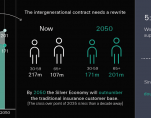
That is roughly how long we have before many societies reach one of the most defining demographic tipping points of our era: the point at which the “new” silver economy (over 65’s) outnumber people aged 30-59 who have traditionally been the bedrock of the life and pensions system.
The intergenerational contract needs a re-write
The significance of this shift goes far beyond demographics.
It represents a symbolic moment that forces us to rethink the intergenerational contract: how we provide care and financial security for people as they move into later life – and how we finance a new set of needs.
The demographic evidence is already visible across major economies. In the US, adults aged 65 and over already outnumber children in 11 states. Singapore’s over-65 population has nearly doubled in a decade to 21%. Japan is approaching 30%. The UK, France and Germany are not far behind
These numbers are well-known. But their meaning is not yet fully reflected in our industry’s existing product strategy.
The tipping point is also more than a statistical curiosity. We will experience it through the decisions we make coming into retirement and to secure the future of the generation coming after us. We will need to make new choices on how we fund care. We will need to make new assumptions about when to retire. And we will face a new reality around how much of the financial burden falls on the state, families or the individual.
Families have always carried the weight of old age, even as pensions, healthcare systems and social care programmes have broadened that responsibility across society.
But the arithmetic underpinning the system is breaking. Globally, the ratio of working-age people financially supporting each person over 65 is projected to fall from around five-to-one in 2021 to three-to-one by 2050. Across developed markets, debates about pension reform, healthcare funding and retirement ages reflect the same underlying question: how do we maintain security and dignity later in life when there are fewer hands to carry the weight?
It’s not a crisis of demographics. It’s a crisis of design – our systems were built for shorter lives and larger workforces, and they haven’t been rebuilt for the world we are actually entering.
That insight matters because it challenges how we think about insurance’s role. I believe we have less than a decade to develop the products that the older consumers who make up the Silver Economy – and their families – will need.
There will be no silver bullet. We cannot return to a single solution based around family care versus public provision. The individual retiree will be the focus, but our thinking will need to be based on a more collaborative model in which families, governments, communities and the private sector work together.
Recent Swiss Re consumer research in France and Germany revealed something striking. People don’t think about later life in terms of pensions or insurance policies. They think about practical outcomes: staying independent, being resilient when health shocks hit, not becoming a burden to their children.
Our industry has spent decades optimising for wealth accumulation and income protection during working years. Ageing societies demand we apply the same rigour to what happens after.
That does not mean the intergenerational contract has failed. It means it is evolving.
We are already seeing what that evolution looks like in practice.
Senior health products in Asia are closing a real gap —The median age of cancer diagnosis is 67, yet many critical illness policies expire before retirement even begins. The result is high out-of-pocket expenses, stressed public healthcare, and increased burden on families. With dedicated products to cover later life illnesses, such as senior cancer products we are effectively closing a protection gap.
Long term care in France has had some success with private solutions alongside public provision. With over 1.4 million people covered by private long term care insurance, France has built a strong risk pool that directly addresses one of the strongest concerns expressed by consumers: not becoming a burden on the next generation.
Deferred annuities offer a third path beyond the binary “draw-down versus annuity” thinking. By combining flexibility today with guaranteed income later, they help transform longevity from an individual financial risk into one that can be shared more broadly.
At first glance these solutions appear very different. In reality, they are pieces of the same puzzle. Each expands the circle of support around the individual. They help families carry less of the burden alone, and they complement the work of state safety nets.
That is what the next evolution of the intergenerational contract looks like in practice.
Ageing societies are one of humanity’s great achievements. But if our products and institutions stay built for a demographic reality that no longer exists, achievement curdles into liability.
We have a decade to close that gap. Let’s treat it as a product-development window, not a deadline.
Disclaimer Certain statements and illustrations contained herein are forward-looking and are made for informational purposes only. These statements (including as to plans, objectives, targets, and trends) and illustrations provide current expectations of future events based on certain assumptions and include any statement that does not directly relate to a historical fact or current fact. Readers are cautioned not to place undue reliance on forward-looking statements. Swiss Re undertakes no obligation to publicly revise or update any forward-looking statements, whether as a result of new information, future events or otherwise. Further information on forward looking statements and the use of information contained in this publication can be found in the Legal Notice section on Swiss Re’s website.
The issuer is solely responsible for the content of this announcement.
About Swiss Re
The Swiss Re Group is one of the world’s leading providers of reinsurance, insurance and other forms of insurance-based risk transfer, working to make the world more resilient. It anticipates and manages risk – from natural catastrophes to climate change, from ageing populations to cyber crime. The aim of the Swiss Re Group is to enable society to thrive and progress, creating new opportunities and solutions for its clients. Headquartered in Zurich, Switzerland, where it was founded in 1863, the Swiss Re Group operates through a network of around 70 offices globally.
A newly examined Everest ransomware encryptor has exposed a sharper technical playbook built to weaken recovery, obstruct analysis and expand damage across dormant network systems before encryption begins. The Windows payload, identified as hlntqyun. exe, is a 114 KB C# assembly compiled for. NET Framework 4.0 and protected with ConfuserEx, a widely abused obfuscation tool used to frustrate static malware analysis. The sample carries the SHA-256 hash […]
DuckDuckGo has added YouTube video ad blocking to its privacy-focused browser, widening its challenge to dominant browsers and giving users a built-in way to watch videos with fewer commercial interruptions. The feature blocks ads that appear before and during videos viewed inside the DuckDuckGo browser, including on YouTube. It relies on community-maintained uBlock Origin filter lists, a significant choice because those lists are open-source, regularly updated and […]
By K Raveendran The Narendra Modi government’s position on fuel prices now looks less like prudent caution and more like an overly defensive reading of a market that has already absorbed much of the Iran-US risk. The more calibrated question, therefore, is not whether New Delhi is right to watch the West Asian security situation, […]
President Trump’s declaration on Wednesday that the ceasefire with Iran is over immediately pushed oil prices higher, lifted Treasury yields and revived concerns about the security of the Strait of Hormuz. Markets responded in familiar fashion, with traders reassessing energy supplies, inflation expectations and monetary policy. Another consequence deserves equal attention. Higher oil prices strengthen the fiscal position of the Gulf’s major energy exporters. Over time, stronger […]
A China-linked cyber-espionage group has expanded its use of hijacked devices to mask attacks on telecommunications infrastructure, deploying three newly documented malware implants across Windows, Linux and network edge systems. The activity, tracked as UAT-9244, has targeted critical telecoms infrastructure in South America since 2024. The campaign shows how state-aligned operators are moving beyond direct server compromise to build distributed relay networks that help them scan, brute-force […]
Enterprise AI agents are moving from pilot projects into business software faster than many security teams can rework the systems that decide who, or what, is allowed to log in. The main obstacle is no longer only model performance. Deployment is being slowed by multi-factor authentication prompts, short-lived session tokens, bot-detection systems, consent screens, delegated permissions and audit requirements built for people using keyboards, not software agents […]
Securitize’s shares have fallen about 40 per cent since the BlackRock-backed tokenisation firm completed its public listing through a Cantor Fitzgerald-linked blank-cheque vehicle, exposing a sharp gap between investor enthusiasm for blockchain-based financial infrastructure and the early trading performance of companies entering public markets through SPAC deals. The company, now trading on the New York Stock Exchange under the ticker SECZ, slipped to about $8 after opening […]
By Satyaki Chakraborty Amidst Trump-Modi bonhomie and the continuation of India-US trade talks, former Indian intelligence chief Vikram Sood said on Sunday in an interview to a British network that the present U.S. deputy secretary of state Christopher Landau told Indian officials during his visit to India in March 2026 that Washington would use tariffs, […]
Arabian Post Staff -Dubai Saudi Arabia has slashed the price of its flagship crude for Asian buyers by the widest margin in more than two decades, signalling a tougher fight for market share as rising supply and softer demand reshape the oil trade. Saudi Aramco cut the August official selling price of Arab Light crude by $11 a barrel, setting it at $1.50 below the Oman-Dubai average, […]
Grand Theft Auto VI has turned a viral comparison with Dubai’s Burj Khalifa into a wider debate over the cost of blockbuster entertainment, as industry estimates place the game among the most expensive creative projects ever attempted. The claim spreading across social platforms is striking: the Burj Khalifa, the world’s tallest building, cost about $1.5 billion and took six years to build, while GTA VI may cost […]
Securitize began trading on the New York Stock Exchange under the ticker SECZ after completing its merger with Cantor Equity Partners II, giving the tokenisation platform a public-market foothold at a time when Wall Street is testing blockchain rails for regulated securities. The Miami and New York-based company closed its business combination on 1 July, with trading starting the following day. The deal is expected to raise […]
By K Raveendran The alleged theft of donations from the Ayodhya Ram Temple has pushed a long-simmering question into the national foreground: who should guard the wealth of religious institutions when faith, money and power converge without adequate public accountability? The issue is not confined to Ayodhya, nor to Hindu institutions. Across denominations, religious endowments, […]
Cape Verde’s breakthrough World Cup campaign ended in Miami Gardens after the Blue Sharks pushed defending champions Argentina to extra time before falling 3-2 in a round-of-32 match that turned one of the tournament’s smallest teams into one of its defining stories. Argentina advanced to a round-of-16 meeting with Egypt, but the night belonged almost as much to Cape Verde, whose players twice came from behind and […]
Etihad Rail has opened passenger journeys between Abu Dhabi and Fujairah, giving travellers a new way to cross the country with online booking, discounted launch fares and a travel time of about one hour and 45 minutes. The first public phase of the UAE’s national passenger rail service began on June 30, connecting Abu Dhabi Station in Mohammed bin Zayed City with Fujairah Station in Al Hilal. […]
By R. Suryamurthy Every war leaves behind shattered cities, broken societies and grieving families. But some wars destroy something less visible yet infinitely more consequential: faith in the institutions created to prevent humanity from repeating history’s darkest chapters. The latest report of the United Nations Independent International Commission of Inquiry on Israel and the Occupied […]
By Satyaki Chakraborty The U.S.-China high tech battle for supremacy has reached a new peak after the China manufactured Supercomputer LineShine was adjudged the best among the Top 500 supercomputers made by various nations including the USA, at the International Supercomputing Conference in Hamburg, Germany held on June 23.China got this top slot recognition after […]
Scientists have identified a possible route by which Alzheimer’s disease advances through the brain, after finding that a protein normally involved in neuron-to-neuron communication may also carry toxic Tau from damaged cells into healthy ones. The discovery centres on Arc, a brain protein known to support learning, memory and synaptic plasticity. New laboratory research in mice indicates that Arc can package Tau into tiny extracellular vesicles, allowing […]
Bengaluru-based Mohalla Tech is preparing to raise as much as $400 million through an initial public offering next year, putting the operator of ShareChat, Moj and QuickTV on course for one of the most closely watched consumer internet listings after years of heavy losses, restructuring and valuation pressure.
The company, led by co-founder and chief executive Ankush Sachdeva, is expected to seek public market capital after tightening costs, narrowing operating losses and pushing harder into advertising, live-streaming and subscription-driven entertainment. The proposed listing would test investor appetite for a local-language social media business that has repositioned itself from a high-burn growth platform into a more disciplined digital entertainment group.
Mohalla Tech’s IPO plans come at a point when technology companies are being judged less on user growth alone and more on cash flow, margins and the durability of revenue. ShareChat was valued at about $5 billion during the venture funding boom of 2022, when large investors including Google, Temasek, Lightspeed and Times Group backed the company. Its valuation came under pressure as the start-up funding environment tightened, forcing the firm to raise convertible debt and cut costs.
ShareChat operates as a social network focused on users in non-English language markets, while Moj competes in the short-video segment. QuickTV, a subscription-led micro-drama app, is part of the company’s attempt to build paid entertainment formats alongside advertising-led services. The group is seeking to show that a platform built around regional content can generate more predictable income from a mix of brands, creators and paying users.
The company’s turnaround has been built around a sharp reduction in losses. Its adjusted Ebitda loss for FY25 fell to about ₹219 crore from ₹793 crore a year earlier, helped by lower marketing spend, headcount reductions and tighter control over creator and technology costs. Revenue is expected to rise further in FY26, with management targeting stronger contributions from advertising, live services and short-form drama subscriptions.
Mohalla Tech’s challenge is that scale has not yet translated into the kind of profitability public investors typically demand. Social media and short-video businesses need sustained spending on content moderation, creator incentives, product development and cloud infrastructure. Advertising demand can also shift quickly, especially when large platforms such as Meta, Google and YouTube continue to dominate brand budgets.
The company has sought to distinguish itself by focusing on language diversity and community-led engagement. ShareChat is available across more than 15 languages and has built a large audience outside the metro-focused English internet market. Its Google Play listing shows more than 500 million downloads for the ShareChat app, while Moj has emerged as a major short-video platform after the 2020 ban on TikTok created room for local alternatives.
That opportunity also brought intense competition. Moj, Josh, YouTube Shorts and Instagram Reels all chased the same creator and viewer base, triggering high spending on influencers, content discovery and user acquisition. Mohalla Tech expanded through acquisition, including the purchase of MX TakaTak, but later shifted to consolidation as the funding environment changed and investors pressed for cleaner unit economics.
The company’s management has already gone through a period of transition. Sachdeva remains the public face of the business, while co-founders Bhanu Pratap Singh and Farid Ahsan stepped back from operating roles in 2023. The firm also implemented multiple rounds of layoffs, including deep reductions in 2023, as it moved away from expansion at any cost.
An IPO would give early backers a potential path to liquidity, though the final size, timing and valuation will depend on market conditions, revenue momentum and profitability milestones. A $400 million issue would be significant for a consumer internet company whose fortunes have mirrored the wider cycle in start-up funding: rapid capital inflows, aggressive expansion, a valuation reset and a pivot towards financial discipline.
The listing plan also comes as equity markets have shown selective support for digital businesses that can demonstrate clear paths to profit. Investors have rewarded companies that cut burn and improved governance, while punishing firms with weak disclosure, unclear revenue models or stretched valuations. Mohalla Tech will have to convince public shareholders that its audience base can support sustainable revenue without a return to heavy promotional spending.
Aflac Life Insurance Japan has disclosed a major cyber incident affecting about 4.38 million customers, with personal, policy and some banking information exposed after unauthorised access to its customer portal and related systems. The breach, announced on June 30 and updated on July 1, involved systems including Aflac Yorisou Net, a policyholder website used for checking contract details and carrying out account changes. The company said the […]
A Brazil-linked banking trojan has shifted its focus to Spain and Portugal, using fake PDF files, hidden code and location checks to reach banking customers while keeping analysts and automated security tools away from its payload. The malware, known as Ousaban or Javali, has long been associated with attacks on financial users in Brazil. Its latest campaign shows a more selective and evasive operation aimed at Windows […]
Investors heading into the second half of 2026 face an uncomfortable reality: the global economy is changing faster than many portfolios are adapting to it. The forces reshaping markets today are structural. AI is triggering one of the largest capital investment booms in modern history. Digital assets have crossed into mainstream finance. Meanwhile, geopolitical conflict, sovereign debt and valuation risk continue to create significant uncertainty. As the […]
A broad group of payment, banking, technology and crypto firms has joined Open Standard to introduce Open USD, a US dollar-backed stablecoin designed for large-scale business payments and digital settlement. The initiative brings together more than 140 companies, including Visa, Mastercard, American Express, BlackRock, Coinbase, Stripe, BNY, Standard Chartered, Google, Shopify, Coinbase, Ripple, Fireblocks, Gemini, MetaMask, Emirates NBD and Abu Dhabi Islamic Bank. Open USD, trading under […]



 https://www.swissre.com/
 https://www.linkedin.com/company/swiss-re/




