News related to
global

Serbia will serve as the Future Digital Economy Partner Country at GITEX Global 2025 in Dubai, becoming the first European nation accorded that role. The designation foregrounds Serbia’s ambitions to reposition itself from outsourcing hub to innovator in global tech markets.

Serbia’s IT exports crossed €3.5 billion in 2023, and the sector has maintained close to 20 percent year-on-year growth. The number of IT firms now exceeds 4,000, with many branching into domains such as fintech, health tech, AI and gaming. The Chamber of Commerce and Industry of Serbia, which leads the national delegation, views the GITEX platform as an opportunity to elevate the country’s narrative beyond cost-competitiveness to creative capacity.

Marko Čadež, president of CCIS, said Serbian firms are now pitching themselves as long-term transformation partners rather than simple vendors. He emphasised that enterprises increasingly expect strategic collaboration, not just software delivery. Meanwhile, analysts point to Serbia’s strong foundations—high math and engineering education standards, English proficiency, and relatively affordable costs—as a competitive edge in Eastern Europe.

Yet Serbia confronts headwinds. Talent retention is an ongoing challenge: many trained professionals migrate to Western Europe or the U. S. Infrastructure remains uneven, with rural areas lagging behind Belgrade in connectivity. In addition, venture capital inflows to the Balkans are smaller compared to Western Europe, constraining the ability of startups to scale aggressively.

Serbia is attempting to counterbalance those constraints through targeted programmes. The Chamber of Commerce has launched “Start 2,” a support scheme for scale-up firms, which includes mentoring and market access, and will be showcased at GITEX Europe in Berlin. The programme focuses on Serbian companies already achieving revenues above €250,000 and aims to open doors into German and EU markets.

At GITEX Global 2025, Serbia will present a showcase of startups and products under “North Star,” highlighting innovations in AI, e-commerce, predictive analytics, and diagnostics tools. Its delegation will also include outsourcing firms pitching upscaled offerings—product co-development, R&D support, and domain expertise in sectors such as telecom and healthcare.

GITEX organisers themselves have underscored Serbia’s place among rising tech nations: the 2025 edition includes 6,800 tech enterprises, 2,000 startups, and participant countries from 180 nations. Serbia joins Brazil and Pakistan as Country Partners this year—a reflection of the broader intention to diversify the event’s global footprint. The spotlight on AI, biotech, semiconductors, data infrastructure, and robotics offers Serbia a chance to align its exposure with the global themes defining tech agendas.


Greenlogue/AP Mubadala Energy achieved a 36.5 per cent drop in its Scope 1 and 2 greenhouse gas emissions in 2024, the company’s newly published Sustainability Report reveals, underscoring the firm’s accelerating role in the energy transition. The decline was complemented by a sharp 55 per cent fall in emissions intensity, from 15.57 to 6.95 tonnes CO₂e per kilo barrel of oil equivalent. Emissions from flared gas fell […]

Over 200 films from 40 countries light up Bangkok until October 15 BANGKOK, THAILAND – Media OutReach Newswire – 8 October 2025 – The Bangkok International Film Festival (BKKIFF) has returned in spectacular form, transforming the Thai capital into a global stage for cinema and culture. Running from September 27 to October 15, 2025, the 19-day festival is now in full swing, already drawing packed audiences, international […]

Oil markets climbed modestly on Wednesday as traders digested OPEC+’s decision to raise production by only 137,000 barrels per day from November — a figure widely viewed as cautious and aimed at managing oversupply pressures. Brent crude gained about 0.7 per cent to $65.93 a barrel, while US West Texas Intermediate added 0.8 per cent, reaching $62.24.

The measured increase is part of an ongoing tug-of-war between easing supply fears and softening demand estimates. Analysts argue that the restrained hike helped calm immediate market jitters about a flood of new barrels entering global markets. At the same time, the surge in output from non-OPEC producers—especially the United States—is tipping the scale toward a heavier supply environment.

The U. S. Energy Information Administration raised its 2025 forecast for domestic oil production to a record 13.53 million barrels per day, up from earlier projections. That upward revision intensifies concerns that global inventories could swell, placing downward pressure on prices. The EIA warns that crude inventories may build further, potentially squeezing prices in the coming months.

OPEC+ has signalled a cautious approach. The bloc’s members, including Saudi Arabia and Russia alongside six others, opted for incremental supply additions rather than aggressive increases. The decision underscores a balancing act: securing market share without triggering a disruptive oversupply.

Some market watchers believe the group is constrained by internal capability limits and the risk of destabilising the market. Only about 75 per cent of the targeted 2.7 million bpd raise since April has actually materialised, as certain member states struggle to meet output goals. Meanwhile, signs of macro slowdown and tepid fuel demand, especially in Asia and Europe, loom as headwinds.

Large oil majors are already adjusting strategies to navigate the tighter margins. Chevron, ExxonMobil, BP, Shell, and TotalEnergies are implementing cost cuts, trimming share buybacks, and streamlining operations to preserve balance sheets. Oil prices under $65 are straining profitability across the sector, particularly for producers with high breaking-even costs. Shell, for instance, has taken a $600 million impairment hit tied to biofuel and remediation operations in Europe.

In Argentina, falling oil revenues threaten the government’s ambitious economic plans centred on energy exports. Output at the country’s Vaca Muerta formation peaked in August but has shown signs of deceleration due to weaker global pricing and elevated costs. Local industry sources warn that strapped fiscal conditions and foreign-exchange restrictions are discouraging further investment.

Futures markets also reflect a state of tension. The structure remains sensitive to signals that either reassure or alarm about supply and demand balances. Traders are closely watching upcoming US inventory data, geopolitical developments affecting Russian shipments, and demand dynamics from China. Some analysts regard the cautious output hike as a temporary reprieve, with the risk that a sharper fall may take prices into the $50–$60 range if oversupply intensifies.

The International Energy Agency projects a potential surplus of 3.3 million barrels per day in 2026, even if current output levels persist — a scenario that would further test OPEC+’s capacity to contain downside. In contrast, OPEC’s internal modeling suggests a smaller deficit under the same conditions, reflecting wide divergences in forecasting assumptions. Investors and policymakers now wait for signs of demand resilience or fresh supply shocks, both of which could dictate whether oil stabilises in the $60s or slips further.

Arabian Post Staff -Dubai Abu Dhabi-based PureHealth Holding has finalised the acquisition of a 60 percent stake in Hellenic Healthcare Group, valued at €800 million, in a move that places HHG’s full equity valuation at around €1.3 billion. This deal represents a major step in PureHealth’s plan to build a globally connected, innovation-driven healthcare platform from its base in the UAE. PureHealth will acquire its majority stake […]

The Central Bank of Kenya reduced its benchmark lending rate by 25 basis points today, bringing it down to 9.25 per cent, in its eighth consecutive cut as consumer inflation remains firmly within allowable limits. The move comes as Kenya’s inflation for September stood at 4.6 per cent year-on-year, slightly up from 4.5 per cent in August, but still well inside the central bank’s target band of […]

OpenAI has struck letters of intent with Samsung Electronics and SK Hynix to supply undiced DRAM wafers for its ambitious “Stargate” AI infrastructure initiative, with projected demand reaching as high as 900,000 wafers per month—potentially equivalent to 40 percent of global DRAM output. The agreements were announced during meetings in Seoul among OpenAI CEO Sam Altman, South Korean President Lee Jae-myung, Samsung Chairman Jay Y. Lee and […]

Advertisements

More than 70 percent of H-1B visa recipients are citizens of India, underscoring the country’s dominant role in the U. S. skilled-worker pipeline. According to U. S. Citizenship and Immigration Services data, in fiscal year 2024, India accounted for 71 percent of approved H-1B petitions. China followed distantly with 11.7 percent.

The H-1B visa programme allows U. S. companies to employ foreign nationals in “specialty occupations,” typically requiring at least a bachelor’s degree, over periods of up to six years. The annual statutory cap is 65,000 new visas plus 20,000 reserved for holders of advanced U. S. degrees.

The Indian concentration in the H-1B cohort has persisted over decades, yet its scale is striking under renewed policy pressure. A recent presidential proclamation raised the cost for new H-1B petitions to $100,000—a move critics say targets exactly the cohort with the greatest concentration in India.

Industry analysts warn the fee hike could shrink participation in the programme or push firms to avoid new petitions, particularly when the number of new visas is strictly limited. The policy excludes existing visa holders and those whose petitions were filed before the proclamation.

The Indian government has cautioned that such steep increases in visa costs may have “humanitarian consequences” for workers and families. It has also expressed concern about disruption to bilateral skilled labour mobility and urged U. S. authorities to reconsider the policy in light of its broader economic implications.

Indian IT firms such as Tata Consultancy Services and Infosys have historically been among the top sponsors of H-1B workers. But recent years have seen U. S. tech firms like Amazon, Microsoft, Google and Meta increasingly dominate the list of petitioners, reflecting evolving dynamics in who hires global talent.

Critics of the visa fee hike argue that Congress—not the executive branch—retains authority to impose fees and that the move could contravene statutory limits on visa allocation. A coalition of industry groups, unions and educational organisations has filed a federal lawsuit challenging the policy’s legality.

Supporters of the change frame it as a measure to prioritise domestic wage levels and reduce abuse of the H-1B system by contractors hiring at low rates. They contend the increased barrier will press firms to invest more in U. S.-based workforce development, though critics counter that American companies rely heavily on foreign technical talent to stay globally competitive.

HO CHI MINH CITY, VIETNAM – Media OutReach Newswire – 7 October 2025 – Vinpearl Golf Léman, a 36-hole course with a distinctive design and comprehensive 5-star facilities, has officially opened in Củ Chi, on the outskirts of Ho Chi Minh City. The launch represents a new step in Vinpearl Golf’s development of international-standard courses and introduces a destination where the golf community can meet, compete, and […]

Edgecore Networks will reveal its latest open infrastructure solutions at the OCP Global Summit in San Jose and GITEX Global in Dubai, with demonstrations of next-generation AI, networking, and compute platforms designed to ease deployment and boost performance.

The Taiwanese firm plans four flagship showcases: new Tomahawk 6–based data centre switches, a proof-of-concept for co-packaged optics, its Nexvec™ turnkey AI solution, and an upgraded Nous infrastructure controller offering composable compute management. The exhibitions will take place during the week of 13 October: at the OCP Summit from 13–16 October and at GITEX from 13–17 October.

Edgecore emphasises that the Tomahawk 6 switches can deliver more than 100 Tbps of bandwidth, supporting AI cluster demands with low latency and high density. The company adds that its CPO concept demonstrates integration of optical elements directly into switch silicon, reducing power and footprint. Its Nexvec™ offering is a pre-validated stack combining open networking with GPU compute, while Nous enables dynamic allocation of GPU, memory and compute resources.

Mingshou Liu, President of Edgecore, is quoted as saying that as AI workloads accelerate, simplifying deployment is crucial, and that the firm seeks to lead in the open infrastructure community with turnkey and scalable offerings.

Edgecore’s push comes at a time when hyperscale data centre operators are under pressure to manage burgeoning AI compute demands without ballooning costs or power draws. Industry trends point to co-packaged optics, disaggregated architectures, and composable resource frameworks as priorities for the next wave of infrastructure evolution. At the OCP Summit, the AI HW/SW co-design and open systems tracks will explore modular compute, memory architectures and photonic interconnects for AI clusters.

In parallel, GITEX Global has become a high-stakes stage for showcasing AI infrastructure, especially in the UAE’s drive to scale AI capabilities and attract global tech investment. With over 45 editions, the event draws global vendors and governments presenting AI, semiconductors, networking, and startup innovation. Edgecore’s presence signals its intention to engage key markets in the Middle East, where data centre growth, AI deployment, and regional cloud expansion are strong levers.

Edgecore is not alone in spotlighting AI infrastructure at these events. Major networking suppliers, chip vendors, and cloud players are expected to present competing solutions, particularly around optical integration, disaggregation, and hardware-software co-design. Observers will closely track how well Edgecore’s offerings stack up in power efficiency, interoperability, and ease of deployment.

Within its broader strategic frame, Edgecore continues to emphasise open, standards-based infrastructure. Its public messaging highlights disaggregated networking, composable compute, and software-defined manageability. The timing of product demonstrations at both OCP and GITEX gives the company a dual audience of deeply technical integrators and regional enterprise buyers.

At the OCP Summit, Edgecore’s participation also coincides with evolving community priorities—AI, sustainability, modular compute, and photonics interconnect are central tracks. During the event, Edgecore’s representative Tim Zhou will present on simplifying large-scale “agentic AI” deployments in a session scheduled for 16 October.][5])

ASUS has confirmed that it will spotlight a broad suite of AI-enabled products and infrastructure at GITEX Global 2025, framing its participation around the theme “Ubiquitous AI. Incredible Possibilities.” The corporation aims to demonstrate how artificial intelligence can permeate devices, enterprise systems and urban environments.

The company’s exhibit will cover four core domains: AI-first design, cloud integration, sustainability and education technology. On the hardware front, ASUS plans to showcase the B5405 ergonomic laptop, the P5405 with a 47 TOPS NPU, and the B9403 weighing under 1 kg with all-day battery life. Chromebook models such as the CX5403 Plus and Windows devices like the BR1204 will cater to education users.

In its infrastructure tier, ASUS will highlight its AI POD, HGX servers and the Ascent GX10 platform powered by the NVIDIA GB10 Grace Blackwell superchip. Workspace innovation will include compact offerings such as the NUC 15 Pro and NUC 14 Pro AI. On the edge side, embedded systems for smart cities and autonomous systems—such as the PE2200U, PE6000G, and PE2100N—are also in the lineup.

ASUS emphasises the role of partnership in its vision. It plans to accentuate cooperation with NVIDIA via its “Enterprise AI Factory” programme, which supports AI-ready racks and POD designs tuned for large language models and immersive workloads. The company will also underline measures in security, durability and ease of maintenance across its product line.

Tolga Özdil, Regional SYS Commercial Director for META at ASUS, remarked that the Middle East is positioned at a digital inflection point, with AI shaping institutional and economic evolution. He framed GITEX as a platform to bring the company’s latest innovations into conversation with regional stakeholders. ASUS’s Regional Director for Middle East & Africa, Senic Chiu, added that the event offers opportunity to show how intelligent tools can reshape industries and daily life.

ASUS’s timing comes against the backdrop of an intensifying global push for AI infrastructure. GITEX 2025 is expected to draw more than 6,800 tech firms and 2,000 startups from 180 countries. Key event themes include advancements in quantum, biotech, data centres and robotics.

Beyond individual exhibitors, the show underscores the rapid expansion of the global AI economy. According to organisers, investment in data centres alone is forecast to surpass US$500 billion in 2025. Meanwhile, GITEX’s startup track, Expand North Star, will run in parallel and feature over 1,200 investors managing US$1.1 trillion in assets.

ASUS’s introduction of its AI roadmap at this scale signals that device manufacturers are no longer content to remain at the periphery of the AI stack. As more process layers—from silicon to application—are exposed to AI optimisation, hardware firms are positioning themselves to own more of the value chain. However, challenges remain: power efficiency, thermal constraints, ethical AI integration and data security are frontlines ASUS must navigate.

When Jane Goodall ventured into the forests of Tanzania in 1960, she carried no formal zoological degree, just a fierce curiosity and letters of introduction to Louis Leakey. She was 26 years old and stepping into what was then a largely uncharted world of primate behaviour. Over the next six and a half decades, she would not only reshape our understanding of chimpanzees, but also become one […]

The World Bank has upgraded its 2025 growth forecast for the Middle East, North Africa, Afghanistan, and Pakistan region to 2.8 percent, up from 2.6 percent, while trimming the outlook for 2026 amid intensifying conflict and faltering oil output. Expansion in the Gulf and non-oil sectors is driving the upward revision in 2025, securing a more optimistic tone for this year. But persistent geopolitical stress—particularly in Iran, […]

Greenlogue/AP Saudi Arabia’s Public Investment Fund has mandated Crédit Agricole CIB, JPMorgan and Société Générale to arrange a dual-tranche, euro-denominated green bond issue in three- and seven-year maturities, sources close to the matter said. This marks the fund’s inaugural euro green bond issuance and appears set to be its only green debt deal of the year. By pursuing this move, the sovereign wealth fund signals a further […]

Dubai Aerospace Enterprise has enlisted a consortium of international and regional banks to host a series of fixed income investor calls beginning 6 October 2025, with the aim of gauging demand for a potential benchmark 5-year senior unsecured US dollar sukuk issuance. The mandate positions Emirates NBD Capital, First Abu Dhabi Bank, Goldman Sachs International and HSBC as active bookrunners, while Abu Dhabi Commercial Bank, Ajman Bank, […]

Sammaan Capital will sharply expand its affordable housing lending operations after Abu Dhabi’s International Holding Company invested $1 billion for a controlling stake, the non-banking lender’s CEO, Gagan Banga, told Reuters. The infusion is expected to accelerate the drive toward an assets-under-management goal of ₹1 trillion by fiscal 2027. To underpin its expansion, Sammaan plans to launch about ten new branches monthly, concentrating on tier-4 and tier-5 […]

Omnix International will unveil its HOT Systems suite—built in collaboration with PNY—at GITEX Global Dubai from 13 to 17 October, spotlighting AI workstations, liquid-cooled laptops and a new system-monitoring tool dubbed HOT Guard.

Visitors to the Hall 5, Booth 30 installation will see across-industry demonstrations—architecture, engineering, media, research—illustrating how tailored hardware accelerates digital transformation, reduces thermal throttling, and boosts reliability under sustained loads. HOT Guard introduces a continuous monitoring layer that oversees thermal behaviour, utilisation and system health, integrated with Omnix’s Hardware Optimization Technology stack.

The partnership with PNY ensures integration of high-performance memory and NVIDIA RTX graphics. PNY’s regional manager for MEA, Talus A Arukalil, emphasised that this collaboration positions the company to deliver “technology that doesn’t just keep pace with the future but defines it in the region.” On the HOT Systems side, Joseph John, Regional Sales Manager, asserted that the hardware is engineered “for today’s demands and tomorrow’s innovation,” targeting sectors where sustained compute power and system stability matter most.

According to Omnix’s own announcements, the new laptop models under the HOT Systems brand will be equipped with cutting-edge silicon—Intel Core Ultra 9 200HX or AMD Ryzen 9000 HX—matched with NVIDIA RTX 5080/5090 GPUs, DDR5 memory up to 128 GB, PCIe Gen 5 SSDs, Wi-Fi 7 and optional liquid cooling. These designs aim to balance high thermal headroom with energy efficiency and sustained performance even under intense workloads such as CAD, simulation and AI/ML inference.

Liquid cooling in a laptop format is still relatively rare. During previews, the company has framed this design choice as essential for holding consistent clock speeds over long renders or training sessions, reducing throttling under heat stress. As TBreak put it, the “pitch is stable clocks over flash specs,” targeting firms that can’t afford dips in performance mid-job.

With the industry steadily shifting from experimental AI use cases to full deployment, enterprises are increasingly looking for turnkey, dependable solutions—not just proof-of-concepts. In this environment, Omnix seeks to differentiate itself by offering not just hardware, but optimised stacks, monitoring, service support and aligned component integration.

GITEX Global 2025 is expected to host over 6,800 exhibitors from around 180 countries, showing advances across semiconductors, data centres, quantum computing, biotech and AI infrastructure. With global AI infrastructure investments accelerating sharply, regional companies and integrators are keen to showcase solutions tailored to local conditions—particularly in arid climates and metropolises with high operating temperatures.

The Co-Hosted With The World Economic Forum, The Summit Is Set To Launch Regional Initiatives on Sustainable and Safe AI and the Transitioning Industrial Cluster KUALA LUMPUR, MALAYSIA – Media OutReach Newswire – 7 October 2025 – The Malaysia Centre for the Fourth Industrial Revolution (MYCentre4IR) together with the World Economic Forum (WEF) will co-host the Powering the Intelligent Age: Driving Innovation with Southeast Asia and Beyond […]

Dubai Airports has announced an extended 10-year strategy aimed at transforming Dubai International and Dubai World Central – Al Maktoum into the world’s most accessible and inclusive airports by 2035. The plan underscores a shift from enhancing infrastructure alone to driving cultural change, embedding empathy and user-centred design in every element of the passenger journey.

The strategy rests on three pillars: reinforcing existing accessibility frameworks, improving guest experience across every touchpoint, and elevating the airports’ status as global benchmarks in inclusive aviation. The commitment aligns with the UAE’s broader obligations to support the rights of People of Determination and Dubai’s ambition to become a disability-friendly city.

Majed Al Joker, Chief Operating Officer of Dubai Airports, emphasised that accessibility is a “core pillar” rather than a peripheral initiative. He noted that, for the first time, the airport authority is co-creating programmes with the PoD community to redesign the passenger journey from their lived perspective. The launch coincides with the debut of a public awareness campaign called “DXB for All”, which presents six narratives of travellers with sensory sensitivities, mobility challenges, hearing or visual impairments, and highlights their airport experiences.

This new phase builds on the 2022 “We All Meet the World Differently” campaign. While that initiative focused primarily on raising awareness, the current strategy delves deeper by integrating accessibility into operations, staff training, and passenger interactions. Airport operators intend to cultivate empathy across staff, travellers, and the public, encouraging all stakeholders to reframe how they engage with PoD.

To facilitate inclusive travel, Dubai Airports already provides a suite of services: a Travel Planner visual guide, the Sunflower Lanyard to signal discreet assistance, free two-hour parking, dedicated taxis, wheelchair support from curb to gate, over 520 hearing loops across terminals, and a sensory-friendly Assisted Travel Lounge in Terminal 2. These measures will be expanded and refined under the new strategy.

The initiative is being deployed through the “oneDXB” partnership network, which includes Emirates, flydubai, Dubai Police, GDIFA, Dubai Customs, dnata, Dubai Health, Dubai Duty Free, Serco, and other stakeholders. The collaborative structure ensures that airport services, security, passenger handling, health and taxi operations all align with inclusivity goals.

Challenges are considerable. DXB is already operating near capacity: in 2024 it handled 92.3 million passengers, its highest ever annual volume. That puts pressure on space, queueing, and infrastructure to adapt without undermining operational efficiency. Meanwhile, DWC is undergoing significant expansion—with a projected $35 billion investment to scale it toward handling up to 260 million passengers annually. Dubai Airports plans to shift major operations to DWC by 2032, adding urgency to ensuring that new terminals and systems are fully accessible from the start.

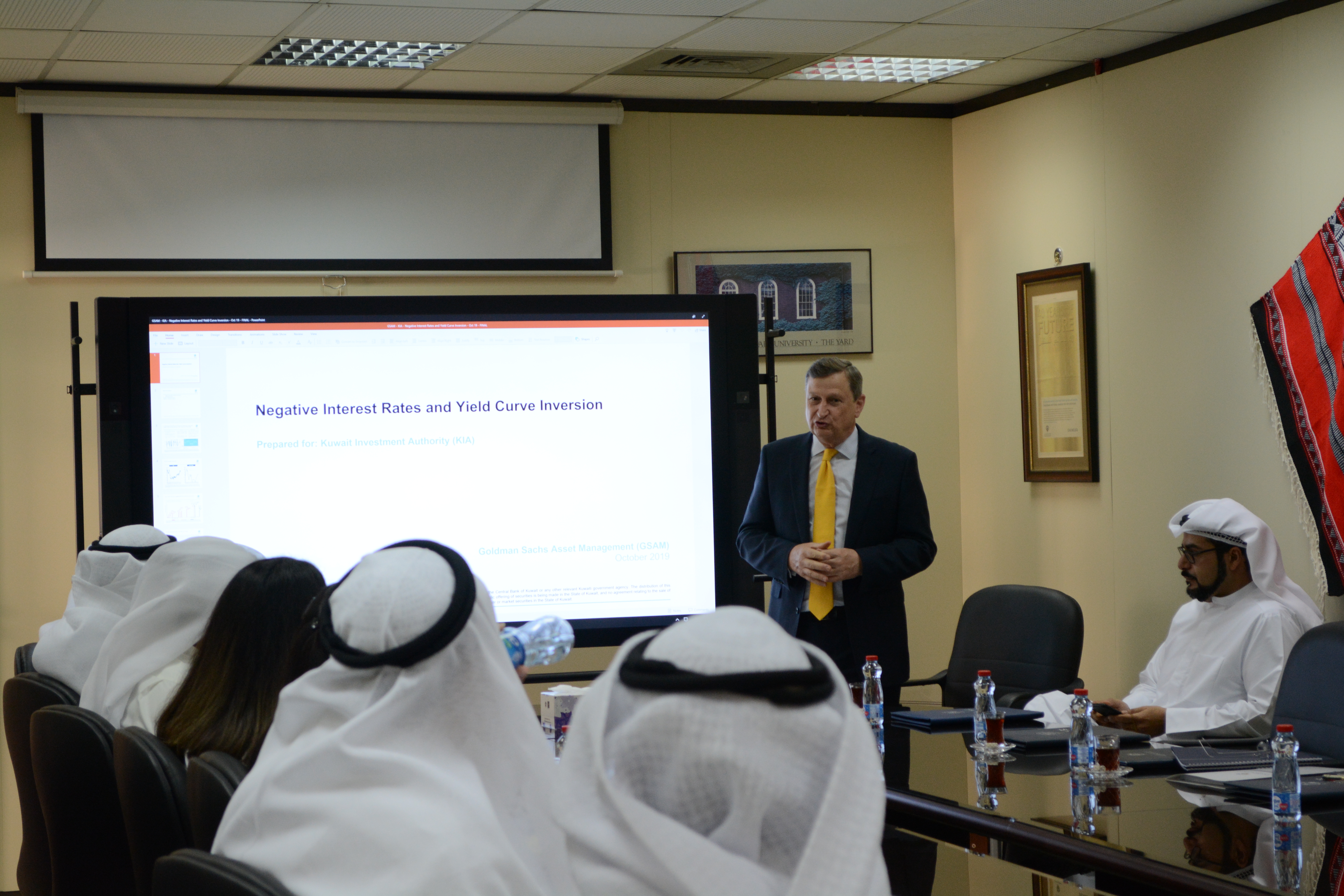
Goldman Sachs has launched a new office in Kuwait, asserting a significant push to enhance its reach across the Middle East and deepen its ties with Gulf-region clients under fresh leadership.

The New York-based investment bank said its role over five decades in Kuwait spans investment banking, capital markets and asset management. As part of its latest expansion, Goldman has tapped Mohammad Almatrouk as managing director of the Kuwait office, pending regulatory green light, while Fahad Alebrahim has been appointed managing director of the firm’s private wealth business in Kuwait.

David Solomon, Goldman Sachs’s Chairman and Chief Executive, framed the move as a commitment to “grow our capabilities across the Middle East and better serve our clients,” emphasising Kuwait’s economic vision as a catalyst for the firm’s expansion.

Goldman Sachs points to a long-standing capacity-building partnership in Kuwait that includes a professional training scheme designed to nurture talent at institutions such as the Kuwait Investment Authority, the Public Institution for Social Security and the Kuwait Fund. That programme, the bank says, will continue to play a central role in integrating local human capital into its global operations.

The choice of Kuwait underscores a growing focus on the Gulf’s institutional capital. Kuwait, host to one of the world’s largest sovereign wealth funds, has attracted global financial firms looking to align with its diversification and investment ambitions. Goldman Sachs’s decision follows earlier regional expansions, such as establishing a presence in Abu Dhabi and securing a banking licence in Saudi Arabia.

Kuwait’s Director General of the Direct Investment Promotion Authority, Sheikh Dr. Meshaal Jaber Al-Ahmad Al-Sabah, praised the move as aligned with Kuwait’s economic diversification and global integration goals. He stressed that opening the office supports national priorities including talent development and sustainable growth.

Regional analysts view Goldman’s Kuwait office as part of a broader recalibration by global banks to embed themselves closer to Gulf capital sources. Over the past two years, deal activity in sovereign and quasi-sovereign asset structures has exploded, prompting major firms including Lazard, JPMorgan and Deutsche Bank to expand in the Gulf with new leadership hires.

Inside Goldman Sachs, the timeline coincides with a leadership transition: the firm’s co-head for the Middle East and North Africa, Fadi Abuali, is slated to retire after nearly 28 years of service. His departure is expected to reshape the firm’s regional hierarchy just as Kuwait becomes a new hub.

Some observers caution the move carries execution challenges. Regulatory approvals in Kuwait must be secured, and Goldman must integrate the new office into its broader Gulf operations without duplicating functions. Success will depend on maintaining local relationships while delivering global platform advantages.

Arabian Post Staff -Dubai Goldman Sachs lifted its December 2026 gold price forecast from $4,300 to $4,900 per ounce, citing strength in Western exchange-traded fund inflows and sustained central bank purchases. Gold’s spot price hovered around $3,960 per ounce early on Tuesday, having earlier touched an intraday high of $3,977.19. Goldman analysts expect central banks—particularly in emerging markets—to continue diversifying foreign-exchange reserves into gold, with forecast average […]

Cisco will unveil its latest innovations at GITEX GLOBAL 2025 in Dubai, aiming to equip enterprises across the Middle East and broader region with infrastructure built specifically for the AI era. The showcase focuses on AI-ready data centres, resilient network architectures, and strengthened security frameworks designed to support advanced workloads in data-intensive environments.

By joining the AI Infrastructure Partnership alongside BlackRock, Microsoft, NVIDIA, xAI and others, Cisco has committed to accelerating capital flows into datacentre and infrastructure projects. The partnership expects to unlock $30 billion in initial funding, scaling up to $100 billion including debt financing. Cisco brings its network, security and systems expertise to support the platform’s mission of secure, at-scale AI infrastructure.

At the heart of Cisco’s push is its new Cisco Data Fabric, launched in integration with Splunk, which provides federated data access across systems such as Amazon S3, Iceberg, Delta Lake and Snowflake, routing workloads intelligently to the best analytics or storage engine. This architecture is intended to reduce data movement, shorten analysis latency, and enable enterprises to transform machine data into AI-ready intelligence.

To support retrieval-augmented generation and agentic AI deployments, Cisco introduced the Secure AI Factory solution with NVIDIA and VAST Data. This validated architecture accelerates data extraction and retrieval at scale while enforcing security guardrails for every token processed. AI PODs built under this architecture offer pre-validated, high-performance building blocks for enterprise AI.

Networking and security are being redefined for the AI workload environment. At Cisco Live 2025, the company launched a next-generation network architecture for campus, branch and industrial environments, delivering unified management and devices purpose-built to support AI traffic patterns. It also introduced Hybrid Mesh Firewall and Universal Zero Trust Network Access to embed security into network fabric across hybrid and distributed environments. These features aim to simplify policy enforcement, improve visibility, and reduce complexity in securing both human users and AI agents.

Cisco CEO Chuck Robbins disclosed that fiscal year 2025 saw record AI infrastructure orders. In its final quarter, the company secured over $800 million from webscale clients, bringing total AI-focused orders to more than $2 billion—more than double its initial target. He described the pipeline as steadily growing into “hundreds of millions” as enterprises demand scalable, secure solutions.

In the Middle East, Cisco plans to demonstrate the regional relevance of its technologies under the theme “Make AI Work for You.” According to Cisco’s new AI Readiness Index, a vast majority of organisations in the UAE expect to expand their data centre capacity for AI within five years. The company will also present its work with Splunk on security and observability platforms at the event.

Cisco’s collaboration with Saudi Arabia’s HUMAIN is intended to build out an open, scalable AI infrastructure ecosystem aligned with Vision 2030. The multi-year programme includes deployment of cloud-based AI infrastructure, joint research initiatives, and efforts to grow local talent and innovation. The partnership underscores Saudi ambitions to position itself as a global AI hub.

Cisco sees accelerating demand for network modernisation. Its internal research reports that 97 percent of IT leaders view modernised networks as critical to deploying AI, cloud and IoT workloads, and 98 percent rate secure networking as essential for growth. However, the same study notes that only 40 percent of organisations have begun deploying advanced segmentation or intelligent control, illustrating an execution gap.

To strengthen its AI strategy, Cisco also expanded its presence in Indonesia by signing a Letter of Intent with BRIN to develop AI and cybersecurity capabilities via its Country Digital Acceleration programme. The plan includes building an AI Centre of Excellence and delivering training in AI, security and networking to 500,000 Indonesians by 2030.

Splunk’s observability portfolio itself is being reworked to embrace agentic AI, deploying AI agents to automate tasks such as root cause detection, alert correlation and issue resolution. This is intended to lighten the operational burden on IT and engineering teams while driving real-time insight.

Filestack has launched a sweeping upgrade to its core platform, introducing a fully integrated Digital Asset Management system, a comprehensive Event Logger, and a revamped Filepicker 4.0 with advanced upload control features. The move is aimed at giving developers stronger tools to manage file workflows, versioning, and audit trails—all without building these systems from scratch. At the heart of the update is the DAM, which allows users […]

Telecom operator du and technology vendor Nokia have completed a trial of an artificial intelligence–driven automation system aimed at simplifying and expediting the expansion and management of optical networks in the UAE.

The deployment tested Nokia’s WaveSuite AI, which combines traditional AI methods with generative models to assist du engineers with tasks such as planning, troubleshooting and documentation retrieval. The trial reportedly halved the time needed for optical network planning and produced designs 30 percent more efficient, while reducing errors during deployment.

During the trial, du’s engineering team used a single natural language interface to query live network status, access accurate documentation instantly, and simulate potential network evolutions. The system flagged possible inconsistencies or conflicting configurations early, allowing corrective adjustment before full-scale rollout. According to du, the result was faster troubleshooting, fewer manual errors and improved resource utilisation.

Saleem AlBlooshi, chief technology officer at du, said the trial “shows how innovation can transform network operations to face challenges brought on by increasingly sophisticated networks and ever-higher traffic volumes.” He emphasised that the automation of routine tasks and provision of intelligent tools would lead to more reliable, SLA-backed connectivity for customers.

From Nokia’s standpoint, Ron Johnson, senior vice president and general manager of Optical Networks, called WaveSuite AI “a demonstration of the real value of automation solutions with both classical and generative AI for optical networking.” He noted that the system reduces friction in planning, documentation search, and operational processes, and helps service providers accelerate provisioning of higher-speed, more reliable services.

The trial builds on du’s broader effort to embed AI and automation more deeply across its systems. Earlier this year, du partnered with Microsoft, Nokia, Khalifa University’s 6G Research Center and the ITU to launch an “Arabic Telecom LLM,” a large language model tailored for internal telecom operations. That model is designed to handle internal workflows, resolve device issues, process complaints and provide operational insights in Arabic and English. The initiative is part of du’s strategy to blend regional research leadership and global AI tools while retaining language and cultural fidelity in its operations.

This AI-driven automation trial comes amid growing pressures on telecom operators worldwide to scale quickly to meet surging demand for bandwidth, driven by AI workloads, data centers and new real-time applications. As networks grow in complexity, manual processes no longer scale efficiently, pushing operators into an era of closed-loop or autonomous operations. Nokia, in its public literature, frames network automation as essential to reducing manual intervention, improving performance and enabling faster service delivery across domains such as core, mobile, IP and optical networks.

In the UAE context, this trial signals du’s ambition to advance its optical infrastructure ahead of demand peaks, while benchmarking its operations for future 6G readiness. The success of automation in planning and deployment could reduce operational costs, increase agility, and support more complex services such as network slicing, ultra-low latency applications and differentiated service tiers.

VISHNU RAJA
RYO YAMADA
HITORI GOTOH
IKUYO KITA
Just in:
DIP Holding targets Dh1.12 IPO price and $529m proceeds // AI trust gap reveals distinct retail priorities: Divergent paths to consumer growth in Hong Kong and the GBA // Use Of Nuclear Weapons Against Iran Could Trigger A Global Chain Reaction // mamun raises US$3 million to finance cross-border trade between the Gulf and Asia // UAE outlines Dh200 billion energy investment at ADIPEC // ONYX Hospitality Group Expands Strategic Partnerships through ONYX Rewards // Winners and losers if a blue wave sweeps US Congress // Can Bernie Sanders Ensure Enough Left Representation In New Congress? // America On Edge: November 3 Mid Term Polls Outcome May Weaken Trump // Arrow Electronics showcases technologies advancing intelligent robotics, mobility and digital infrastructure // ADIPEC leaders urge investment in global energy networks // XTransfer and Bank of China (Hong Kong) Announce Partnership at Hong Kong FinTech Week // ADNOC authorises Ruwais Diyab gas development for 2029 // Assembly ruckus trial begins after 11 years // Ondine Capital Announces First Close of Fund III to Drive AI and Semiconductor Innovation // As AI Reshapes Education, Singapore Convenes Global Dialogue on the Future of Early Childhood Education // CPI, CPM dispute portrayal of Vayalar uprising leaders // Bank99 launches business accounts through Austrian postal network // Apollo broadens Abu Dhabi partnership through Mubadala Capital stake // xCube Access Welcomes Entrust Capital Limited  Expanding Access to Professional Portfolio Management //