Alibaba Group launched its next-generation Qwen artificial intelligence glasses in China on Tuesday, introducing eye-tracking and iris-payment capabilities as the technology group expands its consumer hardware business. The N1 and N1 Pro models went on sale following a product presentation, with the standard N1 priced at 2,899 yuan and the N1 Pro at 3,399 yuan before applicable discounts. The premium model costs roughly $480, while the N1 […]
SHENZHEN, CHINA – Media OutReach Newswire – 13 October 2026 – Global smart device brand OPPO today announced a collaboration with Manus, a leading AI agent platform, to bring next-generation agentic AI experiences to smartphones. By integrating Manus’ agentic capabilities to OPPO AI Mind Pilot, the collaboration will help users turn complex, multi-step tasks into ready-to-use results—advancing OPPO’s vision for Personalized Proactive Intelligence, where AI understands users and proactively helps them get things done.
“Agentic AI marks an important shift from answering questions to helping users get things done.” said Kai Tang, President of Software Engineering at OPPO. “Together with Manus, we are bringing more proactive and capable experiences to AI Mind Pilot, enabling AI to better understand users’ intentions, take actions and complete tasks. Our goal is to make personal AI a natural part of everyday life and work.”
“Smartphones are central to people’s daily lives and support many of the tasks they handle every day, making them a natural platform for personal AI agents,” said Tao Zhang, Co-Founder & CPO of Manus. “By bringing together Manus’ agentic capabilities and OPPO’s system-level integration, we can make advanced AI agents more accessible and help users complete multi-step tasks through simple, natural interactions.”
Manus Capabilities Debut in AI Mind Pilot’s New Agent Mode
The collaboration will debut through the integration of Manus’ agentic capabilities into AI Mind Pilot’s new Agent Mode on the upcoming OPPO Find X10 Series with ColorOS 17.
Designed to move beyond simple question-and-answer interactions, AI Mind Pilot can understand a user’s end goal, break it down into multiple steps, identify relevant information, select the appropriate tools, and deliver a finished result, including by working directly with files and photos stored on the device.
For example, a user planning a trip could simply ask AI Mind Pilot to organize their travel plans. It can find flight tickets, hotel bookings, restaurant reservations, and attraction tickets scattered across different apps on the smartphone, organize them, and combine them with relevant online information to create a personalized, day-by-day itinerary—without requiring users to manually gather and upload the information.
The same capabilities can support everyday creative and professional tasks. Users can ask AI Mind Pilot to find and organize photos from a trip, locate specific images, or bring together existing files and online information to create a presentation, proposal, portfolio, or other ready-to-use content, all with just one single prompt.
Powerful Agentic AI Built Around User Control and Privacy
As AI moves from providing information to working with personal context and completing tasks, privacy, security, and user control become increasingly important. AI Mind Pilot is designed with these priorities at its core.
ColorOS 17 uses on-device models to understand and organize relevant information locally. For local tasks such as finding, organizing, or renaming files and photos, the original content remains on the device and is not shared with Manus. When a task requires external processing, AI Mind Pilot will ask for the user’s explicit confirmation before relevant content is uploaded or shared.
Users remain in control of what information is accessed, which actions are taken and whether external processing is allowed. Through on-device processing and transparent authorization, OPPO and Manus aim to make agentic AI more capable while maintaining a clear fucus on users’ choice and control.
Launching on OPPO Find X10 Series
The Manus-powered capabilities in AI Mind Pilot will debut on the OPPO Find X10 Series with ColorOS 17. Further details on availability, supported markets, and user benefits will be announced at launch.
Hashtag: #OPPO
The issuer is solely responsible for the content of this announcement.
Microsoft has unveiled its third-generation Maia 300 artificial intelligence chip, announcing plans to deploy its proprietary processors across data centres at multi-gigawatt scale from 2027 as it seeks greater control over the cost of running AI services. The company said on Monday that the new accelerator would become the principal system for AI inference across its products, including Copilot, as demand grows for computing resources capable of […]
Hackers are actively exploiting a critical vulnerability in the Bricksforge WordPress plugin that allows outsiders to upload malicious files and execute code on affected websites without signing in, security researchers have warned. The vulnerability, identified as CVE-2026-85097, affects Bricksforge versions up to and including 3.1.8.9. Security firm Patchstack has urged website administrators to install version 3.1.8.10 or later after detecting exploitation attempts beginning on 7 October. Patchstack […]
Turkey has prohibited social media companies from providing services to children younger than 15 under regulations published on Saturday, with the restrictions scheduled to take effect on 1 November. The rules, issued by the Presidency’s Cyber Security Directorate and published in the Official Gazette, require platforms to verify users’ ages, refuse registrations by children below the threshold and close accounts identified as belonging to them. They also […]
A high-severity vulnerability in React Server Components can allow unauthenticated attackers to overwhelm vulnerable Next. js servers through specially crafted HTTP requests, potentially making affected applications unavailable. The flaw, identified as CVE-2026-23870 and tracked under security advisory GHSA-rv78-f8rc-xrxh, affects specific releases of React 19. Security maintainers have issued patches and urged developers operating affected server-side applications to upgrade immediately. The vulnerability carries a severity score of 7.5 […]
Abu Dhabi has launched a new artificial intelligence training programme targeting 20,000 government employees this year, advancing its Dh13 billion strategy to establish the world’s first fully AI-native government by 2027. The Department of Government Enablement announced the AiNative programme on October 7, partnering with OpenAI, Microsoft and Mohamed bin Zayed University of Artificial Intelligence to develop practical AI capabilities across the public sector and eventually among […]
OpenAI has begun rolling out GPT-6 across ChatGPT subscription tiers, introducing an intelligent interface that combines conversational responses with interactive graphics, charts, calculators and other tools generated directly within conversations. The global expansion, announced on October 7, brings GPT-6 Sol to Plus, Pro, Business and Enterprise subscribers, while Free and Go users begin receiving GPT-6 Luna from October 8. Availability will depend on subscription arrangements, supported applications […]
Microsoft has opened pre-orders for its Surface Laptop Ultra, pricing the Nvidia-powered Windows computer from $2,599.99 and positioning it as a premium device capable of running large artificial intelligence models without relying on cloud servers. The company confirmed the pricing and October 16 availability at its October 7 technology event in San Francisco, where Microsoft and Nvidia outlined their partnership to bring advanced AI processing into portable […]
Google has released Nano Banana 2.1, cutting image-generation costs by approximately half while improving editing accuracy, visual consistency and text rendering, as developers face a deadline to migrate from its predecessor. The new artificial intelligence model, introduced on 6 October, targets developers, businesses and creative professionals using automated image production. Google says the upgrade delivers stronger visual quality, better adherence to instructions and greater consistency when users […]
A UPS employee failed to act on a security email barring sensitive F-35 components from transiting Hong Kong, leading the shipment to be diverted there and taken into Chinese custody, according to a person briefed on the incident. The disclosure provides the clearest explanation yet for how a cockpit canopy and weapons-bay door from an Australian F-35 ended up in Hong Kong while being shipped to the […]
Cyber attackers are embedding concealed instructions for artificial intelligence assistants inside phishing emails, creating messages designed to deceive both human recipients and the AI systems that read, summarise or act on their inboxes. Barracuda Research said on Wednesday it had analysed a phishing campaign combining conventional social engineering with hidden prompt injections. The finding illustrates how attackers are adapting email fraud to workplaces where AI assistants increasingly […]
Gulf Business Machines has established what it describes as the UAE’s first AI Lab built on the Cisco Secure AI Factory with NVIDIA, giving organisations across the Gulf a controlled environment for moving artificial intelligence projects from trials into production. The Dubai-based technology company said on Wednesday that the facility combines pre-validated computing, networking, security and AI software to support on-premises and hybrid deployments. GBM said the […]
Qualcomm has agreed to license patents underpinning Huawei Technologies’ LogicFolding chip architecture as part of a broad multiyear intellectual-property agreement spanning 5G, artificial intelligence, computing and networking technologies.
The agreement gives Qualcomm access to technology Huawei has presented as an alternative route to higher semiconductor performance when conventional transistor shrinking becomes harder and more expensive. It also marks an important commercial endorsement of Huawei’s expanding patent portfolio as the company seeks a larger role in global AI and computing markets.
Huawei and Qualcomm said the arrangement includes cross-licences to their patent portfolios across multiple technology fields. Qualcomm will separately purchase certain Huawei patents registered in the United States covering computing, AI, networking and other technologies. That purchase remains subject to required regulatory approvals.
Financial terms and the duration of the agreement were not disclosed. Huawei said completion of the transaction would lift the cumulative value of its patent licensing agreements above $6.9 billion. The company has said its intellectual-property licensing operation has generated positive revenue since 2021.
LogicFolding forms part of Huawei’s Tau Scaling Law, a semiconductor design framework unveiled in May. Rather than depending solely on geometric scaling — making transistors progressively smaller — the approach seeks to reduce the time required for signals to travel through chips and electronic systems.
Huawei says LogicFolding can shorten critical signal paths by reorganising circuits across vertically integrated layers. The company argues that compressing signal-propagation delay can raise effective transistor density and improve performance and energy efficiency without relying entirely on successive advances in lithography.
The technology has particular strategic importance for Huawei because US export controls have restricted its access to some advanced semiconductor equipment and technologies. China-based chipmakers cannot obtain the most advanced extreme-ultraviolet lithography systems made by ASML, complicating efforts to manufacture chips using leading-edge processes through conventional methods.
Huawei has therefore increasingly emphasised architecture, packaging, interconnection and system-level optimisation as ways of extracting more computing performance from available manufacturing technology. LogicFolding is one element of that effort, although Huawei’s performance claims and longer-term projections remain subject to commercial-scale validation.
Huawei has already introduced the architecture in its latest Kirin processors. The Kirin 9050 Pro used in the Mate XT 2 foldable smartphone incorporates LogicFolding, providing an early commercial application of the design approach. Huawei has also outlined plans to extend the underlying method beyond mobile processors towards AI accelerators and other high-performance computing systems.
The patent arrangement does not mean Qualcomm is adopting Huawei’s complete chip architecture in its products. Patent licensing provides legal rights to use covered inventions under agreed terms, while individual product designs, manufacturing decisions and implementation choices remain separate. Neither company disclosed which Qualcomm products, if any, could eventually incorporate technologies covered by the LogicFolding patents.
The broader agreement also deepens a long-running intellectual-property relationship between the companies. Huawei made its first patent-licensing payment to Qualcomm in 2001, while the new pact is their first licensing agreement to encompass 5G technologies.
John Han, executive vice-president and general manager of Qualcomm Technology Licensing, said the agreement recognised Huawei’s continuing innovation and intellectual property in 5G and other technology fields. He also said it reaffirmed recognition of Qualcomm’s 5G technology and its standard-essential-patent licensing programme.
Huawei chief intellectual property officer Alan Fan said the agreement demonstrated the value of Huawei’s innovations while recognising Qualcomm’s foundational contributions to modern communications technology. Both companies said their licensing practices were intended to be consistent with fair, reasonable and non-discriminatory principles.
The deal comes as Qualcomm broadens its business beyond smartphone processors into personal computers, automotive systems, networking and data-centre computing, areas where efficient AI processing and high-speed interconnects are increasingly important.
Qualcomm’s licensing business remains central to its model, with the company saying its portfolio contains 200,000 granted and pending patents across more than 100 countries and jurisdictions, including foundational cellular and AI inventions.
BANGKOK, THAILAND – Media OutReach Newswire – 5 October 2026 – The Long-Term Resident (LTR) visa has attracted 12,010 high-potential foreigners to Thailand in four years, generating approximately USD 1.28 billion (THB 43 billion) in economic value, according to the Board of Investment (BOI). The visa is a key mechanism for attracting executives and highly skilled personnel for future industries while increasing purchasing power and stimulating domestic spending and economic activity. A new online system now links services from four government agencies in an integrated process.
Mr. Narit Therdsteerasukdi, Secretary General of the Thailand Board of Investment (BOI)
Introduced in September 2022 to attract high-potential foreigners to reside and conduct economic activities in Thailand, the LTR visa program has generated an average economic value of more than USD 107,000 (THB 3.6 million) per recipient, according to BOI data. The calculation covers visa fees, spending in Thailand by visa holders, direct investment, and tax revenue from highly skilled professionals.
Amid intensifying global competition for highly skilled personnel, the LTR visa is an important mechanism for bringing global talent into Thailand. This is particularly relevant as the country prepares for a new wave of investment in advanced-technology industries, including semiconductors and advanced electronics, digital technology and AI, humanoid robotics, aviation, and biotechnology.
“The LTR visa is a strategic pillar to attract global talent as Thailand absorbs a new wave of advanced technology investments,” said Narit Therdsteerasukdi, Secretary General of the Board of Investment. “Drawing top-tier executives and technical specialists from around the world is vital to strengthening our national competitiveness and securing technology transfers from international partners.”
Approved LTR visa recipients primarily come from leading economies. The United States accounts for the largest group, with more than 2,400 approvals, followed by Japan with more than 1,300 and the United Kingdom with more than 1,000. Japanese nationals comprise a notable share of the specialist bracket, aligning with Japan’s heavy footprint in Thailand’s automotive and precision-electronics supply networks.
The 12,010 approved LTR visa recipients fall into five categories: 1,779 Highly-Skilled Professionals; 1,043 Work-from-Thailand Professionals, who work from Thailand for overseas employers; 737 Wealthy Global Citizens; 4,561 Wealthy Pensioners; and 3,891 Dependents of recipients in the first four categories.
Among recipients in the Highly-Skilled Professionals and Work-from-Thailand Professionals categories, 54% hold executive-level positions and 36% are professionals in various fields; the remainder are at the technical level. Applicants in each category must meet specific criteria, such as requirements relating to assets, income, investment evidence, work experience, and health insurance, and undergo rigorous checks by the relevant agencies.
To handle rising application volumes and remove long-standing administrative bottlenecks, the BOI rolled out an integrated digital processing portal in September 2026. The platform centralizes review procedures across four primary state bodies: the Department of Consular Affairs, the Immigration Bureau, the Department of Employment, and the Revenue Department.
Complementing the portal, the Thailand Investment and Expat Services Center (TIESC), a one-stop service center, is located on floors 6-7 of the Parade Zone at One Bangkok. “The center is intended to strengthen Thailand’s competitiveness in continuously attracting high-potential talent from around the world,” said Mr. Narit.
In addition to attracting foreign talent through the LTR visa, BOI also facilitates visas and work permits for executives and personnel working in BOI-promoted businesses through the BOI Visa, and offers the Smart Visa for startups. BOI also supports the skills development of Thai personnel through the Skill Bridge measure, and helps Thai entrepreneurs adopt modern technology to enhance their competitiveness through the Business Transformation measure. These measures work hand in hand to attract international experts, develop Thai personnel, and upgrade Thai businesses, strengthening Thailand’s readiness for the transition to a new economy driven by technology and innovation.
Note: Currency conversions are based on the Bank of Thailand’s average selling rate of approximately 1 USD = 33.6 THB.
The issuer is solely responsible for the content of this announcement.
Thailand Board of Investment (BOI)
Established in 1966, the Office of the Board of Investment (BOI) has played an important role for more than 60 years in promoting value-creating investment by both foreign and Thai investors, strengthening competitiveness and supporting Thailand’s sustainable economic restructuring toward the new economy.
HONG KONG SAR – Media OutReach Newswire – 5 October 2026 – Amid rising operating costs and accelerating digital transformation, many small and medium-sized enterprises (SMEs) in Hong Kong are facing increasing pressure from equipment investment, limited manpower resources, and the growing complexity of print management across multiple departments. For organizations with multiple teams, office locations, or hybrid work arrangements, maintaining a reliable and efficient printing environment at a reasonable cost has become an important operational challenge.
Most businesses primarily print A4 documents such as contracts, invoices, reports, and administrative paperwork. When A4 printing is sufficient to meet the majority of daily business requirements, investing in larger and more expensive printing equipment may not be necessary. Brother’s Managed Print Service (MPS) allows businesses to flexibly deploy printing resources according to actual operational needs without incurring substantial upfront capital expenditure. The service also provides comprehensive consumables management, maintenance, and professional technical support, making print management simpler and more efficient.
Comprehensive Print Management That Reduces Administrative and IT Workloads
Traditional printer ownership often involves purchasing equipment, replenishing consumables, arranging repairs, and managing technical support, all of which can increase administrative efforts and hidden operating costs, particularly for SMEs without dedicated IT or administrative teams.
Brother’s Managed Print Service includes printer usage, consumables supply, maintenance services, and technical support. This enables businesses to enjoy a reliable printing experience without spending additional time managing day-to-day printing operations, allowing resources to be redirected toward core business development.
Eliminate Large Capital Expenditure and Improve Cash Flow Management
For growing businesses and startups, major investments in office equipment can significantly impact cash flow planning.
Under the monthly subscription model, businesses pay a fixed monthly fee to access professional-grade Brother printing equipment without making a substantial upfront investment. The service also does not impose a fixed monthly print volume limit, enabling organizations to adjust printing usage and device deployment according to operational needs. This flexibility helps businesses control costs more effectively while minimizing resource underutilization and wastage. Flexible Multi-Device Deployment for Greater Departmental Productivity
For organizations with multiple departments or work teams, relying on a single shared printer can often result in wait times and reduced document processing efficiency.
Brother’s Managed Print Service solution enables businesses to deploy multiple printers according to actual operational requirements. For example, administrative, human resources, finance, and sales departments can each be equipped with printers tailored to their specific needs. This helps minimize waiting time, reduce cross-department disruptions, improve workflow efficiency, and enhance document confidentiality.
The solution is also well-suited for organizations with multiple offices, retail outlets, or distributed business teams, providing centralized management of multiple devices while ensuring consistent technical support and after-sales service.
Proactive Consumables Replenishment Minimizes Business Disruptions
Many businesses have experienced workflow interruptions caused by depleted toner or consumables, potentially delaying important document production, customer service, and internal operations.
Brother’s Managed Print Service automatically monitors printer performance and consumables usage, proactively arranging replenishment before supplies run low. For industries with high printing demands, such as insurance, financial services, logistics, professional services, and education, this not only reduces administrative workload but also minimizes inventory management and procurement-related tasks.
Designed for Hong Kong Offices and Hybrid Work Environments
As hybrid working becomes increasingly common, businesses require more flexible approaches to printer deployment.
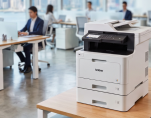
Brother offers a range of compact yet feature-rich printers that are particularly suitable for Hong Kong’s space-constrained office environments, departmental workspaces, and shared offices. With a smaller footprint while still meeting everyday business printing requirements, these devices help organizations make better use of valuable office space.
In addition, Brother provides remote technical support services to assist with device setup, network connectivity, and other technical issues, reducing the day-to-day support burden on IT teams.
Five Key Benefits of Choosing Brother “Managed Print Service”
Reduce large upfront procurement costs and adapt flexibly to changing business needs
Proactive consumables replenishment to minimize inventory management and purchasing efforts
Maintenance and professional technical support to reduce equipment downtime risks
Automated usage monitoring to lower administrative and management workload
Compact printer design ideal for Hong Kong’s limited office space
Focus on Growing Your Core Business
Through its monthly subscription model, flexible device deployment, automated consumables management, and professional technical support, Brother’s Managed Print Service helps businesses simplify print management, reduce overall operating costs, and improve productivity across departments and locations.
When most printing requirements consist primarily of A4 documents, businesses can select the most suitable device configuration based on their actual operational needs without allocating additional resources to infrequent printing demands. By adopting a more flexible and streamlined print management approach, organizations can focus on growing their business, serving customers, and driving innovation, ultimately strengthening their competitive advantage.
Information contained in this release is accurate at the time of publication and is subject to change without prior notice. Hashtag: #BrotherHK #BrotherMPS #BusinessSolutions #OfficeSolutions #PrintManagement #PrinterRental #OfficeSolutions #Sustainability
The issuer is solely responsible for the content of this announcement.
About Brother International (HK) Limited
Founded in Japan in 1908, Brother has over 110 years of history. It has developed into an international brand with 16 production facilities and 51 sales points worldwide, spanning 44 countries. Brother produces high-quality and innovative products for the printing and imaging, labelling, and sewing markets, maintaining a leading position in the industry. Its main products include a variety of inkjet and laser printers, multifunction printers, fax machines, scanners, label printers, and a range of home sewing machines and commercial embroidery machines.
As a trusted brand, Brother adheres to a “customer-first” philosophy in all aspects of its business, continually meeting diverse customer needs and market challenges with comprehensive and high-quality solutions.
Brother International (Hong Kong) is one of the leading suppliers of home, office, and industrial products in Hong Kong. Established in 1994, it has been serving customers in Hong Kong and Macau for over 30 years. According to IDC’s Global Hardware Peripheral Tracker report, Brother’s A3 multifunction colour inkjet printer has been the number one in shipment volume in the world for 18 consecutive years from 2008 to 2025, reaffirming Brother’s business success in the region.
For more information about Brother Hong Kong, contact our WhatsApp at (852) 3187 0505 or visit the website www.brother.com.hk。
NOTE: All brand and products names are trademarks or registered trademarks of their respective companies.
DeepSeek has expanded support for Huawei’s Ascend artificial-intelligence processors by releasing core programming libraries designed to preserve familiar developer workflows across rival hardware, strengthening China’s effort to loosen Nvidia’s grip on AI computing software.
The Hangzhou-based AI developer released Ascend versions of several key components on September 30, including its DeepGEMM matrix-multiplication library and DeepEP communications software. The projects are designed to work with Huawei’s Ascend processors while keeping public interfaces aligned with versions built around Nvidia hardware, reducing the amount of code developers may need to rewrite when moving workloads.
That portability targets a critical part of Nvidia’s competitive advantage. Nvidia’s CUDA software platform has become deeply embedded in AI development, giving programmers mature libraries, tools and optimisation techniques built over years. Competing chips therefore have to overcome not only differences in raw computing performance but also the cost and complexity of shifting software away from CUDA.
DeepSeek’s DeepJIT project takes a further step by providing a shared runtime interface for Nvidia CUDA graphics processors and Huawei Ascend neural-processing units. It handles compilation, caching, loading and launching of specialised AI kernels while retaining backend-specific code where necessary. The approach does not make the two architectures interchangeable, but it can reduce friction for developers maintaining software for both.
DeepGEMM-Ascend is fully API-compatible with DeepSeek’s original DeepGEMM package and supports BF16, FP8 and FP4 calculations used in demanding AI workloads. DeepSeek says the library uses Ascend-specific optimisation methods to approach the hardware’s performance limits while shielding programmers from lower-level complexities including memory layouts, alignment constraints and address calculations.
Its DeepEP-Ascend library similarly aligns its public buffer interfaces with the Nvidia version while using Huawei’s communications technologies underneath. DeepSeek has also added Ascend support to DeepSelect, a specialised component used for sparse-attention and sampling operations, and released Ascend sparse-attention kernels for its model infrastructure.
Huawei, meanwhile, has been opening more of the software surrounding Ascend. Its CANN platform — the company’s counterpart to the programming infrastructure required to exploit AI accelerators — supports frameworks including PyTorch and works with open-source projects such as Triton, vLLM and veRL.
Huawei said last month that CANN had moved to sustained community-driven open-source development, with external programmers accounting for 61 per cent of its CANN developers. The company said the community had more than 5,200 monthly active developers, while more than 40 models had been natively pre-trained using Ascend and CANN.
The combination matters because China’s challenge to Nvidia has increasingly shifted from producing an alternative accelerator to assembling a usable full computing stack. Hardware can win orders only if model developers can train and run workloads efficiently without sacrificing too much engineering time or performance.
DeepSeek’s software also gives Huawei an influential independent developer helping test and improve that stack. The AI laboratory became prominent for building capable models with an emphasis on computational efficiency, and its infrastructure code is closely watched by developers seeking lower-cost approaches to training and inference.
The effort comes as US export controls continue to restrict China’s access to Nvidia’s most advanced processors, creating stronger incentives for technology groups to adopt domestic alternatives. Those restrictions have helped expand the strategic importance of Huawei’s Ascend line, even though China still faces constraints in advanced semiconductor manufacturing.
Nvidia nevertheless retains formidable advantages. CUDA has a vast installed developer base and an extensive collection of mature libraries, while Nvidia’s leading accelerators remain central to major AI training systems outside China. Compatibility layers and open-source libraries also require sustained testing, documentation and optimisation before they can match the reliability of an established platform across diverse workloads.
Cloudflare has released two open-source artificial intelligence decision models, Clef and Clef-flash, mounting a direct challenge to TypeSafe AI’s Jev in the emerging market for fast, structured decisions inside software and autonomous-agent workflows. The company made both models available through Workers AI on October 1 and released their weights on Hugging Face under the Apache 2.0 licence. Clef has 27 billion parameters, while the latency-focused Clef-flash has […]
SHENZHEN, CHINA – Media OutReach Newswire – 3 October 2026 – Huawei hosted an international media roundtable today featuring Richard Yu, Executive Director, Chairman of the Investment Review Board, and Chairman of the Board of Directors of the Consumer BG. Yu shared comprehensive insights into Huawei’s consumer business and HarmonyOS ecosystem.
Richard Yu joined Huawei in 1993, working on early developments like the first-generation program-controlled switch and participating in the establishment of Huawei’s wireless communications business, which started with GSM. Over the past decade, Yu has led Huawei’s consumer business with the vision to deliver a seamless AI life experience to all consumers across five key scenarios: HIMA-powered Smart Travel, HarmonyOS Office, Smart Home, Fitness & Health, and Entertainment, which he said is also the long-term strategy for Huawei’s consumer business over the next 10 years.
Between 2007 and 2025, Huawei invested more than CNY1.8 trillion into R&D shifting from roughly 10% of annual revenue in early years to over 20% recently. Huawei has continued to increase investment into the core technologies of the ICT domain and basic research, which has translated into robust core capabilities, extensive intellectual property, and a vast patent portfolio, and helped with achieving a series of breakthroughs in technological innovation.
The Mate 90 series smartphones Huawei just launched come with the latest Kirin 9050 Pro chip. The overall device performance is 31% higher than the previous generation. The Balong modem, image sensor processor (ISP), mobile security processor (MSP), Lingxi CPU, Maleoon GPU, and the NPU that adopts Huawei’s Da Vinci architecture for AI processing are all designed by Huawei. They offer higher energy efficiency and deliver much-improved overall system-level performance.
Even though Yu admitted that Huawei has limited access to advanced semiconductor processes, Huawei recently made a new breakthrough in the semiconductor domain – the LogicFolding technology under the Tau Scaling Law. Unveiled by He Tingbo, head of Huawei’s Semiconductor Business Department this May, this technology vertically stacks the logic layers of chips and restructures the circuit layout through inter-layer high-density interconnect to shorten critical paths and reduce latency. This technology was adopted on Kirin 9050 Pro chip, which shows very strong AI processing power. The Mate 90 series powered by this chip can run a 30B MoE on-device AI model.
In the AI domain, Yu talked about the Ascend compute foundation that Huawei provides, by remarking Huawei’s large models called openPangu, AI capabilities for intelligent driving, and HarmonyOS Celia, which is similar to Gemini in the Google Android ecosystem. Huawei is also using AI to improve the O&M of communications network equipment. By combining AI computing power with domestic open-source large models, Huawei’s vision is to help enterprises and industries around the world to become more productive and bringing more convenience to everyone.
In the past years, Huawei has launched a broad series of products and solutions, including smartphones, PCs, tablets, wearables, TWS audio products, Smart TVs, home routers, smart home control solutions, as well as intelligent electric vehicles together with partners. Underlying these products and solutions are Huawei’s chip hardware platform and HarmonyOS – another OS ecosystem after iOS from Apple and Android from Google that Huawei developed to support all the smart devices and smart hardware across all scenarios.
Development of HarmonyOS began in 2019. Before that, Huawei was a major contributor to the Android community as well as the entire Android ecosystem. Now, more than 90 million devices, including smartphones, PCs, and tablets, currently run on HarmonyOS 6 and HarmonyOS 7. This figure is expected to hit the 100 million mark by the end of this year. The number of apps and services in the HarmonyOS ecosystem has already exceeded 450,000. Its global registered developer count has reached 11 million, and Huawei now has over 23,000 app innovation partners. Expressing his special thanks to all partners and developers for their trust and support, Yu also pointed out that Huawei is considering gradually bringing HarmonyOS to the global market in the future.
Globalization is another topic of the conversation. Yu mentioned that Huawei had very good collaboration with many companies from the US, Europe, Japan, South Korea, and Taiwan, delivering huge business value and benefits to those partners. When it comes to the difficulties that Huawei overcame since 2019, Yu said that relying on homegrown technologies and capabilities, Huawei gradually designed its own operating system and developed basic tools and software by themselves, putting a domestic supply chain in place. In 2023, Huawei started to manufacture the chips used by smartphones domestically again. With these chips and HarmonyOS, and by relying on China’s domestic supply chain, materials, and process nodes, Huawei has basically gotten rid of the dependence on US technologies.
While Huawei’s global market share was once No. 1, nowadays it only sells several million units of smartphones outside China every year. However, Yu revealed that Huawei is trying to return to the overseas market step by step.
Taking wearables as an example, Huawei is No. 1 in terms of the market share both in China and globally. Other innovative products such as TWS earphones, are also growing fast and have reached No. 1 in many countries. While Huawei’s tablet and PC business was greatly affected after it was denied access to Windows and Intel x86 chips, the HarmonyOS-based tablets are now performing strongly. Another example would be CPE, which is a mobile router that provides connectivity to the unconnected in remote and rural areas. These products are also very well received across many regions outside China, helping more people connect to the rest of the world and live better lives.
Question: Both the Huawei XT 2 and the two most advanced models of the Mate 90 series use a LogicFolding chip. Will LogicFolding chips be used for more phones in the future? We understand that Huawei’s chip production capacity is still limited. Huawei has launched SuperPoDs, and AI infrastructure is a huge business. They are both very important in China. How do you secure a larger share of the chip supply internally?
Richard Yu: We started introducing the chip that adopts the LogicFolding technology powered by the Tau Scaling Law to the Mate XT 2 tri-fold phone. To answer your question, yes, more of our phones will definitely use these LogicFolding chips in the future.
Currently, the production capacity for advanced semiconductors in China still cannot meet the rapidly growing demand. Huawei’s Ascend chips for the AI domain also use such capacity. But we have developed a requirement plan, which also covers the chip requirements of smartphones.
The sharp price increase for memory components over the past two years has somewhat limited the smartphone sales volume. Even though the production capacity remains tight right now, generally it is sufficient to meet our market shipment needs.
We hope that production capacity will ramp up in China’s semiconductor industry so that we can manufacture more advanced products for consumers in the Chinese market as well as the overseas market in the future.
Oman plans to more than double onshore crude storage at Duqm to 10 million barrels within three years while considering two supertankers for floating storage, strengthening capacity outside the Strait of Hormuz as Gulf producers seek alternatives to the contested waterway. State-owned energy group OQ is evaluating the purchase of two very large crude carriers, each capable of holding about 2 million barrels, Group Chief Executive Ashraf […]
President Trump says the White House is considering a ban on US diesel exports “very seriously”. This is a huge threat, but behind the threat sits a problem no export ban can solve: the world can’t refine enough fuel. A barrel of crude does nothing for a truck or a cargo ship until a refinery has processed it. Oil in the ground or on a tanker counts […]
Arabian Post Staff -Dubai Oil prices steadied near $105 a barrel on Tuesday as Saudi Arabia restored substantial flows through its East-West pipeline, easing supply concerns while stalled US-Iran diplomacy kept a risk premium embedded in the market. Brent crude futures for November traded around $105.50 a barrel after settling at $105.28 on Monday, while US West Texas Intermediate was near $93. Prices had risen earlier as […]
SHANGHAI, CHINA – Media OutReach Newswire – 29 September 2026 – From October 12 to 15, 2026, the 2026 International Brew & Beverage Processing Technology and Equipment Exhibition for China (CBB 2026) — the benchmark full-industry-chain exhibition for the liquid food sector in the Asia-Pacific region — will open at the Shanghai New International Expo Centre (SNIEC). With the final countdown underway, this biennial industry event is sending a rallying call to the global liquid food community on an unprecedented scale.
The next decade of the liquid food industry is beginning here — ahead of time.
Guided by the themes of innovation, intelligence, sustainability and high-end development, and committed to “building a new platform for upgrading the entire liquid food industry chain while writing a new chapter of high-quality development,” CBB 2026 will bring together leading enterprises from every segment: baijiu (Chinese spirits), beer, beverages, dairy, condiments and packaging equipment. More than 900 exhibitors from China and abroad will make a joint appearance, and over 60,000 professional visitors from around the world are expected to attend for business discussions, across an exhibition area exceeding 100,000 square meters.
After more than three decades of development, CBB has long been more than a trade fair. It continuously connects the entire chain — from raw materials, brewing and filling to packaging and digital smart manufacturing — creating an integrated industry platform for business matching, technical exchange and innovation. Step into CBB and you will see an exhibition; look closer and you will read the present and the future of an entire industry chain.
01 Leading Enterprises from Every Segment — One Show for the Entire Industry Chain
This year’s exhibitor lineup can truly be described as a full mobilization of the industry chain.
From upstream raw and auxiliary materials, brewing and processing, to midstream filling, packaging equipment and production line integration, and on to downstream labeling and coding, smart warehousing and digital solutions — leading enterprises from every segment, including baijiu, beer, beverages, dairy and condiments, will take the stage together, forming a complete map of the industry.
Whether you are sourcing turnkey production lines or comparing individual machines, whether you focus on a single process or evaluate complete smart-manufacturing solutions, you will find your answer at this show.
02 Four Highlights: Unlocking the 2026 Trends of the Liquid Food Industry
Closely aligned with industry development trends, this edition focuses on four main themes — internationalization, localization, intelligentization and green development — bringing together cutting-edge technologies and innovations from around the world to present a clear picture of where the industry is heading.
Highlight 1 | Global Giants Gather as Frontier Technologies Take the Stage
The international zone boasts a stellar lineup: world-renowned brands including BarthHaas, Fermentis, Krones, HEUFT, CIMC Enric, SACMI, ifm, Endress+Hauser, SEW-Eurodrive, Alfa Laval and Grundfos will all be present, covering core supporting technologies that range from hops, raw and auxiliary materials and pre-treatment processes to filling and packaging equipment and integration, end-of-line packaging and conveying, smart factory solutions and water treatment — spanning the entire liquid food production and packaging chain. A number of brand-new machines and solutions will make their on-site debuts, showcasing the latest achievements in smart manufacturing and green sustainability for the liquid food industry.
Highlight 2 | Chinese Smart Manufacturing Breaks Through as Homegrown Equipment Goes Global
Leading Chinese liquid food equipment manufacturers — Tech-Long, Newamstar, Lehui, Zhongya, Zhongchen, SUNRISE, Hermann and Talos — will exhibit in force, showcasing independently developed core equipment and technologies such as high-speed filling, aseptic packaging, intelligent inspection and integrated smart production, covering the entire production process from raw material pre-treatment, brewing and processing to filling and sealing, labeling and coding, and smart warehousing. These achievements not only help small and medium-sized food producers cut costs, boost efficiency and optimize their production systems, but will also accelerate the expansion of Chinese high-end equipment into global markets.
Highlight 3 | Smart Upgrading Across All Scenarios: Building a New Ecosystem of Digital Production
Digital transformation is one of the defining features of this edition, addressing smart-upgrading needs across the entire liquid food industry chain. From automated and intelligent production scheduling, predictive maintenance and big-data quality control throughout the process, to complete digital-twin factory solutions, every scenario is covered. Core intelligent equipment — including smart sensors, automated control systems and unmanned sorting machines — will be on display, helping the industry move from traditional manual control toward fully digital, intelligent and unmanned production.
Highlight 4 | Green and Low-Carbon Empowerment: Sustainable Production Solutions That Deliver
Aligned with global dual-carbon strategies and the industry’s low-carbon transition, exhibitors will launch a range of low-carbon technologies and equipment, including energy-efficient filling machines, circulating water treatment technologies, equipment for biodegradable packaging, and waste heat recovery systems. While optimizing production costs and efficiency, these solutions comprehensively support energy conservation and emission reduction, offering practical, full-coverage green production solutions for producers of alcoholic drinks, beverages, water, dairy products, condiments and other liquid foods — and helping the industry build a sustainable future.
03 More Than Ten High-Level Forums: Decoding the Trends Shaping the Industry
More than ten high-quality concurrent events will be held during the show, bringing together authoritative industry experts, chief engineers of leading enterprises and industry leaders for in-depth discussions on segment trends, technological innovation and industrial transformation.
04 Why Attend? Three Audiences, Three Answers
If you are a business owner or procurement decision-maker: compare leading solutions from across the industry chain in one place, connect with quality suppliers, and identify practical paths to lower costs, higher efficiency and transformation.
If you are an engineer or part of a production technology team: experience live demonstrations of cutting-edge equipment, meet manufacturers’ technical experts face to face, and be among the first to grasp the trends in smart manufacturing and green, low-carbon technologies.
If you are an industry observer or investor: read the next three to five years of the liquid food industry through the exhibitor lineup, technology directions and forum topics.
05 See You in Shanghai This October
A biennial rendezvous — and a shared point on the calendar for the entire industry.
From October 12 to 15, 2026, CBB 2026 looks forward to welcoming you at the Shanghai New International Expo Centre. For more information, please visit www.chinabrew-beverage.com.
Hashtag: #CBB2026
The issuer is solely responsible for the content of this announcement.
Africa should build artificial intelligence around problems faced by its communities rather than import technological priorities designed elsewhere, a member of a United Nations-backed scientific panel has said. Girmaw Abebe Tadesse, a member of the Independent International Scientific Panel on Artificial Intelligence and head of Microsoft’s AI for Good Lab in Kenya, said countries should identify the challenges they want to address before deciding what technology, infrastructure […]










 https://www.boi.go.th/en/index/


 https://www.facebook.com/brother.hk/?locale=zh_HK
 https://www.instagram.com/brother_hongkong/?hl=en