News related to
processing

HONG KONG SAR – Media OutReach Newswire – 1 September 2026 – Hong Kong Science and Technology Parks Corporation (HKSTP), in collaboration with the Innovation and Technology Commission, successfully hosted the launch ceremony for the third InnoHK research cluster (SEAM@InnoHK) at Hong Kong Science Park today. Focusing on emerging domains such as sustainable development, energy, advanced manufacturing, and materials, SEAM@InnoHK is jointly led by top local and international academic and research institutions. The platform demonstrates Hong Kong’s robust R&D capabilities and global collaboration networks while promising tangible societal benefits, further solidifying Hong Kong’s role as an international I&T hub.

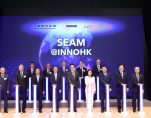
Officiating guests at the Launch Ceremony included Professor Sun Dong, Secretary for Innovation, Technology and Industry (front row, centre); Ms Cordelia Chung, Chairman of HKSTP (front row, 4th from right); Mr Kelvin Choi, Permanent Secretary for Innovation, Technology and Industry (front row, 4th from left); Mr Lyu Feng, Deputy Director-General of the Economic and Financial Department II of the Liaison Office of the Central People's Government in the HKSAR (front row, 3th from right); Mr Ivan Lee, Commissioner for Innovation and Technology (front row, 3th from left); and Mr Terry Wong, Chief Executive Officer of HKSTP (front row, 1st from right).
Officiating guests at the Launch Ceremony included Professor Sun Dong, Secretary for Innovation, Technology and Industry (front row, centre); Ms Cordelia Chung, Chairman of HKSTP (front row, 4th from right); Mr Kelvin Choi, Permanent Secretary for Innovation, Technology and Industry (front row, 4th from left); Mr Lyu Feng, Deputy Director-General of the Economic and Financial Department II of the Liaison Office of the Central People’s Government in the HKSAR (front row, 3th from right); Mr Ivan Lee, Commissioner for Innovation and Technology (front row, 3th from left); and Mr Terry Wong, Chief Executive Officer of HKSTP (front row, 1st from right).

The launch ceremony was officiated by key guests including Professor Sun Dong, Secretary for Innovation, Technology and Industry; Ms Cordelia Chung, Chairman of HKSTP; Mr Kelvin Choi, Permanent Secretary for Innovation, Technology and Industry; Mr Lyu Feng, Deputy Director-General of the Economic and Financial Department II of the Liaison Office of the Central People’s Government in the HKSAR; Mr Ivan Lee, Commissioner for Innovation and Technology; and Mr Terry Wong, Chief Executive Officer of HKSTP. They were joined by representatives and scholars from local and overseas universities, international research organizations, R&D centres, and industry partners to witness the launch of SEAM@InnoHK and explore its R&D roadmap and industrial application prospects.

Building a Flourishing Ecosystem to Empower R&D Commercialisation

As the largest I&T ecosystem in Hong Kong, HKSTP provides comprehensive professional support and resources to the R&D centres under SEAM@InnoHK. This encompasses world-class R&D infrastructure, seamless connections with academic institutions, talent pools, and investor networks, as well as matchmaking with funding and industry partners—empowering teams to transform breakthrough research into scalable, high-impact commercial solutions.

Ms Cordelia Chung, Chairman of HKSTP, said: “InnoHK has been with the Science Park for 5 years and this is the start of the second 5-year period. What we can see is that InnoHK has demonstrated the power of collaboration amongst world eminent scholars, researchers, and global partners. The first two clusters, Health@InnoHK and AIR@InnoHK have delivered world-class achievements. We commit to provide all the support we can to the InnoHK teams, as your success will add to the heartbeat of the ecosystem—not only for HKSTP, but for Hong Kong’s entire innovation landscape.”

Gathering Global Scientific Excellence to Drive Breakthroughs

The eight R&D centres under SEAM@InnoHK have brought together over 30 top global universities and research institutions, including the University of Cambridge, École Polytechnique Fédérale de Lausanne (EPFL), Nagoya University, National University of Singapore, Tsinghua University, and Peking University.

Notably, three R&D centres feature collaborations with Nobel Laureates: Professor Ben L. Feringa from the University of Groningen (2016 Nobel Laureate in Chemistry), who participates in the research at the InnoHK Centre of Functional Materials for Energy and Sustainability (CFMES); Sir Konstantin Novoselov, renowned as the “Father of Graphene” from the National University of Singapore (2010 Nobel Laureate in Physics), who serves as principle investigator for the Inno Centre for Heterogeneous Integration and Production (CHIP); and Professor Hiroshi Amano from Nagoya University (2014 Nobel Laureate in Physics), who participates in research at InnoHK Power Semiconductors and Applications Center (PowerSAC). This stellar international scientific lineup highlights Hong Kong’s unique advantages in assembling world-class research talent, fostering cross-border collaboration, and driving technological innovation, further consolidating its status as a global hub for research cooperation.

InnoHK is a flagship I&T initiative of the HKSAR Government aimed at developing Hong Kong into a global hub for scientific research cooperation. It encourages world-leading universities and research institutes to conduct collaborative research with local institutions by establishing R&D centres in Hong Kong. Together with “Health@InnoHK”, focusing on healthcare technologies and “AIR@InnoHK”, focusing on AI and robotics technologies, the three InnoHK research clusters will further enrich Hong Kong’s world-class scientific landscape, accelerating technology transfer, startup incubation, and the growth of the I&T industry.

Introduction to the Eight SEAM@InnoHK R&D Centres (For details, please refer to the Appendix):

  • InnoHK Centre for Advanced and Smart Manufacturing (CASM): Lead global manufacturing toward Industry 5.0 by fusing AI, advanced materials, additive manufacturing and digital twins to create smart, sustainable, and human-centered solutions.
  • InnoHK Centre of Functional Materials for Energy and Sustainability (CFMES): Advance breakthrough discoveries in functional materials to address bottleneck challenges related to energy and sustainability.
  • InnoHK Centre for Heterogeneous Integration and Production (CHIP): Advance next-generation electronics through innovations in semiconductor equipment and material processing, with a focus on advancing heterogeneous integration technologies.
  • InnoHK Centre for Space Manufacturing Technology (CSMT): Establish a world-class hub for international research collaboration in space manufacturing, integrating cutting-edge R&D in advanced materials and additive processes with demonstration and applied innovation in Hong Kong.
  • InnoHK Hong Kong Center for Renewable Energy and Storage (HKCRES): Develop and integrate high-performance perovskite photovoltaics, green hydrogen systems, and next-generation batteries via an end-to-end innovation framework in Hong Kong.
  • InnoHK Power Semiconductors and Applications Center (PowerSAC): Develop advanced power semiconductors, intelligent chips and system technologies for more efficient, compact and reliable power conversion.
  • InnoHK Research Centre for Intelligent GRID and Energy Technologies (I-GET): Develop intelligent, green and transformative grid and energy technologies for resilient, efficient and carbon-neutral cities.
  • InnoHK Sustainable Materials & Advanced Renewable Technologies (SMART Centre): Leverage artificial intelligence and smart automation technologies to accelerate materials discovery for circular waste upcycling, repurposing, and next-generation clean energy technologies.

Hashtag: #HKSTP

The issuer is solely responsible for the content of this announcement.

About Hong Kong Science and Technology Parks Corporation

Hong Kong Science and Technology Parks Corporation (HKSTP) was established in 2001 and has built a proven foundation as Hong Kong’s leading innovation and technology (I&T) ecosystem. Established for 25 years, HKSTP is supporting 14 unicorns, has nurtured more than 17,000 research professionals and built a community of over 2,400 technology companies from 26 countries and regions across four strategic technology clusters: Life and Health Technology, AI and Data Science, Micro-electronics, and New Energy and Green Technology.

As an ecosystem orchestrator, HKSTP provides end-to-end support to attract and nurture talent, accelerate commercialisation and help technology ventures scale. Its innovation infrastructure spans over 240 hectares covering Hong Kong Science Park in Pak Shek Kok, InnoCentre in Kowloon Tong, and three modern InnoParks in Tai Po, Tseung Kwan O and Yuen Long, advancing Hong Kong’s vision for new industrialisation and smart manufacturing.

Hong Kong Science Park Shenzhen Branch in Futian, Shenzhen, strengthens cross-border collaboration by connecting Hong Kong, the Chinese Mainland and global innovation networks and propels Chinese innovators onto the world stage, while also delivering comprehensive GBA landing support to accelerate cross-border success for local and international ventures.

As HKSTP enters its next chapter with strong foundations, it continues to deepen impact, elevate quality and create value for innovators. As an ecosystem built to lead change, HKSTP is empowering Hong Kong to define what comes next in innovation, growth and opportunity.

More information about HKSTP is available at .

SINGAPORE – Media OutReach Newswire – 31 August 2026 – Apical, through PT Sari Dumai Oleo (PT SDO), recently provided free health screenings and treatment to more than 60 residents of Lubuk Gaung, Sungai Sembilan, Dumai, Riau, helping bring basic healthcare services closer to the local community.

Held at the grounds of Pon An Kiong Temple, the initiative provided residents with medical examinations and consultations for common health conditions, including acute respiratory infections, skin conditions and diarrhea. Residents also received cholesterol, uric acid and blood sugar tests to help monitor their health and identify potential risks at an earlier stage.

Apical Dumai Head of General Affairs M. Jaya Budi Arsa said the initiative was intended to make healthcare services more accessible to residents, particularly those living in communities around Apical’s operations.

“We want to provide support that delivers real benefits and responds to the community’s needs. Through this initiative, we hope residents can access basic health services more easily and address health concerns earlier,” Jaya said.

The initiative reflects Apical’s commitment to supporting communities through programmes that address key areas of wellbeing, including health, education and economic empowerment. These efforts are guided by Apical’s 5Cs philosophy — doing what is good for the community, country, climate and customers, and only then will it be good for the company — which underpins the company’s approach to supporting communities around its operations.

Dumai Health Agency Head Dr. Syaiful welcomed the initiative, noting that collaboration between the government, private sector and communities can help expand access to healthcare and encourage greater awareness of preventive health.

“Collaboration among the government, private sector and communities is important to expanding access to health services. We hope this initiative will benefit local residents while also raising awareness of the importance of regular health checkups,” Syaiful said.

The initiative also received positive responses from local residents. Idrus, representing residents of RT 015, said the free health screenings and medical services made it easier for residents to access healthcare, particularly as the activity was held close to their homes.

Through initiatives such as this, Apical, a member of the RGE group of companies founded by Sukanto Tanoto, continues to work with local government and communities to support practical programmes that respond to local needs.
Hashtag: #RGE #Apical #community #healthcare #Riau


The issuer is solely responsible for the content of this announcement.

About Apical

Apical is a leading vegetable oil processor with an expanding global footprint. Our vertically integrated mid-stream refining and value-added downstream processing makes us an integral supplier that supports the needs of various industries namely food, feed, oleochemicals and renewable fuel, including sustainable aviation fuel (SAF) which enables a great reduction of CO2 emissions.

With integrated assets in strategic locations spanning Indonesia, China and Spain, Apical operates numerous refineries, oleochemical plants, renewable fuel plants and kernel crushing plants. Through joint ventures and strategic partnerships, Apical also has processing and distribution operations in Brazil, India, Pakistan, Philippines, Middle East, Africa, USA and Vietnam.

Apical’s growth is built on the foundations of sustainability and transparency, and motivated by our strong belief that we can contribute to a circular economy for a more meaningful impact, even as we continue to grow our business and deliver innovative solutions to our customers.

Ripple is moving ahead with a four-phase programme to prepare the XRP Ledger for post-quantum cryptography, targeting a transition to quantum-resistant signatures by 2028 while testing security mechanisms before a large-scale quantum threat becomes practical. The roadmap, set out by Ripple in April and detailed by its engineering team, is designed to protect accounts and transactions if powerful quantum computers eventually become capable of breaking the elliptic-curve […]

China’s data industry expanded to 6.78 trillion yuan in 2025, registering 15.7 per cent annual growth as artificial intelligence drove demand for specialised datasets, software and data-processing services.

Figures unveiled at the 2026 China International Big Data Industry Expo in Guiyang, Guizhou province, showed that data-related software products, including AI application software, and data-resource products involving token services generated a combined 4.99 trillion yuan. The two categories accounted for 73.6 per cent of the industry’s total output, underlining the growing commercial connection between data resources and AI development.

The number of data enterprises operating across China reached 482,000 by the end of 2025, an increase of 17.9 per cent from a year earlier. The eastern regions remained the largest concentration of activity, with their data industry valued at about 5.23 trillion yuan.

Growth has accelerated steadily over the past three years. China’s data industry was valued at 5.06 trillion yuan in 2023 and 5.86 trillion yuan in 2024 before climbing above 6.7 trillion yuan last year. Expansion has increasingly shifted from basic data collection and processing towards higher-value services designed for AI models, intelligent agents and industry-specific applications.

High-quality datasets have emerged as a particularly important segment. By August 2026, more than 126,000 such datasets had been established nationwide, containing more than 1,815 petabytes of data. Their combined volume has risen by more than 89 per cent since March, reflecting rapidly expanding demand from developers training and refining AI systems.

The broader supply of digital information is also growing sharply. China generated 52.26 zettabytes of data during 2025, up 27.28 per cent from the previous year and representing roughly 27.4 per cent of global data production. Enterprises accounted for about nine-tenths of the increase, with manufacturing, transport and logistics, software and information technology services recording especially strong gains.

That expansion is occurring alongside rapid growth in AI itself. China’s core AI industry exceeded 1.2 trillion yuan in 2025, with more than 6,200 specialised AI enterprises operating nationwide. More than 30 per cent of large manufacturing enterprises had adopted AI technologies by the end of the year, widening demand for industrial datasets capable of training systems for production, quality inspection, predictive maintenance and automation.

AI development is also changing the composition of the data market. Large language models initially depended heavily on publicly accessible text and image material, but developers are increasingly seeking proprietary industrial, scientific, financial, medical and operational data. The expansion of intelligent agents and embodied AI is adding demand for video, three-dimensional information, sensor readings, physical interaction records and synthetic data.

Intelligent-agent innovation has become another growth area. More than 3,400 patents associated with agent technologies were authorised during 2025, with the pace of growth more than doubling from the previous year. Commercial platforms are simultaneously combining access to multiple AI models with tools that allow companies to select, adapt and deploy systems without developing every component internally.

Policy is increasingly focused on turning China’s vast quantity of information into commercially usable AI resources. A national programme launched this year calls for high-quality industry datasets covering areas including scientific research, manufacturing, agriculture, energy, transport, financial services, healthcare, education, e-commerce, tourism, meteorology, urban governance, autonomous driving, embodied intelligence and biotechnology.

The programme is intended to expand dataset supply, improve annotation and quality assessment, encourage controlled circulation and connect dataset development more closely with practical AI applications. Authorities are targeting significant progress by the end of 2028, including industry datasets tested through real-world applications and specialised companies capable of developing tools and standards around them.

Google DeepMind has completed what it describes as the world’s first double-blind evaluation of a proprietary frontier-class artificial intelligence model, testing Gemini 2.5 Flash-Lite while preventing both the developer and external evaluators from accessing each other’s confidential material. The pilot represents a significant attempt to address benchmark contamination, one of the most persistent weaknesses in measuring advanced AI systems. Under conventional testing arrangements, model developers may gain […]

Manchester Airports Group has disclosed a cyberattack that exposed personal information belonging to about 8.7 million customers across Manchester, London Stansted and East Midlands airports, though flight operations and aviation security were not affected. The breach involved customer information associated with car park, airport lounge and Fast Track bookings, as well as registrations for Wi-Fi services inside the three airports. Data accessed by an unauthorised third party […]

A federal judge has struck down the Pentagon’s blacklisting of artificial intelligence company Anthropic, ruling that the government unlawfully retaliated against the Claude developer over its restrictions on military uses of AI. US District Judge Rita F. Lin said the Defence Department’s decision to designate Anthropic as a national security “supply chain risk” violated the company’s First Amendment rights and was arbitrary and capricious. The ruling removes […]

Advertisements

Andreessen Horowitz has raised $1.1 billion for a new fund dedicated to the physical infrastructure underpinning artificial intelligence, marking a major expansion of the Silicon Valley venture capital firm’s push beyond software into chips, data centres, robotics and advanced computing systems. The fund, called the Machine Age Fund, will invest across processors, memory, networking, storage and other technologies required to sustain the rapidly increasing computational demands of […]

A six-member gang stole more than 100kg of frozen chicken from a moving refrigerated truck on a highway outside Cairo before a police operation ended with three suspects killed and three others arrested. The robbery took place on August 25 on the Cairo-Ismailia Desert Road, within the jurisdiction of Al-Shorouk in eastern Cairo. Video of the operation, filmed from another vehicle, spread rapidly online after showing the […]

Venezuela is considering leaving OPEC as its energy relationship with the United States deepens, raising fresh questions over the producer group’s cohesion only months after the United Arab Emirates ended nearly six decades of membership. No final decision has been taken in Caracas, but the possibility of withdrawing from the Organization of the Petroleum Exporting Countries has figured in discussions involving Venezuelan and US officials. Such a […]

Arabian Post Staff -Dubai United States President Donald Trump has announced a landmark oil agreement with Venezuela that he says will give US interests majority control over more than 65 billion barrels of the country’s proven crude reserves, dramatically expanding Washington’s access to the world’s largest petroleum resource base. Trump described the agreement as the “biggest oil deal in world history”, saying it had been negotiated by […]

Anthropic has agreed to spend about $45 billion over six years to secure artificial intelligence computing capacity from British infrastructure company Nscale, deepening the Claude developer’s push to lock in scarce power and advanced chips ahead of an anticipated stock market listing. The agreement covers roughly 460 megawatts of computing capacity at Nscale’s Monarch Compute Campus in Mason County, West Virginia. Nvidia’s next-generation Vera Rubin systems are […]

Boston Scientific is battling a worldwide operational disruption after a cyberattack disabled key information systems used to process and ship medical-device orders, raising concerns over delays in equipment needed for cardiac and other hospital procedures. The Massachusetts-based medical technology group detected the attack on August 25 and activated its incident-response protocols, bringing in outside cybersecurity specialists to investigate and contain the intrusion. Systems supporting customer orders and […]

HONG KONG SAR – Media OutReach Newswire – 27 August 2026 – In an era when enterprise software valuations are being fundamentally repriced by the rise of agentic AI, Deepexi Technology Co., Ltd. (1384.HK) has emerged as a rare counterexample: a pure-play enterprise AI platform that is delivering both technology leadership and bottom-line profitability. According to the company’s first interim results following its public listing, Deepexi recorded a 115% year-over-year surge in revenue for the first half of the year, powered by a 209% leap in core AI revenue and a decisive turnaround to quarterly GAAP profitability in the second quarter of 2026. This performance has earned the company “Buy” and “Overweight” ratings from multiple brokerages within its first year of listing.

Quarterly Profitability: A Rare Milestone in Hong Kong’s AI Sector

In capital markets, ambitious visions must ultimately be backed by real financial performance—and Deepexi’s interim results provide clear proof of execution.

For the first half of 2026, the company generated RMB 284.0 million in total revenue, marking a 115.0% year-over-year increase. Its AI business served as the primary growth engine, contributing RMB 226.0 million—an impressive 209.2% year-over-year surge—bringing AI revenue to 79.6% of total corporate turnover.

Even more noteworthy is the marked improvement in profitability. First-half gross profit reached RMB 160.0 million, up 120.5% year-over-year, with gross profit margin expanding to 56.5%. Crucially, during the second quarter of 2026, Deepexi posted a standalone quarterly net profit of approximately RMB 30.1 million, officially crossing the breakeven threshold.

In Hong Kong’s technology sector, pure-play enterprise AI companies capable of achieving quarterly net profitability while sustaining high R&D investment remain exceptionally rare. This milestone underscores Deepexi’s operational efficiency, scalable software delivery, and self-sustaining monetization engine.

This scarcity value is equally evident in the company’s revenue composition and vertical reach. Industrial manufacturing accounted for more than 50% of total revenue, while retail and consumer goods contributed 30%, alongside expanding footholds in healthcare and smart transportation. In manufacturing, for example, equipment troubleshooting and predictive maintenance involve dense engineering schematics, real-time IoT sensor telemetry, and extensive historical maintenance logs—all of which Deepexi translates into structured logic that AI models can readily interpret. This deep vertical expertise and proprietary data accumulation create a formidable competitive barrier that general-purpose AI vendors cannot easily match.

Beyond the “SaaSpocalypse”: Deepexi’s AI-Native Platform Defies the Software Valuation Reset

The first quarter of 2026 witnessed what market observers have dubbed the “SaaSpocalypse”—a tectonic shift in which approximately $2 trillion in market capitalization was erased from B2B software equities, driven by a fundamental fear that agentic AI would cannibalize the traditional per-seat licensing model. The iShares Expanded Tech-Software ETF (IGV) plunged nearly 21% year-to-date, and enterprise software multiples (EV/Sales) cratered from a 5.6x average at the end of 2025 to 4.2x by mid-March.

Investors have pivoted decisively toward AI-native infrastructure—companies that manage the data and underlying plumbing of autonomous systems—while penalizing traditional application-layer SaaS vendors reliant on human-centric interfaces. As a recent Windsor Drake analysis notes, “AI-native agentic platforms clear 14x to 22x revenue, with private rounds at 20x to 30x,” while legacy standalone RPA trades at just 2.5x to 5x. The market is now rewarding AI-native architecture and measurable workflow ownership.

Deepexi sits squarely on the winning side of this divergence. Unlike traditional SaaS vendors whose revenues are tied to human seat counts—and thus vulnerable to agentic displacement—Deepexi’s token-based, consumption-driven model aligns directly with the agentic AI future. The company’s DeepWorks enterprise Agent platform does not sell per-seat licenses; it sells AI productivity, enabling enterprises to deploy autonomous agents that replace repetitive administrative work, not software seats. As the market shifts from “AI as a feature” to “AI as a replacement,” Deepexi’s business model is structurally insulated from the seat-compression forces that have punished legacy software vendors.

Focus on Enterprise AI Applications and Proprietary Domain Data

To ensure AI truly meets real-world enterprise demands, generic foundational models are insufficient on their own. Deepexi’s core competitive edge lies in its specialized “Data + AI” dual-engine architecture, anchored by the FastData enterprise data intelligence platform, the FastAGI agentic AI suite, and the Deepexi Enterprise Large Model Platform, supported by its proprietary Deepology ontology dataset containing over 2,000 vertical industry skills.

At the foundational layer, the FastData platform—powered by the FastData Foil fusion engine—acts as an intelligent lakehouse that tokenizes structured, semi-structured, and complex unstructured enterprise data into standardized formats ready for large model training and inference. Building upon this data foundation, the FastAGI platform and DeepWorks Enterprise Agent Platform provide organizations with a flexible, modular AI operating system.

Featuring a pluggable architecture, the platform connects seamlessly to leading open-source foundation models such as DeepSeek and Zhipu AI, giving enterprise clients complete autonomy while eliminating vendor lock-in. This “model-agnostic” approach is a key differentiator in an environment where enterprises increasingly demand flexibility to choose the best model for each use case, rather than being locked into a single provider.

Through native Model Context Protocol (MCP) frameworks and specialized agents—ranging from operational decision-making agents to productivity and autonomous workflow execution agents—Deepexi embeds intelligence directly into core business operations. DeepWorks is fully integrated with mainstream workplace collaboration suites such as DingTalk, Feishu, and Tencent Meeting, allowing employees to summon AI copilots directly for automated weekly reporting, data synthesis, and cross-departmental coordination—effectively turning AI into an indispensable daily productivity tool.

In an enterprise AI market where 42% of organizations already have AI agents in production and 72% are deploying across production and pilots combined, Deepexi’s proven, governed agentic workflows are no longer an experiment—they are core infrastructure.

Strategic Partnership with Huawei Cloud: Tackling Compute and Data Bottlenecks

In the commercialization of enterprise AI, computing costs and access to high-quality domain data represent two of the industry’s most critical bottlenecks. On August 12, Deepexi announced a strategic alliance with Huawei Cloud to jointly launch enterprise data intelligence solutions, providing strong operational backing for the company’s long-term expansion.

The partnership combines the complementary strengths of both technology leaders. Huawei Cloud provides underlying Ascend AI computing clusters and distributed cloud infrastructure, while Deepexi brings its deep expertise in enterprise data governance, data tokenization, and vertical AI agent deployments. By integrating with Huawei’s domestic Ascend compute clusters, Deepexi not only secures stable, long-term computing power but also significantly drives down token processing costs. This cost efficiency establishes ideal conditions for exploring usage-based, token-metered commercial billing models—precisely the kind of consumption-based pricing that aligns with the agentic AI future.

Crucially, falling AI costs are widely expected to accelerate enterprise adoption of autonomous agents. Deepexi’s partnership with Huawei Cloud positions the company to capture this demand wave with a cost structure that improves as token volumes scale—a powerful margin-expansion dynamic that stands in stark contrast to the fixed-cost burden of traditional SaaS.

Strong Institutional Backing Highlights Long-Term Investment Value

Reflecting strong capital market confidence, Deepexi announced on August 17 the successful placement of 14,286,000 new H-shares at HK$35.00 per share, raising net proceeds of approximately HK$488.0 million. Successfully closing a sizeable placement amid broader market volatility demonstrates strong institutional recognition of Deepexi’s proven business model, robust unit economics, and profitability trajectory.

The company’s strategic shareholder structure provides a solid foundation for long-term growth. It is supported by prominent independent investors, including Hillhouse, 5Y Capital, and BAI, as well as industry-focused investors such as Shanghai AI. These partnerships enhance Deepexi’s industry reputation, drive technological innovation, and strengthen its market competitiveness.

The newly raised funds are earmarked primarily for continuous R&D in next-generation enterprise agent systems and token productivity platforms—positioning the company to capture the $206.5 billion AI agent software market projected for 2026, which Gartner expects to grow to $376.3 billion in 2027.

Investment Thesis: Why Deepexi Stands Apart

1. AI-Native Architecture in an Agentic World. Unlike legacy SaaS vendors facing seat compression, Deepexi’s token-based model is structurally aligned with the agentic AI future. The company doesn’t sell software seats—it sells AI productivity.

2. Rare Profitability in Enterprise AI. Quarterly GAAP profitability at a 56.5% gross margin, with projected revenue CAGR of 95.5% through 2027, places Deepexi among the most financially disciplined enterprise AI companies globally.

3. Model-Agnostic, Vendor-Neutral Platform. In an environment where enterprises demand flexibility, Deepexi’s pluggable architecture—supporting DeepSeek, Zhipu, and other open-source models—eliminates lock-in and captures value regardless of which foundation model wins.

4. Proprietary Data Moat. With over 2,000 vertical industry skills and deep expertise in manufacturing, retail, healthcare, and transportation, Deepexi’s domain-specific data capabilities create barriers that general-purpose AI vendors cannot replicate.

5. Strategic Compute Partnership with Huawei Cloud. Long-term, cost-effective compute access, combined with token-metered pricing models, positions Deepexi for sustained margin expansion as token volumes scale.

6. Institutional Validation. Backing from top-tier investors and a successful HK$488 million placement amid market volatility signal strong institutional confidence in Deepexi’s business model and growth trajectory.

The enterprise AI market has decisively shifted from early conceptual exploration into a new era of commercial execution and tangible financial delivery. Backed by mature product suites across FastData and FastAGI, proprietary vertical ontologies, strategic cloud partnerships, and an official transition to net profitability, Deepexi Technology has proven that enterprise AI can deliver both transformative technology and sustainable profits.

Hashtag: #DeepexiTechnology

The issuer is solely responsible for the content of this announcement.

About Deepexi Technology

Deepexi Technology is China’s leading provider of enterprise large model AI application solutions. Through its FastData enterprise data intelligence solution and FastAGI enterprise AI solution, it empowers enterprises to integrate their data, decisions and operations efficiently at scale. Deepexi ranked fifth in China’s enterprise large model AI application solution market in terms of revenue in 2024. Its solutions have achieved large-scale commercialization across multiple verticals, including consumer goods, manufacturing, healthcare and transportation. As of June 30, 2025, Deepexi Technology served a cumulative total of 283 enterprise customers across various industries.

This press release contains forward-looking statements that involve risks and uncertainties. Actual results may differ materially from those projected. The company undertakes no obligation to update any forward-looking statements.

Claims that outgoing White House press secretary Karoline Leavitt confirmed a Donald Trump-branded “Golden Token” can be exchanged at Bank of America for $3 million have no substantiated basis, with official government information and the bank’s published material showing no such redemption programme exists. The allegation has circulated through social-media and messaging accounts promoting purported Trump Golden Tokens as an extraordinary wealth opportunity. Some posts claim holders […]

Arabian Post Staff -Dubai Dubai International Airport’s passenger recovery accelerated through the second quarter, with traffic climbing month by month as airlines restored capacity and international connections began returning after severe disruption to Gulf aviation earlier this year. DXB handled 13 million passengers between April and June. Monthly volumes increased from 3.5 million in April to 4.5 million in May and 5 million in June, a rise […]

SpaceX has unveiled plans to invest $100 billion in a vast Louisiana spaceport designed to become its largest launch complex and support thousands of Starship missions each year. The project, named Starbase Louisiana, will occupy about 125,000 acres in Vermilion Parish near Pecan Island on the Gulf Coast. Construction is expected to begin in 2027, while SpaceX is targeting its first Starship launch from the site in […]

Washington’s expanding economic offensive against Tehran is threatening to squeeze China’s access to discounted Iranian crude after war, blockades and maritime attacks sharply reduced flows through the Middle East’s main energy chokepoints. Chinese imports of Iranian crude moving through the Strait of Hormuz averaged about 530,000 barrels a day in July and August, down roughly 36 per cent from the first half of 2026 and 72 per […]

OpenAI has disclosed performance results for its first custom artificial intelligence chip, saying the processor beat Nvidia’s leading systems on key measures of inference speed and energy efficiency. The chip, called Jalapeño, was developed with Broadcom as part of OpenAI’s push to gain greater control over the computing infrastructure powering ChatGPT and its other artificial intelligence services. Tests released on Tuesday showed the processor delivering between 1.5 […]

India’s data centre real estate footprint is projected to exceed 101 million square feet by 2030, nearly four times the 27 million square feet recorded in the first half of 2026, as artificial intelligence, cloud computing and hyperscale investments accelerate demand for digital infrastructure.

The expansion is being backed by more than $300 billion in announced investment commitments across data centres and associated digital infrastructure, putting the sector among the country’s fastest-growing infrastructure segments. The development pipeline could lift installed data centre capacity beyond 6.7 gigawatts by the end of the decade from more than 1.8 GW in the first half of 2026.

The scale of investment reflects a fundamental shift in the market as generative AI dramatically increases computing requirements. Cloud migration, digital payments, video streaming, 5G networks, enterprise digitisation and growing demand for local processing capacity are adding to workloads that require high-density computing facilities operating around the clock.

Forecasts differ considerably because industry studies use different definitions of operational capacity, committed projects and IT load. A separate assessment released in July projects operational data centre capacity at 12 GW by 2030, compared with 2.2 GW in 2025, as AI-focused capacity expands sharply. AI-dedicated capacity alone could rise from about 275 MW in 2025 to more than 6.5 GW by the end of the decade.

Power availability is emerging as one of the biggest constraints on that growth. Electricity demand from data centres is estimated to reach 13.56 GW by 2031-32, requiring major additions to generation, transmission and renewable-energy infrastructure. Developers are also adopting direct-to-chip liquid cooling, immersion cooling and other technologies designed to reduce the electricity and water requirements of increasingly dense AI computing installations.

Mumbai Metropolitan Region and Chennai remain the largest established data centre markets, benefiting from submarine cable connectivity, fibre infrastructure and concentrations of enterprise customers. Their position at international cable routes connecting Europe, West Asia and Southeast Asia has helped establish both regions as major gateways for hyperscale capacity.

Hyderabad, Delhi-NCR and Bengaluru are now attracting a larger share of planned development as operators seek new land, power and connectivity options. Hyderabad could add 600-700 MW by 2030 to its existing capacity of about 178 MW, while Delhi-NCR is expected to receive another 500-600 MW against a current base of roughly 179 MW.

Global technology companies and large domestic groups are driving the investment cycle. Google has begun construction of an AI hub in Visakhapatnam as part of an approximately $15 billion investment planned between 2026 and 2030. The project combines gigawatt-scale computing infrastructure with subsea connectivity and new energy capacity, making Visakhapatnam an emerging data centre location on the east coast.

Reliance Industries is developing a 168 MW AI-enabled data centre in Jamnagar that Meta will lease, with an option to expand capacity. The facility, expected to be delivered within two years of the June 2026 announcement, will use renewable electricity and desalinated seawater for cooling. It will become Meta’s first built-to-suit data centre capacity in the country.

Real estate groups are also moving into infrastructure traditionally dominated by specialised data centre operators. Lodha Developers has earmarked about 400 acres at Palava near Mumbai for a data centre park and plans roughly 1 GW of powered-shell capacity, with Amazon Web Services and STT Global Data Centres identified as anchor operators. The powered-shell development alone is expected to require roughly ₹10,000 crore to ₹11,000 crore.

Other projects are expanding the competitive field. Yotta Infrastructure is developing additional capacity in Greater Noida, Anant Raj is targeting 357 MW of IT load across locations in Haryana by FY2032, while Prestige Group and NTT Data have agreed to develop a Bengaluru facility with 100 MW of overall capacity and 67.2 MW of critical IT load. NTT is also among the companies pursuing substantial additions in Hyderabad.

Flipkart has emerged as a serious challenger to India’s established quick-commerce platforms two years after launching Minutes, with daily orders surging past one million and its fulfilment network expanding rapidly across large and smaller cities.

The Walmart-owned company’s rapid-delivery service is handling an estimated 1.1 million to 1.2 million orders a day, compared with roughly 390,000 to 400,000 in November. That has brought Flipkart Minutes within striking distance of Swiggy Instamart, which is processing about 1.4 million daily orders.

Blinkit remains well ahead, with estimated daily volumes of roughly 3.4 million to 3.6 million orders, while Zepto handles about 2.4 million to 2.6 million. The gap nevertheless underlines the speed with which Flipkart has transformed itself from a late entrant into a major force in one of the country’s fastest-growing retail segments.

Flipkart Minutes was launched in August 2024, several years after Swiggy introduced Instamart and after Zepto established itself around ultra-fast grocery delivery. Blinkit’s origins stretch further back to Grofers, which began as an online grocery service before moving towards the dark-store model.

Flipkart has compensated for that late start with an aggressive infrastructure build-out. Minutes crossed 1,000 micro-fulfilment centres in June and now covers more than 130 cities and 8,000 pin codes. The company plans to expand its network to about 1,500 centres by the end of 2026. Orders have increased fivefold year on year.

The expansion is increasingly focused beyond the largest metropolitan markets. Around 90 cities added to the Minutes network over the past year are in smaller urban centres, where demand is growing from a relatively low base. Flipkart says its tier-two and tier-three business has expanded 42-fold compared with a year earlier.

That strategy distinguishes Flipkart from competitors that built much of their quick-commerce scale in affluent metropolitan neighbourhoods. The company can draw on an established e-commerce customer base, logistics infrastructure and merchant relationships while extending instant delivery to places where dark-store penetration remains lower.

Average baskets also offer Flipkart another competitive lever. Its average order value has been estimated at about ₹700, reflecting efforts to broaden rapid delivery beyond groceries into electronics, beauty products, wellness items and lifestyle merchandise. Fruits and vegetables remain important, but the average order value within that category has risen about 30% as customers become more comfortable buying larger baskets through Minutes.

The market itself continues to expand sharply. The six largest quick-commerce platforms together are now processing more than nine million orders a day. Blinkit, Zepto and Instamart still account for nearly four-fifths of that volume, but the accelerating expansion of Flipkart and Amazon is changing a market once dominated almost entirely by venture-backed start-ups.

Amazon is scaling its Now service while Reliance and other retailers are also seeking a larger share of instant commerce. Competition is increasingly shifting from simply entering new cities to placing additional fulfilment centres inside already-served pin codes, shortening delivery distances and expanding product selection.

For Swiggy, the pressure comes as Instamart concentrates increasingly on economics rather than network growth alone. The platform operates more than 1,200 dark stores across over 130 cities and serves more than 14 million monthly transacting users. Its gross order value reached ₹7,907 crore in the first quarter of fiscal 2027, rising 40% year on year, while its contribution-margin loss narrowed to 0.2% of gross order value. More than 45% of its dark-store network is contribution-margin positive.

Swiggy is also moving Instamart towards an inventory-led structure after changes to its foreign ownership arrangements, a model designed to improve purchasing efficiency, reduce wastage and give the company greater control over assortment and margins.

Walmart’s financial strength gives Flipkart considerable capacity to sustain investment while the quick-commerce business scales. Walmart International reported a 19% increase in e-commerce sales in its fiscal second quarter, while its operating income benefited partly from lower e-commerce losses. Flipkart’s advertising operations also remained a growth driver for the international division.

Arabian Post Staff -Dubai Saudi Aramco has signed agreements with French companies carrying a potential combined value of more than $3.7 billion, expanding cooperation in drilling equipment, specialised oilfield products and industrial artificial intelligence. The agreements were announced during a Saudi-French investment roundtable in Paris on Monday, August 24, attended by Aramco president and chief executive Amin H. Nasser. They form part of a broader push by […]

Alibaba Cloud has opened its third data centre in South Korea, increasing local computing capacity as businesses accelerate investment in artificial intelligence, cloud applications and data-intensive services.

The facility, launched on August 18, expands the company’s Korea region only about 14 months after its second data centre began operating. Alibaba Cloud established its first South Korean data centre in 2022 after entering the market in 2016, reflecting a faster infrastructure build-out as demand for generative AI and enterprise AI agents increases.

The third site adds capacity for computing, storage, networking, databases, security, containers and cloud-native services. It will also support workloads requiring lower latency and stronger disaster-recovery arrangements, while giving customers more options to distribute applications across separate facilities.

Alibaba Cloud has not disclosed the new centre’s power capacity, investment cost, number of graphics processing units or current utilisation rate. The company has indicated that additional computing equipment can be installed as customer demand expands.

Operating three data centres also changes the resilience of Alibaba Cloud’s South Korean infrastructure. With two facilities, disruption at one centre could leave the remaining location handling workloads alone. The addition of a third allows applications to remain distributed between two facilities if another suffers an outage.

The expanded configuration has enabled Alibaba Cloud to raise the service-level availability commitment for its Korea region from 99.95% to 99.99%, strengthening its pitch to companies running business-critical applications and AI services.

Enterprise AI is becoming an increasingly important part of that strategy. Alibaba Cloud is introducing six agentic AI services in South Korea covering development, testing, deployment, operations and cybersecurity. They include AgentRun, STAROps, ACS Agent Sandbox, Agent Security Center, AI Security Guardrails 2.0 and Agentic SOC.

The services are aimed at companies seeking to move AI agents from experimental projects into production environments, where governance, reliability and security become more demanding. Enterprises are increasingly looking beyond access to large language models towards infrastructure capable of operating autonomous or semi-autonomous software agents at scale.

Alibaba Cloud is pairing those services with its broader full-stack AI offering, including infrastructure, development platforms and the Qwen family of AI models. Qwen models have recorded more than 3 billion downloads globally, while developers have created more than 300,000 derivative models based on the family.

South Korean companies are already using parts of Alibaba Cloud’s AI ecosystem. Gwangju-based Gendive has integrated Alibaba models including Wan for video generation and HappyHorse for image generation into its DevDive enterprise automation platform. NAVER Z’s ZEPETO platform also uses Alibaba Cloud infrastructure to support real-time 3D avatar generation and immersive services across Asian markets.

Alibaba Cloud has built local partnerships with companies including Megazone Soft and Team Sparta, seeking to combine its infrastructure with consulting, implementation and industry-specific services. Such alliances are important in a South Korean cloud market where global hyperscalers compete with strong domestic technology groups.

Data sovereignty is another factor shaping cloud investment. Businesses handling sensitive information increasingly want workloads hosted within national borders, particularly as regulators pay greater attention to cybersecurity, resilience and governance surrounding AI systems. Alibaba Cloud says its South Korean infrastructure is designed to comply with applicable local data-protection and cybersecurity requirements.

The Korea expansion forms part of Alibaba’s wider commitment to spend about 380 billion yuan, roughly $53 billion when the programme was announced, on AI and cloud infrastructure over three years. The group has already committed substantial capital to computing capacity, chips and AI development as it attempts to establish cloud services as a larger growth engine.

Alibaba Cloud revenue rose sharply in the April-June quarter of 2026, with cloud and AI-related sales reaching about 48.4 billion yuan and growing 45% from a year earlier. The expansion has come at a cost: Alibaba’s quarterly capital expenditure climbed to nearly 67.7 billion yuan as spending on computing infrastructure and semiconductor components increased.

The company has also expanded cloud infrastructure in France, Japan, Malaysia and Mexico. With the new South Korean facility, Alibaba Cloud says its global network has reached 104 availability zones across 30 regions.

A powerful anonymous artificial intelligence model designed for coding has emerged with an unusually large context window, free access and a data policy that allows its unidentified operator to retain users’ prompts and responses. Ox Alpha appeared on OpenRouter on August 20 as a “stealth” reasoning model aimed at coding, sustained agentic work and production workloads. Its developer and operator have not been identified publicly, while OpenRouter […]

VISHNU RAJA
RYO YAMADA
HITORI GOTOH
IKUYO KITA