Just in:
AI trust gap reveals distinct retail priorities: Divergent paths to consumer growth in Hong Kong and the GBA // APT29-linked campaign exploits outdated Apple and Android software // e-Crime Bureau Signs Cybersecurity Partnership With Smart Africa, Reinforcing Its Global Expansion // Cyberport Venture & Capital Forum 2026 Grand Opening // U.S. Mid Term Result Is A Clear Verdict Against Trump’s Authoritarianism // Cloudflare unveils Zero Wire vulnerability intelligence service // Vance attributes Republican midterm defeats to Iran conflict // Pinarayi faults UDF over mounting road crashes // Middle East governments assess Iran war after US vote // Utilities pursue ₹1,992 cr in unpaid bills // UK air traffic outage inflicted £33m financial losses // Ta’ziz finalises $1.39bn funding for Ruwais industrial facilities // Anthropic to prohibit persistent abuse of Claude chatbot // xCube Access Welcomes Entrust Capital Limited  Expanding Access to Professional Portfolio Management // Oil and chip shares retreat after Democratic victories // Meraas showcases five residential zones at Dubai Design Week // ADIA and partners establish $1.4 billion aviation venture // Asia Left Behind: Ten international companies have yet to report delivering on their cage-free egg pledges across the region // CR Longdation Aethereal Cybersecurity × Global Cybersecurity Alliance (GCSA) Join Hands to Establish the “AI and Cybersecurity Research Centre” // Dubai boat show confirms international shipyard line-up for November //

News related to
work

Gulf Cooperation Council central banks have lowered key interest rates across the region after the United States Federal Reserve reduced its benchmark rate by 25 basis points. The move marks the Fed’s first rate cut this year, and Gulf economies have quickly aligned their monetary policy to maintain currency pegs, apart from Kuwait, which pegs its dinar to a basket of currencies rather than solely to the dollar.

Saudi Arabia cut its repo rate to 4.75% and its reverse repo rate to 4.25%. The UAE lowered its overnight deposit facility rate to 4.15%. Qatar reduced its deposit, lending, and repo rates each by 25 basis points. Bahrain, Oman, and Kuwait also followed suit with 25 basis point cuts to their key rates.

The rationale driving these moves lies in the Gulf states’ monetary frameworks. Most GCC currencies are pegged to the US dollar, meaning their central banks generally mirror US monetary policy to preserve exchange rate stability. Kuwait stands out as it links its currency to a basket of currencies, weakening the direct link to Fed actions.

Economic analysts note that easing borrowing costs could help stimulate sectors beyond oil, such as real estate, tourism and manufacturing—areas that have strong roles in GCC diversification plans. The UAE expects its non-oil economy to grow by 5.1% this year, while inflation remains modest, easing pressure on rate cuts.

In the United States, the Fed’s decision also signalled expectations of further cuts before the end of the year, setting a stage for global monetary easing. Chair Jerome Powell emphasised that although inflation remains above target, the labour market has weakened enough to justify the cut, but that future reductions will be measured.


/India Press Agency/

By Nitya Chakraborty Prime Minister Narendra Modi has stepped into his 75th year on Wednesday, September 17.His birthday is being celebrated by the BJP nationally. The significance is much more as PM’s 75th birthday celebrations have coincided with the centenary programmes on the founding of the RSS in 1925.On October 2 this year, Vijaya Dasami […]

The article Decoding Prime Minister Narendra Modi As A Political Leader On His 75th Birthday appeared first on Latest India news, analysis and reports on IPA Newspack.

Government officials in New Delhi have unveiled a secure integrated circuit solution, fully developed within India, designed to underpin future digital identity systems including e-passports. All intellectual property is said to reside domestically, marking a significant milestone in the nation’s tech self-sufficiency drive.

The secure IC is embedded with a “smart OS”, enabling secure authentication, encryption, and identity verification. It is intended for deployment in identity credentials issued by federal authorities. Verification features include tamper resistance, cryptographic protection of stored data, and interoperability with global identity verification standards. The OS is modular, allowing updates and extension of features such as biometric modules, NFC, and remote authentication.

The development is part of the broader India Semiconductor Mission and Semicon India Programme, with an investment outlay of ₹76,000 crore supporting chip fabrication, assembly, display fabs, and design projects. The pilot line for this secure chip is being hosted in Gujarat at an OSAT facility.

Sources indicate that ten semiconductor manufacturing projects have been approved across six states—Gujarat, Assam, Uttar Pradesh, Punjab, Odisha, and Andhra Pradesh—with total investment commitments exceeding ₹1.60 lakh crore. These projects include multiple fabs, ATMP/OSAT facilities, and chip design initiatives.

Among recent achievements is the development of Vikram-3201, a 32-bit space-grade processor by the ISRO Semiconductor Laboratory, presented to the Prime Minister at Semicon India 2025. It has been validated in the PSLV-C60 mission and is said to be robust under extreme launch-vehicle conditions. It was fabricated using a 180 nm CMOS process.

The secure IC is expected to be somewhat different in specifications from Vikram-3201: targeted more towards identity and citizen services rather than space applications. Performance metrics are likely less extreme, but security requirements—such as resistance to physical tampering, side-channel attack mitigation, secure boot, and cryptographic module certification—are being prioritised. Implementation of secure OS standards is underway.

In tandem with hardware development, the government has accelerated IP and design ecosystem support. Under the Design Linked Incentive scheme, 23 design projects have been approved to foster startups, MSMEs, and academic participation. Skill development in VLSI design, packaging, EDA tools, and fab-operations is being emphasised.

Policy observers note that global supply-chain disruptions and geopolitical shifts have provided a backdrop that intensifies India’s push for technological sovereignty. External partnerships—for example in materials, equipment, packaging technologies—are being pursued to fill gaps in the domestic ecosystem.

Challenges remain. Process node maturity is one area—while the 180 nm node is proven and reliable for many applications including space, more advanced nodes dominate consumer electronics and high-performance identity solutions globally. Also, certifications for security standards, supply of trusted materials, secure hardware lifecycle management, and scaling production to volumes needed for national identity issuance will test capacity. Ensuring interoperability with international identity verification frameworks will also be essential.

Samsung Electronics has secured the largest exhibit space in its history for CES 2026, relocating its main showcase to the Wynn and Encore Las Vegas. The company’s pavilion will span approximately 4,628 square metres, about 40 per cent larger than its display at CES 2025, making it the biggest individual booth among all exhibitors. Taking place from 6 to 9 January in Las Vegas, CES is drawing […]

Curve DAO is considering a proposal to pre-mint 60 million crvUSD to support its new Yield Basis AMM, a mechanism designed to use leveraged Bitcoin pools to eliminate impermanent loss while boosting yield. The crvUSD would be borrowed and paired with BTC in liquidity positions rather than sold on the open market, avoiding direct dilution of circulating stablecoin supply.

Proposed by Curve founder Michael Egorov, Yield Basis is expected to launch with three capped pools, each for BTC wrappers, with deposit limits of about US$10 million per pool. The proposal claims that Yield Basis returns value to both veYB holders and to Curve / veCRV holders through trade-and-fee flows, vote incentives, and other revenue mechanisms.

However, the plan has met with resistance in Curve’s governance forums. Critics warn that pre-minting unbacked crvUSD introduces systemic risk, including potential for unmanageable supply growth, governance overreach, and threats to the peg of crvUSD. One commenter described the risk of minting “out-of-thin-air, unbacked, 60M crvUSD”. Some community members argue the DAO’s current permissions already allow arbitrary minting of crvUSD, a concern in light of past vulnerabilities.

Risk mitigation is a major topic of debate. Suggestions include turning the pre-mint into a strict credit line structure, with per-pool limits, a governance-controlled kill-switch, staged rollout starting with a single BTC wrapper, insurance or first-loss vaults, and better transparency via telemetry dashboards. Yield Basis proponents have responded by noting that the protocol has passed six audits to date, is running a Sherlock bug bounty, and intends to enforce caps at launch. They emphasise that crvUSD in Yield Basis is minted only when BTC is deposited.

Scale and revenue projections form a core of the discussion. The proposal argues that Yield Basis solves what’s known as the demand-side absorption issue for crvUSD: rather than minting tokens that are sold, pairing them internally with BTC leverages LP positions, creating supply sinks and revenue flows. Fee distributions—from arbitrage trades, stablecoin pair pools involving crvUSD, and trading commissions—are structured to benefit veCRV holders, veYB holders, and liquidity providers. The DAO ecosystem is slated to receive a share of YB token inflation for vote incentives in major stablecoin pools.

Stakeholders are closely watching governance dynamics. veCRV voting power is fragmented, voter turnout on high-stakes proposals is variable, and some members say optics could affect market confidence. The precedent set by this mint could influence how future protocol decisions are made.

The visit showcased Hong Kong’s appeal as a launchpad for global talent and startups to the winners of a pitch competition hosted by Hong Kong Talent Engage in partnership with Germany’s Young Founders Network HONG KONG SAR – Media OutReach Newswire – 17 September 2025 – Twelve outstanding young innovation and technology (I&T) talents and six organisers from Germany completed an intensive five-day trip to Hong Kong […]

ManageEngine has rolled out substantial enhancements to its unified security solution, Log360, aimed at reducing the volume of false alarms faced by security operations centre teams. The upgraded detection system introduces over 1,500 prebuilt, cloud-delivered detection rules mapped to MITRE ATT&CK and SIGMA frameworks, along with advanced filtering and prioritisation features. The alert fatigue that has long plagued SOC analysts is being addressed through a reengineered detection […]

Advertisements

HONG KONG SAR – Media OutReach Newswire – 17 September 2025 – Response to the Policy Address 2025/26 by KK Chiu, International Director, Chief Executive, Greater China of Cushman & Wakefield: Housing Supply and Land Policy Optimize land resource allocation and accelerate public housing supply Hong Kong’s land allocation policies have a profound impact on people’s lives. We are pleased to see the government actively promoting Light […]

Dubai Future Foundation has sealed a Memorandum of Understanding with XSOLLA, a global video-game commerce company, under the framework of the Dubai Program for Gaming 2033. The agreement seeks to reinforce Dubai’s position as a gaming innovation hub, drive thought-leadership in the sector, and deliver economic impact with goals of 30,000 new jobs and an additional US$1 billion in GDP by 2033.

DPG33, launched in November 2023 under the patronage of His Highness Sheikh Hamdan bin Mohammed bin Rashid Al Maktoum, Crown Prince of Dubai and Chairman of the Board of Trustees of DFF, aims to place Dubai among the world’s top ten gaming hubs over the next decade. The XSOLLA deal was inked during Dubai’s participation in Gamescom 2025 in Germany, where the DFF-led pavilion showcased local developers and gaming initiatives.

Under the MoU, the partners will co-operate on generating thought leadership initiatives and spotlight key activities in content, monetisation, infrastructure, and talent development. DFF also will use its platform to attract investment and cultivate a supportive ecosystem for game developers.

Local game studios have already been gaining traction. Dubai-headquartered iBLOXX secured US$5 million in funding to further develop its online game Strayshot, and Artisan Studios’ Lost Hellden drew over 15,000 wishlist additions on Steam plus more than 300,000 views of its promotional video across platforms such as IGN, PlayStation and Nintendo of America during the Gamescom showing. These examples illustrate growing visibility for indie development as well as commercial promise in Dubai’s gaming sector.

Abdulaziz AlJaziri, Deputy CEO of DFF, said that the level of local and international interest in Dubai’s gaming sector reveals “a real appetite to explore and partner with one of the industry’s most promising markets.” He emphasised Dubai’s advantages in infrastructure, investment, and competitive advantages under DPG33.

The economic projections tied to these initiatives rely heavily on success in three arenas: scaling game creation and publishing, enhancing monetisation capabilities, and developing skilled talent. The MoU with XSOLLA is expected to assist especially in the monetisation and scaling end, leveraging XSOLLA’s global commerce tools and developer support services. Analysts note that aligning global platforms like XSOLLA with local innovation programmes is a strategy used in other leading gaming hubs, helping to bridge gaps in market access, revenue optimisation, and international distribution.

Regulatory and infrastructure support remain under scrutiny, as talent attraction—both local and international—depends not only on capital and tools, but also on clarity in regulation, availability of education and training, creative incentives, and digital and physical infrastructure. Dubai’s gaming strategy, via DPG33, aims to address many of these pain-points through government partnership, industry collaboration, and ecosystem development.

Matein Khalid Mauritius, an island archipelago state in the Indian ocean, has long maintained extensive economic and cultural ties with the GCC. Thanks to tax treaties with India, Mauritius is a favourite domicile for wealthy Indian expatriate residents of the UAE and Saudi Arabia. GCC citizens and residents are prominent investors in some of Africa’s most expensive luxury beach resorts located in the island nation, where property […]

On a global scale, the Gulf might not be the gambling hotbed we see in North America and Europe. However, it is a growing market in an area of the world where there is plenty of investment and capital. Obtaining and maintaining trust in any industry is tricky, but in the world of casino gaming, where there’s an international market, multiple cyberthreats and dozens of operators looking […]

SINGAPORE – Media OutReach Newswire – 17 September 2025 – The National University of Singapore (NUS) Business School’s Master of Business Administration (MBA) is ranked first in Asia for the third year in a row in the Quacquarelli Symonds (QS) Global MBA Rankings 2026. The NUS MBA programme rose two places to 23rd worldwide, achieving its highest-ever global position in an evaluation pool that expanded by almost […]

Henk Diepbrink never set out to follow the path laid before him. Growing up in the Netherlands in a family that had little, he was told more than once that poverty was a destiny. Where these words may be the truth for others, it was not for Henk. For him, it became his fuel. Entrepreneurship His first serious step into adulthood came in uniform. As a police officer […]

AIA Live Better Study highlights a critical gap between retirement aspirations and readiness, with social connections emerging as an unsung hero for a fulfilling later life. SINGAPORE – Media OutReach Newswire – 17 September 2025 – AIA Singapore today announced findings from the eighth edition of the AIA Live Better Study, which reflects the evolution of mindsets where retirement in Singapore is being perceived as a new […]

Johannesburg – MTN Group has moved to broaden Africa’s AI infrastructure by initiating plans to build a network of data centres across its 16 markets, partly self-financed and partly through collaborations with U. S. and European technology firms. CEO Ralph Mupita told Bloomberg the company aims to finalise these partnerships before year-end. The first facility under this rollout is a $240 million, 9-megawatt data centre in Nigeria, […]

Complicated access to healthcare and a lack of guidance are keeping patients from receiving the care they need, when they need it HONG KONG SAR – Media OutReach Newswire – 17 September 2025 – Patients in Asia want minimal disruption to their daily life when seeking medical care. This is according to research from Economist Impact commissioned by Prudential plc (“Prudential”). “Patient voices: experiences of healthcare access […]

Prime Minister Narendra Modi turned 75 today amid widespread greetings and the launch of a two-week “Sewa Pakhwada” campaign aimed at welfare and outreach efforts across India. State and central leaders as well as ordinary citizens extolled his leadership, while a slate of new programs for women, children and tribal communities were rolled out, especially from Dhar in Madhya Pradesh.

President Droupadi Murmu hailed Modi as “an exemplar of hard work” who has inspired the nation to set and pursue large goals. She wished him health and joy, emphasising how his leadership has helped shape India’s progress globally. Union ministers including Rajnath Singh, Nitin Gadkari and BJP president J. P. Nadda echoed these sentiments, pointing to Modi’s role in promoting self-reliance, elevating India’s international stature, and executing reforms across sectors.

The “Sewa Pakhwada” initiative has been structured as a fortnight of activity ending on 2 October, coinciding with the birth anniversaries of Mahatma Gandhi and Lal Bahadur Shastri. Under the campaign, programmes such as health check-ups, cleanliness drives, blood donation camps, environmental awareness efforts, promotion of indigenous products, exhibitions, and sports events will take place. BJP youth wings are staging runs and community events in dozens of cities to mark the milestone.

From his birthplace town of Vadnagar in Gujarat to distant corners of the country, celebrations have taken on local flavour. In Madhya Pradesh’s Dhar district, special welfare initiatives for women, children and tribal populations were unveiled. Across India, schools and public spaces have hosted rangoli displays, devotional prayers, and cultural performances. Special Ganga Aarti ceremonies have been organised and major state capitals are seeing visual tributes such as large-scale posters and tricolours.

Political reaction has been overwhelmingly positive, with opposition voices largely restrained or offering measured praise. Chief ministers from various states, as well as senior figures within BJP and allies, emphasised continuity of governance and commitment to delivering public services. Some messages focused on Modi’s global diplomatic presence, while others lauded domestic schemes and grassroots infrastructure projects.

Analysts see the birthday observances and accompanying welfare push as both symbolic and strategic. The scale of the celebrations and outreach efforts suggests an aim to reinforce popular support ahead of upcoming elections. The use of service initiatives spans across regions and social groups; the focus on tribal welfare and women’s health is being viewed as an attempt to address longstanding development gaps. Modi’s third consecutive term as Prime Minister has already witnessed significant policy moves in defence, infrastructure, manufacturing, and digital governance, boosting India’s international profile even as challenges such as inflation, unemployment and rural distress persist.

Shiba Inu is drawing increased attention after the project’s team outlined how a prospective spot SHIB exchange-traded fund could enhance demand for its Layer-2 blockchain, Shibarium, and its gas/governance token, BONE.

Speculation about a SHIB ETF has intensified as SHIB retains a multi-billion dollar market cap, maintains listings on major global exchanges, and commands one of the stronger retail investor communities in crypto. The Shib Inu ecosystem team emphasised that while no asset manager or regulator has yet submitted an approved SHIB ETF, the token’s scaling infrastructure and utility features parallel those that aided Bitcoin and Ethereum. Analysts suggest these attributes may not only raise SHIB’s institutional legitimacy but also funnel value into Shibarium and BONE.

Shibarium, launched in August 2023, serves as Shiba Inu’s native Layer-2 network. Its design aims for fast, low-cost transactions while pushing gas fees to be paid in BONE. Any amplification of SHIB demand could indirectly drive more activity on Shibarium, reinforcing BONE’s utility. In commentary, the SHIB team has framed this as a rising inflection point: greater visibility for SHIB might translate into growing network usage, with BONE benefiting from both transaction volume and staking demand.

Events in the Shibarium ecosystem heighten the urgency. A flash-loan exploit allowed an attacker to purchase about 4.6 million BONE tokens, gain validator voting power, then execute a malicious state change to siphon assets from the Shibarium bridge. The team paused staking operations, moved certain funds to a secure multi-signature hardware wallet, froze the compromised BONE, and launched investigations with security firms. While the exploit dented confidence temporarily, it also drew attention to the importance of infrastructure security in scaling projects.

Market response to these developments has been mixed but leaned positive in some respects. BONE surged by about 40 % at one point after the exploit was revealed, before correcting. SHIB also saw modest gains as traders reacted to the possibility of more institutional participation. Some analysts caution, however, that regulatory hurdles and timing remain uncertain. A SHIB ETF would likely require clear alignment with securities laws in multiple jurisdictions, plus concrete backing from major asset managers.

Institutional exposure is being eyed not just via a direct SHIB ETF but through alternate paths: DeFi-oriented funds, layer-2 infrastructure products, or token baskets that include SHIB and BONE. Shibarium’s base of wallets—numbering over 21 million during earlier phases—and its integration with Ethereum and DeFi protocols are being cited as evidence that usage is scaling.

ADQ and Azerbaijan Investment Holding have signed a memorandum of understanding to pursue joint projects in the financial services sector, aiming to improve market connectivity and bolster the investment environment for sustainable economic growth.

The agreement follows their establishment of a joint investment platform in December 2023, under which both organisations committed equal capital to developing sectors such as agriculture, technology, pharmaceuticals and energy infrastructure across Azerbaijan, the UAE, and Central Asia—with possible expansion beyond those regions.

Mohamed Hassan Alsuwaidi, Managing Director and Group Chief Executive Officer of ADQ, said the deal exemplifies the strategy of deploying patient capital and leveraging investment know-how to stimulate economic diversification, foster industrial expansion, and enhance regional connectivity and competitiveness.

Ruslan Alikhanov, Chief Executive Officer of AIH, described the partnership as a key move to unlock new growth opportunities for Azerbaijan, emphasising that combining capital and expertise will support more diversified development and position Azerbaijan as a proactive actor in regional investment networks.

AIH, founded in 2020, manages strategic state-owned enterprises, enhancing governance, boosting operational efficiency and channeling investment into national priorities. ADQ is recognised for investing in critical infrastructure, global supply chains, and strategic sectors that align with broader national and regional economic transformation agendas.

Trade between the UAE and Azerbaijan has been strengthening, with non-oil trade rising 43 per cent year-on-year to reach about USD 2.4 billion in 2024. UAE investments into Azerbaijan have crossed USD 1 billion, reflecting the deepening economic partnership.

Nasdaq has mandated that listed companies obtain shareholder approval before issuing new shares to acquire cryptocurrencies, and must disclose fuller justifications and risk assessments for large-scale crypto purchases.

The exchange’s enhanced oversight aims to guard investors, particularly retail traders, from underestimating the high volatility and speculative nature of cryptocurrencies. Companies must now explain why they are buying substantial amounts of crypto and articulate the associated financial, regulatory and market‐risk implications.

Under the new requirements, issued by Nasdaq earlier this month, firms proposing to issue equity to raise funds for crypto purchases must secure affirmative vote from their shareholders. Non‐compliance may result in trading suspension or delisting. Nasdaq is also tightening disclosure obligations: entities must show how much crypto they hold, the rationale for those holdings, and how they plan to manage the risks.

Architect Partners reports that over 120 US‐listed companies have announced plans to raise more than US$130-billion this year for cryptocurrency acquisitions, nearly 100 of which are listed on Nasdaq. Many of these firms have adopted “crypto-treasury” strategies—allocating a significant portion of their balance sheets to digital assets. Some high-profile companies have already attracted scrutiny for the size of their holdings and for the effects on shareholder dilution.

Nasdaq justifies the changes by citing investor protection. Wholesale accumulation of crypto assets can dramatically affect stock price volatility. There is concern that some retail investors may not fully grasp how crypto’s price swings, regulatory uncertainty or tax treatment risk hurting returns, or causing losses.

Critics worry the new rules could slow innovation or deter companies considering crypto exposure. Companies accustomed to quickly buying digital assets may face delays because shareholder voting cycles are time-consuming and costly. Some argue that imposing blanket rules could punish well-prepared firms that already maintain strong governance, transparency, and risk controls.

Regulators such as the US Securities and Exchange Commission and the Commodity Futures Trading Commission have been increasing pressure on exchanges and firms around crypto disclosures, anti‐fraud measure and governance. Nasdaq’s move aligns with broader regulatory momentum in financial markets toward more oversight of firms with substantial crypto exposure.

Greenlogue/AP QatarEnergy has awarded Samsung C&T’s Engineering & Construction Group the contract to build a mammoth solar power facility in Dukhan, around 80 km west of Doha. The plant will deliver 2,000 MW in two phases by mid-2029. Phase one will supply 1,000 MW to the Kahramaa grid by end-2028. The full plant is designed to support QatarEnergy’s drive to exceed 4,000 MW of renewable generation capacity […]

Abu Dhabi – Inception, the AI division of G42, has made seven of its domain-specific enterprise products available through Microsoft Azure Marketplace, looking to streamline global access to its scalable, enterprise-grade AI tools. The suite includes: ExecEdge, which automates executive meeting workflows and connects with Microsoft 365; Genius for business strategy research and reporting; Alpha to analyse unstructured data for investment decisions; Business Procurement for supplier discovery, […]

Abu Dhabi will become the base for a new production venture aiming to create large-scale action films, as Emirati actor-producer Mohamed F. Mostafa joins forces with British filmmakers Neil Marshall and Jadey Duffield.

The trio plan to produce under the UK company Art of Action, with two projects already in development: Marshall’s Skeleton Coast, a desert survival thriller, and Duffield’s Blackout, described as a whodunnit in the style of Knives Out crossed with The Raid. Mostafa is establishing a production company in Abu Dhabi to ensure that Emirati talent is deeply involved both in front of and behind the camera.

Abu Dhabi’s film incentive scheme is a cornerstone of the plan. Productions can receive up to 50% cashback on qualifying spend, provided they meet criteria including hiring local cast and crew and investing in local infrastructure. This enhanced rebate framework is intended to attract big-budget shoots while developing the skills of the domestic film workforce.

Marshall, known for directing episodes of Game of Thrones such as “Blackwater” and “The Watchers on the Wall”, described action as a genre with worldwide appeal. He and Duffield emphasise that their films will draw on regional fighting styles and action choreography seldom seen in global cinema, aiming to push what local crews can do alongside their work.

Mostafa said the timing is opportune, asserting that the Emirati entertainment sector has abundant talent that has so far lacked full exposure. He hopes this partnership will showcase that local crews and performers can deliver action content with international production values.

Abu Dhabi has over time hosted major international productions including Dune, Mission: Impossible, and Star Wars-related work. But Mostafa, Marshall and Duffield see potential beyond serving as a filming location: their goal is to make Abu Dhabi a creative base for action filmmaking with staying power.

Duffield emphasises translating external expertise into local growth, especially in areas like stunt and action design, with “knowledge transfer” baked into the structure of their planned films. The idea is not merely to import crews but to train and promote domestic specialists.

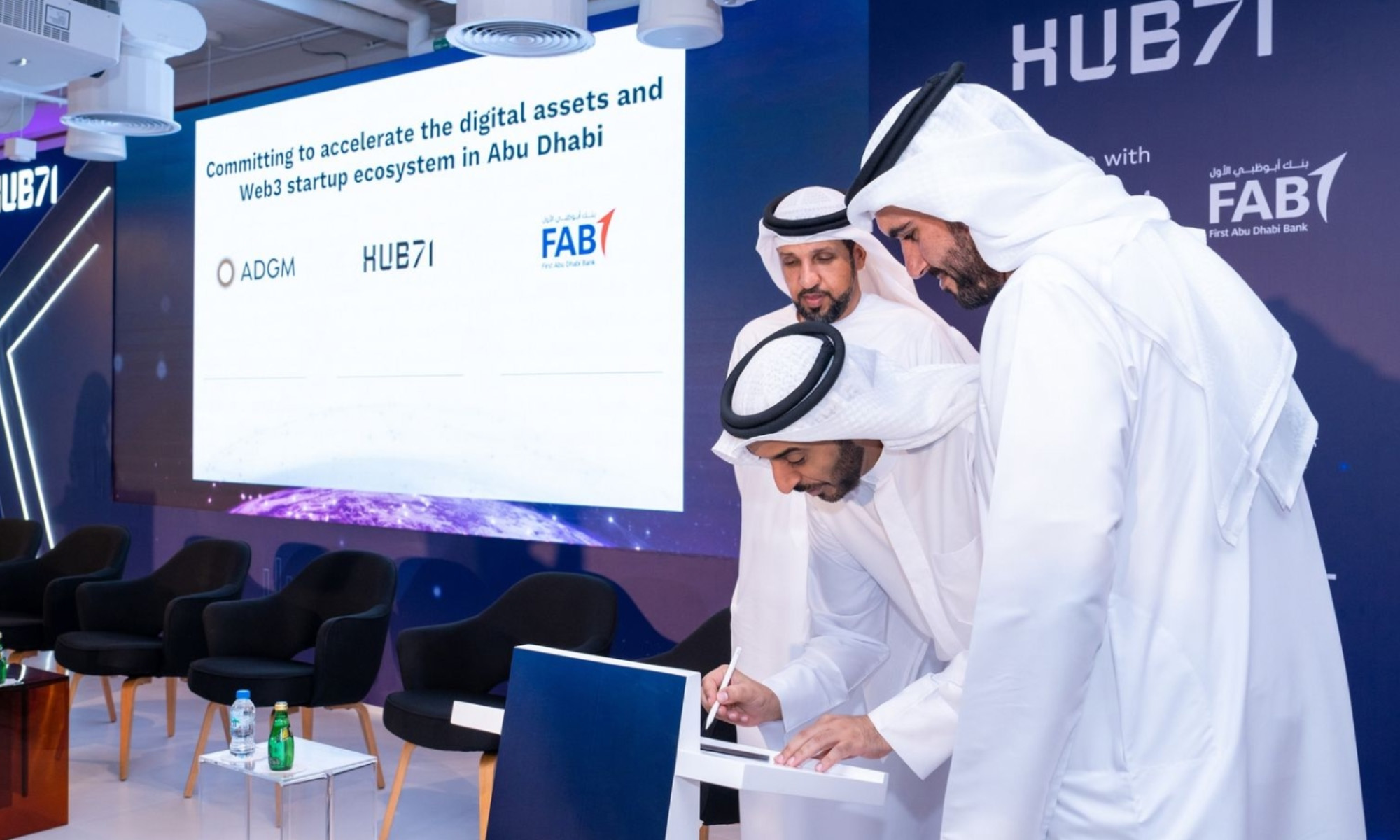
Abu Dhabi’s Hub71 has forged a strengthened alliance with the Japan External Trade Organization aimed at building deeper cross-border innovation, particularly in Web3, AI, spatial intelligence and sustainable tech sectors. Hub71 used its presence at Tokyo’s WebX and the Blockchain Leaders Summit to push forward new collaboration programmes and investment pathways.

At these events, Hub71 spotlighted a number of startups from Abu Dhabi—among them bitgrit, xMap, Aqua Development, Chainsight, Nodeshift, Bit2Me and 1Money—making connections with Japanese investors, corporate entities and ecosystem partners. The showcasing was closely aligned with Japan’s innovation priorities, including governance in blockchain and sustainable water solutions.

Key to the partnership is the launch of the J-StarX Programme, developed jointly by Hub71, JETRO and Elixir Capital, which will host seven Japanese Web3 startups in Abu Dhabi to facilitate scale-ups, market access, and ecosystem integration. Entrepreneurs in this programme will benefit from capital, mentoring, regulatory guidance and networking in the UAE’s tech environment.

Hub71 also assumed title-sponsorship of the Blockchain Leaders Summit in Tokyo, delivering the opening keynote. Executives emphasised the UAE’s position as an enabling region for innovators seeking overseas expansion, and positioned Abu Dhabi as a gateway for startups to penetrate Asia on one side and Middle East markets on the other.

Peter Abou Hachem, Head of Growth and Strategy at Hub71, stated that the collaboration underscores “the value of global connectivity”, and that Japan’s leadership in Web3 and innovation aligns with Hub71’s mission. He noted that through partners like JETRO, both ecosystems can unlock opportunities in market reach, talent exchange and frontier technologies.

VISHNU RAJA
RYO YAMADA
HITORI GOTOH
IKUYO KITA