News related to
Trends

Tata Steel has launched an all-women shift at its Noamundi iron ore mine in Jharkhand, marking a groundbreaking initiative in India’s mining industry. This step underscores the company’s commitment to fostering gender equality and inclusivity in a traditionally male-dominated sector. The shift, which commenced in late 2024, is expected to pave the way for more women to actively participate in the mining workforce.

The decision to implement this all-women shift follows Tata Steel’s broader strategy to integrate diversity into its operations. The company has been at the forefront of promoting gender inclusivity, not just in leadership roles but across all levels of its workforce. By introducing an all-women shift, Tata Steel aims to challenge stereotypes that women are not suited for roles in industries such as mining, which have long been considered predominantly male environments.

The Noamundi mine, one of Tata Steel’s key iron ore production facilities, is known for its high-grade ore and plays a significant role in the company’s operations. The move to introduce the all-women shift is seen as a symbolic and strategic step toward normalizing the presence of women in mining operations, a sector where they have been underrepresented. According to industry experts, this shift has the potential to change the dynamics of the workforce in mines across the country.

Tata Steel’s decision was met with a positive response from both within the company and the larger industrial community. The company’s leadership, in particular, has emphasized that the initiative is part of a broader effort to provide equal opportunities for women in all spheres of business. The all-women shift is not only a step toward ensuring gender parity but also aligns with Tata Steel’s corporate social responsibility goals, which include fostering diversity and enhancing women’s participation in industrial operations.

The Noamundi mine is located in the mineral-rich region of Jharkhand, which is home to several large iron ore deposits. Tata Steel has a longstanding presence in the state, and its operations are crucial to the region’s economic growth. By introducing women into its workforce at the Noamundi mine, Tata Steel is setting an example for other mining companies to follow. The success of this initiative could lead to its expansion in other facilities operated by the company.

The women who have joined the all-women shift come from diverse backgrounds, and many are from the surrounding rural areas. Tata Steel has provided specialized training to ensure these women are equipped with the necessary skills to operate machinery, conduct safety checks, and manage other operational tasks within the mine. This training is part of the company’s broader commitment to skill development and empowerment for women in the region. By ensuring that these women have the right technical expertise, Tata Steel is fostering an environment where gender does not limit career advancement.

This initiative aligns with broader national and global trends aimed at increasing female participation in STEM (Science, Technology, Engineering, and Mathematics) fields and other traditionally male-dominated industries. The mining sector, in particular, has been under scrutiny for its lack of gender diversity. Across the world, efforts are being made to ensure women are given equal opportunities to succeed in industries like mining, which have historically sidelined them. By introducing an all-women shift, Tata Steel is actively contributing to this global movement.

The broader implications of this move are significant, not only for the mining industry but for corporate India at large. In an era where corporate social responsibility and diversity are increasingly becoming important metrics for success, Tata Steel’s initiative could set a precedent for other large companies, particularly in sectors like manufacturing, heavy industry, and construction, where gender diversity remains a challenge. The company’s initiative could be a catalyst for similar programs at other facilities across India, helping to shape the future of gender equality in the workforce.

Tata Steel has a longstanding history of championing diversity and inclusion. The company has previously been recognized for its efforts in empowering women, particularly in leadership roles. Over the years, Tata Steel has taken steps to break barriers for women in various parts of its operations. The introduction of the all-women shift at the Noamundi mine is a logical extension of this commitment, demonstrating the company’s ongoing efforts to ensure that women have a seat at the table in all aspects of its operations.

The shift also brings attention to the potential challenges women face in the mining sector, such as safety concerns, lack of infrastructure, and societal biases. Addressing these challenges requires significant investment in infrastructure, cultural change within the workplace, and ongoing training programs. Tata Steel has taken measures to ensure that the working conditions at the mine are conducive to a gender-inclusive environment, with the necessary facilities and safety standards in place.

With this new initiative, Tata Steel is not only reinforcing its leadership role in the mining sector but also setting a new standard for other companies in India. As the first company to operationalize an all-women shift in the country’s mining sector, Tata Steel is setting a benchmark that could inspire other industries to rethink their approach to gender diversity and inclusion. The Noamundi mine, which has long been an important part of Tata Steel’s operations, will now serve as a beacon of progress for gender equality within India’s industrial landscape.

Parkin and BATIC, two prominent players in the realm of urban mobility solutions, have announced a strategic collaboration aimed at transforming parking systems in Saudi Arabia. The partnership focuses on leveraging cutting-edge technologies to enhance the efficiency and accessibility of parking infrastructure across key urban areas. Parkin, a company known for its innovative smart parking systems, and BATIC, a leader in digital transformation solutions for the transport […]

The UAE’s payment industry is on track for significant growth, projected to reach a value of $27.3 billion by 2028. This surge reflects the country’s increasing digital transformation, with innovative payment technologies gaining traction across multiple sectors. The shift toward a cashless economy and the growing demand for online and mobile payment solutions are key drivers behind this expansion. The shift to digital payments has been accelerated […]

Abu Dhabi-based energy group XRG has entered into a strategic partnership with BP to establish a joint venture aimed at developing a state-of-the-art natural gas platform. The move marks a significant step in the region’s ongoing efforts to expand its energy infrastructure while aligning with global trends towards cleaner energy solutions. This collaboration highlights both companies’ shared commitment to innovating within the natural gas sector, one of […]

The Body Shop, a pioneer in ethical beauty founded in 1976 by Anita Roddick, has embarked on a transformative journey under the stewardship of Auréa Group, led by co-founder and Executive Chairman Mike Jatania. This development follows a period of financial instability that culminated in the company’s administration earlier this year.

In September 2024, Auréa Group finalized the acquisition of The Body Shop, aiming to rejuvenate the brand’s market presence and reaffirm its commitment to ethical consumerism. Jatania, with over three decades in the beauty industry, expressed enthusiasm for revitalizing a brand that resonates with consumers across more than 70 countries. He emphasized plans to invest in product innovation and enhance customer experiences while honoring the brand’s activist heritage.

The Body Shop’s financial challenges became evident when it entered administration in February 2024, leading to the closure of approximately half of its 198 UK stores and significant job losses. The company’s struggles were attributed to increased competition and shifts in consumer preferences.

Under Auréa’s leadership, The Body Shop is poised for a strategic transformation. CEO Charles Denton, who brings a wealth of experience from his tenure at Molton Brown, underscored the necessity for bold actions and a consumer-centric approach to restore the brand’s unique, values-driven spirit.

A key component of the revival strategy involves a renewed focus on product innovation, particularly in skincare and fragrance, to meet the evolving demands of a diverse consumer base. Jatania highlighted the importance of agility in responding to market trends while maintaining the brand’s ethical standards.

The Middle East has been identified as a pivotal region for The Body Shop’s growth. With an existing presence in nine markets, including the UAE and Saudi Arabia, the brand aims to cater to a young, conscientious consumer base that values sustainability and ethical products. Plans are underway to adapt product offerings to local preferences, particularly in fragrance and skincare, to strengthen the brand’s foothold in the region.

The acquisition by Auréa Group has also ensured the continuation of The Body Shop’s operations in the UK, North America, and Australia. The new ownership has committed to keeping the remaining UK stores open, safeguarding approximately 1,500 jobs, and stabilizing the company’s presence in key markets.

flydubai has officially inaugurated its new Business Class Lounge at Terminal 2 of Dubai International Airport (DXB), a move aimed at enhancing the travel experience for its premium passengers. This opening aligns with the airline’s ongoing efforts to offer top-tier services and improve convenience for its growing number of high-end travelers.

The launch event was attended by key figures from the airline and local government, including Hamad Obaidalla, Chief Commercial Officer at flydubai, and H.E. Major-General Obaid Muhair bin Suroor, Deputy Director-General of the General Directorate of Residence and Foreigners Affairs in Dubai. Both emphasized the strategic importance of the new lounge in fostering customer satisfaction and reinforcing Dubai’s position as a global hub for air travel.

flydubai’s new Business Class Lounge is designed to offer a comfortable, spacious environment with state-of-the-art amenities, ensuring that passengers can relax or work in a serene setting before their flights. The lounge features a variety of seating options, private workstations, high-speed Wi-Fi, and an extensive selection of food and beverages, tailored to meet the needs of both business and leisure travelers.

The move marks a significant upgrade to the airline’s offerings, as it continues to expand its route network and improve its services. This new lounge, located in the busy Terminal 2, is also a step towards aligning the airline’s infrastructure with the high standards expected of modern international airports. Terminal 2 handles millions of passengers annually, with a significant portion of those traveling in premium classes, further underscoring the demand for such facilities.

The opening of the lounge comes at a time when global air travel is recovering from the pandemic, with airlines increasingly focusing on improving customer experience and loyalty. This lounge is part of flydubai’s broader strategy to distinguish itself in a highly competitive market by offering tailored services for its business class passengers. The airline has made significant strides over the years, with a focus on modernizing its fleet, expanding routes, and improving in-flight services. The introduction of premium lounges at key airports is another step in its long-term vision to provide a seamless travel experience that meets the expectations of today’s discerning passengers.

The flydubai Business Class Lounge is not only a reflection of the airline’s commitment to customer care but also a response to the growing trend among travelers seeking high-end, comfortable experiences at airports. According to aviation industry experts, premium passengers are increasingly looking for more than just luxury in-flight services; they want a complete experience, starting from the moment they step into the airport. This is particularly true in Dubai, where the airport is a critical hub for international connections, and many passengers spend hours waiting for their connecting flights.

The lounge’s design emphasizes a blend of functionality and luxury. The space is divided into different zones, offering everything from quiet areas for relaxation to more active zones for business meetings. The introduction of private workstations caters to business travelers who need a quiet place to prepare for meetings or make calls. For those looking to unwind, the lounge offers a variety of entertainment options, including television screens and comfortable lounge seating. The food and beverage offerings are diverse, with an emphasis on fresh and healthy options, as well as a selection of regional and international delicacies.

Hamad Obaidalla, speaking at the event, noted that the lounge was not only a response to growing demand but also a reflection of the airline’s dedication to innovation in customer service. “As we continue to expand our operations, we are committed to enhancing the travel experience for our passengers,” he said. “The new lounge is an example of how we are investing in facilities that provide our customers with comfort and convenience at every step of their journey.”

The inauguration of this lounge highlights Dubai’s continuous efforts to upgrade its aviation infrastructure. Dubai International Airport has long been a leading global airport, serving millions of passengers each year, and it continues to evolve to meet the needs of the growing air travel market. With new developments, such as the flydubai Business Class Lounge, the airport reaffirms its role as a key player in the global aviation industry.

The move also aligns with broader trends in the aviation sector, where airlines are increasingly focusing on customer experience to stay competitive. In recent years, airlines worldwide have been ramping up their investments in premium services, including dedicated lounges, personalized travel experiences, and enhanced in-flight offerings. As competition in the Middle East’s aviation market heats up, carriers like flydubai are striving to set themselves apart by offering not only affordable fares but also world-class services.

This new facility also reflects the airline’s increasing focus on the business and corporate travel market. Dubai’s status as a global business hub is well-established, and flydubai’s new lounge is designed to cater to the needs of travelers who prioritize efficiency and comfort. Business travelers often have tight schedules and expect high levels of service both on the ground and in the air. With this new lounge, flydubai hopes to make the airport experience as seamless and stress-free as possible.

HO CHI MINH CITY, VIETNAM – Media OutReach Newswire – 16 December 2024 – Visa, a global leader in digital payments, convened the Digital Future Forum 2024 in Hanoi, showcasing the latest payment trends and innovations shaping Vietnam’s digital landscape. This forum, part of Visa’s annual client appreciation event, underscored Visa’s commitment to driving Vietnam’s digital transformation, with a focus on AI’s role in enhancing security and […]

Advertisements

MicroStrategy has further cemented its position as one of the largest corporate holders of Bitcoin, completing the acquisition of an additional 15,350 BTC for $1.5 billion, translating to an average price of approximately $100,386 per Bitcoin. This latest purchase marks a significant move for the company, reinforcing its bullish stance on the cryptocurrency as part of its long-term strategy.

The firm, led by Michael Saylor, now holds a total of 439,000 BTC, valued at around $27.1 billion. This represents a major commitment to the digital asset class, with an average purchase price of $61,725 per Bitcoin. The recent acquisition comes amid a highly volatile period for Bitcoin, reflecting MicroStrategy’s ongoing belief in the asset’s potential to appreciate over time despite fluctuations in market prices.

This move is part of MicroStrategy’s broader strategy, which has seen it steadily accumulate Bitcoin over several years. The company began its Bitcoin acquisition spree in August 2020, making waves with its decision to adopt Bitcoin as its primary treasury reserve asset. At the time, it was one of the first major publicly traded companies to make such a bold commitment. Since then, MicroStrategy has continued to expand its holdings, with the total now approaching half a million BTC.

The firm’s investment strategy has been both aggressive and disciplined. The recent purchase of 15,350 BTC is one of the largest single acquisitions the company has made, a testament to its confidence in Bitcoin’s future. With a BTC yield of 46.4% quarter-to-date and 72.4% year-to-date, the performance of its holdings has demonstrated significant growth, providing strong returns on investment amid the digital currency’s price movements. Despite the volatility of Bitcoin’s market, these figures underline MicroStrategy’s strategy of holding long-term, seeing fluctuations as temporary rather than risks to the investment.

MicroStrategy’s focus on Bitcoin has not been without its critics, especially given the volatility that the cryptocurrency market can exhibit. Yet, the company’s commitment to holding its Bitcoin rather than liquidating it has helped the firm weather some of the market’s downturns. For instance, when Bitcoin’s value dropped significantly in mid-2022, many investors reassessed their positions, yet MicroStrategy maintained its stance, reaffirming its strategy.

The recent surge in Bitcoin’s price in the latter part of 2023 and into 2024 has only bolstered MicroStrategy’s position. While Bitcoin’s market value has fluctuated over time, with sharp dips followed by recoveries, the price stability seen recently suggests that its adoption as a store of value is gaining broader acceptance. The digital currency has seen increasing interest from institutional investors, signaling a shift in market sentiment towards Bitcoin as a long-term asset rather than a speculative instrument.

MicroStrategy’s massive Bitcoin position has also had implications for the company’s financial health. The firm has financed many of its Bitcoin purchases through a combination of cash reserves and debt offerings, including a significant issuance of convertible senior notes. This strategy has allowed MicroStrategy to leverage its position in the cryptocurrency without diluting its equity.

As Bitcoin adoption continues to grow among institutional investors and corporations, the role of companies like MicroStrategy in shaping market trends becomes more apparent. Their buying patterns not only influence Bitcoin’s price movements but also signal to other investors the viability of cryptocurrency as part of a diversified investment portfolio.

The corporate adoption of Bitcoin, exemplified by MicroStrategy’s approach, has also sparked broader discussions about the future of digital currencies and their integration into the global financial system. While many countries are still grappling with the regulatory implications of cryptocurrencies, the rising influence of institutional players points to an inevitable shift towards digital assets in the broader financial ecosystem.

Despite the challenges of regulatory uncertainty and market volatility, MicroStrategy’s bet on Bitcoin has proven to be a long-term strategy rather than a short-term speculation. The firm’s actions illustrate a deep belief in Bitcoin as a foundational asset for the future, even as the broader market adjusts to its unpredictable nature.

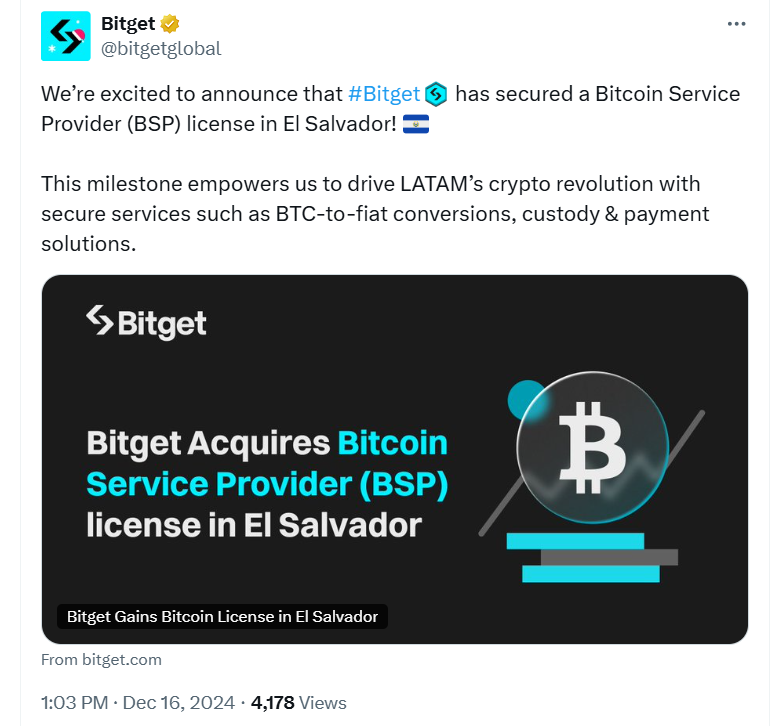
Bitget has received the coveted Bitcoin Service Provider (BSP) license from El Salvador’s Central Reserve Bank, marking a significant step in its global expansion strategy. This authorization allows the platform to offer a range of Bitcoin-related services, including exchanges, payments, and custody solutions, in the Central American nation known for its embrace of cryptocurrency.

The license represents a notable achievement for Bitget, signaling its commitment to adhering to regulatory frameworks in its pursuit of a stronger foothold in Latin America. El Salvador, which made Bitcoin legal tender in 2021, has positioned itself as a hub for crypto innovation, drawing interest from international players eager to tap into its growing digital economy.

Bitget’s decision to prioritize regulatory compliance aligns with its broader mission to establish trust and credibility in the global crypto space. By securing this license, the platform gains access to a burgeoning market while demonstrating its capability to meet the rigorous standards set by El Salvador’s financial authorities. This development underscores the firm’s ambition to build a robust presence in the region, leveraging the country’s pro-Bitcoin stance as a springboard for further growth.

El Salvador’s adoption of Bitcoin as legal tender has attracted significant attention, both for its groundbreaking approach and the challenges associated with integrating digital assets into a traditional economy. The move has created opportunities for companies like Bitget to introduce innovative solutions tailored to the unique needs of the Salvadoran market. By offering services such as secure custodial options and seamless payment integrations, Bitget aims to contribute to the local crypto ecosystem’s development while addressing concerns around security and accessibility.

Bitget’s license acquisition comes at a time when Latin America is experiencing an uptick in cryptocurrency adoption, driven by economic instability, high inflation rates, and limited access to traditional banking services. In this context, Bitcoin and other digital assets are increasingly seen as viable alternatives for financial inclusion. The platform’s expansion into El Salvador is expected to capitalize on these trends, providing users with reliable and regulated avenues for engaging with digital currencies.

Beyond its operations in El Salvador, Bitget has indicated plans to deepen its engagement with the wider Latin American region. Countries such as Brazil, Argentina, and Colombia have shown growing interest in blockchain technology, creating a fertile ground for companies looking to expand their footprint. By obtaining regulatory approvals and investing in localized solutions, Bitget aims to position itself as a leader in the regional crypto market.

El Salvador’s proactive stance on Bitcoin regulation has set it apart from many other nations, where digital assets remain subject to varying degrees of scrutiny and uncertainty. The BSP license issued to Bitget highlights the government’s willingness to work with private sector entities in fostering a dynamic and well-regulated crypto environment. This approach not only enhances the appeal of the Salvadoran market but also sets a precedent for other countries seeking to balance innovation with regulatory oversight.

As part of its expansion strategy, Bitget plans to introduce educational initiatives aimed at increasing awareness and understanding of cryptocurrencies among Salvadorans. These efforts are expected to complement the government’s existing programs and facilitate broader adoption of digital assets across diverse demographics. The company’s emphasis on education reflects its recognition of the need to address skepticism and build confidence among users new to the crypto space.

Bitget’s move also reflects broader industry trends, as major crypto firms increasingly seek to align with regulatory frameworks to ensure long-term sustainability. The BSP license not only enhances Bitget’s credibility but also serves as a testament to its operational rigor and strategic vision. By adhering to the highest standards of compliance, the platform positions itself to attract a diverse user base while mitigating risks associated with the volatile nature of the cryptocurrency market.

The crypto industry, while growing rapidly, remains a highly competitive field where job opportunities are often limited relative to the number of aspiring candidates. Despite a surge in cryptocurrency and blockchain-related innovations, many still struggle to land full-time roles due to the industry’s relatively small size compared to more established sectors.

To succeed in this competitive environment, candidates need to go beyond possessing the right knowledge, skills, and enthusiasm. Preparation and organization are paramount in securing a crypto job. Aspiring crypto professionals must focus on understanding the fundamental concepts of cryptocurrencies and blockchain technology, staying informed about trends such as decentralized finance (DeFi) and emerging blockchain platforms.

Building specialized skills, such as proficiency in blockchain programming languages (Solidity, Python), smart contract development, and cybersecurity, is also crucial. Industry certifications, like Certified Blockchain Developer (CBD), can boost a candidate’s credentials, enhancing their attractiveness to employersking plays a significant role in the crypto industry. Engaging in crypto communities, attending industry events, and participating in hackathons are ways to expand one’s professional network. This not only opens up job opportunities but also provides a platform to showcase one’s skills and gain practical experience. For example, contributing to open-source projects or building a personal portfolio can demonstrate expertise and enthusiasm to potential employers .

With rms and social media channels acting as critical gateways to job opportunities, candidates need to customize their resumes and cover letters for each application. Researching the company and understanding its products, services, and recent developments is essential to show genuine interest during interviews. This effort can set candidates apart in a crowded job market where everyone else may have similar technical skills.

A novel open-source utility has emerged as a solution for managing AppImage applications on Linux, addressing longstanding challenges faced by users. Gear Lever, designed for streamlined handling of portable application formats, is gaining attention for its user-friendly interface and practical features tailored to the Linux ecosystem. AppImages, which allow applications to run without installation or dependency conflicts, have grown popular among Linux users. However, their decentralized nature […]

The cryptocurrency landscape is abuzz with the rise of a new meme coin that could soon join the ranks of the most explosive digital assets in the market. Catslap ($SLAP), a new feline-themed meme coin, has caught the attention of crypto enthusiasts with its impressive lineup of developments aimed at propelling the token to new heights. Riding on the success of previous meme coins like Popcat, which saw explosive gains in 2021, $SLAP is positioning itself as the next big player in the meme coin space, with forecasts suggesting it could experience gains as high as 700x in the coming year.

At the core of the latest buzz surrounding $SLAP is its innovative approach to building community engagement and boosting its market presence. The token has launched a series of initiatives designed to foster a dedicated user base and encourage participation, including a comprehensive Zealy social quests campaign. This initiative allows users to earn rewards and further engage with the $SLAP community, while simultaneously boosting the coin’s visibility across various social media platforms. The campaign’s success is critical, as it has the potential to accelerate the coin’s adoption among mainstream crypto investors.

Adding fuel to the fire is the coin’s airdrop event, designed to distribute tokens to new users, as well as those who have already shown interest in $SLAP. Airdrops have become a common tactic for crypto projects to create buzz and incentivize investment, and $SLAP’s airdrop is no exception. The campaign has already sparked excitement within the cryptocurrency ecosystem, as investors eagerly anticipate the distribution of tokens, hoping to capitalize on the anticipated surge in value.

The meme coin’s growth potential has also been bolstered by a growing online community that backs the project. Communities built around meme coins often play a significant role in their success, and $SLAP has quickly developed a dedicated following across platforms like Twitter, Telegram, and Reddit. As a result, the coin has generated significant buzz, with many hoping that it will follow in the footsteps of other meme-based tokens such as Dogecoin and Shiba Inu, which have both achieved substantial returns for early investors.

Cryptocurrency analysts have been keeping a close eye on $SLAP, with many seeing the coin as a potential powerhouse in the coming months. Some analysts predict that the coin could mirror the success of Popcat, a meme coin that took the crypto world by storm in 2021 and achieved astronomical gains. If $SLAP can capture the same level of attention and investor interest, it could see its value increase exponentially, making it a prime investment opportunity for those seeking high-risk, high-reward ventures.

The rise of meme coins has been one of the defining trends in the cryptocurrency world, particularly over the past few years. Coins like Dogecoin and Shiba Inu have shown that with the right amount of social media buzz and community support, meme coins can achieve massive growth. As more investors seek out the next big opportunity in the meme coin space, $SLAP is well-positioned to ride the wave of growing interest in this niche segment of the market.

However, as with all investments, there are risks involved. The volatility of meme coins is well-documented, and while the potential for massive returns exists, so too does the possibility of rapid losses. Critics argue that the hype surrounding meme coins can lead to unsustainable price surges, followed by sharp declines. For investors considering $SLAP, it is important to approach the coin with caution and an understanding of the risks associated with speculative digital assets.

Despite the risks, $SLAP’s developers have made strides to create a coin that offers more than just speculative trading opportunities. The team behind the project has emphasized its commitment to building a sustainable ecosystem, with plans for further utility integration and partnerships with other blockchain projects. By focusing on long-term growth and real-world use cases, $SLAP aims to differentiate itself from the typical meme coin, which often relies solely on hype and social media buzz for its value.

In addition to its marketing and community-building efforts, $SLAP is also exploring partnerships with other crypto projects to expand its utility and increase its market presence. Collaborations with decentralized finance (DeFi) protocols and non-fungible token (NFT) projects could provide $SLAP with additional use cases, helping to cement its place in the broader cryptocurrency ecosystem.

XRP has drawn renewed focus in the cryptocurrency market as on-chain data reveals substantial outflows of the token from major exchanges. Market analysts and blockchain trackers indicate that $300 million worth of XRP has been withdrawn, fueling speculation of accumulation by whales and institutional investors. This development arrives amid an extended phase of price consolidation for XRP, sparking discussions on its potential trajectory.

According to data from Coinglass, the significant outflows over the past week indicate a strategic shift by high-net-worth investors, who appear to be betting on the token’s future. The movement of such a considerable volume suggests confidence in XRP’s long-term potential despite broader market uncertainties. Observers highlight that such patterns of withdrawal often correlate with accumulation, as holders transfer their tokens to private wallets to prepare for anticipated price surges.

The timing of these transactions is notable, as XRP has demonstrated resilience following regulatory clarity in its ongoing legal battle with the United States Securities and Exchange Commission (SEC). The partial victory Ripple Labs achieved earlier this year, where XRP was deemed not to be a security when sold on secondary markets, has bolstered investor sentiment and rekindled interest in the asset.

XRP’s price has remained relatively stable, hovering within a tight range between $0.50 and $0.55. Analysts attribute this to broader market conditions and the lack of a significant catalyst in the crypto space. However, the scale of the $300 million outflows has prompted speculation that larger players could be positioning themselves for a breakout. Whale Alert, a blockchain tracker, recorded multiple transactions of XRP worth millions, adding weight to the idea that this activity is a precursor to strategic market movements.

Beyond these transactions, Ripple Labs has been advancing its efforts to expand XRP’s utility. The company has been actively pursuing partnerships with financial institutions globally, emphasizing cross-border payment solutions. Such initiatives aim to solidify XRP’s role as a preferred digital asset for seamless, low-cost transactions, a factor that experts believe could drive demand over time.

The cryptocurrency market has witnessed increased volatility in recent months, with fluctuating macroeconomic indicators and shifting investor sentiment impacting digital asset prices. While Bitcoin and Ethereum continue to dominate trading volumes, altcoins like XRP are gaining traction, especially among those seeking diversification in their crypto portfolios.

Analysts caution, however, that market dynamics remain uncertain. Although the $300 million outflows hint at positive sentiment, they do not guarantee immediate price action. Factors such as liquidity, macroeconomic conditions, and regulatory developments will play critical roles in shaping XRP’s near-term prospects. Some experts suggest that retail investors should carefully monitor market trends and avoid being swayed solely by whale activity.

On the regulatory front, Ripple’s legal entanglements continue to weigh on its ecosystem. Despite the partial victory in its case against the SEC, the broader question of XRP’s status under U.S. securities law remains unresolved. A final decision in the matter, expected in the coming months, could serve as a pivotal moment for the token, potentially influencing its adoption and price.

In addition to its legal battles, Ripple Labs is preparing for a new phase of innovation. Its recent announcements about leveraging XRP for real-world applications, including tokenized assets and central bank digital currency (CBDC) pilots, reflect the firm’s ambition to remain at the forefront of blockchain technology. This approach aligns with the growing demand for decentralized financial solutions, which many see as a transformative force in the global financial system.

Market participants are also paying close attention to XRP’s performance against broader altcoin indices. Some argue that the consolidation phase, coupled with heightened whale activity, presents a favorable entry point for long-term investors. However, the inherent volatility of cryptocurrency markets suggests that any investment carries significant risks.

Unveiling Next Year’s Theme – Education: A Shared Future for All HONG KONG SAR – Media OutReach Newswire – 13 December 2024 – The 14th Learning & Teaching Expo 2024 successfully concludes today. This year’s theme, Shaping Education for a World of Change, marks the largest edition in the event’s history. The Expo united government officials, education experts, industry leaders, exhibitors, and educators from across the globe, […]

Forecast Projected Growth of Chinese Luxury Market in 2025: A Shift Towards Experience, Innovation, Chinese Brands and Sustainability HONG KONG SAR – Media OutReach Newswire – 13 December 2024 – MDRi, a leading provider of business insights, today released its China Luxury Consumer Forecast 2025, presenting an in-depth analysis of luxury consumption trends in Mainland China and Hong Kong. The report highlights a market in transition, where […]

uBroker Spa has acquired a significant 49% share in the Italian independent game development studio, Memorable Games, marking a strategic move to broaden its presence in the burgeoning gaming industry. This partnership is poised to bolster the creative ambitions of Memorable Games, known for its innovative titles, while offering uBroker a stronger foothold in the gaming sector, which continues to grow rapidly worldwide. Memorable Games, founded in […]

PHU QUOC, VIETNAM – Media OutReach Newswire – 12 December 2024 – Boasting a comprehensive tourism ecosystem, Phu Quoc has been chosen by the prestigious Rixos brand to debut its concept of ‘luxury all-inclusive’ resorts in Southeast Asia. This milestone positions Pearl Island as a promising destination to attract high end visitors. Time to catch the world-class art performances and fireworks 365 day a year in the […]

BANGKOK, THAILAND – Media OutReach Newswire – 12 December 2024 – Celebrating its 10th year, Chiang Mai Design Week 2024 (CMDW2024), organized by Thailand’s Creative Economy Agency (Public Organization), or CEA, has become a key platform for local creators, designers, artists, and craftsmen. It serves as a hub for talent showcases, knowledge exchange, and innovation, fostering meaningful collaborations among entrepreneurs, designers, and investors. These partnerships create new […]

ADNOC Distribution has unveiled ARIF, an AI-driven chatbot designed to enhance investor relations, during the Abu Dhabi Finance Week. This advanced technology aims to provide a seamless platform for current and prospective investors to access vital financial insights, performance updates, and strategic information, underscoring the company’s commitment to technological innovation and transparency. The launch of ARIF marks a significant step in ADNOC Distribution’s effort to utilize artificial […]

Tether (USDT) has seen a significant shift in its distribution across blockchain networks, with Ethereum surpassing TRON in terms of USDT supply. Over the past month, the amount of USDT on Ethereum has surged by approximately $20 billion, pushing its dominance in the stablecoin market. As of the latest reports, Ethereum now accounts for the majority of the USDT supply, with more than $12 billion of the total circulating USDT on the Ethereum network.

This notable growth is a result of increasing demand for Ethereum-based DeFi applications and the network’s broader adoption. USDT, a leading stablecoin in the cryptocurrency sector, has traditionally been spread across various blockchains, including Bitcoin’s Omni layer, TRON, and others like EOS and Liquid. However, Ethereum has long been the primary platform for stablecoins, and its share has now expanded significantly, reflecting Ethereum’s renewed appeal amid the growing DeFi ecosystem.

Ethereum’s dominance has been bolstered by its Ethereum 2.0 upgrade, improving scalability and transaction costs, which has made it a more attractive option for decentralized finance platforms and crypto traders. The increase in USDT supply on Ethereum is not just a byproduct of market demand but also a strategic move to enhance Ethereum’s role in decentralized applications (dApps) and smart contract solutions.

Meanwhile, TRON, which once held a more substantial share of USDT, has seen its role diminish in the face of Ethereum’s rising prominence. While TRON continues to be a player in the stablecoin ecosystem, its share of the total USDT supply has decreased notably in recent months. This shift is indicative of broader trends in the stablecoin market, where networks like Ethereum are increasingly seen as the go-to platforms for issuing and transferring stablecoins due to their robust infrastructure and widespread use.

Base, a layer-2 blockchain solution built atop Ethereum, has garnered significant attention due to its robust growth in 2024, securing $2.7 billion in net inflows year-to-date. The surge marks a pivotal moment for the project, reflecting strong investor confidence and the growing appeal of scaling solutions within the crypto ecosystem. In stark contrast, Ethereum itself, despite its dominance in the space, experienced a record $7.4 billion in net outflows over the same period, signaling a shift in investor sentiment away from the original Ethereum blockchain toward alternative platforms like Base.

The disparity in inflows and outflows has drawn attention from market analysts, particularly because both assets are intrinsically linked. Base’s success hinges on the Ethereum blockchain for security, but its tailored scalability and lower transaction costs have attracted considerable investment. Ethereum’s outflows are largely attributed to concerns over its scalability issues, particularly its high transaction fees and network congestion that have persisted despite ongoing updates.

The ongoing battle between layer-1 and layer-2 solutions illustrates a broader trend in blockchain development. Layer-2 solutions like Base aim to alleviate the scalability challenges faced by Ethereum by processing transactions off-chain while leveraging Ethereum’s security. This model has proven to be appealing to decentralized application developers and users who seek lower fees and faster transactions. Investors are increasingly recognizing these advantages, which has driven the substantial inflows into Base.

One of the key factors driving Base’s success has been its integration with Optimism, a layer-2 network that employs Optimistic Rollups. This technology allows transactions to be processed in batches, enhancing speed and efficiency while reducing costs. Optimism’s established track record, combined with the robust infrastructure of Base, has resulted in a growing number of decentralized finance (DeFi) protocols migrating to this ecosystem. These protocols are increasingly shifting their focus to Base, buoyed by its ability to scale and manage higher transaction volumes more effectively than Ethereum.

Ethereum’s struggle to retain investor confidence, on the other hand, can be traced to its long-standing scalability limitations. The Ethereum network, often hailed as the backbone of decentralized finance, has been plagued by network congestion, especially during periods of high transaction demand. While Ethereum’s transition to Ethereum 2.0, which aims to implement a Proof of Stake consensus mechanism, is intended to address some of these issues, many investors remain skeptical of its long-term viability in its current form. High transaction fees continue to plague the network, pushing investors and developers to seek alternatives that offer better scalability.

Despite Ethereum’s ongoing development efforts, including the introduction of sharding and other upgrades to enhance throughput, the market sentiment has leaned toward blockchain solutions that can offer immediate relief. Layer-2 solutions like Base, Arbitrum, and Polygon have benefitted from this shift, offering near-instant transaction finality and negligible fees. These benefits have not only attracted developers but also institutional investors who are looking to capitalize on the emerging layer-2 ecosystem, further driving the inflow into these platforms.

The contrast between Ethereum’s challenges and Base’s growth is particularly notable given the overlap in their underlying technologies. While Base runs on Ethereum’s base layer for security and consensus, its innovative scaling model has managed to sidestep many of the bottlenecks that continue to hinder Ethereum itself. This dynamic has led to the rapid rise of Base in the market, with many speculating that this trend could continue as more applications and investors shift their focus to layer-2 solutions.

A key consideration in the ongoing evolution of blockchain technology is the role of decentralization. Ethereum has long been the poster child for decentralization, emphasizing the importance of a trustless and distributed network. However, as scalability and efficiency have become more pressing issues, layer-2 solutions like Base are offering a middle ground—leveraging Ethereum’s security without burdening its mainnet with excessive transactions. This hybrid approach is increasingly gaining favor among users who value both decentralization and efficiency.

The entry of institutional investors into the blockchain space has played a critical role in shaping the landscape. Many institutional players have expressed interest in blockchain technologies that provide high throughput and minimal latency, qualities that are often found in layer-2 solutions. The inflows into Base reflect this shift, as institutions seek to diversify their portfolios in the rapidly evolving digital asset space. The growing adoption of decentralized finance, non-fungible tokens (NFTs), and other blockchain-based innovations has further cemented Base’s position as a platform that can support these applications with lower costs and faster speeds.

The contrasting trends in Ethereum’s outflows and Base’s inflows have sparked debate about the future of Ethereum’s role in the broader blockchain ecosystem. While Ethereum remains the dominant layer-1 blockchain, its scalability issues have led to increased competition from a range of layer-2 solutions. These developments highlight the evolving dynamics within the blockchain space, where scalability, speed, and cost-efficiency are becoming the key determinants of success.

HONG KONG SAR – Media OutReach Newswire – 12 December 2024 – MooneyBird, a proptech company specializing in real estate marketing and AI technologies, has launched Hong Kong’s first AI-powered real estate marketing system. This innovative system is specifically designed for small and medium-sized real estate agencies, offering an integrated solution that combines brand website design, automated marketing, and client management tools. This solution strives to facilitate […]

On November 10, 2024, Dubai hosted the second Russian Design Forum, a key event for design and architecture professionals organized by Olga Melnikova. The Forum, which gathered more than 250 Russian-speaking professionals, became an important platform for sharing experience and establishing contacts in the international design environment. Special attention was paid to the development of design in the Emirates, where Russian designers are confidently asserting themselves, setting […]

Bitcoin’s ambitious march toward the $100,000 mark has hit significant resistance, with market analysts pointing to liquidity constraints and macroeconomic pressures as key factors tempering the rally. Despite a sustained bull run earlier this year, momentum has slowed as traders assess global monetary conditions and broader economic trends.

Cryptocurrency markets often mirror liquidity flows in global financial systems, and Bitcoin’s performance has shown sensitivity to tightening conditions. Market experts highlight that diminished liquidity, compounded by a robust U.S. dollar and increasing bond yields, is exerting downward pressure on risk assets, including cryptocurrencies. Jamie Coutts, a seasoned analyst, noted that liquidity metrics have displayed bearish signals since October, suggesting a challenging environment for Bitcoin in the short term. These constraints may persist for the next several months as markets recalibrate.

Nvidia’s stalled stock rally has also influenced Bitcoin’s trajectory, reflecting broader investor caution. The chipmaker, which has been pivotal in the AI and tech boom, has seen a slowdown in its market performance. This deceleration is significant because a portion of crypto enthusiasm is linked to advancements in AI and related sectors, intertwining tech equities with digital currencies.

Bitcoin’s macroeconomic backdrop is further complicated by external geopolitical and fiscal factors. The U.S. Federal Reserve’s policies, alongside potential shifts in global trade and political landscapes, are shaping the risk appetite across asset classes. Coupled with the anticipation of regulatory developments in major markets, these elements contribute to the uncertainty engulfing Bitcoin’s upward potential.

VISHNU RAJA
RYO YAMADA
HITORI GOTOH
IKUYO KITA