News related to
currency

Strategy, formerly known as MicroStrategy, has acquired an additional 705 bitcoins for approximately $75.1 million, bringing its total holdings to 580,955 BTC. The latest purchase was made at an average price of $106,495 per coin, as disclosed in a regulatory filing on June 2.

This acquisition, executed between May 26 and June 1, was financed through proceeds from the sale of STRK and STRF preferred shares under the company’s at-the-market offering programmes. The cumulative investment in bitcoin now stands at approximately $40.68 billion, with an average purchase price of $70,023 per coin.

Strategy’s aggressive bitcoin accumulation strategy has positioned it as the largest corporate holder of the cryptocurrency, owning nearly 3% of the total supply. The company’s bitcoin yield year-to-date for 2025 has reached 16.9%, reflecting substantial gains amid the cryptocurrency’s price fluctuations.

The firm’s consistent weekly purchases underscore its commitment to bitcoin as a primary treasury reserve asset. This approach has influenced other companies to consider similar strategies, with firms like GameStop and Trump Media initiating significant bitcoin acquisitions.

Despite market volatility, Strategy’s leadership remains steadfast in its bitcoin investment approach. Chairman Michael Saylor has indicated that the company will continue to purchase bitcoin, especially during market dips, emphasizing a long-term perspective on the asset’s value.

The company’s stock performance has been closely tied to bitcoin’s price movements, reflecting investor sentiment towards its cryptocurrency-centric strategy. As of the latest trading session, Strategy’s shares were priced at $369.06, experiencing a slight decline of 0.35%.

Bitcoin has surpassed $111,000, marking a significant milestone in its 2025 bull run. Standard Chartered has reiterated its forecast that the cryptocurrency could reach $500,000 before the end of President Donald Trump’s second term in January 2029. This projection is underpinned by increasing institutional interest and a shift in investment strategies towards digital assets.

Geoffrey Kendrick, Standard Chartered’s Global Head of Digital Assets Research, points to the U.S. Securities and Exchange Commission’s Form 13F filings as evidence of growing institutional engagement with Bitcoin. These filings reveal that sovereign wealth funds and state-affiliated institutions are acquiring shares in companies like Strategy , which hold substantial Bitcoin reserves. This indirect exposure is seen as a strategic move to gain access to Bitcoin’s potential upside while navigating regulatory constraints.

The bank’s confidence in Bitcoin’s trajectory is further bolstered by macroeconomic factors. Diminishing returns on traditional government bonds have prompted investors to seek alternative stores of value. Bitcoin’s capped supply of 21 million coins and its growing acceptance as a digital asset make it an attractive option for those looking to hedge against inflation and economic uncertainty.

Standard Chartered’s analysis suggests a phased growth pattern for Bitcoin: reaching $200,000 by the end of 2025, $300,000 by the end of 2026, and ultimately $500,000 by the end of 2028. This outlook is supported by the increasing integration of Bitcoin into institutional portfolios and the maturation of the cryptocurrency market.

While the bank’s projections are optimistic, they are not without caveats. The forecast assumes continued regulatory support, technological advancements, and sustained investor interest. Any significant disruptions in these areas could impact Bitcoin’s price trajectory.

The Monetary Authority of Singapore has mandated that all locally based digital token service providers without a valid license must cease offering services to overseas clients by 30 June 2025. This directive, issued without a transitional grace period, underscores Singapore’s commitment to aligning with global anti-money laundering and counter-terrorism financing standards.

Under the Financial Services and Markets Act , entities operating from Singapore and providing digital token services abroad are required to obtain a DTSP license. This regulation applies to both individuals and corporations, regardless of whether they are already licensed under the Payment Services Act or the Securities and Futures Act . The MAS has clarified that exemptions are limited, primarily for technical service providers that do not handle client funds or digital tokens.

The licensing process is stringent, with the MAS indicating approvals will be granted only in exceptional cases. Applicants must demonstrate a sound business model and provide valid reasons for operating from Singapore while serving overseas markets. Minimum requirements include a base capital of SGD 250,000 for companies and partnerships, or a cash deposit of the same amount for individuals. Additionally, firms must have at least one local resident director or partner and maintain a physical office in Singapore with staff present for a minimum of 10 days per month.

Licensed DTSPs are subject to ongoing regulatory obligations, including comprehensive AML/CFT measures such as customer due diligence, transaction monitoring, and compliance with value transfer requirements. They must also adhere to standards for technology risk management, cyber hygiene, and business continuity planning. Regular submission of regulatory returns and clear disclosure of risk warnings to customers are mandatory.

The MAS has emphasized that there will be no transitional arrangements for firms currently operating without a license. Entities must halt all overseas digital token services immediately unless they secure the necessary authorization. Failure to comply will result in regulatory penalties.

This move by the MAS reflects a broader effort to prevent regulatory arbitrage and ensure that digital asset service providers operating from Singapore adhere to international standards. By enforcing strict licensing requirements and eliminating transitional leniency, Singapore aims to bolster its reputation as a secure and compliant hub for digital financial services.

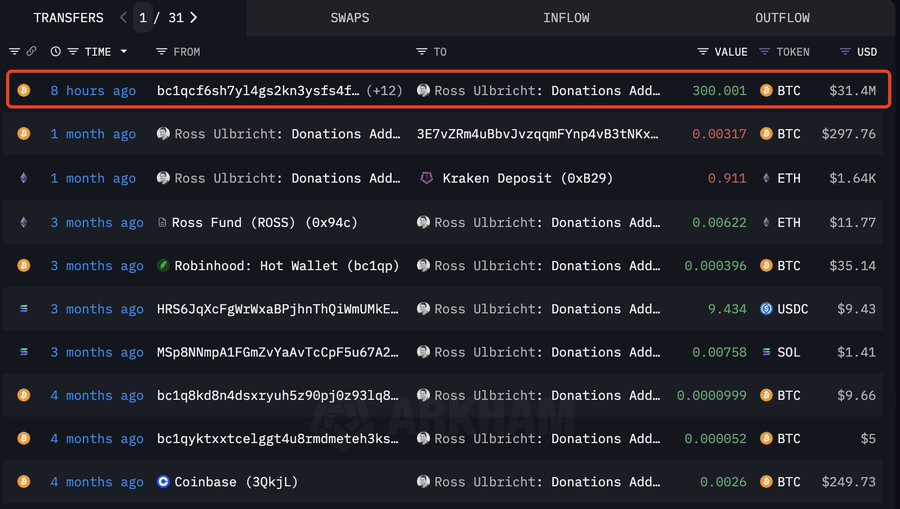
Ross Ulbricht, the founder of the Silk Road darknet marketplace, has received an anonymous donation of 300 Bitcoin, valued at approximately $31.4 million, sent to his official Bitcoin address. This substantial contribution follows his release from prison after a full pardon by former U.S. President Donald Trump in January 2025.

The donation was made to the Bitcoin address listed on freeross.org, a website dedicated to supporting Ulbricht. The identity of the donor remains unknown, and there has been no public acknowledgment from Ulbricht or his representatives regarding the transaction.

In addition to this significant donation, an auction of Ulbricht’s personal belongings has reportedly raised nearly $1.3 million in Bitcoin. The auction, organized to support Ulbricht’s reintegration into society, featured items such as personal writings, artwork, and other memorabilia.

Ulbricht’s financial situation has been a topic of interest since his release. Coinbase executive Conor Grogan identified approximately 430 BTC, worth around $47 million, in wallets associated with Ulbricht that had remained untouched for over 13 years. However, it remains unclear whether Ulbricht has access to the private keys required to control these funds.

The cryptocurrency community has shown considerable support for Ulbricht since his release. Crypto exchange Kraken donated $111,111 in Bitcoin to assist with his transition back into society. Additionally, various fundraising efforts, including merchandise sales, have contributed to a growing fund aimed at supporting Ulbricht’s post-incarceration life.

Ulbricht was arrested in 2013 and later sentenced to double life imprisonment plus 40 years without the possibility of parole for his role in operating the Silk Road marketplace. The platform facilitated the trade of illegal goods and services, primarily using Bitcoin for transactions. His sentence was commuted by President Trump, who cited support from the Libertarian movement and concerns over the severity of the punishment.

South Korea’s cryptocurrency industry appears poised for continued expansion despite uncertainties surrounding the upcoming presidential election. Analysts and market insiders suggest that while the election outcome may influence regulatory approaches, the overall trajectory for crypto adoption and innovation in the country remains largely positive. The nation, known for its advanced digital infrastructure and high rate of technology adoption, continues to be a key global hub for cryptocurrency trading and blockchain development.

Voters are set to choose their next president amid growing public interest in digital assets, a sector that has become deeply embedded in South Korea’s financial landscape. The outgoing administration has maintained a cautious but constructive stance on crypto, emphasising investor protection and regulation to curb speculative risks. However, there is widespread anticipation that the new leadership, regardless of political affiliation, will aim to strike a balance between fostering innovation and ensuring financial stability.

The South Korean crypto market ranks among the world’s largest, with retail investors accounting for a significant share of trading volumes. According to market data, the country’s exchanges handle billions of dollars in daily transactions, reflecting robust participation despite bouts of global market volatility. Industry experts highlight that the presence of a tech-savvy population and extensive mobile connectivity continues to drive demand for cryptocurrencies and related services such as decentralized finance and non-fungible tokens .

Recent policy discussions have centred on enhancing regulatory clarity without stifling growth. Authorities have been moving toward implementing stricter anti-money laundering measures and introducing licensing regimes for crypto exchanges. These steps are designed to increase transparency and build trust among investors, especially after high-profile hacks and fraud cases shook confidence in past years. Nonetheless, crypto entrepreneurs argue that overly rigid rules could hinder South Korea’s competitive edge in the fast-evolving digital economy.

The election campaign itself has seen varying perspectives on how best to approach the burgeoning crypto sector. Some candidates advocate for a more innovation-friendly environment, proposing incentives for blockchain startups and easing certain regulatory burdens. Others emphasise the need for rigorous oversight, citing concerns about market manipulation and consumer protection. This diversity of viewpoints underscores the complexity of integrating crypto assets into mainstream financial systems while safeguarding public interests.

South Korea’s financial regulators are also coordinating with international bodies to align standards and promote cross-border cooperation. This global approach aims to mitigate risks associated with illicit finance and to support legitimate crypto ventures. Moreover, collaboration with major markets like the United States and European Union seeks to harmonise regulatory frameworks, which could facilitate smoother operations for South Korean crypto firms on the world stage.

Despite occasional regulatory headwinds, venture capital funding in South Korea’s blockchain and crypto technology startups has surged. Investments are being channelled into innovative projects that range from smart contract platforms to digital identity solutions and tokenisation of real-world assets. This capital influx is driving research and development, helping local firms compete with international giants in areas such as security, scalability, and user experience.

Market participants also point to South Korea’s well-established IT infrastructure and educational emphasis on STEM disciplines as critical factors supporting the crypto ecosystem’s growth. The country’s universities and research institutions are actively engaging in blockchain research, producing talent that feeds into both the private sector and regulatory agencies. This synergy between academia, government, and industry forms a backbone for sustainable technological advancement.

Consumer attitudes toward cryptocurrencies have evolved significantly, with increasing acceptance among younger demographics. Surveys indicate that digital assets are now viewed not only as speculative tools but also as legitimate instruments for payments, savings, and investment diversification. This cultural shift has encouraged mainstream financial institutions to explore crypto-related products, including custody services, exchange-traded funds , and blockchain-based payment networks.

However, risks remain inherent in the sector, with price volatility, regulatory uncertainty, and cybersecurity threats continuing to challenge market stability. Industry leaders have called for ongoing dialogue with policymakers to ensure that emerging regulations are well-informed and adaptable. Transparency and investor education are emphasised as vital to fostering a resilient market capable of weathering shocks and sustaining public confidence.

The intersection of cryptocurrency and South Korea’s broader economic policy objectives is also under scrutiny. The government aims to position the country as a global innovation hub, leveraging digital technologies to boost productivity and competitiveness. Cryptocurrency and blockchain are seen as integral components of this strategy, with potential to revolutionise areas such as supply chain management, finance, healthcare, and public administration.

Global geopolitical tensions and financial market fluctuations have added layers of complexity to South Korea’s crypto landscape. Supply chain disruptions and inflation concerns worldwide have driven some investors toward digital assets as alternative stores of value. Yet, the international nature of cryptocurrencies requires regulatory frameworks that can keep pace with rapid technological changes and evolving market dynamics.


The U.S. Securities and Exchange Commission has expressed reservations regarding two proposed exchange-traded funds that seek to provide investors with exposure to staked Ethereum and Solana . The ETFs, introduced by REX Financial and Osprey Funds, are under scrutiny for potentially not meeting the legal definition of investment companies as stipulated by the Investment Company Act of 1940.

The SEC’s concerns center on the structure of these ETFs, which aim to offer returns derived from staking rewards—a process where cryptocurrency holders participate in network operations in exchange for additional tokens. The regulatory body has questioned whether the funds are primarily structured to invest in securities, a requirement under federal law.

Despite the initial registration of these funds becoming effective on May 30, the SEC has indicated that this does not equate to an endorsement or approval of the funds’ compliance with legal standards. The agency has highlighted that the disclosures in the registration statements may be potentially misleading regarding the funds’ status as investment companies.

REX Financial has responded by stating that it will not proceed with the launch of these ETFs until the compliance issues raised by the SEC are resolved. Greg Collett, general counsel at REX, acknowledged the SEC’s concerns and emphasized the company’s commitment to addressing them.

The introduction of staking-based ETFs represents a novel approach in the financial markets, aiming to bridge traditional investment vehicles with the decentralized finance sector. However, the SEC’s apprehension underscores the complexities and regulatory challenges associated with integrating such innovative financial products into the existing legal framework.

Ghana’s gold production is projected to reach approximately 5.1 million ounces in 2025, marking a 6.25% increase from the previous year’s record of 4.8 million ounces. This forecast, released by the Chamber of Mines, underscores the nation’s sustained position as Africa’s leading gold producer. The anticipated growth is attributed to heightened activity in both artisanal mining and the commencement of large-scale operations. Notably, Newmont’s Ahafo South Mine […]

Advertisements

Sberbank, Russia’s largest lender, has introduced structured bonds tied to Bitcoin’s performance, offering investors exposure to cryptocurrency price movements without direct ownership. These bonds, denominated in rubles and compliant with Russian law, are currently available to qualified investors through over-the-counter markets, with plans for future listings on the Moscow Exchange.

The initiative follows the Bank of Russia’s recent decision to permit financial institutions to offer crypto-linked financial instruments to accredited investors. Under the new guidelines, banks can provide derivatives, securities, and digital financial assets whose returns are linked to cryptocurrency prices, provided there is no actual delivery of the underlying crypto assets. This move aims to offer regulated exposure to digital assets while mitigating associated risks.

Sberbank’s Deputy Chairman of the Executive Board, Anatoly Popov, stated that the bank’s new product provides a convenient and secure way for investors to gain exposure to cryptocurrency assets without direct ownership, ensuring full compliance with regulatory requirements on Russian infrastructure. The structured bonds are designed to cater to investors seeking returns linked to cryptocurrency dynamics within a regulated framework.

In addition to Sberbank’s offerings, the Moscow Exchange has announced plans to launch a cash-settled Bitcoin futures contract on its derivatives market in June. The SPB Exchange has also outlined intentions to introduce cryptocurrency-linked futures trading, signaling a broader acceptance of crypto-related financial products within Russia’s regulated financial markets.

The Bank of Russia’s decision to allow crypto-linked financial instruments comes amid increasing interest in digital assets among Russian investors. The central bank reported a 51% increase in crypto asset inflows by Russian residents in the first quarter of 2025, totaling 7.3 trillion rubles . To manage potential risks, the central bank has mandated that banks and credit institutions fully back these products with capital, apply conservative risk assessments, and set individual exposure limits.

Sberbank’s move to offer structured bonds tied to cryptocurrency price movements represents a significant step in bridging traditional finance with digital assets in Russia. By providing regulated investment products linked to cryptocurrencies, the bank aims to meet growing investor demand while adhering to the country’s cautious regulatory stance on digital assets.

The U.S. Securities and Exchange Commission has clarified that certain staking activities on proof-of-stake blockchains do not constitute securities transactions under federal law. This development marks a significant shift in the regulatory landscape for the cryptocurrency industry.

The SEC’s Division of Corporation Finance issued a statement indicating that self-staking, self-custodial staking with third parties, and custodial staking services are not subject to securities regulations, provided that the staking activities are conducted in accordance with the underlying blockchain protocols. The guidance emphasizes that staking rewards are considered compensation for services rendered in maintaining the network, rather than profits derived from the efforts of others.

This clarification comes after the SEC’s previous enforcement actions against staking-as-a-service providers, which had created uncertainty within the industry. The new guidance provides a clearer framework for participants engaging in staking activities, potentially encouraging broader adoption and innovation in the sector.

However, the SEC’s statement does not extend to all forms of staking. Activities such as liquid staking and restaking, where providers have control over staking decisions, may still fall under securities laws. The Commission advises that each staking program should be evaluated on a case-by-case basis to determine its regulatory status.

The SEC’s updated position has been met with mixed reactions. While many in the crypto industry view it as a positive step towards regulatory clarity, some SEC commissioners have expressed concerns. Commissioner Caroline Crenshaw criticized the guidance, arguing that it conflicts with existing legal precedents and may undermine investor protections.

The clarification also has implications for the development of cryptocurrency exchange-traded funds . Asset managers seeking to include staking rewards in Ethereum-based ETFs may find the path forward less obstructed, potentially leading to new investment products that offer staking benefits to investors.

Despite the regulatory clarity, market reactions have been subdued. Ethereum’s price experienced a slight decline, reflecting cautious investor sentiment. Nonetheless, the SEC’s stance is expected to have long-term positive effects on the growth and maturation of the cryptocurrency industry.

Stock market information for Ethereum

* Ethereum is a crypto in the CRYPTO market.
* The price is 2611.78 USD currently with a change of -118.73 USD from the previous close.
* The intraday high is 2730.79 USD and the intraday low is 2591.12 USD.

James Wynn, a prominent figure in the cryptocurrency trading community, has suffered a staggering loss of approximately $99.3 million following the liquidation of his leveraged Bitcoin positions on the Hyperliquid platform. The liquidation was triggered as Bitcoin’s price fell below the critical $105,000 threshold, leading to the forced closure of Wynn’s positions totaling 949 BTC.

The sequence of events unfolded rapidly. On May 29, Wynn’s position of 94 BTC, valued at around $10 million, was liquidated when Bitcoin’s price dipped to $106,330. The following day, two larger positions were closed: one comprising 527.29 BTC at $104,950, and another of 421.8 BTC at $104,150, amounting to losses of $55.3 million and $43.9 million respectively. These liquidations collectively accounted for the 949 BTC loss, as confirmed by on-chain analytics platforms.

Wynn’s aggressive trading strategy involved a 40x leveraged long position, a high-risk approach that amplifies both potential gains and losses. He had reportedly increased his leveraged position to $1.25 billion on May 24, banking on a bullish trajectory for Bitcoin. However, the market’s downturn, influenced by macroeconomic factors including discussions on tariffs by the US administration, led to a sharp decline in Bitcoin’s value, undermining Wynn’s position.

Despite the significant losses, Wynn continues to hold a substantial position in the market. He currently maintains a 40x leveraged long position in a perpetual contract, which was initiated when Bitcoin was priced at $107,993. This position is presently at an unrealized loss of approximately $3.4 million, with the liquidation price hovering around $104,607. Wynn’s margin usage is nearing 100%, indicating a precarious situation where any further decline in Bitcoin’s price could trigger additional liquidations.

The incident has sparked discussions within the trading community about the risks associated with high-leverage trading strategies. While such approaches can yield substantial profits, they also expose traders to significant losses, particularly in volatile markets. Wynn’s experience serves as a cautionary tale, highlighting the importance of risk management and the potential consequences of aggressive trading tactics.

In a related development, another trader reportedly capitalized on Wynn’s misfortune by adopting a contrarian strategy—shorting when Wynn went long and vice versa—resulting in a profit of $17 million. This underscores the zero-sum nature of leveraged trading, where one trader’s loss can translate into another’s gain.

The broader cryptocurrency market has also felt the impact of the downturn. Within an hour of Bitcoin’s price dropping below $105,000, approximately $345 million was liquidated from the market, reflecting the high volatility and the cascading effect of large-scale liquidations. Analysts note that such events can lead to heightened caution among traders, elevated funding rates, and potential ripple effects on Bitcoin’s price action and overall market sentiment.

By P. Sudhir Yaqeen Hammad, a 12-year-old Palestinian girl, was shredded into pieces by an Israeli missile attack on her residence. Yaqeen has been aptly called the Anne Frank of Gaza. Like Anne, who kept a diary in an attic in a Holocaust-ravaged, Nazi-occupied neighbourhood, Yaqeen documented the horrors around her. Her diaries – digital […]

Solana’s cryptocurrency token has experienced a notable price surge, driven primarily by an inflow exceeding $1.1 billion to exchanges during May. This substantial movement of funds has attracted significant attention within the digital asset community, highlighting the growing interest in Solana amid an increasingly volatile market environment. The influx of tokens onto exchanges typically signals heightened trading activity, often preceding sharp price movements, and in Solana’s case, it appears to have been a catalyst for recent upward momentum.

The past weeks have seen a consolidation phase for Solana’s price, characterised by fluctuating trading volumes and cautious investor sentiment. However, May’s exchange inflow data reveals a sharp contrast, indicating a renewed wave of buying and selling pressure. This influx surpasses figures recorded in previous months, reflecting intensified activity from institutional players and retail investors alike. Analysts point out that such large-scale transfers to exchanges often suggest an intent to capitalise on price volatility, either through profit-taking or strategic accumulation.

Solana’s blockchain platform, known for its high throughput and fast transaction speeds, has gained traction beyond its original niche, appealing to a broader base of developers and users. Its ecosystem supports a wide range of decentralised applications, including DeFi protocols and NFTs, which have collectively contributed to increasing token demand. Industry experts attribute Solana’s recent price gains not only to market speculation but also to fundamental growth in network usage and ecosystem expansion.

Market participants closely monitor the inflow and outflow trends of tokens on exchanges as indicators of potential price directions. The reported $1.1 billion inflow represents tokens transferred from wallets to trading platforms, signalling that holders are preparing to trade. This can be interpreted in various ways: it may represent holders positioning themselves to sell and realise profits, or conversely, traders gearing up to buy or hedge positions amid market uncertainty.

Broader market conditions have influenced Solana’s trajectory as well. The cryptocurrency sector has witnessed uneven performance across different assets, with some coins consolidating while others rally sharply. Bitcoin’s fluctuating dominance and regulatory developments have introduced layers of complexity into trading decisions. Against this backdrop, Solana’s price action stands out due to the volume and scale of exchange inflows, setting it apart from many peers.

Further analysis of blockchain data confirms that the inflows were concentrated over several large transactions, often linked to known institutional wallets and prominent traders. This pattern contrasts with typical retail trading behaviour, which tends to be characterised by numerous smaller transfers. The presence of institutional activity points to growing confidence in Solana’s potential for medium-term gains, despite lingering concerns over market volatility and regulatory scrutiny.

Solana’s technological edge is often cited as a key factor supporting its valuation. The platform utilises a novel proof-of-history mechanism combined with proof-of-stake consensus, enabling it to process thousands of transactions per second with low fees. This scalability advantage is critical in sustaining the network’s appeal amid growing congestion issues faced by some competing blockchains. The surge in exchange inflows may partly reflect investor anticipation of further adoption driven by these technical strengths.

However, the rapid influx of tokens to exchanges also raises questions about market stability. Large sell-offs following such inflows could lead to increased price swings, challenging traders and investors to navigate the volatility carefully. Some market analysts warn that while the current price rise appears robust, it may be vulnerable to corrections if selling pressure intensifies or if broader market sentiment deteriorates.

Solana’s recent developments extend beyond price movements and token flows. The network has announced partnerships and upgrades aimed at enhancing security and interoperability, which could underpin longer-term growth. These initiatives include collaborations with major fintech firms and integration with cross-chain protocols, designed to broaden Solana’s accessibility and utility. Such advancements bolster the narrative that the project is moving beyond speculative trading into a more mature phase of ecosystem development.

The token’s growing use in decentralised finance applications adds an additional layer of interest for investors. DeFi platforms on Solana have attracted liquidity providers through competitive yields and efficient transaction processing, making them popular alternatives to Ethereum-based solutions burdened by higher fees. This trend has helped sustain demand for SOL tokens, supporting price levels despite wider market fluctuations.

Regulatory scrutiny remains an ongoing challenge for the cryptocurrency industry, including Solana. Various jurisdictions continue to debate rules concerning token classifications, trading practices, and investor protections. How regulators approach emerging blockchain technologies could significantly affect Solana’s market dynamics. Investors are closely watching for clarity that could either open new opportunities or impose restrictions affecting token liquidity and valuation.

Investor sentiment towards Solana reflects a balance of optimism and caution. While the large-scale exchange inflows and fundamental network growth signal promising prospects, market participants acknowledge the inherent risks posed by external economic factors, potential regulatory changes, and technological competition. The interplay of these forces will likely shape Solana’s price trajectory in the weeks ahead.

Russia’s central bank has authorised financial institutions to offer crypto-linked derivatives and digital financial assets to qualified investors, marking a cautious shift in its approach to digital assets. These instruments must be non-deliverable, ensuring no direct transfer of cryptocurrencies to clients.

The Bank of Russia’s decision allows financial institutions to provide derivative instruments, securities, and digital financial assets referencing cryptocurrency prices. However, these products are restricted to a specific class of investors and must not involve actual delivery of cryptocurrencies. The central bank continues to advise against direct investments in cryptocurrencies, citing associated risks.

Financial institutions are expected to adopt a conservative approach, fully covering these instruments with capital and setting individual exposure limits. The Bank of Russia plans to formalise regulations over the next year to better manage risks associated with cryptocurrency price volatility.

This regulatory shift aligns with broader efforts to integrate digital assets into Russia’s legal framework. In April, the Finance Ministry and central bank initiated plans for a state-run crypto exchange, aiming to legitimise crypto and steer digital transactions into a controlled setting. The proposed platform, operating under Russia’s experimental legal regime for financial innovation, would serve only “super-qualified” investors, excluding retail trading.

The move follows disruptions in March when the freezing of stablecoin wallets tied to Russian users exposed vulnerabilities associated with foreign-issued tokens. In response, officials have proposed developing a national stablecoin to enhance financial independence and ensure continued access to digital payments.

Russia’s central bank has historically maintained a cautious stance on cryptocurrencies, emphasising the risks of direct investment. However, the current policy shift indicates a measured openness to integrating digital assets within a regulated framework, reflecting a nuanced approach to balancing innovation with financial stability.

Over 100 AI+ Game Changers Share Cutting-Edge AI Trends—Register for Free to Unlock New Opportunities. HONG KONG SAR- Media OutReach Newswire – 29 May 2025 – Artificial Intelligence (AI) is the game-changing key! Presented by BUSINESS GOVirtual (BGOV), AI+ Power 2025, Hong Kong’s premier AI application exhibition, will take place on June 5-6, 2025, at the Hong Kong Convention and Exhibition Centre. Showcasing local and Greater Bay […]

GameStop Corp. has acquired 4,710 Bitcoin, marking a significant move into digital assets as part of its evolving corporate strategy. The announcement, made from the company’s headquarters in Grapevine, Texas, reflects a broader shift in its investment approach, aligning with its updated corporate policy to include cryptocurrency holdings.

The acquisition positions GameStop among a growing list of publicly traded companies integrating Bitcoin into their treasury reserves. This strategy mirrors that of firms like MicroStrategy, which have adopted similar approaches in recent years. GameStop’s decision comes amid ongoing challenges in its traditional retail operations, including declining physical game sales and increased competition from digital platforms.

Market reactions to the announcement were immediate, with GameStop’s stock experiencing a 6.5% increase in pre-market trading. This uptick reflects investor optimism about the company’s diversification efforts and its potential to capitalize on the growing interest in digital assets.

The company’s move into Bitcoin follows a broader trend of corporate adoption of cryptocurrencies, as businesses seek alternative assets to hedge against inflation and diversify their portfolios. Analysts have noted that while such strategies carry inherent risks due to the volatility of digital currencies, they also offer opportunities for significant returns.

GameStop’s financial position, with a reported $4.8 billion in cash reserves as of early February, provides the company with the flexibility to explore such investments. The decision to allocate a portion of these reserves to Bitcoin indicates a calculated risk aimed at long-term growth and resilience in a rapidly changing market landscape.

Industry observers have highlighted the potential benefits of this move, suggesting that it could enhance GameStop’s appeal to a broader investor base and align the company with emerging financial trends. However, they also caution that the success of this strategy will depend on the company’s ability to manage the inherent risks associated with cryptocurrency investments.

Crypto startups seeking capital in 2025 face a complex array of fundraising options, each with distinct regulatory frameworks, investor protections, and market dynamics. The three primary models—Initial Coin Offerings , Security Token Offerings , and Initial Exchange Offerings —offer varied pathways to secure investment, each with its own set of advantages and challenges.

ICOs, once the dominant fundraising method during the 2017 crypto boom, have evolved significantly. Initially characterized by minimal regulation and high volatility, ICOs have matured into more structured and compliant mechanisms. In 2025, successful ICOs average $14.7 million in funding over a 54-day campaign, reflecting increased investor confidence and improved project quality. This resurgence is attributed to enhanced regulatory clarity, more sophisticated project teams, and a focus on community engagement.

STOs emerged as a response to the regulatory shortcomings of ICOs, offering tokens backed by tangible assets such as equity or real estate. These offerings comply with existing securities laws, providing investors with legal rights and protections akin to traditional financial instruments. While STOs offer greater transparency and investor safeguards, they also entail more complex and costly compliance processes, including thorough legal vetting and adherence to jurisdiction-specific regulations.

IEOs represent a hybrid approach, conducted through centralized cryptocurrency exchanges that vet projects before listing their tokens. This model offers a level of due diligence and investor protection absent in traditional ICOs. Exchanges facilitate the token sale, handle Know Your Customer and Anti-Money Laundering procedures, and provide immediate access to a broad investor base. However, the reliance on centralized platforms introduces concerns about exchange fees, potential conflicts of interest, and the need for projects to cede some control over the fundraising process.

The choice among these fundraising models depends on various factors, including the project’s regulatory environment, target investor base, and desired level of decentralization. ICOs may be suitable for projects seeking rapid capital infusion with fewer regulatory hurdles, provided they can establish credibility and transparency. STOs are ideal for ventures aiming to attract institutional investors and those willing to navigate complex legal landscapes to offer asset-backed tokens. IEOs offer a middle ground, balancing regulatory compliance with broader market access through established exchanges.

Strategy Inc., formerly known as MicroStrategy, has emerged as the top-performing crypto-linked equity in 2025, surpassing the returns of all 74 cryptocurrency-related exchange-traded funds tracked globally. The company’s aggressive accumulation of Bitcoin has propelled its stock to outperform even the most leveraged crypto ETFs, reinforcing its position as the largest corporate holder of the digital asset.

As of May 25, Strategy holds approximately 580,250 Bitcoins, acquired at an average price of $69,979 per token, amounting to a total investment of around $40.61 billion. This latest acquisition of 4,020 Bitcoins, costing $427.1 million, was financed through proceeds from equity, debt, and preferred stock sales. The company’s stock has surged 118% over the past year and remains up nearly 27% year-to-date, trading at $365.95.

In contrast, the best-performing crypto ETF, the T-Rex 2X Long MSTR Daily Target ETF, which is heavily weighted with Strategy’s stock, delivered a 746% return year-to-date. Other notable ETFs, such as the Bitwise Crypto Industry Innovators ETF and the VanEck Digital Transformation ETF, posted returns of 79% and 76.7%, respectively, benefiting from their significant holdings in Strategy.

Strategy’s approach diverges from traditional ETF structures by offering direct exposure to Bitcoin through its corporate treasury. The company has consistently leveraged its balance sheet to acquire Bitcoin, utilizing various financial instruments, including convertible bonds and preferred stock offerings. This strategy has not only amplified its Bitcoin holdings but also attracted investors seeking indirect exposure to the cryptocurrency without the complexities of direct ownership.

The company’s commitment to Bitcoin was further solidified with its announcement of the “21/21 Plan,” aiming to raise $42 billion over three years—$21 billion through equity offerings and another $21 billion via fixed-income securities—to fund additional Bitcoin purchases. This ambitious plan underscores Strategy’s belief in Bitcoin as a superior store of value and a strategic asset for corporate treasuries.

Michael Saylor, Strategy’s Executive Chairman, has been a vocal advocate for Bitcoin, often emphasizing its potential as a hedge against inflation and a more stable alternative to traditional fiat currencies. Under his leadership, the company has transformed from an enterprise software firm into a prominent player in the cryptocurrency space.

The broader market has taken note of Strategy’s performance, with analysts suggesting that its success could inspire other corporations to consider similar strategies. Companies like Trump Media & Technology Group and Strive Asset Management have already announced plans to allocate significant portions of their treasuries to Bitcoin, signaling a potential shift in corporate investment strategies.

However, this aggressive approach is not without risks. The volatility of Bitcoin prices can lead to significant fluctuations in corporate valuations, and the reliance on debt to finance these purchases raises concerns about financial stability. Critics argue that such strategies may expose companies to undue risk, especially if Bitcoin prices experience sharp declines.

Amazon Web Services has introduced Aurora DSQL, a serverless distributed SQL database engineered to deliver high availability, strong consistency, and scalability across multiple regions. Unveiled during AWS re:Invent 2024, Aurora DSQL is designed to address the limitations of existing distributed databases by offering a solution that combines low latency, SQL compatibility, and minimal operational overhead. Aurora DSQL features an active-active architecture that allows applications to perform read […]

A 37-year-old Iranian national, Sina Gholinejad, has pleaded guilty in a North Carolina federal court to his involvement in a series of ransomware attacks that targeted U.S. municipalities and organisations, causing extensive financial and operational damage. Gholinejad admitted to one count of computer fraud and abuse and one count of conspiracy to commit wire fraud. He now faces a maximum sentence of 30 years in prison, with […]

Bitcoin has surged to a record high of nearly $112,000, diverging from a flat and uncertain stock market. Traditionally, both assets moved in tandem, but 2025 has seen episodes of decoupling, particularly as Bitcoin has shown more resilience amid economic uncertainty spurred by President Trump’s tariff policies. Analysts attribute the crypto rally not to a broad risk-on sentiment but to growing optimism around favorable regulatory shifts under the Trump administration. Policies such as Trump’s executive order to create a federal bitcoin reserve and new state-level initiatives like Texas’s proposed strategic bitcoin reserve and New Hampshire’s law allowing public funds in digital assets have bolstered confidence.

The cryptocurrency’s ascent is further supported by institutional investors like BlackRock increasing Bitcoin allocations while reducing stock holdings, suggesting a shift in strategy. Proposed federal legislation to regulate stablecoins could further integrate cryptocurrencies with traditional finance and spur broader adoption.

Despite the mounting risks, Bitcoin has maintained a price range between $90,000 and $100,000. Jeff Park, Head of Alpha Strategies at Bitwise, has boldly declared that Bitcoin currently offers a “generational opportunity” for investors. Park highlighted BTC’s implied volatility percentile – a measure that reflects how its current volatility compares to historical levels – noting that BTC’s IV percentile is at its lowest level of the year, reinforcing his view that Bitcoin presents a “generational opportunity.”

However, some experts urge caution. Mark Hackett from Nationwide Financial emphasized it’s premature to classify bitcoin as a store of value due to its historically risk-prone nature. Analysts note that for bitcoin to be considered a legitimate alternative to safe havens like gold, it must sustain a long-term, low-correlation performance with traditional risk assets.

In emerging markets like BRIC and GCC, Bitcoin exhibits a more distinct behavior, diverging from traditional assets. This divergence may stem from less integrated financial markets, where Bitcoin can act as an alternative investment vehicle in the absence of robust traditional safe havens like government bonds. Furthermore, in these regions, cryptocurrencies may attract retail investors seeking protection against local currency devaluation or inflation, which are more common in emerging economies.

Bitcoin’s unique characteristics, continued adoption, and overall industry growth make the cryptocurrency a viable instrument for hedging against global liquidity crises, according to Grayscale Investments. The digital currency asset manager explores how bitcoin can give investors protection in uncertain political and economic situations, arguing that the digital currency “deserves a steady strategic position within many long-term investment portfolios” as it represents “a transparent, immutable, and global form of liquidity that can provide both wealth preservation and growth opportunities.”

Circle Internet Financial, the issuer of the USD Coin , has filed for an initial public offering on the New York Stock Exchange under the ticker symbol CRCL. The company plans to offer 24 million Class A shares, comprising 9.6 million from Circle itself and 14.4 million from existing shareholders. The anticipated price range is between $24 and $26 per share, potentially valuing the firm at approximately $5 billion.

The offering is underwritten by JPMorgan Chase and Citigroup, indicating strong institutional backing. This move positions Circle as one of the first stablecoin issuers to pursue a traditional IPO, marking a significant step in integrating cryptocurrency firms into mainstream financial markets.

Circle’s financial disclosures reveal a revenue of $1.68 billion in 2024, up from $1.45 billion in 2023. However, net income declined to $156.9 million from $271.5 million the previous year, attributed to increased operating expenses related to product development and regulatory compliance. The company reported operating expenses totaling $491.7 million in 2024, with significant allocations to compensation and administrative costs.

The IPO filing also outlines a three-tier share structure: Class A shares with one vote each, Class B shares with five votes each held by co-founders Jeremy Allaire and Patrick Sean Neville, and non-voting Class C shares. This structure ensures that Circle will not be classified as a “controlled company” under NYSE governance rules post-offering.

Circle’s decision to go public follows a previously aborted SPAC merger in 2022. The current IPO attempt comes amid increasing regulatory clarity around stablecoins, with legislative developments such as the 2025 STABLE Act gaining traction in the U.S. Congress.

USDC, Circle’s flagship stablecoin, has been used in over $25 trillion of on-chain transactions since its inception. With a market capitalization of approximately $60 billion, USDC stands as the second-largest stablecoin globally, trailing only Tether’s USDT.

U.S. spot Bitcoin exchange-traded funds recorded a weekly trading volume of $25 billion between May 19 and 23, marking the highest level in 2025. This surge coincided with Bitcoin reaching an all-time high of $111,861, reflecting heightened investor interest and institutional participation.

Net capital inflows into these ETFs totaled $2.75 billion during the same week, one of the largest weekly inflows since their inception in early 2024. ETF issuers, including BlackRock and Fidelity, responded by creating new shares backed by equivalent Bitcoin purchases, thereby increasing market demand.

The combined assets under management of all active spot Bitcoin ETFs have now surpassed $131.4 billion. BlackRock’s iShares Bitcoin Trust leads the sector, with a net asset value exceeding $71 billion as of May 23. IBIT has maintained 30 consecutive trading sessions without a single day of outflows, holding approximately 3.3% of all existing Bitcoins.

Bitcoin’s price surge to over $111,000 has been attributed to several factors, including strong ETF inflows, increased regulatory clarity, and growing institutional adoption. Analysts note that the cryptocurrency’s momentum is further supported by macroeconomic conditions and policy developments.

President Trump’s directive to establish a Strategic Bitcoin Reserve has also influenced market dynamics. The reserve, capitalized with Bitcoin already owned by the federal government, aims to position the U.S. as a leader in the digital asset space.

Thailand has initiated a pilot programme enabling foreign tourists to make purchases using cryptocurrencies in Phuket, marking a significant step in integrating digital assets into the nation’s tourism sector. The initiative, announced by Deputy Prime Minister and Finance Minister Pichai Chunhavajira, allows visitors to register their Bitcoin through Thai exchanges and verify their identities before transacting. A designated clearinghouse will convert these digital payments into Thai baht, ensuring that local merchants receive funds in the national currency and are insulated from cryptocurrency price volatility.

This pilot operates within Thailand’s existing legal frameworks, requiring no amendments to current laws. The government aims to enhance convenience for tourists and expand business opportunities in the tourism sector, a critical driver of the nation’s economy. Phuket, attracting up to 14 million tourists annually, serves as an ideal location for this trial.

The programme builds upon Thailand’s growing acceptance of cryptocurrency. In Kalasin’s Huay Phueng district, dubbed “Bitcoin Town,” over 80 businesses, including noodle vendors and tuk-tuk services, accept Bitcoin payments. This grassroots adoption demonstrates the potential for broader cryptocurrency integration across the country.

Former Prime Minister Thaksin Shinawatra has advocated for using Phuket as a “Bitcoin sandbox” for tourism, suggesting that Thailand is well-prepared to advance cryptocurrency initiatives compared to other Southeast Asian nations. He also proposed the issuance of a government-guaranteed stablecoin to increase economic liquidity and potentially boost GDP growth.

Despite these advancements, challenges remain. The Bank of Thailand has previously expressed concerns about the use of cryptocurrencies for payments, citing potential threats to financial stability. However, proponents argue that a carefully controlled pilot could attract new capital inflows and liquidity into Thailand’s economy.

Sber, Russia’s largest lender, is poised to become a market maker and liquidity provider on the country’s forthcoming regulated cryptocurrency platforms, marking a significant shift in Moscow’s approach to digital assets. This development aligns with the Central Bank of Russia’s experimental legal regime , designed to permit cryptocurrency trading among a select group of high-net-worth individuals and institutions.

Under the ELR, only “super-qualified” investors—those with over 100 million rubles in securities and deposits or an annual income exceeding 50 million rubles —will be authorized to participate in crypto trading. The initiative, set to span three years, aims to enhance market transparency and establish regulatory standards for digital asset transactions.

Sber’s involvement is a strategic move, leveraging its existing license from the CBR to issue and exchange digital financial assets. This license, obtained in 2022, allows Sber to facilitate transactions involving tokenized assets backed by traditional financial instruments. By acting as a market maker, Sber will provide liquidity to the nascent crypto platforms, ensuring smoother trading experiences for participants.

The ELR represents a cautious yet progressive step by Russian authorities to integrate digital assets into the financial system without fully lifting the domestic ban on cryptocurrency payments. While the use of cryptocurrencies for payments remains prohibited, the ELR provides a controlled environment for investment activities, mitigating risks associated with volatility and illicit transactions.

The CBR and the Finance Ministry are collaborating to finalize the framework for the ELR, including the precise criteria for investor qualification and the operational guidelines for participating institutions. The initiative reflects a broader trend of regulatory experimentation in the face of evolving financial technologies and international sanctions.

Russia’s approach mirrors similar sandbox models adopted by other jurisdictions, aiming to balance innovation with financial stability. By restricting participation to super-qualified investors, the ELR seeks to limit systemic risks while gathering data to inform future regulatory decisions.

The establishment of regulated crypto trading platforms also addresses the current reliance on foreign exchanges by Russian investors, which poses challenges for oversight and compliance. A domestic infrastructure would enable authorities to monitor transactions more effectively and enforce anti-money laundering measures.

Sber’s role is pivotal in this context, given its technological capabilities and extensive client base. The bank’s digital asset platform, which supports the issuance of tokenized financial instruments, is expected to serve as a foundation for the new crypto trading environment. This infrastructure will facilitate the development of a regulated market, offering investors access to digital assets within a legal framework.

The ELR is anticipated to commence in the latter half of 2025, following the completion of regulatory preparations and the establishment of necessary technological systems. During the pilot phase, authorities will assess the effectiveness of the regulatory measures and the performance of market participants, including Sber’s role in maintaining liquidity and market stability.

This initiative is part of Russia’s broader strategy to modernize its financial sector and reduce dependence on Western financial systems, especially in light of ongoing international sanctions. By fostering a regulated digital asset market, Russia aims to attract investment, stimulate innovation, and enhance the resilience of its financial infrastructure.

The success of the ELR could pave the way for more comprehensive integration of digital assets into Russia’s financial ecosystem, potentially leading to the development of new financial products and services. However, the authorities remain vigilant about the risks associated with cryptocurrencies, emphasizing the importance of robust regulatory oversight and investor protection.

VISHNU RAJA
RYO YAMADA
HITORI GOTOH
IKUYO KITA
Just in:
Geely’s i-HEV Intelligent Hybrid Technology Offers a New Direction Vision for Gasoline-Powered Vehicles // Battle Uttar Pradesh Will Be Tougher For Yogi Than Expected // Emaar approves Development buyout ahead of planned delisting // Trump’s Iran War Has A Share Of Contribution To His Midterm Debacle // OpenAI abandons secrecy agreements for future data centres // HKUST President and Chinese Academy of Sciences Academician Prof. Nancy Ip Receives UNESCO Honor for a Second Time // TVM –Mangaluru Vande Bharat claims top spot // Ningbo Consensus on Collaborative Development released at 2026 Global Mayors Dialogue · Ningbo // Oil advances towards $100 as tanker attacks persist // Private varsities bill all set to face the axe // India Under Pressure To Join RCEP On The Eve Of ASEAN Summit In Manila On Nov 15-17 // OpenAI introduces GPT-6 Cyber with restricted security access // Miss Universe Hong Kong Jen Zhou Departs for Puerto Rico to Compete in the 75th Miss Universe World Final // Technology shares plunge as Nasdaq enters correction // Elephant calf on death line airlifted for treatment in Gujarat // Kochi police detain two actors over bid to honey trap doctor // HKUST President Prof. Nancy IP Receives UNESCO–Equatorial Guinea International Prize for Research in Life Sciences // The “1st Greater Bay Area Health and Longevity Summit & Awards Ceremony” concludes successfully in Macao // CM disputes Vijayan’s claims // Democrats Gearing Up For 2028 Presidential Elections To Gain Full Power //