Just in:
Middle East governments assess Iran war after US vote // ADIA and partners establish $1.4 billion aviation venture // Private varsities bill all set to face the axe // Asia Left Behind: Ten international companies have yet to report delivering on their cage-free egg pledges across the region // TVM –Mangaluru Vande Bharat claims top spot // Dubai boat show confirms international shipyard line-up for November // e-Crime Bureau Signs Cybersecurity Partnership With Smart Africa, Reinforcing Its Global Expansion // Ta’ziz finalises $1.39bn funding for Ruwais industrial facilities // Hong Kong mandates crypto transaction disclosures to tax authorities // The “1st Greater Bay Area Health and Longevity Summit & Awards Ceremony” concludes successfully in Macao // OpenAI identifies 948 Linux privilege escalation flaws using AI // Fast Just Got Fastest: STING Energy Boost™ Celebrates Kimi Antonelli’s Formula 1® World Championship and the Fan Energy Behind It // Meraas showcases five residential zones at Dubai Design Week // After Reaching 7 Million Users in the Philippines, Skyro Launches Transparent Cash Loans in Malaysia // Miss Universe Hong Kong Jen Zhou Departs for Puerto Rico to Compete in the 75th Miss Universe World Final // Ousted top Kochi cop gets IG post // Utilities pursue ₹1,992 cr in unpaid bills // UK air traffic outage inflicted £33m financial losses // Kochi police detain two actors over bid to honey trap doctor // APT29-linked campaign exploits outdated Apple and Android software //

News related to
currency

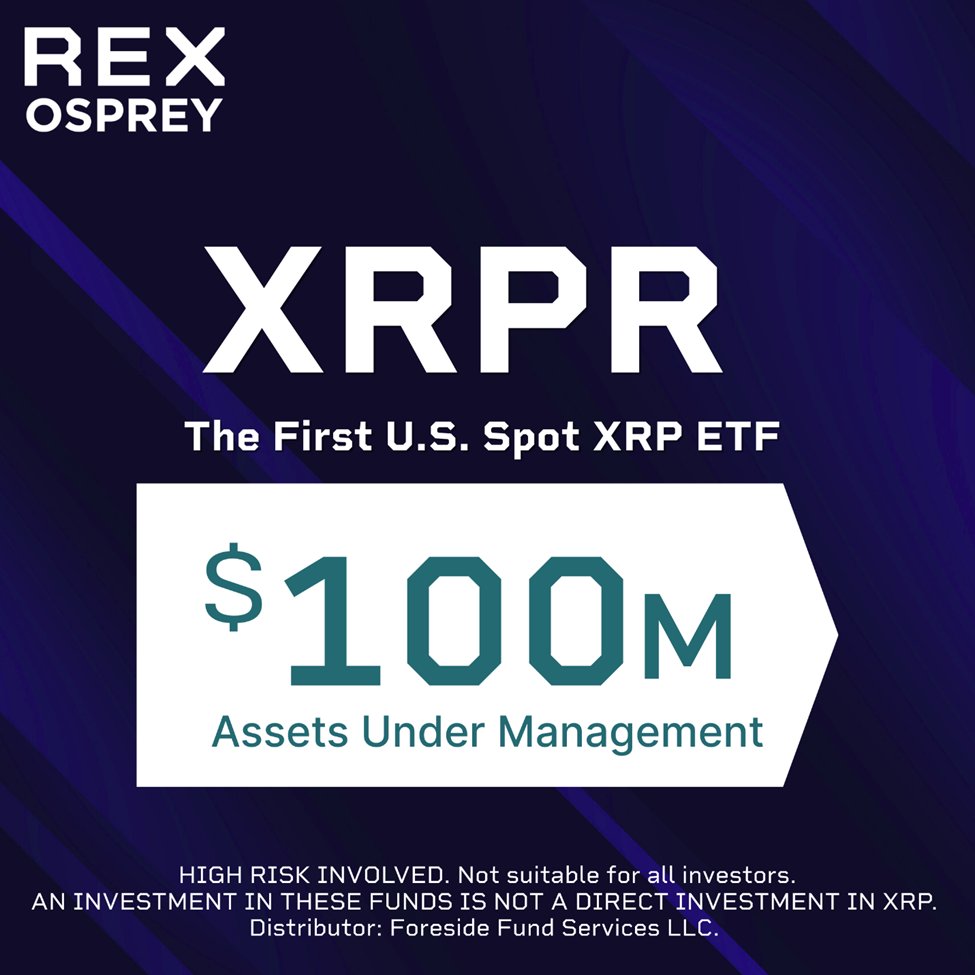
The REX-Osprey XRP ETF, the first U. S. exchange-traded fund offering direct exposure to XRP, has surpassed $100 million in assets under management within a month of its launch. Launched on September 18, the fund provides investors with a unique opportunity to gain direct exposure to XRP, the fourth-largest cryptocurrency by market capitalization, without the complexities of purchasing the digital asset itself.

According to REX Osprey, the firm behind the launch of the ETF, the rapid growth in AUM highlights the increasing interest in digital assets and their integration into mainstream investment products. The ETF, which trades on the Cboe BZX Exchange, allows investors to gain exposure to XRP through a traditional brokerage account, making it more accessible than purchasing the cryptocurrency directly on exchanges.

XRP has long been one of the most controversial and volatile cryptocurrencies, primarily due to its ongoing legal battle with the U. S. Securities and Exchange Commission. The SEC initially filed a lawsuit against Ripple Labs, the company behind XRP, alleging that the cryptocurrency is an unregistered security. However, recent developments in the case, including partial victories for Ripple, have given a boost to investor sentiment, contributing to XRP’s price increase and the subsequent success of the ETF.

Since its launch, the XRP ETF has attracted both institutional and retail investors seeking exposure to the cryptocurrency market in a more regulated, liquid form. The growth in AUM also underscores the growing demand for innovative financial products that allow mainstream investors to participate in the digital asset space without directly owning the underlying cryptocurrencies.

The popularity of cryptocurrency ETFs has been rising globally, and the launch of XRPR marks a significant milestone in the U. S. market, which has been cautious in approving crypto-based exchange-traded products. The approval of the XRP ETF comes at a time when other digital asset ETFs, such as those based on Bitcoin and Ethereum, have seen significant traction. The success of these products has raised expectations for further expansion of the cryptocurrency ETF market, especially as regulatory clarity surrounding digital assets continues to improve.

The launch of the REX-Osprey XRP ETF also reflects broader trends in the financial markets, with traditional financial institutions increasingly integrating cryptocurrencies into their offerings. Institutional investors, who have historically been wary of the volatility and regulatory uncertainty surrounding digital assets, are now more open to exploring the potential of blockchain technology and digital currencies as part of a diversified investment portfolio.

XRP, which has faced significant volatility over the years, has experienced a surge in value following key legal victories in its ongoing battle with the SEC. Ripple’s partial legal wins have boosted investor confidence, and many view the outcome of the case as a critical factor in the future of XRP’s market position. The cryptocurrency’s price has seen a sharp upward movement in response to the more positive outlook surrounding the lawsuit.

The success of the XRP ETF reflects growing confidence in XRP as an investment vehicle, despite the regulatory uncertainties that continue to surround it. While there are still ongoing legal challenges, the launch of this ETF signals a shift in how the cryptocurrency market is viewed by investors and regulators alike. The ability to trade XRP through an exchange-traded fund allows for more streamlined access to the asset, eliminating some of the complexities involved in handling digital currencies directly.

Matein Khalid The supply glut in crude oil, the fragile geopolitics of the Levant, the Gaza wars, the thinnest sovereign credit spreads since the summer of 2006 have not ended the scramble to pick up MENA credit when the issuer is not a serial borrower/distressed credit and the bonds issue reflects improving political/economic fundamentals. The year ago, Oman and Bahrain provided some amazing opportunities for capital gains […]

Mumbai-based crypto exchange WazirX has enabled both Indian-rupee and cryptocurrency deposits as it moves toward resuming full trading and withdrawal services, signalling a critical recovery phase after its high-profile $230-million hack. The platform will initiate trading on 24 October 2025, launching with zero trading fees across all pairs for at least 30 days, and is rolling out withdrawals gradually.

WazirX’s comeback is anchored on a restructuring plan approved by the Singapore High Court for its parent company Zanmai Labs Private Limited, which had been navigating creditor claims and asset recovery since the breach. The company has partnered with US-based custodian BitGo to manage digital-asset wallets and bolster security with insured, institutional-grade custody solutions.

Operating under a phased restart, WazirX will first enable crypto-to-crypto markets and the USDT/INR pair from 24 October, with other INR pairs added later. Deposits are active now; withdrawals will follow in stages. Users who opted in to the restructuring will receive so-called “Recovery Tokens” within ten business days, representing claims on illiquid or frozen assets.

This relaunch occurs after the July 2024 hack — attributed to the Lazarus Group by multiple governments — in which WazirX exposed vulnerabilities that resulted in loss of approximately $234 million in digital assets and triggered a suspension of trading, withdrawals and deposits. The setback had eroded trust among India’s crypto retail community and drawn regulatory scrutiny.

WazirX co-founder and CEO Nischal Shetty acknowledged the challenge of restoring confidence, stating on social media: “Our focus is only YOU — we are committed to a secure and transparent restart.” Still, some users have raised concerns over discrepancies in post-rebalancing balances, alleging that their credited holdings were lower than earlier display values. WazirX has pledged to release a detailed audit and reconcile any shortfalls.

Industry analysts view WazirX’s relaunch as a litmus test for Indian crypto exchanges, which have faced security, regulatory and trust-deficit issues. While the zero-fee offer may stimulate trading volume and liquidity, questions remain over how effectively WazirX can demonstrate enhanced operational resilience and compliance oversight. Further complicating matters is India’s evolving regulatory landscape: a proposed crypto-assets bill is under discussion, and exchange-licensing frameworks remain undefined.

For traders, the phased rollout presents both opportunity and risk. Market-makers caution that liquidity may be thin in the initial days, potentially creating wider spreads or slippage. WazirX’s blog announcement advises users to monitor token availability, confirm order execution conditions and treat first-day price action with caution. With a delisting of some tokens and swaps or mergers during the downtime, certainty over token status is also being tested.

A leading voice at the United Nations General Assembly roundtable pressed for stablecoins and blockchain-based identity systems as crucial tools in closing the gap for the 1.7 billion people globally who remain outside formal financial services. Adrian Wall, managing director of the Digital Sovereignty Alliance, moderated a session on global digital identity and financial inclusion on 22 October 2025 at the UN headquarters in New York, asserting that inclusive digital ecosystems must go hand in hand with personal data ownership.

Wall declared that “financial inclusion without financial literacy is a bridge to nowhere. It is access without empowerment,” emphasising that agency begins with ownership of data and dignity begins with choice. The DSA event convened 48 policy-makers, technology leaders and sustainable-development practitioners to explore frameworks combining blockchain, stablecoins and digital identity protocols in Africa, Asia and Latin America.

The discussion centred on how stablecoins—cryptocurrency units pegged to fiat currencies—and decentralised ledger infrastructures can extend access to payments, savings and credit for those shut out of traditional banking. Wall highlighted that data sovereignty underpins financial sovereignty: by empowering individuals to control their digital identity, systems can shift from passive access to active agency. He noted the critical role of stablecoins in environments where banking infrastructure is weak, pointing to pilots in sub-Saharan Africa where mobile wallets linked to digital identity verify transactions in previously unbanked communities.

Yet speakers also raised caution about stablecoins’ risks. Regulatory oversight remains uneven, with concerns about reserve transparency, anti-money-laundering compliance and the possibility of financial exclusion if digital identity systems mis-function. One attendee warned that “if identity platforms fail, we may deepen the exclusion we’re trying to solve.” The DSA stressed the need for multi-stakeholder governance: national regulators, technology providers and civil-society organisations must co-design the protocols to safeguard inclusion rather than displace it.

Beyond Africa, the dialogue extended to how stablecoins might support cross-border remittance flows, reducing cost and settlement delay. With global remittances hitting over US$700 billion annually, the potential for digital-asset rails has attracted attention from development lenders and fintech firms. Wall suggested that stablecoins anchored to trusted fiat liabilities could complement central bank digital currencies where those are nascent, offering a hybrid model for underserved markets.

Microsoft has raised the price of its Xbox development kit from US$1,500 to US$2,000—a jump of approximately 33 per cent. Sources familiar with the matter state that the price increase applies globally, covering regions beyond the United States. The move follows earlier price hikes for the Xbox Series X and S consoles and increases to the Xbox Game Pass subscription. Microsoft attributes the change to broad “macroeconomic […]

LAGOS – Fintech company Moniepoint Inc. announced yesterday that it has raised more than US $200 million in a Series C equity financing round aimed at accelerating its expansion across Africa and into diaspora markets. The round was led by British private equity firm Development Partners International through its African Development Partners III fund, with participation from impact-investor LeapFrog Investments, Google Africa Investment Fund, global payments giant […]

Moscow has authorised the use of cryptocurrencies in cross-border payments for trade, marking a significant departure from previous policy. The Ministry of Finance of the Russian Federation and the Bank of Russia have reached an agreement to legalise digital-asset settlements in foreign trade transactions, while simultaneously tightening regulatory oversight of the wider crypto market.

Finance Minister Anton Siluanov said the step was necessary because imports are already being paid for with crypto assets and the existing regulatory framework was inadequate. He emphasised that the legalisation would be accompanied by “proper legislative regulation” to restore order in the sector.

Under the new framework, firms engaged in exports and imports will be able to transact using cryptocurrencies—but only via authorised channels that meet stringent anti-money-laundering and know-your-customer standards. The shift builds on an earlier “experimental legal regime” that allowed limited crypto use in foreign trade and by select investors.

The Bank of Russia remains cautious. Its governor Elvira Nabiullina continues to resist full recognition of cryptocurrencies as a means of payment domestically, and proposed restricting use to cross-border trade and wealthy “qualified” investors under licensed firms.

Market analysts interpret the decision in the context of pressures from Western sanctions, which have constrained access to global payment systems. The move is seen as part of Russia’s strategy to bolster trade flows, particularly in energy and commodities, by bypassing traditional channels.

Still, legalisation is selective rather than broad. The regime applies for now only to foreign-trade transactions; the domestic use of cryptocurrency for everyday payments or retail investments remains prohibited. The Bank of Russia argues allowing wide retail access poses “financial and social” risks.

For domestic investors, the path to broader engagement remains narrow. Earlier this year the regulator proposed allowing only those with assets above 100 million roubles or annual incomes above 50 million roubles to participate in a crypto-investment experiment.

Industry players say the legalisation will create new opportunities. Top banks—such as Sberbank and Alfa‑Bank—had warned that millions of Russians hold crypto assets despite being excluded from the formal regime. They argued the grey market status of holdings was a risk for the broader financial system.

Critics caution that regulatory oversight and enforcement will be key. The Prosecutor-General’s Office, under Alexander Gutsan, highlighted that the new framework includes tools to monitor transactions linked to corruption, terrorism, extremism, and illicit financial flows.

Observers outside Russia are weighing potential ripple effects. Some suggest the policy could encourage other sanctioned or emerging-market nations to adopt crypto-based trade settlement models, challenging the dominance of traditional systems such as SWIFT.

For Russian exporters and importers, the shift may offer relief from constrained access to Western-dominated financing and payment networks. Nonetheless, firms must still operate within Bank of Russia-endorsed platforms and are subject to rigorous compliance oversight—so adoption may remain cautious in the near term.

From the government’s perspective the move attempts to draw the large informal crypto-market inside the regulatory perimeter. Holding of crypto assets by Russian users has been estimated in the hundreds of billions of roubles, according to central bank data.

Advertisements

Lagos-based fintech firm Moniepoint Inc. has secured more than USD 200 million in its Series C equity funding round, a move that underscores its rapid growth, profitability at scale and continental ambition. The funding was led by Development Partners International’s African Development III fund and included heavyweight participation from LeapFrog Investments, Visa Inc., Google LLC’s Africa Investment Fund, the International Finance Corporation, Proparco, Swedfund and others. Moniepoint […]

For years, the cryptocurrency debate has centred on price. Every discussion returned to charts, volatility, and market speculation. The fixation on value swings has distracted from a much more important story. The future of digital finance is not about price movement. It is about infrastructure. Regulated stablecoins are emerging as the foundation of a new global financial system. They combine the trust of established currencies with the […]

Cybersecurity firms have uncovered a sophisticated backdoor dubbed ChaosBot, written in the Rust programming language, that uses the chat-and-voice platform Discord for command-and-control traffic, marking a distinct shift in how threat actors are orchestrating cyber-intrusions. The campaign appears to have begun in a financial-services environment, with attackers leveraging compromised credentials and advanced evasion methods to sidestep detection. According to reports from the vendor eSentire, the incident first […]

Visitors to the heart of Australia’s Red Centre are being drawn to Uluru‑Kata Tjuta National Park by a confluence of cultural significance, unique experiences and strategic branding that spotlight the historic destination for 2026. Plunge into the landscape and traditions of this immense sandstone formation and its neighbouring domes, and you’ll discover a land of deep meaning, geological wonder and evolving travel dynamics. Standing 348 metres tall and […]

Tokyo’s financial regulator is advancing a proposal that would permit domestic banks to directly invest in cryptocurrencies such as Bitcoin and operate crypto exchanges, marking a significant shift from earlier restrictions. The Financial Services Agency is set to present its plans to the Financial System Council—an advisory body to the prime minister—later this month.

Under the existing regime promulgated in 2020, Japanese banks have been effectively barred from acquiring and holding digital assets for investment purposes, owing to concerns about volatility and financial-stability risk. The new regulatory blueprint would align crypto asset holdings by banks with traditional financial instruments such as stocks and government bonds, while introducing capital and risk-management requirements tailored to the asset class.

According to data cited by the FSA, Japan’s crypto account holdings have climbed past 12 million as of February 2025—a roughly 3.5-fold increase over five years. The surge in retail interest is growing pressure on regulators to provide greater clarity and institutional-grade infrastructure. Amid this backdrop, the proposed reforms aim to usher in a more integrated digital-asset ecosystem under the purview of regulated financial institutions.

The FSA’s initiative encompasses three key pillars: Firstly, banks would be authorised to purchase and hold unbacked crypto assets for trading or investment, subject to strict internal controls and exposure limits.  Secondly, bank groups may register as licensed “cryptocurrency exchange operators,” effectively allowing them to offer trading and custody services in-house rather than relying solely on third-party platforms.  Thirdly, the FSA plans to shift oversight of digital assets from the current Payment Services Act regime into the Financial Instruments and Exchange Act framework, thereby affording crypto the same legal mould as securities.

Banking groups in Japan are already responding. Three of the country’s largest financial institutions—Mitsubishi UFJ Financial Group, Sumitomo Mitsui Financial Group and Mizuho Financial Group—have announced a joint plan to issue a yen-pegged stablecoin for corporate settlements, signalling a broader shift into digital assets.

Supporters of the reforms argue that allowing regulated banks to engage with crypto assets will bolster investor protections, improve custody and transactional infrastructure, and widen market access. “This reform will treat cryptocurrencies similar to other investible asset classes under bank supervision,” noted one industry analyst. However, sceptics caution that the volatility of cryptocurrencies remains elevated and that exposure must be managed carefully to prevent end-user or systemic risk.

Regulatory design will therefore place a heavy emphasis on limiting banks’ direct holdings of digital assets relative to their capital base, imposing heightened disclosure and governance mandates. One working-group paper recommends that banks maintain separate risk-allocations and stress-testing frameworks for crypto, akin to those used for foreign-exchange or commodity trading desks.

The tax and legal context are also evolving. Japan is preparing to introduce a flat 20 % capital-gains tax on crypto assets as part of its 2025 reforms, and certain tokens are slated to be reclassified as securities under the FIEA. These measures are designed to reduce uncertainty for institutional participants and global investors seeking regulated exposure to digital assets.

Market participants appear cautiously optimistic. Some regional banks are exploring pilot custody services for institutional clients, while fintech firms anticipate greater collaboration with mainstream banks as eligibility expands. On the flip side, legacy concerns persist: past hacks and exchange failures have left regulators and consumers wary of governance failures and inadequate transparency.

The world’s largest cryptocurrency, Bitcoin, vaulted above $111,000 after a steep dip earlier this week, triggering sharp gains across major tokens including Ethereum, XRP and Solana. On-chain metrics signalled accumulating momentum while traditional equity markets in Asia registered fresh highs, boosting risk-assets overall.

Bitcoin climbed to around $111,223, representing a gain of approximately 3.7% within 24 hours, after briefly touching a low near $103,602. Other digital assets followed: Ethereum reached roughly $4,062, XRP $2.47 and Solana approximately $193.33, with 24-hour gains of between 3% and 5%.

Analysts highlight several factors underpinning this recovery. On-chain data show the realised value-to-transaction ratio for Bitcoin has declined — a historical marker of heightened accumulation rather than passive holding. A crypto-analytics firm noted that “strong declines in the RVTS have preceded major bull phases, as they indicate that Bitcoin is being used, accumulated, and transferred — not just held.”

Broader market dynamics provided further tailwinds. In Japan, the Nikkei 225 index soared past 49,000 for the first time, advancing the year-to-date gain to 25%. The move followed media reports indicating that the country’s leading opposition party plans to join coalitions which position its fiscal-dove leader for the prime ministership — one with a policy inclination towards low interest rates and expansionary fiscal measures.

Meanwhile, China’s third-quarter gross domestic product growth of 4.8% year-on-year narrowly exceeded forecasts of 4.7%, providing support for risk assets globally.

Beyond macro-signals, institutional behaviours also deserve attention. A leading publicly listed company with large Bitcoin holdings, Strategy, has signalled fresh crypto purchases — adding a layer of institutional demand to the structural thesis.

Within the crypto space, major platforms tied to tokenisation and stable-coin activity are also part of the narrative. Analysts at Galaxy Digital emphasise three structural drivers: increased AI-capex from tokenised assets, accelerating stable-coin infrastructure, and the migration of real-world assets onto blockchain networks. These are seen as propositions that may sustain momentum beyond short-term price moves.

Yet, market participants remain cautious. Liquidity remains thin and residual risks — such as further macro headwinds, regulatory tightening or a reversal in risk appetite — continue to warrant vigilance. As one analyst put it: “The near-term message is caution — respect thinner liquidity, post-crash psychology and a ‘wall of worry’ mood. The medium-term message is resilience.”

Within altcoins, XRP is gaining renewed focus ahead of potential ETF-related developments, while Solana is benefitting from its association with on-chain tokenisation flows. Market-data platform CoinGecko shows that XRP trades at around $2.46, with volume flows increasing as sentiment rebuilds.

Astra Nova has secured USD 48.3 million in a funding round aimed at accelerating its development of no-code, AI-driven tools for creators in the Web3 entertainment space. The capital will bolster expansion into new regions and deepen integrations among its ecosystem of mini-apps, games and community tools.

The bulk of the funding, approximately USD 41.6 million, came through a strategic investment round, building on prior backing from firms including Outlier Ventures and Middle East family offices. Astra Nova intends to deploy the funds toward global scaling, regulatory readiness and product enhancements.

Astra Nova’s core proposition rests on TokenPlay AI, a platform that enables creators to launch blockchain-enabled micro-apps without writing code. Powered by Alibaba Cloud infrastructure, it is designed to let developers spin up interactive communities and gamified utilities rapidly. In addition, Astra Nova operates NovaToon, Deviants: Fight Club, and BlackPass, all of which already draw user traction.

Crucially, major brands are integrating with Astra Nova ahead of its token launch. Shiba Inu, one of the most active crypto communities, is deploying mini-apps through TokenPlay AI, and the Simon’s Cat IP is also building live integrations. These are not mere announcements: the integrations are functional and active, driving transaction volume even before the token is fully in circulation.

Astra Nova’s native token, $RVV, is scheduled for issuance on 18 October. The token is intended as the foundational utility currency within the ecosystem, underpinning in-app upgrades, advertising, subscriptions, and community incentives. Transaction fees from ecosystem activity are programmed to trigger buybacks of $RVV, creating a feedback loop to support tokenomics.

Backing for the project includes strategic support from NEOM, NVIDIA’s Inception programme, and Alibaba Cloud. NVIDIA’s involvement is particularly significant: it provides access to GPU and AI computing capabilities that are critical to Astra Nova’s adaptive storytelling and intelligent NPC infrastructure. Alibaba Cloud offers global infrastructure scale, while NEOM’s partnership underscores sovereign interest in aligning the startup with Saudi Arabia’s broader AI and tech ambitions.

Astra Nova’s metrics already indicate early scale: the company claims more than 250,000 creators on its waitlist for TokenPlay AI, cumulative user reach across its live products exceeding 500,000, and 200,000 daily active users across the ecosystem. The ARPG built on Unreal Engine 5 has surpassed 100,000 playtest downloads, reinforcing early demand and user engagement.

Analysts see the model’s strength in its orchestration of multiple components—creator tooling, community building, content, and gaming—into a unified framework supported by AI and blockchain. The pre-launch traction with IPs such as Shiba Inu and Simon’s Cat gives the ecosystem a runway of activity even from day zero of token issuance.

Gold surged past $4,300 per ounce this week, setting fresh records as investors turned decisively to safe-haven assets amid mounting geopolitical strain and expectations of forthcoming U. S. rate cuts. The run has intensified scrutiny over gold’s role in modern portfolios—and reopened questions about the value of what critics label a “sterile” asset. Spot gold climbed about 2.5 per cent to $4,316.99, while December futures peaked at […]

Over $250 million has been wiped out from leveraged positions across major cryptocurrency markets within the last 60 minutes, according to real-time tracker alerts. The bulk of the liquidations hit long bets, triggering a sharp lash of volatility that rattled traders across exchanges.

Data from multiple crypto-analytics feeds show that Bitcoin and Ethereum bore the brunt of the forced closures, with long positions cascading under mounting downward pressure. The alerts indicate that around $200 million of that total was liquidated in just the preceding 15 minutes. Margin calls and automatic stop-loss triggers have sharply pared back open interest.

Market participants point to a combination of lower-than-expected macro signals and heightened global risk aversion as catalysts for the sudden liquidation wave. Macro equity markets have seen risk assets fall under pressure over the past sessions, prompting a spillover into speculative crypto positions. The added strain from derivatives exposure amplified the move.

Crypto exchange data show that Binance, Bybit and OKX recorded the highest volumes of liquidations, especially in their perpetual futures markets. On Binance alone, over $80 million in long positions may have been forcibly closed, according to traders cross-checking the on-chain and order-book flows. Ethereum perpetuals also registered substantial losses, particularly in mid- and high-leverage tiers.

Analysts observing funding rates and open interest across exchanges have flagged an abrupt deleveraging. The funding rates for many altcoins flipped negative, signalling that the short side was gaining dominance as leverage unwound. Open interest across high-risk tokens dropped by 15 – 20 % in many cases, suppressing liquidity and heightening slippage.

Several algorithmic trading desks and quant funds experienced knock-on effects. As large liquidations pulled prices lower, stop orders cascaded, exacerbating the decline in thin markets. Some trading firms reported losses due to slippage and forced exits—even though positions were hedged—with automated strategies failing to escape the downdraft in time.

A few larger holders, often designated as ‘whales’, appear to have opportunistically repositioned. Some have placed bids closer to now-discounted levels in anticipation of a bounce; others reduced exposure altogether. On-chain indicators suggest increased inflows to stablecoin pools and accumulation in non-spot holdings, hinting at a cautious redeployment rather than wholesale exit.

Institutional interest remains muted amid the turmoil. According to contacts in digital-asset fund management, most institutions were already operating with limited leverage and hedges in place. Few entered new positions during the seizure of volatility, and many paused trades to watch whether support levels would hold.

Abu Dhabi’s MDGH GMTN priced a one-billion dirham Reg S five-year bond at par, carrying a coupon of 4.20 per cent. The issuer tightened guidance from an initial 4.45 per cent, and book orders surpassed AED 4.7 billion, not counting joint lead manager interest, signalling strong investor demand.

The unsecured bond is guaranteed by Mamoura Diversified Global Holding, with settlement set for 23 October and a planned listing on the London Stock Exchange Main Market. Fitch is expected to assign an “AA” rating in line with Mamoura’s sovereign backing. The issuance was led by a syndicate including Abu Dhabi Commercial Bank, Bank of China, Citi, Emirates NBD Capital, First Abu Dhabi Bank, Goldman Sachs International, HSBC, Industrial and Commercial Bank of China, National Bank of Kuwait and Standard Chartered.

This city-currency issue follows a $750 million ten-year dollar bond issued less than ten days earlier by MDGH, priced at about 55 basis points over U. S. Treasuries under the same guarantee structure. That transaction underlined the group’s growing presence in global markets.

MDGH is wholly owned by Mubadala Investment Company and plays a central role in Abu Dhabi’s strategy to diversify its economic base. In its 2024 financials, the company reported revenues of AED 39,528 million and a net profit attributable to owners of AED 37,376 million, with total assets reaching AED 596,168 million.

Credit agencies currently align Mamoura’s rating with the sovereign, with Fitch affirming an “AA” rating and stable outlook in late 2023. Moody’s and S&P assign comparable ratings of Aa2 and AA respectively.

Analysts note that the new issue shows how Abu Dhabi-linked issuers are able to tap demand for high-grade Gulf debt amid tighter global credit markets. The bond’s tight pricing and oversubscription point to strong appetite among fixed-income investors for Gulf credits backed by sovereign guarantees.

South Korea’s Financial Intelligence Unit has authorised a change in GOPAX’s executive leadership, clearing the way for Binance’s acquisition of 67 per cent of the local exchange and formally restoring its presence in the country. The decision comes after over two years of regulatory review and internal scrutiny.

The executive registration approval by the FIU establishes Binance as the controlling shareholder of GOPAX, resolving a key hurdle that had delayed the deal since its initiation in early 2023. By acquiescing to the change, South Korean authorities have allowed Binance’s re-entry into one of Asia’s most active cryptocurrency ecosystems.

When Binance first acquired the majority stake in GOPAX in February 2023, it sought to stabilise the exchange following a liquidity crisis tied to frozen customer deposits connected to the GoFi yield product. That crisis was traced to exposure to Genesis Global Capital, whose own collapse triggered withdrawals being halted. Binance undertook a capital injection to support GOPAX’s recovery while awaiting formal regulatory sign-off on executive changes.

The FIU’s prior hesitancy centred on concerns that Binance’s international compliance record could clash with South Korea’s anti-money laundering oversight. Legal pressure from U. S. authorities, including enforcement actions and substantial fines, had raised red flags among domestic regulators. But the FIU’s acceptance now signals that uncertainties over Binance’s compliance credentials have been sufficiently addressed.

Under South Korean law, exchanges must report changes in executive or representative roles to the FIU, which effectively acts as a gatekeeper in approving foreign capital in the local crypto sector. No separate screening mechanism exists for major shareholders, making the executive registration process a de facto test of suitability. Delays in this case were reportedly driven by repeated demands for supplemental documentation by regulators.

GOPAX is one of only five exchanges in South Korea authorised to conduct cash-crypto transactions under strict regulatory norms. With Binance now in control, GOPAX could compete more aggressively against dominant local players such as Upbit and Bithumb. Yet entrenched banking relationships and compliance frameworks will still pose barriers to market share gains.

The approval reflects a shift in Korea’s regulatory posture toward greater openness—especially for exchanges that have resolved international legal disputes. Binance’s own settlements regarding AML and market conduct issues appear to have alleviated domestic regulatory apprehension. The acceptance also underscores the FIU’s judgment that Binance’s structural changes and compliance assurances now align with South Korea’s regulatory expectations.

CME Group has launched its first physical base in the Middle East with an office at the Dubai International Financial Centre, to serve as its hub for the region under a licence from the Dubai Financial Services Authority. Sharif Jaghman, relocated from London, will head the new Middle East and Africa operations. The move follows a 16 per cent rise in average daily trading volumes from the […]

U. S. President Donald Trump declared that Indian Prime Minister Narendra Modi has pledged to halt India’s purchases of Russian crude oil, a shift that would significantly upend global energy flows if implemented. Trump told reporters that Modi made the commitment during their conversation, stating that phasing out Russian imports would not happen overnight but would take place “within a short period of time.” The Indian embassy […]

Traders on the U. S. prediction market Kalshi are assigning a 55 percent chance that Bitcoin will exceed $130,000 by the end of 2025, with probabilities of 34 percent for surpassing $140,000 and 24 percent for topping $150,000. That places the market’s expected annual high at roughly $132,000.

Those figures reflect a steadily intensifying optimism about Bitcoin’s trajectory, drawing attention from institutional and retail participants alike. Kalshi’s “How high will Bitcoin get this year?” market is driving price discovery around extreme outcomes for the cryptocurrency.

That optimism today sits alongside growing institutional flows into related assets. Bitcoin spot ETF issuers have been attracting multi-billion dollar inflows across several jurisdictions; analysts view that as a cornerstone of structural demand, tightening supply in spot markets. At the same time, the derivatives market is registering sharply skewed positioning in favour of upside moves, especially in out-of-the-money call options.

Crypto research platforms note that exchange reserves of Bitcoin are at multi-year lows, meaning a smaller buffer for large sell orders to exert downward pressure. Some large holders are moving coins to cold storage or long-term custody, reducing the circulating float further. That dynamic can magnify even moderate inflows into a pronounced price rise.

Macroeconomic factors are reinforcing these tailwinds. Markets broadly expect the U. S. Federal Reserve to shift toward a less restrictive stance in the months ahead, which would lower the opportunity cost of holding a risk asset like Bitcoin. Inflation pressures, geopolitical uncertainty, and currency devaluation narratives have been pushing capital toward non-sovereign stores of value — a trend some asset allocators perceive as supportive for digital assets.

Kalshi itself has expanded rapidly. In October 2025, the company announced growth into over 140 countries following a $300 million funding round that values it at $5 billion. This capital boost is intended to improve infrastructure, broaden partnerships, and scale its product stack beyond simple yes/no event contracts. The valuation surge underscores confidence in prediction markets as a means of tapping collective foresight.

Kalshi is currently viewed as a leader in the prediction-market space, outpacing rivals like Polymarket. As of mid-October, Kalshi’s valuation exceeds that of Polymarket by a wide margin, though the latter retains star appeal in crypto circles.

Kigali has become the launchpad for the Rwanda chapter of the Africa Trade Gateway, a comprehensive digital trade ecosystem developed by the African Export-Import Bank in partnership with the African Continental Free Trade Area Secretariat. The rollout aims to accelerate uptake of the platform across the nation and integrate Rwandan firms more closely into Africa’s digital trade networks. The ATG combines five integrated modules—including PAPSS, MANSA, ATEX, […]

Tether CEO Paolo Ardoino has asserted that only Bitcoin, gold and land will endure as reliable monetary instruments as fiat systems unravel. He framed those three assets as hedges against systemic collapse and said they will outlast any rival currency, reflecting Tether’s ongoing pivot from pure stablecoin backstop to diversified asset allocator.

Speaking during appearances at Bitcoin 2025 and in media interviews, Ardoino has emphasised that Tether will continue to channel a portion of its profits into Bitcoin accumulation and expand gold exposure. He described gold not merely as a relic but as a “natural Bitcoin” and strategic complement to digital reserves. Ardoino also dismissed claims that Tether was liquidating Bitcoin to fund gold purchases, suggesting any shifts in allocation are incremental and disciplined.

Tether’s balance sheet already demonstrates the alignment between rhetoric and action. As of mid-2025, it held around US$8.93 billion in Bitcoin and US$8.72 billion in precious metals, alongside the core swathe of U. S. Treasury allocations. Ardoino has disclosed that gold assets reside in a Swiss vault, underlining both security and the company’s intent to position gold holdings more prominently. His remarks come amid reports that Tether has held discussions with gold mining and royalty firms as part of a broader commodity strategy.

The company’s asset diversification bid is playing out amid intensifying regulatory clarity. With the U. S. Senate having passed the GENIUS Act—legislation meant to regulate stablecoins—Ardoino is charting Tether’s path to compliance while preserving its global reach. He has portrayed the bill as presenting “high but fair” standards for reserve disclosure and anti-money laundering. While it is branded as beneficial to onshore issuers like Circle, Ardoino contends Tether’s offshore structure can adapt via comparable systems or U. S.-based subsidiaries.

Tether is not simply a passive holder of assets. Ardoino has also announced the company’s ambition to become one of the world’s largest Bitcoin miners by year-end, arguing that supporting network security reinforces the value of its reserve holdings. He claimed that while direct Bitcoin investment can outpace mining returns in many scenarios, mining offers strategic hedging benefits. Tether is preparing to open-source its Bitcoin Mining Operating System to enable broader participation in the network, potentially lowering barriers to entry for smaller mining operators.

A team from the International Monetary Fund has secured a staff-level agreement with Somali authorities to complete the fourth review under the Extended Credit Facility arrangement. The agreement, pending approval by the IMF’s Executive Board, unlocks a portion of additional funding and reaffirms commitments to macroeconomic reform. The mission, led by IMF representative Ran Bi, conducted talks with Somali officials between 16 September and 8 October, resulting […]

VISHNU RAJA
RYO YAMADA
HITORI GOTOH
IKUYO KITA
Just in: