Global internet traffic surged to unprecedented levels during 2025, underlining how live sport, high-definition streaming and expanding artificial intelligence workloads are reshaping the world’s digital infrastructure. Network operators and exchange operators recorded sharp spikes during major live events, with a Champions League match night in December emerging as one of the heaviest traffic moments ever observed on public internet exchanges. Data collated from large internet exchange platforms […]
Greenlogue/AP The UAE Research Program for Rain Enhancement Science has named the recipients of its sixth cycle of grants, committing up to US$1.5 million to each selected project over three years as the country sharpens its focus on applied climate research and water security. The awards, announced by the UAE Research Program for Rain Enhancement Science, come with a ceiling of US$550,000 per year for each project […]
Arabian Post Staff -Dubai Source of Fate, a luxury real estate developer operating under the Wheel of Fate Group, has begun construction on Miraggio, a $707 million waterfront development on Al Marjan Island in Ras Al Khaimah, marking one of the largest private luxury residential investments announced on the northern emirate’s coastline. The ground-breaking ceremony on the reclaimed island signals the company’s formal entry into the upper […]
South Africa’s currency advanced to its strongest level in roughly three years as a softer US dollar, firm commodity prices and cautious optimism about domestic reforms combined to lift investor appetite for emerging-market assets. The rand strengthened through the week against the greenback and traded at levels last seen before the global tightening cycle gathered pace, reflecting both external tailwinds and renewed focus on policy signals from […]
Mozambique has secured a fresh boost for its offshore gas ambitions after the Board of Directors of the African Development Bank approved a $150 million senior loan for the Coral North floating liquefied natural gas project. The decision, taken on January 14, signals renewed momentum for the country’s flagship gas developments and underlines lender confidence in large-scale energy infrastructure anchored in the Rovuma Basin. The financing is […]
3,500 Companies Recognized; Support for Working Caregivers Emerges as New Benchmark for Friendly Workplaces
HONG KONG SAR – Media OutReach Newswire – 22 January 2026 – 22 January 2026 – The Hong Kong Council of Social Service (HKCSS) held the 2024/25 Caring Company Scheme Recognition Ceremony today at the Hong Kong Convention and Exhibition Centre. Mr. Chris SUN Yuk-han, JP, Secretary for Labour and Welfare of the Hong Kong Special Administrative Region, attended as the Guest of Honour. This year, a total of 3,500 caring companies and organisations were recognised.
The Caring Company Scheme Recognition Ceremony cum Release of the Caring Business Achievements Overiview concluded successfully today, Mr. Chris SUN, JP, Secretary for Labour and Welfare (centre), joined HKCSS management for a group photo. From left:Hon Grace CHAN Man-yee, Chief Executive Of HKCSS Mr. CHAN Tsz Ming, Director, Analysts at Level 1, Department of Social Affairs, Liaison Office of the Central People’s Government in the HKSAR Mr. Chris SUN, JP, Secretary for Labour and Welfare Revd Canon Hon Peter Douglas KOON Ho Ming, SBS, JP, Chairperson of HKCSS Mr. CHAN Charnwut, Bernard, GBM, GBS, JP, Vice-chairperson of HKCSS Ms. CHAK Tung Ching, Yvonne, Vice-chairperson of HKCSS
For the first time, HKCSS released the major findings from the Caring Business Achievements Overview, providing an in-depth look at corporate trends in addressing social issues such as population ageing, workforce challenges, and climate change across four key pillars: Partnership, Social, Economic, and Environmental Sustainability.
Mr. Chris SUN Yuk-han, JP, Secretary for Labour and Welfare of the Hong Kong Special Administrative Region, congratulated the businesses and organizations recognized by the Caring Company Scheme. He emphasized that building a compassionate society requires collaboration with the business community, which plays a vital role alongside government and non-governmental efforts. By prioritizing employee welfare, employers not only uplift families but also drive growth, attract talent, and foster mutual benefits. Mr. SUN called upon the business sector to engage more proactively in this initiative, fostering a collective commitment to building a more caring society for all.
3,500 companies were commended today; top performers were awarded logos representing leading levels of performance.
24 Years of Deep-Rooted Partnership: 28% of Collaborations Last 10 Years or More The Caring Company Scheme has been running for 24 years. The Revd Canon the Hon. Peter Douglas KOON, SBS, JP, Chairman of HKCSS, stated in his speech: “The Scheme underwent a significant revamp recently to localise international sustainability frameworks. Through our inaugural data analysis, we can observe the business sector’s overall performance in tackling challenges like population ageing and climate change. We hope these trends will guide companies to transform a culture of care into concrete business decisions.”
Data indicates that business-social partnerships have built a solid foundation. Over 70% of companies have maintained partnerships with community partners for three years or more, while 28% have sustained collaborations for over a decade, reflecting a commitment to long-term stability in cross-sectoral collaboration.
104 companies were recognised as Caregiver-Friendly for their outstanding support measures.
New Frontier in the Workplace: Support for Working Caregivers Emerges as a Key Focus Corporate performance in supporting caregivers has become a focal point. Data reveals that over 80% of companiess have popularised flexible work arrangements, and 104 companies received special “Caregiver-Friendly” commendations for their outstanding support measures this year.
Hon Grace CHAN Man-yee, Chief Executive of HKCSS, observed several innovative cases: “Some companies have implemented eight weeks of fully paid adoption leave, five days of leave for only-child caregivers, and even ‘Grandchild Leave’. Others provide patient companion service. Supporting caregivers does not necessarily require massive financial investment; as long as it starts from the employees’ needs, the possibilities for caring business are endless.”
Five Key Recommendations: From “Ad Hoc Actions” to “Policy Integration” While companies excel in charitable donations and active participation, there is room for improvement in environmental data tracking (currently at approximately 30%) and workplace diversity. Consequently, HKCSS proposes five key recommendations:
Deepen Caring Standards: Treat the Caring Company Scheme indicators as operational benchmarks to establish a systematic socially responsible business model.
Promote Professional Sharing and Responsible Procurement: Encourage management to join NGO boards as volunteers to provide professional support and integrate NGO products into corporate procurement supply chains.
Build Diverse and Inclusive Workplaces: Actively employ disadvantaged groups to tap into new talent pools and implement flexible work to support working caregivers.
Sustain Investment in Talent Development: Recognize talent as a driver of economic growth, enhance staff training, and strengthen mental health support.
Initiate Data-Driven Management: We recommend that companies immediately start tracking data related to sustainability performance to ensure that social initiatives are measurable and sustainable.
In 2024/25, the Caring Company Scheme received over 4,300 applications. Ultimately, 3,500 companies and organisations were recognised the Caring Company and Caring Organisation logos, comprising large corporations (42%), SMEs (51%), and organisations (7%). HKCSS emphasised that the data release aims to establish a long-term mechanism to guide the business sector in finding room for improvement and addressing future social challenges through collaboration.
Policy makers and technology leaders are pressing ahead with a governance-by-design approach to artificial intelligence as deployment accelerates across public services, finance, manufacturing and health care, even as scepticism around generative systems keeps trust, data ethics and measurable returns at the centre of decision-making.
Momentum has gathered through a series of policy signals that place safeguards alongside scale. Draft frameworks circulated by NITI Aayog and implementation roadmaps led by Ministry of Electronics and Information Technology have reinforced principles around responsible data use, model transparency and accountability for outcomes, while stopping short of prescribing one-size-fits-all rules that could chill innovation. Officials involved in consultations say the intent is to embed risk controls early—covering bias, explainability and security—rather than bolting them on after systems are deployed.
Enterprise adoption has followed a similar trajectory. Banks, insurers and large manufacturers are prioritising AI programmes that demonstrate near-term productivity gains and compliance readiness, favouring narrowly scoped applications over open-ended generative tools. Executives interviewed across sectors point to fraud detection, demand forecasting and maintenance optimisation as areas where benefits can be quantified and audited. By contrast, unrestricted text and image generation remains subject to tighter internal review, particularly where customer-facing outputs could expose firms to reputational or regulatory risk.
Scepticism has not slowed investment, but it has reshaped it. Venture funding has tilted towards platforms that promise governance controls by default—model cards, audit trails and data lineage—alongside performance. Start-ups building on foundation models increasingly highlight enterprise-grade safeguards as differentiators, responding to procurement teams that now treat ethics and security as commercial requirements rather than public-relations add-ons. Industry analysts note that this shift mirrors global buyer behaviour, but localised rules on data residency and consent amplify its importance.
Public-sector pilots underscore the same pattern. State administrations experimenting with AI for grievance redressal, traffic management and land records have emphasised human oversight and explainability, often keeping decision authority with officials while using algorithms to triage or recommend. Procurement documents reviewed by this publication show explicit clauses on dataset provenance and bias testing, reflecting lessons from earlier digital programmes where opaque automation triggered legal challenges.
At the national level, interoperability with global standards remains a priority. Engagements with multilateral bodies and peer regulators have sought alignment with emerging norms on risk classification and model evaluation, while retaining flexibility for domestic conditions. Officials argue that a principles-based stance will allow rapid adaptation as technology evolves, avoiding the lock-in that can follow prescriptive rules. Critics, however, warn that voluntary compliance may prove uneven without clear enforcement pathways.
Talent development forms another pillar of the blueprint. Universities and skilling platforms are expanding curricula that combine machine learning with ethics, law and product management, aiming to produce practitioners who can translate policy into code. Industry groups say demand is strongest for professionals able to design systems that pass audits and deliver return on investment, rather than purely experimental research. This has influenced hiring, with firms rewarding cross-disciplinary expertise.
Cloud providers and chipmakers are also recalibrating offerings for a market that prizes trust. Secure enclaves, confidential computing and on-premise deployment options are being pitched to enterprises wary of exposing sensitive data. Partnerships between domestic integrators and global technology companies have focused on localisation—language support, regulatory reporting and sector-specific controls—over raw model size.
Amazon is facing renewed questions over its marketplace safeguards after a cluster of high-value graphics card orders went wrong, leaving some buyers unexpectedly enriched while others were left short-changed. The incidents, shared widely across online forums and technology communities, centre on next-generation Nvidia graphics cards sold and shipped by Amazon, and point to weaknesses in returns handling at a time when demand for premium hardware remains intense. […]
A $50 million initiative bringing together the Bill & Melinda Gates Foundation and OpenAI is being positioned as a practical push to embed artificial intelligence into public health delivery across multiple African countries, with backers arguing the effort could help overstretched systems do more with limited resources while raising questions about data governance and long-term capacity. The collaboration, branded Horizon1000, is designed to fund pilots and scale-ups […]
UAE and India have elevated their strategic partnership with a sweeping set of agreements signed during the visit of Sheikh Mohamed bin Zayed Al Nahyan, signalling a calibrated push to broaden cooperation across defence, energy, space, trade, investment and food safety. The pacts, endorsed alongside Narendra Modi, reflect a shared intent to anchor bilateral ties in long-term economic and security interests while navigating a volatile global environment.
The visit culminated in the exchange of multiple memoranda of understanding that collectively aim to translate political goodwill into operational outcomes. Officials from both sides framed the agreements as an expansion of the Comprehensive Strategic Partnership, emphasising implementation timelines and institutional coordination rather than aspirational language. At the centre of the package is a defence cooperation framework that strengthens military-to-military engagement, joint exercises, training exchanges and defence industrial collaboration, an area that has gathered momentum as both countries diversify security partnerships.
Energy cooperation featured prominently, with accords spanning hydrocarbons, clean energy and grid resilience. State-linked firms and private players outlined pathways to scale joint investments in upstream oil and gas while accelerating collaboration in renewables, green hydrogen and energy storage. The emphasis on clean energy dovetails with the UAE’s net-zero ambitions and India’s drive to expand non-fossil capacity, positioning both as partners in technology transfer and project financing across third markets.
Space cooperation agreements mark another pillar of the evolving relationship. Space agencies from Abu Dhabi and New Delhi committed to deeper collaboration in satellite development, earth observation, data sharing and human spaceflight training. The arrangements are designed to support applications ranging from climate monitoring and disaster management to urban planning and agriculture, underscoring the commercial and societal dividends of space-based assets.
Trade and investment pacts seek to build on the momentum generated by the Comprehensive Economic Partnership Agreement, which has reshaped tariff structures and supply chains between the two economies. New understandings focus on easing customs procedures, aligning standards and expanding market access for small and medium-sized enterprises. Investment promotion agencies agreed to coordinate sectoral roadmaps in manufacturing, logistics, digital services and infrastructure, with sovereign investors and development funds expected to play a catalytic role.
Food safety and agricultural cooperation agreements address a strategic priority for both governments. Protocols on standards, certification and inspection aim to streamline the movement of agri-food products while safeguarding consumer interests. Joint research initiatives are set to target crop resilience, post-harvest technologies and cold-chain logistics, reflecting lessons from climate stress and supply disruptions that have sharpened the focus on food security.
Diplomatic engagements during the visit also underscored people-to-people ties, education and skills. Universities and research institutions announced partnerships in advanced materials, artificial intelligence and health sciences, while vocational training programmes were aligned to labour market needs in construction, healthcare and digital services. These measures are intended to deepen the talent pipeline that underpins commercial ties.
Officials were careful to situate the agreements within a broader regional and global context. With shipping lanes under strain and commodity markets exposed to geopolitical shocks, both sides highlighted coordination on maritime security and supply chain resilience. The defence and logistics components of the package are expected to reinforce cooperation in the Indian Ocean region, where the UAE’s ports and India’s maritime capabilities intersect.
Economists note that the breadth of the accords reduces concentration risk by spreading cooperation across multiple sectors, while governance mechanisms embedded in the agreements could improve execution. Joint working groups, periodic reviews and dispute-resolution channels were outlined to ensure progress is measurable. Business leaders welcomed the clarity on standards and compliance, arguing that predictability lowers the cost of capital and accelerates project timelines.
Critics caution that delivery will depend on regulatory alignment and the pace of domestic approvals, particularly in capital-intensive sectors such as energy and defence manufacturing. Past initiatives have sometimes faced delays linked to procurement processes and technology transfer rules. Both governments acknowledged these constraints and signalled intent to address bottlenecks through empowered committees.
A sharp exchange at the World Economic Forum in Davos has underlined widening fault lines between global financial authorities and the cryptocurrency industry, as Brian Armstrong challenged warnings from François Villeroy de Galhau over digital assets, stablecoins and the idea of a so-called bitcoin standard. Speaking during a packed panel discussion on the future of money, Armstrong argued that decentralised finance and blockchain-based currencies were expanding choice, […]
Ubisoft is expanding its investment in generative artificial intelligence as project delays, cancellations and workforce reductions continue to weigh on one of the industry’s largest publishers, signalling a strategic bet that automation can stabilise pipelines and control costs while reshaping how blockbuster games are built. The company has been grappling with uneven release schedules and rising development budgets across its global studios, prompting leadership to prioritise tools […]
Electric motorbike maker Matter has outlined a $150 million investment programme running through the 2028 calendar year, signalling a sharp acceleration in its manufacturing capacity, product development and market reach as competition intensifies in the electric two-wheeler segment. The company has set an annual sales target of between 1.50 lakh and 1.80 lakh electric motorbikes by 2028, positioning itself among the more aggressive growth players in the […]
Bolna has raised $6.3 million in funding from General Catalyst, marking a significant capital infusion for the Bengaluru-based startup as it expands its voice orchestration platform designed for enterprises operating across multiple languages and customer touchpoints. The investment positions Bolna to deepen its presence in India-focused use cases while sharpening its technology for regulated sectors that demand reliability, security and compliance in automated voice interactions.
Founded to address the growing demand for natural, human-like voice interfaces in customer engagement, Bolna develops software that allows companies to design, deploy and manage AI-driven voice agents across telephony systems. The platform focuses on orchestrating speech recognition, natural language understanding, dialogue management and speech synthesis in a single workflow, enabling businesses to automate calls without sacrificing contextual awareness or linguistic nuance. The funding round underscores investor confidence in voice as a critical interface as enterprises look beyond chat-based automation.
Executives familiar with the company’s roadmap say the capital will be directed towards product development, hiring in engineering and applied linguistics, and expanding enterprise partnerships. Bolna has prioritised support for multiple Indian languages and dialects, a feature that has become central as companies in banking, insurance, logistics and commerce seek to reach customers outside metropolitan centres. Industry analysts note that voice automation in India faces distinct challenges due to code-switching, accent variation and noisy environments, making orchestration and model tuning more complex than in English-only deployments.
General Catalyst’s backing reflects a broader venture trend towards applied AI infrastructure rather than consumer-facing chatbots alone. Investors have increasingly focused on platforms that sit beneath applications, enabling enterprises to integrate AI safely into existing workflows. In Bolna’s case, the emphasis on orchestration allows companies to plug in different speech-to-text or text-to-speech engines, including proprietary or open-source models, while maintaining control over call logic and data handling. This flexibility has become attractive as organisations navigate data residency rules and sector-specific compliance obligations.
Voice AI adoption has accelerated as call centres confront rising costs and labour shortages, while customers continue to rely on phone-based interactions for sensitive or complex queries. Research firms tracking enterprise automation report that voice remains the dominant channel for high-value customer service in India, particularly in financial services and public-facing utilities. Bolna’s platform aims to complement human agents rather than fully replace them, handling routine calls and triage before escalating complex cases. Company officials have said this hybrid approach improves efficiency while reducing customer frustration associated with rigid interactive voice response systems.
Competition in the voice AI space has intensified, with global players offering end-to-end solutions and local startups focusing on language coverage and integration with domestic telecom infrastructure. Bolna differentiates itself by positioning as an orchestration layer rather than a monolithic model provider. This approach aligns with enterprise preferences to avoid vendor lock-in and to adapt quickly as speech and language models improve. Analysts also point to the growing importance of observability and analytics in voice systems, areas where Bolna has invested to give clients visibility into call outcomes, latency and error rates.
The funding arrives amid heightened scrutiny of AI ethics and transparency. Voice systems, in particular, raise concerns around consent, disclosure and bias. Bolna has stated that it builds safeguards into deployments, including clear disclosures when callers are interacting with automated agents and configurable controls to limit sensitive data capture. Such measures are increasingly demanded by enterprise clients as regulators and consumers push for responsible AI use.
Scientists have demonstrated a dependable method to generate large numbers of helper T cells from stem cells, removing a long-standing obstacle that has limited immune-based cancer treatments. The advance centres on mastering a developmental signal that decides which subtype of T cell emerges, allowing researchers to consistently produce the immune system’s key coordinators rather than a mixed and unpredictable population. Helper T cells do not usually kill […]
Africa’s fashion sector gathered fresh momentum in Nairobi as Core Fashion Kenya, working with the United Nations Economic Commission for Africa, convened designers, manufacturers, policymakers and investors during the Hub of Africa Fashion Week to map pathways for scaling an industry valued at about $31 billion. The discussions centred on moving beyond fragmented national markets to build continent-wide supply chains, strengthen manufacturing depth and unlock export growth […]
Arabian Post Staff -Dubai United Arab Emirates has accepted an invitation from the United States to join the Board of Peace, a new diplomatic initiative advanced by President Donald Trump that aims to promote stability, restore dependable governance and help secure peace in conflict-affected regions, according to officials familiar with the discussions. The acceptance places Abu Dhabi among the first governments to publicly align with the proposal, […]
Boston Dynamics’ four-legged robot, widely known as the robot dog, has moved from laboratory demonstrations into everyday industrial and public-sector settings, reflecting a shift in how mobile robotics is being adopted across inspection, safety and data-collection roles. The machine, marketed as Spot, is designed to traverse environments that are difficult or hazardous for humans, combining advanced mobility with sensors and autonomous navigation software. Developed by Boston […]
Arabian Post Staff -Dubai EDGE, a specialised business unit operating under Trust’s industrial solutions portfolio, has signed a dealership agreement with Allison Transmission, marking a strategic step that broadens its footprint in high-performance propulsion systems and aftersales support across key regional markets. The agreement positions EDGE as an authorised dealer for Allison Transmission’s fully automatic transmissions, covering sales, service, genuine parts and technical support. The partnership […]
HONG KONG SAR – Media OutReach Newswire – 21 January 2026 – Paul Chan, Financial Secretary of the Hong Kong Special Administrative Region (HKSAR), has joined about 3,000 world leaders attending the 56th Annual Meeting of the World Economic Forum (WEF) in Davos, Switzerland (January 19-23). During the WEF Annual Meeting 2026, themed “A Spirit of Dialogue”, Mr Chan attends, speaks and joins discussions at several keynote meetings, luncheons and dinners. He also meets with political, business and financial leaders to brief them on the latest situation in Hong Kong as well as the city’s new opportunities.
Mr Chan attended a breakfast reception hosted by virtual asset enterprise Animoca Brands, headquartered in Hong Kong, yesterday (January 20). Speaking at the meeting, Mr Chan said that Hong Kong adopts a proactive yet prudent approach to the development of digital assets guided by the principle of “same activity, same risk, same regulation” to promote responsible and sustainable market development. Since 2023, Hong Kong has issued licences to 11 virtual asset trading platforms, and a licensing regime for stablecoins is expected to be launched later this year. The Financial Secretary also noted the HKSAR Government’s leadership role in promoting tokenisation, including the issuance of three batches of tokenised green bonds amounting to around US$2.1 billion.
Mr Chan also engaged with a number of officials from different economies and regional organisations attending the WEF Annual Meeting, including Deputy Prime Minister and the Minister of Finance of Thailand, Mr Ekniti Nitithanprapas; the Secretary-General of the Cooperation Council for the Arab States of the Gulf, Mr Jasem Mohamed Albudaiwi; the Minister of Investment and Foreign Trade of Egypt, Mr Hassan El Khatib; and the State Secretary for International Finance at the Federal Department of Finance of Switzerland, Ms Daniela Stoffel. They exchanged views on the global political and economic landscape and issues of mutual concern, and explored opportunities to strengthen collaboration in areas such as trade, finance, industry development and digital transformation.
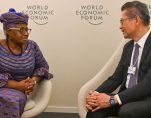
During a meeting with the Director-General of the World Trade Organization (WTO), Dr Ngozi Okonjo-Iweala, Mr Chan reiterated that Hong Kong, China firmly supports free trade and multilateralism, and expressed support for the WTO’s efforts to pursue reforms in response to current global challenges, with a view to enhancing its agility in addressing emerging issues in international trade.
HKSAR’s Financial Secretary Paul Chan (right) meets with the Director-General of the World Trade Organization, Dr Ngozi Okonjo-Iweala, in Davos, Switzerland
On arriving Davos (January 19), Mr Chan began his visit programme by meeting with the Minister of Economy of the Sultanate of Oman, H.E. Dr Said Mohammed Al-Saqri. During the meeting, the two sides discussed ways to deepen mutually beneficial cooperation in areas such as finance, trade, green transformation and industrial development.
Mr Chan said that Hong Kong’s advantages as a “super connector” could support Oman’s transitioning from an oil-driven growth model towards a more diversified economic structure. He said that Hong Kong could facilitate Chinese Mainland and Hong Kong enterprises to invest in Oman to support its infrastructure and industrial development. At the same time, Hong Kong’s status as an international financial centre in Asia could provide Omani enterprises with an ideal platform for fundraising and financing, as well as offshore Renminbi investment and risk management products.
Mr Chan will continue his programme in Davos, including participating at the 2026 Davos-Caixin CEO Luncheon and the “How to Finance Decarbonization?” session of the WEF Annual Meeting, before returning to Hong Kong on January 24 morning.
Arabian Post Staff -Dubai Saudi Arabia recorded a landmark year for tourism in 2025, welcoming more than 122 million domestic and international visitors and generating close to $80 billion in total spending, according to official estimates and sector-wide assessments. The figures underline the scale and pace of change in a country long associated with pilgrimage travel but now positioning itself as a diversified global tourism destination. Data […]
MANILA, PHILIPPINES – Media OutReach Newswire – 21 January 2026 – The Jollibee Group has formally inaugurated its newest – and its largest commissary in Visayas and Mindanao province – in Danao City, on January 8, 2026, a state-of-the-art facility designed to power the company’s expanding manufacturing and logistics footprint across the rapidly growing VisMin region and the wider Philippines.
Jollibee Group officially inaugurates its largest, state-of-the-art commissary in Cebu, Philippines, strengthening its Visayas and Mindanao operations, supporting multiple brands, creating jobs, and advancing sustainable growth across the country.
The inauguration was attended by national and local government leaders, including Cristina Roque, Secretary of the Department of Trade and Industry; Pamela Baricuatro, Governor of Cebu Province; Ace Durano, Cebu Provincial Administrator; Nito Durano, Mayor of Danao City; and Carmen Durano, Vice Mayor of Danao City.
Milestone Facility for a High-Growth Region
The Danao facility is the fourth—and largest—Jollibee Group commissary in Cebu and its first multi-brand, state-of-the-art commissary in the Philippines. It comes at a time of accelerating economic momentum in VisMin, driven by a strong tourism rebound, the rise of BPO hubs, expanding agribusiness exports, and growing manufacturing clusters—factors that continue to drive employment, consumer spending, and demand across the region.
Outfitted with advanced automation and integrated systems, the commissary is designed to support increasing demand across multiple Jollibee Group brands while generating efficiencies by consolidating equipment and production capabilities. This allows the Group to scale responsibly while upholding its standards for food quality, consistency, and operational excellence.
Supporting Brand Expansion and Same-Store Growth
The Danao Commissary supplies key ingredients and products for the Group’s major brands, including Jollibee, Chowking, Mang Inasal, Greenwich, Red Ribbon, and Burger King. These brands continue to expand their store networks in VisMin while sustaining same-store sales growth.
The facility strengthens the Group’s supply chain by supporting distribution centers serving Cebu, Iloilo, Bacolod, Zamboanga, Cagayan de Oro, and Davao, as well as select areas in Luzon—ensuring reliability and scalability as the company accelerates its nationwide expansion.
Economic Impact
Speaking during the program, Department of Trade and Industry (DTI) Secretary Cristina Roque highlighted the broader economic impact of the investment.
“Every new commissary that the Jollibee Group opens represents more jobs, more security, and more growth for our local industries,” Roque said. “As we open more commissaries, we are also encouraging more investments in our country while strengthening our supply chain.”
Speaking at the inauguration, Joseph Tanbuntiong, Chief Executive Officer of Jollibee Group Philippines and Global Head of Jollibee Brand, underscored the strategic importance of the new facility to both the company’s domestic and global growth.
“The opening of the Danao Commissary is both a reflection of our journey and a new beginning,” Tanbuntiong said. “Accelerating our growth by building on the strong momentum in Visayas and Mindanao is critical to our Philippine business.”
The investment also highlights the Jollibee Group’s confidence in Cebu as a strategic hub for manufacturing and logistics.
“This commissary underscores our confidence in Cebu—its people, its capability, and its role in our growth today and in the long term,” he added.
Community Impact and Sustainability
Beyond strengthening operational capacity, the Danao Commissary is expected to deliver shared value for local communities, generating close to 500 jobs, with over 60% of the workforce coming from Danao City. At full capacity, the commissary will create 800 jobs.
Sustainability features were integrated into the facility’s design and operations in line with the Jollibee Group’s Joy for Tomorrow agenda. From Day 1 of commercial operation, the Danao Commissary operates on 99% renewable electricity from geothermal sources. It is also equipped with roof-mounted solar panels, rainwater-harvesting systems, energy-efficient equipment, and wastewater treatment systems—supporting responsible, future-ready growth.
Tanbuntiong said the inauguration marks the beginning of a shared journey among stakeholders involved in the project.
“The success of the Danao Commissary is a shared success—for Danao, for Cebu, and for the nation. Together, we are building a stronger, more inclusive, and more sustainable future.”
Hashtag: #Jollibee
The issuer is solely responsible for the content of this announcement.
About Jollibee Group
Jollibee Foods Corporation (PSE: JFC) (the “Company”) is one of the world’s fastest-growing restaurant companies, driven by its purpose of spreading joy through superior taste. It manages and operates a portfolio that includes 19 brands (the “Jollibee Group”) with over 10,000 stores and cafés across 33 countries.
The Jollibee Group’s portfolio includes nine (9) wholly-owned brands (Jollibee, Chowking, Greenwich, Red Ribbon, Mang Inasal, Yonghe King, Hong Zhuang Yuan, Smashburger and Tim Ho Wan), five (5) franchised brands (Burger King, Panda Express, Yoshinoya, Common Man Coffee Roasters, and Tiong Bahru Bakery in the Philippines), and ownership stakes in other key brands like The Coffee Bean and Tea Leaf (80%), Compose Coffee (70%), SuperFoods Group that operates Highlands Coffee (60%), and bubble tea brand Milksha (51%). The Company also has membership interests in Tortazo, LLC, along with Chef Rick Bayless, for Tortazo in the U.S. and in Botrista, a leader in beverage technology.
The Jollibee Group’s global sustainability agenda, Joy for Tomorrow, underscores its commitment to sustainable business practices across food safety, employee welfare, community support, good governance, and environmental responsibility, among others. These focus areas are aligned with the United Nations Sustainable Development Goals (UN SDGs).
The Company has been recognized as the Philippines’ Most Admired Company by the Asian Wall Street Journal, named one of Asia’s Fab 50 Companies, and listed among Forbes’ World’s Best Employers and Top Female-Friendly Companies. The Company is also a four-time Gallup Exceptional Workplace Award recipient and featured in TIME’s World’s Best Companies and Fortune’s Southeast Asia 500 List.
AD Ports Group has agreed to acquire full ownership of Balenciaga Astilleros Shipyard, one of Spain’s long-established shipbuilding and repair facilities, for a total consideration of €11.2 million, extending the Abu Dhabi-based group’s industrial footprint across the Mediterranean and reinforcing its push into offshore wind support services. The transaction is being executed through SAFEEN Drydocks, a subsidiary within Noatum Maritime, marking a further step in AD Ports […]
Dubai-based developer Binghatti Properties has unveiled a Mercedes-Benz-branded residential mega project near Meydan in Nad Al Sheba, a move that highlights the growing pull of branded residences as a premium asset class within the emirate’s property market. The scheme, launched in partnership with Mercedes-Benz, reflects a broader recalibration in buyer preferences towards design-led, globally recognisable labels that promise both lifestyle cachet and investment appeal. Valued at about […]








 https://www.brandhk.gov.hk/
 https://www.linkedin.com/company/brand-hong-kong/
 https://x.com/Brand_HK/
 https://www.facebook.com/brandhk.isd
 https://www.instagram.com/brandhongkong