News related to
work

Showcasing Hong Kong’s Innovation and Technology Opportunities at Tsinghua and Peking University HONG KONG SAR – Media OutReach Newswire – 2 June 2025 – Hong Kong Science and Technology Parks Corporation (HKSTP) is actively expanding efforts to attract talent and enterprises to Hong Kong’s innovation and technology (I&T) sector. From 18 to 20 May, HKSTP led a delegation to Beijing, engaging with local I&T companies, industry associations, […]

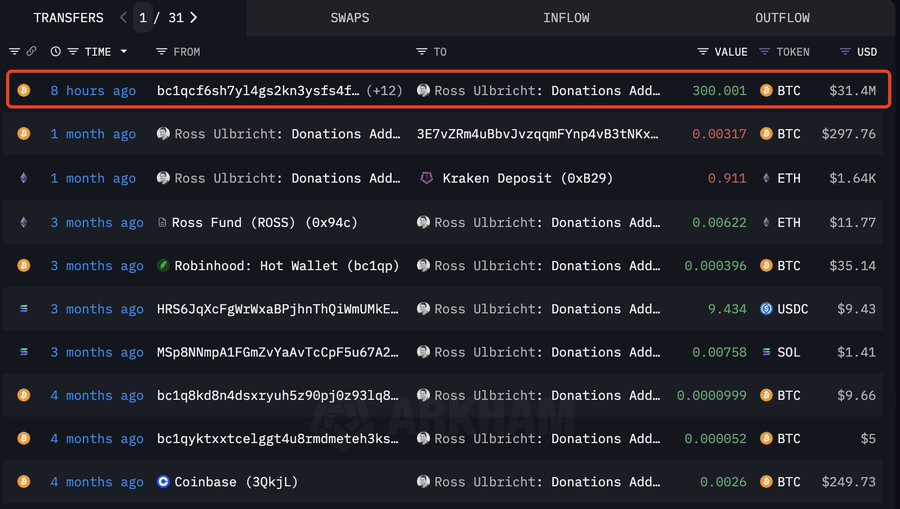
Ross Ulbricht, the founder of the Silk Road darknet marketplace, has received an anonymous donation of 300 Bitcoin, valued at approximately $31.4 million, sent to his official Bitcoin address. This substantial contribution follows his release from prison after a full pardon by former U.S. President Donald Trump in January 2025.

The donation was made to the Bitcoin address listed on freeross.org, a website dedicated to supporting Ulbricht. The identity of the donor remains unknown, and there has been no public acknowledgment from Ulbricht or his representatives regarding the transaction.

In addition to this significant donation, an auction of Ulbricht’s personal belongings has reportedly raised nearly $1.3 million in Bitcoin. The auction, organized to support Ulbricht’s reintegration into society, featured items such as personal writings, artwork, and other memorabilia.

Ulbricht’s financial situation has been a topic of interest since his release. Coinbase executive Conor Grogan identified approximately 430 BTC, worth around $47 million, in wallets associated with Ulbricht that had remained untouched for over 13 years. However, it remains unclear whether Ulbricht has access to the private keys required to control these funds.

The cryptocurrency community has shown considerable support for Ulbricht since his release. Crypto exchange Kraken donated $111,111 in Bitcoin to assist with his transition back into society. Additionally, various fundraising efforts, including merchandise sales, have contributed to a growing fund aimed at supporting Ulbricht’s post-incarceration life.

Ulbricht was arrested in 2013 and later sentenced to double life imprisonment plus 40 years without the possibility of parole for his role in operating the Silk Road marketplace. The platform facilitated the trade of illegal goods and services, primarily using Bitcoin for transactions. His sentence was commuted by President Trump, who cited support from the Libertarian movement and concerns over the severity of the punishment.

South Korea’s cryptocurrency industry appears poised for continued expansion despite uncertainties surrounding the upcoming presidential election. Analysts and market insiders suggest that while the election outcome may influence regulatory approaches, the overall trajectory for crypto adoption and innovation in the country remains largely positive. The nation, known for its advanced digital infrastructure and high rate of technology adoption, continues to be a key global hub for cryptocurrency trading and blockchain development.

Voters are set to choose their next president amid growing public interest in digital assets, a sector that has become deeply embedded in South Korea’s financial landscape. The outgoing administration has maintained a cautious but constructive stance on crypto, emphasising investor protection and regulation to curb speculative risks. However, there is widespread anticipation that the new leadership, regardless of political affiliation, will aim to strike a balance between fostering innovation and ensuring financial stability.

The South Korean crypto market ranks among the world’s largest, with retail investors accounting for a significant share of trading volumes. According to market data, the country’s exchanges handle billions of dollars in daily transactions, reflecting robust participation despite bouts of global market volatility. Industry experts highlight that the presence of a tech-savvy population and extensive mobile connectivity continues to drive demand for cryptocurrencies and related services such as decentralized finance and non-fungible tokens .

Recent policy discussions have centred on enhancing regulatory clarity without stifling growth. Authorities have been moving toward implementing stricter anti-money laundering measures and introducing licensing regimes for crypto exchanges. These steps are designed to increase transparency and build trust among investors, especially after high-profile hacks and fraud cases shook confidence in past years. Nonetheless, crypto entrepreneurs argue that overly rigid rules could hinder South Korea’s competitive edge in the fast-evolving digital economy.

The election campaign itself has seen varying perspectives on how best to approach the burgeoning crypto sector. Some candidates advocate for a more innovation-friendly environment, proposing incentives for blockchain startups and easing certain regulatory burdens. Others emphasise the need for rigorous oversight, citing concerns about market manipulation and consumer protection. This diversity of viewpoints underscores the complexity of integrating crypto assets into mainstream financial systems while safeguarding public interests.

South Korea’s financial regulators are also coordinating with international bodies to align standards and promote cross-border cooperation. This global approach aims to mitigate risks associated with illicit finance and to support legitimate crypto ventures. Moreover, collaboration with major markets like the United States and European Union seeks to harmonise regulatory frameworks, which could facilitate smoother operations for South Korean crypto firms on the world stage.

Despite occasional regulatory headwinds, venture capital funding in South Korea’s blockchain and crypto technology startups has surged. Investments are being channelled into innovative projects that range from smart contract platforms to digital identity solutions and tokenisation of real-world assets. This capital influx is driving research and development, helping local firms compete with international giants in areas such as security, scalability, and user experience.

Market participants also point to South Korea’s well-established IT infrastructure and educational emphasis on STEM disciplines as critical factors supporting the crypto ecosystem’s growth. The country’s universities and research institutions are actively engaging in blockchain research, producing talent that feeds into both the private sector and regulatory agencies. This synergy between academia, government, and industry forms a backbone for sustainable technological advancement.

Consumer attitudes toward cryptocurrencies have evolved significantly, with increasing acceptance among younger demographics. Surveys indicate that digital assets are now viewed not only as speculative tools but also as legitimate instruments for payments, savings, and investment diversification. This cultural shift has encouraged mainstream financial institutions to explore crypto-related products, including custody services, exchange-traded funds , and blockchain-based payment networks.

However, risks remain inherent in the sector, with price volatility, regulatory uncertainty, and cybersecurity threats continuing to challenge market stability. Industry leaders have called for ongoing dialogue with policymakers to ensure that emerging regulations are well-informed and adaptable. Transparency and investor education are emphasised as vital to fostering a resilient market capable of weathering shocks and sustaining public confidence.

The intersection of cryptocurrency and South Korea’s broader economic policy objectives is also under scrutiny. The government aims to position the country as a global innovation hub, leveraging digital technologies to boost productivity and competitiveness. Cryptocurrency and blockchain are seen as integral components of this strategy, with potential to revolutionise areas such as supply chain management, finance, healthcare, and public administration.

Global geopolitical tensions and financial market fluctuations have added layers of complexity to South Korea’s crypto landscape. Supply chain disruptions and inflation concerns worldwide have driven some investors toward digital assets as alternative stores of value. Yet, the international nature of cryptocurrencies requires regulatory frameworks that can keep pace with rapid technological changes and evolving market dynamics.


Dubai’s Roads and Transport Authority has initiated a comprehensive upgrade of Umm Suqeim Street, aiming to significantly enhance traffic flow and urban connectivity across the city. The project, stretching from the intersection with Jumeirah Street to Al Khail Road, is a pivotal component of a broader strategy to modernise the city’s infrastructure and accommodate its rapid urban expansion.

The upgrade is designed to increase the road’s capacity to 16,000 vehicles per hour in both directions, effectively reducing travel time between Jumeirah Street and Al Khail Road from 20 minutes to just six. This enhancement is expected to alleviate congestion and improve accessibility for key residential and commercial areas, including Jumeirah, Umm Suqeim, Al Manara, Al Sufouh, Umm Al Sheif, Al Barsha, and Al Quoz.

Integral to the project are the redevelopment of six major intersections along Umm Suqeim Street. These include the construction of four bridges and three tunnels, collectively spanning 4.1 kilometres. Notably, a two-lane tunnel in each direction will be constructed at the intersection with Jumeirah Street, complemented by a signalised surface-level junction. Another two-lane tunnel is planned at the intersection with Al Wasl Street to facilitate traffic flow from Sheikh Zayed Road towards Jumeirah Street, while maintaining uninterrupted surface traffic in the direction of Sheikh Zayed Road.

At the intersection with Sheikh Zayed Road, two bridges will be constructed to eliminate traffic overlap and enhance movement efficiency. Additionally, a tunnel will be developed at the intersection with First Al Khail Street to accommodate traffic from Al Barsha towards Sheikh Zayed Road, along with associated surface-level improvements. The stretch between First Al Khail Street and Al Asayel Street will be widened by adding one lane in each direction, increasing capacity to four lanes per direction. At Al Khail Road, the works involve the construction and widening of two flyovers—one connecting Al Khail Road with Al Quoz Industrial Area, and the other facilitating traffic from Umm Suqeim Street to Al Khail Road heading towards Deira.

Beyond vehicular traffic improvements, the project places a strong emphasis on enhancing pedestrian and cyclist infrastructure. Upgrades include the development of pedestrian walkways, dedicated cycling tracks, landscaped boulevards, and vibrant public spaces designed to foster community interaction and promote sustainable urban living. A direct link will also be established between the Mall of the Emirates Metro Station and nearby residential communities, enhancing last-mile connectivity and encouraging the use of public transportation.

This initiative is part of RTA’s master plan to overhaul the surrounding road network, which includes planned upgrades to Jumeirah Street, Al Wasl Street, and Al Safa Street. The overarching goal is to enable uninterrupted traffic flow from Jumeirah to Al Qudra Road over a distance of 20 kilometres, thereby improving connectivity across four major transport corridors: Sheikh Zayed Road, Al Khail Road, Sheikh Mohammed bin Zayed Road, and Emirates Road.

Mattar Al Tayer, Director General and Chairman of the Board of Executive Directors at RTA, stated that the upgraded corridor will directly serve vital residential and development areas with a combined population exceeding two million. He emphasised that the project is designed to accommodate Dubai’s rapid population growth and urban expansion while improving the overall quality of life for residents and visitors.

Construction is already 70% complete on a 4.6-kilometre segment of Umm Suqeim Street from Al Khail Road to Sheikh Mohammed bin Zayed Road. This phase includes an 800-metre tunnel near Kings’ School in Al Barsha South and a surface-level junction, scheduled to open in the third quarter of the year. The completion of this segment is expected to reduce travel time between Sheikh Mohammed bin Zayed Road and Al Khail Road by 61%, from 9.7 minutes to just 3.8 minutes.

The RTA is also leveraging advanced technologies to monitor and manage the project’s progress. Drones are being utilised to capture and analyse project data, while artificial intelligence is employed to track construction milestones and performance indicators. This integrated approach has enhanced operational efficiency on-site, accelerated decision-making processes, and enabled the provision of real-time, high-precision data. The adoption of these technologies has resulted in a 100% increase in field presence and a 60% reduction in the time required for site surveys. Time-lapse imaging systems are also being used to continuously monitor construction activities, contributing to a 40% improvement in overall project monitoring efficiency.

Emirates has confirmed plans to operate its fleet of Airbus A380 double-decker aircraft until the close of the 2030s, signalling a strategic decision to extend the service life of the very planes that propelled the airline to global prominence. The Dubai-based carrier intends to introduce one final upgrade to the A380’s first-class cabins as part of its commitment to maintaining the aircraft’s appeal and competitive edge on […]

Emaar Development has secured a significant land acquisition in Ras Al Khor, marking a strategic expansion amid Dubai’s robust property market. The construction subsidiary of Emaar Properties, the emirate’s largest publicly listed real estate firm, completed the purchase of the plot from Amlak Property Investment for 2.9 billion dirhams , alongside associated transaction costs. This move enhances Emaar Development’s land portfolio, positioning the company to capitalise on […]

The U.S. Securities and Exchange Commission has expressed reservations regarding two proposed exchange-traded funds that seek to provide investors with exposure to staked Ethereum and Solana . The ETFs, introduced by REX Financial and Osprey Funds, are under scrutiny for potentially not meeting the legal definition of investment companies as stipulated by the Investment Company Act of 1940.

The SEC’s concerns center on the structure of these ETFs, which aim to offer returns derived from staking rewards—a process where cryptocurrency holders participate in network operations in exchange for additional tokens. The regulatory body has questioned whether the funds are primarily structured to invest in securities, a requirement under federal law.

Despite the initial registration of these funds becoming effective on May 30, the SEC has indicated that this does not equate to an endorsement or approval of the funds’ compliance with legal standards. The agency has highlighted that the disclosures in the registration statements may be potentially misleading regarding the funds’ status as investment companies.

REX Financial has responded by stating that it will not proceed with the launch of these ETFs until the compliance issues raised by the SEC are resolved. Greg Collett, general counsel at REX, acknowledged the SEC’s concerns and emphasized the company’s commitment to addressing them.

The introduction of staking-based ETFs represents a novel approach in the financial markets, aiming to bridge traditional investment vehicles with the decentralized finance sector. However, the SEC’s apprehension underscores the complexities and regulatory challenges associated with integrating such innovative financial products into the existing legal framework.

Advertisements

Elon Musk has announced the rollout of XChat, a new messaging feature on the X platform, integrating end-to-end encryption, vanishing messages, and support for various file types. Developed in Rust, XChat also offers audio and video calling capabilities without requiring a phone number, marking a significant shift in the platform’s communication tools.

The introduction of XChat follows the discontinuation of X’s previous encrypted direct messaging system, which had been available to paid subscribers for two years. The new system is gradually being made accessible to premium users, with broader availability expected in the coming weeks.

Central to XChat’s security is its “Bitcoin-style” encryption, a term Musk uses to describe the platform’s adoption of elliptic curve cryptography . This method, also employed in Bitcoin transactions, provides robust security with smaller key sizes, enhancing performance and reducing resource consumption. While specific details about the encryption implementation remain undisclosed, the approach suggests a focus on decentralized and secure communication.

The choice of Rust as the programming language for XChat underscores a commitment to safety and performance. Rust’s emphasis on memory safety helps mitigate vulnerabilities common in other languages, such as memory corruption, which has been a significant source of security issues in software development.

XChat’s features extend beyond encryption. Users can send messages that automatically disappear after a set period, enhancing privacy. The platform supports the transfer of various file types, catering to diverse communication needs. Notably, audio and video calls can be made without linking to a phone number, allowing for greater anonymity and flexibility across devices.

This development aligns with Musk’s broader vision of transforming X into a comprehensive “everything app,” akin to China’s WeChat. By integrating messaging, calling, and file-sharing functionalities, X aims to become a central hub for users’ digital interactions. Plans are also underway to introduce X Money, a digital wallet service developed in partnership with Visa, enabling peer-to-peer payments and further expanding the platform’s ecosystem.

As XChat enters the competitive messaging landscape, it positions itself against established players like Signal and Telegram. While these platforms have long prioritized user privacy and security, XChat’s integration into the broader X platform offers a unique proposition. However, experts advise caution, noting that XChat has yet to undergo independent security audits, a standard practice for verifying the robustness of encryption protocols.

The move towards enhanced privacy features reflects a growing demand among users for secure communication channels. With increasing concerns over data breaches and surveillance, platforms that prioritize user confidentiality are gaining traction. XChat’s emphasis on encryption and user control over messages indicates an awareness of these concerns and a response to the evolving digital landscape.

KUALA LUMPUR, MALAYSIA – Media OutReach Newswire – 2 June 2025 – June 2025 is shaping up to be one of the most eventful months of the year for global markets. For traders, this means opportunity—but also volatility. The economic calendar is packed with macroeconomic data releases and central bank meetings, while geopolitical risks remain close to the surface. Beyond the usual inflation prints and interest rate […]

The World Bank has launched its first open-source software tool, the Metadata Editor, marking a significant step in its commitment to data transparency and open science. This web-based application is designed to assist data curators in documenting various types of data, including statistical indicators, survey microdata, geographic datasets, documents, images, videos, and scripts, in compliance with international metadata standards. By releasing this tool under the MIT License, […]

LightEdge, a provider of hybrid hosting solutions, has expanded its collaboration with Corero Network Security through a $1.2 million agreement aimed at enhancing its defence against distributed denial-of-service attacks. This strategic move involves the deployment of Corero’s SmartWall ONE platform across LightEdge’s global data centre network, replacing an existing competitor’s solution. The expanded partnership underscores LightEdge’s commitment to bolstering its cybersecurity framework, particularly as organisations increasingly adopt […]

NetActuate has unveiled a new point of presence in Dublin, Ireland, marking its tenth operational site in Europe. Situated within Equinix’s DB1 Dublin IBX Data Center, this expansion aims to bolster the company’s capacity to deliver low-latency, high-performance connectivity across the continent. The Dublin facility offers direct access to major digital exchange points, including the Equinix Internet Exchange and the Internet Neutral Exchange , facilitating seamless interconnection […]

Passenger traffic across the Middle East is projected to reach 530 million by 2043, doubling from current levels, according to forecasts presented at the International Air Transport Association Annual General Meeting held in Dubai. This growth represents an average annual increase of 3.9% over the two-decade period from 2023 to 2043, slightly outpacing the global average of 3.8%.

Kamil Al Awadhi, IATA’s Regional Vice President for Africa and the Middle East, highlighted the region’s strategic geographic position and robust infrastructure investments as key drivers of this anticipated growth. He noted that Middle Eastern carriers have fully recovered from the pandemic-induced downturn, with cargo performance also showing a 6.4% increase as of April 2024.

The surge in passenger numbers is underpinned by significant investments in airport infrastructure across the region. Dubai has initiated the expansion of Al Maktoum International Airport, with plans to accommodate up to 260 million passengers annually upon completion, positioning it as the world’s largest airport. In Abu Dhabi, a new terminal commenced operations in November, enhancing the capital’s capacity to handle increased traffic. Qatar continues to expand Hamad International Airport in Doha, while Saudi Arabia has launched Riyadh Air and announced the development of a new terminal in Riyadh with a capacity for 120 million passengers annually.

These developments are complemented by the region’s efforts to diversify economies and reduce reliance on oil revenues. Saudi Arabia’s Vision 2030 initiative, for instance, emphasizes tourism and infrastructure development, with the Red Sea International Airport beginning operations in September 2023 to serve the burgeoning tourism sector.

The Middle East’s role as a global aviation hub is further reinforced by its proximity to emerging markets in South Asia and Africa. This strategic location allows airlines to offer efficient connectivity between East and West, capitalizing on the growing demand for air travel in these regions.

Industry analysts suggest that the anticipated growth will necessitate a corresponding increase in fleet size and workforce. Airlines are expected to place substantial orders for new aircraft to meet demand, while also investing in training programs to ensure a skilled workforce capable of supporting expanded operations.

Environmental considerations remain a focal point, with IATA members committed to achieving carbon-neutral growth from 2020 and a 50% reduction in net aviation carbon emissions by 2050 relative to 2005 levels. Airlines in the region are exploring sustainable aviation fuels and more efficient aircraft to align with these goals.

WASHINGTON D.C, USA – Media OutReach Newswire – 1 June 2025 – Vietnam’s Minister of Agriculture and Environment Do Duc Duy plans to lead a delegation with nearly 50 agencies, agribusinesses and associations to explore opportunities to promote trade and import agrifood and timber from the United States during June 1-7, 2025. The delegation expects to participate in business dialogues in Iowa, Ohio, and Washington D.C. Vietnamese […]

HONG KONG SAR – Media OutReach Newswire – 31 May 2025 – International mediation marked a significant milestone yesterday (May 30) with the establishment of the International Organization for Mediation (IOMed). The IOMed, with its headquarters in Hong Kong, is the world’s first inter-governmental international legal organisation devoted to the use of mediation in resolving international disputes. More than 80 countries and about 20 international organisations, including […]

KUALA LUMPUR, MALAYSIA – Media OutReach Newswire – 30 May 2025 – Traders and investors alike are unnerved by the recent turbulence in the bond markets. After Moody’s—a major rating agency—downgraded U.S. government debt on 16 May, and Japanese long-term bond yields soared to multi-decade highs, some market participants started to fear that the world may be on the verge of a major debt crisis. Meanwhile, the […]

A sweeping crackdown on international students under President Donald Trump’s administration has triggered a global realignment in higher education, as universities across Europe and Asia move swiftly to attract displaced talent and research funding. The United States, long considered the premier destination for international scholars, is witnessing a sharp decline in its appeal. A survey by the Keystone Education Group indicates that 42% of prospective international students […]

SINGAPORE – Media OutReach Newswire – 30 May 2025 – Synology showcased its latest lineup of innovations at COMPUTEX 2025, Taiwan, presenting a comprehensive solution portfolio spanning enterprise storage, data protection, video surveillance, on-premise productivity suite, and personal private cloud. “At Synology, our goal has always been to build a data management ecosystem our customers can trust,” said Philip Wong, Chairman and CEO of Synology. “We design […]

Sberbank, Russia’s largest lender, has introduced structured bonds tied to Bitcoin’s performance, offering investors exposure to cryptocurrency price movements without direct ownership. These bonds, denominated in rubles and compliant with Russian law, are currently available to qualified investors through over-the-counter markets, with plans for future listings on the Moscow Exchange.

The initiative follows the Bank of Russia’s recent decision to permit financial institutions to offer crypto-linked financial instruments to accredited investors. Under the new guidelines, banks can provide derivatives, securities, and digital financial assets whose returns are linked to cryptocurrency prices, provided there is no actual delivery of the underlying crypto assets. This move aims to offer regulated exposure to digital assets while mitigating associated risks.

Sberbank’s Deputy Chairman of the Executive Board, Anatoly Popov, stated that the bank’s new product provides a convenient and secure way for investors to gain exposure to cryptocurrency assets without direct ownership, ensuring full compliance with regulatory requirements on Russian infrastructure. The structured bonds are designed to cater to investors seeking returns linked to cryptocurrency dynamics within a regulated framework.

In addition to Sberbank’s offerings, the Moscow Exchange has announced plans to launch a cash-settled Bitcoin futures contract on its derivatives market in June. The SPB Exchange has also outlined intentions to introduce cryptocurrency-linked futures trading, signaling a broader acceptance of crypto-related financial products within Russia’s regulated financial markets.

The Bank of Russia’s decision to allow crypto-linked financial instruments comes amid increasing interest in digital assets among Russian investors. The central bank reported a 51% increase in crypto asset inflows by Russian residents in the first quarter of 2025, totaling 7.3 trillion rubles . To manage potential risks, the central bank has mandated that banks and credit institutions fully back these products with capital, apply conservative risk assessments, and set individual exposure limits.

Sberbank’s move to offer structured bonds tied to cryptocurrency price movements represents a significant step in bridging traditional finance with digital assets in Russia. By providing regulated investment products linked to cryptocurrencies, the bank aims to meet growing investor demand while adhering to the country’s cautious regulatory stance on digital assets.

Abu Dhabi’s Department of Municipalities and Transport is on track to issue the main construction tender for the second phase of the Mid Island Parkway Project by the end of 2025. This phase encompasses approximately 11 kilometres of highway development, featuring a combination of three-lane, four-lane, and five-lane roads. The project aims to enhance connectivity between key islands—Um Yifeenah, Al-Jubail, Al-Sammaliyyah, and Sas Al-Nakhl—and mainland areas such as Khalifa City and the E10 highway.

Integral to this phase are the construction of three significant interchanges: the E20, E10, and a dumbbell interchange on Al-Sammaliyyah Island. These interchanges are designed to facilitate smoother traffic flow and reduce congestion, aligning with Abu Dhabi’s broader urban development goals under the Plan Capital Urban Evolution programme.

The Mid Island Parkway Project, spanning a total of 25 kilometres, is a cornerstone of Abu Dhabi’s strategic infrastructure initiatives. It is designed to bolster the city’s transportation network, improve accessibility, and support the emirate’s economic growth by connecting emerging urban centres.

Phase one of the MIPP included the construction of the Umm Yifeenah Bridge, a 3.8-kilometre overwater structure that links Al Reem Island, Umm Yifeenah Island, and Sheikh Zayed bin Sultan Street. This bridge, which accommodates up to 12,000 vehicles per hour, also features pedestrian and cycling paths, promoting sustainable modes of transport.

The upcoming tender for phase two reflects the DMT’s commitment to advancing Abu Dhabi’s infrastructure in line with its urban planning vision. By enhancing connectivity between islands and the mainland, the project is expected to alleviate traffic congestion and support the city’s expansion.

The U.S. Securities and Exchange Commission has clarified that certain staking activities on proof-of-stake blockchains do not constitute securities transactions under federal law. This development marks a significant shift in the regulatory landscape for the cryptocurrency industry.

The SEC’s Division of Corporation Finance issued a statement indicating that self-staking, self-custodial staking with third parties, and custodial staking services are not subject to securities regulations, provided that the staking activities are conducted in accordance with the underlying blockchain protocols. The guidance emphasizes that staking rewards are considered compensation for services rendered in maintaining the network, rather than profits derived from the efforts of others.

This clarification comes after the SEC’s previous enforcement actions against staking-as-a-service providers, which had created uncertainty within the industry. The new guidance provides a clearer framework for participants engaging in staking activities, potentially encouraging broader adoption and innovation in the sector.

However, the SEC’s statement does not extend to all forms of staking. Activities such as liquid staking and restaking, where providers have control over staking decisions, may still fall under securities laws. The Commission advises that each staking program should be evaluated on a case-by-case basis to determine its regulatory status.

The SEC’s updated position has been met with mixed reactions. While many in the crypto industry view it as a positive step towards regulatory clarity, some SEC commissioners have expressed concerns. Commissioner Caroline Crenshaw criticized the guidance, arguing that it conflicts with existing legal precedents and may undermine investor protections.

The clarification also has implications for the development of cryptocurrency exchange-traded funds . Asset managers seeking to include staking rewards in Ethereum-based ETFs may find the path forward less obstructed, potentially leading to new investment products that offer staking benefits to investors.

Despite the regulatory clarity, market reactions have been subdued. Ethereum’s price experienced a slight decline, reflecting cautious investor sentiment. Nonetheless, the SEC’s stance is expected to have long-term positive effects on the growth and maturation of the cryptocurrency industry.

Stock market information for Ethereum

* Ethereum is a crypto in the CRYPTO market.
* The price is 2611.78 USD currently with a change of -118.73 USD from the previous close.
* The intraday high is 2730.79 USD and the intraday low is 2591.12 USD.

James Wynn, a prominent figure in the cryptocurrency trading community, has suffered a staggering loss of approximately $99.3 million following the liquidation of his leveraged Bitcoin positions on the Hyperliquid platform. The liquidation was triggered as Bitcoin’s price fell below the critical $105,000 threshold, leading to the forced closure of Wynn’s positions totaling 949 BTC.

The sequence of events unfolded rapidly. On May 29, Wynn’s position of 94 BTC, valued at around $10 million, was liquidated when Bitcoin’s price dipped to $106,330. The following day, two larger positions were closed: one comprising 527.29 BTC at $104,950, and another of 421.8 BTC at $104,150, amounting to losses of $55.3 million and $43.9 million respectively. These liquidations collectively accounted for the 949 BTC loss, as confirmed by on-chain analytics platforms.

Wynn’s aggressive trading strategy involved a 40x leveraged long position, a high-risk approach that amplifies both potential gains and losses. He had reportedly increased his leveraged position to $1.25 billion on May 24, banking on a bullish trajectory for Bitcoin. However, the market’s downturn, influenced by macroeconomic factors including discussions on tariffs by the US administration, led to a sharp decline in Bitcoin’s value, undermining Wynn’s position.

Despite the significant losses, Wynn continues to hold a substantial position in the market. He currently maintains a 40x leveraged long position in a perpetual contract, which was initiated when Bitcoin was priced at $107,993. This position is presently at an unrealized loss of approximately $3.4 million, with the liquidation price hovering around $104,607. Wynn’s margin usage is nearing 100%, indicating a precarious situation where any further decline in Bitcoin’s price could trigger additional liquidations.

The incident has sparked discussions within the trading community about the risks associated with high-leverage trading strategies. While such approaches can yield substantial profits, they also expose traders to significant losses, particularly in volatile markets. Wynn’s experience serves as a cautionary tale, highlighting the importance of risk management and the potential consequences of aggressive trading tactics.

In a related development, another trader reportedly capitalized on Wynn’s misfortune by adopting a contrarian strategy—shorting when Wynn went long and vice versa—resulting in a profit of $17 million. This underscores the zero-sum nature of leveraged trading, where one trader’s loss can translate into another’s gain.

The broader cryptocurrency market has also felt the impact of the downturn. Within an hour of Bitcoin’s price dropping below $105,000, approximately $345 million was liquidated from the market, reflecting the high volatility and the cascading effect of large-scale liquidations. Analysts note that such events can lead to heightened caution among traders, elevated funding rates, and potential ripple effects on Bitcoin’s price action and overall market sentiment.

ESSEN, GERMANY – Media OutReach Newswire – 30 May 2025 – Midea, the World’s No.1 Residential Inverter Air Conditioner Company, reached another important milestone in its innovation journey as the Midea Numen air conditioner won the German Red Dot Product Design Award 2025, the globally prestigious recognition for excellence in design. Numen stands out with its AI system and innovative structure design that improve energy efficiency and […]

Tether’s USDT stablecoin has experienced significant expansion over the past year, with its market capitalisation rising by 37% to surpass $150 billion. Daily transfer volumes have increased by 90%, and the estimated user base has grown by 51%, according to CEO Paolo Ardoino.

These figures underscore USDT’s dominant position in the $238 billion stablecoin market, where it accounts for over 60% of the total market share. The surge in daily transfer volumes, now exceeding $90 billion, reflects heightened activity across both decentralised finance platforms and centralised exchanges.

The user base has expanded notably, with an estimated 46 million new wallets added in the first quarter of 2025 alone. This growth is attributed to increased adoption among retail and institutional investors seeking stable, dollar-pegged assets for trading and cross-border transactions.

Tether’s strategic initiatives have played a role in this expansion. The company’s acquisition of a 70% stake in Latin American agriculture and energy firm Adecoagro aims to integrate stablecoins into commodity trading, extending USDT’s utility beyond digital assets. This move aligns with Tether’s broader strategy to embed stablecoins into real-world financial ecosystems.

In terms of reserves, Tether has reported holding over $120 billion in U.S. Treasuries, positioning it among the largest holders globally. The company also holds more than 100,000 bitcoins and over 50 tons of gold, reinforcing its commitment to backing USDT with substantial assets.

Regulatory developments have also influenced Tether’s operations. The U.S. Senate’s advancement of the GENIUS Act, which introduces stricter oversight for stablecoin issuers, has prompted Tether to enhance its compliance measures. The act includes provisions for audits, prohibitions on yield offerings, and strengthened anti-money-laundering protocols.

VISHNU RAJA
RYO YAMADA
HITORI GOTOH
IKUYO KITA
Just in:
Ningbo Consensus on Collaborative Development released at 2026 Global Mayors Dialogue · Ningbo // The “1st Greater Bay Area Health and Longevity Summit & Awards Ceremony” concludes successfully in Macao // Millions Of Indians May Soon Be Deprived Of Government Assistance // Kochi police detain two actors over bid to honey trap doctor // Motorola introduces Signature 27 flagship priced at $1,599 // Meraas showcases five residential zones at Dubai Design Week // Hong Kong mandates crypto transaction disclosures to tax authorities // OpenAI abandons secrecy agreements for future data centres // Dubai boat show confirms international shipyard line-up for November // APT29-linked campaign exploits outdated Apple and Android software // Emaar approves Development buyout ahead of planned delisting // Trump’s Iran War Has A Share Of Contribution To His Midterm Debacle // Oil and chip shares retreat after Democratic victories // Xi Jinping Preparing For A Trilateral Summit With Trump And Putin At APEC Summit On Nov 18-19 // Emirates Group records AED 4.1 billion half-year profit // Geely’s i-HEV Intelligent Hybrid Technology Offers a New Direction Vision for Gasoline-Powered Vehicles // Dubai details five-year visa benefits for returning visitors // Ousted top Kochi cop gets IG post // Geely’s i-HEV Intelligent Hybrid Technology Offers a New Direction for Gasoline-Powered Vehicles // CR Longdation Aethereal Cybersecurity × Global Cybersecurity Alliance (GCSA) Join Hands to Establish the “AI and Cybersecurity Research Centre” //