News related to
fall

The U.S. Securities and Exchange Commission has clarified that meme coins, including the TRUMP token, generally fall outside its regulatory jurisdiction, leaving investors without traditional protections. This stance comes as the TRUMP token, launched on January 17, 2025, experienced a dramatic 80% decline from its peak of $72.60, resulting in approximately $2 billion in investor losses, according to Chainalysis.

SEC Commissioner Hester Peirce, leading the agency’s crypto task force, emphasized that many meme coins do not meet the criteria of securities under existing laws. She stated that these tokens are often more akin to collectibles, lacking the characteristics that would subject them to SEC oversight. The SEC’s Division of Corporate Finance reinforced this view in a staff statement, noting that meme coins typically do not satisfy the Howey Test, which determines what qualifies as a security.

Despite the SEC’s position, the TRUMP token’s rapid rise and fall have raised concerns. Launched by President Donald Trump, the token’s market capitalization soared to $14.5 billion before plummeting to $3 billion. While investors faced significant losses, the Trump Organization and its partners reportedly earned around $100 million in trading fees.

The SEC’s approach marks a shift from previous enforcement strategies. Under former Chair Gary Gensler, the agency pursued aggressive actions against crypto entities. However, the current administration, with Peirce at the helm of crypto regulation, is moving towards establishing clear policies rather than relying on enforcement. This change aims to provide a more innovation-friendly environment for digital assets.

Critics argue that the lack of regulatory oversight for meme coins leaves investors vulnerable to market manipulation and fraud. They point to the TRUMP token’s volatility and the significant profits earned by its promoters as evidence of potential exploitation. Ethics experts have also raised concerns about conflicts of interest, given President Trump’s dual role as a political leader and a crypto entrepreneur.

In response to these developments, some lawmakers are calling for greater transparency and regulation. Representative Jamie Raskin has launched an investigation into a private dinner hosted by President Trump for top investors in the TRUMP token, citing potential ethical and legal issues. The event allowed investors who purchased large amounts of the token to attend, with many top holders’ identities remaining anonymous.

While the SEC maintains that it is not a “merit regulator” and does not endorse or evaluate the quality of investments, the agency’s stance on meme coins underscores the importance of investor due diligence. As the crypto market continues to evolve, the balance between fostering innovation and protecting investors remains a contentious issue.

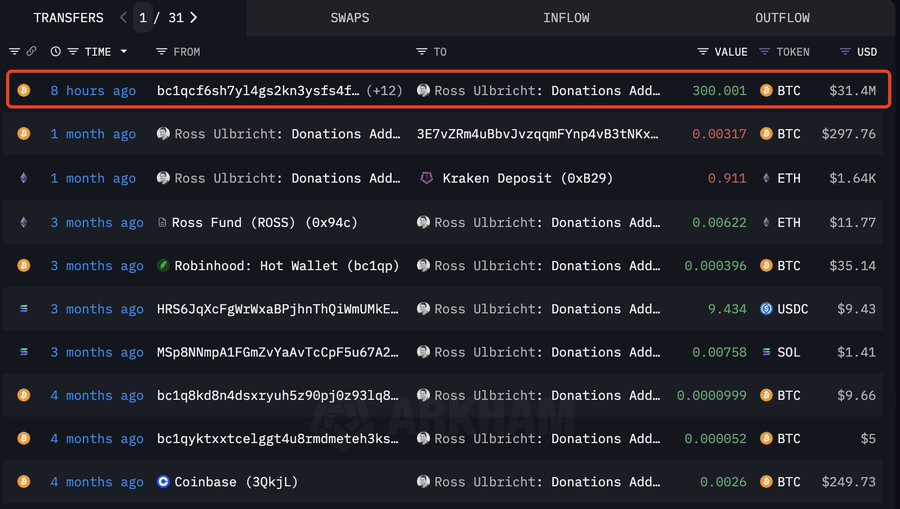
Ross Ulbricht, the founder of the Silk Road darknet marketplace, has received an anonymous donation of 300 Bitcoin, valued at approximately $31.4 million, sent to his official Bitcoin address. This substantial contribution follows his release from prison after a full pardon by former U.S. President Donald Trump in January 2025.

The donation was made to the Bitcoin address listed on freeross.org, a website dedicated to supporting Ulbricht. The identity of the donor remains unknown, and there has been no public acknowledgment from Ulbricht or his representatives regarding the transaction.

In addition to this significant donation, an auction of Ulbricht’s personal belongings has reportedly raised nearly $1.3 million in Bitcoin. The auction, organized to support Ulbricht’s reintegration into society, featured items such as personal writings, artwork, and other memorabilia.

Ulbricht’s financial situation has been a topic of interest since his release. Coinbase executive Conor Grogan identified approximately 430 BTC, worth around $47 million, in wallets associated with Ulbricht that had remained untouched for over 13 years. However, it remains unclear whether Ulbricht has access to the private keys required to control these funds.

The cryptocurrency community has shown considerable support for Ulbricht since his release. Crypto exchange Kraken donated $111,111 in Bitcoin to assist with his transition back into society. Additionally, various fundraising efforts, including merchandise sales, have contributed to a growing fund aimed at supporting Ulbricht’s post-incarceration life.

Ulbricht was arrested in 2013 and later sentenced to double life imprisonment plus 40 years without the possibility of parole for his role in operating the Silk Road marketplace. The platform facilitated the trade of illegal goods and services, primarily using Bitcoin for transactions. His sentence was commuted by President Trump, who cited support from the Libertarian movement and concerns over the severity of the punishment.

KUALA LUMPUR, MALAYSIA – Media OutReach Newswire – 2 June 2025 – June 2025 is shaping up to be one of the most eventful months of the year for global markets. For traders, this means opportunity—but also volatility. The economic calendar is packed with macroeconomic data releases and central bank meetings, while geopolitical risks remain close to the surface. Beyond the usual inflation prints and interest rate […]

The U.S. Securities and Exchange Commission has clarified that certain staking activities on proof-of-stake blockchains do not constitute securities transactions under federal law. This development marks a significant shift in the regulatory landscape for the cryptocurrency industry.

The SEC’s Division of Corporation Finance issued a statement indicating that self-staking, self-custodial staking with third parties, and custodial staking services are not subject to securities regulations, provided that the staking activities are conducted in accordance with the underlying blockchain protocols. The guidance emphasizes that staking rewards are considered compensation for services rendered in maintaining the network, rather than profits derived from the efforts of others.

This clarification comes after the SEC’s previous enforcement actions against staking-as-a-service providers, which had created uncertainty within the industry. The new guidance provides a clearer framework for participants engaging in staking activities, potentially encouraging broader adoption and innovation in the sector.

However, the SEC’s statement does not extend to all forms of staking. Activities such as liquid staking and restaking, where providers have control over staking decisions, may still fall under securities laws. The Commission advises that each staking program should be evaluated on a case-by-case basis to determine its regulatory status.

The SEC’s updated position has been met with mixed reactions. While many in the crypto industry view it as a positive step towards regulatory clarity, some SEC commissioners have expressed concerns. Commissioner Caroline Crenshaw criticized the guidance, arguing that it conflicts with existing legal precedents and may undermine investor protections.

The clarification also has implications for the development of cryptocurrency exchange-traded funds . Asset managers seeking to include staking rewards in Ethereum-based ETFs may find the path forward less obstructed, potentially leading to new investment products that offer staking benefits to investors.

Despite the regulatory clarity, market reactions have been subdued. Ethereum’s price experienced a slight decline, reflecting cautious investor sentiment. Nonetheless, the SEC’s stance is expected to have long-term positive effects on the growth and maturation of the cryptocurrency industry.

Stock market information for Ethereum

* Ethereum is a crypto in the CRYPTO market.
* The price is 2611.78 USD currently with a change of -118.73 USD from the previous close.
* The intraday high is 2730.79 USD and the intraday low is 2591.12 USD.

Dubai is gearing up for its largest shopping event of the year, as the Three-Day Super Sale returns from May 30 to June 1, offering discounts of up to 90% across more than 2,500 outlets and over 500 brands citywide. The event, strategically timed ahead of Eid Al Adha, is expected to draw significant footfall from both residents and tourists seeking value-driven purchases. Organised by the Dubai […]

Dr Akinwumi Adesina, nearing the conclusion of his decade-long presidency at the African Development Bank , has called upon his successor to prioritise Africa’s financial sovereignty and ensure the continent’s interests are robustly defended on the global stage. This appeal comes as the AfDB prepares to elect a new leader during its annual meeting in Abidjan, Côte d’Ivoire, on 29 May. The incoming president will assume office […]

Over 6,000 delegates from 81 countries convened in Abidjan on Monday as the African Development Bank commenced its 2025 Annual Meetings, focusing on strategies to harness Africa’s capital for sustainable development. The five-day event, held at the Sofitel Abidjan Hotel Ivoire, is set to culminate in the election of a new president to succeed Dr. Akinwumi Adesina, whose decade-long tenure concludes in September. The summit’s theme, “Making […]

Advertisements

Allianz Safety and Shipping Review 2025: Trade conflict between the US and China and growing shadow fleet add to substantial challenges for the shipping industry. Despite geopolitical headwinds: only 27 large ships lost worldwide in 2024, down by more than 20%, the industry’s lowest-ever total. Progress made on traditional risks such as fires, collisions, and groundings, which are the main causes of losses, but potential for large […]

The altcoin market is under intense scrutiny as a leading blockchain analyst warns of a potential collapse nearing 99% by 2026. This stark projection has intensified debate among investors and industry observers about the sustainability and risks within the broader cryptocurrency ecosystem beyond Bitcoin and Ethereum.

A seasoned on-chain analyst, known for precise timing and market predictions, has publicly announced plans to exit all altcoin holdings by August 2025. The analyst’s outlook is grounded in an examination of historical price trends, network activity, and macroeconomic factors affecting digital assets. Despite periodic rallies often dubbed “altcoin seasons,” the warning signals suggest that many alternative tokens could face dramatic value erosion over the coming years.

Altcoins, which include thousands of cryptocurrencies other than Bitcoin, have historically exhibited higher volatility and speculative characteristics. Periods of rapid price appreciation have often been followed by steep declines. The analyst’s research highlights patterns from past cycles indicating that altcoin prices tend to surge in mid-year months before collapsing sharply over subsequent periods. While these cyclical phenomena have produced short-term gains for some investors, the risk of a severe market downturn remains elevated.

Underlying this bearish view is a cluster of challenges. Regulatory uncertainty looms large across major jurisdictions, with authorities in the United States, Europe, and Asia intensifying scrutiny of cryptocurrency projects. Increased enforcement actions against fraudulent or non-compliant tokens have undermined investor confidence. Furthermore, rising interest rates globally have driven capital away from high-risk assets such as altcoins toward safer instruments, shrinking liquidity in the crypto markets.

Technological factors also contribute to the forecast. Many altcoins suffer from lack of developer engagement, insufficient user adoption, and unclear utility beyond speculative trading. Network activity data reveals a trend of declining transaction volumes and wallet addresses interacting with a majority of smaller projects. This erosion in on-chain activity signals fading real-world relevance, which historically correlates with falling valuations.

Institutional interest has increasingly concentrated on established digital assets with clearer use cases, such as Bitcoin and Ethereum, leaving lesser-known altcoins vulnerable. Large investment funds and hedge managers are selectively reallocating portfolios, favouring assets perceived as more resilient amid tightening monetary conditions. This shift contributes to widening disparities in market capitalisation within the cryptocurrency sector.

The analyst’s planned exit timing in August 2025 aligns with predictive models that identify peak speculative behaviour preceding significant corrections. By exiting well ahead of anticipated declines, the strategy aims to mitigate losses linked to the expected altcoin slump. This contrarian stance challenges narratives promoting imminent altcoin booms and “100x” token gains, cautioning investors against excessive optimism.

Market sentiment remains divided. Proponents of altcoins argue that innovation in decentralized finance , non-fungible tokens , and layer-two scaling solutions could catalyse renewed interest and price recovery. Projects with strong developer communities and proven protocols may weather the storm better than most. However, even promising initiatives must navigate tightening regulations, evolving market dynamics, and competition from traditional financial platforms integrating blockchain technology.

The macroeconomic environment adds complexity. Inflation pressures and geopolitical uncertainties are influencing global investment flows. Crypto markets have shown sensitivity to monetary policy shifts, and tighter credit conditions may limit speculative capital entering altcoins. This contrasts with prior years when expansive liquidity fueled exuberant asset price increases, including in crypto.

Investor behaviour during prior altcoin cycles provides instructive context. The pattern of exuberance followed by capitulation remains a recurring theme. For example, the 2017 bull run ended with widespread losses during the 2018 crash, while subsequent cycles showed similar boom-and-bust dynamics. The warning of a 99% decline aligns with extreme downside scenarios that, while dramatic, are not unprecedented in highly speculative markets.

Surveillance of on-chain metrics and market data continues to be crucial for participants. Indicators such as active addresses, transaction counts, token issuance rates, and exchange flows offer insights into momentum and sustainability. The analytical focus is increasingly on distinguishing quality projects from those vulnerable to failure or manipulation.

This forecast challenges investors and stakeholders to reconsider risk exposure and due diligence processes. Portfolio diversification, rigorous project evaluation, and cautious entry timing emerge as essential strategies. The prospect of a severe altcoin downturn underscores the need for heightened awareness of structural vulnerabilities in the crypto market landscape.

The African Development Bank is convening in Abidjan, Côte d’Ivoire, this week to elect a new president, as the institution confronts significant financial pressures following proposed reductions in U.S. contributions. The U.S. government’s plan to decrease its support to the AfDB and its African Development Fund by $555 million presents a substantial challenge for the incoming president. The successor to President Akinwumi Adesina, who concludes his tenure […]

A new summer campaign launched by Mercato Shopping Mall and Town Centre Jumeirah is offering diners a chance to win a luxury holiday for two to the Maldives, in partnership with Emirates Holidays. The promotion, titled “Dine, Scan & Win,” encourages customers to spend AED 200 or more at participating outlets. Upon scanning their PrivilegePLUS app ID, shoppers are entered into a draw for a three-night stay […]

India’s early southwest monsoon arrival has offered welcome relief to farmers, but uncertainty remains over the precise timing, distribution, and intensity of rainfall across the country. Addressing this challenge, the Indian Meteorological Department has introduced a sophisticated weather prediction model aimed at enhancing agricultural planning and flood management, marking a significant step in the nation’s climate resilience efforts.

This new weather model, developed through collaboration between national scientific agencies and international partners, integrates high-resolution atmospheric data and advanced computational techniques to improve the accuracy of monsoon forecasts. The system utilises a blend of satellite observations, ground station measurements, and oceanic data to create detailed projections of precipitation patterns at the district and sub-district levels.

For decades, India’s reliance on the southwest monsoon has shaped the rhythms of its agriculture and economy. The monsoon typically accounts for about 70% of the country’s annual rainfall, influencing the sowing and harvesting cycles of key crops such as rice, wheat, and pulses. However, the monsoon’s unpredictability—often caused by complex interactions between land, sea, and atmospheric conditions—has posed significant risks to food security and rural livelihoods.

The new model aims to reduce these risks by providing farmers and policymakers with more reliable short-term and seasonal forecasts. By predicting rainfall onset, duration, and distribution more precisely, the system enables better crop planning, irrigation management, and disaster preparedness. For flood-prone regions, timely alerts could minimise damage to infrastructure and human settlements.

Experts note that the model’s improvements stem largely from advances in artificial intelligence and machine learning, which allow for the assimilation and analysis of vast datasets that traditional forecasting methods struggle to process. The enhanced resolution of the model—down to a 5 km grid in many areas—represents a leap forward from previous models that averaged conditions over much larger geographic scales.

Climate scientists have long warned that climate change is exacerbating the variability and intensity of monsoon rainfall. Erratic monsoon behaviour, including unseasonal droughts and heavy downpours, has led to crop failures and increased vulnerability among India’s predominantly agrarian population. This makes timely and accurate weather forecasting more critical than ever.

The IMD’s new model is also expected to support state governments in managing water resources amid shifting rainfall patterns. States such as Maharashtra, Karnataka, and Tamil Nadu, which have experienced acute water shortages in recent years, could use the improved forecasts to optimise reservoir operations and groundwater recharge programmes.

While the system’s rollout is a technological milestone, challenges remain in ensuring that the forecasts translate into actionable insights for farmers, many of whom have limited access to digital platforms. To bridge this gap, the government is intensifying efforts to expand rural connectivity and disseminate weather information through local language broadcasts, mobile alerts, and community outreach programmes.

In parallel, agricultural extension services are being trained to interpret the forecasts and advise farmers on adaptive strategies, such as adjusting sowing dates and crop varieties to anticipated rainfall. Private sector players, including agri-tech startups, are also integrating these forecasts into advisory services and precision farming tools.

The enhanced weather model complements other ongoing initiatives in India’s climate adaptation framework, including the National Adaptation Fund for Climate Change and state-level disaster management plans. By aligning improved meteorological insights with policy and grassroots actions, authorities hope to mitigate the adverse impacts of climate variability on millions of rural households.

International experts have lauded the development as a crucial example of how countries with diverse climatic zones can leverage data-driven approaches to manage complex weather phenomena. The Indian model’s ability to simulate monsoon dynamics across the Himalayas, Western Ghats, and the vast Indo-Gangetic Plain provides valuable insights into regional microclimates.

KUALA LUMPUR, MALAYSIA – Media OutReach Newswire – 26 May 2025 – As global crypto markets show increased volatility, traders rethink their risk exposure. One vivid option is contracts for difference (CFDs). Kar Yong Ang, a financial market analyst at Octa broker, shares three reasons crypto traders should adopt CFDs and migrate from traditional exchanges. This year began with a harsh reminder that even the biggest crypto […]

Major news organisations are grappling with the fallout from deploying artificial intelligence in content creation, as instances of fabricated material and misattributed authorship surface, raising concerns over journalistic integrity. The Chicago Sun-Times and The Philadelphia Inquirer faced backlash after publishing a summer reading list featuring non-existent books and fictitious expert quotes. The content, syndicated by King Features and crafted by freelance writer Marco Buscaglia using AI tools, […]

SINGAPORE – Media OutReach Newswire – 24 May 2025 – GoodCool Pte Ltd, an aircon contractor in Singapore, is marking its second anniversary with the launch of a new community engagement initiative. As part of its corporate social responsibility (CSR) initiatives, the company will provide volunteer-based air-conditioning services for selected households across Singapore. GoodCool Introduces CSR Initiative to Support Households in Singapore Community-Focused Support through Volunteer Service […]

The Commodity Futures Trading Commission has affirmed that crypto perpetual futures are allowed for trading within the United States, providing much-needed regulatory clarity to market participants and investors in the digital asset space. This confirmation signals a significant development in the regulation of cryptocurrency derivatives, which have previously operated in a somewhat ambiguous legal environment. The CFTC’s explicit stance is expected to bring greater legitimacy and stability to an increasingly popular segment of the crypto market, while also setting the tone for future regulatory frameworks.

Crypto perpetual futures, a type of derivative contract that allows traders to speculate on the price movements of cryptocurrencies without an expiry date, have gained widespread traction globally. Unlike traditional futures contracts with fixed settlement dates, perpetual futures enable continuous trading, providing liquidity and hedging opportunities that attract institutional and retail investors alike. However, their regulatory status has often been unclear, causing uncertainty among exchanges and traders, especially in the US, where regulatory agencies tend to apply stringent oversight to financial instruments.

The CFTC’s confirmation comes amid growing scrutiny of the broader cryptocurrency ecosystem, which has faced regulatory challenges regarding investor protection, market manipulation, and systemic risks. The agency clarified that perpetual futures on cryptocurrencies fall under its jurisdiction as derivatives products, which means platforms offering these contracts must comply with relevant CFTC rules and regulations. This includes registration requirements for exchanges, adherence to anti-fraud measures, and maintaining transparent market practices.

Market leaders in crypto derivatives, such as Binance.US, FTX , and CME Group, have actively developed or listed perpetual futures contracts, but the lack of a formal regulatory framework had limited broader institutional adoption. The CFTC’s clear position may pave the way for more exchanges to offer these products, potentially increasing market liquidity and fostering innovation. The move also aligns with the agency’s broader approach to fostering responsible innovation in the derivatives market while safeguarding investor interests.

Industry experts note that the CFTC’s position contrasts with the Securities and Exchange Commission’s approach toward cryptocurrencies, which is generally more cautious, particularly regarding spot trading and certain crypto tokens. The delineation between the two agencies’ jurisdictions has been a subject of ongoing debate, especially since the SEC considers many digital assets as securities, thus subject to more stringent rules. The CFTC’s focus on futures and derivatives, rather than spot trading, offers a clearer regulatory path for these instruments.

This clarification from the CFTC also coincides with increased legislative and policy interest in digital assets at both federal and state levels. Lawmakers have debated comprehensive crypto regulatory frameworks to unify the patchwork of existing rules and provide consistency for market players. The CFTC’s explicit statement on perpetual futures could serve as a foundation for such legislative efforts, informing standards that balance innovation with risk management.

The implications of this regulatory clarity extend beyond the immediate crypto derivatives market. Institutional investors, including hedge funds, asset managers, and pension funds, have expressed cautious interest in digital asset products but often cite regulatory uncertainty as a key barrier. With perpetual futures formally recognised by the CFTC, these market participants may feel more confident engaging in cryptocurrency markets, potentially unlocking fresh capital inflows.

At the same time, consumer advocates and regulatory observers remain watchful. The high leverage and volatility inherent in perpetual futures trading can pose significant risks to less experienced traders, raising concerns about potential losses and market manipulation. The CFTC’s mandate includes protecting market integrity and consumer interests, so its enforcement actions and rulemaking around these contracts will likely intensify to address these risks effectively.

Cryptocurrency exchanges operating within the US have welcomed the announcement, viewing it as a step toward harmonising regulatory oversight and reducing operational uncertainty. Many platforms have invested heavily in compliance infrastructure, knowing that robust regulatory approval is crucial for long-term sustainability and growth. The clear jurisdictional guidance from the CFTC provides a framework for exchanges to innovate within established legal boundaries.

Internationally, regulatory bodies are also grappling with the rapid evolution of crypto derivatives. Countries such as Singapore, Switzerland, and the United Kingdom have developed varying approaches to the supervision of perpetual futures and similar instruments. The US’s decision to permit these contracts under the CFTC’s regulatory umbrella could influence global standards, encouraging a more coherent international regulatory environment.

Financial analysts highlight that the integration of crypto perpetual futures into regulated markets may increase price transparency and reduce volatility over time. By bringing these products under official oversight, the CFTC enables enhanced surveillance tools and risk controls, potentially deterring manipulative trading practices that have plagued the crypto space.

This regulatory clarity comes as decentralised finance platforms continue to explore perpetual futures through automated protocols. While the CFTC’s ruling primarily affects centralised exchanges and traditional trading venues, it sets a precedent that could influence regulatory approaches to DeFi derivatives as well. Authorities are closely monitoring DeFi developments, which challenge conventional frameworks due to their borderless and algorithm-driven nature.

Industry voices underscore the importance of balancing innovation with prudent oversight. The CFTC’s confirmation reflects a broader shift towards integrating cryptocurrency markets into the mainstream financial system while managing systemic risks. The move is likely to spur further collaboration between regulators, industry stakeholders, and market participants to develop standards that protect users without stifling technological advancement.

This regulatory milestone arrives amid a period of consolidation and maturation in the crypto market. After years of rapid growth, speculative excesses, and high-profile failures, the sector is increasingly focused on compliance, institutionalisation, and sustainable development. The CFTC’s stance on perpetual futures underlines the evolving recognition that digital assets and their derivatives require clear, enforceable rules tailored to their unique characteristics.


A developing low-pressure system over the east-central Arabian Sea is poised to intensify into a depression within 36 hours, prompting the India Meteorological Department to issue advisories for coastal regions of Gujarat, Maharashtra, and Goa. The system, currently situated near the Konkan-Goa coastline, is expected to bring heavy rainfall and strong winds, particularly affecting areas along the western coast.

The IMD has placed Mumbai under an orange alert, anticipating significant rainfall and gusty winds over the weekend. Southern Konkan districts, including parts of Goa, are under a red alert, with forecasts indicating very heavy to extremely heavy rainfall. Fishermen along the North and South Gujarat coasts have been strictly advised to refrain from venturing into the sea until May 26 due to deteriorating marine conditions.

In Gujarat, several districts are bracing for adverse weather. The IMD has issued a yellow alert for regions including Surat, Tapi, Valsad, Dang, Navsari, Amreli, and Bhavnagar. Rajkot, which recorded a high of 42.3°C, experienced sudden weather changes with rain and lightning. Tragically, in Garnara village, Gondal, a man was fatally struck by lightning. The state has received 42mm of rain from March 1 to May 22, significantly surpassing the average of 2.5mm for this period.

Authorities are on high alert, with Chief Minister Bhupendra Patel directing district control rooms to monitor the situation continuously. The Surat Municipal Corporation has established a 24/7 control room at the Integrated Command and Control Centre to address emergencies, including waterlogging and property damage, utilizing CCTV surveillance for efficient response.

In Maharashtra, the IMD has reported that the low-pressure system is likely to strengthen, with conditions favorable for further intensification. While there is no official cyclone warning yet, the potential for the system to develop into a cyclonic storm has not been ruled out. Coastal districts are preparing for heavy rainfall and strong winds, with the IMD closely monitoring the evolving situation.

A growing crisis in African agriculture, driven by climate change and biodiversity loss, is jeopardising Europe’s access to essential food imports, including cocoa, coffee, and maize. New research indicates that over half of the European Union’s imports of these staples originate from countries ill-equipped to handle escalating environmental challenges. A report by UK-based consultancy Foresight Transitions reveals that the EU’s dependence on climate-vulnerable nations for key commodities […]

Chemin is a key pillar in enabling TDCX to tap $1 trillion AI services opportunity Brings together more than 50 technologists from 18 countries to accelerate AI adoption SINGAPORE – Media OutReach Newswire – 22 May 2025 – Mr. Laurent Junique, Founder and Chief Executive Officer of TDCX, a leading global business process outsourcing (BPO) company for technology and blue-chip companies, was today named the Businessman of […]

By Sushil Kutty Nobody can beat the Prime Minister in breathing fire at adversaries. Especially, when his ire is directed at Pakistan. The Pakistanis, they can be irritating, damn! But Pakistani newspapers would have spent much of May 22 reworking their scripts after Prime Minister Modi went all out against the Pak Army and the […]


Headless commerce is reshaping the retail landscape by decoupling the front-end customer interface from the back-end commerce functionality, enabling brands to offer more personalised, flexible, and scalable shopping experiences. This architectural shift is gaining momentum as retailers face increasing pressure to innovate in response to evolving consumer behaviour, technological advancements, and the demand for seamless omnichannel engagement. At its core, headless commerce separates the presentation layer—how customers […]

Matein Khalid The fallout from the Moody’s downgrade is unfolding exactly as I guesstimated it would in my Sunday afternoon post. The 10 Year US Treasury note yield is now 4.54% and 30 year money is now 5.02%. So my 2/10 and 2/30 US Treasury note bear steepener strategy is oozing green – so far. Gold is also a classic haven from the fiscal Frankenstein that is […]

Global financial markets reeled on Monday following Moody’s Investors Service’s decision to downgrade the United States’ sovereign credit rating from Aaa to Aa1. The move, citing escalating fiscal deficits and a ballooning national debt, has intensified scrutiny over Washington’s economic policies and triggered a wave of investor unease.

The downgrade has led to a sharp rise in U.S. Treasury yields, with the 30-year bond yield climbing to 5.03%, its highest level since November 2023. The 10-year yield also surged to 4.55%, reflecting growing apprehension about the sustainability of U.S. fiscal policy. Concurrently, the U.S. dollar weakened against major currencies, while global equity markets experienced significant declines.

Moody’s action follows the narrow approval of President Donald Trump’s $3.8 trillion tax-cut package by the House Budget Committee. The legislation, which aims to extend the 2017 tax cuts and introduce new reductions on tips and overtime income, is projected to add between $3 trillion and $5 trillion to the national debt over the next decade. Analysts warn that such measures could exacerbate fiscal imbalances and undermine investor confidence.

European markets responded negatively, with the pan-European STOXX 600 index falling by 0.7%, ending a five-week winning streak. Luxury stocks, heavily reliant on Chinese demand, were particularly affected due to disappointing retail sales data from China. In the UK, the FTSE 100 index dropped by 0.8%, while the midcap FTSE 250 fell by 1.3%, influenced by the U.S. credit downgrade and anticipation surrounding a UK-EU summit.

Asian markets mirrored this trend, with key indices declining amid concerns over the U.S. fiscal outlook. The downgrade has also stalled the recent Wall Street rally, with futures dipping and the dollar weakening. Investors are increasingly wary of the U.S.’s rising debt burden and the potential implications for global financial stability.

The concept of “bond vigilantes”—investors who sell off government bonds in response to fiscal irresponsibility—has resurfaced. Analysts caution that if yields continue to rise, it could lead to instability in both bond and stock markets, potentially forcing the Federal Reserve to intervene. Some foresee a scenario where yields could exceed 6%, posing significant risks to economic growth.

Moody’s downgrade aligns the U.S. with other major economies that have lost their triple-A ratings, such as the UK and France. The agency projects that the U.S. debt-to-GDP ratio could reach 134% by 2035, up from 98% last year. The federal deficit, currently at 6.4% of GDP, is expected to rise to 9% by 2035, driven by increased interest payments and entitlement spending.

Despite these warnings, Treasury Secretary Scott Bessent dismissed the downgrade, asserting that the tax cuts would spur economic growth sufficient to offset the increased debt. However, nonpartisan analysts and some lawmakers express skepticism, highlighting the lack of substantial spending cuts or new revenue measures to balance the budget.

The political landscape remains divided, with hardline Republicans advocating for deeper cuts to programs like Medicaid and the repeal of green tax credits. Moderate Republicans and some senators oppose such measures, citing potential harm to vulnerable populations and the broader economy. The proposed cuts could result in 8.6 million people losing Medicaid coverage, raising concerns about the social impact of fiscal austerity.

Matein Khalid The US Treasury bond market is unnerved by Powell’s reluctance to cut rates at the May FOMC and increasing short bets on long duration Uncle Sam IOUs by the world’s biggest hedge funds. This is the reason the 2-year Treasury note yield, the single security most sensitive to changes in expectation of US central bank monetary policy, has risen 15 basis points this week to […]

VISHNU RAJA
RYO YAMADA
HITORI GOTOH
IKUYO KITA
Just in:
As AI Reshapes Education, Singapore Convenes Global Dialogue on the Future of Early Childhood Education // Fast Just Got Fastest: STING Energy Boost™ Celebrates Kimi Antonelli’s Formula 1® World Championship and the Fan Energy Behind It // OpenAI identifies 948 Linux privilege escalation flaws using AI // SC to examine students’ exam plea today // U.S. Mid Term Result Is A Clear Verdict Against Trump’s Authoritarianism // Arrow Electronics showcases technologies advancing intelligent robotics, mobility and digital infrastructure // DIP Holding targets Dh1.12 IPO price and $529m proceeds // BJP’s Aggressive Response Exposes Anxiety Over Opposition Unity // mamun raises US$3 million to finance cross-border trade between the Gulf and Asia // Vingroup And Legends Global Announce Strategic Partnership For VinFast – Trong Dong Stadium // CPI, CPM dispute portrayal of Vayalar uprising leaders // xCube Access Welcomes Entrust Capital Limited  Expanding Access to Professional Portfolio Management // Cloudflare unveils Zero Wire vulnerability intelligence service // Burying Head In “India Made Poverty Reduction” Data Is Dangerous // Democrats capture Senate majority with seven Republican seats // Utilities pursue ₹1,992 cr in unpaid bills // Middle East governments assess Iran war after US vote // ADIPEC leaders urge investment in global energy networks // Cyberport Venture & Capital Forum 2026 Grand Opening // ADIA and partners establish $1.4 billion aviation venture //