Just in:
ADIA and partners establish $1.4 billion aviation venture // Cloudflare unveils Zero Wire vulnerability intelligence service // After Reaching 7 Million Users in the Philippines, Skyro Launches Transparent Cash Loans in Malaysia // As AI Reshapes Education, Singapore Convenes Global Dialogue on the Future of Early Childhood Education // U.S. Mid Term Result Is A Clear Verdict Against Trump’s Authoritarianism // UK air traffic outage inflicted £33m financial losses // Oil and chip shares retreat after Democratic victories // Utilities pursue ₹1,992 cr in unpaid bills // Emirates Group records AED 4.1 billion half-year profit // Pinarayi faults UDF over mounting road crashes // Hong Kong mandates crypto transaction disclosures to tax authorities // Fast Just Got Fastest: STING Energy Boost™ Celebrates Kimi Antonelli’s Formula 1® World Championship and the Fan Energy Behind It // APT29-linked campaign exploits outdated Apple and Android software // Anthropic to prohibit persistent abuse of Claude chatbot // Meraas showcases five residential zones at Dubai Design Week // SC to examine students’ exam plea today // CR Longdation Aethereal Cybersecurity × Global Cybersecurity Alliance (GCSA) Join Hands to Establish the “AI and Cybersecurity Research Centre” // xCube Access Welcomes Entrust Capital Limited  Expanding Access to Professional Portfolio Management // Cyberport Venture & Capital Forum 2026 Grand Opening // Vance attributes Republican midterm defeats to Iran conflict //

News related to
security

Genians and RASInfotech are set to showcase a unified cybersecurity stack centred on Network Access Control, Endpoint Detection & Response and Universal Zero Trust Network Access at GITEX 2025, positioning their approach as a path to measurable security outcomes in the Middle East and Africa.

At the heart of their presentation is the proposition that NAC is not just an access control tool but a foundational anchor for Zero Trust adoption. With RASInfotech acting as their MEA distributor, Genians claims to deliver seamless transitions from on-premises NAC systems to cloud-managed deployment models with no operational downtime, while extending enforcement to both IT and OT environments.

Genians’ EDR offering, emphasised as on-premises to satisfy data sovereignty demands, is promoted as a complement to NAC—working together to fortify visibility, threat response, and enforcement. Executives point to deployments in sectors such as government, healthcare and retail across the MEA region to validate their approach.

Cybersecurity demand in the region is rising sharply. The Middle East cyber market is projected to expand significantly in coming years. Observers note that adversaries are increasingly adopting AI-driven techniques such as deepfake phishing, polymorphic malware and supply chain intrusions, making traditional perimeter defences inadequate. At GITEX, solutions built on identity, device context and continuous monitoring are gaining traction.

To that end, Genians intends to demonstrate how NAC and EDR modules integrate into a unified Zero Trust architecture—eschewing fragmented SASE modules in favour of a cohesive platform. Their roadmap emphasises enforcement from the network layer outwards, rather than additive overlays. The company also claims to have identified threat campaigns—such as a North Korean cyber espionage operation leveraging ChatGPT—that its platform is capable of detecting and analysing, reinforcing its real-world efficacy.

Regional support is central to Genians’ strategy. RASInfotech maintains a technical support centre in India to offer 24/7 engineering backup across time zones, while a regional Korean government–backed cybersecurity initiative taps Genians and partner vendors to strengthen regional infrastructure resilience. The collaboration is framed around “regional sovereignty” in data control and local compliance alignment.

Within the channel ecosystem, the role of integrators and resellers is evolving. Traditional resellers are being pushed to become resilience architects—advisors that guide enterprises from legacy infrastructure to Zero Trust, rather than merely deploying point products. Genians and RASInfotech are reportedly investing in partner training, labs, and enablement to support that shift.


The U. S. Department of Commerce has granted export licences for several billion dollars’ worth of Nvidia chips destined for the United Arab Emirates under a bilateral AI agreement struck in May, paving the way for a high-stakes test of America’s artificial intelligence diplomacy. The licences were issued through the Commerce Department’s Bureau of Industry and Security, marking the first concrete implementation of the Trump-era pact with […]

Greenlogue/AP A global analysis commissioned by Transport & Environment and conducted by Cerulogy reveals that biofuels now generate 16 percent more carbon dioxide emissions than the fossil fuels they are intended to replace. The finding throws into sharp relief the risks of scaling up crop-based biofuel programmes ahead of the COP30 climate summit in Belém, Brazil. The study includes emissions not only from cultivation, harvesting and processing, […]

Donald Trump announced that Israel and Hamas have acquiesced to the first phase of a U. S.-brokered Gaza peace plan, under which hostages would be released “very soon” and Israeli troops would withdraw to a predetermined line. He described the agreement as an opening step toward “a strong, durable, and everlasting peace.” The accord, reportedly brokered in Egypt, calls for the immediate release of all living hostages—with […]

Portuguese quantum computing firm Quantica Tech has revealed a new digital currency, Quantic Bitcoin, engineered to resist attacks from future quantum computers. The project rests on a proprietary “Quantum Interoperability” protocol designed to allow conventional blockchains and quantum‐era architectures to communicate and co-operate.

BTCQ is intended to preserve Bitcoin’s proof-of-work consensus but replace vulnerable cryptographic signatures with algorithms that conform to NIST-approved post-quantum standards. In transitional phases, the system runs quantum algorithm emulation on classical hardware—enabling development without immediate dependence on quantum hardware. Quantica has also introduced tiered fractional units, named Photons, Quarks and Bosons, to mirror Bitcoin’s Satoshi model at microtransaction scale.

The announcement reflects intensifying concern within cryptographic and blockchain communities about quantum threats to existing systems. Shor’s algorithm, for instance, is capable of undermining widely used public-key schemes, such as ECDSA, that secure most cryptocurrencies today. A literature review of quantum impacts on blockchain estimates that, although scalable quantum machines remain a work in progress, the threat horizon is accelerating, pushing many in the industry to preemptively explore quantum-safe alternatives.

Quantica says its interoperability protocol enables smart contracts in languages such as Solidity, Rust, Plutus and Vyper to invoke quantum layer functions through external script calls. The firm claims it has already shared the initial design of that protocol with the scientific community, though specific cryptographic details remain withheld. Plans are in place to issue Simple Agreements for Future Tokens in late 2025 and conduct a pre-sale of the token units ahead of public launch. The company is also working in parallel on related projects—Quanticacoin, USDT-Q and Q-Solana—to extend its quantum-capable ecosystem.

BTCQ joins a growing number of blockchain initiatives adopting quantum-resistant techniques. The Quantum Resistant Ledger, for example, has long leveraged XMSS to offer protection against quantum attacks, and many networks have begun integrating lattice-based or hash-based post-quantum cryptography.

Still, implementation and security challenges loom. Recent academic analysis warns that purely algorithmic guarantees do not suffice; side-channel attacks and hardware vulnerabilities may undermine post-quantum schemes if not carefully addressed. Analysts caution that the “harvest now, decrypt later” risk remains active: encrypted data captured today may be decrypted when quantum capabilities mature.

Market reception has been cautious. Many observers view Quantica’s claims as ambitious, given the dearth of open cryptographic proofs or independent audits so far. Some see the project as an early bet on quantum transition rather than an immediate substitute for existing value chains. Others argue the broader utility of quantum-resistant assets will depend heavily on regulatory frameworks, interoperability standards, and community adoption.

Quantica’s announcement arrives against the backdrop of intensifying activity in quantum and cryptographic infrastructure. Hardware vendors and research institutions are racing to scale error correction, qubit coherence and interconnects. Meanwhile, financial and security firms are preparing migration strategies for sensitive systems. Among commercial players, SEALSQ has unveiled hybrid cryptographic hardware intended to safeguard blockchain systems and IoT devices against quantum attacks.

Quantica has positioned BTCQ’s development as a shift from theoretical readiness to pragmatic construction. The firm contends it can build bridges between classical chains and quantum systems without heavy disruption to existing protocols. Early access via SAFTs and token presales aim to bootstrap an ecosystem of developers and enthusiasts.

The Internal Revenue Service announced plans to furlough almost half its employees as the U. S. government shutdown extends past its initial contingency period. The move signals a drastic scaling back of tax-collection operations and invites legal scrutiny over potential permanent layoffs. Under the updated contingency plan, around 39,870 IRS staffers—roughly 53.6 per cent of its workforce—will continue to work, while the remainder will be placed on […]

Demand for Regulated Forex Brokers Grows for UAE Investors Trade247, a broker firm based in Dubai and regulated by the UAE’s Securities and Commodities Authority as well as the Financial Services Commission of Mauritius, has introduced its technology geared towards what it calls “complete multi-asset trading,” which covers forex, equities, indices, commodities, precious metals, energy products, and digital currencies, in which they identify the current trend of […]

Advertisements

By Nitya Chakraborty Just forty eight hours within the external affairs minister Dr. S Jaishankar’s candid statement that Trump has to respect red lines drawn by India at trade talks, Indian officials joining China, Russia, Taliban government of Afghanistan and even Pakistan denouncing President Trump’s bid to take over Bagram air base in Afghanistan, is […]

The article India’s Opposition To Trump Bid To Take Over Bagram Airbase Has Special Significance appeared first on Latest India news, analysis and reports on Newspack by India Press Agency).

Jamf launched its 16th annual Jamf Nation User Conference in Denver, unveiling a bold expansion of its device management platform with new AI tools, a richer API ecosystem and automated updates driven by declarative device management. The three-day gathering at the Colorado Convention Center brings together Apple IT administrators, security professionals and developer partners to explore the next era of enterprise Apple management. Jamf CEO John Strosahl […]

HONG KONG SAR – Media OutReach Newswire – 8 October 2025 – Jamf, (NASDAQ: JAMF), the standard in managing and securing Apple at work, today kicked off its 16th annual Jamf Nation User Conference (JNUC) in Denver, Colorado. Joined by key partners including Apple, Okta, AWS, Microsoft, Google and more, Jamf unveiled the latest updates to its leading Apple device management and security platform. Those updates include […]

The World Bank has warned of a looming cycle of poverty in Gaza, in which child malnutrition, psychological trauma and institutional collapse could entrench deprivation across generations. The economist issuing the warning, speaking in an internal briefing that has been seen by multiple international analysts, observed that Gaza’s humanitarian emergency is evolving into structural impoverishment — a process that cannot be reversed simply by aid injections. He […]

ASUS has confirmed that it will spotlight a broad suite of AI-enabled products and infrastructure at GITEX Global 2025, framing its participation around the theme “Ubiquitous AI. Incredible Possibilities.” The corporation aims to demonstrate how artificial intelligence can permeate devices, enterprise systems and urban environments.

The company’s exhibit will cover four core domains: AI-first design, cloud integration, sustainability and education technology. On the hardware front, ASUS plans to showcase the B5405 ergonomic laptop, the P5405 with a 47 TOPS NPU, and the B9403 weighing under 1 kg with all-day battery life. Chromebook models such as the CX5403 Plus and Windows devices like the BR1204 will cater to education users.

In its infrastructure tier, ASUS will highlight its AI POD, HGX servers and the Ascent GX10 platform powered by the NVIDIA GB10 Grace Blackwell superchip. Workspace innovation will include compact offerings such as the NUC 15 Pro and NUC 14 Pro AI. On the edge side, embedded systems for smart cities and autonomous systems—such as the PE2200U, PE6000G, and PE2100N—are also in the lineup.

ASUS emphasises the role of partnership in its vision. It plans to accentuate cooperation with NVIDIA via its “Enterprise AI Factory” programme, which supports AI-ready racks and POD designs tuned for large language models and immersive workloads. The company will also underline measures in security, durability and ease of maintenance across its product line.

Tolga Özdil, Regional SYS Commercial Director for META at ASUS, remarked that the Middle East is positioned at a digital inflection point, with AI shaping institutional and economic evolution. He framed GITEX as a platform to bring the company’s latest innovations into conversation with regional stakeholders. ASUS’s Regional Director for Middle East & Africa, Senic Chiu, added that the event offers opportunity to show how intelligent tools can reshape industries and daily life.

ASUS’s timing comes against the backdrop of an intensifying global push for AI infrastructure. GITEX 2025 is expected to draw more than 6,800 tech firms and 2,000 startups from 180 countries. Key event themes include advancements in quantum, biotech, data centres and robotics.

Beyond individual exhibitors, the show underscores the rapid expansion of the global AI economy. According to organisers, investment in data centres alone is forecast to surpass US$500 billion in 2025. Meanwhile, GITEX’s startup track, Expand North Star, will run in parallel and feature over 1,200 investors managing US$1.1 trillion in assets.

ASUS’s introduction of its AI roadmap at this scale signals that device manufacturers are no longer content to remain at the periphery of the AI stack. As more process layers—from silicon to application—are exposed to AI optimisation, hardware firms are positioning themselves to own more of the value chain. However, challenges remain: power efficiency, thermal constraints, ethical AI integration and data security are frontlines ASUS must navigate.

The U. S. Cybersecurity and Infrastructure Security Agency has designated CVE-2021-43226, a privilege-escalation vulnerability in Microsoft’s Common Log File System driver, as actively exploited and added it to its Known Exploited Vulnerabilities catalog. The flaw allows a local, authenticated user to bypass security controls and elevate privileges to the SYSTEM level—a shift that can lead to full system compromise. Microsoft rates the vulnerability with a CVSS 3.1 […]

Dubai Airports has announced an extended 10-year strategy aimed at transforming Dubai International and Dubai World Central – Al Maktoum into the world’s most accessible and inclusive airports by 2035. The plan underscores a shift from enhancing infrastructure alone to driving cultural change, embedding empathy and user-centred design in every element of the passenger journey.

The strategy rests on three pillars: reinforcing existing accessibility frameworks, improving guest experience across every touchpoint, and elevating the airports’ status as global benchmarks in inclusive aviation. The commitment aligns with the UAE’s broader obligations to support the rights of People of Determination and Dubai’s ambition to become a disability-friendly city.

Majed Al Joker, Chief Operating Officer of Dubai Airports, emphasised that accessibility is a “core pillar” rather than a peripheral initiative. He noted that, for the first time, the airport authority is co-creating programmes with the PoD community to redesign the passenger journey from their lived perspective. The launch coincides with the debut of a public awareness campaign called “DXB for All”, which presents six narratives of travellers with sensory sensitivities, mobility challenges, hearing or visual impairments, and highlights their airport experiences.

This new phase builds on the 2022 “We All Meet the World Differently” campaign. While that initiative focused primarily on raising awareness, the current strategy delves deeper by integrating accessibility into operations, staff training, and passenger interactions. Airport operators intend to cultivate empathy across staff, travellers, and the public, encouraging all stakeholders to reframe how they engage with PoD.

To facilitate inclusive travel, Dubai Airports already provides a suite of services: a Travel Planner visual guide, the Sunflower Lanyard to signal discreet assistance, free two-hour parking, dedicated taxis, wheelchair support from curb to gate, over 520 hearing loops across terminals, and a sensory-friendly Assisted Travel Lounge in Terminal 2. These measures will be expanded and refined under the new strategy.

The initiative is being deployed through the “oneDXB” partnership network, which includes Emirates, flydubai, Dubai Police, GDIFA, Dubai Customs, dnata, Dubai Health, Dubai Duty Free, Serco, and other stakeholders. The collaborative structure ensures that airport services, security, passenger handling, health and taxi operations all align with inclusivity goals.

Challenges are considerable. DXB is already operating near capacity: in 2024 it handled 92.3 million passengers, its highest ever annual volume. That puts pressure on space, queueing, and infrastructure to adapt without undermining operational efficiency. Meanwhile, DWC is undergoing significant expansion—with a projected $35 billion investment to scale it toward handling up to 260 million passengers annually. Dubai Airports plans to shift major operations to DWC by 2032, adding urgency to ensuring that new terminals and systems are fully accessible from the start.

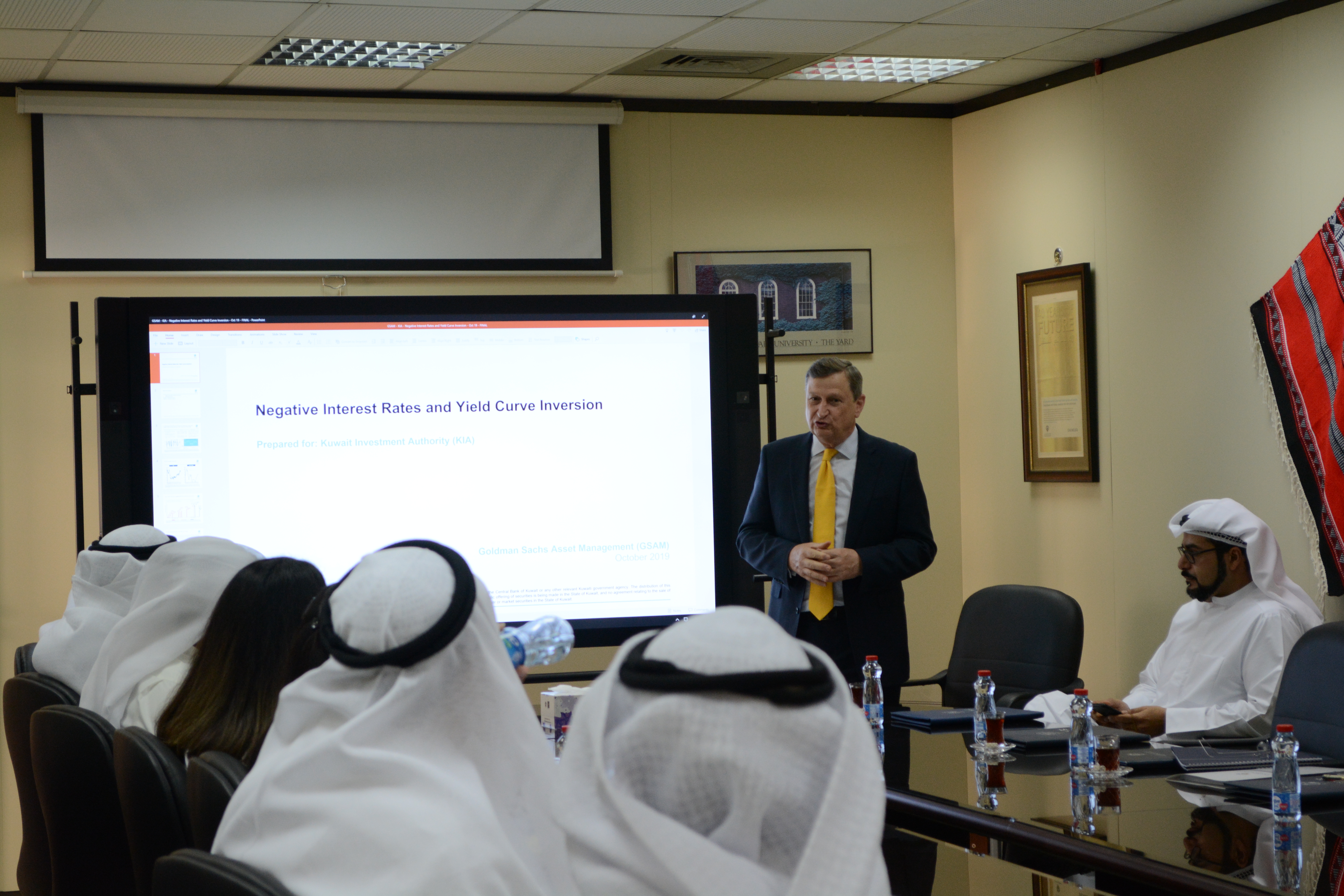
Goldman Sachs has launched a new office in Kuwait, asserting a significant push to enhance its reach across the Middle East and deepen its ties with Gulf-region clients under fresh leadership.

The New York-based investment bank said its role over five decades in Kuwait spans investment banking, capital markets and asset management. As part of its latest expansion, Goldman has tapped Mohammad Almatrouk as managing director of the Kuwait office, pending regulatory green light, while Fahad Alebrahim has been appointed managing director of the firm’s private wealth business in Kuwait.

David Solomon, Goldman Sachs’s Chairman and Chief Executive, framed the move as a commitment to “grow our capabilities across the Middle East and better serve our clients,” emphasising Kuwait’s economic vision as a catalyst for the firm’s expansion.

Goldman Sachs points to a long-standing capacity-building partnership in Kuwait that includes a professional training scheme designed to nurture talent at institutions such as the Kuwait Investment Authority, the Public Institution for Social Security and the Kuwait Fund. That programme, the bank says, will continue to play a central role in integrating local human capital into its global operations.

The choice of Kuwait underscores a growing focus on the Gulf’s institutional capital. Kuwait, host to one of the world’s largest sovereign wealth funds, has attracted global financial firms looking to align with its diversification and investment ambitions. Goldman Sachs’s decision follows earlier regional expansions, such as establishing a presence in Abu Dhabi and securing a banking licence in Saudi Arabia.

Kuwait’s Director General of the Direct Investment Promotion Authority, Sheikh Dr. Meshaal Jaber Al-Ahmad Al-Sabah, praised the move as aligned with Kuwait’s economic diversification and global integration goals. He stressed that opening the office supports national priorities including talent development and sustainable growth.

Regional analysts view Goldman’s Kuwait office as part of a broader recalibration by global banks to embed themselves closer to Gulf capital sources. Over the past two years, deal activity in sovereign and quasi-sovereign asset structures has exploded, prompting major firms including Lazard, JPMorgan and Deutsche Bank to expand in the Gulf with new leadership hires.

Inside Goldman Sachs, the timeline coincides with a leadership transition: the firm’s co-head for the Middle East and North Africa, Fadi Abuali, is slated to retire after nearly 28 years of service. His departure is expected to reshape the firm’s regional hierarchy just as Kuwait becomes a new hub.

Some observers caution the move carries execution challenges. Regulatory approvals in Kuwait must be secured, and Goldman must integrate the new office into its broader Gulf operations without duplicating functions. Success will depend on maintaining local relationships while delivering global platform advantages.

Cisco will unveil its latest innovations at GITEX GLOBAL 2025 in Dubai, aiming to equip enterprises across the Middle East and broader region with infrastructure built specifically for the AI era. The showcase focuses on AI-ready data centres, resilient network architectures, and strengthened security frameworks designed to support advanced workloads in data-intensive environments.

By joining the AI Infrastructure Partnership alongside BlackRock, Microsoft, NVIDIA, xAI and others, Cisco has committed to accelerating capital flows into datacentre and infrastructure projects. The partnership expects to unlock $30 billion in initial funding, scaling up to $100 billion including debt financing. Cisco brings its network, security and systems expertise to support the platform’s mission of secure, at-scale AI infrastructure.

At the heart of Cisco’s push is its new Cisco Data Fabric, launched in integration with Splunk, which provides federated data access across systems such as Amazon S3, Iceberg, Delta Lake and Snowflake, routing workloads intelligently to the best analytics or storage engine. This architecture is intended to reduce data movement, shorten analysis latency, and enable enterprises to transform machine data into AI-ready intelligence.

To support retrieval-augmented generation and agentic AI deployments, Cisco introduced the Secure AI Factory solution with NVIDIA and VAST Data. This validated architecture accelerates data extraction and retrieval at scale while enforcing security guardrails for every token processed. AI PODs built under this architecture offer pre-validated, high-performance building blocks for enterprise AI.

Networking and security are being redefined for the AI workload environment. At Cisco Live 2025, the company launched a next-generation network architecture for campus, branch and industrial environments, delivering unified management and devices purpose-built to support AI traffic patterns. It also introduced Hybrid Mesh Firewall and Universal Zero Trust Network Access to embed security into network fabric across hybrid and distributed environments. These features aim to simplify policy enforcement, improve visibility, and reduce complexity in securing both human users and AI agents.

Cisco CEO Chuck Robbins disclosed that fiscal year 2025 saw record AI infrastructure orders. In its final quarter, the company secured over $800 million from webscale clients, bringing total AI-focused orders to more than $2 billion—more than double its initial target. He described the pipeline as steadily growing into “hundreds of millions” as enterprises demand scalable, secure solutions.

In the Middle East, Cisco plans to demonstrate the regional relevance of its technologies under the theme “Make AI Work for You.” According to Cisco’s new AI Readiness Index, a vast majority of organisations in the UAE expect to expand their data centre capacity for AI within five years. The company will also present its work with Splunk on security and observability platforms at the event.

Cisco’s collaboration with Saudi Arabia’s HUMAIN is intended to build out an open, scalable AI infrastructure ecosystem aligned with Vision 2030. The multi-year programme includes deployment of cloud-based AI infrastructure, joint research initiatives, and efforts to grow local talent and innovation. The partnership underscores Saudi ambitions to position itself as a global AI hub.

Cisco sees accelerating demand for network modernisation. Its internal research reports that 97 percent of IT leaders view modernised networks as critical to deploying AI, cloud and IoT workloads, and 98 percent rate secure networking as essential for growth. However, the same study notes that only 40 percent of organisations have begun deploying advanced segmentation or intelligent control, illustrating an execution gap.

To strengthen its AI strategy, Cisco also expanded its presence in Indonesia by signing a Letter of Intent with BRIN to develop AI and cybersecurity capabilities via its Country Digital Acceleration programme. The plan includes building an AI Centre of Excellence and delivering training in AI, security and networking to 500,000 Indonesians by 2030.

Splunk’s observability portfolio itself is being reworked to embrace agentic AI, deploying AI agents to automate tasks such as root cause detection, alert correlation and issue resolution. This is intended to lighten the operational burden on IT and engineering teams while driving real-time insight.

Filestack has launched a sweeping upgrade to its core platform, introducing a fully integrated Digital Asset Management system, a comprehensive Event Logger, and a revamped Filepicker 4.0 with advanced upload control features. The move is aimed at giving developers stronger tools to manage file workflows, versioning, and audit trails—all without building these systems from scratch. At the heart of the update is the DAM, which allows users […]

A consortium led by Saudi Arabia’s Public Investment Fund, with Silver Lake and Jared Kushner’s Affinity Partners, has struck a deal to acquire Electronic Arts for approximately $55 billion, taking the iconic game publisher private. Under the agreement, EA’s shareholders will receive $210 per share, a 25 percent premium over the share price before the deal emerged, as the consortium combines fresh equity with a leveraged debt […]

openSUSE Project has rolled out the beta of Leap 16, marking a substantial shift in its Linux distribution strategy by extending community support to 24 months and introducing core architectural changes. The transition signals a deliberate move toward modernization and longer-term stability for users. Leap 16’s codebase is now aligned with SUSE Linux Enterprise 16 and built atop the SUSE Linux Framework One. The beta ships with […]

Perplexity now offers its AI-enabled browser Comet free to users worldwide, removing its earlier US$200/month subscription restriction. The company also launched Comet Plus, a paid tier offering curated news content and revenue sharing with publishers. Comet integrates Perplexity’s AI directly into the browsing experience, combining the firm’s answer-engine with an assistant that can summarise pages, complete tasks, and guide users across tabs. It was first released in […]

The Labour Fund, Tamkeen, has confirmed it will organise the Kingdom of Bahrain’s pavilion at GITEX Global 2025 in Dubai, featuring 14 Bahraini technology start-ups and small and medium enterprises alongside the Economic Development Board and ARRAY Innovations.

The event, scheduled from 13 to 17 October 2025, promises to provide the participating firms with access to global investors, partners and industry networks. The pavilion’s aim is explicit: to boost the international visibility of Bahrain’s ICT ecosystem and facilitate business growth.

Tamkeen’s announcement places it firmly in a leadership role for the pavilion’s curation and operations. The decision aligns with its 2025 strategic priorities, which emphasise supporting enterprise growth, promoting digitalisation, strengthening private-sector competitiveness and fostering sustainability.

Officials from Tamkeen and the Economic Development Board have highlighted that the selection of the 14 entities spans multiple subsectors within ICT, including software, data analytics, cybersecurity, and emerging technologies. They say the mix is intended to reflect both Bahrain’s current strengths and its ambitions for diversification.

In past editions of GITEX, Bahrain’s pavilion drew attention from regional and international delegations. During GITEX Global 2024, the pavilion was credited with facilitating multiple memoranda and partnership discussions. Tamkeen’s continued involvement signals its belief that sustained pavilion presence is critical to maintaining momentum in Bahrain’s tech diplomacy.

Some observers note that Bahrain’s tech infrastructure and regulatory environment are increasingly seen as competitive in the Gulf region. Over the past few years, the kingdom has liberalised foreign ownership rules in certain sectors and introduced incentives for startups and innovation funds. This pavilion engagement is viewed by analysts as part of a broader soft-power strategy to position Bahrain as a hub for digital investment.

However, challenges remain. For many Bahraini startups, scaling beyond domestic markets continues to be difficult. Access to international capital, navigating cross-jurisdictional regulation, and building brand recognition are persistent hurdles. Critics caution that pavilion exposure does not always translate into long-term market entry, and that stronger post-exhibition support is needed to ensure sustained growth.

Tamkeen has stated that it plans to accompany pavilion exposure with mentorship, investor matchmaking and export facilitation services for participating firms. The hope is that a combination of showcase visibility and structural support will help convert leads into lasting collaborations.

Already, the pavilion has generated interest among regional stakeholders. Several Gulf regional delegations and venture capital firms have expressed intent to engage with Bahrain’s teams during the event. The EDB is reportedly coordinating bilateral sessions between Bahrain’s entrants and visiting foreign trade missions.

For the 2025 edition, organisers have introduced a more structured schedule for pitch sessions, one-on-one meetings and thematic forums. This signals learning from past editions, where informal networking sometimes overshadowed targeted client engagement. Tamkeen officials have emphasised tighter alignment of startup offerings with investor interest sectors like fintech, AI and cloud services.

Within Bahrain’s domestic ecosystem, private sector associations and incubators have welcomed the announcement. Some have pushed for better curation, arguing that selecting firms with proven traction or clear roadmaps increases the chance that pavilion participation yields concrete contracts or investment.

Glencore has entered a 20-year agreement with Discovery Green to supply renewable energy for four of its South African mining operations, beginning 2027. The deal is expected to deliver over 290 GWh annually to mines in the eMalahleni area, replacing the bulk of their existing power demand with wind and solar energy. Under the terms of the agreement, renewable power will be delivered from Discovery Green’s contracted […]

Organisers have confirmed that Future Blockchain Summit x Fintech Surge will take place at Dubai Harbour from 12 to 15 October 2025, positioning the event as a central nexus for blockchain, digital assets, and fintech innovation across the MENA region. The four-day gathering, held alongside Expand North Star and powered by GITEX GLOBAL, aims to attract regulators, investors, entrepreneurs and technologists to shape emerging frameworks for finance.

Attendance is expected to exceed 70,000, with over 1,200 investors and more than 225 speakers scheduled to participate, alongside 150 exhibitors showcasing new products and solutions. A feature highlight is the Digital Assets Forum, which brings regulators, banks, and innovators together for intensive discussions on topics such as CBDCs, stablecoins, tokenised capital markets, cross-border regulation and the role of AI in compliance.

Speakers confirmed include Jimmy Su, Lily Liu, Eric Piscini, Oliver Stauber, Helen Liu and Kevin Lee. The event also features the Supernova Challenge, a startup pitch competition offering equity-free prizes totalling US$214,000 to finalists presenting to global judges and investors. Corporations such as Ruya, OKX and DKK Partners anchor the sponsorship tiers, while YPAY backs the Digital Assets Forum.

Dubai has been steadily reinforcing its position in the digital asset ecosystem. Earlier this year, the DAMAC Group signed a $1 billion contract with blockchain platform MANTRA to tokenise its real-world assets, a move aligned with the UAE’s aspirations to become a global digital assets hub. The country has been actively implementing regulatory frameworks, particularly in free zones like ADGM and DMCC, to attract blockchain firms and promote tokenisation of assets.

Investment momentum in the broader crypto and fintech sphere in the UAE has been robust. In the first quarter of 2025, global venture capital funding into cryptotech startups reached $5.4 billion, its highest quarterly total since 2022. Dubai has hosted major conferences such as TOKEN2049, drawing tens of thousands of participants and signalling regional leadership, though industry sentiment currently balances optimism with caution amid regulatory uncertainty and macro-economic pressures.

Technology trends driving this year’s agenda include the convergence of AI and blockchain, regulatory clarity for digital assets, tokenised infrastructure, and embedded finance. A newly published academic framework proposes integrating blockchain with Zero Trust security models to improve protection against insider threats in fintech ecosystems — a demonstration of how research is intersecting with commercial deployment.

Organisers emphasise that the event’s format is more than a conference: it is designed to enable deal-making, pilot launches and real partnerships. One-to-one investor matchmaking, live product demonstrations, and structured labs are scheduled to convert ideas into actionable projects. Startups exhibiting at Expand North Star receive automatic inclusion in the Supernova Challenge, deepening integration between the startup and blockchain-fintech community.

Regulators from the MENA region and beyond are expected to engage at the forum. Discussions will centre on harmonising cross-border rules, interoperability of digital asset legislation, and pathways for institutional adoption of tokenised assets. Several central banks may share updates on central bank digital currency explorations.

Teams at GITEX Global 2025 in Dubai will put liquid-cooled AI laptops under extreme thermal stress, testing whether advanced cooling systems can uphold sustained performance in one of the world’s harshest climates. Omnix International’s HOT Systems division, in partnership with PNY, will unveil a lineup of AI workstations, liquid-cooled laptops and the new HOT Guard monitoring suite, aiming to prove that these machines can maintain stability in high ambient temperatures.

At the heart of the exhibit is the challenge posed by regional heat: daytime temperatures in Dubai frequently exceed 40 °C, while indoor exhibition halls still pose cooling constraints. For high-performance AI workloads—particularly those involving CAD, BIM and machine learning—thermal throttling can cripple throughput. HOT Systems claims its integrated cooling and hardware optimisation can circumvent that performance drop. The accompanying HOT Guard software will monitor temperatures, fan and pump behaviour and security in real time on site.

Liquid cooling is no novelty in high-density server enclosures, but applying it in portable form factors presents a tougher engineering problem. In data centres, the shift from air to liquid systems has accelerated because conventional cooling struggles to keep up with power densities above 10–15 kW per rack. Liquid systems offer reduced power use, higher thermal headroom and often reclaimed waste heat reuse. But translating that to mobile form demands compact and robust fluid paths, efficient pumps, and risk control against leakage.

Advances in chip cooling are reinforcing that liquid systems represent more than a marginal improvement. Microsoft engineers have developed a microfluidics cooling technique that embeds coolant channels within the silicon substrate itself, enhancing heat removal efficiency at the chip level. That suggests future AI hardware may increasingly rely on liquid solutions at a micro scale.

Regional data centre operators are already embracing the shift: Khazna Data Centres, active across the UAE, has rolled out the country’s first liquid-cooled AI data centre and is developing more AI-optimised campuses. The move reflects recognition that standard cooling infrastructure cannot scale profitably with AI workloads.

Technical design choices behind liquid cooling include direct-to-chip systems, which place cold plates atop CPUs or GPUs, and immersion cooling, where liquid envelops hardware. The former is more suited for modular, retrofit deployments; the latter can offer full heat removal but introduces maintenance and material challenges, especially for localised devices. A recent review in AI systems architecture emphasises single-phase direct cooling as a flexible compromise for power levels below extreme thresholds, though it demands high reliability in fluid delivery and sealing.

Within the exhibition context, the HOT Systems demo will likely emphasise sustained throughput rather than peak benchmarks. The company plans real-world workflows—such as rendering, simulation and AI model inference—to demonstrate how the cooling system maintains clock speeds under load. PNY’s involvement underlines the reliance on qualified memory, GPUs and driver support, ensuring that thermal gains translate into usable computing stability.

End-users in architecture, media, engineering and AI fields are closely watching such developments. If heat throttling can be mitigated in this climate, portable AI rigs could expand in markets previously constrained to air-conditioned labs. But adoption depends on how well the solutions resist failure under harsh dust, vibration and heat cycles inherent to Gulf environments.

VISHNU RAJA
RYO YAMADA
HITORI GOTOH
IKUYO KITA
Just in:
Oil and chip shares retreat after Democratic victories // Cloudflare unveils Zero Wire vulnerability intelligence service // Fast Just Got Fastest: STING Energy Boost™ Celebrates Kimi Antonelli’s Formula 1® World Championship and the Fan Energy Behind It // After Reaching 7 Million Users in the Philippines, Skyro Launches Transparent Cash Loans in Malaysia // As AI Reshapes Education, Singapore Convenes Global Dialogue on the Future of Early Childhood Education // xCube Access Welcomes Entrust Capital Limited  Expanding Access to Professional Portfolio Management // Burying Head In “India Made Poverty Reduction” Data Is Dangerous // Middle East governments assess Iran war after US vote // SC to examine students’ exam plea today // Hong Kong mandates crypto transaction disclosures to tax authorities // CR Longdation Aethereal Cybersecurity × Global Cybersecurity Alliance (GCSA) Join Hands to Establish the “AI and Cybersecurity Research Centre” // Asia Left Behind: Ten international companies have yet to report delivering on their cage-free egg pledges across the region // Govt opposes Arlekar’s PSC action // Emirates Group records AED 4.1 billion half-year profit // APT29-linked campaign exploits outdated Apple and Android software // Meraas showcases five residential zones at Dubai Design Week // Ta’ziz finalises $1.39bn funding for Ruwais industrial facilities // Dubai boat show confirms international shipyard line-up for November // ADIA and partners establish $1.4 billion aviation venture // e-Crime Bureau Signs Cybersecurity Partnership With Smart Africa, Reinforcing Its Global Expansion //