Dubai has launched SME in a Box, a digital platform intended to cut the time, cost and complexity faced by entrepreneurs setting up and operating small businesses in the emirate. The initiative, introduced by the Dubai Department of Economy and Tourism through the Mohammed Bin Rashid Establishment for Small and Medium Enterprises Development, gives founders a single entry point to access core services that are usually handled […]
MIT and IBM researchers have opened a new front in multimodal artificial intelligence by releasing ChartNet, a large synthetic dataset designed to teach smaller vision-language models how to read, extract and reason from charts with greater accuracy than far larger commercial systems. The dataset, available through Hugging Face, contains 1.7 million richly annotated core chart samples and a broader collection running into millions of synthetic examples. Its […]
Goldman Sachs has joined Apex Group and Archax in launching a blockchain-native real estate fund, marking a fresh institutional test of whether tokenised structures can bring greater efficiency, transparency and transferability to a traditionally illiquid asset class without moving outside regulated fund frameworks. The Luxembourg-domiciled fund has been developed with LRC Group and Ownera, combining established alternative investment fund structures with on-chain issuance of fund units. The […]
Arabian Post Staff -Dubai Abu Dhabi Exports Office has begun direct site visits to UAE-based manufacturers under its AED1 billion financing partnership with Emirates Development Bank, stepping up efforts to link industrial companies with export funding, working capital support and market-expansion tools. The visits covered MEDECO, Star Paper Mill and Dana Steel, three manufacturers operating in sectors closely tied to the country’s localisation and export-growth agenda. ADEX […]
By Dr. Gyan Pathak The preliminary version of the OECD Outlook released on June 3, 2026 has projected the real GDP of India to grow by 6.3% during the FY 2026-27, which is a sharp decline from the robust growth rate of 7.8 per cent year-on-year in the quarter ending in December 2025 (Q3 FY2025–26), […]
Cybercriminal groups are shifting phishing campaigns from fake login pages to malware-led intrusions that silently extract passwords, browser cookies, session tokens, cryptocurrency wallet data and other sensitive information from infected devices. The change marks a significant turn in online fraud tactics. Classic phishing pages still imitate banks, cloud services, delivery firms and workplace platforms, but attackers are increasingly using emails, search ads, fake software installers, messaging apps […]
Gas engine manufacturer Innio has raised $2.43 billion in a US initial public offering, pricing an upsized share sale at the top of its marketed range as investors continue to chase companies tied to the electricity demands of artificial intelligence. The Munich-based distributed energy group priced 90 million shares at $27 each, above the 75 million shares originally planned and at the upper end of the $24 […]
HONG KONG SAR – Media OutReach Newswire – 3 June 2026 – A large delegation, led by John Lee, Chief Executive of the Hong Kong Special Administrative Region (HKSAR), is visiting Kazakhstan and Uzbekistan (June 1-6) to forge closer ties with Central Asia.
Comprising over 70 business and professional representatives from Hong Kong and the Chinese Mainland, the delegation has already yielded significant results at its first stop in Kazakhstan.
Speaking at a business luncheon in Astana yesterday (June 2), Mr Lee highlighted that 43 memoranda of understanding (MOU) and agreements have been concluded by the visiting delegation with companies and organisations from Kazakhstan, with more agreements to come.
“They span aviation, finance and trade, innovation and technology, the digital economy, green development, and more,” Mr Lee said, adding that a Hong Kong airline plans to launch direct flights to Almaty in the first quarter of 2027.
“I believe that Kazakhstan can serve as a hub for Hong Kong to connect with the Central Asian market. In turn, Hong Kong can be Central Asia’s hub in the east and southeast Asian region,” Mr Lee said.
“By strengthening co-operation between our two hubs, we can construct a hub-to-hub co-operation model.”
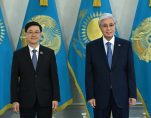
On his first day of visit in Astana (June 1), Mr Lee met with top government officials including the President of Kazakhstan, Kassym-Jomart Tokayev, Prime Minister Olzhas Bektenov, and Deputy Prime Minister and Minister of National Economy Serik Zhumangarin.
Hong Kong SAR’s Chief Executive John Lee (left) meets with the President of Kazakhstan Kassym-Jomart Tokayev to exchange views on deepening bilateral relations.
Mr Lee noted that Kazakhstan has been actively promoting reforms on various fronts to bring about rapid economic growth.
“As one of the world’s three major financial centres, and the world’s largest cross-boundary wealth management centre and offshore Renminbi business hub, Hong Kong can provide diversified and flexible support including capital and asset allocation for Kazakhstan’s economic reforms and infrastructure development,” Mr Lee said.
The Chief Executive also encouraged companies in Kazakhstan to leverage Hong Kong’s advantages under the “one country, two systems” principle.
“Under this unique principle, Hong Kong has its own economic, social, legal, legislative and judicial systems. We are the only common law jurisdiction in China. We have our own currency, with no capital or foreign exchange controls. We are, as well, a separate customs territory,” Mr Lee said.
“The ‘one country, two systems’ principle ensures Hong Kong’s unparalleled access to the markets of the Chinese Mainland. Capitalising on our global connectivity and world-class professional services, Hong Kong is your ideal, two-way springboard for business expansion.”
Mr Lee also visited the Astana International Financial Centre and the Astana Hub, a local technology and innovation park, to respectively learn about Kazakhstan’s experience in promoting the development of the non-bank financial sector and the latest developments of the country in the field of AI.
Hong Kong SAR’s Chief Executive John Lee (centre) witnesses the exchange of memoranda of understanding and co-operation agreements between organisations from both sides with the Governor of the Astana International Financial Centre Renat Bekturov (second right).
Before leaving Kazakhstan today (June 3), Mr Lee visited Nazarbayev University, underscoring the historic significance of the trip.
“It was here, at Astana’s Nazarbayev University in 2013, that President Xi Jinping first raised the visionary initiative of jointly building the Silk Road Economic Belt – today’s Belt and Road Initiative (BRI),” Mr Lee said.
Last year, at the 10th Belt and Road Summit in Hong Kong, the university signed a MOU with the Hong Kong University of Science and Technology, demonstrating a shared commitment to advancing higher education co-operation under the BRI. It further reached MOUs with Hong Kong’s Education University and Polytechnic University today.
“These agreements will deepen academic and research collaboration.
“Hong Kong is the only city in the world with five of the top 100 universities. This talent environment is reinforced by our global standing: last year, Hong Kong ranked first in Asia, and fourth globally, in the World Talent Ranking,” he added.
Mr Lee will continue to lead the delegation to Uzbekistan for the second leg of the mission to Central Asia.
Anthropic has expanded access to Claude Mythos Preview to about 200 organisations, widening a controlled cybersecurity programme designed to help governments, companies and critical software maintainers find severe vulnerabilities before attackers can exploit them. The San Francisco-based artificial intelligence company is adding around 150 organisations to Project Glasswing, its gated initiative for defensive use of a frontier model that has drawn intense attention from technology companies, banks, […]
Persistent dollar strength pushed the yen back towards 160 per US dollar on Wednesday, reviving concern that Tokyo may step into the foreign exchange market as renewed Gulf hostilities drove investors towards the US currency.
The yen traded near 159.92 per dollar in Asian dealings, close to the level widely viewed by traders as a possible trigger for official action. The move erased much of the currency’s rebound after Japan’s ¥11.7 trillion intervention campaign earlier this year, leaving markets alert to fresh warnings from the Ministry of Finance.
Dollar demand strengthened after renewed fighting in the Gulf raised fears of wider disruption to energy supplies and trade routes. The US currency benefited from its reserve status, while risk-sensitive currencies came under pressure. The dollar index held around 99.27, supported by geopolitical uncertainty and firm US labour indicators that have reduced expectations of near-term monetary easing by the Federal Reserve.
Japan’s authorities have intensified verbal warnings as the yen weakens. Finance Minister Satsuki Katayama has said the government is ready to respond appropriately to excessive currency moves, language that traders typically read as a signal that intervention remains on the table. Officials have also stressed coordination with the United States, a politically sensitive point because unilateral currency action can draw scrutiny from trading partners.
The yen’s slide reflects a combination of external pressure and domestic policy constraints. Japan remains heavily dependent on imported energy, much of it priced in dollars. Higher oil prices therefore worsen the trade position and add pressure to household costs, while a weaker yen raises import bills further. Brent crude climbed towards $95 a barrel as Gulf tensions fed concerns over supplies, adding another layer of strain for Japan’s economy.
Attention is now focused on Bank of Japan Governor Kazuo Ueda, whose next policy signals will be watched closely ahead of the June 15-16 policy meeting. Markets have increased bets that the central bank could raise interest rates from 0.75% to 1%, especially as imported inflation pressures build. Any move would mark a further step away from the ultra-loose policy framework that kept Japan’s rates far below those of other major economies for years.
Still, the Bank of Japan faces a difficult balance. A rate increase could support the yen and help restrain inflation expectations, but policymakers remain cautious about tightening too sharply while domestic demand stays uneven. Wage growth has improved, yet household purchasing power remains vulnerable to higher energy and food costs. A premature tightening cycle could hurt consumption just as companies pass on higher input costs.
The interest-rate gap with the United States remains central to the yen’s weakness. US policy rates are still high by comparison, keeping dollar assets attractive to global investors. Stronger US jobs data has strengthened the argument that the Federal Reserve may keep policy restrictive for longer, or even consider further tightening if inflation risks intensify. That has limited any relief for currencies trading against the dollar.
Other major currencies also softened. The euro slipped as investors assessed rising energy-driven inflation in the eurozone and the possibility of a European Central Bank rate increase at its June 11 meeting. Sterling edged lower, while the Australian and New Zealand dollars were weighed down by weaker risk appetite. Cryptocurrency markets also came under pressure as investors moved away from volatile assets.
For Japan, the 160 level carries market and political significance. Authorities intervened when the yen breached similar levels in 2024 and again used large-scale buying this year to slow the currency’s decline. The effectiveness of intervention, however, depends on whether monetary policy and global market conditions move in the same direction. Without a narrower yield gap or a broader fall in the dollar, direct yen purchases can lose impact quickly.
Advancing Cross-Border Payments Across Latin America and Europe
AMSTERDAM, NETHERLANDS – Media OutReach Newswire – 3 June 2026 – XTransfer, the world’s leading B2B cross-border trade payment platform, and BBVA, a global financial group, have signed a Memorandum of Understanding (MOU) during Money20/20 Europe 2026 in Amsterdam to deepen cross-border payment infrastructure across Latin America and Europe.
The MOU was signed by Bill Deng, Founder and CEO of XTransfer, and Ksenia Nekrasova, Global Sector Co-Head of TMT at BBVA, at Money20/20 Europe 2026 in Amsterdam.
Under the MOU, XTransfer and BBVA will combine their respective strengths to explore the delivery of integrated cross-border financial solutions, spanning FX conversion, local payments and cross-border payments across Latin America, Europe and Hong Kong SAR.
The parties will also explore leveraging technology and innovation, including APIs, digital platforms, collection solutions and virtual accounts, to support more automated, real-time and seamless FX conversion and transaction processing. By streamlining payment flows and improving operational connectivity, the collaboration is expected to enhance the scalability, efficiency and reliability of cross-border financial services for SMEs engaged in international trade.
In recent years, trade between China and Latin America has grown closer. XTransfer data shows that in 2025, payment collections from Latin America on its platform rose 94% y-o-y. Yet many SMEs still face major cross-border settlement hurdles, including slow onboarding, FX constraints, and complex compliance. The partnership between XTransfer and BBVA is structured to tackle these barriers directly.
For XTransfer, the partnership strengthens the coverage and depth of X-Net, its global unified B2B cross-border settlement and risk management network, in two of the most important regions for its SME clients. With Latin America emerging as a high-growth corridor for Chinese exporter settlements, BBVA’s strong presence across Latin America and Europe further strengthens XTransfer’s reach and competitive position.
With XTransfer’s network of more than 897,000 SME clients worldwide, the partnership also strengthens BBVA’s position in global payments and expands its ability to serve a broader, more diverse client base across multiple regions.
Bill Deng, Founder and CEO of XTransfer, said, “Latin America remains an active but underserved B2B trade corridor, where SMEs still encounter significant challenges. We are pleased to sign this MOU with BBVA, enabling us to leverage their expertise to bring X-Net’s infrastructure directly into the region. Together, we aim to simplify cross-border finance and improve the efficiency and inclusivity for global traders.”
Ksenia Nekrasova, Global Sector Co-Head of TMT at BBVA, said: “Beyond the growth in flows, we are seeing a shift in how our clients operate: digital platforms with global, real-time and highly integrated needs. This agreement allows us to anticipate that evolution, strengthening our capabilities in the TMT space and supporting these clients in their international expansion with solutions designed for their scale and complexity.” Hashtag: #XTransfer #BBVA #CrossborderPayments #SMEs
The issuer is solely responsible for the content of this announcement.
About XTransfer
XTransfer, the world’s largest B2B cross-border trade payment platform with over US$60 billion TPV in 2025, according to CIC. Founded in 2017 as one of the first payment platforms worldwide dedicated to B2B cross-border trade, we serve the largest customer base of over 800,000 registered SMEs globally as of March 31, 2026.
We connect top-tier financial institutions directly to SMEs, the backbone of global trade, giving businesses of every size access to the same secure, compliant and seamless payment infrastructure once reserved for multinationals. As of March 31, 2026, we provide payment services across more than 200 countries and regions through partnerships with financial institutions, including some of the most established international banks around the world.
XTransfer has obtained required licenses in major hubs, including the Chinese Mainland, Hong Kong, the United Kingdom, the United States, Singapore, the Netherlands, Australia and Canada.
For more information, please visit: https://www.xtransfer.com
Oman India Fertiliser Company is preparing to sell 25 per cent of its share capital through an initial public offering, setting up a July debut on the Muscat Stock Exchange as Oman pushes ahead with a broader programme to widen public ownership of strategic assets.
The offering will comprise existing ordinary shares held by the company’s current shareholders, meaning proceeds from the sale will go to the selling shareholders rather than to OMIFCO. The subscription period is expected to open this month, subject to final regulatory approvals from the Financial Services Authority, with trading targeted for July if market conditions remain supportive.
OMIFCO is 50 per cent owned by Oman state energy group OQ, while Indian Farmers Fertiliser Cooperative Limited and Krishak Bharati Cooperative Limited each hold 25 per cent. The float is expected to give investors access to one of Oman’s largest industrial exporters and a fertiliser producer with strong exposure to global urea and ammonia demand.
The company operates from Sur Industrial City, where its complex includes two ammonia trains and two urea trains. Annual nameplate capacity stands at about 1.15 million tonnes of ammonia and 1.65 million tonnes of urea, making the producer one of the largest fertiliser operators in the Gulf. The business is supported by long-term gas supply arrangements, established marketing relationships and export infrastructure, including a dedicated deep-water berth that connects the plant to overseas markets.
The IPO comes at a sensitive moment for fertiliser supply chains, with Middle East producers drawing stronger investor attention as global prices respond to disruptions in energy and shipping routes. Urea remains OMIFCO’s dominant revenue source, accounting for the bulk of sales, while ammonia provides an additional export stream and supports integrated production at the Sur complex.
OMIFCO generated revenue of $802.3 million in 2025, with an EBITDA margin of 50.6 per cent and a net profit margin of 40 per cent. Revenue for the first quarter of 2026 reached $207.4 million, while EBITDA margin stood at 50.5 per cent and profit margin at 40.4 per cent. The company has said it has maintained a net cash position for several years and has no interest-bearing debt, a profile likely to feature prominently in investor marketing.
The company expects to distribute dividends of about RO71.2 million, equivalent to roughly $185 million, for the 2026 financial year. The payout is planned in two equal instalments, scheduled for September 2026 and April 2027. For the following two financial years, dividend guidance is expected to be linked to either 90 per cent of net profit or a minimum annual compounded increase from the 2026 dividend base, whichever is higher.
The planned sale follows a series of listings and privatisation moves aimed at expanding the depth of Oman’s capital market. OQ Exploration and Production’s 2024 listing was one of the largest offerings in the region that year, while Asyad Shipping also formed part of the state-linked pipeline of public market transactions. OMIFCO’s proposed listing would extend that momentum into industrial manufacturing and food-security-linked exports.
Bank Muscat and Société Générale have been appointed joint global coordinators for the offering, with Bank Muscat also acting as issue manager. Arqaam Capital and United Securities are serving as joint bookrunners. The final structure, allocations and investor eligibility terms will be detailed in the prospectus after approval by the Financial Services Authority.
The offering is expected to include tranches for institutional and retail investors, with participation governed by Oman’s regulations for public joint stock companies. Shares will also be offered to selected qualified investors outside the United States under applicable securities rules, broadening the potential investor base while keeping the formal listing on the Muscat Stock Exchange.
OMIFCO’s position is closely linked to demand from agriculture markets, particularly urea used in crop nutrition. India has remained a major destination for its exports, supported by long-term commercial ties with its cooperative shareholders. From 2023 to 2025, the country accounted for most exported urea volumes and a substantial share of ammonia shipments, reinforcing the company’s role in cross-border fertiliser supply.
Kioxia Holdings has moved within striking distance of Toyota Motor’s market value, underscoring how the artificial intelligence boom is reshaping Japan’s corporate hierarchy and lifting a memory-chip maker that listed in Tokyo less than two years ago into the country’s market elite.
The Tokyo-based maker of NAND flash memory and solid-state drives has become one of the most closely watched stocks on the Tokyo Stock Exchange after a sharp rally tied to demand for data-centre storage, AI servers and high-performance memory systems. Its market capitalisation has climbed into the tens of trillions of yen, placing it near Toyota and behind SoftBank Group in a reshuffled ranking that would have seemed unlikely when Kioxia priced its initial public offering at 1,455 yen a share in December 2024.
The shift marks a wider challenge to the long-standing dominance of Japan’s manufacturing champions. Toyota, the global carmaker that symbolised the strength of Japan Inc. for decades, has been displaced from the top position by SoftBank during the latest AI-led surge, while Kioxia has risen rapidly from a former Toshiba memory unit backed by Bain Capital into a central player in the market’s technology rotation.
Kioxia’s climb reflects investor expectations that memory will remain a bottleneck in AI infrastructure. Generative AI systems require vast amounts of storage and high-speed data movement, pushing demand beyond the older cycle driven mainly by smartphones and personal computers. Data-centre operators, cloud companies and chip designers are competing for components needed to train and run large AI models, giving memory producers stronger pricing power after years of volatility.
The company’s earnings have strengthened sharply. Kioxia has projected operating profit of about 1.3 trillion yen for the April-June quarter, a figure that puts it among the most profitable listed companies in Japan. Its latest annual results showed strong momentum in revenue, margins and cash generation, helping ease earlier concerns about debt and cyclicality. Rating upgrades to investment grade have added to the perception that the balance sheet is improving at a time when investors are rewarding semiconductor exposure.
Kioxia’s origins give its rise broader industrial significance. The company traces its roots to Toshiba’s memory business, which was sold to a Bain-led consortium in 2018 after Toshiba’s financial crisis. The group was renamed Kioxia in 2019, drawing on the Japanese word for memory and the Greek word for value. Its public listing in 2024 valued it below 800 billion yen, after earlier IPO attempts were delayed by weak valuation conditions and pressure in the memory market.
That cautious debut contrasts sharply with its current status. Shares have multiplied as investors reassessed the role of NAND flash in AI systems, especially as large-scale data centres require higher storage density, faster access and more energy-efficient hardware. Kioxia has also been developing advanced BiCS FLASH technology and promoting next-generation SSDs for AI storage infrastructure.
The rally has also lifted questions over valuation risk. Memory chips remain one of the semiconductor industry’s most cyclical segments, with prices exposed to shifts in capital spending, inventory levels and customer demand. A sharp rise in market value leaves Kioxia vulnerable if hyperscaler investment slows, if competitors add capacity faster than expected, or if customers push back against higher pricing.
Competition is intense. Samsung Electronics, SK Hynix, Micron Technology and SanDisk remain key players across memory markets, with SK Hynix holding a dominant position in high-bandwidth memory used in AI accelerators. Kioxia’s strength is more closely tied to NAND flash and SSDs, where demand from AI infrastructure has broadened the market but does not eliminate the risk of oversupply once new capacity comes on stream.
Toyota’s relative decline in the rankings does not point to operational weakness alone. The carmaker remains one of the world’s largest manufacturers by sales and a major profit generator, but investors have been rotating away from traditional industrial leaders towards companies with direct AI exposure. Concerns over electric-vehicle competition, currency movements and the cost of future technologies have weighed on auto valuations, even as Toyota continues to command global scale in hybrid vehicles and supply-chain management.
SoftBank’s ascent has further highlighted the changing market narrative. Its exposure to Arm and AI-related investments has drawn investors seeking Japan-based access to global AI infrastructure. Together, SoftBank and Kioxia now represent a market story centred on chips, data centres, software platforms and computing capacity rather than the export-led industrial model that long defined Japan’s equity market.
Foreign investor flows have amplified the shift. Japan’s equity market has benefited from corporate-governance reforms, stronger capital returns and renewed interest in companies linked to the AI supply chain. The Nikkei 225 has reached record territory, though the rally has been uneven, with gains concentrated in a limited group of technology-linked names while broader market performance has been more mixed.
Kioxia’s next test will be whether it can convert favourable pricing and sold-out capacity into durable earnings. Investors will look for clearer shareholder-return plans, disciplined capital expenditure and evidence that AI storage demand can remain strong beyond the current investment wave. The company’s contemplated US share listing would widen access to global technology investors and could further raise its profile if market conditions remain supportive.
SINGAPORE – Media OutReach Newswire – 3 June 2026 – Handshake Finance, the Singapore-based fintech company building escrow-as-a-service infrastructure for high-trust service industries, has closed a S$500,000 pre-seed funding round. The capital will accelerate the company’s expansion across its beachhead renovation and interior design market in Singapore, with longer-term ambitions to extend its platform across other service industries where payment trust remains a structural problem.
Handshake Finance Founders Christopher Chan (Left) and Lee Jun Xian (Right)
Born From Personal Experience
Handshake Finance launched in September 2025, founded by Christopher Chan and Lee Jun Xian. Both had seen the trust gap up close.
Jun’s close friend lost S$80,000 in pre-payments to a renovation company that collapsed mid-project. At the same time, Christopher’s friend paid a deposit on a rental home she had never viewed, only to discover the listing was fraudulent. Both incidents pointed to the same structural failure: in service industries, someone always carries the risk, and when trust breaks down, there is little recourse on either side.
The two founders met as university classmates in London and returned to the problem with complementary backgrounds. Christopher Chan had spent his career in fintech, designing compliant payment flows on regulated infrastructure. Lee Jun Xian came from venture capital, with experience scaling early-stage companies from zero to one.
Trust as the foundation, not the feature
Handshake operates on bank-grade payment infrastructure provided by MAS-regulated partners. All payment flows are fully MAS regulated, and funds are held with DBS in segregated escrow accounts. For the founders, this is not a checkbox — it is the entire foundation of the business.
“We are trying to solve a structural trust gap in service industries. But before any of that, our users have to trust us,” said Christopher Chan, Co-Founder of Handshake Finance. “Making sure every fund flow is fully compliant, and that our users feel completely assured handing us money in what are often life-changing transactions, is our number one priority. Everything else is built on top of that.”
Closing the Trust Gap Across Service Industries
Every high-trust service transaction carries the same structural flaw: either the customer pays before work is done, or the provider works before getting paid. Someone always carries the risk. Across industries — from renovation and interior design to event planning, creative agencies, and professional services — that risk falls entirely on one side, and when trust breaks down, there is little recourse for either party.
Handshake Finance was built to close that gap. The platform holds customer funds in escrow and releases them to service providers against agreed milestones, giving buyers protection from pre-payment risk while giving service providers the confidence to deliver. The model is designed to work across any service industry where the payment trust problem exists.
Why Renovation and Interior Design Is Handshake’s Beachhead Market
Renovation was where the structural failure ran deepest. The industry operates with no mandatory licensing or regulatory framework. Anyone can set up as an interior designer with no accreditation required, leaving homeowners with no reliable way to assess accountability before signing a contract.
There is no standard payment framework either. Homeowners routinely pay up to 50% of the total project value upfront, with funds going directly to the interior designer before any work begins. If a project stalls or a firm shuts down, there is limited protection and recourse. At the other end of the project, interior designers face the opposite problem: the final handover payment, where homeowners hold most of the leverage, can be withheld over disputes that wipe out up to half a project’s margin.
Eight Months of Listening Before a Single Line of Code
Before writing any software, the Handshake team spent eight months speaking with more than 80 interior designers and homeowners across Singapore to understand the real frictions on both sides of the transaction. What they found reinforced the decision to start here: high transaction values, a broken payment norm, an unregulated supply side, and no existing platform that protected both parties.
That research shaped how the product was built. After a renovation contract is signed, Handshake’s AI automatically generates the transaction structure with line items, payment schedules, and sub-milestones set out clearly to remove ambiguity. Homeowners place funds into escrow rather than paying upfront directly to the interior designer.
Payment releases to the designer as work progresses against agreed milestones, with sub-milestone releases providing faster cashflow access without compromising homeowner protection. The platform also replaces the manual spreadsheet-based back-office admin most interior design firms still run, and offers complimentary mediation and independent assessments in the event of a dispute.
More than 40 Interior Design Companies Onboarded and 2 Major Partnerships Signed
Handshake now has more than 40 interior design companies onboarded. The company has signed partnerships with Renonation.sg and Network SG, two of Singapore’s most established renovation marketplaces, to drive awareness and adoption across the broader ecosystem.
“It is an incredible feeling to see this much support behind us, and we are excited about what is ahead,” said Lee Jun Xian, Co-Founder of Handshake Finance. “We are industry-agnostic by design, but we are laser-focused on fixing renovation first. The scams that are still everyday occurrences in this space need to go, and the transactional experience for everyone involved needs to be better before we turn our attention to the next industry or market.”
Homeowners and interior designers can learn more or request access athandshake.finance.
Hashtag: #HandshakeFinance
The issuer is solely responsible for the content of this announcement.
About Handshake Finance
Handshake Finance is a Singapore-based fintech building escrow-as-a-service infrastructure for high-trust service industries. The platform holds customer funds in segregated escrow accounts and releases them against agreed milestones, protecting buyers from pre-payment risk while giving service providers the confidence to deliver. All payment flows are fully MAS regulated. Funds are held with DBS. Handshake is currently focused on Singapore’s renovation and interior design market as its beachhead, with plans to expand across other service industries and Southeast Asia.
Arabian Post Staff -Dubai Dubai Multi Commodities Centre has introduced a targeted acceleration package for its community of more than 26,000 companies, offering licence renewal discounts, penalty waivers and operational flexibility aimed at easing cost pressures and supporting business expansion from Dubai. The initiative is designed to reduce operating costs, improve cash flow and help companies navigate a more competitive global trading environment. It comes as businesses […]
Arabian Post Staff -Dubai Al Ansari Exchange recorded a sharp rise in companies using its Wage Protection System platform on June 1, as private-sector employers across the UAE moved to meet tighter salary-payment rules that took effect at the start of the month. The UAE remittance and foreign exchange company said the number of companies processing salaries through its WPS platform rose by more than 151 per […]
Mainland Chinese investors have turned net sellers of Hong Kong-listed equities through Stock Connect, marking a rare reversal in cross-border flows as enthusiasm for onshore artificial intelligence shares draws capital back towards Shanghai and Shenzhen.
The shift reflects a sharp change in investor preference after months of underperformance by Hong Kong equities against mainland peers. Mainland investors sold about HK$3.6 billion of Hong Kong shares through the trading links last month, the first monthly net outflow since June 2023 and one of only a small number of monthly selling episodes since the southbound channel became a key route for mainland money into the city’s market.
The move is striking because southbound buying has been one of the strongest supports for Hong Kong stocks over the past year. Mainland funds poured into high-dividend banks, telecoms groups, energy companies and internet platforms during earlier phases of the rally, helping offset caution among global investors. That support is now weakening as domestic funds chase companies tied to AI infrastructure, chips, optical modules, software and computing power.
Onshore AI shares have delivered a stronger performance than Hong Kong’s technology benchmarks this year. The CSI Artificial Intelligence Index has risen sharply, while the Hang Seng Tech Index has lagged, weighed down by concerns over platform margins, heavy spending on AI models and pressure from subsidy battles in e-commerce and online services. The divergence has encouraged active money managers and retail traders to reassess whether Hong Kong-listed internet giants still offer the most attractive exposure to China’s technology story.
The change in flows also comes as Beijing’s industrial policy continues to favour advanced manufacturing, domestic semiconductors, large language models and high-end computing. Companies linked to AI servers, data centres, optical communications, robotics and chip design have become favoured market proxies for China’s effort to reduce dependence on foreign technology. That policy backdrop has helped support valuations even as questions persist over earnings visibility, capital expenditure demands and competition.
Cambricon Technologies, Zhongji Innolight, Kingsoft Office, iFlytek and other mainland-listed technology names have been among the companies watched closely by investors seeking domestic AI exposure. Hong Kong still hosts major technology groups such as Tencent, Alibaba, Baidu, Meituan and Xiaomi, but the market’s heavyweight structure makes it more exposed to mature platform businesses than to the faster-growing AI hardware and infrastructure supply chain favoured by onshore traders.
Hong Kong’s role as a fundraising centre remains intact despite the outflow. The city has continued to attract listings from technology, healthcare, robotics and semiconductor-related companies, while mainland firms still view it as the most practical offshore venue for raising international capital. Several AI and chip-linked companies are preparing or considering Hong Kong share sales, suggesting the city remains central to China’s capital market architecture even as secondary-market money rotates elsewhere.
The weakness in southbound appetite also reflects broader caution over Hong Kong valuations after a strong earlier advance. Investors who bought the market for dividends and policy support are locking in gains while seeking higher-beta opportunities at home. The shift does not necessarily point to a structural rejection of Hong Kong stocks, but it does show that mainland money is becoming more selective after helping drive earlier momentum.
Regulatory pressure on offshore investment channels may also be influencing behaviour. Authorities have tightened scrutiny of unauthorised cross-border trading accounts and offshore brokerage activity, reinforcing the appeal of regulated domestic routes. While Stock Connect remains an approved mechanism, wider efforts to keep capital within supervised channels have added another layer of sensitivity around outbound allocations.
Market analysts say the key question is whether the AI-led onshore rally can broaden beyond a narrow group of highly valued companies. China’s AI supply chain is benefiting from state support, falling model costs and growing enterprise adoption, but investors face risks from crowded positioning, uneven profitability and rapid technological shifts. Several AI-linked companies still trade more on expectations than on proven earnings, leaving the sector vulnerable to volatility if sentiment turns.
FOMO Pay merchants in Singapore will soon be able to accept DuitNow QR payments, enabling Malaysian travellers and visitors to pay using familiar home-country banking and payment applications.
The rollout comes ahead of the Johor Bahru–Singapore RTS Link, expected to carry up to 40,000 passengers daily upon launch in January 2027.
SINGAPORE – Media OutReach Newswire – 3 June 2026 – FOMO Pay, a leading Singapore-headquartered payment institution, will launch DuitNow QR acceptance in Singapore, enabling Malaysian travellers and visitors to make payments using familiar banking and payment applications while merchants receive settlement in Singapore Dollars (SGD).
The rollout comes ahead of the opening of the Johor Bahru–Singapore Rapid Transit System (RTS) Link in January 2027, a landmark infrastructure project expected to carry up to 40,000 passengers daily. The rail link is expected to further strengthen travel and consumer activity between Singapore and Malaysia.
Supporting Singapore Merchants with Growing Malaysian Visitor Traffic As travel between Singapore and Malaysia continues to increase, merchants are seeing a growing demand for payment experiences that are frictionless to regional consumers.
By enabling DuitNow QR acceptance in Singapore, FOMO Pay allows Malaysian visitors to pay using their local banking and payment apps in Malaysian Ringgit (MYR), while Singapore merchants receive full settlement in SGD. The rollout will simplify payment acceptance for merchants, removing the need for separate payment setups or manual foreign currency handling.
As cross-border consumer traffic continues to grow, seamless payment experiences are expected to play an increasingly important role in shaping consumer confidence and purchase behaviour, particularly in retail, dining, and lifestyle environments.
Enhancing Cross-Border Payment Experiences
“Cross-border commerce is no longer limited to large enterprises or international brands. Increasingly, everyday businesses are serving consumers who move frequently across markets,” said Rose Wang, Head of Digital Payments at FOMO Pay. “As travel and consumer movement across Southeast Asia becomes increasingly fluid, real-time payment rails like DuitNow are fast becoming part of the infrastructure powering everyday regional commerce. Enabling DuitNow QR acceptance in Singapore helps merchants better connect with Malaysian consumers in ways that feel natural to how they already transact in their daily lives.”
The rollout marks another step in FOMO Pay’s broader efforts to help merchants access Asia’s growing network of national instant payment systems through a unified multi-rail, multi-currency platform, better supporting increasingly cross-border consumer spending across the region.
The issuer is solely responsible for the content of this announcement.
About FOMO Pay
Founded in 2015, FOMO Pay is a payment institution licensed in Singapore, Hong Kong and the Middle East. The firm has become a leading one-stop digital payment, digital banking, and digital asset solution provider. It is currently building Asia’s fully licensed financial platform, helping institutions and businesses connect between traditional and next-generation financial services. The firm offers its three flagship products:
* FOMO Payment – One-stop digital payment solution for merchants, corporates and financial institutions
Oil markets are heading towards a possible August inflection point as constrained flows through the Strait of Hormuz, recovering seasonal demand and disrupted supply chains combine to keep upward pressure on crude prices. Philippe Khoury, executive vice-president for sales and trading at ADNOC, told the Middle East Petroleum and Gas Conference in London that prices could move sharply higher if demand strengthens while the Iran war supply […]
Gold has overtaken US Treasuries as the world’s largest reserve asset by market value, marking a significant change in the composition of official reserves and underlining how central banks are adjusting to geopolitical risk, high debt levels and uncertainty over the dollar-based financial system. The European Central Bank’s latest review of the international monetary system shows gold accounted for 27 per cent of total official foreign reserves […]
Mounting pressure on the rupee has put the Reserve Bank of India’s reserve strategy under sharper scrutiny after a report indicated that the central bank may have sold about $12 billion worth of gold holdings to protect foreign currency assets from the fallout of the US-Iran conflict.
The reported move, if confirmed, would mark a significant shift in the composition of India’s external buffers at a time when oil prices, foreign portfolio outflows and import demand are combining to test the country’s balance of payments position. The RBI has not publicly confirmed any gold sale of that scale, and the latest available reserve data show a fall in the value of gold holdings rather than a definitive disclosure of physical bullion sales.
India’s foreign exchange reserves fell to $681.4 billion for the week ended May 22, down $7.5 billion from the previous week. Foreign currency assets declined by about $3 billion to $543 billion, while the value of gold reserves dropped by roughly $4.5 billion. The fall came as the rupee traded near record lows, having weakened by more than 4 per cent since the outbreak of the US-Iran conflict and the accompanying rise in energy prices.
The rupee has been under sustained pressure from higher crude oil and liquefied natural gas costs, wider hedging by importers and withdrawals by overseas investors from domestic equities. Brent crude has traded in the mid-$90 range, raising concern over India’s import bill because the country depends heavily on overseas energy supplies. Any prolonged disruption in Gulf shipping routes would add to inflation risks and intensify demand for dollars from refiners and importers.
The RBI has intervened through state-run banks to slow the currency’s decline, with traders indicating that the central bank has been uncomfortable with disorderly depreciation. The rupee was around 95 to the dollar this week after briefly sliding close to 97 in May. The central bank’s policy decision due this week is being watched for signals on whether it will rely mainly on liquidity tools, dollar sales and administrative measures, or consider a firmer monetary response.
The reported $12 billion gold-related action has drawn attention because India’s gold holdings have expanded in importance within the reserve portfolio. The central bank held about 880.5 tonnes of gold at the end of March, with gold accounting for nearly 17 per cent of total foreign exchange reserves. The physical stock has been broadly steady around 880 tonnes since mid-2025, suggesting that changes in the dollar value of gold reserves can reflect price movements, accounting effects and reserve operations as well as outright sales.
Gold has become a larger part of central bank reserves worldwide as monetary authorities seek diversification away from dollar assets and protection against geopolitical shocks. India has also moved more of its bullion to domestic vaults, reducing custody risks linked to overseas storage. That strategy had been seen as a long-term strengthening of sovereign reserve control, making any suggestion of sizeable gold liquidation politically and financially sensitive.
The government has moved separately to curb foreign exchange outflows. Import duties on gold and silver have been lifted sharply to about 15 per cent from 6 per cent, reversing earlier tariff relief and increasing the landed cost of precious metals. Rules around some bullion imports have also been tightened, while appeals have been made to households to reduce discretionary gold purchases.
Fuel prices have also been raised as state-run retailers pass through part of the increase in international crude costs. Petrol and diesel prices have risen after several years of limited retail adjustments, adding to household costs but reducing the burden on public-sector oil marketing companies. The step is intended to limit under-recoveries at fuel retailers and reduce the fiscal strain that would otherwise build if global prices stay elevated.
The combined policy response reflects the strain of a classic external shock: a weaker currency lifts import costs, higher oil prices widen the trade deficit, and investors demand higher compensation for risk. India enters this phase with substantial reserves, moderate inflation by past crisis standards and a financial system that remains broadly stable, but the speed of the rupee’s decline has revived comparisons with earlier episodes of currency stress.
For markets, the key question is whether the central bank can preserve confidence without exhausting liquid dollar assets or signalling panic. A calibrated use of reserves can smooth volatility, but heavy intervention may raise doubts if investors see it as a defence of a particular exchange-rate level. The RBI’s challenge is to keep currency markets orderly while allowing enough flexibility for the rupee to adjust to the oil shock and global risk aversion.
Johannesburg has become the opening stage for a European Union push to turn a pledged €12 billion investment package for South Africa into bankable projects, with about 200 companies joining the bloc’s first investment roadshow in the country as competition intensifies over critical minerals. The event, hosted at the Johannesburg Stock Exchange on Monday, marked the first major effort to mobilise private capital under the EU-South Africa […]
SolyxImmortal, a Python-based information-stealing malware, is drawing attention from cyber defenders because of its ability to combine browser credential theft, document harvesting, keystroke logging and screen surveillance inside a single Windows implant. Technical analysis shows the malware is designed to operate quietly on compromised machines, using common Python libraries, Windows features and multi-threaded execution to run several data-collection functions at the same time. Its targets include saved […]
Binance has launched regulated dirham bank transfers for users in the UAE, giving customers a local-currency route to buy and sell selected stablecoins through a framework designed to strengthen protection for client funds. The service allows eligible users to transfer UAE dirhams through a regulated financial channel and convert funds into USDT and USDC, reducing reliance on dollar-linked payment routes, card transactions and informal transfer methods. Transactions […]





 https://www.brandhk.gov.hk/
 https://www.linkedin.com/company/brand-hong-kong/
 https://x.com/Brand_HK/
 https://www.facebook.com/brandhk.isd
 https://www.instagram.com/brandhongkong