News related to
Bank

India’s push to build an artificial intelligence ecosystem that is both strategically independent and culturally grounded is gathering pace, as policymakers, startups and large enterprises converge around a shared question: how to create AI systems that are secure enough for national priorities and rich enough to reflect the country’s languages, knowledge traditions and institutional memory.

That debate has sharpened after comments by Arun Subramaniyan, founder and chief executive of Articul8, who argued that India’s AI trajectory should not be framed as a choice between sovereign control and cultural depth, but as a need for both. His view comes at a time when the public and private sectors are moving from broad enthusiasm around generative AI to harder questions of ownership, trust, utility and scale.

The timing is notable. Under the IndiaAI Mission, the government has been expanding support for domestic compute, foundational models, datasets, skills and applications, while official messaging at the India AI Impact Summit in February cast sovereign AI as a strategic capability rather than a branding exercise. Government-backed efforts such as BharatGen have also been positioned as multilingual, multimodal systems designed around the country’s linguistic diversity and socio-cultural context. Together, those moves show that the argument for AI sovereignty in India is no longer limited to who owns the model or where the servers sit. It is increasingly about whether AI built for India can understand how people speak, work and make decisions across vastly different regions and sectors.

Subramaniyan’s intervention adds another layer to that discussion. He has suggested that sovereignty on its own can become too narrow if it is treated only as a matter of defence, infrastructure or control. In his framing, heritage matters because AI systems that ignore local language, history and context risk becoming technically impressive but socially shallow. That point has growing resonance as global concern rises over English-heavy training data, cultural blind spots and the danger that smaller languages may become underrepresented in the next generation of digital tools.

For India, the heritage argument carries practical as well as symbolic importance. A country with hundreds of languages, wide variations in literacy and deep differences in economic activity cannot rely on AI products optimised only for Western datasets or metropolitan users. Voice interfaces, translation layers, domain-specific copilots and public-service tools all perform better when they are trained on the speech patterns, terminology and workflows of the people expected to use them. This is why multilingual model development has moved from a niche research issue to a core policy concern.

At the same time, the enterprise case is becoming clearer. Many companies have discovered that generic large language models can help with drafting, summarising and coding, but struggle when deployed in regulated or mission-critical environments without access to internal knowledge. The more valuable opportunity lies in turning proprietary documents, engineering manuals, transaction records, legal archives and operational know-how into structured intelligence that can support decisions. That is the commercial logic behind domain-specific AI, and it helps explain why firms such as Articul8 are pitching secure, enterprise-grade systems built around private data rather than public internet corpora alone.

This shift also reflects a broader global pattern. Corporate surveys and advisory research have shown that many organisations remain stuck between pilot projects and real productivity gains, largely because governance, data quality and workflow integration have lagged behind excitement over model capabilities. In practice, companies tend to get stronger returns when AI is tied to specific functions and high-value use cases rather than treated as a general-purpose novelty. For banks, manufacturers, energy groups and healthcare providers, that often means models that can work inside tightly controlled environments and understand sector language with precision.

India’s opportunity may lie in combining these two strands. One is sovereign capability: domestic compute, public datasets, local model development and policy oversight. The other is heritage depth: linguistic coverage, cultural nuance and knowledge systems that reflect the country’s own realities. The third, emerging alongside them, is institutional depth inside enterprises, where AI can turn decades of accumulated expertise into a working asset instead of leaving it trapped in silos.

There are, however, risks in the current moment. A strong sovereign AI narrative can drift into protectionism or technological duplication if it becomes a race to mimic every frontier model at any cost. Heritage-focused rhetoric can also become vague if it is not matched by usable datasets, benchmark standards and transparent governance. Enterprises face a different danger: spending heavily on AI assistants that are poorly connected to business processes, weak on accuracy and difficult to audit.

GitHub Copilot Chat has been shown to carry a serious prompt-injection weakness that allowed a researcher to demonstrate how secrets, private source code and other sensitive repository data could be siphoned out of trusted development workflows without planting malware in the victim’s environment. The issue, dubbed CamoLeak, was disclosed by Legit Security researcher Omer Mayraz after he said he found it in June 2025, reported it through […]

Bitcoin and other major cryptocurrencies fell on Saturday after high-level talks between the United States and Iran in Islamabad ended without an agreement, puncturing a bout of market optimism that had followed a temporary ceasefire and hopes of a broader diplomatic settlement. U. S. Vice President J. D. Vance said the American delegation was leaving Pakistan after about 21 hours of negotiations without a breakthrough. Markets reacted […]

Arabian Post Staff -Dubai Careem Pay has expanded its remittance service to Saudi Arabia and Türkiye, opening two new money-transfer corridors for UAE residents as digital finance platforms compete more aggressively for a larger share of cross-border payments in the Gulf. The company said transfers to bank accounts in both markets can be completed within five to 10 minutes, with transaction limits of up to AED150,000 for […]

S&P Global Ratings has lowered its growth expectations for both the UK and Egypt, saying the economic fallout from conflict-linked disruption across the Middle East is feeding through energy prices, trade routes and business confidence. For Egypt, S&P cut its forecast for real GDP growth in the 2025-2026 fiscal year to 4.7 per cent from 4.8 per cent, while also trimming the following year to 4.3 per […]

Arabian Post Staff -Dubai Saudi Arabia has moved to raise its profile in global data governance after the Saudi Data and Artificial Intelligence Authority, known as SDAIA, said it had joined the Global Privacy Assembly, a forum that links privacy and data protection authorities worldwide. The step puts the Kingdom’s privacy regime more visibly alongside international rule-setting efforts at a time when Riyadh is pushing digital government, […]

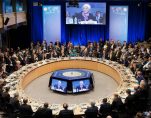
By Saifur Rahman The UAE will host the Annual Meetings of the International Monetary Fund (IMF) and World Bank Group in 2029 in Abu Dhabi, about 26 years after the country hosted the same in 2003 in Dubai. The news comes at a time when the UAE banking assets reached its highest value, to Dh5.4 trillion (US$1.47 trillion), and foreign reserves jumped 23.4 percent to Dh1.05 trillion […]

Advertisements

Arabian Post Staff -Dubai MBME Pay has secured a Category 3 Payment Service Provider licence from the Central Bank of the UAE, giving the company regulatory approval to carry out merchant acquiring and payment aggregation activities and placing it in a narrower circle of fully licensed operators in one of the Gulf’s fastest-moving fintech markets. The approval marks a step up for the Abu Dhabi-listed MBME Group […]

A Microsoft-tracked cybercrime group is using adversary-in-the-middle techniques to hijack Microsoft 365 sessions, bypass multifactor authentication and reroute employee pay into attacker-controlled bank accounts, in what researchers describe as a geographically focused campaign against users in Canada. Microsoft said the actor, tracked as Storm-2755, combined search-result poisoning, fake sign-in pages and session replay to move from account takeover to payroll fraud, causing direct financial loss for at […]

Dubai International Financial Centre has rolled out a temporary package of economic support measures for businesses and retailers, offering flexible payment plans, licence-fee instalments and grace periods on selected administrative charges as the emirate’s financial hub seeks to cushion companies from a turbulent regional operating environment. The steps took effect immediately and were presented by the centre as a way to reduce short-term financial and operational pressure […]

Bank of Korea left its benchmark interest rate unchanged at 2.50 per cent on Friday, extending its policy pause to a seventh straight meeting as policymakers confronted a harder mix of rising price pressures, a weak won and a growth outlook darkened by higher energy costs and disruption linked to conflict in the Middle East.

The seven-member Monetary Policy Board said uncertainty had intensified and judged it appropriate to hold the base rate while assessing how the conflict, financial-market volatility and foreign-exchange swings feed through to the domestic economy. The central bank’s statement made clear that the policy dilemma has sharpened: inflation risks are moving up even as growth is expected to slow more than earlier forecast.

Governor Rhee Chang-yong, speaking after what Reuters reported was his final press conference before his term ends on April 20, said supply-side shocks from the Middle East were especially damaging for Asian economies reliant on imported energy. That matters acutely for South Korea, where policymakers are trying to prevent a renewed inflation cycle without choking activity at a time when sentiment has softened and some industries are already facing production constraints.

The rate hold had been widely anticipated. Reuters said all 31 economists in its poll expected no move at this meeting, reflecting a market consensus that the central bank had little room to ease and few grounds to tighten immediately. Instead, the decision underscored how monetary authorities in export-driven Asian economies are being forced to navigate a narrow path between external shocks and domestic fragilities.

At the centre of the debate is inflation. Official data showed consumer prices in March rose 2.2 per cent from a year earlier, up from 2.0 per cent in February, while core inflation, which excludes food and energy, also stood at 2.2 per cent. The Bank of Korea said petroleum prices had risen sharply and noted that short-term inflation expectations among the public edged up to 2.7 per cent. It now expects consumer inflation this year to exceed its February projection of 2.2 per cent by a meaningful margin, with core inflation also likely to come in above the earlier 2.1 per cent forecast.

That shift is important because the central bank had been able for months to argue that price growth was gradually stabilising near target. The worsening external backdrop has disrupted that narrative. The board said inflation is likely to move into the mid- to upper-2 per cent range as global oil prices and supply constraints lift import costs, though government price-stabilisation measures may soften part of the blow. Reuters reported that Seoul’s fuel-price caps, introduced last month for the first time in decades, helped restrain March inflation but are unlikely to provide a lasting shield if energy costs stay elevated.

Growth, meanwhile, is losing momentum. The central bank said the economy had been supported by strong exports, firmer consumption and continued job gains, but warned that downside pressure had increased since the outbreak of the Middle East conflict. It expects expansion this year to come in below the 2.0 per cent forecast issued in February, as higher energy prices and supply bottlenecks offset support from semiconductor exports and a supplementary budget. That combination leaves the Bank of Korea confronting an uncomfortable form of policy tension: weaker activity alongside stronger inflation.

The won has added to the pressure. The central bank said the currency weakened into the 1,500-won range against the US dollar as investors moved into safer assets and foreign investors sold domestic equities, before recovering some ground after a temporary ceasefire between the United States and Iran. A softer currency raises the local-currency cost of imported fuel and raw materials, complicating the inflation picture and limiting the case for any near-term rate cuts.

Financial markets reflected that cautious tone. Reuters reported that South Korea’s policy-sensitive three-year treasury bond futures erased early gains during the governor’s press conference, suggesting investors interpreted the message as more alert to inflation risks than to immediate growth support. Analysts cited by Reuters said the rebound in energy prices and the won’s weakness have narrowed the central bank’s room for manoeuvre, even if domestic demand still needs close watching.

US unemployment benefit claims rose last week but stayed at levels that still point to a labour market holding together, even as investors and policymakers brace for a March inflation reading that could complicate the Federal Reserve’s next move. Initial claims for state unemployment benefits increased by 16,000 to 219,000 in the week ended April 4, according to Labor Department data released on Thursday. The prior week’s […]

Arabian Post Staff -Dubai Dubai’s financial regulator has unveiled temporary relief measures for firms in the Dubai International Financial Centre, offering regulatory flexibility on licensing, staffing, reporting and selected implementation deadlines as companies manage an exceptional operating environment. The Dubai Financial Services Authority said the package is designed to help regulated firms continue serving clients and markets while preserving supervisory standards. The measures apply both to firms […]

Embedded banking is moving financial services out of the bank branch and bank app and into the software people and companies already use, reshaping how accounts, cards, payments and credit are distributed across the economy. What began as an extension of embedded payments has matured into a broader model in which regulated banks provide the licensed infrastructure while technology platforms control the customer experience, a shift that […]

Arabian Post Staff -Dubai Saudi medical devices distributor ProMedEx has renewed an 84 million riyal Islamic financing package with Riyad Bank for one year, extending a facility the company says will be used to fund existing projects and back expansion plans as healthcare suppliers across the kingdom continue to seek working capital for inventory, imports and contract execution. The facility is equivalent to about $22.4 million. The […]

South Africa’s net foreign reserves fell to $73.19 billion at the end of March from $75.84 billion in February, as the country’s gross reserves also dropped to $77.76 billion from $81.06 billion, according to central bank data released on Thursday. The decline came after a stronger February reading and marks a pullback from levels that had been supported earlier this year by higher reserve values and foreign-exchange […]

Sub-Saharan Africa’s growth is set to hold at 4.1% in 2026, but the World Bank has cut its earlier projection and warned that a more hostile external backdrop, led by conflict-linked jumps in fuel and fertiliser costs, is making the region’s recovery harder to sustain. The lender said the outlook had been revised down by 0.3 percentage points from its October 2025 estimate, even as governments across […]

DataBank and Goodman Group have formed a 50-50 joint venture to build a 32MW data centre in Vernon, California, betting that one of the most capacity-starved digital infrastructure markets in the United States will stay tight as demand from artificial intelligence, cloud and enterprise customers keeps rising. The project is due to begin operations in December 2026 with an initial 6MW, with the remaining capacity scheduled to […]

Commercial Bank of Dubai will redeem $600 million of perpetual additional tier 1 securities on April 21 and seek to cancel their listings on Euronext Dublin and Nasdaq Dubai once the repayment is completed, marking the planned exit of a capital instrument the lender issued in 2020 as Gulf banks were strengthening balance sheets during a volatile funding period. The securities were issued on October 21, 2020 […]

S&P Global Ratings has lowered the Philippines’ outlook to stable from positive, while affirming its long-term sovereign credit rating at BBB+, saying the war in the Middle East has raised the risks facing the country’s external accounts and public finances. The move keeps the nation within investment-grade territory but signals that a near-term upgrade is now less likely as higher energy costs, inflation pressure and a weaker peso complicate the policy outlook.

The ratings agency said elevated oil prices are likely to widen the current-account deficit this year and weaken external buffers, even as it still expects the economy to expand at a healthy pace and the fiscal deficit to narrow over the next two years. S&P projected growth of 5.8% in 2026 after the economy expanded 4.4% in 2025, with softer momentum in the first half and a rebound later in the year.

The decision lands at a delicate moment for Manila. The Bangko Sentral ng Pilipinas warned this week that higher fuel costs were already feeding into broader prices after March inflation accelerated to 4.1%, above the central bank’s 2% to 4% target band and sharply higher than February’s 2.4%. Transport costs were the main driver, with diesel prices up 59.5% from a year earlier and gasoline up 27.3%, while core inflation also edged higher, suggesting second-round effects may be starting to build.

That inflation pulse helps explain why S&P has become more cautious. A country that depends heavily on imported fuel is especially exposed when conflict disrupts Middle East energy flows, and the Philippines has been among the Asian economies hit hardest by the latest oil shock. Reuters reported that Brent crude had risen 55% since the Iran war began on February 28, while the Philippine peso slid to record lows against the dollar, adding another layer of imported inflation pressure.

The external vulnerability is not new, but the conflict has made it harder to ignore. Philippine officials have been scrambling to secure energy supplies, including seeking assurances over safe passage for Philippine-flagged ships and fuel cargoes through the Strait of Hormuz. Manila has also explored alternative sources of crude and emergency measures to protect domestic supply, underlining how quickly a geopolitical crisis can turn into a ratings issue for an energy-importing economy.

For investors, the key point is that S&P did not cut the rating itself. The agency kept the BBB+ grade in place, indicating that it still sees underlying strengths in the economy, including growth potential, remittance support and expectations of gradual fiscal repair. That distinction matters. An outlook change signals rising risk over the medium term, but it is not the same as a downgrade, and it leaves room for the sovereign to stabilise if external pressures ease and macroeconomic management holds firm.

Still, the downgrade in outlook will sharpen attention on the government’s fiscal path. The Philippines has already lowered its medium-term growth targets to reflect the impact of Middle East tensions and shifts in US trade policy. Official forecasts now put 2025 growth at 5.5% to 6.5%, down from 6% to 8%, while targets for 2026 to 2028 have been narrowed to 6% to 7%. That softer growth backdrop makes deficit reduction harder, particularly if the state is forced to spend more on fuel relief, transport support or other measures to cushion households and businesses.

There are signs, however, that the fiscal picture is not uniformly worsening. Treasury data showed the budget deficit in February narrowed marginally from a year earlier, while year-to-date figures improved sharply because of stronger revenues and earlier remittance of dividends. S&P’s own statement suggests it still expects fiscal metrics to improve, even if the war has made that path more vulnerable to setbacks.

Beyond the government balance sheet, the social cost of the energy spike is becoming harder to miss. Reuters reported that some farmers in Benguet province were abandoning harvests because higher fuel, labour and transport costs made it uneconomic to bring produce to market. That kind of strain matters for credit analysis because it shows how an oil shock can move from shipping lanes and currency markets into household spending, food supply chains and political pressure for intervention.

Matein Khalid The US-Israel war with Iran has now stretched beyond five weeks, inflicting extensive damage on energy infrastructure, airports, ports and commercial and technology hubs across the six GCC states. The closure of the Strait of Hormuz to Gulf oil and gas exports is, in itself, an economic catastrophe. It forces the GCC to conclude that energy export security is not national security. Drone and missile attacks triggered a sharp […]

HONG KONG SAR – Media OutReach Newswire – 9 April 2026 – Jardine Matheson Holdings Limited (Jardines) has released its 2025 Sustainability Report, which outlines the Group’s approach to sustainability, progress towards its objectives and 2025 performance. The report can be found at sustainability.jardines.com/2025/.

Jardines embeds sustainability within its value creation strategy and applies a rigorous lens to investment and capital allocation decisions. There are clear sustainability expectations for our diverse portfolio of market‑leading businesses with the aim to build resilience and mitigate emerging risks.

Earlier, Jardines announced its strategic repositioning from owner-operator to an investment company with a focus on sustainable, top-quartile Total Shareholder Return. Jardines is also committed to active portfolio value creation, talent development, world-class governance and sustainability improvements across its portfolio.

In 2025, Jardine Matheson delivered strong progress on its ‘Building Towards 2030’ sustainability strategy:

  • Climate action – Decarbonisation remains top priority. 8% decline in scope 1 and 2 emissions from companies on the Decarbonisation and Transition pathway
  • Responsible consumption – Improvements in waste reduction, resource efficiency and circularity initiatives. 29% decrease in total waste generated and 95% total waste diverted from landfill
  • Social inclusion – Ongoing investments in education, health and livelihoods. US$59m in community investments made
  • Governance and transparency – Enhanced sustainability governance and disclosure as Jardines maintains portfolio oversight of sustainability across its portfolio. ESG ratings improvement reflect positive response on sustainability performance (S&P: 82nd percentile, ISS ESG: Prime)


Ben Keswick, Executive Chairman of Jardine Matheson said
, “Sustainability is foundational to how we protect and enhance economic value and build long-term resilience across Jardine Matheson – it is an essential value that every business in our portfolio must commit to and that guides the investment decisions we make. We will continue to embed sustainability in our strategy and portfolio management decisions, with a clear focus on decarbonisation, by setting clear commitments, measuring progress against our roadmaps, and applying disciplined governance across our portfolio.”

Decarbonisation is top priority
Contributing to a sustainable, low-carbon future is a strategic priority for Jardines. In 2025, the Group delivered an 8% reduction in total scope 1 and 2 emissions, reflecting steady progress across its diversified portfolio. This was supported by a continued shift away from fossil-fuel energy, with renewable energy accounting for 45% of total energy consumption, alongside an overall reduction in energy use.

Jardines’ decarbonisation approach is structured around two pathways: a Decarbonisation Pathway, and a Transition Pathway for mining and energy businesses.

In 2025, Jardines’ portfolio companies began formal reporting on climate risks and opportunities to their audit committees, following the integration of climate risks into existing ERM processes the prior year. Alongside, Jardines is also integrating sustainability factors into investment due diligence and decision-making, ensuring material sustainability-related aspects of an investment are considered as Jardines continues to unlock value creation for its stakeholders.

Looking forward
Looking ahead, Jardines will continue to embed sustainability as a core value driver across its portfolio by setting clear commitments and prioritising decarbonisation. The Group will continue to strengthen governance and incentives to drive accountability and deliver on scope 1 and 2 emissions reduction pathways.

To access the Sustainability Report 2025, please visit sustainability.jardines.com/2025/ or click here to download the PDF.
Hashtag: #JardineMatheson


The issuer is solely responsible for the content of this announcement.

Jardine Matheson

Jardine Matheson (Jardines) is a diversified, Asia-focused investment company. Founded in China in 1832, Jardines creates value for our stakeholders by building lasting, scalable businesses in Asia that produce sustainable returns and market leading services and products.

We ensure highly-qualified boards and leadership teams are in place across the Group, with incentives aligned to driving shareholder value. At the holding company level, we aim for decisive portfolio management built on disciplined capital allocation and strong investment expertise.

At Jardines, we value integrity and long-term partnerships. We ensure global best practice in risk management and governance is embedded across our portfolio, and coupled a strong balance sheet with excellent access to low-cost funding from banks and the capital markets.

Since our founding, Jardines has benefitted from the role of family shareholders who act as long term stewards of our values and commitments – which includes embedding sustainability across our portfolio companies and doing right by our communities for the long term. We are proud to build value for shareholders while also making a positive contribution to the communities we serve.

Jardine Matheson holds interests in Hongkong Land (54.7%), DFI Retail Group (77.5%), Mandarin Oriental (100%), Jardine Pacific (100%), Jardine Cycle & Carriage (JC&C) (85.7%), and Zhongsheng (21.4%). JC&C in turn has a 50.1% shareholding in Astra.

Jardine Matheson Holdings Limited is a listed company with a primary listing on the London Stock Exchange and a secondary listing in Singapore.

Arabian Post Staff -Dubai Dubai shares posted their strongest one-day rise in more than a decade on Wednesday after a two-week ceasefire between the United States and Iran eased fears over a wider regional conflict, soothed concern over energy shipping routes and triggered a broad relief rally across Gulf markets. Dubai’s benchmark index jumped as much as 8.5% intraday, while Abu Dhabi’s main market also recorded its […]

UBS and five other banks in Switzerland have joined Swiss Stablecoin AG to test potential uses for a Swiss franc stablecoin, marking one of the clearest signs yet that established lenders in the country want a bigger role in tokenised finance. The initiative, announced on Wednesday, creates a live sandbox rather than a full public launch, meaning the project remains in a controlled testing phase through 2026. […]

VISHNU RAJA
RYO YAMADA
HITORI GOTOH
IKUYO KITA