Just in:

News related to
Bank

A plunge of nearly 90 percent in blockchain-related job postings across Europe underscores a stark contraction in the sector, even as industry leaders plan to rally through the 11th European Blockchain Convention in Barcelona. By one estimate, Europe went from over 100,000 jobs referencing “blockchain” in 2022 to roughly 10,000 in 2025, representing the dramatic erosion in demand. Analysts cite regulatory complexity, high energy costs, and capital […]

Visitors in Saudi Arabia will be able to open local bank accounts using their “Visitor ID,” following a decision by the Saudi Central Bank to accept the identification document issued by the Ministry of Interior. This marks a major regulatory shift in how non-residents can access financial services in the Kingdom.

SAMA’s directive mandates that banks recognise the Visitor ID—traditionally used for immigration and internal tracking—as a valid identity document for account onboarding, provided it is digitally verifiable through government-authorised platforms. According to SAMA, this adjustment will enable banks to reach new customer segments without altering their existing account-opening rules.

This change aligns with Saudi Arabia’s push under Vision 2030 to expand financial inclusion and improve the visitor experience. By lowering barriers to formal banking, the Kingdom aims to reduce dependence on cash, support digital payments, and draw more tourists, business travellers and pilgrims into regulated financial channels.

Banks will be required to adjust verification systems and compliance protocols to integrate the new policy. Many are expected to link the Visitor ID to local digital check platforms and mobile wallets, allowing holders to conduct everyday transactions. Some limitations may apply: banks may restrict access to credit, loans or other advanced banking services until further identification or residency status is established.

Under existing SAMA account rules, banks already require robust customer identification steps for all new accounts. These include verifying identity documents, screening for anti-money laundering, and collecting customer contact and address details. The updated regulation does not eliminate those checks but changes the baseline identity document accepted for visitors.

Observers see this as one of several steps in a broader regional movement. While Gulf states have long required residence permits or more rigid documentation to open standard accounts, the Saudi reform may test whether similar access models are feasible elsewhere. Already, financial technology and tourism stakeholders are evaluating the competitive edge this gives Saudi Arabia.

Critics caution that implementation risks must be managed carefully. Allowing visitor-based accounts introduces potential anti-money laundering and fraud vulnerabilities. Banks will need to balance user convenience with real-time monitoring, transaction limits, and strong identity verification safeguards.

From the visitor standpoint, the reform reduces friction in accessing local banking: new arrivals will no longer have to rely solely on foreign banks, prepaid cards or cash. Pilgrims and business travellers handling local payments, donations, or services should benefit directly.

SAMA emphasised that the change came through its periodic policy review, intended to keep regulations in line with evolving financial technology trends and market needs. The central bank said it expects the reform to reinforce the Kingdom’s cashless payments infrastructure and strengthen the banking ecosystem’s responsiveness to global customer expectations.

The policy rollout may occur in phases, as banks update internal systems, train staff, and obtain approvals from compliance units. Over the coming weeks, banks are likely to issue guidelines explaining account features, permissible transaction types, and validity periods tied to the Visitor ID status.

OpenAI has surged past its prior valuation to reach an estimated $500 billion after current and former employees sold approximately $6.6 billion worth of shares to a consortium of investors. The deal, structured as a secondary share transaction, elevates OpenAI to the top of private tech valuations globally. Buyers in the transaction include Thrive Capital, SoftBank, Dragoneer Investment Group, Abu Dhabi’s MGX and T. Rowe Price. Although […]

The U. S. Securities and Exchange Commission’s Division of Investment Management has issued a no-action stance confirming that registered advisers and regulated funds may use state-chartered trust companies for custody of crypto assets without fear of enforcement under certain conditions.

Under the letter released on 30 September, the SEC staff stated it “would not recommend enforcement action” against advisers or funds that treat state trust companies as a “bank” for purposes of holding digital assets and related cash, provided they adhere to strict safeguards and eligibility requirements. The letter stops short of legal advice, but marks a shift in how crypto custody might evolve under federal oversight.

While the no-action relief does not carry the force of a rule, it addresses long-standing ambiguity over whether state trust companies qualified as custodians under the Investment Advisers Act and the Investment Company Act. The guidance is conditional on advisers performing due diligence to confirm the trust’s authority, maintaining audited financial statements, segregating client assets, restricting rehypothecation without client consent, and verifying internal controls.

The SEC’s letter was precipitated by a request from law firm Simpson Thacher & Bartlett on behalf of financial advisers seeking formal assurances about using state trust entities for crypto custody. This marks the second such no-action letter from the agency in short order, reflecting a trend towards regulatory clarity in crypto frameworks.

Proponents argue the move broadens the pool of eligible custodians beyond a small set of federally chartered institutions. Many prominent crypto custodians already operate under state trust charters, including affiliates of Coinbase, Paxos, and others. Under previous regulatory interpretations, these firms faced uncertainty about whether they satisfied the “qualified custodian” requirement.

SEC Commissioner Hester Peirce applauded the letter, saying it ends the “guessing game” that advisers confronted in choosing custody providers. She suggested the guidance could pave the way for future reforms of custody rules that are more flexible and technology-aware. However, Commissioner Caroline Crenshaw dissented, warning that the agency’s move bypasses formal rulemaking and could undermine trust in the regulatory process by favouring state trust firms over applicants seeking national charters.

Market observers welcomed the clarity. James Seyffart, an ETF analyst, described the letter as “a textbook example of more clarity for the digital asset space.” Institutional participants, previously wary of custody risk, may now consider deeper allocations to crypto. The move may also prompt competition from new entrants able to operate under state trust frameworks.

Bitcoin’s price has flirted with the $115,000 mark, only to pull back and settle into a tight range between about $108,750 and $112,000 as buying momentum weakens. Traders and analysts now await a decisive move in either direction to signal the next major trend.

After a breakout attempt stalled just above $115,000, liquidity cooled and buyers began to step aside, according to on-chain data and sentiment analysis. The 30-day momentum index on CryptoQuant dropped to –2 per cent from +1 per cent earlier in the week, underlining a loss of conviction behind the rally. The price action now shows descending highs, suggesting bulls are losing early ground. Resistance sits in the $111,000–$112,000 zone; only a sustained move here could re-ignite upward pressure. Failure to defend support around $108,600 could expose the market to a slide toward $106,000–$105,000.

Technical analysts point to a pattern of consolidation following the failed breakout above $115,000. While buyers attempted to push through, they lacked follow-through, leaving the market stuck in a neutral to slightly bearish posture. Axel Adler, whose work with CryptoQuant is cited in analyses, observed that sellers are stepping in at lower highs, limiting upside attempts. Market structure is now tilted toward volatility unless fresh demand emerges.

Institutional behaviour adds nuance. Whale wallets—those holding between 100 and 1,000 BTC—have accumulated roughly 65,000 BTC in recent sessions, bringing their aggregate holdings to an all-time high of about 3.65 million BTC. That accumulation suggests structural demand remains under the surface. At the same time, analysts note that technical indicators like moving averages have formed bullish signals—for instance, a “golden cross” between the 50-day and 100-day exponential moving averages on shorter timeframes is seen as supportive. Some forecasts even project a path toward $150,000 should momentum revive.

Macro drivers are also in focus. ETF inflows in the United States are injecting liquidity into the market and are widely regarded as a catalyst for continuation moves. Bitcoin has reclaimed its 100-day moving average, which had acted as resistance and is now a support anchor. RSI readings have turned positive, and the broader sentiment has shifted from outright bearish to cautiously optimistic as institutional capital flows reappear.

Still, not everyone is confident. Some analysts argue that despite price strength, the upside is structurally vulnerable. A technical review on Seeking Alpha has rated Bitcoin a “Sell” over the next 12 months, citing weaker momentum and divergence as signals that gains may not sustain without external catalysts.

Crucially, macroeconomic uncertainty looms. Market bets converge around expectations of U. S. Federal Reserve interest rate cuts in the final quarter. Should stimulus emerge, risk-assets including Bitcoin might rally; if inflation surprises or central banks hold firm, volatility could reverberate downward.

Oil markets face mounting pressure to weaken as forecasts from Macquarie warn of a shift into the $50-per-barrel range amid “punishing oversupply.” Macquarie’s analysts trimmed their price outlooks and argue supply growth from both OPEC+ and non-OPEC producers threatens to swamp demand. The bank now expects West Texas Intermediate to average about $64 per barrel in 2025, down by $3 from previous estimates, and to drop further […]

A joint venture between UAE grocer Spinneys and Philippines conglomerate Ayala Corporation aims to introduce premium supermarkets across the archipelago, with the first outlet slated for the fourth quarter of 2026. Ayala will control 60 per cent of the venture, with Spinneys holding the remaining 40 per cent, launching the Dubai-based brand’s first expansion beyond the Gulf Cooperation Council. The two-phase deal calls for Spinneys to bring […]

Advertisements

Gold surged to an unprecedented high on Wednesday, driven by investor flight to safe assets after the United States entered a federal government shutdown that threatens to delay key economic data releases.

Spot gold climbed above $3,875 per ounce, and U. S. gold futures for December touched $3,887.40, marking fresh peaks in the metal’s dramatic rally this year. The dollar weakened, while U. S. stock futures slid, reflecting the heightened uncertainty gripping global markets.

The shutdown froze large swathes of federal operations after Congress failed to approve funding for the 2026 fiscal year, triggering furloughs for approximately 750,000 federal workers and imposing a daily cost to the government of around $400 million.

With the shutdown effectively halting the release of critical economic indicators—most notably the September non-farm payrolls data—the Federal Reserve is being forced to rely on alternate data sources to assess conditions ahead of its October meeting. Chicago Fed President Austan Goolsbee warned that central bankers will need to “turn to other data sources” if official reports are suspended.

In labor market reports released earlier, the JOLTS data showed only marginal growth in job openings in August, while hiring declined—signalling cooling momentum in the U. S. labour market. This, combined with the shutdown, has increased market expectations that the Fed will move to cut interest rates in October. Futures now price in a 96 per cent likelihood of a 25-basis-point cut.

Institutional demand has bolstered the gold rally: central banks have continued to accumulate bullion, even as inflows to gold-backed exchange-traded funds have surged. Analysts point to a powerful confluence of safe-haven inflows and speculative momentum. Deutsche Bank and other firms have flagged upside targets in the $3,900–$4,000 range if current conditions persist.

Silver also posted gains, hitting a 14-year high, while platinum and palladium lagged modestly. In India, gold prices on the MCX breached all-time highs, crossing ₹1,17,351 per 10 grams as global and domestic investors sought shelter from volatility.

Analysts caution, however, that the rally faces key risks. A rebound in the dollar, a surprise hawkish tilt from the Fed, or a sudden resolution of the funding impasse could reverse momentum. The longer the shutdown endures, the greater the danger that data collection becomes impaired—threatening the quality of future releases such as inflation, GDP, and employment statistics.

The valuation of the U. S. Treasury’s gold reserves has also gained attention: the gold holdings—officially booked at historical rates—now command a market value exceeding $1 trillion, driven by the steep rise in bullion prices.

Wall Street insiders note that the shutdown has injected a new element of volatility into markets already stretched by geopolitical tensions and macro imbalances. Equity futures were already under pressure on Wednesday, with the S&P 500 and Nasdaq both down nearly 0.5 per cent in early trade.

HONG KONG SAR – Media OutReach Newswire – 1 October 2025 – As Hong Kong’s iconic green transport infrastructure, MTR Corporation is committed to keeping cities moving and creating value for the sustainable development of Hong Kong. The Corporation announces today (23 September 2025) that with the support of 15 leading international banks, it has signed a HKD30 billion seven-year syndicated green term loan facility (the “Facility”), […]

Matein Khalid The old adage that stock markets swing between fear and greed has been borne out by the mixed performance of Saudi Arabia’s Tadawul All Share Index over the first nine months of 2025. A turning point came on Wednesday September 24 when the Tadawul staged its biggest single-day rally since 2020, after a Capital Market Authority board member signalled that the 49 percent foreign ownership cap on Saudi equities […]

HONG KONG SAR – Media OutReach Newswire – 30 September 2025 – KPMG celebrated its 80th anniversary in Hong Kong last Friday, reaffirming its enduring commitment to the city’s growth and its role as a leading international financial centre. The milestone event, held at the Hong Kong Convention and Exhibition Centre, was graced by The Honourable John KC Lee, The Chief Executive of Hong Kong Special Administrative […]

The overnight Hong Kong Interbank Offered Rate surged to 5.018 %, marking its first breach of 5 % this year amid tightening liquidity pressures tied to quarter-end demand.

Liquidity in the local banking system has become deeply constrained as the aggregate balance of Hong Kong dollar deposits plunged to historically low levels and the Hong Kong Monetary Authority continues active currency-peg defence. The jump in HIBOR reflects mounting stress in short-term funding markets even as the HKMA’s base rate remains at 4.50 %, following its downward adjustment earlier this month in line with the U. S. Federal Reserve.

Banks are confronting sharper funding costs just as capital market activity intensifies. The costs of intra-day and overnight loans between financial institutions are rising, exerting upward pressure on lending rates and potentially damping leveraged trading strategies and margin financing. Several market participants have begun repricing forward rate agreements to reflect a higher floor for short-term rates.

The sharp move in overnight HIBOR comes after months of extreme volatility. Earlier in 2025, the overnight rate plunged—from around 4.50 % in May to near zero—as the HKMA intervened by selling Hong Kong dollars to counter excessive strength, flooding banks with liquidity. That in turn compressed funding costs across all tenors. But the very intervention that depressed rates is now being reversed: as the HKMA buys Hong Kong dollars to defend the weak end of its trading band, it is draining system liquidity, pushing interbank rates upward.

Analysts view this as part of the natural adjustment embedded in Hong Kong’s Linked Exchange Rate System, where capital flows and monetary interventions translate into automatic interest rate feedback mechanisms. With the aggregate balance shrinking sharply, funding is now scarcer and HIBOR has begun to converge toward U. S. dollar rates.

Still, structural frictions remain. Banks have so far been cautious to fully pass through heightened HIBOR into lending rates, citing competitive pressures and deposit stickiness. Likewise, mortgage borrowers on HIBOR-based plans face mounting exposure.

The HKMA’s earlier 25 basis point cut to its base rate to 4.50 % followed a matching reduction from the U. S. Federal Reserve. That move provides a nominal cushion to banks’ cost of funds. But with HIBOR now overshooting expectations, the policy buffer is tightening.

In foreign exchange markets, the HKMA’s continued interventions to maintain the HKD’s 7.75–7.85 peg are intensifying. Pounds and U. S. dollar flows have grown more volatile, pressuring capital inflows and outflows that ripple into short-term rates. Some strategists caution that if HIBOR remains elevated, Hong Kong’s carry trade — borrowing in HKD at low cost to invest in higher-yielding assets — may lose its appeal.

At the same time, robust IPO issuance and equity market activity bolster demand for Hong Kong dollars, adding to funding stresses. Brokers and margin financiers, squeezed by rising short-term rates, are beginning to reduce leverage usage.

Monetary officials have reiterated that the primary mandate of the HKMA is exchange rate stability, not targeting specific interest rates. But as interbank funding becomes more expensive, the tension between rate dynamics and peg defence is becoming harder to manage.

Market watchers are now eyeing whether HIBOR will stabilise around the 4.5 %–5.5 % band or continue climbing. Forward curves imply that some of the rate shock is already priced in. Meanwhile, banks are expected to adjust lending floors and reframe risk pricing over the coming weeks, especially in the mortgage and leveraged finance sectors.

U. S. equity markets eked out modest gains on Monday as investors absorbed mixed signals from policymakers and braced for a potentially disruptive funding impasse. The S&P 500 rose about 0.3 percent, while the Nasdaq added 0.5 percent.

Tech and semiconductor names powered much of the upside, with Nvidia climbing nearly 2 percent and Micron advancing over 4 percent. Meanwhile, energy lagged, weighing on the Dow Jones. Treasuries rallied: the 10-year yield fell to around 4.14 percent.

Markets have long eyed the congressional standoff over government funding, now escalating toward a possible shutdown as the funding deadline tightens. If Congress fails to agree on a stopgap measure by the start of October, crucial economic reports — including this week’s non-farm payrolls — may be delayed.

Within the Senate, tension has grown around healthcare and Medicaid funding demands, a key sticking point in negotiations. Democratic leaders have warned against accepting a funding plan that omits those measures, even as pressure mounts to avoid a closure.

Analysts warn that the shutdown risk magnifies uncertainty over Federal Reserve policy. Without fresh labour and inflation data, the central bank may have to lean more heavily on its own forecasts, complicating rate-cut expectations. Some strategists suggest the Fed could still manage two cuts in 2025, contingent on how deeply economic data is disrupted.

Historical precedent somewhat tempers alarm. In past shutdowns of limited duration, equities have tended to rebound quickly. On average, the S&P 500 returns roughly 0.1 percent during shutdowns, and over the following year the index has gained about 12.2 percent. Still, the threat this time includes a new wrinkle: proposals for mass federal layoffs rather than traditional furloughs, which could intensify economic and psychological fallout.

Sector watchers anticipate uneven effects. Government contractors and firms reliant on federal payments could see downside pressure. In contrast, defensive and AI-linked names may continue attracting flows.

Gold cracked past $3,800 per ounce as investors rotated into safe havens, and the dollar weakened amid risk aversion. Meanwhile, earnings announcements and deal activity remain under close scrutiny: Electronic Arts jumped nearly 4.5 percent after announcing a $55 billion going-private deal.

Markets have thus far held up despite the political drama. The headline indexes are still straddling their 50-day moving averages — Nasdaq has run more than 100 sessions without dipping below. But as the week progresses, volatility could spike if lawmakers stall or key data go missing.

India defeated Pakistan in the Asia Cup final in Dubai, but it was the trophy presentation that has reverberated across cricketing circles. Indian players refused to accept the trophy or medals from Mohsin Naqvi, the head of the Pakistan Cricket Board and President of the Asian Cricket Council, turning what should have been a moment of celebration into a publicly charged standoff.

Tensions ripple beyond the pitch because of this act. Through the refusal, both nations have set what analysts say is a dangerous template where political grievances eclipse sport itself. The decision to rebuff a symbolic handover, traditionally steeped in sporting civility, signals that future India-Pakistan fixtures may be shaped less by cricketing merit than by national narratives.

The refusal drew immediate attention. India’s captain, Suryakumar Yadav, lamented that his team was denied the rightful moment of recognition. Across national media, voices questioned the boundaries between patriotism and play. In Pakistan, captain Salman Ali Agha accused India of disrespecting the spirit of cricket, while insisting that gestures made behind closed doors had been misrepresented.

For India, the refusal came after repeated snubs in the tournament — players declined to shake hands with their Pakistani counterparts. The Board of Control for Cricket in India confirmed that the team had resolved not to accept the trophy from Naqvi. The BCCI plans to lodge a formal protest at the upcoming ICC meeting.

Observers see this as the collapse of the practice known as “cricket diplomacy” — the idea that cricketing encounters might ease broader geopolitical tensions. Analysts warn that once such norms crumble, they are difficult to resurrect. The absence of handshakes, the broken presentation protocol, and accusations of politicisation all feed into a narrative that cricket is simply another front in the bilateral rivalry.

This is not the first time politics has shadowed India-Pakistan cricket, but few moments match the clarity of this rupture. Political polarisation in both countries has long influenced bilateral relations, and the 2025 military flare-ups between them have deepened fissures. Some critics argue that the match-day conduct was unavoidable given the broader climate of hostility. Others contend that the sanctity of the game deserves insulation from statecraft.

Stakeholders are now walking a tightrope. The ACC must decide whether to uphold its leadership’s neutrality or face accusations of bias. The ICC will be pressured to weigh in — either by endorsing standards that separate sport from politics or by allowing countries to redefine the conduct of play. Grassroots cricket lovers, meanwhile, worry that the spectacle of national identities may overshadow the joy of the game itself.

Core42, a subsidiary of G42, is rapidly advancing the UAE’s ambitions in cloud sovereignty and artificial intelligence, combining regulatory assurance with innovation infrastructure. Mohammed Adnane Retmi, Vice President of Sovereign Public Cloud at Core42, has articulated how this approach is enabling regulated sectors and positioning the nation as an AI hub. At the heart of Core42’s offering is its Sovereign Public Cloud, built atop Microsoft Azure but […]

Matein Khalid Wall Street’s strong bid is skating on macro thin ice as a government shutdown that reflects the toxic polarization in Congress looms. The latest PCE data shows that Powell’s fear for a tariff related uptick in inflation was well founded and Fed funds futures have narrowed the odds of a December rate cut to only 60%, which is perfectly rational given that the US economy […]

The Central Bank of the UAE and Dubai Finance today formalised an agreement to deepen collaboration in the development of the country’s capital markets, enabling Dubai to draw on the central bank’s infrastructure to issue dirham-denominated government bonds.

Khaled Mohamed Balama, Governor of the CBUAE, and Abdulrahman Saleh Al Saleh, Director-General of Dubai’s Department of Finance, signed the Memorandum of Understanding in Abu Dhabi before senior officials and assistant governors.

Under the pact, Dubai Finance gains access to the central bank’s systems and platforms to support bond issuance, while both parties commit to joint efforts in fintech, payment systems, and digital currency development. The agreement further encompasses capacity building, knowledge exchange and coordination in regulatory and infrastructural domains.

Balama described the partnership as “an important step toward advancing the country’s financial markets, supporting their growth, and ensuring their readiness to adapt to future changes.” He affirmed that the nation’s leadership is focused on promoting innovation and digitisation in financial services to boost private-sector participation and investor confidence.

Al Saleh said the MoU would help diversify the UAE’s investment tools and align capital market expansion with the vision of the country’s leadership. He emphasised the importance of collaboration with regulatory bodies at both federal and local levels to elevate the nation’s reputation as an investment hub.

The MoU aligns with broader moves by the central bank in strengthening financial infrastructure and market regulation. The central bank has recently advanced its “Financial Infrastructure Transformation” programme, which includes the rollout of the domestic card scheme Jaywan and development of a Central Bank Digital Currency, known as the Digital Dirham. The institution also introduced regulations on Open Finance platforms and has conducted stress tests affirming resilience in the banking sector under diverse macroeconomic pressures.

The UAE’s push to build robust capital markets fits into a regional trend of using debt instruments to broaden funding sources beyond oil and real estate. In December 2024, the CBUAE signed an MoU with the Hong Kong Monetary Authority to enhance cross-border debt issuance and settlement between the UAE and Asia, aiming to foster deeper connectivity between debt markets.

Analysts see the newly inked agreement as a mechanism to centralise the infrastructure layer of government debt issuance under one roof, avoiding fragmentation across emirates. Doing so could lower costs, standardise procedures, and deepen liquidity in domestic markets. It may also foster greater issuance activity from state and municipal entities.

0.1 percent of first-year regular premium equivalent from Family Takaful products launched after 1 August 2025 will be donated to the Community Chest of Singapore SINGAPORE – Media OutReach Newswire – 30 September 2025 – Etiqa Insurance Singapore, the insurance arm of Maybank Group, today announced a charity pledge linked to the launch of its latest Takaful products. Invest purpose, a new Shariah-compliant investment-linked plan designed for […]

Sheikh Mohammed bin Zayed Al Nahyan received Sam Altman, chief executive of OpenAI, in Abu Dhabi on Saturday, where they engaged in talks designed to deepen AI collaboration between UAE institutions and OpenAI. The meeting concentrated on intensifying research cooperation, advancing practical AI applications, and aligning strategies to bolster the UAE’s integrated AI ecosystem. The UAE’s state media noted the partnership “aligns with the UAE’s ambition to […]

QNB Group has shifted its US dollar corporate payment operations in Qatar onto JPMorgan’s blockchain-based platform, enabling business clients to execute dollar payments within minutes, around the clock. The move marks a notable milestone in the uptake of decentralised ledger technology in mainstream banking.

The Doha-based lender will use JPMorgan’s Kinexys Digital Payments system to facilitate 24/7 USD transfers for its corporate clientele. Traditional banking rails, by contrast, typically operate during business days and may take several days to complete a transfer. The QNB–JPMorgan tie-up underscores the intensifying push by major financial institutions to modernise payment infrastructure.

Kinexys, previously known as JPMorgan’s payments and tokenisation arm, has seen growing traction across the Middle East and North Africa. QNB became one of the first banks in the region to adopt the system, following Saudi National Bank’s earlier deployment. The platform allows programmable payments, enabling banks to embed automated rules or compliance checks directly into settlement flows.

Under its new arrangement, QNB clients in Qatar will now enjoy significantly improved settlement speed and liquidity management. Instead of waiting for traditional cut-off windows, funds flow without interruption, reducing operational risk and improving cash-flow efficiency. Internally, the system allows QNB to manage its USD liquidity more dynamically across its branches and treasury operations.

JPMorgan’s wider strategy with Kinexys spans tokenised deposit accounts, cross-border settlements, and programmable payment capability. Earlier this year, the firm announced a GBP-denominated blockchain deposit offering, complementing its USD tokenisation efforts. JPMorgan has also piloted USD deposit tokens built on its Base blockchain in collaboration with institutional clients.

Across the MENA region, several leading banks have gone live on Kinexys. Commercial Bank of Dubai, First Abu Dhabi Bank and Bank ABC are among the adopters. Saudi National Bank currently uses the system for its U. S. dollar-denominated flows and plans to extend the infrastructure to large corporates in its domestic market.

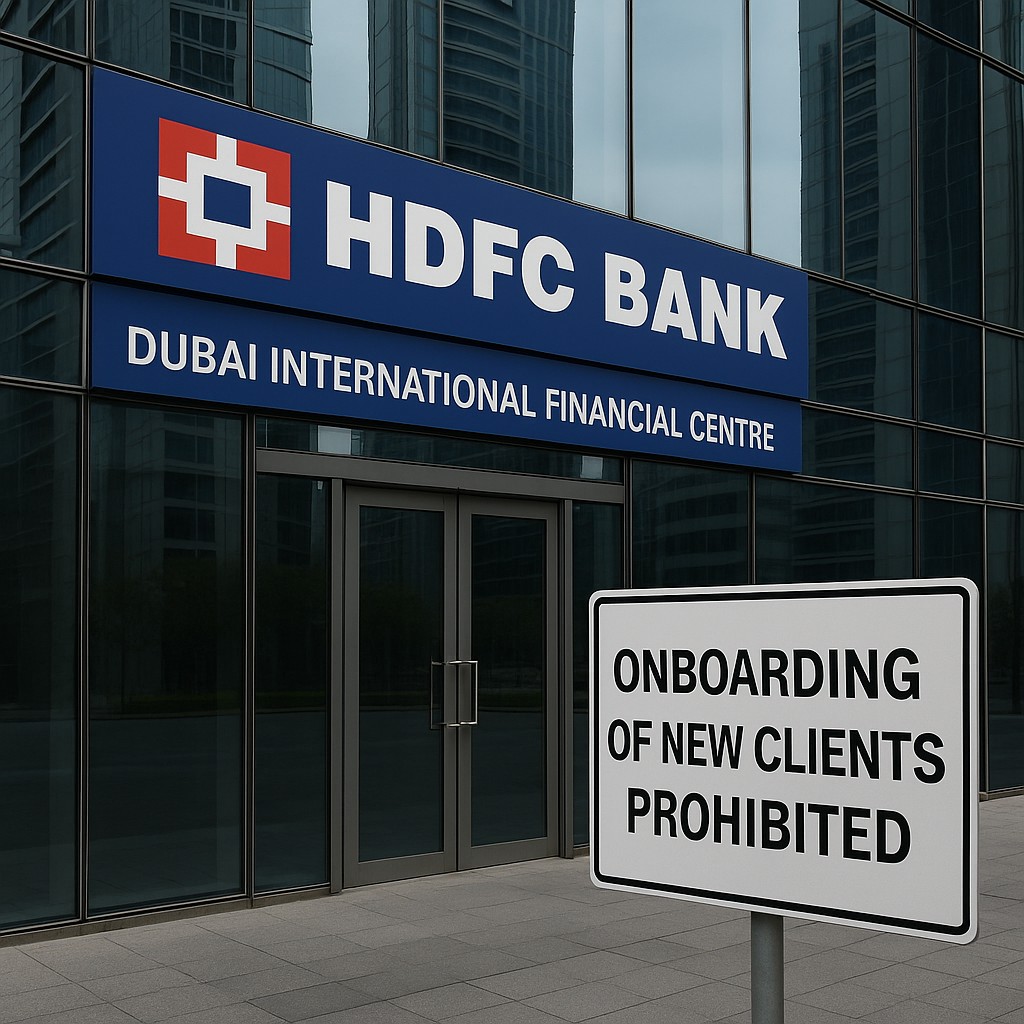
Dubai’s financial regulator has barred HDFC Bank’s Dubai International Financial Centre branch from soliciting, onboarding or servicing new clients, citing compliance lapses.

The order, issued by the Dubai Financial Services Authority and effective from 26 September, remains in force “until otherwise amended or revoked,” the bank stated. HDFC said it is taking steps to comply with the directive while engaging with the DFSA to address concerns.

HDFC clarified that the restriction does not apply to existing clients of the DIFC branch, nor to those who had already been offered services prior to the notice. As of 23 September, the branch had 1,489 customers, including joint holders.

According to HDFC, the bank does not expect this to materially affect its overall operations or financial position, noting that the Dubai branch’s business is not significant relative to its global activities.

The DFSA’s decision notice accuses the branch of servicing clients who were not properly onboarded, deficiencies in client onboarding processes, and other unspecified compliance shortcomings. The prohibition extends to advising on financial products, arranging deals, extending credit, custodial services, and financial promotions for new clients.

Analysts point to a backdrop of scrutiny over HDFC’s role in selling risky instruments—particularly Credit Suisse additional tier-1 bonds—to retail investors in the UAE. Those clients accused the bank of misclassification and inadequate risk disclosures. Investor accounts allege that KYC records were manipulated to designate them as “professional clients,” a requirement under DIFC rules for high-risk products.

Some UAE-based investors welcomed the DFSA’s move but urged stronger action, stating the suspension of new client intake is a limited measure given potential damage already done.

HDFC has a broader international presence including representative offices in Abu Dhabi, Kenya, London and Singapore, and branches in Bahrain and Hong Kong. The bank faces parallel scrutiny in India regarding related sales practices, prompting investigations by Indian enforcement agencies.

As the DFSA and HDFC engage in remediation talks, markets will closely watch whether the regulator escalates sanctions or lifts the ban after compliance is demonstrated.

Dubai police have announced an extensive set of security measures and entry restrictions for spectators attending the Asia Cup 2025 final between India and Pakistan at the Dubai International Cricket Stadium. Violations of the rules could trigger fines of up to Dh30,000 and imprisonment under federal law governing sports venues.

Every seat for Sunday’s showdown has been sold, with organisers confirming a full capacity of 28,000 spectators. With the historic match being the first final between these arch-rivals in Asia Cup history, expectations of heightened emotions have driven authorities to step up security preparations.

The police directive mandates that attendees arrive at least three hours before the start and that each ticket admits a single entry—re-entry will not be allowed. All spectators must enter through gates assigned by organisers, follow instructions from stewards and security staff, and park only in specified areas. Any departure from the stadium during the match will forfeit re-entry.

The list of prohibited items is comprehensive. Fireworks, flares, laser pointers, and any flammable or hazardous materials are banned outright. Sharp objects, weapons, toxic substances, remote-controlled devices, large umbrellas, camera rigs, tripods, selfie sticks, and unauthorised photographic equipment are also barred. Flags, banners, or placards without official approval, pets, bicycles, skateboards, scooters, glass items, and outside food or drink are disallowed. Smoking or carrying any item that could endanger public safety will attract penalties.

Under the Federal Law on the Security of Sports Facilities and Events, the penalties range from Dh5,000 to Dh30,000 for breaches such as entering the pitch, carrying banned items or misbehaving. More severe violations — including throwing objects, abusive or racist language — may lead to fines in the Dh10,000 to Dh30,000 range or imprisonment for up to three months.

Multiple specialised police units and surveillance teams will be deployed around the stadium. Authorities have urged full cooperation from fans to allow the match to proceed without incident. The Events Security Committee is jointly monitoring crowd movement, traffic, and stadium access.

On the transport front, traffic congestion is expected to peak along Al Khail Road, Sheikh Mohammed bin Zayed Road, Hessa Street, Umm Al Suqeim Street, and via routes through Al Barsha, Dubai Motor City and surrounding neighbourhoods. Alternate routes such as Umm Al Suqeim Street or Al Fay Road via Sheikh Mohammed bin Zayed Road are being recommended, especially for motorists approaching from the south.

Parking zones P1 to P4 at the stadium are allocated, and overflow areas in Dubai Motor City and Dubai Studio City will provide shuttle services. Some park-and-ride facilities near Mall of the Emirates and First Abu Dhabi Bank Metro stations will function, connecting visitors to the venue via feeder services and taxis.

Dubai police have also issued multilingual advisories to reach a broader cross-section of fans. Authorities emphasise that the cooperation of spectators will be crucial to preserving a safe environment and ensuring that the focus remains on the cricketing spectacle.


Bitcoin nudged higher overnight, trading around $109,448, as markets showed signs of stabilisation following a wave of forced liquidations across crypto derivatives.

Stock market information for Bitcoin
Bitcoin is a crypto in the CRYPTO market.
The price is 109448.0 USD currently with a change of 30.00 USD from the previous close.
The intraday high is 110305.0 USD and the intraday low is 108741.0 USD.

Ethereum outperformed, crossing the $4,000 threshold, while broader sentiment remains under strain amid macro uncertainty.

Crypto markets endured brutal deleveraging earlier in the week, with more than $1.5 billion in long positions wiped from derivatives across major tokens. Analysts report that Ether accounted for a significant share of that, prompting cascade liquidations in leveraged positions. Some firms with heavy Bitcoin exposure have seen their stock valuations collapse below the value of token holdings.

Investors tagged this as the sharpest deleveraging event of 2025, emphasising how excess leverage built up in recent months is being violently unwound. That same vulnerability leaves markets sensitive to any surprise in macro data or central bank commentary.

The immediate bounce in Bitcoin and Ether is viewed as corrective rather than structural—several traders suggest the market may trade sideways or drift lower unless fresh catalysts emerge. The rebound succeeded in erasing some losses, but resistance above $110,000 for Bitcoin and around $4,200 for Ether remained challenging.

The U. S. personal consumption expenditures index for August showed year-on-year inflation of 2.7%, broadly in line with expectations. That alignment suggests policymakers are threading a narrow path between supporting growth and avoiding inflation surprises. Some strategists believe the muted inflation reading reduces pressure on central banks to delay easing; others caution that sticky core inflation still leaves room for hawkish surprises.

Crypto sentiment has weakened sharply. The Fear & Greed Index plunged to levels last seen in mid-April, underscoring elevated trader anxiety. According to strategists, over $3 billion of leveraged long positions have been liquidated in the past few sessions, pushing the long-to-short ratio in many tokens toward one-to-nine. That extreme positioning could set the stage for short squeezes—but not without attendant risk.

On-chain flows hint at institutional accumulation, a counterpoint to retail panic. Ethereum has seen meaningful inflows tied to existing ETH ETFs, while some large wallets have made ETH-to-BTC swaps. That movement could reflect growing conviction in Ethereum as a structural play for DeFi and smart contract demand, rather than a pure speculative asset. But challenges remain: Ethereum’s fee-based economics have softened, and alternative chains are gaining traction in niche sectors.

Seasonal models bolster optimism toward the year-end. Historically, Bitcoin has delivered an average return of over 80 per cent in the final quarter, with November being the strongest month on record. Ether, though more volatile, also has a track record of strong Q4 performance. These patterns are not guarantees, but they influence positioning among quantitative funds.

The Dubai Financial Services Authority has issued a decision notice barring HDFC Bank’s Dubai International Financial Centre branch from onboarding or engaging new clients, citing deficiencies in its onboarding procedures and promotional practices.

Under the DFSA’s directive dated 25 September 2025, the branch is prohibited from soliciting or conducting any business with clients who had not already completed the onboarding process by that date. The restrictions span across a range of financial services: advising on financial products, arranging investment deals, arranging or advising credit, custody services, and engaging in financial promotions.

HDFC Bank has confirmed the measure, stating the branch’s Dubai operations are not “material to [the] overall business or financial position.” It said it has initiated steps to engage with the DFSA and address the regulator’s concerns.

Existing customers of the DIFC branch remain unaffected by the decision, and clients who had already been offered services may still be served.

The DFSA’s public register confirms the restrictions imposed on HDFC DIFC under Article 75 of the Regulatory Law 2004.

Concern over HDFC’s UAE operations has been mounting since investigations linked to the mis-selling of Credit Suisse Additional Tier-1 bonds surfaced. High-net-worth non-resident Indian investors alleged that HDFC’s UAE arms had pushed leveraged exposure to these risky instruments without adequate disclosure. When Credit Suisse’s AT1 bonds were written down in 2023, several clients in the Middle East faced losses and margin calls.

Regulatory scrutiny has coalesced around whether the branch’s client onboarding systems sufficiently aligned with the stricter DIFC regime for assessing and classifying “professional clients.”

Observers note that the regulatory move at HDFC’s DIFC arm fits a broader trend in the UAE: ensuring that financial institutions operating in its free zones adhere to rigorous compliance standards. While the central bank has in recent months fined other banks and suspended new customer intake over Sharia or anti-money laundering violations, this is a rare case targeting the onboarding practices of a foreign bank’s offshore branch.

Market analysts suggest the restriction could dampen HDFC’s ambitions in the Gulf region. The DIFC branch caters largely to high-net-worth and institutional clients, a growing segment across the Middle East.

Analysts also note that, though the branch is currently a limited part of HDFC’s global footprint, reputational damage and extended regulatory enforcement could constrict cross-border investment programmes tied to its UAE hub.

HDFC’s next steps include formal remediation under DFSA oversight, and the bank will need to demonstrate that its compliance and client due diligence processes meet the regulator’s expectations. Meanwhile, the directive will remain active until the DFSA issues a written amendment or revocation.

VISHNU RAJA
RYO YAMADA
HITORI GOTOH
IKUYO KITA