News related to
Phase

Qatar and the United States have moved to cement their military cooperation with high-level commitments that signal a recalibration of regional security dynamics. The Qatari Prime Minister and Foreign Minister, Sheikh Mohammed bin Abdulrahman bin Jassim Al-Thani, met with the Commander of the US Central Command, Admiral Charles Bradford Cooper, to discuss expanding bilateral defence cooperation. The talks pointed to broad agreement on enhancing joint military readiness, intelligence sharing and coordination on regional security challenges.

The defence discussions follow a backdrop of heightened tensions after an airstrike on Qatari territory by Israel targeting Hamas political leaders. The strike led to strong condemnation across Gulf states and sparked a broader reassessment of the security framework anchoring US presence in the Gulf. The United States responded by reaffirming its commitment to Qatar’s sovereignty.

An executive order signed by US leadership has committed Washington to defending Qatari territory and infrastructure if subjected to external attack, including by military means if necessary. This formal guarantee elevates Qatar’s strategic importance in the US security architecture.

Concurrently, Washington and Doha have arranged deeper integration of military infrastructure. An agreement has been finalised to build a facility at a US Air Force base in Idaho to host a contingent of Qatari F-15QA fighter jets and associated personnel. The facility aims to enhance combined training, preparedness and interoperability under US command — though ownership and command remain US-controlled, eliminating concerns about a permanent foreign base on US soil.

These developments follow multiple engagements aimed at strengthening mutual defence ties. The November meeting between the Qatari Prime Minister and CENTCOM’s commander underscored mutual interest in “support and strengthen” shared strategic goals in defence domains.

Observers interpret this phase as part of a broader US strategy to reinforce alliances in a volatile Middle East. The enhanced cooperation offers Qatar increased security assurances and greater leverage in regional diplomacy, while offering the US a more secure and integrated network of partnerships to project influence and stability. Critics, however, warn that such deepening military ties may further entangle Gulf states in US-led strategic rivalry and increase regional polarization.

Advances in large language models have delivered extraordinary gains, yet each new iteration introduces a structural tension that the wider software ecosystem is only beginning to confront. As foundation models evolve from version 4.X to 4.X+1, the coding assumptions, prompt-engineering conventions and guardrails that developers rely on can shift in subtle but consequential ways. This is emerging as a modern variant of the software world’s old problem […]

Amazon has begun shipping its most advanced phased-array terminal, dubbed Leo Ultra, to select enterprise customers as part of a preview programme for its satellite broadband service Amazon Leo — the rebranded successor to Project Kuiper. The company claims the terminal can deliver download speeds up to 1 gigabit per second and upload speeds reaching 400 megabits per second, representing a bold push to challenge incumbent players […]

Merck & Co has agreed to acquire Cidara Therapeutics for approximately $9.2 billion, paying $221.50 per share in cash to acquire all outstanding Cidara stock. The deal secures for Merck access to Cidara’s lead candidate, CD388, a long-acting antiviral designed to prevent influenza A and B infections, particularly among individuals at elevated risk of complications. CD388 is currently undergoing Phase III trials after earlier data demonstrated promising […]

Publisher Electronic Arts states that 98 per cent of games in Battlefield 6 were played without cheater interference during the week following its launch. According to the company’s report, only about 2 per cent of matches showed signs of cheating — a significant drop compared with many contemporary online shooters. The backbone of this shift is the kernel-level anti-cheat system EA Javelin, which the publisher credits with […]

By Nantoo Banerjee It is encouraging to note that the government has decided to invest large sums of money in support of rare earth magnet manufacturing and substantially improve the country’s rare earth-based metals production to escape China’s global chokehold in this strategic sector. Presently, there are a few small Indian companies engaged in manufacturing […]

The article India’s Push For Self-Reliance In Rare Earth Magnet Making Is Laudable appeared first on Latest India news, analysis and reports on Newspack by India Press Agency).

Greenlogue/AP A consortium comprising ACWA Power, Badeel and Saudi Aramco Power Company has completed the financial close on seven large-scale renewable energy projects totalling 15 gigawatts. The agreements signed with Saudi Power Procurement Company cover five solar photovoltaic plants and two wind power farms to be built across several provinces, representing one of the largest investments under the Kingdom’s National Renewable Energy Programme. The portfolio of projects […]

Advertisements

Bahrain-based alternative investment firm Investcorp has agreed to sell its majority stake in the European fintech firm Shine to cloud-software group Cegid, marking the end of an eight-year partnership. The deal will be executed via Investcorp Technology Partners and comes nearly a decade after Investcorp first backed the Danish fintech, then known as Ageras. Financial terms remain undisclosed, and the sale awaits customary regulatory clearances.

Shine, headquartered in Copenhagen, operates across multiple European markets including France, the DACH region, the Netherlands and Denmark. The platform provides a broad suite of services for small and medium-sized businesses — covering business formation, digital banking, invoicing, accounting, and payroll. Under Investcorp’s stewardship, it expanded its reach and grew recurring revenues more than ten-fold, while completing nine acquisitions in its core regions.

Cegid — majority-owned by private equity firm Silver Lake — aims to integrate Shine into its Small Business division, positioning the combined entity as a pan-European “financial copilot” for SMEs and accountants. The merged platform is being designed to offer a unified, cloud-native, AI-driven ecosystem combining e-invoicing, accounting, business banking, payments, payroll, HR and tax compliance. The target user base across Europe is estimated at over one million SMBs and 15,000 accounting professionals.

Reflecting on the sale, Investcorp’s Head of Technology Partners and Chairman of Shine, Gilbert Kamieniecky, said the firm is proud of having supported Shine’s evolution “from a start-up with only a few million in revenue into a European leader and unicorn.” Shine’s co-founders, Rico Andersen and Martin Hegelund, expressed optimism about the next phase under Cegid, emphasising their ambition to deliver more advanced, scalable financial infrastructure to businesses across Europe.

For Cegid, adding Shine strengthens its footprint across key European markets and significantly boosts its SMB customer base, offering opportunities to deploy embedded finance solutions and streamline compliance workflows ahead of evolving e-invoicing and digital reporting mandates across the continent. The integration of Shine’s scalable technology stack with Cegid’s existing cloud and AI infrastructure underscores a strategic bet on digital transformation in SME finance and accounting.

Dan Houser, co-founder of a major video-game studio and now leading his own at Absurd Ventures, has offered a candid assessment of artificial intelligence’s current role in game development. While acknowledging that he is using AI as part of creative and technical workflows for his next project, he stressed that the tools available today fall short of many public claims — and cautioned against viewing them as […]

By K Raveendran A quieter phase has set in around discussions on a potential trade agreement between India and the United States, yet the subdued optics conceal a period of more intense negotiation. Officials on both sides describe a process that has deliberately stepped away from public signalling, opting instead for steady and less visible […]

The article India, US Energy Alignment Shapes A Quieter Trade Push appeared first on Latest India news, analysis and reports on Newspack by India Press Agency).

Abu Dhabi’s Modon Holding has taken a strategic equity stake in Wellington Lifestyle Partners, signalling its first foray into a high-end equestrian and real estate development project in the United States. The investment is slated to support the expansion of Wellington International showgrounds in Florida and underpin an ambitious ultra-luxury development that blends horse sport, upscale residences, hospitality and leisure amenities. The funding will go toward completing […]

Sunteck Realty Ltd has launched its international arm, Sunteck International, and formally entered the UAE real-estate market with the unveiling of a 2.5-acre land parcel in Downtown Dubai. The site is positioned within seconds walking distance of the Burj Khalifa and The Dubai Mall. The first development—a pair of ultra-luxury residential towers—is projected at AED 5 billion gross development value as the initial phase of a broader […]

Market attention turned sharply towards World Liberty Financial as its WLFI token climbed more than 7% on the daily chart, supported by renewed momentum in a buyback programme that has drawn heightened interest from traders. The jump in value, which pushed volumes higher across multiple exchanges, underscored a shift in sentiment around the project after a period of steady consolidation in its price trajectory.

Traders noted that the upswing aligned with the recommencement of the token buyback scheme, which had been announced earlier in the year as part of the platform’s strategy to stabilise circulating supply and incentivise long-term holding. The renewed activity around the programme appeared to signal confidence within the project’s core team, with market participants interpreting the move as an effort to strengthen liquidity and reinforce the token’s market position during a phase of broader volatility in digital assets.

The project, positioned as a decentralised finance ecosystem offering yield products and cross-border payment tools, has been attempting to carve out a more distinct space in the congested DeFi landscape. Its token performance has shown periods of sharp movement in line with broader market swings, but the latest rise stood out due to the targeted intervention through the buyback initiative. Analysts tracking on-chain data confirmed a noticeable reduction in WLFI circulating supply over the past 48 hours, indicating execution of the buyback in measurable volumes.

A senior market analyst at a Dubai-based digital asset fund said the token’s rebound reflected “a coordinated liquidity strategy combined with renewed user engagement,” adding that sustained price support would depend on whether the buybacks continue at a stable pace. The analyst also pointed to the rising interest in tokens backed by structured DeFi models, noting that these projects have gained traction as traders search for instruments offering more predictable mechanics compared with purely speculative assets.

WLFI’s latest surge coincided with a broad improvement in sentiment across mid-cap digital tokens, though its gain exceeded the general market trend. Data aggregators showed that while major assets such as Bitcoin and Ether recorded modest upward moves, WLFI’s performance outpaced most alternative tokens in its category. The increase was accompanied by a measurable uptick in wallet activity, with new holders entering the market as trading forums circulated speculation about further buyback rounds.

Company representatives had earlier disclosed that the buyback programme was designed to respond dynamically to market conditions, enabling the project to reinforce token value during periods of instability. Blockchain analysts have noted that such mechanisms, if implemented with transparency and predictable parameters, can help sustain community confidence and mitigate sharp sell-offs. The WLFI team’s renewed engagement, including technical updates and communication around upcoming ecosystem features, also contributed to the current sentiment shift.

Industry observers said market participants were also watching regulatory signals closely, as global jurisdictions continue to refine frameworks for digital assets. A clearer regulatory environment, particularly in markets influential to token liquidity, has historically contributed to greater investor participation. WLFI’s activity in markets such as the UAE and Southeast Asia has expanded over the past year, aided by partnerships with payment service providers and liquidity networks aiming to widen adoption.

Developments in DeFi have shown that buyback-driven appreciation, while effective in the short term, typically requires sustained platform growth to maintain momentum. This has put attention on WLFI’s roadmap, which outlines the rollout of additional financial tools and integrations aimed at strengthening ecosystem utility. Market analysts said user adoption metrics over the next quarter would be critical in determining whether the token can retain the gains recorded following the buyback revival.

The broader digital asset market has been characterised by alternating periods of risk appetite and caution, shaped by shifting macroeconomic indicators and geopolitical developments. WLFI’s rise occurred during a phase where traders were displaying a stronger preference for tokens linked to structured platforms with defined use cases. This positioned WLFI favourably as its developers highlighted enhancements to yield mechanisms and expansion into multi-chain support, which could increase platform accessibility.

Trading desks reported that the token’s order books reflected thicker buy-side interest as the session progressed, suggesting that momentum-driven traders were reinforcing the upward movement. Price analysts, however, cautioned that tokens experiencing sudden appreciation following buybacks may face corrections if broader market sentiment turns or if programme intensity decreases. Despite this, WLFI’s advocates argue that the project’s tokenomics structure is engineered to provide periodic support without distorting long-term market behaviour.


Stablecoins have moved from the fringe of digital finance to the centre of American geopolitical strategy with astonishing speed. A year ago, many analysts still dismissed them as an experiment, an irritant or a regulatory problem. Today they sit at the heart of a much bigger financial vision inside Washington. The Trump administration, I now believe, is using stablecoins as a new mechanism to strengthen the dollar’s […]

The prediction-market platform Polymarket has gained regulatory clearance to resume operations in the United States following approval from the Commodity Futures Trading Commission. The move positions Polymarket to re-enter a market it exited after a settlement with the regulator in 2022, signalling a major shift in how event-based trading may evolve in the US financial ecosystem.

Polymarket, founded by Shayne Coplan in 2020 and headquartered in New York City, agreed to pay a US$1.4 million penalty in 2022 for running an unregistered derivatives trading platform for US users and subsequently blocked American access. The company operated offshore in the interim. The pathway back into the domestic market opened when Polymarket acquired QCX LLC, a Florida-based derivatives exchange and clearinghouse that already held CFTC licences. That acquisition cost US$112 million, paving the way for regulatory compliance. Filings show QCX was designated as a “designated contract market” by the CFTC on 9 July 2025.

In September the CFTC issued a no-action letter to QCX and QC Clearing, exempting them from certain swap-data reporting and record-keeping requirements in relation to event contracts. This relief underpinned Polymarket’s return plans. According to sources the platform is now onboarding select US customers in a beta phase ahead of full rollout, with initial trading markets expected to focus on sports and pop-culture outcomes. Polymarket has stated it will operate through a fully regulated US-compliant structure and self-certify markets for US users.

Polymarket stands in a more competitive field than when it left. Peer Kalshi, likewise a US-licensed event-contract platform, secured major funding and a US regulatory victory in the preceding period. Kalshi’s US positioning has prompted other entrants—including FanDuel and DraftKings—to develop federally compliant “predictions” offerings. Polymarket’s re-entry means the event-trading sector is becoming a more mainstream component of financial and sentiment-based markets rather than a niche crypto experiment.

Industry watchers view the CFTC’s approval as indicative of a broader regulatory willingness to accommodate prediction markets, provided they operate under transparent, licenced frameworks. Acting CFTC Chair Caroline Pham has previously described event contracts as an “important new frontier.” Polymarket’s CEO Coplan declared on social media: “Polymarket has been given the green light to go live in the USA by the @CFTC. Credit to the Commission and staff for their impressive work. This process has been accomplished in record timing.”

Polymarket claims that global users placed about US$6 billion worth of predictions in the first half of 2025 alone on its platform, covering politics, entertainment and economy. Critics contend that even under regulated models, event markets carry risks of gambling-style behaviour and could present transparency and integrity challenges. Some US state regulators have expressed concern that such products may bypass traditional gaming laws under the guise of financial contracts.

Record Turnout Signals City’s Rise as Asia’s Trading Card Hub Event Backed by Virtual Asset Venture MemeStrategy, Entertainment Platform 9GAG HONG KONG SAR – Media OutReach Newswire – 25 November 2025 – In a city long synonymous with skyscrapers and stock tickers, an unlikely subculture is staking its claim: trading cards. The just-concluded Grade10 Festival, drawing a record 23,000 attendees to Hong Kong’s bustling convention hall in […]

Gold futures and spot prices slipped as the US dollar held near six-month highs and investors reconsidered expectations for interest-rate cuts by the Federal Reserve. Spot gold was trading around $4,055.73 per ounce and US futures for December delivery fell to approximately $4,052.40 per ounce. The dollar index rose above 100, a level that poses headwinds for gold since a stronger dollar makes the non-yielding metal more […]

Dubai’s leadership has endorsed a comprehensive architectural identity for the emirate’s road network, signalling a major shift in how transport infrastructure is designed and experienced. Sheikh Hamdan bin Mohammed bin Rashid Al Maktoum, in his capacity as Chairman of the Executive Council of Dubai, approved the framework that aligns with the city’s broader ambition to deliver integrated, sustainable and visually coherent urban environments. The initiative, overseen by […]

Abu Dhabi-listed NMDC Energy has launched a full branch in Taiwan and a commercial office in Shanghai, marking a strategic move into the Asia-Pacific region to support its project pipeline and strengthen supply-chain relationships. The company also sealed a memorandum of understanding with CITIC Steel, one of China’s largest steel producers, signalling a concerted effort to lock in reliable sourcing for its energy-services operations. NMDC Energy’s decision […]

The world’s largest cryptocurrency, Bitcoin, fell swiftly this week as a sustained sell-off put the token on track for its steepest monthly decline since 2022. It slipped as much as 7.6 per cent to around $80,553 before trimming losses, while the broader crypto market cap fell below $3 trillion for the first time since April.

Forced liquidations, institutional outflows and thin liquidity emerged as key drivers of the slide. Analysts at Ergonia pointed to a convergence of derivative blow-outs and structural selling via exchange-traded products as factors creating a “particularly vulnerable state” where even stabilisation efforts face immediate supply pressure. Futures liquidations exceeded $1 billion, and data highlight more than 30 per cent in market cap erasure since early October.

While Bitcoin climbed to an all-time high near $126,000 in early October, the recent downturn amounts to roughly a 25 per cent retreat within the month. Bloomberg data confirm this represents the largest monthly fall since June 2022. The correction has triggered a reevaluation of year-end positioning, with derivatives markets assigning around a 50 per cent chance that Bitcoin finishes the year under $90,000 — marking a significant sentiment shift in a matter of weeks.

One root cause of the near-term pressure lies in the unwind of leveraged positions. Many traders who piled into futures and perpetual contracts saw funding rates turn against them, triggering cascaded liquidations. Binance chief executive Richard Teng described the move as a “healthy consolidation” for the industry, albeit one that comes amid rising risk aversion and tighter macro conditions. The wave of deleveraging has spilled into alt-coins and broader risk assets, emphasising how crypto still mirrors the wider market’s orientation toward volatility and liquidity stress.

Institutional-product flows add another level of challenge. The launch of spot Bitcoin ETFs earlier this year raised expectations of large capital inflows, but the current environment has seen outflows, particularly from funds that repositioned, hedged or redeemed positions. This structural selling has combined with retail and leveraged exits to deepen the draw-down.

Despite the short-term strain, some analysts suggest the correction may clear the way for a healthier structure going forward. Liquidity indicators normally near major crypto rallies are showing signs of restocking, and some models view the current phase as a reset rather than the end of the cycle. However, sceptics caution that macro risks — including higher rates, regulatory headwinds and geopolitical stress — continue to hang over the sector and may dampen the timing or pace of any recovery.

Among market participants, sentiment has shifted markedly. Portfolio manager Nigel Green of deVere Group noted that heavy borrowing in speculative positions meant “any reversal triggers liquidations that accelerate the move”. Others highlight that although corrections of 20–30 per cent have occurred in past Bitcoin bull markets, the current confluence of leverage, product flows and liquidity outflows is unique, suggesting this phase may represent more than a standard dip.

With December positioning now in focus, the coming days will be closely watched. The monthly close looms large — if Bitcoin avoids a full 25 per cent drop it could blunt the signal of stress; if it does not the message to markets could be more definitive. The broader crypto ecosystem will also look for signs of capitulation or stabilisation — levels of derivative stress, fund flows and institutional signals will inform whether this is a tactical pull-back or the early stages of a deeper consolidation.

As one of the first major asset-classes to undergo structural institutional adoption, Bitcoin’s current draw-down serves as a test of how the market absorbs large-scale flows and macro shocks. The unfolding developments will have implications well beyond the crypto world, casting light on how digital assets behave within the larger financial system.

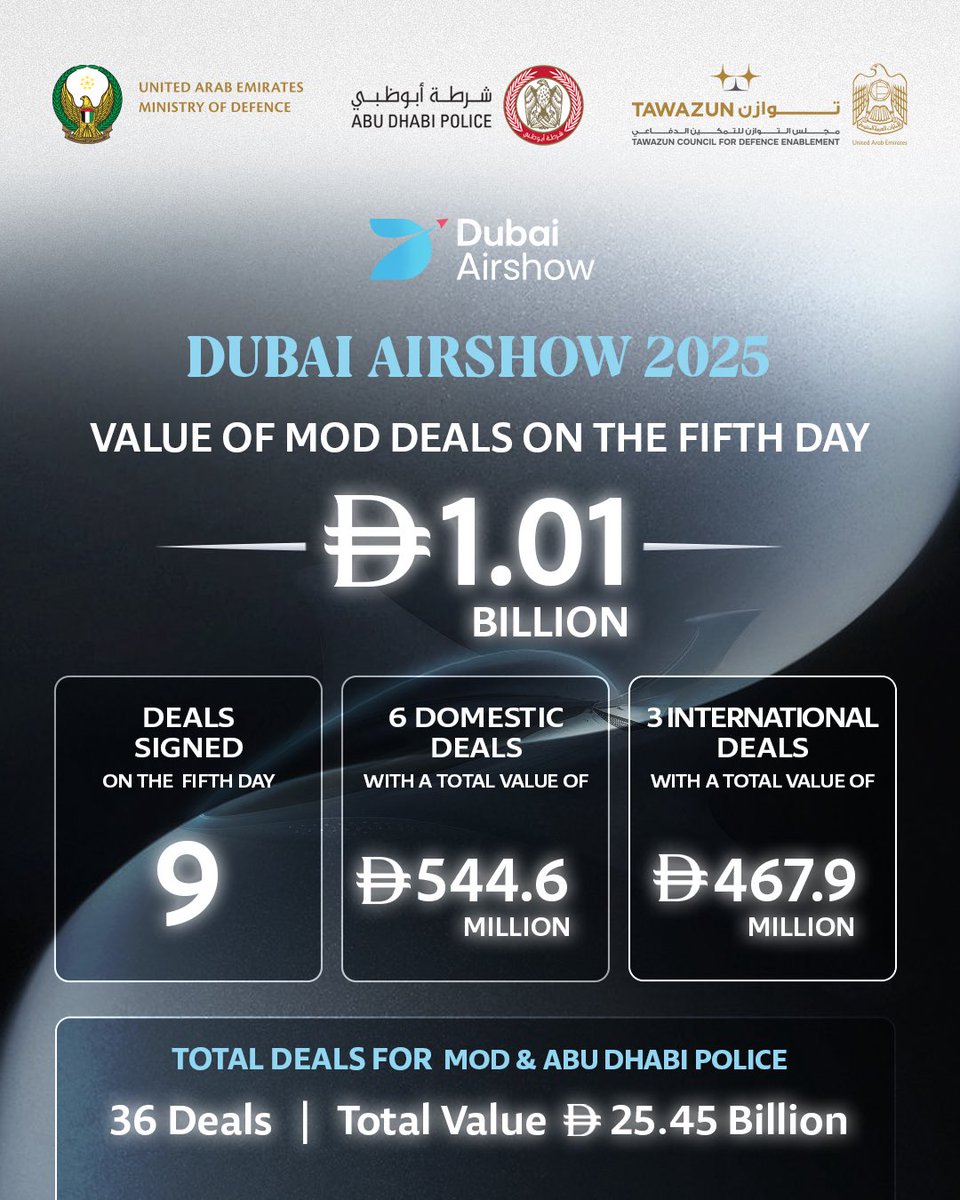
The Tawazun Council for Defence Enablement recorded nine new contracts worth AED 1.012 billion on behalf of the Ministry of Defence on the fifth and final day of the Dubai Airshow 2025, elevating the event’s five-day total to 36 agreements with a cumulative value of AED 25.455 billion.

At a press conference in Dubai attended by spokespersons Majed Ahmed Al Jaberi, Abdulla Ahmed Al Saeedi and Manea Abdulkarim Al Mansoori, the council detailed that six of the final-day contracts, sized at AED 544.675 million, were with local firms, while the balance, AED 467.913 million, involved international companies.

Among the domestic deals, two contracts with the Abu Dhabi-based M4 Trading comprised a AED 57.636 million order for a Grand Control Station and a AED 161.634 million deal for aircraft procurement. A AED 29 million contract went to Al Taif Technical Services Company for cooling-equipment and power-generator maintenance, while MP3 Company secured a AED 154.5 million agreement for aerial-rescue systems and spare parts. International Golden Group received AED 65.905 million for aerial drop systems and AED 76 million went to Abu Dhabi Autonomous Systems Investments for drone procurement.

On the global front, two agreements with Lockheed Martin amounted to AED 184 million and AED 63.551 million respectively for maintenance and spare-parts support. A third contract with Raytheon Technologies was valued at AED 220.362 million for friendly-force identification systems.

Across the event, earlier announcements show the council had already signed 20 contracts worth AED 18.01 billion during the first three days of the airshow. This underlines a consistent pace of deal-making spanning both national and international industrial partners.

The contract portfolio highlights the UAE’s emphasis on building a robust domestic defence-and-security-industrial ecosystem, spanning aircraft systems, drones, radars, simulation and service-support infrastructure. Analysts note this reflects a shift from traditional procurement towards localisation, technology transfer and national capability building.

Tawazun’s officials emphasised that the partnerships frame more than incremental orders; they represent structural steps toward embedding industry in sovereign defence strategy. Ms Mansoori observed that the council “continues to foster a competitive and enabling environment for the private sector” and that the outcomes achieved through the airshow “reflect the UAE’s vision of developing an integrated, innovative and strategically driven defence and security sector.”

While the headline figure of AED 25.455 billion positions Dubai Airshow 2025 among the region’s most commercially active defence gatherings, some independent observers caution that the true measure of success will rest on execution, delivery timelines and domestic-industry uptake. Questions remain about how many contracts include meaningful offsets, R&D components and long-term local value-creation versus straightforward procurement.

Nevertheless, the event’s records reinforce Dubai’s growing role as a hub for aerospace-defence engagement, with deals touching both military and dual-use capabilities. Compared with earlier editions, this year’s flow involves a higher proportion of contracts that combine hardware, maintenance-services and technology-transfer features — signalling deeper industrial ambition rather than purely kit acquisition.

The spread of contract-values — from tens of millions of dirhams for niche specialised systems to multi-hundred-million agreements with global primes — reveals a multipronged strategy. Domestic SMEs are being drawn into the supply chain alongside major established defence-sector players, thereby diversifying participation and reducing reliance on external supply.

As the UAE moves ahead with its national defence-industrial roadmap, the final-day flurry of deals from Tawazun brings the focus firmly onto the implementation phase of those agreements and the strategic partnerships that will underpin them over the coming years.

A super-charged solar storm known as the “Gannon event” forced the Earth’s plasmasphere—a doughnut-shaped shell of charged particles that normally envelops the planet—to shrink to roughly one-fifth of its usual size, exposing satellites, communications networks and power infrastructure to elevated risks. Scientists tracking the process say the collapse was rapid and the recovery slowed significantly, offering a rare window into how extreme space weather reshapes our planet’s […]

Organizations are deploying artificial-intelligence-driven defences to counter increasingly sophisticated cyber threats as attackers harness the same technology to mount agile attacks. Leaders at major cybersecurity firms say the conflict between defenders and adversaries has entered a new phase, where speed, adaptability and automation are critical. The security firm Palo Alto Networks announced upgraded platforms designed to protect cloud assets and AI-based applications, citing the need to monitor […]

Authorities in Kerala have issued widespread weather warnings as a strengthening atmospheric circulation over the southeast Arabian Sea intensifies rainfall across multiple districts. The India Meteorological Department has placed seven districts—Thiruvananthapuram, Kollam, Pathanamthitta, Alappuzha, Kottayam, Idukki and Ernakulam—under a yellow alert, signifying expected rainfall between 64.5 mm and 115.5 mm in a 24-hour period. The advisory also highlights the possibility of thunderstorms, lightning and gusty winds reaching up to 40 km/h.

The underlying weather trigger is a low-pressure system that formed over the Strait of Malacca and adjoining Andaman Sea around 22 November, and is forecast to develop into a depression over the southeast Bay of Bengal by 24 November. This system is expected to bring moisture-laden winds into the region, maintaining wet conditions over the coming days.

Forecasters report that isolated areas in Kerala may receive 7–11 cm of rainfall in a 24-hour window between 22 and 26 November, with similar conditions flagged for the nearby Lakshadweep archipelago. Fisherfolk along coastal waters have been advised to refrain from venturing out due to rough sea conditions and winds of 35–55 km/h.

The yellow alert classifications carry significant implications for life and infrastructure. Local officials note heightened risk of waterlogging on roads, reduced visibility in hill-tracks and potential disruption of the ongoing Sabarimala pilgrimage season. Devotees travelling between Sannidanam, Pampa and Nilakkal are being urged to adjust plans and monitor weather updates.

On the marine front, maritime authorities have warned deep-sea vessels to return to the nearest harbour by Tuesday and advised fishermen along the Kerala and Lakshadweep coasts to suspend operations. Similar advisories extend to the coast of south Tamil Nadu and the Gulf of Mannar up to Wednesday as the system may increase wave activity further.

Looking at district-specific schedules, the IMD indicates that on 24 November, yellow warnings will shift to Palakkad and Malappuram alongside the core list of districts; on 25 and 26 November, the alert is expected to persist in the earlier-listed seven districts.

While yellow alerts are not the most severe classification, the extended duration of the weather system and its broad geographic footprint warrant strong preparedness. Infrastructure officials are monitoring river and dam levels, road-maintenance crews are on standby for landslide-prone zones in the Western Ghats, and local governments have begun messaging on minimizing non-essential travel.

Kerala has faced heavy rainfall challenges in past years, including major landslides in 2024 and 2018 that underlined the vulnerability of hill-terrain regions. That history adds urgency to current warnings and reinforces the need for preventive action.

As the state transitions into the winter season, this spell of sustained rainfall poses a dual risk of flooding and landslides, especially where hillside stability has been compromised by prior weather events. Hydrology experts emphasise monitoring of water-storage levels in reservoirs, the drainage readiness of urban areas and the real-time condition of key pilgrimage routes and forest paths.

VISHNU RAJA
RYO YAMADA
HITORI GOTOH
IKUYO KITA