News related to
Capital

Arada has acquired a 75 percent stake in London-based residential developer Regal as part of a Dhs 2.5 billion investment that marks its first UK foray and second international expansion after Australia. The UK business will be rebranded as Arada London, with an ambition to turbocharge Regal’s pipeline from 10,000 units across 11 projects to over 30,000 within three years.

The acquisition was formalised in a ceremony attended by Sheikh Sultan bin Ahmed bin Sultan Al Qasimi, Chairman of Arada. Arada’s Group CEO, Ahmed Alkhoshaibi, said that more than half of the capital will be channelled into accelerating development and securing new land parcels. He described the London market environment as one presenting “right opportunities to acquire the right sites at the right price”.

Regal’s chief executive, Jonathan Seal, and the existing executive team will remain in post after the transaction. Seal remarked that Arada’s alignment with Regal’s strategic values and long-term vision made it a fitting partner to lead the next phase of growth.

The deal gives Arada an immediate platform in London, tapping into Regal’s diversified portfolio, which spans for-sale residential units, purpose-built student accommodation, and mixed-use regeneration schemes. Among ongoing developments is the Fulton & Fifth project in Wembley, comprising 876 homes of which 40 percent are designated as affordable housing, and Orchard Wharf in Tower Hamlets, which recently secured approval for 1,365 student beds and 200 homes.

Analysts see strategic logic in entering London via acquisition rather than greenfield development, citing the complexities and regulatory friction in the UK housing sector. Arada’s move follows a wave of Gulf-based developers expanding into London, including Damac, Aldar, and Modon, often via partnerships or subsidiaries.

However, entering the London residential market is not without risk. Regal’s 2024 accounts showed £252 million in short-term debt, contrasted against £196 million of investment property, reflecting potential balance-sheet stress. The UK housing sector continues to face headwinds from construction inflation, planning delays, and demand volatility.

Arada has defended the timing. Alkhoshaibi stated that entering markets when sentiment is subdued allows for acquiring desirable assets at lower cost, positioning for upside when conditions recover. He noted that Arada’s approach is to maintain momentum in its UAE operations while layering growth abroad.

Beyond the UK, Arada is also contemplating further regional expansion. The company is reportedly in discussions with Saudi Arabia’s Public Investment Fund about a large mixed-use project in the kingdom. In the UAE itself, Arada plans a Dhs 3 billion development project in Ras Al Khaimah next year, reinforcing its domestic footprint.

The Indian rupee plunged to a lifetime low of ₹88.7975 per US dollar, sliding about 0.5 per cent on the day as fears over a sharp hike in U. S. H-1B visa fees rallied selling pressure across foreign exchange markets. Intervention by the Reserve Bank of India failed to staunch the slide fully, leaving the currency exposed amid faltering capital inflows and heightened external risks.

Markets pointed to the visa fee jump as a critical trigger. The Trump administration’s new proclamation imposes a $100,000 application cost on fresh H-1B visa petitions, vastly above its prior range, and is widely seen as a threat to remittance flows and the earnings outlook for India’s technology exporters. Meanwhile, persistent foreign portfolio outflows and U. S. tariff tensions on Indian goods compounded downward pressure.

Analysts estimate that remittances from the U. S. account for roughly 3.4 per cent of India’s GDP, making any disruption in the flow of workers and repatriated funds significant for the external balance. The visa change, if sustained, could erode that buffer. Traders now widely expect the rupee’s trajectory to remain weak in the coming weeks unless policy tailwinds emerge.

Speculation is building that the RBI sold dollars via state banks in the ₹88.50 zone to support the rupee, but the support was limited. While intervention took multiple forms—spot market, non-deliverable forwards and futures—the central bank appears to be managing volatility more than defending a fixed exchange rate. Some market participants view the decline as partly calibrated and allowable, until macro fundamentals justify a reversal.

Data from the RBI’s monthly bulletin show that in July alone, the central bank sold a net $2.54 billion in the spot foreign exchange market. It held forward dollar sales of about $57.85 billion at the end of July—suggesting pre-emptive hedging and reserve deployment to offset pressure. The use of forward sales is a tool to mitigate speculative demand and signal resolve.

U. S. rate expectations and the global dollar trajectory also weigh heavily. The U. S. dollar index remains firm, underpinning strength in emerging market currency pairs’ downside. Weakness in India’s export performance and looming protectionist measures add to caution. In September to date, foreign investors withdrew over $1 billion from Indian equities, pushing year-to-date outflows to roughly $16 billion.

Technology stocks bore the brunt of the rupee stress. With margins threatened by the visa fee shock, several large IT firms are already budgeting for higher immigration costs. Estimates place incremental fee burdens between $150 million and $550 million for major firms, depending on visa volumes and contract structures.

The Indian government mounted a diplomatic push in response, deploying a high-level delegation to Washington to discuss the visa fee policy and broader trade concerns. Delhi has warned of “humanitarian consequences,” arguing that abrupt changes in visa costs risk disrupting families and the livelihood of highly skilled professionals. In public remarks, Commerce Minister Piyush Goyal and other officials have insisted that they will press for reversals or carveouts.

White House sources clarified that the $100,000 fee will apply only to new applications, not renewals or current visa holders—a move that soothed some immediate concerns in the IT industry. That assurance has allowed short-term relief in some quarters, though uncertainty lingers over enforcement guidelines and compliance timelines.

Defence stocks will rally and global investors will be paying attention, I believe. The reason the bullish analysis is a catalyst came the moment President Donald Trump, after meeting Ukraine’s President Volodymyr Zelenskyy at the UN General Assembly, declared that Kyiv can reclaim all territory seized by Russia, an abrupt and market-moving pivot from his earlier calls for compromise. In a single statement, the world’s largest economy […]

Leading Financial Institutions, Regulators, and Tech Innovators Converge to Accelerate Hong Kong’s AI Readiness and Global Leadership HONG KONG SAR – Media OutReach Newswire – 24 September 2025 – Citi Hong Kong, in collaboration with Mastercard and the FinTech Association of Hong Kong (FTAHK), successfully co-hosted the “Creating an AI Ready Economy” forum yesterday. Riding on the success of last year, this flagship event, now in its […]

MetaMask’s long-awaited native token, MASK, has received confirmation from ConsenSys CEO Joe Lubin that it is on the horizon, stoking anticipation across crypto markets. Lubin suggested the token may arrive sooner than many expect, reawakening speculation about a potential airdrop tied to user activity. Traders have already begun positioning around the move.

Parallel to the MASK buzz, derivatives activity around Aster’s native token has escalated dramatically: futures open interest has expanded by 46 per cent, reflecting aggressive speculative demand.

Bitcoin’s climb toward as high as $113,500 has added momentum to altcoin risk appetite, though analysts warn of resistance near $115,000 as a critical hurdle for sustained upside.

Momentum behind Aster has been fuelled by on‐chain flows and whale accumulation. One address spent over $1.18 million acquiring nearly 595,580 ASTER tokens in a single trade, underscoring deep-pocketed conviction in the token’s trajectory. Aster has also introduced 300x leverage trading for HYPE, drawing comparison and competition with Hyperliquid’s native token ecosystem.

Meanwhile, Hyperliquid’s own tokenomics are under pressure. A major holder transferred around 200,000 HYPE tokens—worth roughly $8.9 million—within two hours, moving the assets toward Aster platforms. The selling pressure from large holders is prompting governance discussions: one proposal suggests burning 45 per cent of HYPE supply to counterbalance impending token unlocks.

Liquidity metrics reflect the competitive dynamics among perpetual DEX platforms. While Hyperliquid historically dominated, new entrants such as Aster, Lighter and edgeX are aggressively capturing share through incentives and token distribution programmes. Some analysts caution that much of Aster’s volume is driven by incentive-seeking rather than long-term retention.

The MASK narrative adds an extra layer of complexity. Decrypt reports that prediction markets assign roughly 32 per cent odds to a token launch by November, indicating widespread uncertainty despite Lubin’s confident tone. MetaMask’s path to decentralisation is expected to involve allocation to active users—those conducting swaps or interacting with dApps—though tokenomics remain unpublished.

Traders are watching to see whether cross-correlations form between MASK speculation and derivative positioning in ASTER and HYPE. If Aster’s futures momentum continues, it may draw further capital away from incumbents, even while regulatory risk looms over token launches.

Dubai’s engineering and construction powerhouse ALEC Holdings PJSC has fixed its IPO share price between AED 1.35 and AED 1.40, opening subscriptions for a 20 percent stake in the company. The offering will feature 1 billion existing shares, valuing the company at AED 6.75 billion to AED 7 billion at the time of listing. The subscription period began on 23 September and will close on 30 September […]

Abu Dhabi’s Presight and investment company Shorooq have introduced a $100 million fund called Presight–Shorooq Fund I to back artificial intelligence start-ups worldwide. The fund, which is hosted in the Abu Dhabi Global Market, combines both capital investment and access to infrastructure to help scale promising ventures. The fund targets start-ups at early and growth stages developing in areas such as AI/ML, smart cities, energy, fintech, AR/VR, […]

Advertisements

Saudi Arabia’s capital markets are poised for a transformative leap as the Capital Market Authority moves toward allowing foreigners to hold more than 49 percent stakes in listed firms, marking one of the most consequential policy reversals in decades. Abdulaziz Abdulmohsen Bin Hassan, a CMA board member, confirmed that the regulator is in advanced stages of softening the ownership ceiling.

The current 49 percent cap on foreign ownership, introduced in the latest regulations, restricts the extent to which overseas investors can control local companies. Under the new proposal, non-Saudi investors would be able to exceed that threshold in select cases. The CMA has not publicly disclosed the new upper limit, but Bin Hassan suggested that the change could take effect before the end of the year.

Market analysts view this as a critical push by Saudi authorities to deepen global investor participation in the Kingdom’s equity market. By raising the allowable foreign shareholding, Saudi stocks would likely climb in weighting within MSCI and FTSE emerging-market indexes, thus drawing fresh capital flows.

Despite the momentum, several caveats remain. The draft change still requires sign-offs from multiple government bodies. Observers note that any permitted increase may come with conditions—such as lock-in periods, sectoral restrictions, or thresholds specific to strategic or institutional investors.

Over the past year, Saudi regulators have introduced a series of capital market reforms to bridge the gap between local standards and international norms. In July, the CMA approved amendments to rules governing investment funds and procedures for opening investment accounts for foreign individuals and institutions. Those changes broadened access and simplified cross-border investment mechanisms.

Under current rules, a foreign strategic investor is exempt from the 49 percent cap if it commits to holding shares for at least two years. These strategic investors are often long-term institutional players with operational or financial interests in the Kingdom. The expanded ownership proposal may build on this classification.

In 2025, Saudi Arabia also opened the door to foreign investment in listed companies owning real estate in Mecca and Medina—previously off limits to non-Saudi investors. That move allowed participation in shares and convertible instruments up to 49 percent.

For many Gulf and global fund managers, the prospective loosening is a signal that Saudi markets are gearing up to compete more aggressively with financial hubs like Dubai and Singapore. Some institutional investors have been reluctant to commit heavily to Saudi equities due to restrictions on ownership, market liquidity and governance complexity.

But not everyone is unconstrained by the cap: a handful of foreign firms already command regulatory exceptions or use swap agreements and licenced intermediaries to gain indirect exposure. The push to raise the ownership ceiling could simplify such structures or render them unnecessary.

Saudi sovereign and public funds may play a central role in cushioning any shocks from greater foreign participation. Observers expect state-backed capital to anchor or co-invest in large deals, reinforcing stability.

Citadines strengthens leadership in the resilient upper-midscale segment through rapid conversions and geographical diversification Franchise model gains momentum as a driver of scalable, efficient growth Global brand campaign amplifies refreshed Citadines lifestyle with activ∞ and “For the Love of Coffee” experiences across operational properties SINGAPORE – Media OutReach Newswire – 24 September 2025 – The Ascott Limited (Ascott), the wholly owned lodging business unit of CapitaLand Investment […]

Abu Dhabi Securities Exchange has listed the Boreas Solactive Quantum Computing UCITS ETF under the ticker QUANTM, offering investors exposure to 25 companies pioneering quantum computing technologies. This marks the first thematic ETF of its kind on ADX, and joins 16 other ETFs already trading on the platform. The new fund tracks the Solactive Developed Quantum Computing Index, representing firms active in hardware, software & algorithms, and […]

China’s goods exports expanded by 4.4% year-on-year in August, the slowest growth in six months, as shipments to the United States plunged more than 33%, weighed down by steep tariffs. Customs data showed imports rising just 1.3%, leading to a trade surplus of approximately US$102.3 billion for the month. China has now posted a goods surplus of more than US$785 billion through the first eight months of the year.

Exporters are offsetting the loss of U. S. demand by shifting focus to markets in Southeast Asia, Africa and Europe. Shipments to Southeast Asian nations rose 22.5%, while exports to Africa are on track for an annual peak, demonstrating that China’s firms are diversifying sales away from U. S. consumers.

India has emerged as a critical destination. August saw Chinese sales to India hit record highs, with strong volumes in electronics playing a central role. Firms assembling smartphones and components have increasingly used export routes into India, capitalising on shifting supply-chains that seek to avoid punitive duties in U. S. trade policy.

The gains elsewhere have only partially compensated for losses in the U. S. Bilateral shipments to America fell by about 33% in August compared to the same month last year; exports to the EU, by contrast, rose about 10.4%.

Manufacturers are accepting lower profit margins to maintain volume. Domestic industrial profits have declined in recent months as overcapacity forces price-cutting for export orders. Meanwhile, home consumption remains weak, undercut by a property sector in distress, tight credit for consumers, and muted wage growth.

Trade policy experts warn the durability of this export pivot depends heavily on external stability. Many countries receiving surging shipments from China are contemplating anti-dumping investigations; India, for example, has reportedly registered dozens of petitions addressing low-cost imports from China and Vietnam. Indonesia has raised concern over ultra-cheap clothing items appearing in its large urban markets.

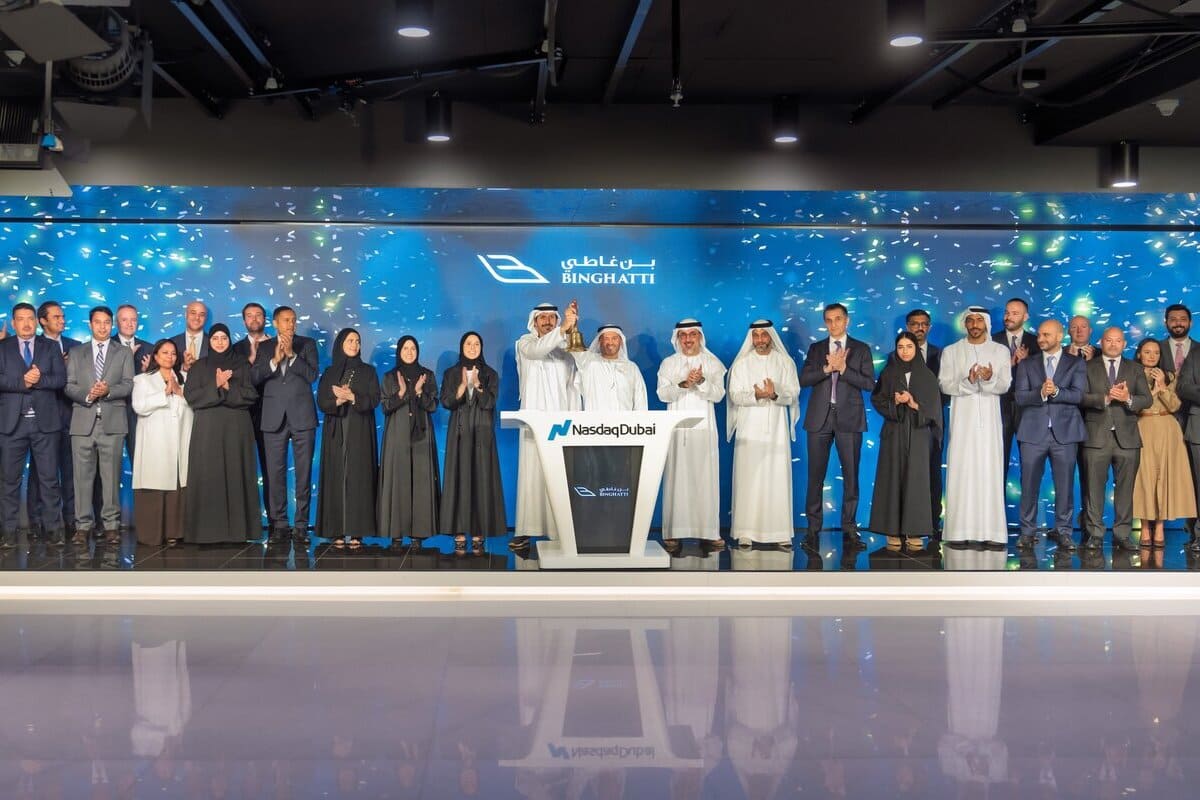
Binghatti Holding Limited has appointed a slate of banks to lead its first USD Reg S senior unsecured three-year green sukuk under its $1.5 billion Trust Certificate Issuance Programme. The developer, rated Ba3 by Moody’s and BB- by Fitch with both outlooks stable, has kick-started global investor calls and fixed income meetings. The mandate names Abu Dhabi Islamic Bank, Dubai Islamic Bank, Emirates NBD Capital, JP Morgan and Mashreq as Joint Global Coordinators; Abu Dhabi Commercial Bank, Ajman Bank, Arqaam Capital, Crédit Agricole CIB, First Abu Dhabi Bank, RAKBANK, Sharjah Islamic Bank and Warba Bank will act as Joint Lead Managers and Joint Bookrunners.

The green structuring is overseen solely by Mashreq, with DNV, based in Oslo, providing the Second Party Opinion on Binghatti’s Green Financing Framework. The issuance will make use of Binghatti Sukuk 2 SPC Limited under its wider Trust Certificate Issuance Programme.

Binghatti’s credit profile strengthened earlier this year when Moody’s assigned it its first ever corporate family rating of Ba3 with a stable outlook, citing its strong market position in Dubai’s luxury real estate sector, a vertically integrated model, low leverage, strong liquidity and disciplined cost controls. Shortly after, Fitch upgraded its long-term issuer default rating to BB- from B+, also citing its resilient growth, liquidity position and ability to self-fund projects through internal cash flows.

The developer’s previous sukuk issued under the same Programme—a five-year senior unsecured benchmark in August—was priced at a profit rate of 8.125%. That issuance attracted over USD 2.5 billion of orders, making it oversubscribed about five times and confirming significant demand from global and regional investors. That sukuk was dual listed on the London Stock Exchange and Nasdaq Dubai.

HONG KONG AND SHANGHAI, CHINA – Media OutReach Newswire – 22 September 2025 – Hang Lung Group Limited (SEHK stock code: 00010) and Hang Lung Properties Limited (SEHK stock code: 00101) (collectively known as “Hang Lung” or “the Group”) today hosted a cocktail reception to celebrate their 65th anniversary, gathering important business partners, industry leaders, and key stakeholders to commemorate its legacy, and to explore what the […]

CEO Explores New Opportunities in Foreign Trade Finance SHANGHAI, CHINA – Media OutReach Newswire – 22 September 2025 – XTransfer, the World’s Leading & China’s No.1 B2B Cross-Border Trade Payment Platform, was recently invited by the Global Finance & Technology Network (GFTN) to attend the highly anticipated annual technology event, 2025 Inclusion·Conference on the Bund in Shanghai. Bill Deng, Founder and CEO of XTransfer, was invited as […]

UAE has set an objective of growing its business base to more than two million companies by 2031, while also aiming to see ten unicorns—start-ups valued at over US$1 billion—emerge within that period, Abdullah bin Touq Al Marri, Minister of Economy and Tourism, has declared. He stated that at present about five unicorns have already originated in the country. The announcement came during a press briefing revealing […]

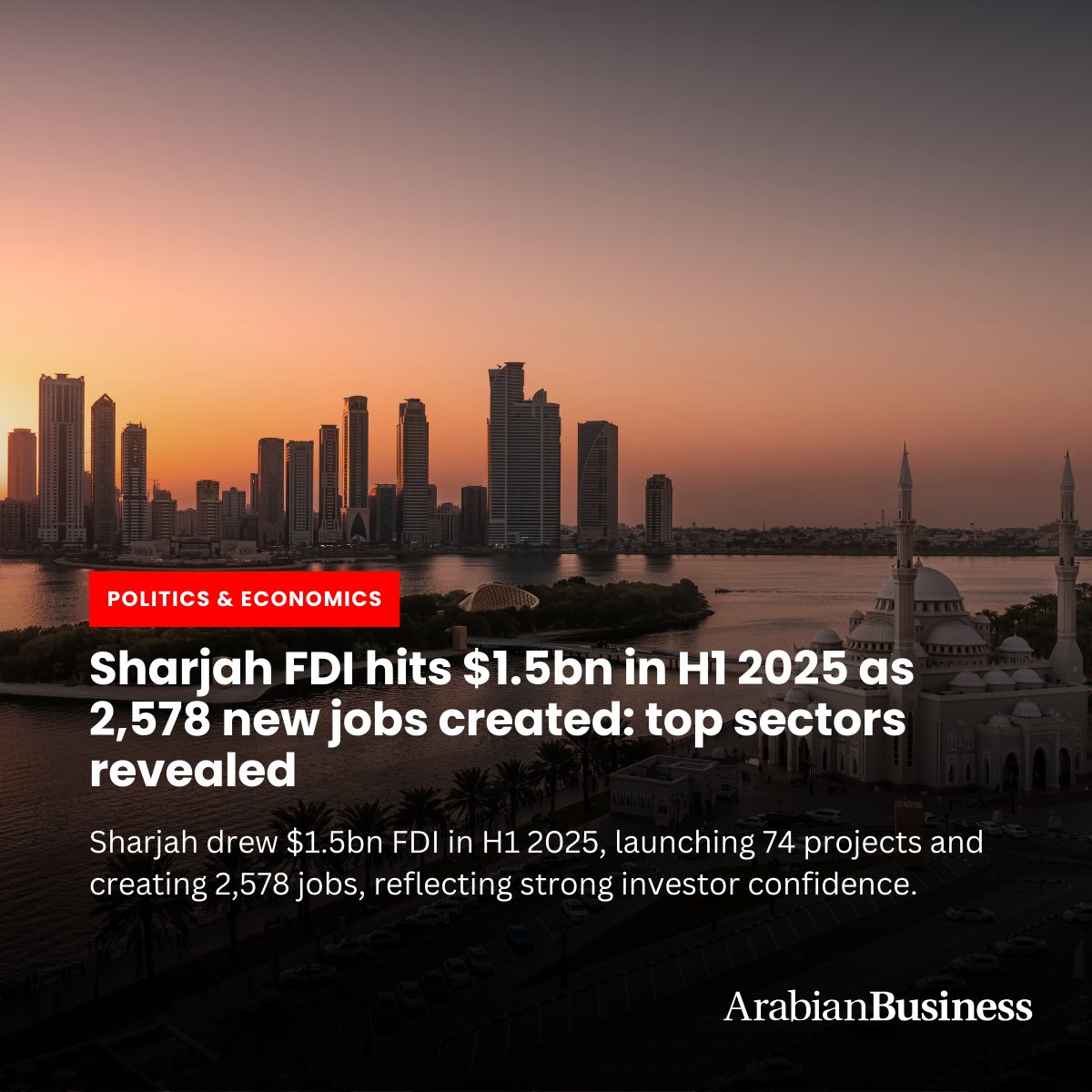
Sharjah has recorded capital inflows of $1.5 billion in foreign direct investment during the first half of 2025, marking a 361 percent rise compared to $325 million in the same period last year. The emirate also saw 74 new FDI projects, and 2,578 jobs created, a 45 percent increase from H1 2024.

Growth has been strongest in consumer products, food & beverage, business services, and industrial equipment. The consumer products sector led in investment, with project numbers rising by 53 percent and capital spend increasing by 188 percent. Food & beverage saw project volume more than double, while job creation in that sector rose by about 25 percent. Business services posted the biggest leap in employment—about 1,100 percent—alongside a 500 percent jump in project activity. Industrial equipment saw a 100 percent increase in projects and a 45 percent rise in capital investment.

Officials attribute the surge to government strategy that emphasises strong infrastructure, regulatory flexibility, and investment in human capital. Sheikha Bodour bint Sultan Al Qasimi, Chairperson of the Sharjah Investment and Development Authority, said the figures represent more than statistics—they mark improved livelihoods and sustainable value for the community. Mohamed Juma Al Musharrkh, CEO of Invest in Sharjah, pointed to Sharjah’s integrated policy framework and robust investment climate as central to building investor trust.

Elon Musk’s artificial intelligence firm, xAI, has raised $10 billion in its latest financing round, pushing its valuation to $200 billion. The capital includes a split between debt and equity, as Musk’s firm accelerates plans for infrastructure expansion and model development. xAI’s funding round was structured as $5 billion in debt, comprising secured notes and term loans, and another $5 billion via strategic equity investment. The raise, […]

Crypto influencer Ben Armstrong, known as BitBoy, has asserted that Ripple’s XRP possesses potential to rival Bitcoin’s dominance—not in every metric, but in overall market influence and growth. He argues that while Bitcoin remains unmatched on decentralisation and brand recognition, XRP may outpace Bitcoin in return-on-investment and adoption under certain conditions.

Armstrong points to several factors he believes could drive XRP forward: its far faster transaction settlement times, its emerging use for cross-border payments, and increasing interest from both retail and institutional investors. He acknowledges these victories come with drawbacks—particularly XRP’s higher centralisation compared with Bitcoin, given significant holdings of its supply are controlled by Ripple.

He describes market capitalisation as one pathway for competition, noting that XRP lags far behind Bitcoin’s more than US$2 trillion valuation. Nevertheless, he suggests that XRP could narrow that gap by capitalising on regulatory improvements and product developments in the crypto space. He cited possibilities such as exchange-traded funds for XRP and Ripple’s potential corporate moves that could boost legitimacy.

Comparisons with Ethereum form a large part of Armstrong’s argument. He has predicted that XRP may overtake Ethereum in market cap, saying Ethereum’s role in decentralised finance gives it current strength but also comes with trade-offs in efficiency and scalability. XRP, in his view, may benefit from being lighter in overhead, and more directly applicable in payment systems. Critics, however, highlight that Ethereum’s developer ecosystem, DeFi dominance, and smart contract utility are powerful advantages that XRP must overcome.

Recent legal developments related to Ripple have itself affected XRP’s trajectory. Armstrong notes that favourable rulings, greater regulatory clarity in jurisdictions like the US, and growing institutional interest are enhancing investor confidence. He also emphasises that the narrative around cryptocurrency regulation is shifting, which could favour assets like XRP that are often under scrutiny.

On price forecasts, Armstrong has offered a range of scenarios: gains ranging from three-fold to much higher depending on whether certain catalysts—such as regulatory approvals or ETF launches—unfold as hoped. He cautions that for XRP to truly rival Bitcoin, sustained momentum must be maintained over a multi-year horizon, not just in speculative bursts.

Abu Dhabi and Baku have sealed two Memoranda of Understanding between Presight and Azerbaijan’s government aimed at fuelling the country’s Artificial Intelligence Strategy 2025–2028, with strong emphasis also placed on education. The agreements were formalised with top-level signatories during the state visit of the UAE President to Azerbaijan. Under the deal with the Ministry of Digital Development and Transport, Presight will act as a strategic advisory and […]

Flydubai began service to Iași in Romania with twice-weekly flights, making it the first carrier from the United Arab Emirates to connect Dubai directly with Romania’s cultural capital of Moldavia. The new route operates on Tuesdays and Fridays between Dubai International’s Terminal 2 and Iași International Airport.

The airline is also scaling up its operations to Bucharest, moving from three weekly flights to three daily services, which will bring the weekly frequency between Dubai and the Romanian capital to 21 flights.

Flydubai has placed Iași as its second Romanian destination, following Bucharest, and has already expanded into the neighbouring region with the launch of flights to Chișinău in Moldova. Further expansion for Europe includes planned routes to Vilnius and Riga later in the year.

Jeyhun Efendi, Divisional Senior Vice President of Commercial Operations and E-commerce at Flydubai, said growth in Romania has averaged about 16 per cent annually on the Bucharest route since flights launched in 2012. He expressed confidence that the new Iași service and increased frequency to Bucharest will offer passengers more convenience and opportunities for both cultural and business travel.

Romeo Vatră, General Manager of Iași Airport, described the route’s inauguration as a “significant milestone”, noting that Iași becomes the only airport in the Moldova region with a direct link to the United Arab Emirates.

Fare details were published: return fares in Business Class from Dubai to Iași start from AED 8,000, while in Economy Lite they begin at AED 1,600. In the reverse direction, prices start at EUR 2,000 and EUR 380 respectively.

By D Raja The Twenty-Fifth Congress of the Communist Party of India will convene in Chandigarh from September 21, 2025, at Suravaram Sudhakar Reddy Nagar (Kisan Bhawan). We gather at a moment of extraordinary circumstances. Punjab is reeling under devastating floods. Fields are submerged, homes are damaged, and livelihoods are disrupted. Yet, our comrades in […]

The article Why The 25th Congress Of CPI On September 21-25 In Chandigarh Is Significant In Indian Politics? appeared first on Latest India news, analysis and reports on IPA Newspack.

Abu Dhabi’s XRG, the ambitious investment arm of ADNOC, has abandoned its US$18.7–19 billion bid to acquire Australia’s Santos Ltd after failing to agree on key commercial terms, while its takeover attempt of German chemicals firm Covestro AG faces serious threats from an EU competition and subsidy probe. The Santos takeover fell apart largely over valuation disagreements and tax liabilities, according to people familiar with the negotiations. […]

Alec Holdings is set to list about 20% of its shares in an initial public offering on the Dubai Financial Market, while Binghatti Holding is preparing for a possible IPO, as both seek to harness surging demand in Dubai’s real estate sector. These moves reflect growing confidence among developers and investors in a rapidly expanding market. Alec, wholly owned by the Investment Corporation of Dubai, will offer […]

Sharjah has posted a striking upturn in foreign direct investment capital in the first half of 2025, attracting $1.5 billion, a leap of 361 percent compared to $325 million in the same period last year. The emirate also saw the launch of 74 new projects—57 percent more than in H1 2024—and generated 2,578 new jobs, an increase of 45 percent. The gains are concentrated in four sectors: […]

VISHNU RAJA
RYO YAMADA
HITORI GOTOH
IKUYO KITA