News related to
Capital

A sharp rebound in the Taiwan dollar has intensified financial pressure on exporters, undermining earnings and dampening competitiveness in overseas markets. The appreciation, driven by a blend of strong trade inflows, hedging activities, and speculative pressures, has prompted swift policy attention and heightened concern among industry observers.

Taiwan’s currency surged to its highest level since early 2022—landing near NT$29 per U. S. dollar—amid a weakening U. S. dollar and heightened equity inflows. The rally, measuring around 12 per cent so far this year, has inflicted renewed strain on leading exporters, including Taiwan Semiconductor Manufacturing Company and Foxconn, which report substantial margin erosion when the Taiwan dollar strengthens.

Exporters are finding that every one‑unit appreciation of the currency can slash revenue by roughly 3 per cent and chip away at gross margins—Foxconn estimates its margins dip by 0.1 percentage point per NT$1 gain. Smaller, traditional manufacturers—especially machinery producers—are even more exposed, with limited hedging capacity and tighter operating margins.

Life insurers are not spared. Many hold a sizable portion of assets in U. S. dollars—Fubon Financial, for example, has about 70 per cent of its portfolio in foreign holdings—and face amplified foreign‑exchange losses as the local currency climbs.

Regulators are treading a delicate line. Taiwan’s central bank has urged restraint, discouraging speculative trades through vehicles such as ETFs, and cautioning against exaggerated market commentary. It has also issued warnings to foreign investors who may be circumventing capital controls by not deploying inflows into domestic securities—a move intended to curb volatility without triggering accusations of currency manipulation from Washington.

Policy shifts and trade developments elsewhere may be compounding the pressures. Analysts observe that rapid appreciation could weaken Taiwan’s offerings amid looming U. S. tariffs and a lack of definitive agreements with Washington. Others point to structural shifts: Asian economies, Taiwan included, are unwinding dollar‑heavy positions amid growing concern over U. S. policy and economic fragility. One commentator dubbed this a “reverse Asian crisis,” pointing to a regional transfer of purchasing power back to local currencies.

Reactions continue to unfold across sectors. The logistics industry, for instance, is grappling with imbalances in shipping flows and heightened forex risk; yet it also sees potential growth through import logistics and value‑added FX‑savvy services for clients.

Altogether, Taiwan confronts a complex convergence of forces: strong export volumes feeding currency strength, speculators and hedgers accelerating the appreciation, and policy efforts seeking to stabilise markets without undermining global credibility. With export earnings vulnerable, insurers weighed down by FX losses, and the broader economy exposed to tariff dynamics, the coming months could heighten the stakes if the exchange rate remains elevated, especially in the absence of agreements that mitigate trade frictions.

Journalistic due diligence underscores that the data and figures—such as the currency’s 12 per cent gain, margin impacts for Foxconn and others, and the insurers’ USD-exposure ratios—have been corroborated across reputable sources. Reporting maintains a balanced perspective, acknowledging both the financial risks and policy responses shaping Taiwan’s export-heavy economy.


Greenlogue/AP Dubai is gearing up to host the 11th World Green Economy Summit on 1–2 October 2025 at the Dubai World Trade Centre, where green finance will sit at the forefront of global climate discussions. Under the theme ‘Innovating for Impact: Accelerating the Future of the Green Economy’, the summit will convene policymakers, investors, business leaders, academics and innovators to mobilise capital toward equitable, sustainable growth. Organised […]

AI’s growing sophistication is pushing operational costs skywards, as developers and startups grapple with soaring token usage, escalating compute demands, and shifting business models. At the heart of the challenge lies a paradox: while the per‑token price of AI continues to decline, the number of tokens consumed for meaningful tasks has surged dramatically, especially where reasoning-intensive workflows dominate. Tasks once considered lightweight now demand tens or even […]

The mortgage market in Dubai and the wider UAE has entered a new stage of maturity. Once dominated almost entirely by cash buyers, today’s property landscape is increasingly shaped by mortgage financing. The first quarter of 2025 recorded AED 33 billion in cash transactions versus AED 21 billion in financed purchases. This indicates a clear rise in mortgage penetration as more residents, families, and long-term investors choose […]

McLaren Racing is set to be valued at in excess of £3 billion as its Middle Eastern backers move to acquire the remaining minority stake in the team. Bahrain’s Mumtalakat sovereign wealth fund and Abu Dhabi’s CYVN Holdings are preparing to buy out the 30 per cent share previously held by investors such as MSP Sports Capital, UBS O’Connor and Ares Management in a deal expected to be confirmed imminently.

This valuation marks a substantial leap from its December 2020 valuation of approximately £560 million, when MSP Sports Capital entered the picture during a fundraising round. The outcome promises significant returns for the minority investors who backed McLaren during its earlier financial challenges.

McLaren’s resurgence under chief executive Zak Brown and team principal Andrea Stella has helped propel the team back to the forefront of Formula One. Following years overshadowed by dominant rivals, McLaren clinched its first constructors’ championship in 2024, and in the current season its drivers—Oscar Piastri and Lando Norris—are locked in a fierce duel at the top of the drivers’ standings.

The sport’s expanding global appeal, driven by Liberty Media’s strategic digital outreach and the cultural phenomenon of the Netflix series Drive to Survive, has magnified team valuations across the grid. McLaren’s rise is emblematic of that broader trend.

Alongside on-track performance, McLaren has diversified into other motorsport arenas. It competes in IndyCar and has confirmed plans to enter the World Endurance Championship, notably the 24 Hours of Le Mans, beginning in 2027. Mastercard has also joined as the team’s title sponsor, in a deal slated to begin in 2026.

The Gulf investors, Mumtalakat and CYVN, currently hold control of McLaren Group Limited, the parent entity of McLaren Racing. With this deal, they will consolidate full ownership of the racing arm.

Beyond this deal, McLaren’s broader corporate structure has undergone notable change. In March 2024, Mumtalakat completed a full takeover of McLaren Group. Later, in December 2024, CYVN acquired McLaren Automotive along with a non‑controlling interest in the racing division. These moves underscore a strategic integration under Gulf ownership, spanning both competition and high-performance automotive manufacturing.

The proposed stake sale is set to be formally announced in the coming days—and might already be public by the time this report is published.

Further context: Aston Martin, another Formula One team, recently sold a minority stake in its racing operation for approximately $147 million, valuing that team at around $3.2 billion.

Alibaba cloud to dedicate its global capabilities to support Bosch’s technology stack Both intend to deepen collaboration in leveraging Alibaba’s AI strength to facilitate Bosch’s business innovations, such as smart cockpit Bosch to expand its e-commerce presence in Southeast Asia, Spain, and Latin America through Alibaba’s global platforms HANGZHOU, CHINA – Media OutReach Newswire – 2 September 2025 – Bosch, a leading global supplier of technology and […]

First Abu Dhabi Bank, the UAE’s largest lender by assets, today instructed a consortium of global banks to coordinate a series of investor calls focused exclusively on environmental, social and governance fixed‑income opportunities. These discussions pave the way for the offering of a benchmark 5‑year, USD‑denominated, Regulation S low‑carbon energy bond, to be issued under FAB’s USD 20 billion Euro Medium Term Note programme. The institutions enlisted as joint lead managers and bookrunners […]

Advertisements

Enterprise technology budgets are increasingly tilted towards AI, with artificial intelligence infrastructure and software commanding the lion’s share of growth while traditional hardware investment shows signs of stagnation. IDC projects global AI spending will surge to over US $632 billion by 2028, propelled by an almost 30 percent compound annual growth rate between 2024 and 2028. Generative AI alone is expected to capture roughly one‑third of this, driven by a […]

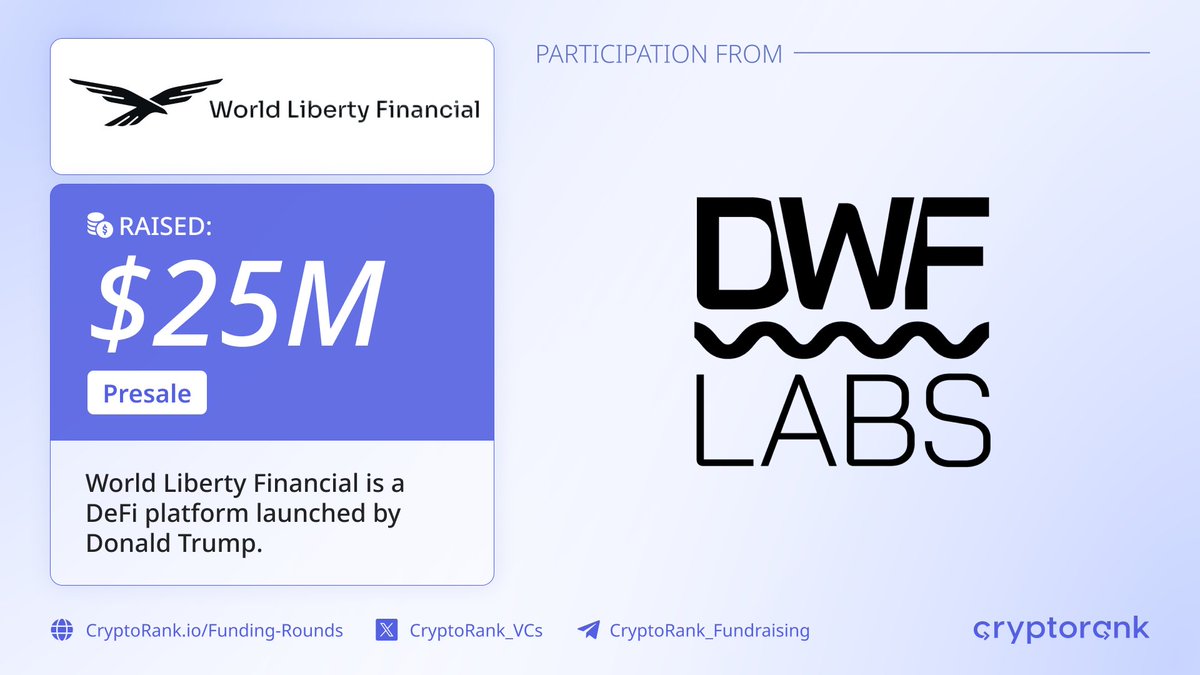
DWF Ventures, the investment arm of Web3 market‑maker DWF Labs, has delivered a detailed evaluation of $WLFI, World Liberty Financial’s newly issued utility token. Published via X, the analysis emphasises $WLFI’s integration into World Liberty’s broader ecosystem and its potential as a key enabler in connecting traditional finance with on‑chain liquidity. Unlike World Liberty’s $TRUMP memecoin, $WLFI is purpose‑built to power the upcoming “WLFI super app”, which will streamline access through web wallets and bank on‑ramps, and underpin planned lending and borrowing services.

The report highlights the success of the USD1 stablecoin—backed by short‑term US Treasuries and cash equivalents—which now commands a market capitalisation approaching $2.5 billion and enjoys listings on major exchanges such as Binance and Coinbase. These developments have significantly boosted investor attention toward the $WLFI token.

World Liberty has raised approximately $500 million across two funding rounds by selling about a quarter of its 100 billion token supply. Among its backers are DWF Labs itself and crypto figure Justin Sun, while ALT5 Sigma has outlined a $1.5 billion treasury strategy centred around $WLFI. DWF Ventures expects that the token could soon be integrated by several DeFi protocols, including Falcon Finance, Ethena and Mantle.

Importantly, DWF Ventures positions $WLFI’s launch as more than a token debut; it sees the initiative as a structural pivot that could catalyse institutional adoption and facilitate compliant capital onboarding—possibly even drawing interest from sovereign investors.

But $WLFI’s entry into the market has triggered concerns. Reports reveal technical difficulties involving the Lockbox contract, intended to unlock 20 percent of token allocations for early investors, which have left many users unable to activate the mechanism. Pre‑market trading responded with a 40 percent drop, raising doubts about launch readiness. Coupling these issues with the political profile of its founders, the token has become entangled in financial and reputational risks.

Indeed, WLFI’s connection to the family of the former president has cast a shadow over its market potential. The token’s political dimensions have already affected diplomatic engagements—such as withdrawals from the Bitcoin Asia 2025 conference—and prompted ethical criticism over conflicts of interest.

Broader scrutiny of World Liberty Financial underscores such tensions. Investigations have revealed that the Trump family commands a substantial share of revenue from token sales and that governance design reflects unusual centralisation for a DeFi project. Further concerns relate to self‑dealing practices: for instance, ALT5 Sigma—a firm acquired by World Liberty—purchased $750 million worth of WLFI tokens. As part of this arrangement, its leadership includes Eric Trump and WLFI co-founder Zach Witkoff, a structure that regulators and critics view as raising red flags.

Ethics experts warn that such close ties between ruling office, private enterprise and foreign investment could undermine democratic safeguards. The New Yorker, for one, described the venture as stretching the norms of political ethics, with World Liberty seen by some as a mechanism for influence through token‑based access channels.

The $WLFI launch is clearly more than a token generation event—it is shaping into a test case for the nexus of politics, finance and regulation in the emerging Web3 era.

SEOUL, SOUTH KOREA – Media OutReach Newswire – 1 September 2025 – Aon plc (NYSE: AON), a leading global professional services firm, today announced Bonjay Koo has been appointed Enterprise Client Leader, Asia Pacific in South Korea effective September 1. Bonjay Koo In this strategic role, Koo will be responsible for the delivery of integrated Risk Capital and Human Capital solutions to Aon’s enterprise and large multinational […]

HONG KONG SAR – Media OutReach Newswire – 31 August 2025 – The augmented reality (AR) industry is witnessing an unprecedented surge, propelled by Rokid Glasses’ record-breaking single-day sales of over 10,000 units and revenues surpassing RMB 30 million. At the forefront of this global phenomenon, Lens Technology emerges as a pivotal player, capitalizing on its dual role as the exclusive device manufacturer and strategic investor to […]

Meta’s bold $14.3 billion investment in a 49 per cent stake in data‑labeling firm Scale AI—designed to accelerate its AI advancement—has quickly encountered turbulence. Only months into the venture, key technical leaders from Scale AI and veteran Meta researchers have exited, while concerns over data quality and internal culture clashes have prompted some Meta teams to turn to rival providers. Meta appointed Scale AI’s founder, Alexandr Wang, to oversee its […]

Mastercard and Circle have deepened their collaboration to enable settlement of transactions in USDC and EURC stablecoins for acquirers and merchants across Eastern Europe, the Middle East and Africa. Arab Financial Services and Eazy Financial Services are among the first institutions to access this capability, which integrates stablecoin payments into Mastercard’s established global network.

The initiative marks a clear shift towards tokenised money. Mastercard’s President for EEMEA, Dimitrios Dosis, emphasised the ambition to bring stablecoins into mainstream finance by investing in infrastructure, governance and partnerships, while leveraging the company’s longstanding expertise in security and compliance. Kash Razzaghi, Chief Business Officer at Circle, framed the move as a step towards “borderless, real‑time commerce,” seeking to make USDC as ubiquitous as traditional payments.

Arab Financial Services highlighted the tangible value of the new model: improved liquidity, operational efficiencies and dramatically reduced friction in high‑volume reconciliations. Eazy Financial Services underscored how the expanded settlement option aligns with its mission to offer faster, more secure, and efficient payment solutions, setting a fresh standard for digital settlements in EEMEA.

This development builds on existing collaborations such as crypto payment card solutions with the likes of Bybit and S1LKPAY, which already use USDC for settlement in the region. Mastercard further extends its stablecoin portfolio beyond USDC and EURC, already supporting USDG, FIUSD and PYUSD across various use‑cases spanning remittances, B2B, and payouts via platforms like Mastercard Move and the Multi‑Token Network, underpinned by its Crypto Credential and Crypto Secure frameworks.

Financial infrastructure experts view the rollout as particularly meaningful for emerging markets. World Bank data indicates cross‑border transfer costs remain high—around 8% on average—far exceeding the UN’s Sustainable Development Goal threshold of 3%. Introducing stablecoin settlement is expected to trim costs, accelerate transfers, and bolster working capital and currency resilience for small and medium businesses.

Analyses point to early adopters witnessing significant gains: settlement speeds up by 30%, and liquidity costs drop around 20%, according to some reports. Mastercard’s compliance infrastructure, combined with evolving regulatory frameworks like the European MiCA and US GENIUS Act, fosters institutional trust in this digital settlement evolution.

Circle is working to fortify USDC’s global footprint beyond this initiative. Its broader strategy includes partnerships with Finastra to plug USDC into traditional payment hubs, OKX for zero‑fee USDC conversions, and ventures with SBI Group and Ripple in Asia—all aimed at building liquidity, interoperability and widespread adoption.

Nigeria’s energy shortfall continues to constrict economic potential, affecting millions of homes and businesses, prompting a call from Ronald Adams—Chairman of the off‑grid impact fund All On and Managing Director of Shell Nigeria Exploration and Production Company —for substantial private investment to close the gap. Addressing business leaders at the Lagos Chamber of Commerce and Industry’s 2025 International Business Conference & Expo, Adams highlighted that over 80 million Nigerians lack […]

Fenerbahce have parted ways with José Mourinho, bringing to an end his tenure as head coach of the Turkish giants just two days after the team failed to advance past Benfica in the Champions League play‑off. The club confirmed the decision, describing it as mutual, and extended their appreciation for his contributions to the first team since the 2024–25 season. Mourinho’s dismissal underscores the significance Fenerbahce placed […]

Greenlogue/AP Veolia has moved to acquire the remaining 30 per cent stake in its Water Technologies and Solutions subsidiary from CDPQ, in a deal valued at around US$1.75 billion, positioning the company for greater strategic agility and cost-efficiency. The transaction is expected to bring about €90 million in run‑rate cost synergies by 2027, simplification of the group’s structure, and added value through streamlined decision‑making and integration. The move forms […]

A magnitude 5.1 earthquake struck off the coast of Burgos, Surigao del Norte, at precisely 8:44 am on Friday, emerging from tectonic activity beneath Philippine waters. The Philippine Institute of Volcanology and Seismology reported the quake’s epicentre at a shallow depth of around 10 km, situated roughly 10 km northeast of Burgos. Shaking was felt across parts of the Visayas, with Hinunangan in Southern Leyte recording an intensity of III—typically perceived indoors […]

3 Cross-regional fashion events kicking off at CENTRESTAGE in Hong Kong followed by a fashion show and exhibition in Seoul Bringing together 35 units of renowned and emerging designers from Guangdong-Hong Kong-Macao Greater Bay Area and Korea to present over 100 creations Breaking cultural boundaries with Cantopop, K-pop and films from Hong Kong and Korea to open a new frontier in cultural exchange HONG KONG SAR – […]

First Abu Dhabi Bank has unveiled a pioneering five‑year Blue Bond worth HKD 390 million, marking the first such issuance by a financial institution in the Gulf. Placed via private placement and backed by an Article 9 investor, the bond signals a bold move into water‑ and marine‑related sustainable financing. FAB’s issuance aligns with its Sustainable Finance Framework 2023 and adheres to the International Capital Market Association’s Green Bond Principles. […]

Global logistics investor GLP will receive up to $1.5 billion from a wholly owned subsidiary of the Abu Dhabi Investment Authority, signalling the sovereign wealth fund’s first move from limited partner to direct stakeholder in the firm. The initial capital deployment of $500 million is earmarked for expanding GLP’s operations in logistics, digital infrastructure, and renewable energy, with further investment to follow in coming months.

The capital infusion aligns with growing global demand across sectors driven by e‑commerce growth, artificial intelligence and cloud adoption, and the green energy transition. GLP’s data‑centre division is notably thriving: its annual revenue surged 43 percent year‑on‑year to US $193 million.

GLP oversees approximately US $80 billion in assets through its management arm, GLP Capital Partners. This move marks a strategic shift for ADIA—long an investor in GLP’s funds—into becoming a direct shareholder in the global investment group.

In a statement, GLP co‑founder and chief executive Ming Z Mei emphasised that the enhanced capital base and strategic partnership will enable the company to “accelerate growth” and capitalise on the “secular expansion of new economy sectors in which we operate.” Mohamed Al Qubaisi, executive director of ADIA’s real estate department, noted that the transaction deepens their longstanding relationship with GLP and supports its next growth phase while scaling exposure to new economy segments.

The investment supports GLP’s diversified global platform. The firm has operations across Brazil, China, Europe, India, Japan, the US, and Vietnam, spanning logistics real estate, data centres and renewables. Moreover, the investments come amid escalating interest in digital infrastructure, particularly data centres, which are seen as pivotal to AI and cloud services growth.

GLP’s momentum is further underlined by recent capital inflows from regional partners. In China, the company secured 2.5 billion yuan from Zhejiang government‑backed investors to boost its data‑centre operations. Earlier in the year, GLP completed the sale of its ex‑China funds management business to Ares Management for US $3.7 billion, in a deal partly financed with cash and equity. The company also retains stakes in those funds and has backed Ares’s first Japanese data‑centre fund, which completed a US $2.4 billion final closing in June.

GLP’s evolution over the past decade provides further context for this development. Founded in 2009 by Ming Z Mei and Jeffrey H Schwartz, the firm originated as Global Logistic Properties. It went public in 2010 in what was at the time Singapore’s largest IPO. It was taken private in 2018, following a leveraged buyout led by a private‑equity consortium. The company has since transformed into a multi‑sector platform across logistics, digital infrastructure and renewable energy.

On the other side, ADIA stands as one of the world’s largest sovereign wealth funds, managing a diversified global portfolio across asset classes including real estate, private equity and data‑centre platforms. This leap into a direct stake in GLP underscores the fund’s strategy of pursuing active positions in entities driving structural sectoral growth.

A surge of enthusiasm from the United Arab Emirates’ retail investors is bolstering domestic stock markets, signalling growing public confidence in the country’s economic trajectory. Data from the latest edition of the UAE Retail Investor Beat, conducted between 10 and 21 July 2025, shows that 85 per cent of people taking investment decisions are now allocated to UAE-listed equities, with 39 per cent invested in Abu Dhabi shares, 28 per cent in Dubai, and 18 per cent holding positions in both platforms.

Investor confidence appears grounded. Currently, 63 per cent report being “very confident” in the UAE’s economic performance, while a further 29 per cent describe themselves as “somewhat confident.” When looking ahead, 59 per cent express strong confidence in the long-term performance of locally listed stocks, with an additional 32 per cent somewhat confident. Investors remain optimistic about the near future: 48 per cent anticipate substantial gains over the next 12 months, while 34 per cent expect steady growth. On a regional scale, 58 per cent believe the Middle East will generate the highest returns over the next five years, ahead of the United States at 50 per cent.

Sectoral preferences reveal clear priorities. Real estate leads with 55 per cent of investors expressing confidence, followed by technology at 48 per cent, and both financial services and energy at 37 per cent each.

George Naddaf, managing director of eToro MENA, framed these findings in the context of market performance: the Dubai Financial Market and Abu Dhabi Securities Exchange are among the top-performing exchanges globally, outperforming the S&P 500 by a wide margin. He credits sustained earnings, robust macroeconomic conditions, and supportive government measures for underpinning investor sentiment and reinforcing preference for local opportunities.

Despite this supportive sentiment, geopolitical risks remain front of mind. Nine‑tenths of respondents expect tariffs and trade disputes to exert meaningful pressure on their portfolios over the next six months, and 89 per cent have either adjusted or intend to adjust investment strategies in response. More than half—53 per cent—are tilting further towards UAE equities, while 51 per cent are increasing exposure to commodities. Gold and precious metals are viewed as the most resilient asset class by 49 per cent of investors; cryptocurrency ranks second at 45 per cent and is already the most held class, with 54 per cent ownership.

Naddaf described this as a “disciplined, dual-track approach,” combining reinforcement in domestic equities with defensive hedges in commodities.

Capital commitment remains strong. Sixty‑five per cent of UAE retail investors have already stepped up contributions in past months, while 76 per cent anticipate further increases in the coming three months.

Berkshire Hathaway’s National Indemnity Company has lifted its stake in Mitsubishi Corporation to 10.23 %, up from 9.74 % earlier, signalling a reinforced commitment to Japan’s leading trading house. The investment follows similar moves in March across other sogo shosha, including Mitsui & Co.

The decision reflects Warren Buffett’s enduring confidence in Japanese megatraders, whose disciplined capital allocation, governance reforms, and investor-friendly policies align strongly with Berkshire’s investment philosophy. As Buffett admired in his annual letters, these firms’ governance improvements, such as stronger board oversight and enhanced transparency, have elevated their attractiveness globally.

Markets responded with optimism. Mitsubishi shares advanced approximately 1.8 %, while Mitsui and its peers—including Sumitomo, Itochu, and Marubeni—also rose, lifting the Nikkei 225. Notably, Berkshire’s growing yen‑denominated dividend income, estimated at $812 million, substantially exceeds its $135 million in interest costs—from its debt exposure—further underscoring the financial logic behind the move.

Buffett first entered these companies around 2019, building stakes across five major trading houses. At that time, the positions were modest—roughly 5 % each—and have been gradually expanded as corporate reform deepened. Last year, ownership in these firms reached as high as 9.8 %. At the annual shareholder meeting in Omaha, Buffett stressed his intention to hold these stakes “for many decades,” a sentiment shared by vice‑chairman Greg Abel.

Several strategic and structural factors underpin this move. Japanese trading houses are diversifying rapidly—expanding into renewable energy, logistics, tech, and sustainable infrastructure—which offers resilience against inflation and trade volatility. Their shareholder returns via dividends and share buybacks, combined with conservative executive pay, align with Berkshire’s preference for capital‑efficient businesses.

Buffett’s growing exposure coincides with Japan’s corporate governance revolution. Since former Prime Minister Abe’s reforms and the stewardship code, sogo shosha have improved transparency, board independence, and capital discipline—making them far more attractive to foreign investors.

Berkshire’s strategic calculation is also macro‑driven. In a year when the iShares MSCI Japan ETF has gained around 17 %, outperforming the S&P 500, the broader market trend reinforces the allure of Japanese equities.

Paragraf has clinched a $55 million Series C financing round, anchored by a $35 million injection from Mubadala Investment Company—the sovereign wealth fund of Abu Dhabi—earning Mubadala a 12.8 per cent equity stake in the UK-based firm. The deal, formally approved under the National Security and Investment Act, will underpin Paragraf’s bid to scale up production of graphene-based semiconductors and pursue global expansion plans. Leading the company’s development, co‑founder […]

Major players and startups are racing to establish dominance in India’s quick‑commerce landscape, where urban consumers now expect deliveries within minutes. Blinkit, Zepto, Instamart, Amazon Now, BigBasket Now and others are expanding rapidly, focusing both on speed and diversification beyond groceries, even as questions mount over sustainability.

Blinkit, the q‑commerce arm of Eternal, delivered a sharp uplift in adjusted revenue for the first quarter of 2025, reaching ₹71.67 billion—a year‑on‑year increase of more than 70 per cent. However, soaring expenses, largely driven by aggressive discounting and the rapid build‑out of “dark stores,” pulled net profit down by nearly 90 per cent to ₹250 million. Blinkit continues to lead in the segment, delivering groceries and essentials within 10 minutes across more than 30 cities.

Zepto, founded in 2021 by Aadit Palicha and Kaivalya Vohra, has built a dense network of dark stores across ten metropolitan areas and operates over 250 stores as of 2024. Its valuation has surged past $5 billion, underpinned by a leap in FY24 revenue to ₹4,454 crore.

Swiggy’s Instamart continues recalibrating its business, shifting from its origins in restaurant delivery to prioritising ultra-fast delivery of grocery and everyday items in a broader consumer market.

Global giants are also aggressively entering the fray. Amazon’s “Now” 10‑minute delivery service, first piloted in Bengaluru, has now rolled out across select New Delhi pin codes. Flipkart, backed by Walmart, has likewise deployed its rapid‑delivery offering in the country. Competition has intensified, with both global and domestic players vying to own consumer mindshare.

Market projections suggest explosive growth: quick‑commerce has scaled from about $300 million in 2022 to $7.1 billion in 2025, with forecasts projecting a staggering $40 billion by 2030. Growth is being fuelled not only by metro usage, but also by demand in tier‑2 and tier‑3 cities, which have accounted for 60 per cent of new e‑retail customers since 2020.

To support this infrastructure leap, commercial property heights are shifting downwards—hyperlocal warehousing is surging in both major metros and smaller cities. Platforms are converting underused urban spaces—like basements and small plots—into rapid fulfilment hubs to meet expectations of 10‑ to 15‑minute deliveries.

Still, financial caution flags are being raised. Gopal Srinivasan, chairman of TVS Capital Funds, has warned that India’s quick‑commerce boom may be a “passing fad,” sustained mainly by private equity and venture capital rather than sustainable economics. Industry observers point to sharp increases in customer acquisition costs, shrinking margins, and low consumer loyalty if discounts and free delivery models are scaled back.

The origins of the model lie in a consumer demand for ultra‑fast replenishment, transforming smartphones into virtual marketplaces not just for staples, but festive goods, personal care items, apparel and electronics—especially during cultural festivals like Raksha Bandhan.

A financial corridor is emerging beneath the digital storefronts: hyperlocal logistics operators such as Xpressbees, already present in over 4,500 service centres and 250 hubs by March 2025, are becoming critical partners to power the last‑mile challenge.

Traditional players are also adapting. BigBasket, owned by Tata Digital, has introduced a 10‑minute food delivery service in Bengaluru, including offerings from Tata Starbucks and IHCL’s Qmin platform.

VISHNU RAJA
RYO YAMADA
HITORI GOTOH
IKUYO KITA